

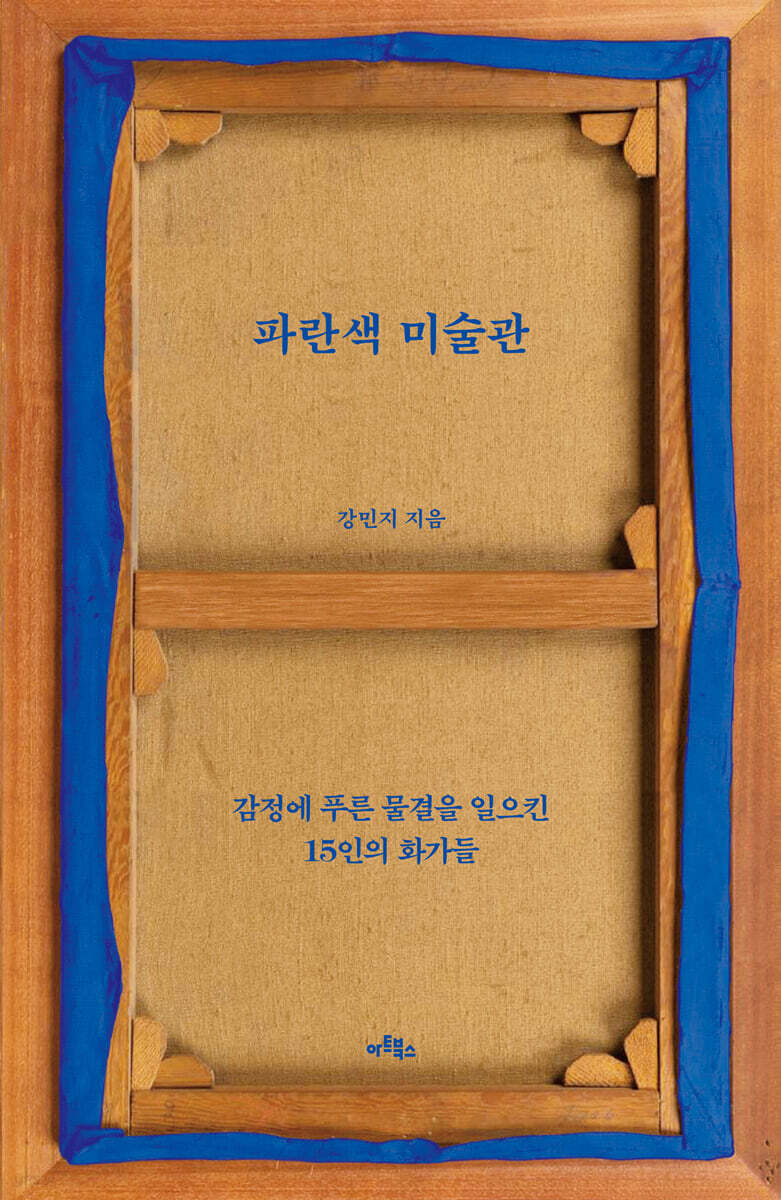
Blue Art Museum
 |
Description
Book Introduction
Blue waves, blue waves
15 Painters Who Painted Turbulent Lives Green
The blue world they loved
Blue, the color that makes you dream
Captivate everyone
According to Michel Pastoureau, a French scholar who has been studying the history of color since 1968, blue has been the most preferred color among Europeans since the 18th century, and today it is ranked as the most preferred color in many countries around the world.
Why is it that so many people like blue so much among the hundreds and thousands of colors that exist in the world?
Blue, the color that represented the Virgin Mary's clothing in the Middle Ages, was used as the color representing European royalty from the 12th century onwards, and also appears in words that signify a positive and new path, such as green light, blueprint, and blue ocean.
But blue doesn't just connote dazzling, bright, positive meanings.
In the West, the word 'blue' also carries with it opposite meanings such as depression and loneliness, coldness and indifference, sadness and anxiety.
Perhaps this is the charm of 'blue'.
The color blue conveys different cultural and historical meanings depending on its saturation and brightness, as well as its historical context.
That is why, for painters who deal with color, blue was an important means of expression that conveyed emotions and feelings.
And here are fifteen painters who have filled their canvases with colorful blue paints, depicting the hopes, love, hardships, sorrows, and loneliness they have encountered in their lives.
Painters who sometimes colored their inner selves with 'cobalt blue', a color that shines with joy, and sometimes with 'Prussian blue', a color that falls into despair.
"Blue Museum" is a book that examines the artistic journey of artists by following the waves of life and emotions that are reflected in their works, focusing on paintings in which the color blue stands out.
As the author says, “Through this work, we too can empathize with joy and delight, sadness and despair, find solace in the fact that the world is not just cruel to us, and I hope that it provides an opportunity to dream again of a tomorrow so blue that it hurts our eyes.” After reading this book, we too will be able to discover our own “own blue” that will color our inner selves.
15 Painters Who Painted Turbulent Lives Green
The blue world they loved
Blue, the color that makes you dream
Captivate everyone
According to Michel Pastoureau, a French scholar who has been studying the history of color since 1968, blue has been the most preferred color among Europeans since the 18th century, and today it is ranked as the most preferred color in many countries around the world.
Why is it that so many people like blue so much among the hundreds and thousands of colors that exist in the world?
Blue, the color that represented the Virgin Mary's clothing in the Middle Ages, was used as the color representing European royalty from the 12th century onwards, and also appears in words that signify a positive and new path, such as green light, blueprint, and blue ocean.
But blue doesn't just connote dazzling, bright, positive meanings.
In the West, the word 'blue' also carries with it opposite meanings such as depression and loneliness, coldness and indifference, sadness and anxiety.
Perhaps this is the charm of 'blue'.
The color blue conveys different cultural and historical meanings depending on its saturation and brightness, as well as its historical context.
That is why, for painters who deal with color, blue was an important means of expression that conveyed emotions and feelings.
And here are fifteen painters who have filled their canvases with colorful blue paints, depicting the hopes, love, hardships, sorrows, and loneliness they have encountered in their lives.
Painters who sometimes colored their inner selves with 'cobalt blue', a color that shines with joy, and sometimes with 'Prussian blue', a color that falls into despair.
"Blue Museum" is a book that examines the artistic journey of artists by following the waves of life and emotions that are reflected in their works, focusing on paintings in which the color blue stands out.
As the author says, “Through this work, we too can empathize with joy and delight, sadness and despair, find solace in the fact that the world is not just cruel to us, and I hope that it provides an opportunity to dream again of a tomorrow so blue that it hurts our eyes.” After reading this book, we too will be able to discover our own “own blue” that will color our inner selves.
- You can preview some of the book's contents.
Preview
index
Prologue: When you need hope and comfort, try the color blue.
I.
Blue_An artist who affirms life with an optimistic attitude
Claude Monet, who painted the world with the colors of nature and light, "Antibes, Afternoon Effect"
Auguste Renoir's "Umbrella," a celebration of the joy and beauty of life
A Reason to Live: Family_Joaquin Sorolla, "A Walk by the Beach"
Raoul Dufy, "Ships Decorated with Flags," sings of life's joys in the blue of home.
Alphonse Mucha, "Four Stars," presents a unique art form with sensual sophistication.
Breaking the mold and innovating again and again_Yves Klein, "California"
II.
Blue_An artist who rose from a difficult life
Odilon Redon, "The Chariot of Apollo," experienced the sweetness of a life-changing transformation through dreams and love.
Henri Matisse, who always praised art, whether in sorrow or happiness, "Polynesia, the Sea"
Hope After a Long Wait_Vincent van Gogh, "A Little Street Near Arles"
Edvard Munch, who lived a life more cinematic than a movie, "Starry Night"
Kazimir Malevich, who wrote a new history by defying fate with a firm will, "Torso"
III.
Blue_The artist who discovered the color within
Johannes Vermeer, "The Woman in Blue Reading a Letter," depicting material abundance with a mysterious sensibility.
A Different Perspective on Life_Edgar Degas, "The Song of the Dog"
A Light of Solace in Solitude_Edward Hopper, "Sunbathers"
Peder Severin Kröyer, "Summer Evening in Skagen - The Painter's Wife and the Dog," captures the beauty of Northern Europe with a contemplative sensibility.
Thank you
I.
Blue_An artist who affirms life with an optimistic attitude
Claude Monet, who painted the world with the colors of nature and light, "Antibes, Afternoon Effect"
Auguste Renoir's "Umbrella," a celebration of the joy and beauty of life
A Reason to Live: Family_Joaquin Sorolla, "A Walk by the Beach"
Raoul Dufy, "Ships Decorated with Flags," sings of life's joys in the blue of home.
Alphonse Mucha, "Four Stars," presents a unique art form with sensual sophistication.
Breaking the mold and innovating again and again_Yves Klein, "California"
II.
Blue_An artist who rose from a difficult life
Odilon Redon, "The Chariot of Apollo," experienced the sweetness of a life-changing transformation through dreams and love.
Henri Matisse, who always praised art, whether in sorrow or happiness, "Polynesia, the Sea"
Hope After a Long Wait_Vincent van Gogh, "A Little Street Near Arles"
Edvard Munch, who lived a life more cinematic than a movie, "Starry Night"
Kazimir Malevich, who wrote a new history by defying fate with a firm will, "Torso"
III.
Blue_The artist who discovered the color within
Johannes Vermeer, "The Woman in Blue Reading a Letter," depicting material abundance with a mysterious sensibility.
A Different Perspective on Life_Edgar Degas, "The Song of the Dog"
A Light of Solace in Solitude_Edward Hopper, "Sunbathers"
Peder Severin Kröyer, "Summer Evening in Skagen - The Painter's Wife and the Dog," captures the beauty of Northern Europe with a contemplative sensibility.
Thank you
Detailed image

Into the book
It seems that the value and happiness of life come from the small and quiet everyday things, not from big and flashy things.
Like a warm and sweet cup of hot chocolate on a cold winter day, the moment when your nephew, who has just started walking, walks up to you and hugs you, or the time after a day's work on a summer night when you shower with fragrant body wash and enjoy the air conditioning.
Claude Monet, a painter who led French Impressionism from the 19th century to the early 20th century.
He seemed to know the value of these small happinesses, and he captured the small joys of everyday life on canvas.
For him, small happiness came from nature.
Nature, which is always with us, is something we easily overlook, but is also the most important thing to us.
Monet was fascinated by landscapes of nature and light, and lived as a nature painter until the end of his life.
--- p.13
Renoir's life was far from happy; it was a series of pain, heartbreak, and hardship.
But on all of his canvases, which numbered over 6,000 during his lifetime, only songs praising love, happiness, and life resonate so ecstatically and refreshingly that one would never dream of such a situation.
As Renoir believed that paintings should always be joyful and pretty, he said, “Paintings must be painted beautifully and be a means of conveying joy to people.”
Renoir captured the ordinary days of people in a cheerful, joyful, and bright atmosphere that no other artist had ever depicted before.
Renoir gave us a simple yet precious melody of hope, like a steaming cup of hot tea on a cold winter afternoon.
Even if each of us is facing difficult and arduous situations, if we change our thoughts just a little bit to embrace bright, positive hope like Renoir, wouldn't our "pictures of life" also be filled with warmth and light like Renoir's works?
--- p.51~52
Born on the coast of Valencia, Spain, Sorolla returned to the sea.
To capture the beach in its entirety on canvas, I set up a canvas on the sandy beach and began to paint the Mediterranean Sea and the Spanish people who work and enjoy their leisure time there, enduring the hot sun and sandstorms.
He mainly painted children playing enthusiastically in the sea as their playground, and women on the beach caring for them and chatting elegantly in the sea as their sanctuary.
--- p.64
A philosophy craze has been blowing in Korea for several years now.
From Nietzsche to Schopenhauer, biophilosophy on reflection on life has been very popular.
Nietzsche preaches to us the philosophy of Dionysian affirmation.
This philosophy says that if you accept the inevitable difficulties of reality that unfold before you and enjoy them for what they are, you can face the best life.
And here is a painter who, due to difficult family circumstances, had to jump into the front lines of life at the age of fourteen, endured fear and terror in the midst of a merciless battlefield in his youth, and endured tremendous physical pain in his later years.
However, he is a painter who perfectly fits Nietzsche's philosophy of Dionysian positivity because he paints pictures that are filled with only joy, pleasure, and delight, without any hint of pain or hardship.
Raoul Dufy, whose works brim with colorful colors and excellent sensibility cheerfully show the happiness of life, is the wonderful protagonist.
--- p.75
Matisse expressed the free world, the utopia he dreamed of, through 'color' and 'decoration'.
In 1895, after being accepted to the École des Beaux-Arts, Matisse traveled to Brittany, France, studying under Gustave Moreau, a pioneer of Symbolist art at the time.
Matisse, who first encountered Impressionism there, became passionate about colorful colors.
He later married Amélie Noéliès Parère in 1898 and spent spring and summer on the French island of Corse in the Mediterranean.
The experience of being exposed to the dazzling light of the Mediterranean had a more profound influence on Matisse's work than anything else.
Also, Matisse, who was persuaded by the color methodology suggested by Paul Signac, a representative painter of Impressionism, in his book 『From Delacroix to Neo-Impressionism』, chose color as a way to express beautiful light.
--- p.156
Vincent's life in Arles, filled with blue and yellow, was filled with heart-pounding joy and hope in his otherwise difficult and arduous life, and it was a series of moments that brought about his greatest growth as a painter.
And Vincent left us with a scene he discovered one wonderful day by chance in Arles, a place that warmly embraced his cold and lonely heart.
How about quietly closing your eyes and feeling how mysterious and captivating the endless blue sky and fields reflected in Vincent's pure and innocent eyes must have been on the day he painted "A Little Road Near Arles"?
--- p.189
Munch lived his entire life in an abyss of pain, anxiety, sadness, and depression.
For him, painting was the only solace that comforted him as a friend and family member.
He recalled that when he was overcome by deep despair, painting brought him peace and calm, and when his mind was filled with anxiety, painting brought him to sleep with a happy heart.
Munch's family, the warm shelter that supported him in every situation, was gradually disappearing, and he was unable to form honest and stable relationships with his loved ones.
Munch, who had been immersed in pessimism due to a series of coincidences, learned of Vincent van Gogh, and was able to sublimate his pain into beautiful art and successfully walk his own path.
--- p.210
Malevich said that 'color' is the greatest value in the process of creating a painting and the essence of the work.
Perhaps that's why "Torso," with its striking blue hue, seems to shine more brightly than other Malevich paintings from around the same time, and even exudes a noble elegance.
The white painted on one side of the body, the red accents, and the black hand expressed in a cute way make the blue of the background and torso stand out even more.
Like a warm and sweet cup of hot chocolate on a cold winter day, the moment when your nephew, who has just started walking, walks up to you and hugs you, or the time after a day's work on a summer night when you shower with fragrant body wash and enjoy the air conditioning.
Claude Monet, a painter who led French Impressionism from the 19th century to the early 20th century.
He seemed to know the value of these small happinesses, and he captured the small joys of everyday life on canvas.
For him, small happiness came from nature.
Nature, which is always with us, is something we easily overlook, but is also the most important thing to us.
Monet was fascinated by landscapes of nature and light, and lived as a nature painter until the end of his life.
--- p.13
Renoir's life was far from happy; it was a series of pain, heartbreak, and hardship.
But on all of his canvases, which numbered over 6,000 during his lifetime, only songs praising love, happiness, and life resonate so ecstatically and refreshingly that one would never dream of such a situation.
As Renoir believed that paintings should always be joyful and pretty, he said, “Paintings must be painted beautifully and be a means of conveying joy to people.”
Renoir captured the ordinary days of people in a cheerful, joyful, and bright atmosphere that no other artist had ever depicted before.
Renoir gave us a simple yet precious melody of hope, like a steaming cup of hot tea on a cold winter afternoon.
Even if each of us is facing difficult and arduous situations, if we change our thoughts just a little bit to embrace bright, positive hope like Renoir, wouldn't our "pictures of life" also be filled with warmth and light like Renoir's works?
--- p.51~52
Born on the coast of Valencia, Spain, Sorolla returned to the sea.
To capture the beach in its entirety on canvas, I set up a canvas on the sandy beach and began to paint the Mediterranean Sea and the Spanish people who work and enjoy their leisure time there, enduring the hot sun and sandstorms.
He mainly painted children playing enthusiastically in the sea as their playground, and women on the beach caring for them and chatting elegantly in the sea as their sanctuary.
--- p.64
A philosophy craze has been blowing in Korea for several years now.
From Nietzsche to Schopenhauer, biophilosophy on reflection on life has been very popular.
Nietzsche preaches to us the philosophy of Dionysian affirmation.
This philosophy says that if you accept the inevitable difficulties of reality that unfold before you and enjoy them for what they are, you can face the best life.
And here is a painter who, due to difficult family circumstances, had to jump into the front lines of life at the age of fourteen, endured fear and terror in the midst of a merciless battlefield in his youth, and endured tremendous physical pain in his later years.
However, he is a painter who perfectly fits Nietzsche's philosophy of Dionysian positivity because he paints pictures that are filled with only joy, pleasure, and delight, without any hint of pain or hardship.
Raoul Dufy, whose works brim with colorful colors and excellent sensibility cheerfully show the happiness of life, is the wonderful protagonist.
--- p.75
Matisse expressed the free world, the utopia he dreamed of, through 'color' and 'decoration'.
In 1895, after being accepted to the École des Beaux-Arts, Matisse traveled to Brittany, France, studying under Gustave Moreau, a pioneer of Symbolist art at the time.
Matisse, who first encountered Impressionism there, became passionate about colorful colors.
He later married Amélie Noéliès Parère in 1898 and spent spring and summer on the French island of Corse in the Mediterranean.
The experience of being exposed to the dazzling light of the Mediterranean had a more profound influence on Matisse's work than anything else.
Also, Matisse, who was persuaded by the color methodology suggested by Paul Signac, a representative painter of Impressionism, in his book 『From Delacroix to Neo-Impressionism』, chose color as a way to express beautiful light.
--- p.156
Vincent's life in Arles, filled with blue and yellow, was filled with heart-pounding joy and hope in his otherwise difficult and arduous life, and it was a series of moments that brought about his greatest growth as a painter.
And Vincent left us with a scene he discovered one wonderful day by chance in Arles, a place that warmly embraced his cold and lonely heart.
How about quietly closing your eyes and feeling how mysterious and captivating the endless blue sky and fields reflected in Vincent's pure and innocent eyes must have been on the day he painted "A Little Road Near Arles"?
--- p.189
Munch lived his entire life in an abyss of pain, anxiety, sadness, and depression.
For him, painting was the only solace that comforted him as a friend and family member.
He recalled that when he was overcome by deep despair, painting brought him peace and calm, and when his mind was filled with anxiety, painting brought him to sleep with a happy heart.
Munch's family, the warm shelter that supported him in every situation, was gradually disappearing, and he was unable to form honest and stable relationships with his loved ones.
Munch, who had been immersed in pessimism due to a series of coincidences, learned of Vincent van Gogh, and was able to sublimate his pain into beautiful art and successfully walk his own path.
--- p.210
Malevich said that 'color' is the greatest value in the process of creating a painting and the essence of the work.
Perhaps that's why "Torso," with its striking blue hue, seems to shine more brightly than other Malevich paintings from around the same time, and even exudes a noble elegance.
The white painted on one side of the body, the red accents, and the black hand expressed in a cute way make the blue of the background and torso stand out even more.
--- p.229
Publisher's Review
Looking at the blue picture
The Artists' Artistic Journey
The book, divided into three parts, contains stories about the art of familiar painters as well as lesser-known artists.
Part 1, 'Blue: Artists Who Affirmed Life with an Optimistic Attitude', is filled with stories and works of artists who expressed the beauty and joy of life with blue, such as Claude Monet, Raoul Dufy, and Alphonse Mucha.
In particular, Joaquin Sorolla, who captured his love for his family on canvas against the backdrop of the blue sea of Valencia, Spain, is known as a painter who brought about the winds of impressionism in Spain, a wasteland for new art movements, and is still much loved today.
Looking at the blue works he left behind, the warm personality of the artist seems to be conveyed as it is, such as the blue yet white waves of the Mediterranean Sea, the children running energetically along the beach, and the waves sparkling in the sunlight.
Part 2, 'Blue_Artists Who Overcame Hardships in Life', depicts the artistic journeys of painters who lived lives more cinematic than movies, such as Odilon Redon, Henri Matisse, and Kazimir Malevich, or who wrote new history by defying fate with a firm will.
Edvard Munch, a 20th-century Norwegian expressionist painter who demonstrated new possibilities in painting by expressing the anxiety and fear hidden within without reservation, is an artist who beautifully sublimated a life filled with depression and pain into beautiful art and walked his own path with great success.
"Starry Night," which he painted in the latter half of his life, is a spectacular work of art featuring a number of large stars illuminating the night sky like lights, and a mysterious mixture of purple, green, and blue, as if the aurora had been moved.
Although the background of the work is clearly a cold winter landscape, this painting somehow evokes a warm and gentle atmosphere, and you can appreciate Munch's blue colors transforming into a positive energy.
In Part 3, 'Blue: Artists Who Discovered the Color Within', we examine the works of artists such as Johannes Vermeer, Edgar Degas, and Edward Hopper, who discovered their own blue color in the midst of unstable lives and left behind paintings of it.
Among them, 'Blue Hour', loved by Peder Severin Krøyer, who is called the greatest painter in Danish history, is an important color motif that runs through his world of work.
Blue hour, a twilight hour that is neither too dark nor too bright, the boundary between day and night, turning the world blue, is a gift-like color given by the sunset sky.
Krøyer's works, which particularly depict the mysterious and soft blue of Skagen Beach, evoke memories of the past and happy times, and moisten the emotions of the viewers.
In addition, the book contains stories of painters who were active from the 17th century to the early 20th century and left their mark on the long history of art by creating turbulence and innovation, as well as interesting art stories that were overshadowed by fame.
Above all, by looking at the paintings while examining why these painters had to paint in blue at a certain time and what the color blue meant to them, you can savor the intensity of the emotions expressed through the color and experience the works more richly.
And when you close this book, you will find your own unique color, each with its own charm.
The Artists' Artistic Journey
The book, divided into three parts, contains stories about the art of familiar painters as well as lesser-known artists.
Part 1, 'Blue: Artists Who Affirmed Life with an Optimistic Attitude', is filled with stories and works of artists who expressed the beauty and joy of life with blue, such as Claude Monet, Raoul Dufy, and Alphonse Mucha.
In particular, Joaquin Sorolla, who captured his love for his family on canvas against the backdrop of the blue sea of Valencia, Spain, is known as a painter who brought about the winds of impressionism in Spain, a wasteland for new art movements, and is still much loved today.
Looking at the blue works he left behind, the warm personality of the artist seems to be conveyed as it is, such as the blue yet white waves of the Mediterranean Sea, the children running energetically along the beach, and the waves sparkling in the sunlight.
Part 2, 'Blue_Artists Who Overcame Hardships in Life', depicts the artistic journeys of painters who lived lives more cinematic than movies, such as Odilon Redon, Henri Matisse, and Kazimir Malevich, or who wrote new history by defying fate with a firm will.
Edvard Munch, a 20th-century Norwegian expressionist painter who demonstrated new possibilities in painting by expressing the anxiety and fear hidden within without reservation, is an artist who beautifully sublimated a life filled with depression and pain into beautiful art and walked his own path with great success.
"Starry Night," which he painted in the latter half of his life, is a spectacular work of art featuring a number of large stars illuminating the night sky like lights, and a mysterious mixture of purple, green, and blue, as if the aurora had been moved.
Although the background of the work is clearly a cold winter landscape, this painting somehow evokes a warm and gentle atmosphere, and you can appreciate Munch's blue colors transforming into a positive energy.
In Part 3, 'Blue: Artists Who Discovered the Color Within', we examine the works of artists such as Johannes Vermeer, Edgar Degas, and Edward Hopper, who discovered their own blue color in the midst of unstable lives and left behind paintings of it.
Among them, 'Blue Hour', loved by Peder Severin Krøyer, who is called the greatest painter in Danish history, is an important color motif that runs through his world of work.
Blue hour, a twilight hour that is neither too dark nor too bright, the boundary between day and night, turning the world blue, is a gift-like color given by the sunset sky.
Krøyer's works, which particularly depict the mysterious and soft blue of Skagen Beach, evoke memories of the past and happy times, and moisten the emotions of the viewers.
In addition, the book contains stories of painters who were active from the 17th century to the early 20th century and left their mark on the long history of art by creating turbulence and innovation, as well as interesting art stories that were overshadowed by fame.
Above all, by looking at the paintings while examining why these painters had to paint in blue at a certain time and what the color blue meant to them, you can savor the intensity of the emotions expressed through the color and experience the works more richly.
And when you close this book, you will find your own unique color, each with its own charm.
GOODS SPECIFICS
- Date of issue: October 24, 2024
- Page count, weight, size: 312 pages | 526g | 142*218*20mm
- ISBN13: 9788961964500
- ISBN10: 896196450X
You may also like
카테고리
korean


korean

![GQ KOREA Mark (Monthly): December [2025]](http://librairie.coreenne.fr/cdn/shop/files/8ef265dbbfbf186523ed75ba7319009d.jpg?v=1765340328&width=3840)


