

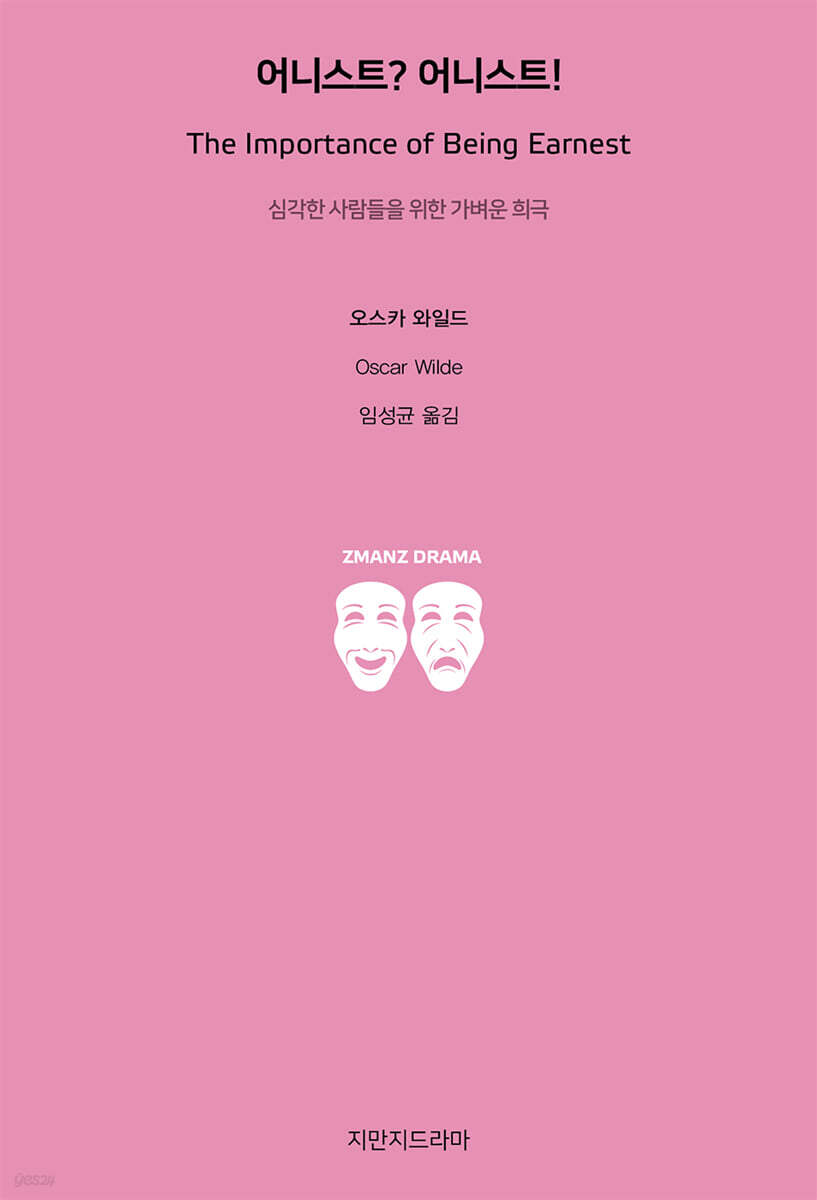
Ernest? Ernest!
 |
Description
Book Introduction
Oscar Wilde's most successful and last play captured the attention of both the public and critics from its premiere.
It is a play that reveals the capitalist atmosphere of the 19th century Victorian era and is still attractive even when read in modern times.
Even though he deals with popular subjects, Wilde's comic prose is full of wit.
February 14th is St. Valentine's Day.
Valentine's Day) and it is also the day this work was first performed.
Since its premiere in 1895, it has been performed on numerous stages and was adapted into the film The Importance of Being Earnest (2002), starring Colin Firth as Jack.
It is a play that reveals the capitalist atmosphere of the 19th century Victorian era and is still attractive even when read in modern times.
Even though he deals with popular subjects, Wilde's comic prose is full of wit.
February 14th is St. Valentine's Day.
Valentine's Day) and it is also the day this work was first performed.
Since its premiere in 1895, it has been performed on numerous stages and was adapted into the film The Importance of Being Earnest (2002), starring Colin Firth as Jack.
index
Ernest? Ernest! Characters Act 1 Act 2 Act 3 Commentary About the Author About the Translator
Into the book
Algernon: I don't like scars.
They are the only ones who are never serious.
--- p.56
Algernon: Well, if you want to have fun in life, you have to be serious about something.
I somehow got seriously into bunburying.
I have no idea what in the world you take so seriously.
I guess maybe it's not all that serious.
Because you have such a completely insignificant personality.
--- p.114
Algernon: Hmm, you can't eat a muffin with that anxious attitude.
Then maybe butter will get on my sleeves.
When eating muffins, you should always eat them very calmly.
That's the only way to eat a muffin.
--- p.116
Gwendolen: When it comes to matters of serious importance, form is more important than sincerity.
--- p.126
Mrs. Bracknell: The two weaknesses of our time are a lack of principles and a lack of perspective.
They are the only ones who are never serious.
--- p.56
Algernon: Well, if you want to have fun in life, you have to be serious about something.
I somehow got seriously into bunburying.
I have no idea what in the world you take so seriously.
I guess maybe it's not all that serious.
Because you have such a completely insignificant personality.
--- p.114
Algernon: Hmm, you can't eat a muffin with that anxious attitude.
Then maybe butter will get on my sleeves.
When eating muffins, you should always eat them very calmly.
That's the only way to eat a muffin.
--- p.116
Gwendolen: When it comes to matters of serious importance, form is more important than sincerity.
--- p.126
Mrs. Bracknell: The two weaknesses of our time are a lack of principles and a lack of perspective.
--- p.133
Publisher's Review
“If I wanted a good conversation, I would choose Oscar Wilde as the best storyteller.” _ George Bernard Shaw
Oscar Wilde's pursuit of aesthetic truth
A hilarious comedy intertwined with love and lies.
Two men need the name 'Ernest' to win the heart of the woman they love.
They become Ernest, their own 'other selves', and go to meet their lovers.
For the two women, the only thing that matters is that the man they love has a 'name' of Ernest.
I don't really care whether they are truly sincere, honest, and earnest as their name suggests.
As a romance develops between the four characters, everything comes to a head when they come together and a shocking secret surrounding Jack is revealed.
Is the ending where he pretends to be Ernest and becomes the 'real' Ernest a happy ending?
"A Bunburyite? What on earth does a Bunburyite mean?"
Contains delicate humor and sharp satire
Wilde's sentence
Although he deals with such commonplace subjects as romance between lovers and the secrets of birth, Wilde's prose is witty, delicate, and never vulgar.
Armed with humor, it criticizes the moral strictures of the 19th-century Victorian era and sharply targets capitalist values on marriage, money, and education.
At the same time, while satirizing the society of the time, it also portrays even worldly figures like Mrs. Bracknell, who is the subject of the satire, with great warmth.
The two main characters, Algernon and Jack, go to Bunbury to meet the woman they love, and although they show a duality, it is not dark or malicious.
Rather, it makes the story more complicated and the comedy more prominent.
“Novelist Poster (E.
M. Foster) emphasized the satirical aspect of the work, evaluating it as showing a world where true values are reversed and rationality and irrationality are mixed.
Meanwhile, novelist H. Wells
G. Wells) highlighted the comic elements of the work by commenting that the work uses dramatic devices such as dialogue and reversal in a comical way to create great laughter.” _Page 195
The theme and material of the play, 'Bunburism', refers to the act of creating a virtual character, another 'self', and living as a completely different being depending on the location or the people one meets.
In other words, it is about moving the standards that shape me to another place, breaking free from social obligations, and experiencing new worlds and relationships.
One reason why "Ernest? Ernest!" continues to be reread in modern times and is considered one of Wilde's most important works is that Wilde's perspective on the world remains completely unsung.
Even without any particular moral message or profound theme, you will find yourself being drawn into the story the author unfolds without even realizing it.
The Importance of Seriousness.
In this play, known by titles such as “The Importance of Being Ernest,” “important” values are mocked through characters and dialogue, ultimately leaving one wondering, “What was really important?”
Serious people might find themselves in the world Wilde created, becoming more serious, or leaving in search of something more serious, or appearing to be absorbed in something but quickly becoming childish.
The title was retranslated to reflect the multi-layered implications of the adjective and proper noun 'Ernest' in this work and to encourage reflection on the work.
Before publication, we edited and reorganized a separate page of readers' interviews where they shared their thoughts while enjoying the snacks and tea featured in the play.
On the web page linked by QR code, you can find stories of five interesting readers' works, materials about Oscar Wilde's life, and behind-the-scenes stories of the editing process.
Oscar Wilde's pursuit of aesthetic truth
A hilarious comedy intertwined with love and lies.
Two men need the name 'Ernest' to win the heart of the woman they love.
They become Ernest, their own 'other selves', and go to meet their lovers.
For the two women, the only thing that matters is that the man they love has a 'name' of Ernest.
I don't really care whether they are truly sincere, honest, and earnest as their name suggests.
As a romance develops between the four characters, everything comes to a head when they come together and a shocking secret surrounding Jack is revealed.
Is the ending where he pretends to be Ernest and becomes the 'real' Ernest a happy ending?
"A Bunburyite? What on earth does a Bunburyite mean?"
Contains delicate humor and sharp satire
Wilde's sentence
Although he deals with such commonplace subjects as romance between lovers and the secrets of birth, Wilde's prose is witty, delicate, and never vulgar.
Armed with humor, it criticizes the moral strictures of the 19th-century Victorian era and sharply targets capitalist values on marriage, money, and education.
At the same time, while satirizing the society of the time, it also portrays even worldly figures like Mrs. Bracknell, who is the subject of the satire, with great warmth.
The two main characters, Algernon and Jack, go to Bunbury to meet the woman they love, and although they show a duality, it is not dark or malicious.
Rather, it makes the story more complicated and the comedy more prominent.
“Novelist Poster (E.
M. Foster) emphasized the satirical aspect of the work, evaluating it as showing a world where true values are reversed and rationality and irrationality are mixed.
Meanwhile, novelist H. Wells
G. Wells) highlighted the comic elements of the work by commenting that the work uses dramatic devices such as dialogue and reversal in a comical way to create great laughter.” _Page 195
The theme and material of the play, 'Bunburism', refers to the act of creating a virtual character, another 'self', and living as a completely different being depending on the location or the people one meets.
In other words, it is about moving the standards that shape me to another place, breaking free from social obligations, and experiencing new worlds and relationships.
One reason why "Ernest? Ernest!" continues to be reread in modern times and is considered one of Wilde's most important works is that Wilde's perspective on the world remains completely unsung.
Even without any particular moral message or profound theme, you will find yourself being drawn into the story the author unfolds without even realizing it.
The Importance of Seriousness.
In this play, known by titles such as “The Importance of Being Ernest,” “important” values are mocked through characters and dialogue, ultimately leaving one wondering, “What was really important?”
Serious people might find themselves in the world Wilde created, becoming more serious, or leaving in search of something more serious, or appearing to be absorbed in something but quickly becoming childish.
The title was retranslated to reflect the multi-layered implications of the adjective and proper noun 'Ernest' in this work and to encourage reflection on the work.
Before publication, we edited and reorganized a separate page of readers' interviews where they shared their thoughts while enjoying the snacks and tea featured in the play.
On the web page linked by QR code, you can find stories of five interesting readers' works, materials about Oscar Wilde's life, and behind-the-scenes stories of the editing process.
GOODS SPECIFICS
- Date of issue: October 4, 2024
- Page count, weight, size: 170 pages | 170g | 128*188*170mm
- ISBN13: 9791173070648
You may also like
카테고리
korean


korean

![GQ KOREA Mark (Monthly): December [2025]](http://librairie.coreenne.fr/cdn/shop/files/8ef265dbbfbf186523ed75ba7319009d.jpg?v=1765340328&width=3840)


