

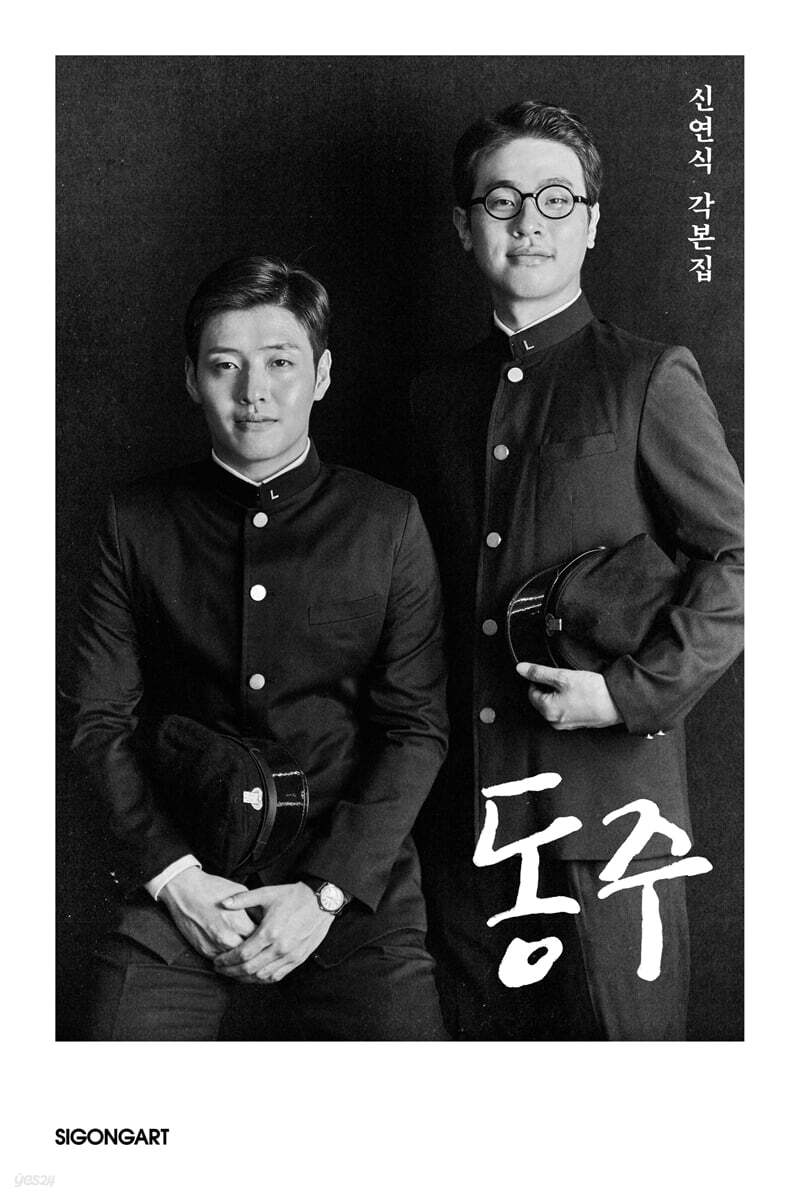
Dongju
 |
Description
Book Introduction
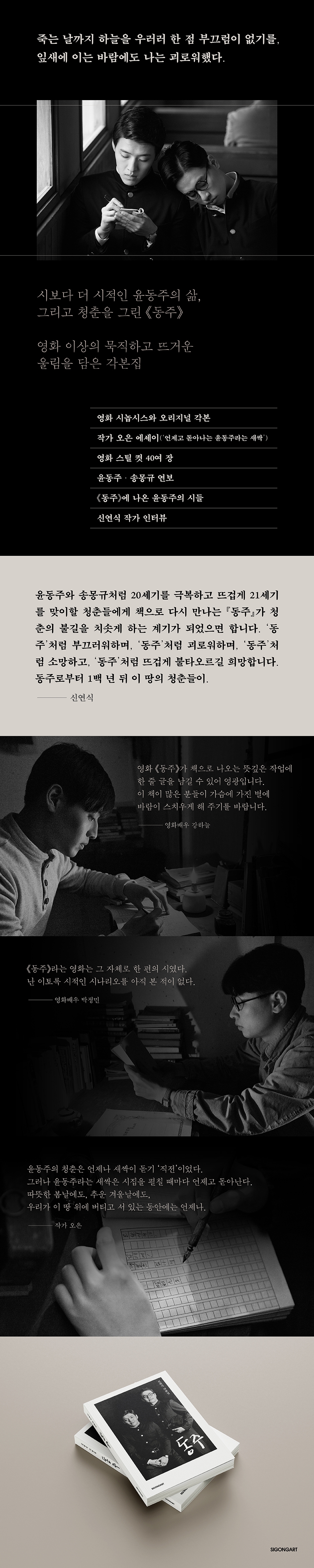
“Until the day I die, I hope to look up to the sky without any shame,
“Even the wind blowing through the leaves made me suffer.”
- Original screenplay collection for 『Dongju』, which won the 17th Busan Film Critics Association Awards, the 37th Blue Dragon Film Awards, the 36th Korean Association of Film Critics Awards, and the 25th Buil Film Awards for Best Screenplay
- Includes essays by poet Oh Eun, still cuts, a chronology of Yun Dong-ju and Song Mong-gyu, poems by Yun Dong-ju featured in the film, and an interview with the author.
There is no one who does not know the poet Yun Dong-ju.
I can recite a few lines of his poetry at any time, and his tightly closed lips and features can be clearly drawn even with my eyes closed.
"Dongju" depicts the life of Yun Dong-ju, who can be called a national poet without hesitation.
But after watching the movie, we are surprised by the poet's face and new story that we thought we knew so well, feel sorry, and are at a loss as to how to express something heavy.
This book, which contains the original script for the film "Dongju," fills the hearts of audiences who cannot easily leave their seats even after the film ends.
The film was released in 2016, but has been re-released and seen multiple times.
I rediscovered the character of Song Mong-gyu, and the two main characters in the film grew from rising stars to trustworthy actors.
Above all, it made us ask ourselves, a century after Yun Dong-ju, what we live for and what we hope for in the free Republic of Korea, the country for which the poet dedicated his life.
Now, audiences can enjoy movies to their heart's content and for a long time through books.
“Even the wind blowing through the leaves made me suffer.”
- Original screenplay collection for 『Dongju』, which won the 17th Busan Film Critics Association Awards, the 37th Blue Dragon Film Awards, the 36th Korean Association of Film Critics Awards, and the 25th Buil Film Awards for Best Screenplay
- Includes essays by poet Oh Eun, still cuts, a chronology of Yun Dong-ju and Song Mong-gyu, poems by Yun Dong-ju featured in the film, and an interview with the author.
There is no one who does not know the poet Yun Dong-ju.
I can recite a few lines of his poetry at any time, and his tightly closed lips and features can be clearly drawn even with my eyes closed.
"Dongju" depicts the life of Yun Dong-ju, who can be called a national poet without hesitation.
But after watching the movie, we are surprised by the poet's face and new story that we thought we knew so well, feel sorry, and are at a loss as to how to express something heavy.
This book, which contains the original script for the film "Dongju," fills the hearts of audiences who cannot easily leave their seats even after the film ends.
The film was released in 2016, but has been re-released and seen multiple times.
I rediscovered the character of Song Mong-gyu, and the two main characters in the film grew from rising stars to trustworthy actors.
Above all, it made us ask ourselves, a century after Yun Dong-ju, what we live for and what we hope for in the free Republic of Korea, the country for which the poet dedicated his life.
Now, audiences can enjoy movies to their heart's content and for a long time through books.
- You can preview some of the book's contents.
Preview
index
Recommendation 1
Recommendation 2
Author's Note
Synopsis
script
Oh Eun's Essay - The Ever-Springing Bud Called Yun Dong-ju
Still cut
Yun Dong-ju and Song Mong-gyu Chronology
Yun Dong-ju's poems from [Dongju]
Interview with author Shin Yeon-sik
Recommendation 2
Author's Note
Synopsis
script
Oh Eun's Essay - The Ever-Springing Bud Called Yun Dong-ju
Still cut
Yun Dong-ju and Song Mong-gyu Chronology
Yun Dong-ju's poems from [Dongju]
Interview with author Shin Yeon-sik
Detailed image
Into the book
I hope that, like Yun Dong-ju and Song Mong-gyu, the young people who have overcome the 20th century and are passionately welcoming the 21st century will be able to rekindle the flames of youth by reading "Dongju" again.
I hope to be ashamed like Dongju, to suffer like Dongju, to hope like Dongju, and to burn as passionately as Dongju.
One hundred years after Dongju, the youth of this land.
---From the author's note
Mong-gyu: What's the point of just writing poetry? You have to present it.
Dongju/ How can I announce it if I don't win?
Mong-gyu/ Are you just going to ignore it and say no?
- Dong-ju tidies up without saying anything.
Monggyu/ Let's create a literary magazine and publish your poetry.
We're talking about making our own magazine.
Dong-ju/ (stops and looks back) A magazine?
Monggyu/ You write poetry and I write prose.
---From "# 7 Yongjeong-Dongju's House (Day-Night)"
- Dong-ju loitering by the window… .
Mong-gyu/ Now even Joseon students will be dragged into the war.
What are you going to do?
Dongju… .
Mong-gyu/ (sigh) What's the big deal about killing one or two Japanese soldiers?
Even if you graduate from military school right now, you'll most likely end up as cannon fodder for Chiang Kai-shek's army.
- Monggyu gets up and shakes his body.
Dongju/Monggyu, do you want to go to Gyeongseong with me? If you're at least a liberal arts major, I'm sure your father will like it.
---From "#23 Jeongmiso (Night)"
- Yeojin throws the manuscript she was looking at next to the manuscript thrown by Mong-gyu.
Mong-gyu and Yeo-jin chuckle.
Dong-ju/ You've only seen Mr. Lee Kwang-soo's works, right?
Mong-gyu/ It's a story from when I was young.
Dongju/ It's the same now.
It's a mistake to be caught up in customs and ideologies and make hasty judgments.
- Friends who are nervous in a strange atmosphere.
Monggyu/ It's about breaking down customs and ideologies.
So let's take out the poetry? (sigh) I have a reason and purpose for doing this literary magazine.
I'm not saying this to ignore poetry.
Dongju/Sido is not lacking in the ability to express his own thoughts.
Literature becomes fully powerful only when it reveals the living truth in people's hearts.
The world will change only when such powers come together one by one.
---From "#33 Okindong Boarding House (Night)"
Jeong Ji-yong/ You might as well go to Japan.
There are many good teachers in Japan too.
I also enjoyed my time in Kyoto.
Even now, the Apcheon River flowing through Kyoto is vivid before my eyes.
Dongju/I think Mr. Jeon's "Apcheon" is a masterpiece.
Yejin/ I'm serious.
Dongju copied his teacher's "Apcheon" and wrote that it was a masterpiece.
Dongju/ But… I don’t know if I should go abroad to study and change my name.
I feel ashamed that I went to such lengths to study abroad.
Jeong Ji-yong/ Don't be ashamed.
It's a shame.
I'm ashamed of myself for being silent, I'm ashamed of myself for being drunk, and I'm ashamed of myself for suggesting that you study abroad in Japan.
How difficult it must be to live without shame. Knowing shame is not something to be ashamed of.
It is shameful to turn away from shame.
---From "#40 Jeong Ji-yong's House-Room"
- Dong-ju walking around the parade ground among men in prison uniforms… .
Prisoners carrying water from a well.
A cloud passes over the well.
Dongju reveals his face above the well… .
Thinking back, I feel sorry for that man.
When I looked down the road, the man was still there.
- The sun is hanging between the barbed wire.
Dong-ju, who is extremely weak and whose complexion is getting darker and darker… stops walking.
---From "#56 Prison"
- Dong-ju waiting for the lecture… .
Write a poem in a notebook.
Lovely Memories (Dong-ju's voice)
One spring morning, at a small station in Seoul
Waiting for the train like hope and love,
- Kumi comes to the back seat.
Kumi/ Do you write poetry?
Dongju/ Ah… no… .
just….
Kumi/ You were writing poetry last time too, right?
- Dong-ju hesitates while looking out the window.
I drop a thin shadow on the platform,
I smoked a cigarette.
---From "#71 Rikkyo University Lecture Room"
- Dong-ju comes in carrying his bag and sits down across from Kumi.
Kumi/ I brought them all.
English translation too.
I also wrote down the address of the British publisher.
Dongju/ Thank you.
Kumi/ I like poetry.
It would have been better if I knew Korean… .
Dong-ju/ (looking) I have to wake up quickly now.
Kumi/ (looking at the bag) Are you going a long way?
Dongju/ Thank you.
Even if I can't get married... I won't forget you.
- Kumi looking at Dongju.
Kumi/ … .
What is the title of the poetry collection…?
- Dong-ju writes the title on a napkin… .
---From "#96 Western-style Cafe"
Dongju/ I will not sign.
I feel so ashamed to hear you say this, I can't do it.
In this world, I wanted to write poetry… I wanted to be a poet… I’m so ashamed… I’m so ashamed that I couldn’t lead and just followed… I’m so ashamed… I’m so ashamed…
I can't sign.
- Dong-ju tears up the documents in front of him.
---From "#97 Interrogation Room (Dong-ju/Mong-gyu Crossover Scene)"
- Monggyubu and Dongjubu bring their children's remains one by one.
Monggyubu drops the urn to the ground.
Monggyubu is surprised and sweeps up the remains.
Dongjubu/Monggyu told me not to leave even a single piece of bone on Japanese soil.
What are you going to do if you take Japanese soil with you?
- Monggyubu carefully picks out the remains while crying… .
---From "#103 Makeup Shop"
When I watched [Dongju] again a few years later, it was only then that Dongju (played by Kang Ha-neul) caught my eye.
He always had that 'just before' look on his face.
Just before speaking, just before acting, even while writing poetry, it seemed as if he was just about to write poetry.
At that time, Koreans would have been united in their dreams of life just before independence and life after independence.
The expression on his face just before is full of anxiety because he hasn't done anything yet, but at the same time, he is full of strength because he fervently hopes for what is to come.
Mong-gyu's power and Dong-ju's anxiety are inseparable, but at some point they come into conflict.
If the Monggyu is always overflowing, the Dongju is in a state of overflowing.
Dongju's expression is reminiscent of the surface of water, and the subtle changes in his expression sway helplessly like the surface of water facing the wind.
---From Oh Eun's essay "A Sprout Called Yun Dong-ju That Always Sprouts"
There's one thing I want to tell you.
In [Dongju], the part where poet Yun Dong-ju tried to publish an English poetry collection is completely fictional.
No similar evidence can be found in any source.
But I think that poet Yun Dong-ju must have desperately hoped that his poetry collection would see the light of day in some way.
Because I could feel the hopes and fears I experienced as a teenager in poet Yun Dong-ju's notes.
When we think of poet Yun Dong-ju, isn't it because we all had unfinished youth?
I hope to be ashamed like Dongju, to suffer like Dongju, to hope like Dongju, and to burn as passionately as Dongju.
One hundred years after Dongju, the youth of this land.
---From the author's note
Mong-gyu: What's the point of just writing poetry? You have to present it.
Dongju/ How can I announce it if I don't win?
Mong-gyu/ Are you just going to ignore it and say no?
- Dong-ju tidies up without saying anything.
Monggyu/ Let's create a literary magazine and publish your poetry.
We're talking about making our own magazine.
Dong-ju/ (stops and looks back) A magazine?
Monggyu/ You write poetry and I write prose.
---From "# 7 Yongjeong-Dongju's House (Day-Night)"
- Dong-ju loitering by the window… .
Mong-gyu/ Now even Joseon students will be dragged into the war.
What are you going to do?
Dongju… .
Mong-gyu/ (sigh) What's the big deal about killing one or two Japanese soldiers?
Even if you graduate from military school right now, you'll most likely end up as cannon fodder for Chiang Kai-shek's army.
- Monggyu gets up and shakes his body.
Dongju/Monggyu, do you want to go to Gyeongseong with me? If you're at least a liberal arts major, I'm sure your father will like it.
---From "#23 Jeongmiso (Night)"
- Yeojin throws the manuscript she was looking at next to the manuscript thrown by Mong-gyu.
Mong-gyu and Yeo-jin chuckle.
Dong-ju/ You've only seen Mr. Lee Kwang-soo's works, right?
Mong-gyu/ It's a story from when I was young.
Dongju/ It's the same now.
It's a mistake to be caught up in customs and ideologies and make hasty judgments.
- Friends who are nervous in a strange atmosphere.
Monggyu/ It's about breaking down customs and ideologies.
So let's take out the poetry? (sigh) I have a reason and purpose for doing this literary magazine.
I'm not saying this to ignore poetry.
Dongju/Sido is not lacking in the ability to express his own thoughts.
Literature becomes fully powerful only when it reveals the living truth in people's hearts.
The world will change only when such powers come together one by one.
---From "#33 Okindong Boarding House (Night)"
Jeong Ji-yong/ You might as well go to Japan.
There are many good teachers in Japan too.
I also enjoyed my time in Kyoto.
Even now, the Apcheon River flowing through Kyoto is vivid before my eyes.
Dongju/I think Mr. Jeon's "Apcheon" is a masterpiece.
Yejin/ I'm serious.
Dongju copied his teacher's "Apcheon" and wrote that it was a masterpiece.
Dongju/ But… I don’t know if I should go abroad to study and change my name.
I feel ashamed that I went to such lengths to study abroad.
Jeong Ji-yong/ Don't be ashamed.
It's a shame.
I'm ashamed of myself for being silent, I'm ashamed of myself for being drunk, and I'm ashamed of myself for suggesting that you study abroad in Japan.
How difficult it must be to live without shame. Knowing shame is not something to be ashamed of.
It is shameful to turn away from shame.
---From "#40 Jeong Ji-yong's House-Room"
- Dong-ju walking around the parade ground among men in prison uniforms… .
Prisoners carrying water from a well.
A cloud passes over the well.
Dongju reveals his face above the well… .
Thinking back, I feel sorry for that man.
When I looked down the road, the man was still there.
- The sun is hanging between the barbed wire.
Dong-ju, who is extremely weak and whose complexion is getting darker and darker… stops walking.
---From "#56 Prison"
- Dong-ju waiting for the lecture… .
Write a poem in a notebook.
Lovely Memories (Dong-ju's voice)
One spring morning, at a small station in Seoul
Waiting for the train like hope and love,
- Kumi comes to the back seat.
Kumi/ Do you write poetry?
Dongju/ Ah… no… .
just….
Kumi/ You were writing poetry last time too, right?
- Dong-ju hesitates while looking out the window.
I drop a thin shadow on the platform,
I smoked a cigarette.
---From "#71 Rikkyo University Lecture Room"
- Dong-ju comes in carrying his bag and sits down across from Kumi.
Kumi/ I brought them all.
English translation too.
I also wrote down the address of the British publisher.
Dongju/ Thank you.
Kumi/ I like poetry.
It would have been better if I knew Korean… .
Dong-ju/ (looking) I have to wake up quickly now.
Kumi/ (looking at the bag) Are you going a long way?
Dongju/ Thank you.
Even if I can't get married... I won't forget you.
- Kumi looking at Dongju.
Kumi/ … .
What is the title of the poetry collection…?
- Dong-ju writes the title on a napkin… .
---From "#96 Western-style Cafe"
Dongju/ I will not sign.
I feel so ashamed to hear you say this, I can't do it.
In this world, I wanted to write poetry… I wanted to be a poet… I’m so ashamed… I’m so ashamed that I couldn’t lead and just followed… I’m so ashamed… I’m so ashamed…
I can't sign.
- Dong-ju tears up the documents in front of him.
---From "#97 Interrogation Room (Dong-ju/Mong-gyu Crossover Scene)"
- Monggyubu and Dongjubu bring their children's remains one by one.
Monggyubu drops the urn to the ground.
Monggyubu is surprised and sweeps up the remains.
Dongjubu/Monggyu told me not to leave even a single piece of bone on Japanese soil.
What are you going to do if you take Japanese soil with you?
- Monggyubu carefully picks out the remains while crying… .
---From "#103 Makeup Shop"
When I watched [Dongju] again a few years later, it was only then that Dongju (played by Kang Ha-neul) caught my eye.
He always had that 'just before' look on his face.
Just before speaking, just before acting, even while writing poetry, it seemed as if he was just about to write poetry.
At that time, Koreans would have been united in their dreams of life just before independence and life after independence.
The expression on his face just before is full of anxiety because he hasn't done anything yet, but at the same time, he is full of strength because he fervently hopes for what is to come.
Mong-gyu's power and Dong-ju's anxiety are inseparable, but at some point they come into conflict.
If the Monggyu is always overflowing, the Dongju is in a state of overflowing.
Dongju's expression is reminiscent of the surface of water, and the subtle changes in his expression sway helplessly like the surface of water facing the wind.
---From Oh Eun's essay "A Sprout Called Yun Dong-ju That Always Sprouts"
There's one thing I want to tell you.
In [Dongju], the part where poet Yun Dong-ju tried to publish an English poetry collection is completely fictional.
No similar evidence can be found in any source.
But I think that poet Yun Dong-ju must have desperately hoped that his poetry collection would see the light of day in some way.
Because I could feel the hopes and fears I experienced as a teenager in poet Yun Dong-ju's notes.
When we think of poet Yun Dong-ju, isn't it because we all had unfinished youth?
---From "Author Interview"
Publisher's Review
Scriptbooks, Delivering More Than Just a Movie
『Dongju』 is the original script collection for the movie [Dongju].
The original script is different from the version presented to the public (for theaters) after being directed, edited, etc.
This allows readers to look at the characters and events through the eyes of the writer rather than the director.
Most movies have a director who writes the screenplay or is deeply involved in the production, but in this movie, the screenwriter and director are different.
Writer Shin Yeon-sik is also active as a film director, but he was in charge of the screenplay and production for [Dongju].
The essence of the writer, who always presents films that contain literary thoughts and the concerns of the times, shines especially in this film.
In the movie, Dong-ju writes and rewrites poems that fill his notebook.
He also wanted to publish a poetry collection, even if it was in English.
This wish was not fulfilled during his lifetime.
In an interview included in the book, the author confesses that as a teenager, he filled his notebooks with ideas for the films he wanted to make, but at the same time, like Yun Dong-ju, he suffered from the fear that he might not be able to release a single film to the world during his lifetime.
A script collection is a way to experience a film that the writer has created solely through words, and it is also an opportunity to once again confirm the charm of writing.
In particular, 『Dongju』 faithfully performs the function that only literature can do: to evoke and excite emotions.
How to love and remember movies
In addition to the movie scenario and original screenplay, 『Dongju』 has a variety of things to read and see.
Starting with recommendations from actors Kang Ha-neul and Park Jung-min, who played Yun Dong-ju and Song Mong-gyu, the book includes an essay by poet Oh Eun ('A Sprout Called Yun Dong-ju That Always Grows'), movie stills, a chronology of Yun Dong-ju and Song Mong-gyu, poems by Yun Dong-ju featured in the film, and an interview with the author.
[Dongju] was widely recognized for its excellent screenplay, winning the Best Screenplay Award at the 17th Busan Film Critics Association Awards, the 37th Blue Dragon Film Awards, the 36th Korean Association of Film Critics Awards, and the 25th Buil Film Awards in 2016.
The public is also full of enthusiastic praise for the rediscovery of Yun Dong-ju and the discovery of Song Mong-gyu.
A good work is one that leaves behind not just one, but a variety of emotions and impressions.
Audiences may be confused about where to begin and how to resolve this, but through this, they can gain the greatest enjoyment that the film can offer, and more.
It is the power that changes me.
Movies like this are constantly being talked about over time.
Like [Dongju], like Yun Dong-ju's poems.
There are many elements in the book that will make like-minded people revisit and remember this film in various ways.
You can savor lines you missed, examine photos that linger rather than just passing footage, read the author's inner thoughts that weren't included in the film, empathize with essays written by the same poet, and reread Yun Dong-ju's poems to carefully reminisce about the film and the poet.
『Dongju』 is the original script collection for the movie [Dongju].
The original script is different from the version presented to the public (for theaters) after being directed, edited, etc.
This allows readers to look at the characters and events through the eyes of the writer rather than the director.
Most movies have a director who writes the screenplay or is deeply involved in the production, but in this movie, the screenwriter and director are different.
Writer Shin Yeon-sik is also active as a film director, but he was in charge of the screenplay and production for [Dongju].
The essence of the writer, who always presents films that contain literary thoughts and the concerns of the times, shines especially in this film.
In the movie, Dong-ju writes and rewrites poems that fill his notebook.
He also wanted to publish a poetry collection, even if it was in English.
This wish was not fulfilled during his lifetime.
In an interview included in the book, the author confesses that as a teenager, he filled his notebooks with ideas for the films he wanted to make, but at the same time, like Yun Dong-ju, he suffered from the fear that he might not be able to release a single film to the world during his lifetime.
A script collection is a way to experience a film that the writer has created solely through words, and it is also an opportunity to once again confirm the charm of writing.
In particular, 『Dongju』 faithfully performs the function that only literature can do: to evoke and excite emotions.
How to love and remember movies
In addition to the movie scenario and original screenplay, 『Dongju』 has a variety of things to read and see.
Starting with recommendations from actors Kang Ha-neul and Park Jung-min, who played Yun Dong-ju and Song Mong-gyu, the book includes an essay by poet Oh Eun ('A Sprout Called Yun Dong-ju That Always Grows'), movie stills, a chronology of Yun Dong-ju and Song Mong-gyu, poems by Yun Dong-ju featured in the film, and an interview with the author.
[Dongju] was widely recognized for its excellent screenplay, winning the Best Screenplay Award at the 17th Busan Film Critics Association Awards, the 37th Blue Dragon Film Awards, the 36th Korean Association of Film Critics Awards, and the 25th Buil Film Awards in 2016.
The public is also full of enthusiastic praise for the rediscovery of Yun Dong-ju and the discovery of Song Mong-gyu.
A good work is one that leaves behind not just one, but a variety of emotions and impressions.
Audiences may be confused about where to begin and how to resolve this, but through this, they can gain the greatest enjoyment that the film can offer, and more.
It is the power that changes me.
Movies like this are constantly being talked about over time.
Like [Dongju], like Yun Dong-ju's poems.
There are many elements in the book that will make like-minded people revisit and remember this film in various ways.
You can savor lines you missed, examine photos that linger rather than just passing footage, read the author's inner thoughts that weren't included in the film, empathize with essays written by the same poet, and reread Yun Dong-ju's poems to carefully reminisce about the film and the poet.
GOODS SPECIFICS
- Publication date: August 15, 2022
- Page count, weight, size: 232 pages | 442g | 140*210*18mm
- ISBN13: 9791169251259
- ISBN10: 1169251250
You may also like
카테고리
korean


korean

![GQ KOREA Mark (Monthly): December [2025]](http://librairie.coreenne.fr/cdn/shop/files/8ef265dbbfbf186523ed75ba7319009d.jpg?v=1765340328&width=3840)


