

Suin x I-jong character design
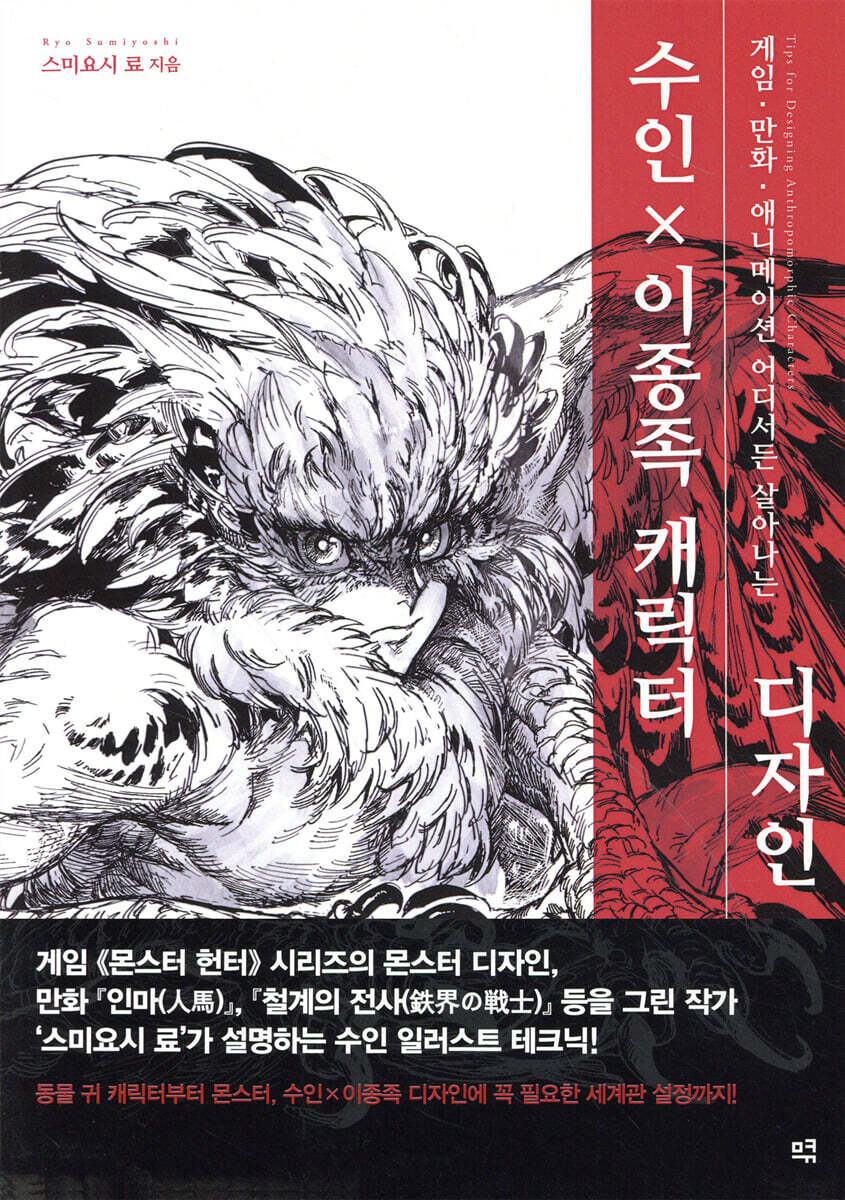 |
Description
Book Introduction
Design techniques for realistically and three-dimensionally depicting humans and other species
Let's anthropomorphize mammals, birds, reptiles, arthropods, and fish with 20 examples!
《Monster Hunter》 Designer Explains Techniques & Worldview Settings!
Let's learn design techniques for 20 different types of beastmen and other races, from mermaids to animal ears, creatures, monsters, and even monsters! By referring to expressions by medium, skeletons and muscles, tools, and world-building techniques taught by the designers of "Monster Hunter," you will be able to bring your characters to life.
If you are a Suinler or Inoeler who has only drawn according to your feelings, try making fantasy creatures into realistic 'living beings'.
This book covers everything from the basics, such as 'deformation, understanding the skeleton, and associating ideas', which are essential for drawing human and other race characters, to advanced topics, such as 'simplifying the body structure, lifestyle, culture, horns, and scales of centaurs'.
In particular, the technique of anthropomorphizing 'grasshoppers, cockroaches, spiders, bees, and cabbage white butterflies' in an attractive way by reducing the aversion to arthropods will provide new inspiration to designers who love beasts and other species.
Let's anthropomorphize mammals, birds, reptiles, arthropods, and fish with 20 examples!
《Monster Hunter》 Designer Explains Techniques & Worldview Settings!
Let's learn design techniques for 20 different types of beastmen and other races, from mermaids to animal ears, creatures, monsters, and even monsters! By referring to expressions by medium, skeletons and muscles, tools, and world-building techniques taught by the designers of "Monster Hunter," you will be able to bring your characters to life.
If you are a Suinler or Inoeler who has only drawn according to your feelings, try making fantasy creatures into realistic 'living beings'.
This book covers everything from the basics, such as 'deformation, understanding the skeleton, and associating ideas', which are essential for drawing human and other race characters, to advanced topics, such as 'simplifying the body structure, lifestyle, culture, horns, and scales of centaurs'.
In particular, the technique of anthropomorphizing 'grasshoppers, cockroaches, spiders, bees, and cabbage white butterflies' in an attractive way by reducing the aversion to arthropods will provide new inspiration to designers who love beasts and other species.
- You can preview some of the book's contents.
Preview
index
preface
Chapter 1: Basic Knowledge of Comics, Animation, and Game Character Design
Expression methods that vary depending on the medium
Basic sketch points
Create realistic animals as characters
Character (personality) setting starting from facial expression
Deformation tips
Understanding the basic skeleton of the human body
┃Column 1┃ Author Category Classification
Animal images that are important in character design
Idea association method
What is a heterodox?
Heterogeneous elements and degree of variation
Giving movement to the finished character
┃Column 2┃ A one-of-a-kind character created by associating keywords
Chapter 2 Mammals
(Animal Ears) Feline Character
(Animal Ears) Dog and Character
(Suin) cat character
(Suin) Dog and character
(Creature) Dog and character
(Interspecies) Horses and Characters
Setting the lifestyle and culture of characters from different races
Designing a water-human character that utilizes mammalian characteristics
Adding personality to horned animals
【Sketch Notes】Mammals
Chapter 3: Birds and Reptiles
Bird wing structure and feather folding patterns
(Animal Wings) Bird Character
Expanding variations using one character
(Suin) Bird character
(Creature) Bird character
(Creature) Wolf x Bird Character
【Sketch Notes】 Birds
┃Column 3┃ 'Dinosaurs' are interesting creatures that connect birds and reptiles.
Reptile emotional expression and body structure
The relationship between reptile poses and facial expressions
Designing a character that takes advantage of reptilian characteristics
(Suin) Reptile character
(Creature) Snake and Character
(Creature) Tyrannosaurus character
Set the character size
【Sketch Notes】Dinosaurs and Reptiles
Chapter 4: Arthropods
Arthropod character
Reduce disgust
Arthropod character design in commercial settings
(Monster) Arthropod character
Change the worldview and create a different character
The charm of arthropod characters
(Suin) Outdoor insect character
(Monster) Crustacean character
(Monster) Arthropod character
(Monster) Crustacean character
【Sketch Notes】 Insects
【Sketch Notes】Arthropods
┃Column 4┃ Enjoying the Personification of Formless Senses and Concepts
Chapter 5: Fish
(Creature) Mermaid character
(Monster) Mermaid character
【Sketch Notes】 Fish
TIPS & Interviews
Production environment and production sequence
Author Interview
Conclusion
Chapter 1: Basic Knowledge of Comics, Animation, and Game Character Design
Expression methods that vary depending on the medium
Basic sketch points
Create realistic animals as characters
Character (personality) setting starting from facial expression
Deformation tips
Understanding the basic skeleton of the human body
┃Column 1┃ Author Category Classification
Animal images that are important in character design
Idea association method
What is a heterodox?
Heterogeneous elements and degree of variation
Giving movement to the finished character
┃Column 2┃ A one-of-a-kind character created by associating keywords
Chapter 2 Mammals
(Animal Ears) Feline Character
(Animal Ears) Dog and Character
(Suin) cat character
(Suin) Dog and character
(Creature) Dog and character
(Interspecies) Horses and Characters
Setting the lifestyle and culture of characters from different races
Designing a water-human character that utilizes mammalian characteristics
Adding personality to horned animals
【Sketch Notes】Mammals
Chapter 3: Birds and Reptiles
Bird wing structure and feather folding patterns
(Animal Wings) Bird Character
Expanding variations using one character
(Suin) Bird character
(Creature) Bird character
(Creature) Wolf x Bird Character
【Sketch Notes】 Birds
┃Column 3┃ 'Dinosaurs' are interesting creatures that connect birds and reptiles.
Reptile emotional expression and body structure
The relationship between reptile poses and facial expressions
Designing a character that takes advantage of reptilian characteristics
(Suin) Reptile character
(Creature) Snake and Character
(Creature) Tyrannosaurus character
Set the character size
【Sketch Notes】Dinosaurs and Reptiles
Chapter 4: Arthropods
Arthropod character
Reduce disgust
Arthropod character design in commercial settings
(Monster) Arthropod character
Change the worldview and create a different character
The charm of arthropod characters
(Suin) Outdoor insect character
(Monster) Crustacean character
(Monster) Arthropod character
(Monster) Crustacean character
【Sketch Notes】 Insects
【Sketch Notes】Arthropods
┃Column 4┃ Enjoying the Personification of Formless Senses and Concepts
Chapter 5: Fish
(Creature) Mermaid character
(Monster) Mermaid character
【Sketch Notes】 Fish
TIPS & Interviews
Production environment and production sequence
Author Interview
Conclusion
Detailed image
.jpg)
Into the book
Cartoonistic expressions such as ‘human facial expressions’ and ‘human gestures’ serve as effective ‘communication’ means.
This is called personification.
--- p.
8
Deformation is not simply 'making something round or reducing the height', but is a technique that extracts and organizes information.
If you understand this, you will be able to deform any object.
--- p.
17
I think character design is personality planning, portraying a being who lives a different life from oneself.
Once you start coming up with ideas, there is no end to them.
This means that we can imagine an endless variety of beings.
--- p.
27
A character's personality and mood can also be expressed through color combinations.
'Base color' is the color that determines the character's impression, and is painted over a large area.
The 'main color' is applied to the entire area.
An 'accent color' is an eye-catching color that is applied to a small area.
--- p.
35
When designing a character's tools, the ecological characteristics and natural environment of the species are most important.
We need to bridge the gap between ecological characteristics and the natural environment, and we need to devise the necessary tools, the circumstances surrounding their emergence, and the circumstances that allowed them to take root in society.
--- p.
46
Habits (behaviors) make us feel close to a character, so let's explore them in depth by sketching out their habits, such as 'What do they do? What do they eat? How do they eat?'
--- p.
73
Since the scales that are close together do not cast shadows, erase the lines. Since the scales that are about to be close cast shadows the darkest, draw the lines even thicker.
By adjusting the strength of the strokes according to the interval like this, you can draw lines in a charming way.
--- p.
85
If you have a fixed idea that you should only draw the head as a head, you will not be able to expand your ideas.
If you put aside thoughts about 'big head' or 'small front paws' for a moment and just think about the function of each part, you may come up with unique expressions.
--- p.
88
It takes effort to get the chance to draw your favorite motifs to your heart's content.
And remember, having a wide range of expression is a weapon that can help you seize that opportunity.
In other words, reducing disgust is not about flattering the public or giving up, but rather a shift in perception necessary to broadly work on motifs that you truly like.
--- p.
100
A true professional is strict because they live in that world, but they don't arbitrarily dismiss other people's drawings or treat them like fools.
If you have the opportunity, I recommend continuing to show your drawings to a professional and get advice.
This is called personification.
--- p.
8
Deformation is not simply 'making something round or reducing the height', but is a technique that extracts and organizes information.
If you understand this, you will be able to deform any object.
--- p.
17
I think character design is personality planning, portraying a being who lives a different life from oneself.
Once you start coming up with ideas, there is no end to them.
This means that we can imagine an endless variety of beings.
--- p.
27
A character's personality and mood can also be expressed through color combinations.
'Base color' is the color that determines the character's impression, and is painted over a large area.
The 'main color' is applied to the entire area.
An 'accent color' is an eye-catching color that is applied to a small area.
--- p.
35
When designing a character's tools, the ecological characteristics and natural environment of the species are most important.
We need to bridge the gap between ecological characteristics and the natural environment, and we need to devise the necessary tools, the circumstances surrounding their emergence, and the circumstances that allowed them to take root in society.
--- p.
46
Habits (behaviors) make us feel close to a character, so let's explore them in depth by sketching out their habits, such as 'What do they do? What do they eat? How do they eat?'
--- p.
73
Since the scales that are close together do not cast shadows, erase the lines. Since the scales that are about to be close cast shadows the darkest, draw the lines even thicker.
By adjusting the strength of the strokes according to the interval like this, you can draw lines in a charming way.
--- p.
85
If you have a fixed idea that you should only draw the head as a head, you will not be able to expand your ideas.
If you put aside thoughts about 'big head' or 'small front paws' for a moment and just think about the function of each part, you may come up with unique expressions.
--- p.
88
It takes effort to get the chance to draw your favorite motifs to your heart's content.
And remember, having a wide range of expression is a weapon that can help you seize that opportunity.
In other words, reducing disgust is not about flattering the public or giving up, but rather a shift in perception necessary to broadly work on motifs that you truly like.
--- p.
100
A true professional is strict because they live in that world, but they don't arbitrarily dismiss other people's drawings or treat them like fools.
If you have the opportunity, I recommend continuing to show your drawings to a professional and get advice.
--- p.
141
141
Publisher's Review
It comes to life anywhere, in games, comics, and animation!
Suin x alien character design prepared for Suinler and Inoeler!
Everything from the Monster Hunter designer's writing style to the world setting is included.
I highly recommend this book to anyone who loves characters from different races!
Does something have to be uniquely drawn to be attractive?
〈Point 1〉 Realistic drawing style
- Centaur skeleton? Thanks~ -
After sketching various creatures and understanding their skeletons and characteristics, deform them into characters.
It is characterized by a drawing style that seems to exist in reality, using real animals as motifs.
Also, like the author's philosophy that 'every skeleton has an evolutionary history and dignity as a living being', design skills can be developed in a direction that emphasizes the aesthetic characteristics of living things rather than a sense of strangeness and disgust.
Can it be drawn as a cartoon or webtoon?
〈Point 2〉 Worldview Setting
- After the world was roughly destroyed, the beastmen...
-
The author's worldview is reflected in each character according to category classification.
In particular, it does not focus only on drawing characters prettily, but also explains 'why they were drawn that way' and 'what characteristics they have by drawing them this way'.
This will help establish the worldview, which is the most important thing for designers of human and other race characters.
Can I draw a Suin x Ijong character too?
〈Point 3〉 Detailed explanation
- What do you think, everyone? It's easy, right? -
Rather than simply explaining an already drawn illustration by saying, "You should draw it like this," explain in detail where you got your inspiration, how you got the idea, and how you drew it.
By learning how to effectively express characteristic features such as deer antlers, lizard scales, and arthropod joints, you can expect to improve your expressiveness.
Is there a medium that can accept heterogeneous painting styles?
〈Point 4〉 Scope of application by medium
- Uh, the client is talking back...? -
While not ignoring the designer's worldview or characters, it suggests methods for each medium to consider what aspects should be considered in order to be accepted by the public in a realistic sense.
In addition to the things to watch out for and what's allowed, we discuss the attitudes and mindsets professionals need to adopt to present their work to the public without harm.
What is the attitude of a professional character designer?
〈Point 5〉 Production environment and interview
- Writer Ryo, what do you think about professionals? -
The author briefly explains the tools and programs he believes are necessary.
Rather than just advertising, we recommend appropriate tools based on the characteristics of the products and the designer's working style.
Meanwhile, through an interview, the author introduces anecdotes from his life experiences that led him to his current position.
The author, who loved drawing, did not have a very happy childhood, so it will resonate deeply with those in similar situations.
"Aren't there any unique techniques to bring out the characters of different races?"
'Isn't there a way to accept people who dislike the character?'
'How can we establish a realistic worldview for a Suin character work?'
Suin x Love for other races
If you're a person, let's meet right now!
Suin x alien character design prepared for Suinler and Inoeler!
Everything from the Monster Hunter designer's writing style to the world setting is included.
I highly recommend this book to anyone who loves characters from different races!
Does something have to be uniquely drawn to be attractive?
〈Point 1〉 Realistic drawing style
- Centaur skeleton? Thanks~ -
After sketching various creatures and understanding their skeletons and characteristics, deform them into characters.
It is characterized by a drawing style that seems to exist in reality, using real animals as motifs.
Also, like the author's philosophy that 'every skeleton has an evolutionary history and dignity as a living being', design skills can be developed in a direction that emphasizes the aesthetic characteristics of living things rather than a sense of strangeness and disgust.
Can it be drawn as a cartoon or webtoon?
〈Point 2〉 Worldview Setting
- After the world was roughly destroyed, the beastmen...
-
The author's worldview is reflected in each character according to category classification.
In particular, it does not focus only on drawing characters prettily, but also explains 'why they were drawn that way' and 'what characteristics they have by drawing them this way'.
This will help establish the worldview, which is the most important thing for designers of human and other race characters.
Can I draw a Suin x Ijong character too?
〈Point 3〉 Detailed explanation
- What do you think, everyone? It's easy, right? -
Rather than simply explaining an already drawn illustration by saying, "You should draw it like this," explain in detail where you got your inspiration, how you got the idea, and how you drew it.
By learning how to effectively express characteristic features such as deer antlers, lizard scales, and arthropod joints, you can expect to improve your expressiveness.
Is there a medium that can accept heterogeneous painting styles?
〈Point 4〉 Scope of application by medium
- Uh, the client is talking back...? -
While not ignoring the designer's worldview or characters, it suggests methods for each medium to consider what aspects should be considered in order to be accepted by the public in a realistic sense.
In addition to the things to watch out for and what's allowed, we discuss the attitudes and mindsets professionals need to adopt to present their work to the public without harm.
What is the attitude of a professional character designer?
〈Point 5〉 Production environment and interview
- Writer Ryo, what do you think about professionals? -
The author briefly explains the tools and programs he believes are necessary.
Rather than just advertising, we recommend appropriate tools based on the characteristics of the products and the designer's working style.
Meanwhile, through an interview, the author introduces anecdotes from his life experiences that led him to his current position.
The author, who loved drawing, did not have a very happy childhood, so it will resonate deeply with those in similar situations.
"Aren't there any unique techniques to bring out the characters of different races?"
'Isn't there a way to accept people who dislike the character?'
'How can we establish a realistic worldview for a Suin character work?'
Suin x Love for other races
If you're a person, let's meet right now!
GOODS SPECIFICS
- Date of issue: June 30, 2022
- Page count, weight, size: 148 pages | 484g | 182*257*20mm
- ISBN13: 9791168014619
- ISBN10: 1168014611
You may also like
카테고리
korean


korean

![GQ KOREA Mark (Monthly): December [2025]](http://librairie.coreenne.fr/cdn/shop/files/8ef265dbbfbf186523ed75ba7319009d.jpg?v=1765340328&width=3840)


