

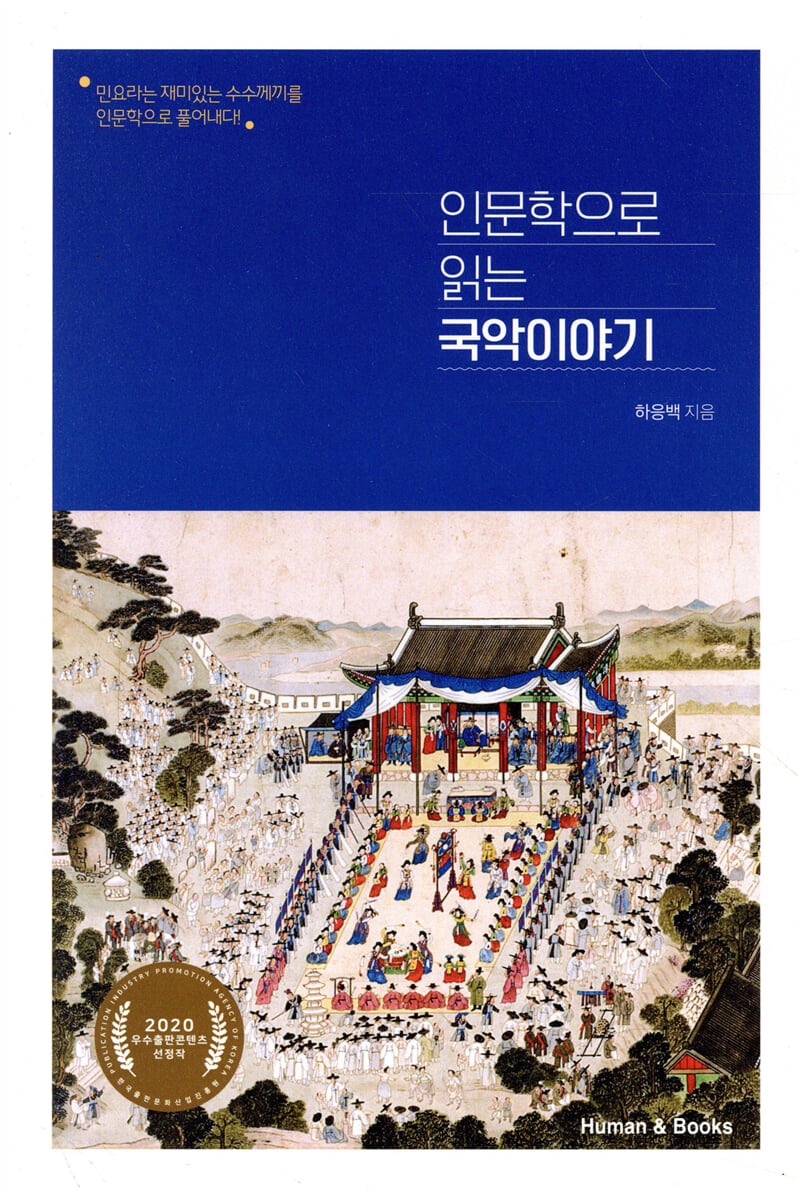
A Story of Korean Traditional Music Through the Humanities
 |
Description
Book Introduction
A story about our traditional Korean music that is more interesting than opera or musical!
“Whenever time allowed, I organized the lyrics of folk songs little by little and published a book called ‘Changakjipseong’ (2011).
Following the publication of the book, a radio program titled “Ha Eung-baek’s Changak Collection” was broadcast on the National Gugak Broadcasting System for two hours every Sunday for about two years.
I also wrote a series of articles about Korean traditional music lyrics in the Korean Traditional Music Newspaper for about three years.
In 2019, 100 episodes of 'Ha Eung-baek's Interesting Story Sijo' were recorded on Naver Audio Clip, and are currently in service.
He also published a research paper titled “Study on Nollyang Intersection” (2019).
If there is too much writing, it could become a book.
Among the articles I've written about traditional Korean music, there are many that are one-offs or lack quality.
I decided to publish a book on Korean traditional music, despite my concerns that it would be unsightly, even though I had already removed what needed to be removed.
“The reason is that books that examine Korean traditional music lyrics from a humanities, especially literary, perspective are rare, and I thought that an analysis of Korean traditional music lyrics from a literary critic’s perspective might not be meaningless.”
-From the author's preface
As the title suggests, this book is a story about Korean traditional music viewed through the lens of humanities.
It is also a process of solving the interesting mystery called folk songs through humanities.
In order to enrich the various stories contained in the lyrics of traditional Korean music, historical facts and literary perspectives were added.
“Whenever time allowed, I organized the lyrics of folk songs little by little and published a book called ‘Changakjipseong’ (2011).
Following the publication of the book, a radio program titled “Ha Eung-baek’s Changak Collection” was broadcast on the National Gugak Broadcasting System for two hours every Sunday for about two years.
I also wrote a series of articles about Korean traditional music lyrics in the Korean Traditional Music Newspaper for about three years.
In 2019, 100 episodes of 'Ha Eung-baek's Interesting Story Sijo' were recorded on Naver Audio Clip, and are currently in service.
He also published a research paper titled “Study on Nollyang Intersection” (2019).
If there is too much writing, it could become a book.
Among the articles I've written about traditional Korean music, there are many that are one-offs or lack quality.
I decided to publish a book on Korean traditional music, despite my concerns that it would be unsightly, even though I had already removed what needed to be removed.
“The reason is that books that examine Korean traditional music lyrics from a humanities, especially literary, perspective are rare, and I thought that an analysis of Korean traditional music lyrics from a literary critic’s perspective might not be meaningless.”
-From the author's preface
As the title suggests, this book is a story about Korean traditional music viewed through the lens of humanities.
It is also a process of solving the interesting mystery called folk songs through humanities.
In order to enrich the various stories contained in the lyrics of traditional Korean music, historical facts and literary perspectives were added.
- You can preview some of the book's contents.
Preview
Into the book
Among our folk songs, there are often cases where the lyrics are completely incomprehensible.
There are several reasons for this.
Since folk songs have been passed down orally for a long time, some of the lyrics may have become dead words that are no longer used, or may have been mispronounced.
In the case of difficult Chinese characters, the meaning completely changes when trying to change it to an easier word, and when the meaning becomes unclear, it is sometimes changed to a completely different word that makes sense.
--- p.12
After the rain, we sat down face to face
When I die and go to the next life, I will serve you first.
This song is also included in the first year of middle school music textbook, and its meaning is, “It’s raining hard, my sister-in-law and my sister-in-law are sitting across from each other, and I suddenly die and in the next life, I will serve my husband.”
The leap is so far that I can't even understand what it means.
--- p.14
Among the songs classified as folk songs in Korean traditional music, there are few cases where the lyricist and composer are known.
In the case of sijo or gagok, since the lyrics are based on sijo poetry, there are many cases where the lyricist is known, but in the case of general folk songs, since most of them were created naturally and passed down orally, the composer is almost unknown.
However, in the case of “Gwansanyungma,” which is classified as a poem-singing, it can be exceptionally identified as having been written by Shin Gwang-su and composed by Pyongyang gisaeng Moran.
--- p.32
There is a grave of Jo Won's ancestors in Paju, and the grave keeper was falsely accused of being a cattle thief.
During the Joseon Dynasty, petty theft was a serious crime punishable by death.
His wife came to find the gravedigger in a hurry on his behalf, who was locked in the graveyard.
As Jo Won was out and things were very urgent, Ok Bong wrote a poem and gave it to the grave keeper's wife, saying:
“You can take this and take it to Pastor Paju.”
After seeing the letter, the pastor of Paju released the gravedigger.
What kind of poem was it?
--- p.
44
Looking at the current lyrics of "Baettarigi," it is about a sailor who was fishing on a boat when the boat hit a reef and wrecked, killing everyone. Luckily, the captain, the cook, and the eldest grandson survived and returned home after three years.
However, the lyrics for the beginning of “Baettaragi” are slightly different for each person who sings it or for each book.
The cycle of reincarnation has all passed (Kim Jeong-yeon, 『Complete Collection of Calligraphy and Music』)
The spring colors are all gone (Lee Chang-bae, 『Korean Singing Series』)
The moist summer and moist color have all passed (Park Ki-jong, 『Anthology of Seodo Sori Gasajip』)
The intervening summer and intervening months have all passed (Choi Chang-ho, ‘Folk Songs Along the Three Thousand Miles’)
Because there are so many versions, even the people who actually sing it are bound to get confused about which one is correct.
--- p.
118
Around September 2011, not long after I published the book “Changakjipseong” in June, I received a phone call from the writer in charge of KBS’s “Gugak Hanmadang.”
The content was that the lyrics of “Changbu Taryeong” contain the phrase “Hayagugu,” and the question was what on earth does this mean.
Some people call it 'Hayagugu', others call it 'Hayaguigui'. Doesn't it mean 'How can I return home' in Chinese characters? Some people interpret it as 'How can I return home', so it was a request to speak frankly.
There are several reasons for this.
Since folk songs have been passed down orally for a long time, some of the lyrics may have become dead words that are no longer used, or may have been mispronounced.
In the case of difficult Chinese characters, the meaning completely changes when trying to change it to an easier word, and when the meaning becomes unclear, it is sometimes changed to a completely different word that makes sense.
--- p.12
After the rain, we sat down face to face
When I die and go to the next life, I will serve you first.
This song is also included in the first year of middle school music textbook, and its meaning is, “It’s raining hard, my sister-in-law and my sister-in-law are sitting across from each other, and I suddenly die and in the next life, I will serve my husband.”
The leap is so far that I can't even understand what it means.
--- p.14
Among the songs classified as folk songs in Korean traditional music, there are few cases where the lyricist and composer are known.
In the case of sijo or gagok, since the lyrics are based on sijo poetry, there are many cases where the lyricist is known, but in the case of general folk songs, since most of them were created naturally and passed down orally, the composer is almost unknown.
However, in the case of “Gwansanyungma,” which is classified as a poem-singing, it can be exceptionally identified as having been written by Shin Gwang-su and composed by Pyongyang gisaeng Moran.
--- p.32
There is a grave of Jo Won's ancestors in Paju, and the grave keeper was falsely accused of being a cattle thief.
During the Joseon Dynasty, petty theft was a serious crime punishable by death.
His wife came to find the gravedigger in a hurry on his behalf, who was locked in the graveyard.
As Jo Won was out and things were very urgent, Ok Bong wrote a poem and gave it to the grave keeper's wife, saying:
“You can take this and take it to Pastor Paju.”
After seeing the letter, the pastor of Paju released the gravedigger.
What kind of poem was it?
--- p.
44
Looking at the current lyrics of "Baettarigi," it is about a sailor who was fishing on a boat when the boat hit a reef and wrecked, killing everyone. Luckily, the captain, the cook, and the eldest grandson survived and returned home after three years.
However, the lyrics for the beginning of “Baettaragi” are slightly different for each person who sings it or for each book.
The cycle of reincarnation has all passed (Kim Jeong-yeon, 『Complete Collection of Calligraphy and Music』)
The spring colors are all gone (Lee Chang-bae, 『Korean Singing Series』)
The moist summer and moist color have all passed (Park Ki-jong, 『Anthology of Seodo Sori Gasajip』)
The intervening summer and intervening months have all passed (Choi Chang-ho, ‘Folk Songs Along the Three Thousand Miles’)
Because there are so many versions, even the people who actually sing it are bound to get confused about which one is correct.
--- p.
118
Around September 2011, not long after I published the book “Changakjipseong” in June, I received a phone call from the writer in charge of KBS’s “Gugak Hanmadang.”
The content was that the lyrics of “Changbu Taryeong” contain the phrase “Hayagugu,” and the question was what on earth does this mean.
Some people call it 'Hayagugu', others call it 'Hayaguigui'. Doesn't it mean 'How can I return home' in Chinese characters? Some people interpret it as 'How can I return home', so it was a request to speak frankly.
--- p.
206
206
Publisher's Review
An exciting journey through Korean traditional music and humanities to discover the true DNA of Koreans!
Since folk songs often originated among the people over a long period of time, their lyrics contain multi-layered content.
For example, the song [Nollyangsa Geori], a song by a sadangpae, widely incorporates sijo, Chinese poetry, and 18th-century Korean lyrics, and the spatial movements (performance activities) of the sadangpae are inherent in the lyrics.
Therefore, if we examine [Nollyang Intersection] through a humanistic yardstick, we can see what kind of life the Sadangpae, a commoner group, lived, what activities they engaged in, and what joys and sorrows there were in their life history.
This book also presents a methodology for interpreting the lyrics of folk songs such as Gyeonggisori and Seodosori, which have been almost neglected.
The lyrics of folk songs suggest that one can approach the substantive content by synthesizing various elements such as dialect, literature research, and legend.
By exploring folk songs in this way, we can discover the prototype of Kim So-wol's poetry in folk songs like [Ginari].
In the case of [Gangwon-do Arirang], we find the actual joys and sorrows of the residents of Gangwon-do as a timber production base through historical research, and trace the origins of [Gangwon-do Arirang] from an ontological perspective.
If you sing folk songs like this while understanding the meaning of the lyrics, the songs will be more enjoyable.
Traditional Korean music becomes much more enjoyable when you know the lyrics.
This is almost the first work in Korea to examine the lyrics of traditional Korean music in a three-dimensional way through literature, history, and linguistics.
Another advantage of this book is that it avoids difficult academic terminology and uses readable sentences to make it easily accessible to readers.
I recommend this book to students and the general public studying Korean traditional music, intellectuals seeking to learn about Korean traditional music as a form of cultural enrichment, literature enthusiasts, and many others who enjoy the humanities.
It was selected as '2020 Excellent Publishing Content' by the Korea Creative Content Agency.
Since folk songs often originated among the people over a long period of time, their lyrics contain multi-layered content.
For example, the song [Nollyangsa Geori], a song by a sadangpae, widely incorporates sijo, Chinese poetry, and 18th-century Korean lyrics, and the spatial movements (performance activities) of the sadangpae are inherent in the lyrics.
Therefore, if we examine [Nollyang Intersection] through a humanistic yardstick, we can see what kind of life the Sadangpae, a commoner group, lived, what activities they engaged in, and what joys and sorrows there were in their life history.
This book also presents a methodology for interpreting the lyrics of folk songs such as Gyeonggisori and Seodosori, which have been almost neglected.
The lyrics of folk songs suggest that one can approach the substantive content by synthesizing various elements such as dialect, literature research, and legend.
By exploring folk songs in this way, we can discover the prototype of Kim So-wol's poetry in folk songs like [Ginari].
In the case of [Gangwon-do Arirang], we find the actual joys and sorrows of the residents of Gangwon-do as a timber production base through historical research, and trace the origins of [Gangwon-do Arirang] from an ontological perspective.
If you sing folk songs like this while understanding the meaning of the lyrics, the songs will be more enjoyable.
Traditional Korean music becomes much more enjoyable when you know the lyrics.
This is almost the first work in Korea to examine the lyrics of traditional Korean music in a three-dimensional way through literature, history, and linguistics.
Another advantage of this book is that it avoids difficult academic terminology and uses readable sentences to make it easily accessible to readers.
I recommend this book to students and the general public studying Korean traditional music, intellectuals seeking to learn about Korean traditional music as a form of cultural enrichment, literature enthusiasts, and many others who enjoy the humanities.
It was selected as '2020 Excellent Publishing Content' by the Korea Creative Content Agency.
GOODS SPECIFICS
- Publication date: June 25, 2020
- Page count, weight, size: 300 pages | 568g | 152*225*20mm
- ISBN13: 9788960787209
- ISBN10: 8960787205
You may also like
카테고리
korean


korean

![GQ KOREA Mark (Monthly): December [2025]](http://librairie.coreenne.fr/cdn/shop/files/8ef265dbbfbf186523ed75ba7319009d.jpg?v=1765340328&width=3840)


