

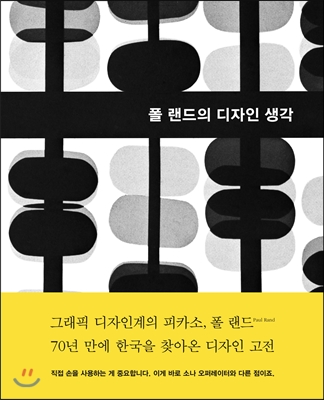
Paul Rand's design thinking
 |
Description
Book Introduction
Paul Rand, the Picasso of graphic design
A compact yet robust design classic, published in Korea for the first time in 70 years, featuring 82 works.
『Design Thoughts of Paul Rand』 is an essay about design written by American graphic designer Paul Rand (1914-1996) when he was thirty-three.
First published in 1947 by Wytenborn Schultz in New York, it went out of print later, but was republished by Chronicle Books in San Francisco to commemorate the 100th anniversary of Paul Rand's birth.
This is the first time this edition has been translated and published in Korean.
Paul Rand was a pioneer of 20th-century American graphic design, working actively as an art director, book designer, children's book author, and educator. He is best known for designing corporate logos for companies such as IBM, ABC, UPS, Westinghouse, and NexT.
Paul Rand explains what makes good design, what doesn't, and what the "timeless principles" of design are.
It contains 82 works including magazines, trademarks, packages, and book designs that he personally worked on.
Although it is only about 100 pages long, it is more than enough to get an idea of Paul Rand's design philosophy and principles.
A compact yet robust design classic, published in Korea for the first time in 70 years, featuring 82 works.
『Design Thoughts of Paul Rand』 is an essay about design written by American graphic designer Paul Rand (1914-1996) when he was thirty-three.
First published in 1947 by Wytenborn Schultz in New York, it went out of print later, but was republished by Chronicle Books in San Francisco to commemorate the 100th anniversary of Paul Rand's birth.
This is the first time this edition has been translated and published in Korean.
Paul Rand was a pioneer of 20th-century American graphic design, working actively as an art director, book designer, children's book author, and educator. He is best known for designing corporate logos for companies such as IBM, ABC, UPS, Westinghouse, and NexT.
Paul Rand explains what makes good design, what doesn't, and what the "timeless principles" of design are.
It contains 82 works including magazines, trademarks, packages, and book designs that he personally worked on.
Although it is only about 100 pages long, it is more than enough to get an idea of Paul Rand's design philosophy and principles.
- You can preview some of the book's contents.
Preview
index
Preface to the Revised Edition
Preface to the 3rd edition
Preface to the First Edition
Beauty and practicality
Designer's Problem
Symbols in advertising
The versatility of symbols
The role of humor
Imagination and Image
Reader Participation
Yesterday and today
Typographic forms and expressions
Translator's Note
Paul Rand Chronology
Preface to the 3rd edition
Preface to the First Edition
Beauty and practicality
Designer's Problem
Symbols in advertising
The versatility of symbols
The role of humor
Imagination and Image
Reader Participation
Yesterday and today
Typographic forms and expressions
Translator's Note
Paul Rand Chronology
Detailed image


Into the book
"Paul Rand's Design Thoughts" is written in short, clear sentences, and is designed with the simplicity of a children's book, with vivid and engaging illustrations.
On the surface, this book appears to be a guide to design using examples from a designer's own work.
But in fact, this book is a manifesto, a code of conduct, and a definition of what makes good design.
---From the "Preface to the Revised Edition"
I believe that only by applying timeless principles to design can we achieve external excellence and understand the transient nature of "fashion."
I want to emphasize that these principles are timeless and applicable.
---From the "Preface to the 3rd Edition"
If it's inappropriate, it's not good design.
If it doesn't help with the means and methods of communication, it's not good design.
---From "Beauty and Practicality"
Designers should not begin work with preconceived notions.
The result of careful observation and research is an idea, and the product of that idea is a design.
Designers must go through certain mental processes to effectively solve a task.
---From "Designer's Problem"
It is not true that a symbol must be simple to be valuable as a symbol.
The fact that some of the best symbols are simplified images does not mean that the word simplification is used, but rather that it refers to the effect of simplicity.
---From "Symbols in Advertising"
There are cases where 'abstract' shapes, geometric patterns, fonts, etc. created by hand or computer are used indiscriminately.
If this use is limited to simply a means of expressing itself, the expression ultimately becomes petty.
On the other hand, if the visual language expresses the core of the idea and is based on function, imagination, and analytical judgment, it is not only original but also meaningful and memorable.
---From "Imagination and Image"
Although photograms rely on the simple mechanical principle of shining light on photosensitive paper, they offer designers a wide range of opportunities for aesthetic value and expressive craftsmanship.
In a sense, a photogram is not a depiction of an object, but is the object itself, expressing a sense of continuous movement.
---From "Reader Participation"
When a designer delivers a visual message that is not only engaging and persuasive, but also creative, dramatic, and entertaining, he or she not only fulfills his or her duty to the client, but also achieves the satisfaction of having achieved a higher level as a designer.
---From "Typographic Form and Expression"
Paul Rand was a designer who directly persuaded and executed commissioned designs for executives, thereby elevating design to the level of a CEO business.
It was possible because the era he lived in was the early days of design, but it was also possible because he was Paul Rand.
I would like to remember him as a 'visual poet' who elevated commercial design to the level of art.
On the surface, this book appears to be a guide to design using examples from a designer's own work.
But in fact, this book is a manifesto, a code of conduct, and a definition of what makes good design.
---From the "Preface to the Revised Edition"
I believe that only by applying timeless principles to design can we achieve external excellence and understand the transient nature of "fashion."
I want to emphasize that these principles are timeless and applicable.
---From the "Preface to the 3rd Edition"
If it's inappropriate, it's not good design.
If it doesn't help with the means and methods of communication, it's not good design.
---From "Beauty and Practicality"
Designers should not begin work with preconceived notions.
The result of careful observation and research is an idea, and the product of that idea is a design.
Designers must go through certain mental processes to effectively solve a task.
---From "Designer's Problem"
It is not true that a symbol must be simple to be valuable as a symbol.
The fact that some of the best symbols are simplified images does not mean that the word simplification is used, but rather that it refers to the effect of simplicity.
---From "Symbols in Advertising"
There are cases where 'abstract' shapes, geometric patterns, fonts, etc. created by hand or computer are used indiscriminately.
If this use is limited to simply a means of expressing itself, the expression ultimately becomes petty.
On the other hand, if the visual language expresses the core of the idea and is based on function, imagination, and analytical judgment, it is not only original but also meaningful and memorable.
---From "Imagination and Image"
Although photograms rely on the simple mechanical principle of shining light on photosensitive paper, they offer designers a wide range of opportunities for aesthetic value and expressive craftsmanship.
In a sense, a photogram is not a depiction of an object, but is the object itself, expressing a sense of continuous movement.
---From "Reader Participation"
When a designer delivers a visual message that is not only engaging and persuasive, but also creative, dramatic, and entertaining, he or she not only fulfills his or her duty to the client, but also achieves the satisfaction of having achieved a higher level as a designer.
---From "Typographic Form and Expression"
Paul Rand was a designer who directly persuaded and executed commissioned designs for executives, thereby elevating design to the level of a CEO business.
It was possible because the era he lived in was the early days of design, but it was also possible because he was Paul Rand.
I would like to remember him as a 'visual poet' who elevated commercial design to the level of art.
---From the Translator's Note
Publisher's Review
The greatest living graphic designer, admired by Steve Jobs
Steve Jobs (1955-2011) called Paul Rand “a phenomenal thinker and writer.
“He is someone who can solve the intertwined problems of art and business.”
When he created the logo for NexT Computer, founded by Steve Jobs, Paul Rand worked on an equal footing with the client.
There is a famous anecdote that Paul Rand came to Jobs with only one of his best drafts, and Jobs, after looking at it, asked if he could hug Paul Rand without saying a word.
Before Paul Rand died, Steve Jobs praised him as “the greatest living graphic designer.”
John Maeda (1966-), a world-renowned graphic designer and computer engineer, is known for crossing the boundaries between art, design, and technology.
There was a decisive moment when he became fascinated with the world of design while majoring in electrical engineering at MIT.
I just discovered 『Paul Rand's Design Thinking』 at the library.
John Maeda was so impressed by this book that it changed his career path.
Good design doesn't change.
The book is divided into nine chapters.
It covers topics such as “Beauty and practicality are not different,” “Problems for designers to solve,” “The power of symbols, humor, and typography,” “The relationship between tradition and modernity,” and “Reader participation.”
All evidence for claims and proposals is his own work.
Because he is not a professional writer, the core of 'what is good design' and 'what are the unchanging principles' are revealed in a concise and honest style.
Designers and those interested in good design will find this book practical, entertaining, and insightful.
Use your hands
We live in an age where everything is digitalized.
It has become natural for creative work to be computer-based.
However, interest in traditional metal type such as letterpress is increasing.
Taking pictures one by one by hand can be a tedious task, but it becomes a work of art in itself.
Paul Rand said that while new thinking and new techniques are important, it is also important to use your hands.
In that respect, Paul Rand's message remains valid and will become even more important.
Steve Jobs (1955-2011) called Paul Rand “a phenomenal thinker and writer.
“He is someone who can solve the intertwined problems of art and business.”
When he created the logo for NexT Computer, founded by Steve Jobs, Paul Rand worked on an equal footing with the client.
There is a famous anecdote that Paul Rand came to Jobs with only one of his best drafts, and Jobs, after looking at it, asked if he could hug Paul Rand without saying a word.
Before Paul Rand died, Steve Jobs praised him as “the greatest living graphic designer.”
John Maeda (1966-), a world-renowned graphic designer and computer engineer, is known for crossing the boundaries between art, design, and technology.
There was a decisive moment when he became fascinated with the world of design while majoring in electrical engineering at MIT.
I just discovered 『Paul Rand's Design Thinking』 at the library.
John Maeda was so impressed by this book that it changed his career path.
Good design doesn't change.
The book is divided into nine chapters.
It covers topics such as “Beauty and practicality are not different,” “Problems for designers to solve,” “The power of symbols, humor, and typography,” “The relationship between tradition and modernity,” and “Reader participation.”
All evidence for claims and proposals is his own work.
Because he is not a professional writer, the core of 'what is good design' and 'what are the unchanging principles' are revealed in a concise and honest style.
Designers and those interested in good design will find this book practical, entertaining, and insightful.
Use your hands
We live in an age where everything is digitalized.
It has become natural for creative work to be computer-based.
However, interest in traditional metal type such as letterpress is increasing.
Taking pictures one by one by hand can be a tedious task, but it becomes a work of art in itself.
Paul Rand said that while new thinking and new techniques are important, it is also important to use your hands.
In that respect, Paul Rand's message remains valid and will become even more important.
GOODS SPECIFICS
- Date of issue: August 31, 2016
- Format: Hardcover book binding method guide
- Pages, weight, size: 104 pages | 330g | 167*205*10mm
- ISBN13: 9788970598628
- ISBN10: 8970598626
You may also like
카테고리
korean


korean

![GQ KOREA Mark (Monthly): December [2025]](http://librairie.coreenne.fr/cdn/shop/files/8ef265dbbfbf186523ed75ba7319009d.jpg?v=1765340328&width=3840)


