

Calligraphy Workbook 660
 |
Description
Book Introduction
The field of calligraphy has developed rapidly in recent years.
When a field emerges, related publications naturally follow, and calligraphy is no exception, with works by several early authors appearing.
In any field, when a book is first published, it is usually for beginners, and in the field of calligraphy, similar books with similar content have been pouring out, and there are now dozens of books for beginners.
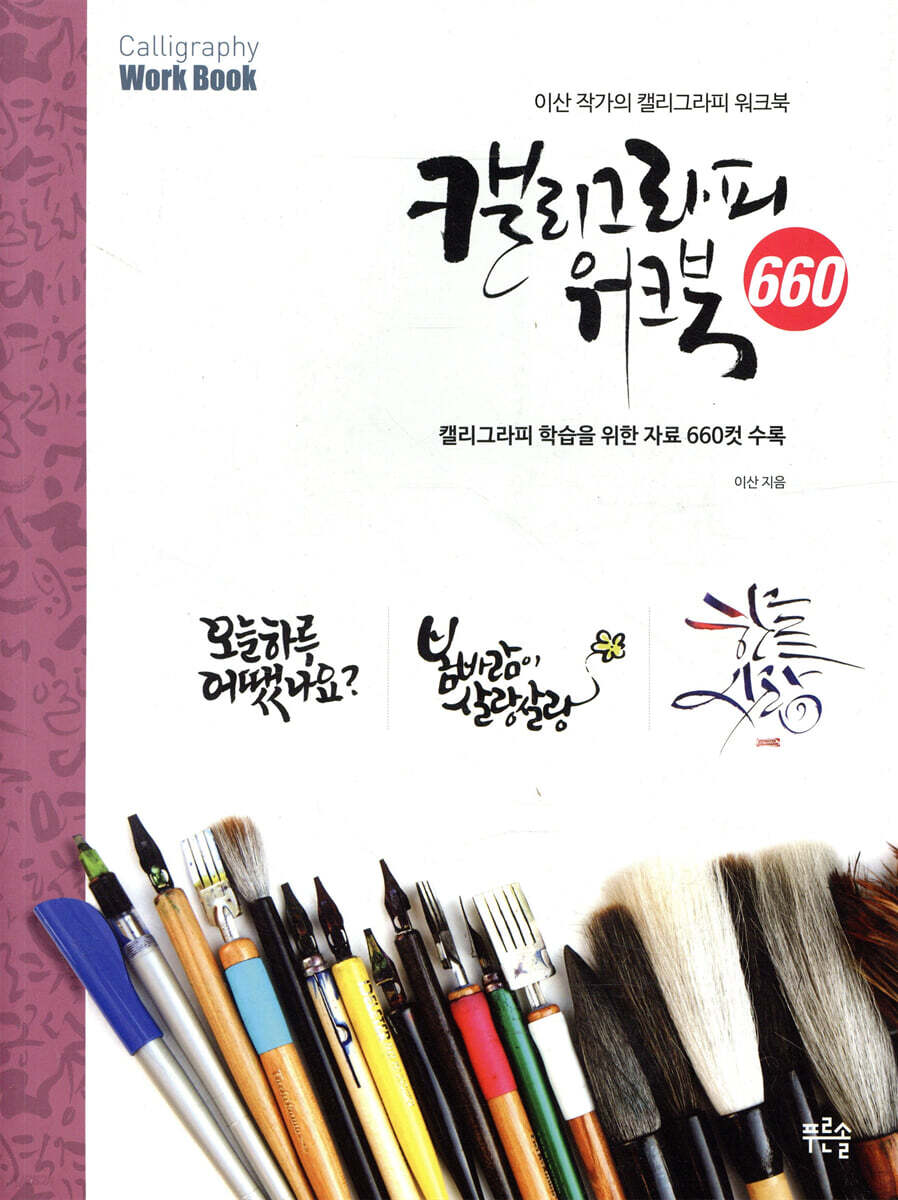
This book by author Lee San is characterized by its diversity of writing styles.
It shows the novelty of how Hangul can be expressed in such a way, and shows approximately 660 works with such a variety of expressions that it is hard to believe that they were written by one person.
The essence of calligraphy is to create different expressions depending on the use.
If you're beyond the beginner level, this book, which presents a variety of reference works worthy of its title, is perfect for those who want to learn calligraphy.
When a field emerges, related publications naturally follow, and calligraphy is no exception, with works by several early authors appearing.
In any field, when a book is first published, it is usually for beginners, and in the field of calligraphy, similar books with similar content have been pouring out, and there are now dozens of books for beginners.
This book by author Lee San is characterized by its diversity of writing styles.
It shows the novelty of how Hangul can be expressed in such a way, and shows approximately 660 works with such a variety of expressions that it is hard to believe that they were written by one person.
The essence of calligraphy is to create different expressions depending on the use.
If you're beyond the beginner level, this book, which presents a variety of reference works worthy of its title, is perfect for those who want to learn calligraphy.
index
Calligraphy is the Korean language's go-to outfit.
Chapter 1 - A few words before starting calligraphy
Memories and handwriting in notebooks
Calligraphy is a pictographic script.
All the letters in the world are lines
A monster with a thousand faces!
Let's consider three different stroke thicknesses.
Let's take a look at the first letter of the Korean alphabet.
Should we change the structure of the original version?
Calligraphy from Nature
Draw various pictures for line practice
Let's classify calligraphy
The chronology is not one stroke
Why Hangul is Creative
Hangul can be used freely in all directions.
The structure of Hangul and the expansion, omission, and reduction of strokes
If you write with three different stroke thicknesses,
Let's try varying the strength and pressure of the strokes.
Let's try calligraphy so that the meaning of the word is reflected in the shape of the letters.
Understanding word spacing structure
Understanding the internal space of letters
Comparison of Korean and English alphabets
Some words used in calligraphy
Chapter 2: Learning Various Fonts
Korean basic form of Imseo data
Let's practice the variations of the block font and the palace font.
Would you like to write cutely?
Should I try writing in cursive?
Flowers, Flower Name Practice Materials
Hangul, a colorful and elegant way to write
Try writing one character with one stroke
Materials for pressure point practice
Chapter 3 - A Collection of Creative Brand Calligraphy
Chapter 4 - English and Chinese Calligraphy
Chapter 5: Food and Food-Related Calligraphy
Chapter 6 _ Writing Sentences
Chapter 7: Writing Freely and Creating Quick Stories
Make up proverbs or funny sentences
Chapter 8: Writing Korean with a Wooden Brush, Dip Pen, or Parallel Pen
Korean pen calligraphy
A collection of works by artist Lee San
Chapter 1 - A few words before starting calligraphy
Memories and handwriting in notebooks
Calligraphy is a pictographic script.
All the letters in the world are lines
A monster with a thousand faces!
Let's consider three different stroke thicknesses.
Let's take a look at the first letter of the Korean alphabet.
Should we change the structure of the original version?
Calligraphy from Nature
Draw various pictures for line practice
Let's classify calligraphy
The chronology is not one stroke
Why Hangul is Creative
Hangul can be used freely in all directions.
The structure of Hangul and the expansion, omission, and reduction of strokes
If you write with three different stroke thicknesses,
Let's try varying the strength and pressure of the strokes.
Let's try calligraphy so that the meaning of the word is reflected in the shape of the letters.
Understanding word spacing structure
Understanding the internal space of letters
Comparison of Korean and English alphabets
Some words used in calligraphy
Chapter 2: Learning Various Fonts
Korean basic form of Imseo data
Let's practice the variations of the block font and the palace font.
Would you like to write cutely?
Should I try writing in cursive?
Flowers, Flower Name Practice Materials
Hangul, a colorful and elegant way to write
Try writing one character with one stroke
Materials for pressure point practice
Chapter 3 - A Collection of Creative Brand Calligraphy
Chapter 4 - English and Chinese Calligraphy
Chapter 5: Food and Food-Related Calligraphy
Chapter 6 _ Writing Sentences
Chapter 7: Writing Freely and Creating Quick Stories
Make up proverbs or funny sentences
Chapter 8: Writing Korean with a Wooden Brush, Dip Pen, or Parallel Pen
Korean pen calligraphy
A collection of works by artist Lee San
Detailed image


Publisher's Review
Calligraphy is the Korean language's go-to outfit.
The author says, 'Calligraphy is the Korean language's going-out clothes.'
When anyone is planning to go out, they think about what clothes to wear and decide based on the people they will meet and the place they will go.
In this way, calligraphy is the practice of writing Hangul in a way that suits its intended use, like wearing clothes that are intentionally decorated and worn while going out, and it places a purpose in expression.
If you write by hand without any special decoration to convey a certain message, it is just handwriting.
This is the difference between calligraphy and handwriting.
This book does not explain how to hold a brush.
The field of calligraphy has developed rapidly in recent years.
When a field emerges, related publications naturally follow, and calligraphy is no exception, with works by several early authors appearing.
In any field, when a book is first published, it is usually for beginners, and in the field of calligraphy, similar books with similar content have been pouring out, and there are now dozens of books for beginners.
In this situation, the author listened to the opinions of students who wanted to learn calligraphy.
As a result, the reaction was largely skeptical about basic calligraphy books.
Basic calligraphy books teach you how to hold the brush, how to write ㄱ ㄴ ㄷ ㄹ, just like when you first learned calligraphy in elementary school.
He said that since it explains how to use it, it does not go far beyond universality and the author's characteristics are not well revealed.
Expressing Korean like this...
660 cuts of various expressions
This book by author Lee San is characterized by its diversity of writing styles.
It shows the novelty of how Hangul can be expressed in such a way, and shows approximately 660 works with such a variety of expressions that it is hard to believe that they were written by one person.
The essence of calligraphy is to create different expressions depending on the use.
If you're beyond the beginner level, this book, which presents a variety of reference works worthy of its title, is perfect for those who want to learn calligraphy.
Writer Lee San is the writer who created the logo for Chamisul, the soju known as the nation's soju.
Lee San's writing is being utilized in many fields, including publishing, advertising, BI, CI, TV, and media.
Based on extensive lectures, this book reflects the author's experiences and provides vivid explanations.
We hope that this will be of great help to those interested in handwriting, designers, publishers, and video title creators.
The author says, 'Calligraphy is the Korean language's going-out clothes.'
When anyone is planning to go out, they think about what clothes to wear and decide based on the people they will meet and the place they will go.
In this way, calligraphy is the practice of writing Hangul in a way that suits its intended use, like wearing clothes that are intentionally decorated and worn while going out, and it places a purpose in expression.
If you write by hand without any special decoration to convey a certain message, it is just handwriting.
This is the difference between calligraphy and handwriting.
This book does not explain how to hold a brush.
The field of calligraphy has developed rapidly in recent years.
When a field emerges, related publications naturally follow, and calligraphy is no exception, with works by several early authors appearing.
In any field, when a book is first published, it is usually for beginners, and in the field of calligraphy, similar books with similar content have been pouring out, and there are now dozens of books for beginners.
In this situation, the author listened to the opinions of students who wanted to learn calligraphy.
As a result, the reaction was largely skeptical about basic calligraphy books.
Basic calligraphy books teach you how to hold the brush, how to write ㄱ ㄴ ㄷ ㄹ, just like when you first learned calligraphy in elementary school.
He said that since it explains how to use it, it does not go far beyond universality and the author's characteristics are not well revealed.
Expressing Korean like this...
660 cuts of various expressions
This book by author Lee San is characterized by its diversity of writing styles.
It shows the novelty of how Hangul can be expressed in such a way, and shows approximately 660 works with such a variety of expressions that it is hard to believe that they were written by one person.
The essence of calligraphy is to create different expressions depending on the use.
If you're beyond the beginner level, this book, which presents a variety of reference works worthy of its title, is perfect for those who want to learn calligraphy.
Writer Lee San is the writer who created the logo for Chamisul, the soju known as the nation's soju.
Lee San's writing is being utilized in many fields, including publishing, advertising, BI, CI, TV, and media.
Based on extensive lectures, this book reflects the author's experiences and provides vivid explanations.
We hope that this will be of great help to those interested in handwriting, designers, publishers, and video title creators.
GOODS SPECIFICS
- Date of issue: October 5, 2015
- Page count, weight, size: 431 pages | 1,320g | 210*280*25mm
- ISBN13: 9788993596564
- ISBN10: 8993596565
You may also like
카테고리
korean


korean

![GQ KOREA Mark (Monthly): December [2025]](http://librairie.coreenne.fr/cdn/shop/files/8ef265dbbfbf186523ed75ba7319009d.jpg?v=1765340328&width=3840)


