

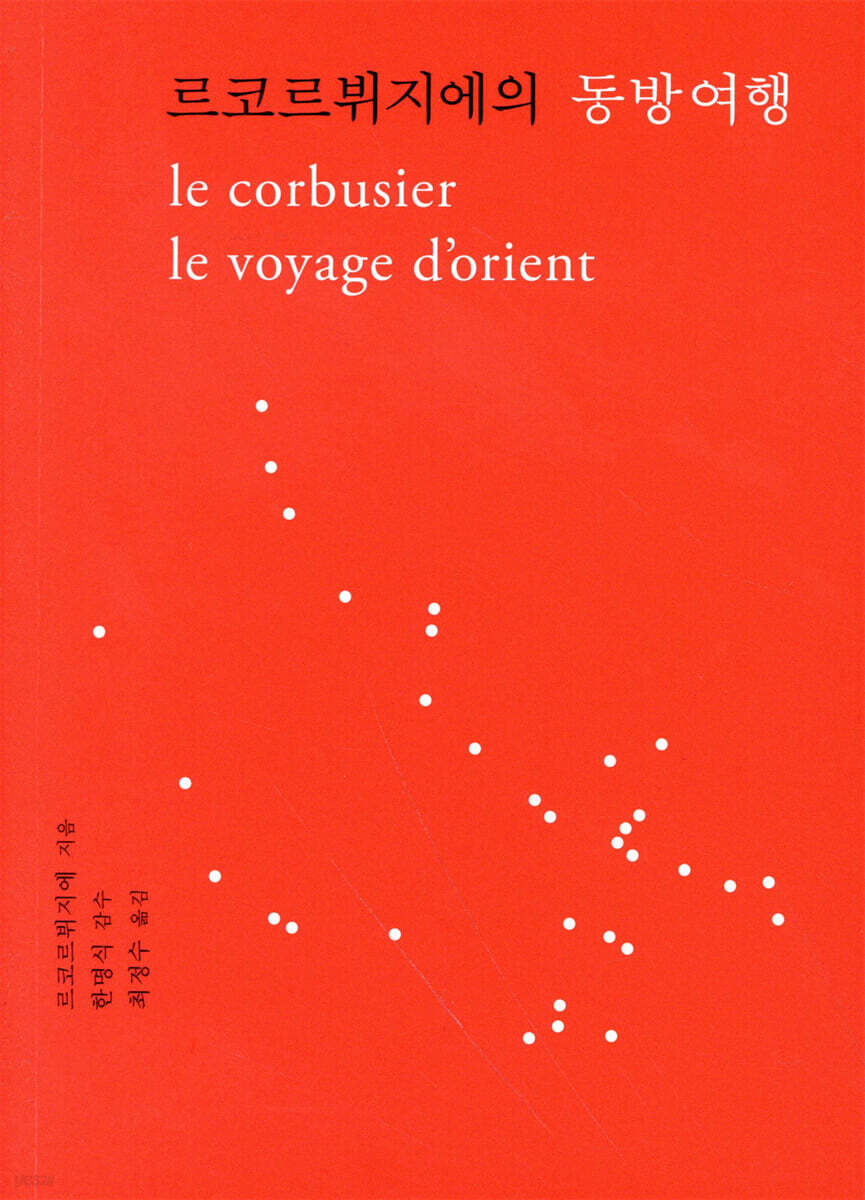
Le Corbusier's Journey to the East
 |
Description
Book Introduction
A travel essay by Le Corbusier, one of the three great masters of modern architecture.
From May to October 1911, he traveled extensively through Bohemia, Serbia, Romania, Bulgaria, and Turkey with his friend Auguste Clipstein.
Moving from Dresden to Constantinople, from Athens to Pompeii, Le Corbusier discovered the architecture of those places and made many drawings.
In the process, you will learn how to see things.
Published in 1965, 54 years after his trip, this book is a record of the time that played a crucial role in Le Corbusier's growth as an artist and architect.
From May to October 1911, he traveled extensively through Bohemia, Serbia, Romania, Bulgaria, and Turkey with his friend Auguste Clipstein.
Moving from Dresden to Constantinople, from Athens to Pompeii, Le Corbusier discovered the architecture of those places and made many drawings.
In the process, you will learn how to see things.
Published in 1965, 54 years after his trip, this book is a record of the time that played a crucial role in Le Corbusier's growth as an artist and architect.
- You can preview some of the book's contents.
Preview
index
To my older brother, the musician Albert Jeanneret
Journey to the East in 1911
Some impressions
Letter to my friends at La Chaux de Ponts
bean
Danube River
Bucharest
Turnovo
On Turkish soil
Constantinople
mosque
cemeteries
They and them
cafe
Open, Sesame
Two fairy tales, one reality
The Disaster of Stambhal
Confusing memories, return and reversion...
Mount Athos
Parthenon
In Western Europe
Reviewer's Note
Translator's note
Le Corbusier Chronology
Journey to the East in 1911
Some impressions
Letter to my friends at La Chaux de Ponts
bean
Danube River
Bucharest
Turnovo
On Turkish soil
Constantinople
mosque
cemeteries
They and them
cafe
Open, Sesame
Two fairy tales, one reality
The Disaster of Stambhal
Confusing memories, return and reversion...
Mount Athos
Parthenon
In Western Europe
Reviewer's Note
Translator's note
Le Corbusier Chronology
Publisher's Review
Meet Le Corbusier in his 20s!
"Journey to the East," a meticulously collected collection of inspirational memoirs of all things visible, perceptual, and emotionally impacting. Images of time recorded in writing by the young Le Corbusier during his travels through Bohemia, Serbia, Bulgaria, and Turkey.
This book will be an important and meaningful resource that documents a period that played a crucial role in Le Corbusier's development as an artist and architect.
Journey of the East
Berlin/Dresden/Prague/Vienna/Vac/Budapest/Bojo/Giurgiu/Belgrade/Knjazevac/Niš/Bucharest, Turnovo (Veliko Turnovo)/Gabrovo/Sipka/Kazanlak/Adrianople (Edirne)/Rhodes (Tekirdağ)/Constantinople (Istanbul)/Daphni/Bursa/Athos/Thessaloniki/Athens/Itea/Delphi/Patras/Brindisi/Naples/Rome/Pompeii/Florence/Lucerne
In 1911, Le Corbusier, who was working as a designer at the Peter Behrens office in Berlin, planned a trip to Constantinople with his friend Auguste Klipstan.
The two friends, with very little money, wandered through Bohemia, Serbia, Romania, Bulgaria, and Turkey from May to October.
On that journey, Le Corbusier discovers the architecture there as a splendid play of forms under sunlight and an intimate system of the soul.
As he moved from Dresden to Constantinople, from Athens to Pompeii, Le Corbusier kept a travel journal.
He records his impressions of his travels in his diary and also makes many drawings.
As he draws, he learns how to see things.
He excerpted some of the notes he had written at that time and published them in a local newspaper.
After a while, he sorts and refines the records and makes them into a book.
The book was scheduled to be published in 1914 under the title Le Voyage d'Orient.
However, because of the war, publishing the book was difficult, and the manuscript continued to pile up in Le Corbusier's study.
It will be there.
After 54 years of travel, he finally decided to publish this book, a testament to the hesitations and discoveries of his youth.
In July 1965, he revised the manuscript without consulting any other sources and added meticulous annotations.
That's how I was born.
“Actually, I personally don’t like Le Corbusier.
First of all, it's not my taste.
I don't like the neutral sense of mass that can be read in his architecture, and the dryness felt in the material properties is just so-so.
Above all, his century-long fame, in which every detail of his life is revealed without exception, bores me.
Some people call this 'axe personality'.
No matter how good something was, it becomes uninteresting once it becomes famous. This is ultimately why people think Le Corbusier was not very good.
To be honest, I don't want to join in the numerous analyses and definitions of his architecture and his thinking, and his standardized admiration.
At least before reading this book, Le Corbusier's Journey to the East.
After reading this book, my view on Le Corbusier changed a lot.
It is a clear fact.
This book transformed my boring notions about him into curiosity.
That's not to say that he suddenly became interesting.
However, it is clear that I discovered an impressive side of him through this book.
What I want to say in conclusion is this.
I admit that I felt this way because I wanted to do that.
His sensitivity, his truly meticulous gaze, his curiosity so pure that it seems meaningless, this book captures the world as Charles-Edouard Jeanneret, in his early twenties, encounters the world, not as the typical architect I am not interested in.
What is most striking is that, despite publishing this travelogue in book form 54 years later, he did not associate Jeanneret with Le Corbusier.
This is what I am most drawn to.
As an architect who has settled into the top, this travelogue could have easily served as an anti-aging regenerative cream.
(syncopation)
Le Corbusier is recognized as a master who defined modern architecture beyond the modern era, and is also considered the person who created the dry city and architecture we see today.
The 'shining city plan' he envisioned is not much different from the urban landscape we enjoy today.
(syncopation)
This book reaffirms the true meaning of travel for architects, artists, and even for all people in the world as they navigate life.
And it also gives technical advice on how to travel.
(syncopation)
- From the editor's writing
"Journey to the East," a meticulously collected collection of inspirational memoirs of all things visible, perceptual, and emotionally impacting. Images of time recorded in writing by the young Le Corbusier during his travels through Bohemia, Serbia, Bulgaria, and Turkey.
This book will be an important and meaningful resource that documents a period that played a crucial role in Le Corbusier's development as an artist and architect.
Journey of the East
Berlin/Dresden/Prague/Vienna/Vac/Budapest/Bojo/Giurgiu/Belgrade/Knjazevac/Niš/Bucharest, Turnovo (Veliko Turnovo)/Gabrovo/Sipka/Kazanlak/Adrianople (Edirne)/Rhodes (Tekirdağ)/Constantinople (Istanbul)/Daphni/Bursa/Athos/Thessaloniki/Athens/Itea/Delphi/Patras/Brindisi/Naples/Rome/Pompeii/Florence/Lucerne
In 1911, Le Corbusier, who was working as a designer at the Peter Behrens office in Berlin, planned a trip to Constantinople with his friend Auguste Klipstan.
The two friends, with very little money, wandered through Bohemia, Serbia, Romania, Bulgaria, and Turkey from May to October.
On that journey, Le Corbusier discovers the architecture there as a splendid play of forms under sunlight and an intimate system of the soul.
As he moved from Dresden to Constantinople, from Athens to Pompeii, Le Corbusier kept a travel journal.
He records his impressions of his travels in his diary and also makes many drawings.
As he draws, he learns how to see things.
He excerpted some of the notes he had written at that time and published them in a local newspaper.
After a while, he sorts and refines the records and makes them into a book.
The book was scheduled to be published in 1914 under the title Le Voyage d'Orient.
However, because of the war, publishing the book was difficult, and the manuscript continued to pile up in Le Corbusier's study.
It will be there.
After 54 years of travel, he finally decided to publish this book, a testament to the hesitations and discoveries of his youth.
In July 1965, he revised the manuscript without consulting any other sources and added meticulous annotations.
That's how I was born.
“Actually, I personally don’t like Le Corbusier.
First of all, it's not my taste.
I don't like the neutral sense of mass that can be read in his architecture, and the dryness felt in the material properties is just so-so.
Above all, his century-long fame, in which every detail of his life is revealed without exception, bores me.
Some people call this 'axe personality'.
No matter how good something was, it becomes uninteresting once it becomes famous. This is ultimately why people think Le Corbusier was not very good.
To be honest, I don't want to join in the numerous analyses and definitions of his architecture and his thinking, and his standardized admiration.
At least before reading this book, Le Corbusier's Journey to the East.
After reading this book, my view on Le Corbusier changed a lot.
It is a clear fact.
This book transformed my boring notions about him into curiosity.
That's not to say that he suddenly became interesting.
However, it is clear that I discovered an impressive side of him through this book.
What I want to say in conclusion is this.
I admit that I felt this way because I wanted to do that.
His sensitivity, his truly meticulous gaze, his curiosity so pure that it seems meaningless, this book captures the world as Charles-Edouard Jeanneret, in his early twenties, encounters the world, not as the typical architect I am not interested in.
What is most striking is that, despite publishing this travelogue in book form 54 years later, he did not associate Jeanneret with Le Corbusier.
This is what I am most drawn to.
As an architect who has settled into the top, this travelogue could have easily served as an anti-aging regenerative cream.
(syncopation)
Le Corbusier is recognized as a master who defined modern architecture beyond the modern era, and is also considered the person who created the dry city and architecture we see today.
The 'shining city plan' he envisioned is not much different from the urban landscape we enjoy today.
(syncopation)
This book reaffirms the true meaning of travel for architects, artists, and even for all people in the world as they navigate life.
And it also gives technical advice on how to travel.
(syncopation)
- From the editor's writing
GOODS SPECIFICS
- Date of issue: June 14, 2010
- Page count, weight, size: 316 pages | 414g | 125*175*30mm
- ISBN13: 9788970594453
- ISBN10: 8970594450
You may also like
카테고리
korean


korean

![GQ KOREA Mark (Monthly): December [2025]](http://librairie.coreenne.fr/cdn/shop/files/8ef265dbbfbf186523ed75ba7319009d.jpg?v=1765340328&width=3840)


