

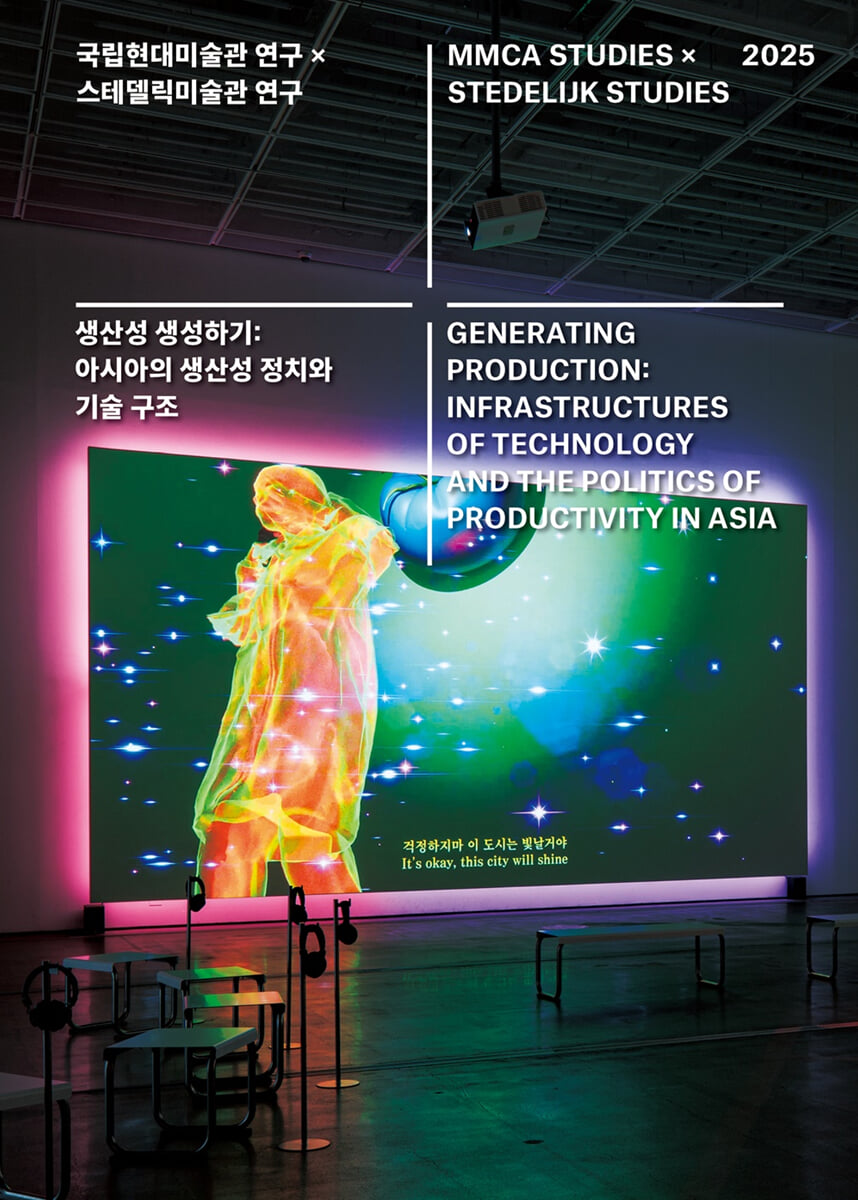
National Museum of Modern and Contemporary Art Research × Stedelijk Museum Research: Creating Productivity
 |
Description
Book Introduction
『National Museum of Modern and Contemporary Art Research』 presents its 17th volume as a special issue jointly published by the National Museum of Modern and Contemporary Art and the Stedelijk Museum in Amsterdam.
The two institutions have selected Lim Su-young, a Seoul-based independent curator and art historian, as an editorial fellow, aiming for experimental knowledge production and circulation.
Lim Soo-young takes up the topic of “Creating Productivity: Productivity Politics and Technological Structures in Asia” and criticizes the tendency to regard technology as universal and neutral, exploring how technology is intertwined with Asia’s geopolitical and historical specificities.
A team of 16 writers with roots in East and Southeast Asia provides a three-dimensional view of contemporary art and technological phenomena, and contemplates the history, role, and position of art museums within these conditions.
The book also includes conversations between publishing staff and writers from the National Museum of Modern and Contemporary Art and the Stedelijk Museum, providing a glimpse into the process-oriented research methodology and value of mutual learning discovered through collaboration between the two institutions.
The two institutions have selected Lim Su-young, a Seoul-based independent curator and art historian, as an editorial fellow, aiming for experimental knowledge production and circulation.
Lim Soo-young takes up the topic of “Creating Productivity: Productivity Politics and Technological Structures in Asia” and criticizes the tendency to regard technology as universal and neutral, exploring how technology is intertwined with Asia’s geopolitical and historical specificities.
A team of 16 writers with roots in East and Southeast Asia provides a three-dimensional view of contemporary art and technological phenomena, and contemplates the history, role, and position of art museums within these conditions.
The book also includes conversations between publishing staff and writers from the National Museum of Modern and Contemporary Art and the Stedelijk Museum, providing a glimpse into the process-oriented research methodology and value of mutual learning discovered through collaboration between the two institutions.
- You can preview some of the book's contents.
Preview
index
Editing notes
6. Im Su-yeong and Chae Yeon, "Creating Productivity"
Generating Productivity: Productivity Politics and Technological Structures in Asia
16 Horui An, “Network State, National Networks, and the Political Order of Representation”
46 Lee Moon-seok, "A Travel Guide for Traveling from 'One Region' to 'That Region'"
66 Nagata Kosuke, "The Grafting of Things Once Broken: Production Notes for "Fire in the Water"
84 Unmake Lab, "Fables of the Machine"
104 Go A-chim and Cheon Hyeon-deuk, "Bold Talk: Issues Surrounding AI Ethics—Agency, Transparency, and Practicality"
124 Jeon Yu-jin, "Things We Lose"
142 Kathleen Ditzig and Ryan Ho, “Amanda Heng’s Let’s Talk More and Retired Singer: AI Art Commissions at the Museum of Modern Art”
Park So-hyun, "How the 'Future' Was Planned and Rejected: Between Expo '67 and Expo '70"
190 Lee Su-yeon, "On the Human Way of Working"
208 Shin Jin-young and Lim Su-young, "Boldness: Creating Life"
230 Apsa (Christina Yuna Go, Mooni Peri, Park Yu-jin, Seo Pa), "The End of Days: A Time Capsule for Lost Time Travelers"
246 Miyu, "Daria"
262 Charles Landbrocht, Working Group on the National Museum of Modern and Contemporary Art Research × Stedelijk Museum Research, "Roundtable: Political and Subjective Knowledge Production at the Stedelijk Museum"
288 About the Author
6. Im Su-yeong and Chae Yeon, "Creating Productivity"
Generating Productivity: Productivity Politics and Technological Structures in Asia
16 Horui An, “Network State, National Networks, and the Political Order of Representation”
46 Lee Moon-seok, "A Travel Guide for Traveling from 'One Region' to 'That Region'"
66 Nagata Kosuke, "The Grafting of Things Once Broken: Production Notes for "Fire in the Water"
84 Unmake Lab, "Fables of the Machine"
104 Go A-chim and Cheon Hyeon-deuk, "Bold Talk: Issues Surrounding AI Ethics—Agency, Transparency, and Practicality"
124 Jeon Yu-jin, "Things We Lose"
142 Kathleen Ditzig and Ryan Ho, “Amanda Heng’s Let’s Talk More and Retired Singer: AI Art Commissions at the Museum of Modern Art”
Park So-hyun, "How the 'Future' Was Planned and Rejected: Between Expo '67 and Expo '70"
190 Lee Su-yeon, "On the Human Way of Working"
208 Shin Jin-young and Lim Su-young, "Boldness: Creating Life"
230 Apsa (Christina Yuna Go, Mooni Peri, Park Yu-jin, Seo Pa), "The End of Days: A Time Capsule for Lost Time Travelers"
246 Miyu, "Daria"
262 Charles Landbrocht, Working Group on the National Museum of Modern and Contemporary Art Research × Stedelijk Museum Research, "Roundtable: Political and Subjective Knowledge Production at the Stedelijk Museum"
288 About the Author
Into the book
“More importantly, as the structures of control embedded in the Internet begin to expand on a global scale, we are witnessing the emergence of ‘national networks’ on this largely unregulated political frontier.
These are networks, particularly cloud platforms, that are beginning to implement new forms of sovereignty without completely replicating the traditional functions of the state.
As Benjamin Bratton theorized, this unprecedented political formation cannot be grasped through existing discourses on the 'art of government'.
Because it is created by the very computer network it is meant to govern.”
--- p.39, from 「Horuian, 「Network State, National Networks, and the Political Order of Representation」
“So to speak, knowledge about a region begins with information about what is produced in that region (whether it be products or language).
It's similar to knowing about tourist attractions.
To imagine a foreign land is to borrow another mouth for a moment to experience unfamiliar food and things to say, to become a tourist who eats and talks in a virtual foreign land.
Therefore, the process of learning about a place is no different from preparing to be a guest with an unfamiliar 'borrowed mouth.'
--- p.47, from "Lee Moon-seok, A Tourist Guide to Going from 'One Region' to 'That Region'"
“So much has been lost, so much has been left unresolved, that we no longer even know what we have lost.
Isn't this loss of loss the very project of modernity?
[......] Time and space from the past to the present are divided and integrated under the name of the nation, and geographical bodies and eras are organized simultaneously.
In this way, time and space are completely uprooted and modernity is grafted onto them.
The past is reduced to the cause of the present.
“Despite the fact that there are countless pasts that have been broken in the process.”
--- p.83, from "Nagata Kosuke, "Grafting of Things Once Broken: Production Notes for "Fire in the Water""
“Tasty fixes the generalized human desire to dominate nature and animals by physically extracting only the skin of the animal and exhibiting (reproducing) it.
The two processes stimulated mutual thinking in that machine learning extracts patterns from data, computes and reconstructs them, and then fixes the structure of visual power with generalized weights, thereby reproducing the world in a certain form.
If we look at these two in terms of linear time, it seems that the stereotypes, norms, and behaviors of viewing the world are inherited from the past to the future.”
--- p.87, from "Unmake Lab," "Fables of the Machine"
“For example, if we acknowledge the agency of LLM but deny moral responsibility, we would be viewing them as agents who deserve moral respect, similar to children or adults with mental impairment, and who have some agency but cannot be held completely responsible.
I'm dissatisfied with the idea that AI itself is viewed as a living, childlike entity. AI didn't just appear out of nowhere.
“It is an artifact that involves the interests, thoughts, and wills of all kinds of people, and that someone invested money into, developed, and tested to become a product.”
--- p.109, from "Go A-chim, Cheon Hyeon-deuk, "Bold Talk: Issues Surrounding AI Ethics? Agency, Transparency, and Practicality"
“AI technology, which has been a hot topic in recent years, has not been liberating humans from the arduous physical labor they have long desired, but rather has been operating in a way that makes existing human labor invisible and undervalued.
New forms of labor and exploitation emerged, and the gap between working classes widened.
For cutting-edge technology to feel more innovative, human labor had to be invisible, even if it was present.
There are clear limitations to understanding AI solely through the framework of labor replacement. The threat from AI isn't limited to jobs or careers.
Even in areas of human relationships that I believed would be irreplaceable—conversations, sharing thoughts, comforting and encouraging, and caring for one another—AI is increasingly taking my place.”
--- p.133, 「Jeon Yu-jin, from 「Things We Lose」
“The contemporary art museum is a nexus of culture and industry, a repository of critical socio-historical contexts, and a generative device for new industrial creation and imagination of the future.
This dual role makes art museums valuable and productive 'datasets' of culture.
Therefore, art museums are emerging as a source of technological advancement and a space for shaping the world. At this juncture, when the future of AI society and human agency are being widely shaped, art museums are becoming spaces that harness their potential and ideological significance to imagine and concretize the future.
--- p.149, from 「Kathleen Ditzig and Ryan Ho, 「Amanda Heng's "Let's Talk More" and "Retired Singer": AI Art Commissions at the Museum of Modern Art」
“The emergence of modern art museums in East Asia, including Korea, is intertwined with the history of seeking survival of the fittest from the Western powers’ world by utilizing the device of world expositions as a response to Western imperialist expansion or invasion.
The national projects encompassed by the World's Fair were crucial projects that sought to promote industry and industry and strengthen the nation through industrial modernization modeled on the West in the era of the Industrial Revolution and colonial development, while simultaneously shedding the stigma of being "barbaric/uncivilized" in the eyes of the West and entering the ranks of "civilization."
--- p.169, from Park So-hyun, “How was the ‘future’ planned and rejected: Between Expo ’67 and Expo ’70”
“New technologies and science always speak of the possibility of new truths.
However, such truth is not given naturally, but is produced within a network of artificially designed devices, evidence, and consensus.
“Science creates new definitions of human beings, but it does not completely replace previous definitions or reduce them to a single definition.”
--- p.197, from Lee Su-yeon, “On the Human Way of Working”
“I believe that the pre-stage training, rest, and rehabilitation are absolutely necessary to reach the actual stage, and that the time itself should be included in the work.
But many writers are embarrassed to appear unprepared, and out of a sense of pride, they try not to reveal such trials and errors.
As we rush towards our goals, it's easy to lose sight of how we're sharing this moment and what emotions and confidence we're accumulating."
--- p.223, from "Shin Jin-young and Im Su-young, "Boldness: Creating Life"
“Collective time is born in delay.
It's not just a matter of coordination, but because each person's sense of time itself is different.
Doing something together takes practice.
“If we don’t stop, slow down, or bend the time we have been sensing, the meeting cannot happen in the first place.”
--- p.231, 「Afsa (Christina Yuna Go, Mooni Peri, Park Yu-jin, Seopa), from 「The End of Days: A Time Capsule of Lost Time Travelers」
“The important thing is that Asian thinkers and practitioners must actively engage with the West.
To position ourselves critically, what areas of Western historical history should we examine? What parts of our tradition should we reexamine, reinterpret, and continue?
--- p.251, 「Miyu, from 「Dalian」
“Our work challenges the notion of a neutral or authoritarian museum.
The public thinks that art museums have authority.
So if people are to take what we say as truth, we must approach the truth we present with caution.
This begs the question, "Are we, who work in art museums, equipped to provide the truth? Or even something close to it? Do we have enough diversity and information?"
These are networks, particularly cloud platforms, that are beginning to implement new forms of sovereignty without completely replicating the traditional functions of the state.
As Benjamin Bratton theorized, this unprecedented political formation cannot be grasped through existing discourses on the 'art of government'.
Because it is created by the very computer network it is meant to govern.”
--- p.39, from 「Horuian, 「Network State, National Networks, and the Political Order of Representation」
“So to speak, knowledge about a region begins with information about what is produced in that region (whether it be products or language).
It's similar to knowing about tourist attractions.
To imagine a foreign land is to borrow another mouth for a moment to experience unfamiliar food and things to say, to become a tourist who eats and talks in a virtual foreign land.
Therefore, the process of learning about a place is no different from preparing to be a guest with an unfamiliar 'borrowed mouth.'
--- p.47, from "Lee Moon-seok, A Tourist Guide to Going from 'One Region' to 'That Region'"
“So much has been lost, so much has been left unresolved, that we no longer even know what we have lost.
Isn't this loss of loss the very project of modernity?
[......] Time and space from the past to the present are divided and integrated under the name of the nation, and geographical bodies and eras are organized simultaneously.
In this way, time and space are completely uprooted and modernity is grafted onto them.
The past is reduced to the cause of the present.
“Despite the fact that there are countless pasts that have been broken in the process.”
--- p.83, from "Nagata Kosuke, "Grafting of Things Once Broken: Production Notes for "Fire in the Water""
“Tasty fixes the generalized human desire to dominate nature and animals by physically extracting only the skin of the animal and exhibiting (reproducing) it.
The two processes stimulated mutual thinking in that machine learning extracts patterns from data, computes and reconstructs them, and then fixes the structure of visual power with generalized weights, thereby reproducing the world in a certain form.
If we look at these two in terms of linear time, it seems that the stereotypes, norms, and behaviors of viewing the world are inherited from the past to the future.”
--- p.87, from "Unmake Lab," "Fables of the Machine"
“For example, if we acknowledge the agency of LLM but deny moral responsibility, we would be viewing them as agents who deserve moral respect, similar to children or adults with mental impairment, and who have some agency but cannot be held completely responsible.
I'm dissatisfied with the idea that AI itself is viewed as a living, childlike entity. AI didn't just appear out of nowhere.
“It is an artifact that involves the interests, thoughts, and wills of all kinds of people, and that someone invested money into, developed, and tested to become a product.”
--- p.109, from "Go A-chim, Cheon Hyeon-deuk, "Bold Talk: Issues Surrounding AI Ethics? Agency, Transparency, and Practicality"
“AI technology, which has been a hot topic in recent years, has not been liberating humans from the arduous physical labor they have long desired, but rather has been operating in a way that makes existing human labor invisible and undervalued.
New forms of labor and exploitation emerged, and the gap between working classes widened.
For cutting-edge technology to feel more innovative, human labor had to be invisible, even if it was present.
There are clear limitations to understanding AI solely through the framework of labor replacement. The threat from AI isn't limited to jobs or careers.
Even in areas of human relationships that I believed would be irreplaceable—conversations, sharing thoughts, comforting and encouraging, and caring for one another—AI is increasingly taking my place.”
--- p.133, 「Jeon Yu-jin, from 「Things We Lose」
“The contemporary art museum is a nexus of culture and industry, a repository of critical socio-historical contexts, and a generative device for new industrial creation and imagination of the future.
This dual role makes art museums valuable and productive 'datasets' of culture.
Therefore, art museums are emerging as a source of technological advancement and a space for shaping the world. At this juncture, when the future of AI society and human agency are being widely shaped, art museums are becoming spaces that harness their potential and ideological significance to imagine and concretize the future.
--- p.149, from 「Kathleen Ditzig and Ryan Ho, 「Amanda Heng's "Let's Talk More" and "Retired Singer": AI Art Commissions at the Museum of Modern Art」
“The emergence of modern art museums in East Asia, including Korea, is intertwined with the history of seeking survival of the fittest from the Western powers’ world by utilizing the device of world expositions as a response to Western imperialist expansion or invasion.
The national projects encompassed by the World's Fair were crucial projects that sought to promote industry and industry and strengthen the nation through industrial modernization modeled on the West in the era of the Industrial Revolution and colonial development, while simultaneously shedding the stigma of being "barbaric/uncivilized" in the eyes of the West and entering the ranks of "civilization."
--- p.169, from Park So-hyun, “How was the ‘future’ planned and rejected: Between Expo ’67 and Expo ’70”
“New technologies and science always speak of the possibility of new truths.
However, such truth is not given naturally, but is produced within a network of artificially designed devices, evidence, and consensus.
“Science creates new definitions of human beings, but it does not completely replace previous definitions or reduce them to a single definition.”
--- p.197, from Lee Su-yeon, “On the Human Way of Working”
“I believe that the pre-stage training, rest, and rehabilitation are absolutely necessary to reach the actual stage, and that the time itself should be included in the work.
But many writers are embarrassed to appear unprepared, and out of a sense of pride, they try not to reveal such trials and errors.
As we rush towards our goals, it's easy to lose sight of how we're sharing this moment and what emotions and confidence we're accumulating."
--- p.223, from "Shin Jin-young and Im Su-young, "Boldness: Creating Life"
“Collective time is born in delay.
It's not just a matter of coordination, but because each person's sense of time itself is different.
Doing something together takes practice.
“If we don’t stop, slow down, or bend the time we have been sensing, the meeting cannot happen in the first place.”
--- p.231, 「Afsa (Christina Yuna Go, Mooni Peri, Park Yu-jin, Seopa), from 「The End of Days: A Time Capsule of Lost Time Travelers」
“The important thing is that Asian thinkers and practitioners must actively engage with the West.
To position ourselves critically, what areas of Western historical history should we examine? What parts of our tradition should we reexamine, reinterpret, and continue?
--- p.251, 「Miyu, from 「Dalian」
“Our work challenges the notion of a neutral or authoritarian museum.
The public thinks that art museums have authority.
So if people are to take what we say as truth, we must approach the truth we present with caution.
This begs the question, "Are we, who work in art museums, equipped to provide the truth? Or even something close to it? Do we have enough diversity and information?"
--- p.265, 「Charles Landbrocht, 『National Museum of Modern and Contemporary Art Research × Stedelijk Museum Research』 Working Group, 「Roundtable: Political and Subjective Knowledge Production at the Stedelijk Museum」
GOODS SPECIFICS
- Date of issue: December 1, 2025
- Page count, weight, size: 298 pages | 185*260*20mm
- ISBN13: 9788963034645
- ISBN10: 896303464X
You may also like
카테고리
korean


korean

![GQ KOREA Mark (Monthly): December [2025]](http://librairie.coreenne.fr/cdn/shop/files/8ef265dbbfbf186523ed75ba7319009d.jpg?v=1765340328&width=3840)


