

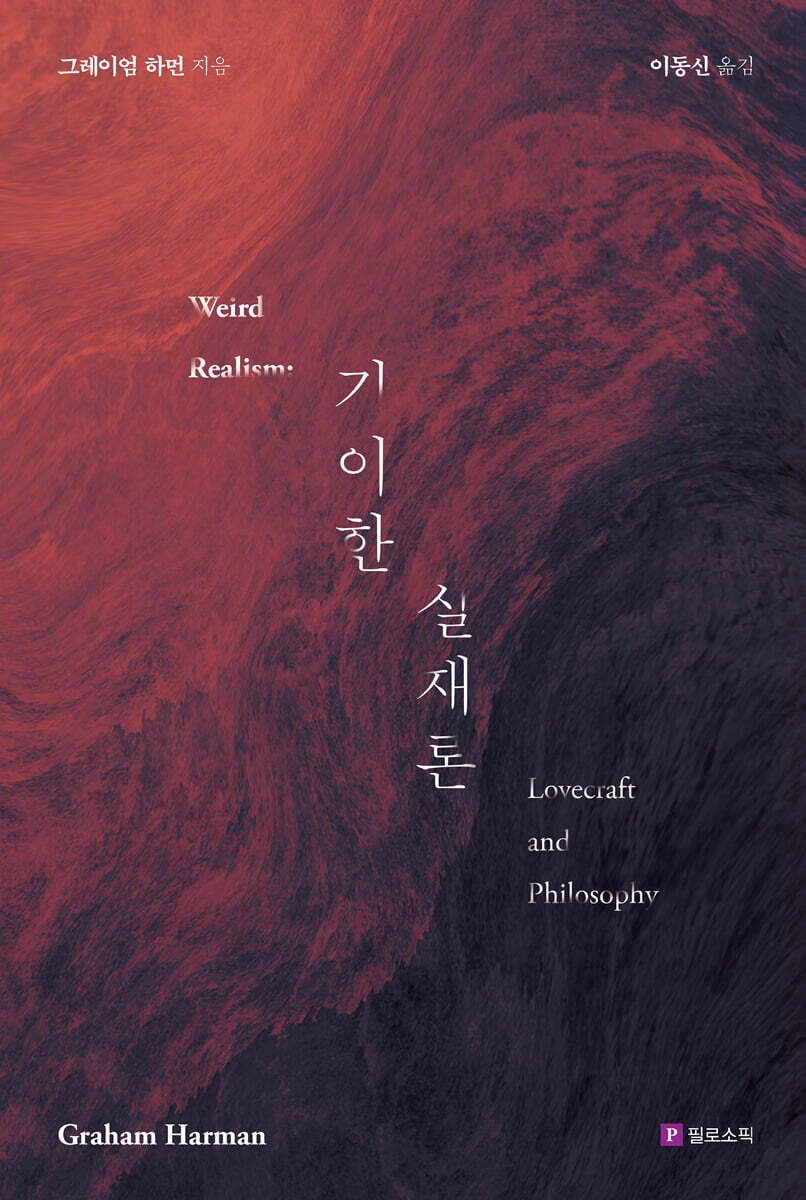
Bizarre Realism
 |
Description
Book Introduction
“Just as Hölderlin was to Heidegger, or Mallarmé was to Derrida or Meillassoux,
Lovecraft is a writer who was established for object-oriented philosophy.
Philosopher Graham Harman boldly calls Lovecraft the greatest writer of the 20th century.
Even Lovecraft's greatness resonates outside the literary world, because he touches on some of the most important philosophical themes of our time.
Some say that Lovecraft's works are nothing more than pulp fiction that cannot escape the limitations of the genre.
However, Harman reads Lovecraft's work as a philosophical text that deals with a world we can never grasp, a reality hidden beyond human perception.
Lovecraft's monsters, which endlessly withdraw and create 'gaps' from the sensory qualities we can perceive, best embody Graham Harman's 'strange realism', that is, objects that cannot be fully grasped by the subject.
To philosophically defend the authenticity of Lovecraft's fiction, Harman selects 100 passages from his short stories and analyzes their unique style.
He uses sharply honed language to reveal the most outstanding achievements of Lovecraft's novels, which have had a profound impact on popular culture and subculture, such as "The Call of Cthulhu" and "At the Mountains of Madness."
This book is both a critique of Lovecraft and a philosophical work that outlines the core of Harman's philosophy through his work, but it is also a writing guide that allows a high-resolution observation of how an excellent 'style' is created.
Lovecraft is a writer who was established for object-oriented philosophy.
Philosopher Graham Harman boldly calls Lovecraft the greatest writer of the 20th century.
Even Lovecraft's greatness resonates outside the literary world, because he touches on some of the most important philosophical themes of our time.
Some say that Lovecraft's works are nothing more than pulp fiction that cannot escape the limitations of the genre.
However, Harman reads Lovecraft's work as a philosophical text that deals with a world we can never grasp, a reality hidden beyond human perception.
Lovecraft's monsters, which endlessly withdraw and create 'gaps' from the sensory qualities we can perceive, best embody Graham Harman's 'strange realism', that is, objects that cannot be fully grasped by the subject.
To philosophically defend the authenticity of Lovecraft's fiction, Harman selects 100 passages from his short stories and analyzes their unique style.
He uses sharply honed language to reveal the most outstanding achievements of Lovecraft's novels, which have had a profound impact on popular culture and subculture, such as "The Call of Cthulhu" and "At the Mountains of Madness."
This book is both a critique of Lovecraft and a philosophical work that outlines the core of Harman's philosophy through his work, but it is also a writing guide that allows a high-resolution observation of how an excellent 'style' is created.
index
preface
Chapter 1.
Lovecraft and Philosophy
Author of Gaps and Fear
The problem of writing in full
The essential stupidity of all content
Background of existence
It is not inaccurate in its essence
phenomenological gap
Lovecraftian ontology
About the ruin
A strange and remote countryside
comical and tragic orientation
Style and content
Chapter 2.
Lovecraft-style scene
Call of Cthulhu
Color from Space
Dunwich Horror
Whisperer in the Dark
On the Mountain of Madness
Shadows over Innsmouth
Dream of the Witch's House
Shadows Out of Time
Chapter 3.
Bizarre Realism
Gathering threads
nuclear fusion
nuclear fission
taxonomic errors
Strange content
clear
Americas
Chapter 1.
Lovecraft and Philosophy
Author of Gaps and Fear
The problem of writing in full
The essential stupidity of all content
Background of existence
It is not inaccurate in its essence
phenomenological gap
Lovecraftian ontology
About the ruin
A strange and remote countryside
comical and tragic orientation
Style and content
Chapter 2.
Lovecraft-style scene
Call of Cthulhu
Color from Space
Dunwich Horror
Whisperer in the Dark
On the Mountain of Madness
Shadows over Innsmouth
Dream of the Witch's House
Shadows Out of Time
Chapter 3.
Bizarre Realism
Gathering threads
nuclear fusion
nuclear fission
taxonomic errors
Strange content
clear
Americas
Into the book
Contrary to Wilson's straightforward assertion that "Lovecraft was not a good writer," I would call him one of the greatest writers of the 20th century.
Even Lovecraft's greatness extends beyond the literary world.
Because it touches on some of the most important philosophical topics of our time.
--- p.23
A dogmatist I know once refuted Lovecraft's monster Cthulhu on the grounds that "a dragon with an octopus head isn't scary."
But strictly speaking, Cthulhu was not portrayed that way.
Lovecraft's first description of Cthulhu is as follows:
“If my somewhat overactive imagination conjured up a picture of an octopus, a dragon, and a human caricature all at once, it would not be inaccurate in its essence… but what made it so shockingly creepy was the overall outline of the body…” It is not Lovecraft’s fault that Cthulhu is depicted as an octopus-headed dragon on T-shirts and fantasy art around the world.
…but by exploiting the indirect nature of literature, as distinct from painting or film, Lovecraft simultaneously suspends literal description in three different ways while hinting at the octopus-like dragon.
--- p.40
Lovecraft is not a pulp writer who forces us to believe simple pronouncements about the amazing properties of otherworldly creatures.
Instead, he is almost dangerously alert to the background that deviates from the certainty of every statement.
So much energy is spent on weakening one's own narrative.
In this way, Lovecraft's sentences create a gap between reality and our access to that reality.
This is the 'Kantian' aspect of his writing.
--- p.45
In a sense, the theme of this book is the correlation between style and content.
The title, "Strange Realism," suggests a plan to reach a deeper level of realism through Lovecraft than usual.
Most philosophical realism is 'representational' in character.
Such theories maintain that not only is there a real world beyond all human contact, but that this reality can be properly illuminated by discoveries made through natural science or other modes of knowledge.
The book's critique of the literalism and the foolishness of its contents strongly argues that this is impossible.
Reality cannot be directly translated into any kind of representation.
Reality is strange.
Because reality is very different from any attempt to represent or measure itself.
Even Lovecraft's greatness extends beyond the literary world.
Because it touches on some of the most important philosophical topics of our time.
--- p.23
A dogmatist I know once refuted Lovecraft's monster Cthulhu on the grounds that "a dragon with an octopus head isn't scary."
But strictly speaking, Cthulhu was not portrayed that way.
Lovecraft's first description of Cthulhu is as follows:
“If my somewhat overactive imagination conjured up a picture of an octopus, a dragon, and a human caricature all at once, it would not be inaccurate in its essence… but what made it so shockingly creepy was the overall outline of the body…” It is not Lovecraft’s fault that Cthulhu is depicted as an octopus-headed dragon on T-shirts and fantasy art around the world.
…but by exploiting the indirect nature of literature, as distinct from painting or film, Lovecraft simultaneously suspends literal description in three different ways while hinting at the octopus-like dragon.
--- p.40
Lovecraft is not a pulp writer who forces us to believe simple pronouncements about the amazing properties of otherworldly creatures.
Instead, he is almost dangerously alert to the background that deviates from the certainty of every statement.
So much energy is spent on weakening one's own narrative.
In this way, Lovecraft's sentences create a gap between reality and our access to that reality.
This is the 'Kantian' aspect of his writing.
--- p.45
In a sense, the theme of this book is the correlation between style and content.
The title, "Strange Realism," suggests a plan to reach a deeper level of realism through Lovecraft than usual.
Most philosophical realism is 'representational' in character.
Such theories maintain that not only is there a real world beyond all human contact, but that this reality can be properly illuminated by discoveries made through natural science or other modes of knowledge.
The book's critique of the literalism and the foolishness of its contents strongly argues that this is impossible.
Reality cannot be directly translated into any kind of representation.
Reality is strange.
Because reality is very different from any attempt to represent or measure itself.
--- p.75
GOODS SPECIFICS
- Date of issue: November 10, 2025
- Page count, weight, size: 352 pages | 142*212*30mm
- ISBN13: 9791157833849
- ISBN10: 1157833845
You may also like
카테고리
korean


korean

![GQ KOREA Mark (Monthly): December [2025]](http://librairie.coreenne.fr/cdn/shop/files/8ef265dbbfbf186523ed75ba7319009d.jpg?v=1765340328&width=3840)


