

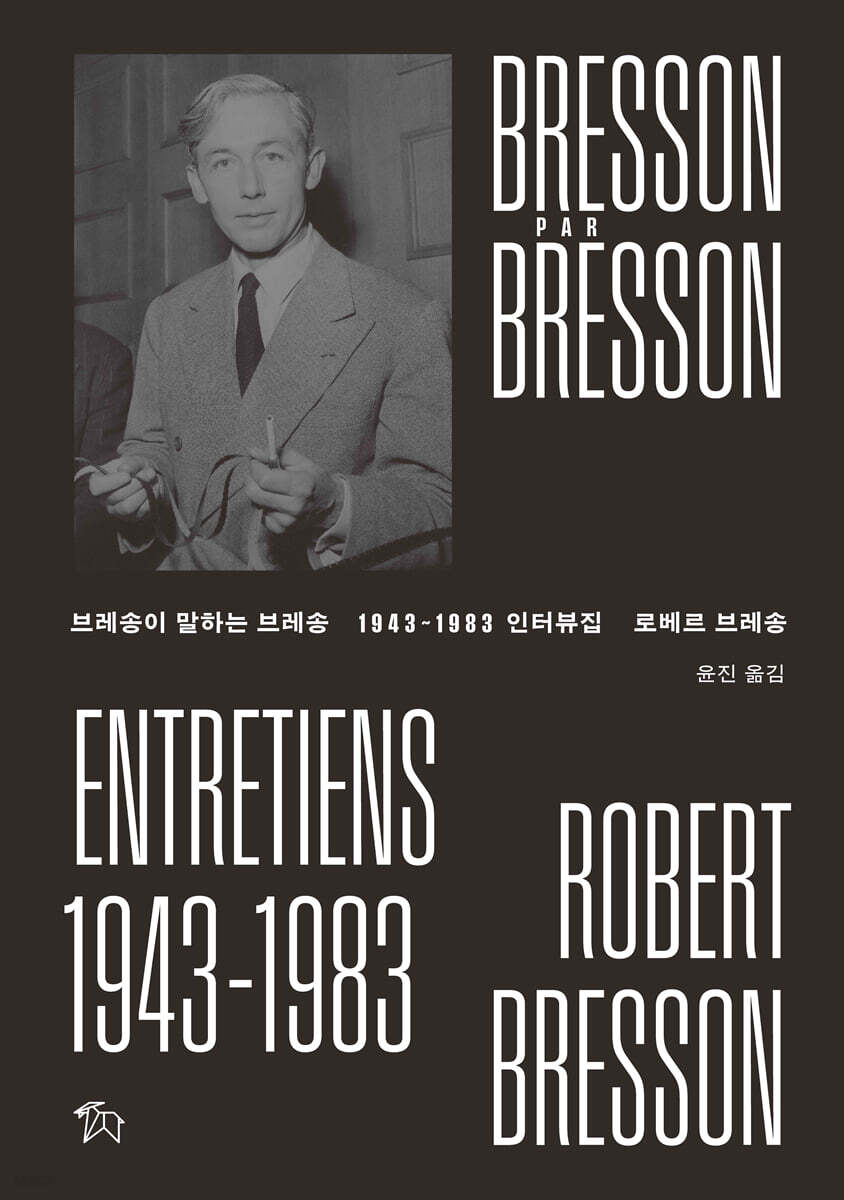
Bresson talks about Bresson
 |
Description
Book Introduction
Life and Art through Camera
A translation of 40 years of key dialogues with filmmaker Robert Bresson published.
Robert Bresson (1901-1999), a master of pure cinema who spent his life exploring the essence of film.
A collection of interviews spanning the 40 years of his career (1943-1983) will be published in Korean.
This book is a collection of interviews that culminate in the most profound and essential remarks made by Bresson himself, providing the most comprehensive insight into his aesthetics and philosophical thinking.
The selection of the interviews, curated by his wife, Mylène Bresson, is arranged chronologically around major works and concepts, providing an excellent overview of Bresson's creative process, theoretical foundations, and the philosophical evolution of an artist.
Although his personal life is little known, his identity is vividly revealed through Bresson's voice, which speaks of the entire creative process from conception to completion without reservation and without dream.
Much of the book is devoted to rhythm and structural design, the relationship between image and sound, and the expression of transcendental themes, which will resonate deeply with film lovers as well as creators.
“Cinematography is a new way of writing and a new way of feeling.”
“Film should be reality itself, not a shadow of it.”
“Every aspect of life can be transformed into art.”
“Creation is a discipline.”
“The soundtrack invented silence.”
“Instead of transforming into a character, an actor must exist as a human being.”
Emotional excess distorts the truth.
“A film should resemble what the audience sees when they close their eyes.”
“A film is a conversation, and the subject of that conversation is the audience.”
“Films allow the audience to return to their own world.”
“The movie did nothing.”
“Make visible what you would never have seen without you.”
A translation of 40 years of key dialogues with filmmaker Robert Bresson published.
Robert Bresson (1901-1999), a master of pure cinema who spent his life exploring the essence of film.
A collection of interviews spanning the 40 years of his career (1943-1983) will be published in Korean.
This book is a collection of interviews that culminate in the most profound and essential remarks made by Bresson himself, providing the most comprehensive insight into his aesthetics and philosophical thinking.
The selection of the interviews, curated by his wife, Mylène Bresson, is arranged chronologically around major works and concepts, providing an excellent overview of Bresson's creative process, theoretical foundations, and the philosophical evolution of an artist.
Although his personal life is little known, his identity is vividly revealed through Bresson's voice, which speaks of the entire creative process from conception to completion without reservation and without dream.
Much of the book is devoted to rhythm and structural design, the relationship between image and sound, and the expression of transcendental themes, which will resonate deeply with film lovers as well as creators.
“Cinematography is a new way of writing and a new way of feeling.”
“Film should be reality itself, not a shadow of it.”
“Every aspect of life can be transformed into art.”
“Creation is a discipline.”
“The soundtrack invented silence.”
“Instead of transforming into a character, an actor must exist as a human being.”
Emotional excess distorts the truth.
“A film should resemble what the audience sees when they close their eyes.”
“A film is a conversation, and the subject of that conversation is the audience.”
“Films allow the audience to return to their own world.”
“The movie did nothing.”
“Make visible what you would never have seen without you.”
- You can preview some of the book's contents.
Preview
index
Wherever you want to go… …wherever the camera leads you 5
1 Public Affairs AFFAIRES PUBLIQUES ( 1 9 3 4 )
Prologue 2 5
2 Angels of Sin LESANGESDUP ⓒ CH ⓒ ( 1 9 4 3 )
We Need a Writer 3 1
Jang Giraudoux 3 6
3 The Women of the Bois de Boulogne
LES DAME SDUBOISDEBOULOGNE ( 1 9 4 5 )
Vortex and Shock 4 3
Inside Leads 4 7
Jean Cocteau 5 3
Festival of Cursed Films 5 4
4 The Diary of a Country Priest
JOURNALD ' UNCUR ⓒ DEC AMPA GNE ( 1 9 5 1 )
Between Two Worlds 5 9
I was drawn to the reckless challenge 6 1
View and Listen 6 5
Like writing poetry 6 9
5 Death row inmates escape
' EST ⓒ CHAPP ⓒ ( 1 9 5 6 )
The wind blows where it wants to blow 7 5
New means of expression 8 8
6 Pickpocket PICKPOCKET ( 1 9 5 9 )
Film of Hands, Objects, and Gaze 9 3
The rhythm of a film should be a heartbeat 9 7
To capture reality only 1 0 7
Reaching the Mystery 1 1 3
Poetry and Truth Are Sisters 1 2 5
The Trial of Joan of Arc (1962)
A supernatural familiarity that can be felt in your hands 1 3 3
I don't know anything more cruel and heartbreaking than that 1 4 3
The movie is what I wanted 1 4 5
Emotions alone should be our guide 1 5 3
Joan of Arc was beautiful, elegant, genius, and contemporary.
: Free Mystic 1 6 3
1 7 5 To make her real and close to us
To allow current to flow, the wire's insulation must be stripped 1 8 2
8 adaptations
Creating Drama, Some Aspects: Adaptation 1 9 1
9 Donkey Balthazar AUHASARDBA LT HAZAR ( 1 9 6 6 )
Pure, calm, serene, and sacred donkey 2 0 1
The most free film I've ever made,
The movie that got me most into it 2 1 1
The Secret to Living Without Duplicating Life 2 4 2
The road taken 2 6 6
1 0 MOUCHETTE ( 1 9 6 7 )
2 8 5 in the manner of a portrait artist
I like Bernanos who makes the supernatural real 2 8 9
The gazes that lead to death 2 9 7
1 1 Soundtrack
The ear is creative, much more so than the eye. 3 0 7
1 2 Gentle Woman UNEFE MME DOUCE ( 1 9 6 9 )
The Confrontation of Life and Death 3 1 5
I am here, and others are somewhere else,
Silence is terrible 3 2 2
1 3 Four Nights of the Dreamer QU AT RENUITSD '
Art is not a luxury, but a necessity for survival. 3 3 3
3 4 0 between blue and dark brown
Finding Surprises 3 4 7
1 4 LANCELOTDULAC of the Lake (1 9 7 4 )
Bringing the past into the present 3 5 5
Lancelot's extraordinary inner adventure was amazing 3 5 9
Torn between loyalty and disloyalty 3 6 3
Noise produced by iron 3 6 8
The Holy Grail, the power hidden beneath the story 3 7 3
1 5 Notes on Cinematography
NOTESSURLECIN ⓒ M AT OGRAPHE ( 1 9 7 5 )
Book 381: A Deep Exploration of Bresson's Art
1 6 Maybe the devil LEDIABLEPROBABLEMENT ( 1 9 7 7 )
Fighting Opponents 3 9 5
Poetry enters the empty space 4 0 0
1 7 Don L'A RGENT ( 1 9 8 3 )
Oh, Money! The visible God! 4 0 7
The movie is vast, and we did nothing 4 1 6
Poetry in Image and Sound 4 2 5
1 Public Affairs AFFAIRES PUBLIQUES ( 1 9 3 4 )
Prologue 2 5
2 Angels of Sin LESANGESDUP ⓒ CH ⓒ ( 1 9 4 3 )
We Need a Writer 3 1
Jang Giraudoux 3 6
3 The Women of the Bois de Boulogne
LES DAME SDUBOISDEBOULOGNE ( 1 9 4 5 )
Vortex and Shock 4 3
Inside Leads 4 7
Jean Cocteau 5 3
Festival of Cursed Films 5 4
4 The Diary of a Country Priest
JOURNALD ' UNCUR ⓒ DEC AMPA GNE ( 1 9 5 1 )
Between Two Worlds 5 9
I was drawn to the reckless challenge 6 1
View and Listen 6 5
Like writing poetry 6 9
5 Death row inmates escape
' EST ⓒ CHAPP ⓒ ( 1 9 5 6 )
The wind blows where it wants to blow 7 5
New means of expression 8 8
6 Pickpocket PICKPOCKET ( 1 9 5 9 )
Film of Hands, Objects, and Gaze 9 3
The rhythm of a film should be a heartbeat 9 7
To capture reality only 1 0 7
Reaching the Mystery 1 1 3
Poetry and Truth Are Sisters 1 2 5
The Trial of Joan of Arc (1962)
A supernatural familiarity that can be felt in your hands 1 3 3
I don't know anything more cruel and heartbreaking than that 1 4 3
The movie is what I wanted 1 4 5
Emotions alone should be our guide 1 5 3
Joan of Arc was beautiful, elegant, genius, and contemporary.
: Free Mystic 1 6 3
1 7 5 To make her real and close to us
To allow current to flow, the wire's insulation must be stripped 1 8 2
8 adaptations
Creating Drama, Some Aspects: Adaptation 1 9 1
9 Donkey Balthazar AUHASARDBA LT HAZAR ( 1 9 6 6 )
Pure, calm, serene, and sacred donkey 2 0 1
The most free film I've ever made,
The movie that got me most into it 2 1 1
The Secret to Living Without Duplicating Life 2 4 2
The road taken 2 6 6
1 0 MOUCHETTE ( 1 9 6 7 )
2 8 5 in the manner of a portrait artist
I like Bernanos who makes the supernatural real 2 8 9
The gazes that lead to death 2 9 7
1 1 Soundtrack
The ear is creative, much more so than the eye. 3 0 7
1 2 Gentle Woman UNEFE MME DOUCE ( 1 9 6 9 )
The Confrontation of Life and Death 3 1 5
I am here, and others are somewhere else,
Silence is terrible 3 2 2
1 3 Four Nights of the Dreamer QU AT RENUITSD '
Art is not a luxury, but a necessity for survival. 3 3 3
3 4 0 between blue and dark brown
Finding Surprises 3 4 7
1 4 LANCELOTDULAC of the Lake (1 9 7 4 )
Bringing the past into the present 3 5 5
Lancelot's extraordinary inner adventure was amazing 3 5 9
Torn between loyalty and disloyalty 3 6 3
Noise produced by iron 3 6 8
The Holy Grail, the power hidden beneath the story 3 7 3
1 5 Notes on Cinematography
NOTESSURLECIN ⓒ M AT OGRAPHE ( 1 9 7 5 )
Book 381: A Deep Exploration of Bresson's Art
1 6 Maybe the devil LEDIABLEPROBABLEMENT ( 1 9 7 7 )
Fighting Opponents 3 9 5
Poetry enters the empty space 4 0 0
1 7 Don L'A RGENT ( 1 9 8 3 )
Oh, Money! The visible God! 4 0 7
The movie is vast, and we did nothing 4 1 6
Poetry in Image and Sound 4 2 5
Publisher's Review
Seeking art that reveals human flaws rather than making everything fit together perfectly
A master of pure cinema, excluding traditional narrative, emotional acting, and musical excess.
Pure cinema is a concept that is easy to understand and talk about, but it seems to be quite difficult to implement with a camera.
Just by looking into the process of dedication he went through to make others (audio-visually) aware of the sense that one medium is distinct from another, one realizes that purity, moderation, and exclusion are by no means synonymous with less effort or lesser actions.
According to Bresson, cinema is not only not like theater, literature, or painting, but it should not pretend to be like them.
Rather than simply conveying a story, a film should awaken the senses and stimulate thought in the viewer through audiovisual language.
He practiced these values in his thirteen works by eschewing conventional acting and emotional excess, which formed his unique aesthetic.
Bresson asked actors to 'exist' as human beings rather than 'acting' emotions.
As Bresson restrains himself, we, the audience, become busy.
You end up pouring energy into feeling and judging for yourself.
In the process, we acquire the status of observers, participants, rather than spectators who understand a well-crafted scenario.
Actually, this is wrong.
Bresson's unique consideration lies in not taking away the status that other films had.
Because he is not the one who says that the soundtrack creates the atmosphere, but the one who says that he “invented silence,” because he is the one who says that “a film should resemble what the audience sees when they close their eyes,” his films are finally completed within us, and his films and words become a truly free journey for us, the audience.
If an actor should exist as a human being instead of transforming into a character,
Shouldn't readers also exist as human beings themselves, rather than being transformed into recipients?
A friend of mine said that Bresson didn't use professional actors.
“Isn’t it because he doesn’t have money?” However, Bresson was able to break away from professional actors more boldly in his later years than in his debut years, and he did so.
It was, in effect, his struggle that allowed him to make and keep his own laws, to maintain absolute control over every aspect of filmmaking and to tolerate no outside interference that would compromise his artistic vision.
So, isn't the originality of a single person less a matter of self-righteousness and more a miracle that allows that originality to multiply? Bresson's originality was absorbed not only as inspiration but also as a force by his colleagues like Jean-Luc Godard and Andrei Tarkovsky, and by his neighbors like André Bazin.
This collection of interviews, which summarizes Bresson's creative philosophy, will be an inspiration to film students, researchers, artists, and, most importantly, to ourselves who read it.
Because it is a film made not for the audience but for Bresson himself, and because it is not a word spoken for the reader but for Bresson himself.
A master of pure cinema, excluding traditional narrative, emotional acting, and musical excess.
Pure cinema is a concept that is easy to understand and talk about, but it seems to be quite difficult to implement with a camera.
Just by looking into the process of dedication he went through to make others (audio-visually) aware of the sense that one medium is distinct from another, one realizes that purity, moderation, and exclusion are by no means synonymous with less effort or lesser actions.
According to Bresson, cinema is not only not like theater, literature, or painting, but it should not pretend to be like them.
Rather than simply conveying a story, a film should awaken the senses and stimulate thought in the viewer through audiovisual language.
He practiced these values in his thirteen works by eschewing conventional acting and emotional excess, which formed his unique aesthetic.
Bresson asked actors to 'exist' as human beings rather than 'acting' emotions.
As Bresson restrains himself, we, the audience, become busy.
You end up pouring energy into feeling and judging for yourself.
In the process, we acquire the status of observers, participants, rather than spectators who understand a well-crafted scenario.
Actually, this is wrong.
Bresson's unique consideration lies in not taking away the status that other films had.
Because he is not the one who says that the soundtrack creates the atmosphere, but the one who says that he “invented silence,” because he is the one who says that “a film should resemble what the audience sees when they close their eyes,” his films are finally completed within us, and his films and words become a truly free journey for us, the audience.
If an actor should exist as a human being instead of transforming into a character,
Shouldn't readers also exist as human beings themselves, rather than being transformed into recipients?
A friend of mine said that Bresson didn't use professional actors.
“Isn’t it because he doesn’t have money?” However, Bresson was able to break away from professional actors more boldly in his later years than in his debut years, and he did so.
It was, in effect, his struggle that allowed him to make and keep his own laws, to maintain absolute control over every aspect of filmmaking and to tolerate no outside interference that would compromise his artistic vision.
So, isn't the originality of a single person less a matter of self-righteousness and more a miracle that allows that originality to multiply? Bresson's originality was absorbed not only as inspiration but also as a force by his colleagues like Jean-Luc Godard and Andrei Tarkovsky, and by his neighbors like André Bazin.
This collection of interviews, which summarizes Bresson's creative philosophy, will be an inspiration to film students, researchers, artists, and, most importantly, to ourselves who read it.
Because it is a film made not for the audience but for Bresson himself, and because it is not a word spoken for the reader but for Bresson himself.
GOODS SPECIFICS
- Date of issue: June 16, 2025
- Page count, weight, size: 432 pages | 438g | 128*182*28mm
- ISBN13: 9791189519827
- ISBN10: 1189519828
You may also like
카테고리
korean


korean

![GQ KOREA Mark (Monthly): December [2025]](http://librairie.coreenne.fr/cdn/shop/files/8ef265dbbfbf186523ed75ba7319009d.jpg?v=1765340328&width=3840)


