

History of Film
 |
Description
Book Introduction
It's not the end of the movie
The history of cinema will never stop.
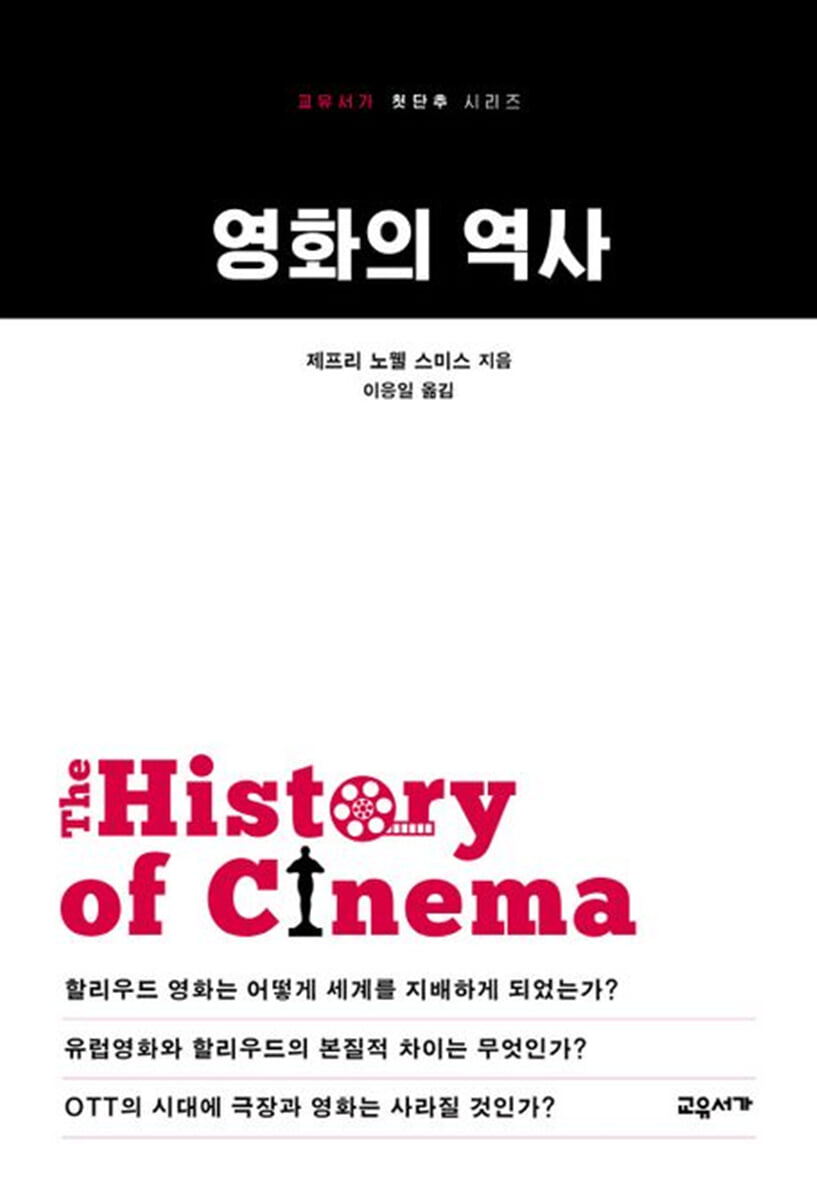
How did Hollywood movies come to dominate the world?
What are the essential differences between European cinema and Hollywood?
In the age of OTT, will theaters and movies disappear?
“A huge amount of content is packed into this short book.
It is not simply a summary of film history, but also a description of film technology,
“It contains the core of cultural and ideological development and reflections on the current multimedia revolution.” _〈Total Film〉
If cinephiles read this book, they will come to accept the nature of film as an industry.
If people in the film industry read this, they will be reminded of the artistic aspect of film.
_From the translator's note
A clear insight into the core of film history that even cinephiles didn't know!
This book is a translation of THE HISTORY OF CINEMA, published by Oxford University Press in 2017 by Geoffrey Nowell Smith, a renowned film scholar in the English-speaking world.
This book concisely explains the overall flow of film and socio-cultural relations, enabling a deeper understanding of the history and cultural context of film.
Film is the first and greatest of the industrialized art forms that dominated 20th-century cultural life.
Cinema evolved through the interwar years and has witnessed numerous smaller wars, revolutions, and social upheavals over the years.
Even today, it continues to adapt and grow with new technologies and platforms, and remains a vital cultural and artistic entertainment experience for people around the world.
The history of film reflects this changing environment and technological advancements more rapidly than any other art form.
In this book, author Jeffrey Nowell Smith covers the historical development of cinema from the early days of silent films to sound films and from black-and-white to color films, to the digital revolution and the globalization of the film industry, explaining how films have evolved amidst technological innovation and social change.
This book also comprehensively examines the artistic aspects, industrial development, and cultural influence of film, examining how modern cinema has influenced social and political discourse, and comprehensively covering the film industries of various countries around the world, including Hollywood, European cinema, and Asian cinema.
Although it is a short book, it examines important moments in the film industry and covers a wide range of genres, from intellectual arthouse cinema to popular entertainment.
This book will be a definitive guide to film history, useful not only to film studies, media studies, cultural researchers, and those interested in the digital revolution, but also to film enthusiasts and general readers.
The history of cinema will never stop.
How did Hollywood movies come to dominate the world?
What are the essential differences between European cinema and Hollywood?
In the age of OTT, will theaters and movies disappear?
“A huge amount of content is packed into this short book.
It is not simply a summary of film history, but also a description of film technology,
“It contains the core of cultural and ideological development and reflections on the current multimedia revolution.” _〈Total Film〉
If cinephiles read this book, they will come to accept the nature of film as an industry.
If people in the film industry read this, they will be reminded of the artistic aspect of film.
_From the translator's note
A clear insight into the core of film history that even cinephiles didn't know!
This book is a translation of THE HISTORY OF CINEMA, published by Oxford University Press in 2017 by Geoffrey Nowell Smith, a renowned film scholar in the English-speaking world.
This book concisely explains the overall flow of film and socio-cultural relations, enabling a deeper understanding of the history and cultural context of film.
Film is the first and greatest of the industrialized art forms that dominated 20th-century cultural life.
Cinema evolved through the interwar years and has witnessed numerous smaller wars, revolutions, and social upheavals over the years.
Even today, it continues to adapt and grow with new technologies and platforms, and remains a vital cultural and artistic entertainment experience for people around the world.
The history of film reflects this changing environment and technological advancements more rapidly than any other art form.
In this book, author Jeffrey Nowell Smith covers the historical development of cinema from the early days of silent films to sound films and from black-and-white to color films, to the digital revolution and the globalization of the film industry, explaining how films have evolved amidst technological innovation and social change.
This book also comprehensively examines the artistic aspects, industrial development, and cultural influence of film, examining how modern cinema has influenced social and political discourse, and comprehensively covering the film industries of various countries around the world, including Hollywood, European cinema, and Asian cinema.
Although it is a short book, it examines important moments in the film industry and covers a wide range of genres, from intellectual arthouse cinema to popular entertainment.
This book will be a definitive guide to film history, useful not only to film studies, media studies, cultural researchers, and those interested in the digital revolution, but also to film enthusiasts and general readers.
index
1.
introduction
2.
technology
3.
industry
4.
Film as an art form
5.
Movies and the Outside World
6.
Conclusion: Seven Eras of Film
ㆍThank you | Note
Translator's Note | Translator's Reading Guide
ㆍList of illustrations
introduction
2.
technology
3.
industry
4.
Film as an art form
5.
Movies and the Outside World
6.
Conclusion: Seven Eras of Film
ㆍThank you | Note
Translator's Note | Translator's Reading Guide
ㆍList of illustrations
Into the book
The goals of film technology have varied over time and place, and whether these goals are achieved has often depended on factors other than the perfection of the technology itself.
There are many cases where inventions developed in the early days of film were buried for a long time and were only commercialized after a commercial opportunity arose.
--- p.23
Among the technological changes, four are undoubtedly considered important.
These include the flicker-reducing projectors of the 1920s, sound films of the 1930s, color films that became widespread in the 1960s, and home theater technology that has evolved since the 1990s to rival movie theater quality.
--- p.48~49
American films have spread throughout the world and continue to dominate the global film market to this day.
This revolution began when numerous filmmakers and entrepreneurs on the East Coast of the United States moved their companies to Southern California, specifically to the small town of Hollywood, a suburb west of Los Angeles, and its surrounding areas.
There were several reasons why they did so.
--- p.55
Even at that time, powerful factors were emerging that influenced the international structure of the film industry.
There were two sources of this power.
It was trade liberalization and large-scale immigration, that is, the flow of money and people.
--- p.78
According to Tom Gunning's theory, it had to change from a 'film of attraction' to a 'film with an integrated narrative'.
Not all movies have to be like that.
Films still have the ability to show, in addition to telling (like documentaries), and they also have the ability to loosely hold on to elements that cannot be fully integrated into the narrative (like spectacle genres like musicals and science fiction).
--- p.94
Although they may seem realistic at first glance, genre films should never be considered mere mirrors of real life.
Conversely, genre films, to varying degrees, have always transposed the underlying situations and conflicts of reality to another level, and this has resonated much more powerfully in the imagination than in ordinary reality.
--- p.101~102
Godard began to dismantle not only the mechanisms of cinema, but also the very ideological foundations of cinema's claim to be a medium for conveying truth.
He argued that reality in films should be explored rather than simply revealed, and he was not alone in this view.
--- p.116
Pasolini defined film as “a language that records reality,” but also believed that reality could be transformed poetically through that language.
--- p.117
The film clearly shows the objects of fear and desire as tangible entities, and introduces various techniques that make the objects appear close enough to be touched by the subject of desire.
--- p.159
Film has not developed linearly to reach its current status.
It's not just a matter of building up to greater achievements; perhaps it's a smooth parabola that peaks and then declines.
Rather, cinema has evolved in different ways at different times and places, embracing conflicting pressures and changing demands.
In the process, the film sometimes regressed, sometimes abandoned aspects that were considered progressive, or rediscovered lost values.
There are many cases where inventions developed in the early days of film were buried for a long time and were only commercialized after a commercial opportunity arose.
--- p.23
Among the technological changes, four are undoubtedly considered important.
These include the flicker-reducing projectors of the 1920s, sound films of the 1930s, color films that became widespread in the 1960s, and home theater technology that has evolved since the 1990s to rival movie theater quality.
--- p.48~49
American films have spread throughout the world and continue to dominate the global film market to this day.
This revolution began when numerous filmmakers and entrepreneurs on the East Coast of the United States moved their companies to Southern California, specifically to the small town of Hollywood, a suburb west of Los Angeles, and its surrounding areas.
There were several reasons why they did so.
--- p.55
Even at that time, powerful factors were emerging that influenced the international structure of the film industry.
There were two sources of this power.
It was trade liberalization and large-scale immigration, that is, the flow of money and people.
--- p.78
According to Tom Gunning's theory, it had to change from a 'film of attraction' to a 'film with an integrated narrative'.
Not all movies have to be like that.
Films still have the ability to show, in addition to telling (like documentaries), and they also have the ability to loosely hold on to elements that cannot be fully integrated into the narrative (like spectacle genres like musicals and science fiction).
--- p.94
Although they may seem realistic at first glance, genre films should never be considered mere mirrors of real life.
Conversely, genre films, to varying degrees, have always transposed the underlying situations and conflicts of reality to another level, and this has resonated much more powerfully in the imagination than in ordinary reality.
--- p.101~102
Godard began to dismantle not only the mechanisms of cinema, but also the very ideological foundations of cinema's claim to be a medium for conveying truth.
He argued that reality in films should be explored rather than simply revealed, and he was not alone in this view.
--- p.116
Pasolini defined film as “a language that records reality,” but also believed that reality could be transformed poetically through that language.
--- p.117
The film clearly shows the objects of fear and desire as tangible entities, and introduces various techniques that make the objects appear close enough to be touched by the subject of desire.
--- p.159
Film has not developed linearly to reach its current status.
It's not just a matter of building up to greater achievements; perhaps it's a smooth parabola that peaks and then declines.
Rather, cinema has evolved in different ways at different times and places, embracing conflicting pressures and changing demands.
In the process, the film sometimes regressed, sometimes abandoned aspects that were considered progressive, or rediscovered lost values.
--- p.166~167
Publisher's Review
A clear insight into the core of film history that even cinephiles didn't know!
This book is a translation of THE HISTORY OF CINEMA, published by Oxford University Press in 2017 by Geoffrey Nowell Smith, a renowned film scholar in the English-speaking world.
Film is the first and greatest of the industrialized art forms that dominated 20th-century cultural life.
Even today, it continues to adapt and grow with new technologies and platforms, and remains a vital cultural and artistic entertainment experience for people around the world.
Cinema evolved through the interwar years and has witnessed numerous smaller wars, revolutions, and social upheavals over the years.
The history of film reflects this changing environment and technological advancements more rapidly than any other art form.
In this book, author Jeffrey Nowell Smith examines key moments in the film industry, from the transition from silent to sound and from black-and-white to color, and covers a wide range of genres, from intellectual arthouse cinema to mass-market entertainment.
Films are constantly changing entities, both in the past and present.
To achieve the goals of this book, I want to treat film as a complex of various elements.
Technology or a combination of technologies, industries and related industries, one or more art forms, techniques for creating the world through images and sounds, and elements that construct the virtual worlds each of us has in our heads.
_From the "Preface"
A common question for discussing the history of film is "What is film?"
What is cinema? As film and theatrical screenings disappear, and digital and platform platforms become widespread, what form does cinema remain in, and what will its future hold? This book examines the history of cinema, less than 150 years old, and demonstrates that cinema is more than just the images created on film.
Before discussing the history of film, let us ask what film is.
Cinema refers to the physical film, the machinery that produces and screens it, and the place where the audience gathers to watch it.
Moreover, as a type of industry, films create economic and cultural trends that transcend national and linguistic boundaries, are influenced by society and politics, and are conveyed to the public.
What explains the author's ability to articulate the complexly intertwined history of film while embracing diverse perspectives? Perhaps it stems from the author's experience as a film professor, traveling between the UK and the US.
Or, more broadly, it may be due to the identity of British cinema, which has been equally influenced by the art-oriented nature of European cinema and the commercial, genre-driven nature of American cinema.
_From the translator's note
Rather than following a syntactic and limited history of film by tracing the lineage of major films, the author examines the elements that define cinema, focusing on changes in film production and viewing.
Films, which began with the short films of the Lumière brothers, have continued to develop to this day.
The short silent black-and-white films of the late 19th century didn't mean the same thing as movies do today, and movie audiences in the 1920s didn't expect the same things today.
Not only the technology of the film, but also the format and content of the produced images have changed significantly.
World wars, revolutions, and the Cold War brought about changes and restrictions in the production and distribution of films, and new techniques and genres emerged, while others fell into disuse.
The film market has undergone significant changes again since the 1990s.
American films, represented by Hollywood films, are no longer dominant, and the digital revolution is leading to a decline in theatrical releases.
Nonetheless, the author argues that various forms of video production and viewing belong to cinema.
This brief history of film explores the definition and aesthetics of film, and the process of its evolution in response to and understanding of the world around it.
This book is a translation of THE HISTORY OF CINEMA, published by Oxford University Press in 2017 by Geoffrey Nowell Smith, a renowned film scholar in the English-speaking world.
Film is the first and greatest of the industrialized art forms that dominated 20th-century cultural life.
Even today, it continues to adapt and grow with new technologies and platforms, and remains a vital cultural and artistic entertainment experience for people around the world.
Cinema evolved through the interwar years and has witnessed numerous smaller wars, revolutions, and social upheavals over the years.
The history of film reflects this changing environment and technological advancements more rapidly than any other art form.
In this book, author Jeffrey Nowell Smith examines key moments in the film industry, from the transition from silent to sound and from black-and-white to color, and covers a wide range of genres, from intellectual arthouse cinema to mass-market entertainment.
Films are constantly changing entities, both in the past and present.
To achieve the goals of this book, I want to treat film as a complex of various elements.
Technology or a combination of technologies, industries and related industries, one or more art forms, techniques for creating the world through images and sounds, and elements that construct the virtual worlds each of us has in our heads.
_From the "Preface"
A common question for discussing the history of film is "What is film?"
What is cinema? As film and theatrical screenings disappear, and digital and platform platforms become widespread, what form does cinema remain in, and what will its future hold? This book examines the history of cinema, less than 150 years old, and demonstrates that cinema is more than just the images created on film.
Before discussing the history of film, let us ask what film is.
Cinema refers to the physical film, the machinery that produces and screens it, and the place where the audience gathers to watch it.
Moreover, as a type of industry, films create economic and cultural trends that transcend national and linguistic boundaries, are influenced by society and politics, and are conveyed to the public.
What explains the author's ability to articulate the complexly intertwined history of film while embracing diverse perspectives? Perhaps it stems from the author's experience as a film professor, traveling between the UK and the US.
Or, more broadly, it may be due to the identity of British cinema, which has been equally influenced by the art-oriented nature of European cinema and the commercial, genre-driven nature of American cinema.
_From the translator's note
Rather than following a syntactic and limited history of film by tracing the lineage of major films, the author examines the elements that define cinema, focusing on changes in film production and viewing.
Films, which began with the short films of the Lumière brothers, have continued to develop to this day.
The short silent black-and-white films of the late 19th century didn't mean the same thing as movies do today, and movie audiences in the 1920s didn't expect the same things today.
Not only the technology of the film, but also the format and content of the produced images have changed significantly.
World wars, revolutions, and the Cold War brought about changes and restrictions in the production and distribution of films, and new techniques and genres emerged, while others fell into disuse.
The film market has undergone significant changes again since the 1990s.
American films, represented by Hollywood films, are no longer dominant, and the digital revolution is leading to a decline in theatrical releases.
Nonetheless, the author argues that various forms of video production and viewing belong to cinema.
This brief history of film explores the definition and aesthetics of film, and the process of its evolution in response to and understanding of the world around it.
GOODS SPECIFICS
- Date of issue: December 13, 2024
- Page count, weight, size: 188 pages | 242g | 128*188*13mm
- ISBN13: 9791193710913
- ISBN10: 119371091X
You may also like
카테고리
korean


korean

![GQ KOREA Mark (Monthly): December [2025]](http://librairie.coreenne.fr/cdn/shop/files/8ef265dbbfbf186523ed75ba7319009d.jpg?v=1765340328&width=3840)


