

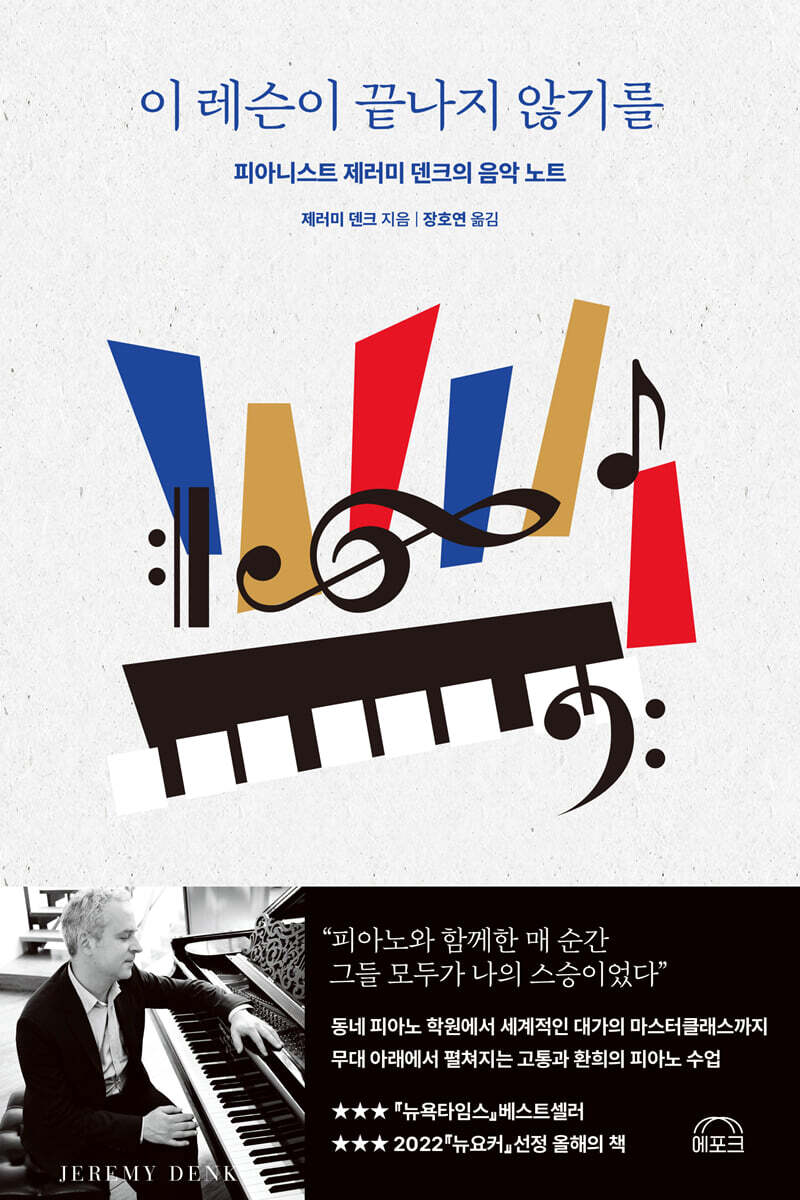
I hope this lesson never ends
 |
Description
Book Introduction
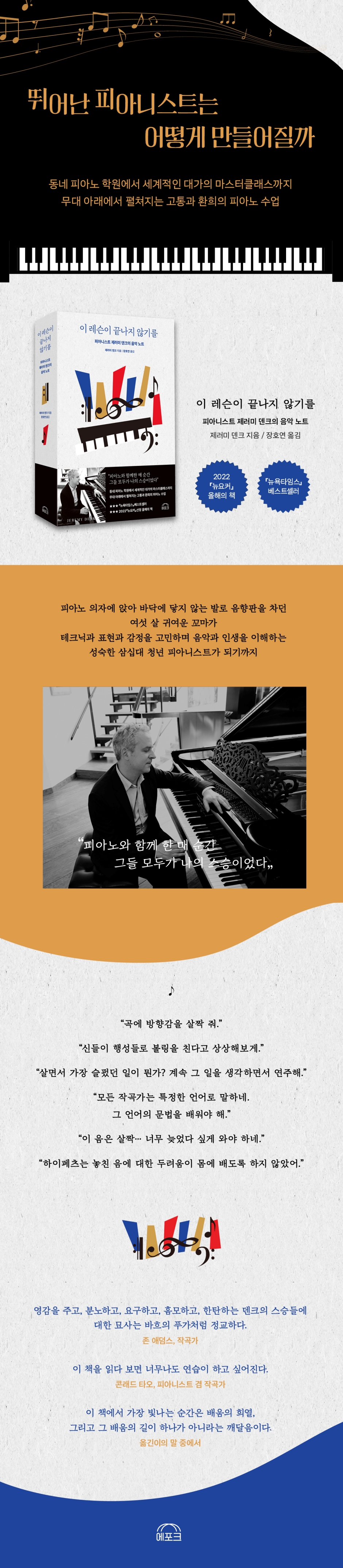
“Every moment spent with the piano “They were all my teachers.” From neighborhood piano academies to masterclasses by world-renowned masters A piano lesson of pain and joy unfolding beneath the stage - New York Times bestseller - 2022 New Yorker Book of the Year Richard Yongjae O'Neill & Jeremy Denk to perform at the Seoul Arts Center Concert Hall on December 26th In 2022, pianist Lim Yun-chan surprised the world by becoming the youngest winner of the Van Cliburn Competition. After that, the Korean classical music world began to suffer from a real 'Im Yun-chan fever'. Interest in pianists is at an all-time high, and the craze for learning the piano, which began during the COVID-19 pandemic, continues steadily. Every time I see a great pianist, I wonder. What process goes into becoming a classical pianist? How do pianists practice and what lessons do they receive? How wonderful would it be to be able to closely observe the hours spent behind the scenes, from interpretation of the piece to technique and emotional expression, creating a beautiful and moving performance? |
- You can preview some of the book's contents.
Preview
index
To Korean readers
Prelude
1st period Mars
Chapter 1: The First Lesson
Chapter 2 Mars: The First Lesson
Chapter 3 I can't hear you practicing!
Chapter 4 Mars: The Second Lesson
Chapter 5: Set to Piano
Chapter 6 Mars: The Third Lesson
2nd period melody
Chapter 7 Do you really think so?
Chapter 8 Melody: First Lesson
Chapter 9 You don't have to be a piano teacher
Chapter 10 Melody: Second Lesson
Chapter 11: The Crisis that Befell the Fourth Finger
Chapter 12 Melody: The Third Lesson
3rd period rhythm
Chapter 13: "If You Do Nothing, Everything Happens"
Chapter 14 Rhythm: Lesson One
Chapter 15: Competitions and Masterclasses
Chapter 16 Rhythm: Lesson Two
Chapter 17: Reaching the Destination
Chapter 18 Rhythm: Lesson Three
Chapter 19 So I want to go to Juilliard
Coda (Transitional Department)
Acknowledgements
Translator's Note
Appendix Playlist Commentary
Prelude
1st period Mars
Chapter 1: The First Lesson
Chapter 2 Mars: The First Lesson
Chapter 3 I can't hear you practicing!
Chapter 4 Mars: The Second Lesson
Chapter 5: Set to Piano
Chapter 6 Mars: The Third Lesson
2nd period melody
Chapter 7 Do you really think so?
Chapter 8 Melody: First Lesson
Chapter 9 You don't have to be a piano teacher
Chapter 10 Melody: Second Lesson
Chapter 11: The Crisis that Befell the Fourth Finger
Chapter 12 Melody: The Third Lesson
3rd period rhythm
Chapter 13: "If You Do Nothing, Everything Happens"
Chapter 14 Rhythm: Lesson One
Chapter 15: Competitions and Masterclasses
Chapter 16 Rhythm: Lesson Two
Chapter 17: Reaching the Destination
Chapter 18 Rhythm: Lesson Three
Chapter 19 So I want to go to Juilliard
Coda (Transitional Department)
Acknowledgements
Translator's Note
Appendix Playlist Commentary
Detailed image
Into the book
To help me play under pressure, Teacher Lillian taught me a simple and effective method she developed called the "Memory Stop."
The teacher had me number several key points in the music.
Then I had to learn how to play it by heart from there.
When the teacher called out a number during class time, I skipped to that point.
“Five!” I said, and then I turned to the topic halfway down the page.
When I said “Set!” I went back to where I had played before.
I couldn't get into a particular mood.
The music is ruined.
But while my parents sweat, I hear coughs in the audience, and I regret the moment Ms. Lillian gave me a chance, at least I won't be on stage, heartbroken, thinking about what's to come.
Because there was always a point where I could skip over it with ease.
There was no need to fumble and stop playing.
--- p.45~46
While all the piano teachers in the world would stick star stickers on my practice notebooks, Bill would hand-draw stars to convey his praise.
Sometimes, they would put a halo or crown on the star to show their pride.
Sometimes the star was depicted as squinting to show its dissatisfaction, and other times it was depicted as limping with a cane.
When I couldn't help feeling disappointed, I drew snails, caterpillars, and poisonous civets.
The most brilliant star emerged at the 1981 Piano Teachers Association Auditions, which became our first milestone.
--- p.79
I went to have my last lesson with Bill.
He was pleased with our achievements and thrilled that I was taking the next step.
But he said there were also some regrets.
“I should have been born 50 years ago.” There was nothing I could do about it.
“There weren’t many pianists back then.
Someone like you would definitely make a name for yourself.
There are a million pianists out there these days who can play, and it's nearly impossible to make a living.
A few days ago I received a letter from the winner of the Cliburn Competition.
"Can you help me find a job?" "Damn it, even you are like this?" I thought.
But now it was time to leave.
--- p.165
“Just give it a try,” he said.
After several failed attempts, I finally got the sforzando, staccato, and pedal notation down.
Oh my goodness! The grumpy trio were the epitome of romanticism.
The upper note has more urgency, and the lower note is hesitant with a lingering feeling, as if the hand of a former lover is still felt.
It wasn't just a single note, it was a layered experience, a stirring of uneasy memories.
I looked at Greg with gratitude.
(…) “That’s not so outrageous, is it?” Greg said smugly.
He opened our eyes to great wonders, yet he never missed a word that provoked anger.
"Do I even have to tell you this? You're a prodigy, aren't you? You should know how to read music." Then, softening his tone, he relayed the lesson of the day.
“I should be able to write down the music while listening to your performance.
“I want to hear all the notations with my ears.”
--- p.278
Two people walked out.
Sadly, a cough erupted from the audience.
As if in response, a quiet adjustment and creaking sound was heard on stage.
Finally, Starker took hold of the cello and glanced to the side.
Shebok lowered his arm and played the A for him to tune.
There was a murmur among the audience.
The person sitting next to me leaned over and asked me.
“You know, you’re a pianist.
“How on earth did he do it?” I wanted to know too.
That A was the most seductive sound I've ever heard.
A focused, uncluttered sound.
It was Shebok's magic.
It was a talent that only he had.
By the way, was it really necessary to play the introductory note for practical purposes so beautifully?
--- p.404
My scheduled debut at Alice Tully Hall was in April.
In February and March, I listened to dozens of recordings of Bach's E minor Partita.
Most of the performances by renowned Bach experts such as Schiff, Gould, and Turek were considered boring.
I had to fix this boring world.
I was debating whether to play the last movement in eighth notes or go for crazy triplets.
Stesin wanted me to play like jazz.
He loved rough Bach.
(…) One day, after a lesson, over a martini (his favorite drink), he said:
“Eventually you will find a way to play Bach in your own way.
“Not now, though.”
The teacher had me number several key points in the music.
Then I had to learn how to play it by heart from there.
When the teacher called out a number during class time, I skipped to that point.
“Five!” I said, and then I turned to the topic halfway down the page.
When I said “Set!” I went back to where I had played before.
I couldn't get into a particular mood.
The music is ruined.
But while my parents sweat, I hear coughs in the audience, and I regret the moment Ms. Lillian gave me a chance, at least I won't be on stage, heartbroken, thinking about what's to come.
Because there was always a point where I could skip over it with ease.
There was no need to fumble and stop playing.
--- p.45~46
While all the piano teachers in the world would stick star stickers on my practice notebooks, Bill would hand-draw stars to convey his praise.
Sometimes, they would put a halo or crown on the star to show their pride.
Sometimes the star was depicted as squinting to show its dissatisfaction, and other times it was depicted as limping with a cane.
When I couldn't help feeling disappointed, I drew snails, caterpillars, and poisonous civets.
The most brilliant star emerged at the 1981 Piano Teachers Association Auditions, which became our first milestone.
--- p.79
I went to have my last lesson with Bill.
He was pleased with our achievements and thrilled that I was taking the next step.
But he said there were also some regrets.
“I should have been born 50 years ago.” There was nothing I could do about it.
“There weren’t many pianists back then.
Someone like you would definitely make a name for yourself.
There are a million pianists out there these days who can play, and it's nearly impossible to make a living.
A few days ago I received a letter from the winner of the Cliburn Competition.
"Can you help me find a job?" "Damn it, even you are like this?" I thought.
But now it was time to leave.
--- p.165
“Just give it a try,” he said.
After several failed attempts, I finally got the sforzando, staccato, and pedal notation down.
Oh my goodness! The grumpy trio were the epitome of romanticism.
The upper note has more urgency, and the lower note is hesitant with a lingering feeling, as if the hand of a former lover is still felt.
It wasn't just a single note, it was a layered experience, a stirring of uneasy memories.
I looked at Greg with gratitude.
(…) “That’s not so outrageous, is it?” Greg said smugly.
He opened our eyes to great wonders, yet he never missed a word that provoked anger.
"Do I even have to tell you this? You're a prodigy, aren't you? You should know how to read music." Then, softening his tone, he relayed the lesson of the day.
“I should be able to write down the music while listening to your performance.
“I want to hear all the notations with my ears.”
--- p.278
Two people walked out.
Sadly, a cough erupted from the audience.
As if in response, a quiet adjustment and creaking sound was heard on stage.
Finally, Starker took hold of the cello and glanced to the side.
Shebok lowered his arm and played the A for him to tune.
There was a murmur among the audience.
The person sitting next to me leaned over and asked me.
“You know, you’re a pianist.
“How on earth did he do it?” I wanted to know too.
That A was the most seductive sound I've ever heard.
A focused, uncluttered sound.
It was Shebok's magic.
It was a talent that only he had.
By the way, was it really necessary to play the introductory note for practical purposes so beautifully?
--- p.404
My scheduled debut at Alice Tully Hall was in April.
In February and March, I listened to dozens of recordings of Bach's E minor Partita.
Most of the performances by renowned Bach experts such as Schiff, Gould, and Turek were considered boring.
I had to fix this boring world.
I was debating whether to play the last movement in eighth notes or go for crazy triplets.
Stesin wanted me to play like jazz.
He loved rough Bach.
(…) One day, after a lesson, over a martini (his favorite drink), he said:
“Eventually you will find a way to play Bach in your own way.
“Not now, though.”
--- p.480
Publisher's Review
How Great Pianists Are Made
There are countless people in this world who know how to play the piano even a little.
Among them, there are quite a few pianists who are active and famous all over the world (if you put your mind to it), but you could count them all.
Among them, there are quite a few pianists (so many that it would take more than two hands and two feet to name them) who have left a deep impression on music lovers and general readers through their writings.
Perhaps God gave them the talent to play the piano and also gave them the talent to write.
There is another outstanding pianist we should add to this list.
In the United States, Jeremy Denk is known as the 'genius pianist'.
He may be a bit unfamiliar to us as he is mainly active in the US and Europe, but he visited Korea in 2018 and held a solo concert, and in 2019, he also met Korean audiences with a duo concert with Richard Yongjae O'Neill.
And in April 2024, his first book, "I Hope This Lesson Never Ends," which fully demonstrated his other "genius," was published in Korea.
How a six-year-old who couldn't even read sheet music became a world-renowned pianist
The original title of this book, “Every Good Boy Does Fine,” was taken from a game of making sentences using the note names (EGBDF) corresponding to the staff of the treble clef.
This is a memorization technique for children who are learning music for the first time.
This unusual title tells you at a glance what makes Jeremy Denk's book different.
This book, which depicts the journey of a cute six-year-old boy who sat on a piano bench and kicked the soundboard with his feet that didn't touch the floor, to a mature young pianist in his thirties who understands music and life while contemplating technique, expression, and emotion, is no exaggeration in saying that it most honestly and accurately depicts the meaning of being a pianist.
Because it contains not the life as a concert pianist, but the life from childhood until becoming a concert pianist.
The time behind the stage that we never knew about until one person became a world-class pianist unfolds in detail and delight.
You will encounter the process of growing stronger and growing through endless cycles of boring and arduous practice sessions, incomprehensible lessons, unavoidable competition preparation, thrilling moments of inspiration, small successes and small failures, and big successes and big failures.
As the author described this book in an interview as “a love letter to music teachers,” there were certainly many teachers along the way.
A record of love dedicated to the countless piano teachers around the world.
Your first lesson begins with a local piano teacher.
Hold your hands horizontally, fingers curled and wrists low.
Keep your back straight and lift only one finger joint at a time.
Learn the notes, learn the beats, and learn fingering.
Reading these passages—the Dohnányi scale exercises that opened up a new horizon of boredom, the joy of discovering the structure of music while practicing Mozart's A major Concerto K. 488, the struggle with the metronome to control the ever-increasing tempo—brings to mind the endearing image of a child sitting in front of the piano, struggling, and a smile comes to my face.
The scene where the village elders step in to support his tuition before he goes to college reminds us once again that outstanding talent is not created alone.
As I entered college, the process of learning as a pianist began in earnest.
Having studied with Joseph Schwartz of Oberlin College, György Schebok of Indiana University, and Herbert Stencin of the Juilliard School, Denk records in considerable detail not only his private and studio lessons with them, but also his masterclasses with Leon Fleischer, Janos Starker, and others, providing a glimpse into the nature of professional piano lessons.
When you happen to hit it right, how do you apply that technique to the rest of the piece? What does it mean to give a piece a sense of direction? How do you differentiate the meaning of two separate notes from those connected by a slur? How can you play a note so it feels sad, heavy, or sweet? How can you make it sound like the note is soaring into the sky, or barely lifting off its feet?
Every moment I spent with the piano, they were all my teachers.
Just because you can play the piano doesn't mean you have to learn from a piano teacher.
This book unfolds the author's colorful daily experiences as he grew as a pianist, along with his piano lessons. Through his time with the conductor of the school orchestra he was active in during his high school years, the local orchestra he met through concerts, and the musicians he met at various music festivals, the author gains profound insights at every moment.
And during my college years, I learned a lot from professors in various fields while giving lessons to my friends to earn money, such as playing the violin, cello, flute, and singing.
From Larry Rechlef, conductor of the Contemporary Music Ensemble, I learned the precision and rigor of every notation written in the score, and from cello professor Norman Fischer, I learned how to express the human warmth and musical motivation that are not written in the score.
I learned from violin professor Greg Fulkerson how to describe music as a flowing river.
Also, the way he prepares for the competition, learns the repertoire, learns about competition, and grows steadily as a pianist while going back and forth between confidence and self-deprecation on the competition stage is deeply human.
Music isn't learned just through music.
A word from his fellow musicians, a glance, a look, a hug, a small smile, a fleeting moment of escape, a leisurely river, a star in the night sky… so many things enlightened and inspired him.
Denk's Music Lessons and Playlist Commentary
Another highlight of this book is Denk's commentary on classical pieces that appear in music lessons and stories.
His music classes, which are divided into the three fundamentals of music—harmony, rhythm, and melody—explain complex musical concepts in an easy-to-understand way using a variety of metaphors while being professional. (“Melody has, how should I put it, an object-like aspect.
(I hum and own it by myself.) Also, the writing style, which sparkles with humor and wit throughout and poetically connects classical music and universal aspects of the human spirit, will satisfy even readers who enjoy literary essays.
The song descriptions and recommended albums in the playlist commentary included as an appendix fully reveal the direction and tendency of the music that Denk pursues.
Recommended performances by Artur Schnabel, Ignaz Friedmann, Alfred Brendel, Alfred Cortot, and others are enough to open the eyes and ears of classical music lovers as well as majors.
There are countless people in this world who know how to play the piano even a little.
Among them, there are quite a few pianists who are active and famous all over the world (if you put your mind to it), but you could count them all.
Among them, there are quite a few pianists (so many that it would take more than two hands and two feet to name them) who have left a deep impression on music lovers and general readers through their writings.
Perhaps God gave them the talent to play the piano and also gave them the talent to write.
There is another outstanding pianist we should add to this list.
In the United States, Jeremy Denk is known as the 'genius pianist'.
He may be a bit unfamiliar to us as he is mainly active in the US and Europe, but he visited Korea in 2018 and held a solo concert, and in 2019, he also met Korean audiences with a duo concert with Richard Yongjae O'Neill.
And in April 2024, his first book, "I Hope This Lesson Never Ends," which fully demonstrated his other "genius," was published in Korea.
How a six-year-old who couldn't even read sheet music became a world-renowned pianist
The original title of this book, “Every Good Boy Does Fine,” was taken from a game of making sentences using the note names (EGBDF) corresponding to the staff of the treble clef.
This is a memorization technique for children who are learning music for the first time.
This unusual title tells you at a glance what makes Jeremy Denk's book different.
This book, which depicts the journey of a cute six-year-old boy who sat on a piano bench and kicked the soundboard with his feet that didn't touch the floor, to a mature young pianist in his thirties who understands music and life while contemplating technique, expression, and emotion, is no exaggeration in saying that it most honestly and accurately depicts the meaning of being a pianist.
Because it contains not the life as a concert pianist, but the life from childhood until becoming a concert pianist.
The time behind the stage that we never knew about until one person became a world-class pianist unfolds in detail and delight.
You will encounter the process of growing stronger and growing through endless cycles of boring and arduous practice sessions, incomprehensible lessons, unavoidable competition preparation, thrilling moments of inspiration, small successes and small failures, and big successes and big failures.
As the author described this book in an interview as “a love letter to music teachers,” there were certainly many teachers along the way.
A record of love dedicated to the countless piano teachers around the world.
Your first lesson begins with a local piano teacher.
Hold your hands horizontally, fingers curled and wrists low.
Keep your back straight and lift only one finger joint at a time.
Learn the notes, learn the beats, and learn fingering.
Reading these passages—the Dohnányi scale exercises that opened up a new horizon of boredom, the joy of discovering the structure of music while practicing Mozart's A major Concerto K. 488, the struggle with the metronome to control the ever-increasing tempo—brings to mind the endearing image of a child sitting in front of the piano, struggling, and a smile comes to my face.
The scene where the village elders step in to support his tuition before he goes to college reminds us once again that outstanding talent is not created alone.
As I entered college, the process of learning as a pianist began in earnest.
Having studied with Joseph Schwartz of Oberlin College, György Schebok of Indiana University, and Herbert Stencin of the Juilliard School, Denk records in considerable detail not only his private and studio lessons with them, but also his masterclasses with Leon Fleischer, Janos Starker, and others, providing a glimpse into the nature of professional piano lessons.
When you happen to hit it right, how do you apply that technique to the rest of the piece? What does it mean to give a piece a sense of direction? How do you differentiate the meaning of two separate notes from those connected by a slur? How can you play a note so it feels sad, heavy, or sweet? How can you make it sound like the note is soaring into the sky, or barely lifting off its feet?
Every moment I spent with the piano, they were all my teachers.
Just because you can play the piano doesn't mean you have to learn from a piano teacher.
This book unfolds the author's colorful daily experiences as he grew as a pianist, along with his piano lessons. Through his time with the conductor of the school orchestra he was active in during his high school years, the local orchestra he met through concerts, and the musicians he met at various music festivals, the author gains profound insights at every moment.
And during my college years, I learned a lot from professors in various fields while giving lessons to my friends to earn money, such as playing the violin, cello, flute, and singing.
From Larry Rechlef, conductor of the Contemporary Music Ensemble, I learned the precision and rigor of every notation written in the score, and from cello professor Norman Fischer, I learned how to express the human warmth and musical motivation that are not written in the score.
I learned from violin professor Greg Fulkerson how to describe music as a flowing river.
Also, the way he prepares for the competition, learns the repertoire, learns about competition, and grows steadily as a pianist while going back and forth between confidence and self-deprecation on the competition stage is deeply human.
Music isn't learned just through music.
A word from his fellow musicians, a glance, a look, a hug, a small smile, a fleeting moment of escape, a leisurely river, a star in the night sky… so many things enlightened and inspired him.
Denk's Music Lessons and Playlist Commentary
Another highlight of this book is Denk's commentary on classical pieces that appear in music lessons and stories.
His music classes, which are divided into the three fundamentals of music—harmony, rhythm, and melody—explain complex musical concepts in an easy-to-understand way using a variety of metaphors while being professional. (“Melody has, how should I put it, an object-like aspect.
(I hum and own it by myself.) Also, the writing style, which sparkles with humor and wit throughout and poetically connects classical music and universal aspects of the human spirit, will satisfy even readers who enjoy literary essays.
The song descriptions and recommended albums in the playlist commentary included as an appendix fully reveal the direction and tendency of the music that Denk pursues.
Recommended performances by Artur Schnabel, Ignaz Friedmann, Alfred Brendel, Alfred Cortot, and others are enough to open the eyes and ears of classical music lovers as well as majors.
GOODS SPECIFICS
- Date of issue: April 5, 2024
- Page count, weight, size: 576 pages | 728g | 140*210*35mm
- ISBN13: 9791198123145
- ISBN10: 1198123141
You may also like
카테고리
korean


korean

![GQ KOREA Mark (Monthly): December [2025]](http://librairie.coreenne.fr/cdn/shop/files/8ef265dbbfbf186523ed75ba7319009d.jpg?v=1765340328&width=3840)


