

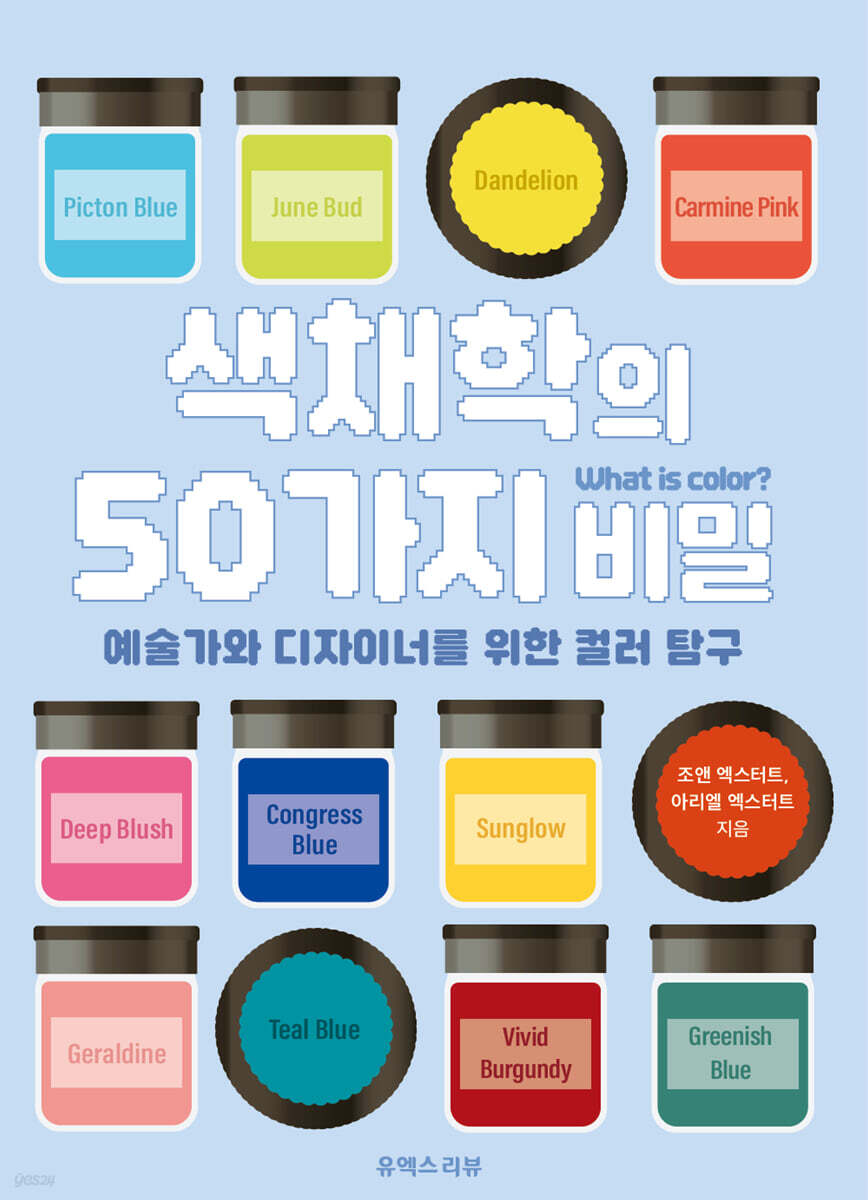
50 Secrets of Color Science
 |
Description
Book Introduction
Art, design, fashion, photography, marketing…
An amazing story that anyone who works with color must know!
Discover the beautiful and mysterious world of color theory through 50 questions.
What kind of lighting should I place my product under to make it look more attractive?
Will the newly ordered yellow cushions go well with my brown sofa?
Will the red apple I drew look the same red to other people?
What color paint should I use to paint the walls to create a comfortable bedroom?
What color background should I use to make my subject stand out more?
If we take a closer look at these questions that arise in our daily lives, we will realize how closely humans and color are related.
Color exerts a deeper and more pervasive influence on human cognition, psychology, and even survival than we might think.
For this reason, color science has been a subject of study that has piqued the curiosity of countless scientists, philosophers, artists, and businessmen for hundreds of years in human history.
And it is still an interesting topic, with much of it shrouded in mystery.
In "50 Secrets of Color Science," the fascinating story of color is revealed one by one through 50 carefully selected questions.
As a book about color, it is printed in full color and contains images and infographics to enhance understanding and enjoyment.
It contains content that can be read with interest by anyone, from ordinary consumers concerned about color combinations for interior design or clothing to experts in various fields dealing with color, such as artists, designers, marketers, and art teachers.
If you understand and utilize the mysterious principles of color perception through this book, you will gain a much improved perspective and sense.
An amazing story that anyone who works with color must know!
Discover the beautiful and mysterious world of color theory through 50 questions.
What kind of lighting should I place my product under to make it look more attractive?
Will the newly ordered yellow cushions go well with my brown sofa?
Will the red apple I drew look the same red to other people?
What color paint should I use to paint the walls to create a comfortable bedroom?
What color background should I use to make my subject stand out more?
If we take a closer look at these questions that arise in our daily lives, we will realize how closely humans and color are related.
Color exerts a deeper and more pervasive influence on human cognition, psychology, and even survival than we might think.
For this reason, color science has been a subject of study that has piqued the curiosity of countless scientists, philosophers, artists, and businessmen for hundreds of years in human history.
And it is still an interesting topic, with much of it shrouded in mystery.
In "50 Secrets of Color Science," the fascinating story of color is revealed one by one through 50 carefully selected questions.
As a book about color, it is printed in full color and contains images and infographics to enhance understanding and enjoyment.
It contains content that can be read with interest by anyone, from ordinary consumers concerned about color combinations for interior design or clothing to experts in various fields dealing with color, such as artists, designers, marketers, and art teachers.
If you understand and utilize the mysterious principles of color perception through this book, you will gain a much improved perspective and sense.
- You can preview some of the book's contents.
Preview
index
1.
What is color?
2.
Why do we see color?
3.
How is color related to light?
4.
How did we learn that sunlight has different colors?
5. What is ROYGBIV?
6.
What are spectral colors?
7.
What is the relationship between color and wavelength?
8.
What is the visible spectrum?
9.
What does energy have to do with color?
10.
How does light change into color?
11.
How does our visual system adapt to changes in light?
12.
Why are boundaries and borders central to our color perception?
13.
What does the retina do?
14.
What are stromal cells?
15.
What are cone cells?
16.
What is trichromatic color vision?
17.
What is color contrast?
18.
What is an afterimage?
19.
What is color constancy?
20.
What is simultaneous contrast?
21.
Why do the same colors appear different depending on the light source?
22.
What is metamerism?
23.
How many colors can humans see?
24.
What is color vision deficiency?
25.
How does human vision differ from that of other animals?
26.
What are non-spectral colors?
27.
What is pigment?
28.
What is the difference between purple and violet?
29.
What is black?
30.
What is white?
31.
What are pastel colors?
32.
What are primary colors?
33.
What are complementary colors?
34.
What is additive color mixing?
35.
What is subtractive color?
36. What is RGB?
37. What is CMYK?
38.
Why do colors look different on monitor and on paper?
39.
What is color?
40.
What is brightness?
41.
What is saturation?
42.
What is a color wheel?
43. What is the CIE color space?
44.
What is the Munsell color system?
45. What is PMS color?
46.
What is color rendering index?
47.
What are warm books and cool colors?
48.
Do colors affect our mood?
49.
How does language affect the colors we see?
50.
What color is this dress?
What is color?
2.
Why do we see color?
3.
How is color related to light?
4.
How did we learn that sunlight has different colors?
5. What is ROYGBIV?
6.
What are spectral colors?
7.
What is the relationship between color and wavelength?
8.
What is the visible spectrum?
9.
What does energy have to do with color?
10.
How does light change into color?
11.
How does our visual system adapt to changes in light?
12.
Why are boundaries and borders central to our color perception?
13.
What does the retina do?
14.
What are stromal cells?
15.
What are cone cells?
16.
What is trichromatic color vision?
17.
What is color contrast?
18.
What is an afterimage?
19.
What is color constancy?
20.
What is simultaneous contrast?
21.
Why do the same colors appear different depending on the light source?
22.
What is metamerism?
23.
How many colors can humans see?
24.
What is color vision deficiency?
25.
How does human vision differ from that of other animals?
26.
What are non-spectral colors?
27.
What is pigment?
28.
What is the difference between purple and violet?
29.
What is black?
30.
What is white?
31.
What are pastel colors?
32.
What are primary colors?
33.
What are complementary colors?
34.
What is additive color mixing?
35.
What is subtractive color?
36. What is RGB?
37. What is CMYK?
38.
Why do colors look different on monitor and on paper?
39.
What is color?
40.
What is brightness?
41.
What is saturation?
42.
What is a color wheel?
43. What is the CIE color space?
44.
What is the Munsell color system?
45. What is PMS color?
46.
What is color rendering index?
47.
What are warm books and cool colors?
48.
Do colors affect our mood?
49.
How does language affect the colors we see?
50.
What color is this dress?
Detailed image

Into the book
There is a question that has puzzled scientists and philosophers for centuries.
Is color a property of matter? Are the petals of a red rose originally red? It's doubtful that many people today would answer "yes!"
Newton presented compelling evidence that something more complex was going on.
It is because of light that we can see color.
But Newton could not explain the role of the brain in the properties of color.
--- p.19, 「4.
How did we come to know that there are different colors in sunlight?
We receive a tremendous amount of information and try to perceive it as best we can, yet we are not overwhelmed by it.
Our visual system uses numerous cues to help us determine what color is in front of us.
The light reflected back at us from a particular area is just one of many such clues.
As we try to figure out what the object before us is, we must construct its shape, the light source illuminating it, the expanded field of view within which it lies, and the color that fills its boundaries.
--- p.32, 「10.
From "How does light change into color?"
Metamerism can be seen when a shirt and jeans appear to be the same color in sunlight, but then appear different colors indoors.
Just as we can't tell the difference between a bag of five-pound dumbbells and a bag of two-pound and three-pound dumbbells, we can't tell the difference between colors.
Because of the limitations of the human visual system, we can never know what combination of wavelengths light is made of when it enters our eyes.
For example, yellow, which is a mixture of yellow, red, and green light on the spectrum, appears exactly the same to us.
--- p.67, 「22.
From "What is Metamerism?"
The color wheel most familiar today is the original one created by Isaac Newton in 1672.
Despite the linearity of the visible spectrum, Newton connected red and violet at opposite ends of the spectrum.
Colors on opposite sides of the color wheel are also related.
When you mix those colors, you get achromatic colors or lose each color.
The smooth connection between each color and the placement of complementary colors (also known as complementary colors) formed the basis of the color wheel taught in art classes around the world today.
The question of which colors should be placed on the color wheel and which colors should be placed on its opposite side has changed slightly over time and is still debated today.
--- p.112, 「42.
From "What is a color wheel?"
Scientists have been delving into the physics and chemistry of color for centuries, but the world of vision is still in its infancy.
What we currently know is that we can quantify the wavelength of light, but not its color.
It seems almost impossible to accept that 'what we are seeing now is not objective fact'.
It's like taste.
Just as olives are salty to some and bitter to others, we cannot be certain how red or any other color appears to others.
There are still many mysteries about color that remain unsolved, but even if we study what we know so far, we can effectively apply it to various human activities such as art, design, fashion, manufacturing, and marketing.
Is color a property of matter? Are the petals of a red rose originally red? It's doubtful that many people today would answer "yes!"
Newton presented compelling evidence that something more complex was going on.
It is because of light that we can see color.
But Newton could not explain the role of the brain in the properties of color.
--- p.19, 「4.
How did we come to know that there are different colors in sunlight?
We receive a tremendous amount of information and try to perceive it as best we can, yet we are not overwhelmed by it.
Our visual system uses numerous cues to help us determine what color is in front of us.
The light reflected back at us from a particular area is just one of many such clues.
As we try to figure out what the object before us is, we must construct its shape, the light source illuminating it, the expanded field of view within which it lies, and the color that fills its boundaries.
--- p.32, 「10.
From "How does light change into color?"
Metamerism can be seen when a shirt and jeans appear to be the same color in sunlight, but then appear different colors indoors.
Just as we can't tell the difference between a bag of five-pound dumbbells and a bag of two-pound and three-pound dumbbells, we can't tell the difference between colors.
Because of the limitations of the human visual system, we can never know what combination of wavelengths light is made of when it enters our eyes.
For example, yellow, which is a mixture of yellow, red, and green light on the spectrum, appears exactly the same to us.
--- p.67, 「22.
From "What is Metamerism?"
The color wheel most familiar today is the original one created by Isaac Newton in 1672.
Despite the linearity of the visible spectrum, Newton connected red and violet at opposite ends of the spectrum.
Colors on opposite sides of the color wheel are also related.
When you mix those colors, you get achromatic colors or lose each color.
The smooth connection between each color and the placement of complementary colors (also known as complementary colors) formed the basis of the color wheel taught in art classes around the world today.
The question of which colors should be placed on the color wheel and which colors should be placed on its opposite side has changed slightly over time and is still debated today.
--- p.112, 「42.
From "What is a color wheel?"
Scientists have been delving into the physics and chemistry of color for centuries, but the world of vision is still in its infancy.
What we currently know is that we can quantify the wavelength of light, but not its color.
It seems almost impossible to accept that 'what we are seeing now is not objective fact'.
It's like taste.
Just as olives are salty to some and bitter to others, we cannot be certain how red or any other color appears to others.
There are still many mysteries about color that remain unsolved, but even if we study what we know so far, we can effectively apply it to various human activities such as art, design, fashion, manufacturing, and marketing.
--- p.134, 「50.
From "What color is this dress?"
From "What color is this dress?"
Publisher's Review
What exactly is 'color'?
50 Questions About the Magic of Color That Fills the World
What if one day the entire world suddenly lost its color and appeared in black and white? Even the most exquisite delicacies would taste somehow bland, and the most beautiful scenery would no longer be as moving as before.
We are so accustomed to a world filled with color that we easily forget its value, but just think of black-and-white photographs or movies for a moment and you will see how much color affects our lives and senses.
Because it is such a closely related area to our daily lives, mankind has extensively explored color throughout history.
From the fundamental question, "How do we see color?" to the practical question, "What color will help sell a product?", humanity's curiosity about color is quite diverse.
However, many questions still remain without definitive answers.
What on earth is 'color'?
For humans, color has a meaning beyond adding beauty to the world.
You can tell your health status by looking at the color of someone's face, you can tell your safety by looking at the color of traffic lights, and you can tell at a glance which person in a crowded stadium is on your favorite sports team.
It's also interesting to note that how we perceive colors differs depending on whether our native language has a word for that color, and that we experience different emotions when we see a single color based on our personal experiences.
It is difficult to discuss human life without color, as color perception is an important ability that our brain has developed over a long period of time, starting from the evolutionary stage about 30 million years ago.
"50 Secrets of Color Science" is a story told by Joan and Ariel Extert, a mother and daughter who delve deeper than anyone else into the inseparable relationship between humans and color.
As color consultants and lifestyle shop owners, the two authors, who have a deep connection with color science, carefully select 50 questions and, based on the latest research results and colorful images, introduce in detail the principles of color that humanity has discovered so far.
This book systematically covers all the questions you might have about color, such as how color and light are related, how physics, chemistry, biology, and language affect the colors we see, how various industries utilize color, and the truth behind the 'white gold vs. blue and black one-piece dress debate' that has been causing a stir around the world.
Color only exists when we see it!
The world of color theory that you see as much as you know
If we were to choose the field in which color has the greatest influence on our lives today, it would undoubtedly be art and industry.
Anyone who has ever used a design tool on a computer is probably familiar with the color models called RGB and CMYK.
It is common sense and a known formula in the design world that digital work should be done in RGB and print work should be done in CMYK.
But do you know exactly why different color models are used depending on the type of artwork? This is because colors created from light and colors created from ink appear completely different to our eyes. RGB colors are directly transmitted to the eye through a light source, while CMYK colors are transmitted indirectly through light reflected once by ink.
Therefore, if you work on design work destined for paper printing in RGB, you're likely to end up with dull and disappointing results. This is ultimately why "K" is needed in addition to the three primary colors of "C, M, and Y" to achieve a vivid black in CMYK.
Ink printed on ordinary paper does not absorb enough light, so it appears muddy rather than black.
To print a deep, solid black, it is best to mix all three inks, C, M, Y, and K, in equal proportions.
If you understand the underlying principles beyond the one-dimensional information about color, you can create designs that are more precise and fit your purpose.
Meanwhile, in highly competitive industries, color is also valuable as a symbol that increases brand awareness.
As a representative example, jewelry brand Tiffany & Co. registered its signature color as a trademark.
If you've ever seen a Tiffany box in its clear blue, the mere mention of "Tiffany Blue" will instantly bring that color to mind.
Tiffany Blue, which instantly evokes the brand with its distinct branding effect, is one of the oldest examples of color marketing and continues to reap the benefits.
The 'Stroop effect', which means that the language pathway in the human brain is faster than the color pathway, is one piece of evidence supporting how naming colors is an important marketing tool.
This book was written to help readers easily and enjoyably satisfy their curiosity and gain inspiration through rich stories related to humans and colors.
The explanations for each of the 50 questions are divided into three paragraphs, allowing readers to gain knowledge at different levels according to their needs and interests.
This is a must-read, especially for those who want to become true experts in fields that deal with color, such as artists, designers, marketers, and art teachers.
This book will help you understand and utilize the mysterious principles of color perception, further enhancing your vision and senses.
50 Questions About the Magic of Color That Fills the World
What if one day the entire world suddenly lost its color and appeared in black and white? Even the most exquisite delicacies would taste somehow bland, and the most beautiful scenery would no longer be as moving as before.
We are so accustomed to a world filled with color that we easily forget its value, but just think of black-and-white photographs or movies for a moment and you will see how much color affects our lives and senses.
Because it is such a closely related area to our daily lives, mankind has extensively explored color throughout history.
From the fundamental question, "How do we see color?" to the practical question, "What color will help sell a product?", humanity's curiosity about color is quite diverse.
However, many questions still remain without definitive answers.
What on earth is 'color'?
For humans, color has a meaning beyond adding beauty to the world.
You can tell your health status by looking at the color of someone's face, you can tell your safety by looking at the color of traffic lights, and you can tell at a glance which person in a crowded stadium is on your favorite sports team.
It's also interesting to note that how we perceive colors differs depending on whether our native language has a word for that color, and that we experience different emotions when we see a single color based on our personal experiences.
It is difficult to discuss human life without color, as color perception is an important ability that our brain has developed over a long period of time, starting from the evolutionary stage about 30 million years ago.
"50 Secrets of Color Science" is a story told by Joan and Ariel Extert, a mother and daughter who delve deeper than anyone else into the inseparable relationship between humans and color.
As color consultants and lifestyle shop owners, the two authors, who have a deep connection with color science, carefully select 50 questions and, based on the latest research results and colorful images, introduce in detail the principles of color that humanity has discovered so far.
This book systematically covers all the questions you might have about color, such as how color and light are related, how physics, chemistry, biology, and language affect the colors we see, how various industries utilize color, and the truth behind the 'white gold vs. blue and black one-piece dress debate' that has been causing a stir around the world.
Color only exists when we see it!
The world of color theory that you see as much as you know
If we were to choose the field in which color has the greatest influence on our lives today, it would undoubtedly be art and industry.
Anyone who has ever used a design tool on a computer is probably familiar with the color models called RGB and CMYK.
It is common sense and a known formula in the design world that digital work should be done in RGB and print work should be done in CMYK.
But do you know exactly why different color models are used depending on the type of artwork? This is because colors created from light and colors created from ink appear completely different to our eyes. RGB colors are directly transmitted to the eye through a light source, while CMYK colors are transmitted indirectly through light reflected once by ink.
Therefore, if you work on design work destined for paper printing in RGB, you're likely to end up with dull and disappointing results. This is ultimately why "K" is needed in addition to the three primary colors of "C, M, and Y" to achieve a vivid black in CMYK.
Ink printed on ordinary paper does not absorb enough light, so it appears muddy rather than black.
To print a deep, solid black, it is best to mix all three inks, C, M, Y, and K, in equal proportions.
If you understand the underlying principles beyond the one-dimensional information about color, you can create designs that are more precise and fit your purpose.
Meanwhile, in highly competitive industries, color is also valuable as a symbol that increases brand awareness.
As a representative example, jewelry brand Tiffany & Co. registered its signature color as a trademark.
If you've ever seen a Tiffany box in its clear blue, the mere mention of "Tiffany Blue" will instantly bring that color to mind.
Tiffany Blue, which instantly evokes the brand with its distinct branding effect, is one of the oldest examples of color marketing and continues to reap the benefits.
The 'Stroop effect', which means that the language pathway in the human brain is faster than the color pathway, is one piece of evidence supporting how naming colors is an important marketing tool.
This book was written to help readers easily and enjoyably satisfy their curiosity and gain inspiration through rich stories related to humans and colors.
The explanations for each of the 50 questions are divided into three paragraphs, allowing readers to gain knowledge at different levels according to their needs and interests.
This is a must-read, especially for those who want to become true experts in fields that deal with color, such as artists, designers, marketers, and art teachers.
This book will help you understand and utilize the mysterious principles of color perception, further enhancing your vision and senses.
GOODS SPECIFICS
- Date of issue: March 15, 2024
- Page count, weight, size: 136 pages | 170*235*20mm
- ISBN13: 9791193217429
- ISBN10: 1193217423
You may also like
카테고리
korean


korean

![GQ KOREA Mark (Monthly): December [2025]](http://librairie.coreenne.fr/cdn/shop/files/8ef265dbbfbf186523ed75ba7319009d.jpg?v=1765340328&width=3840)


