

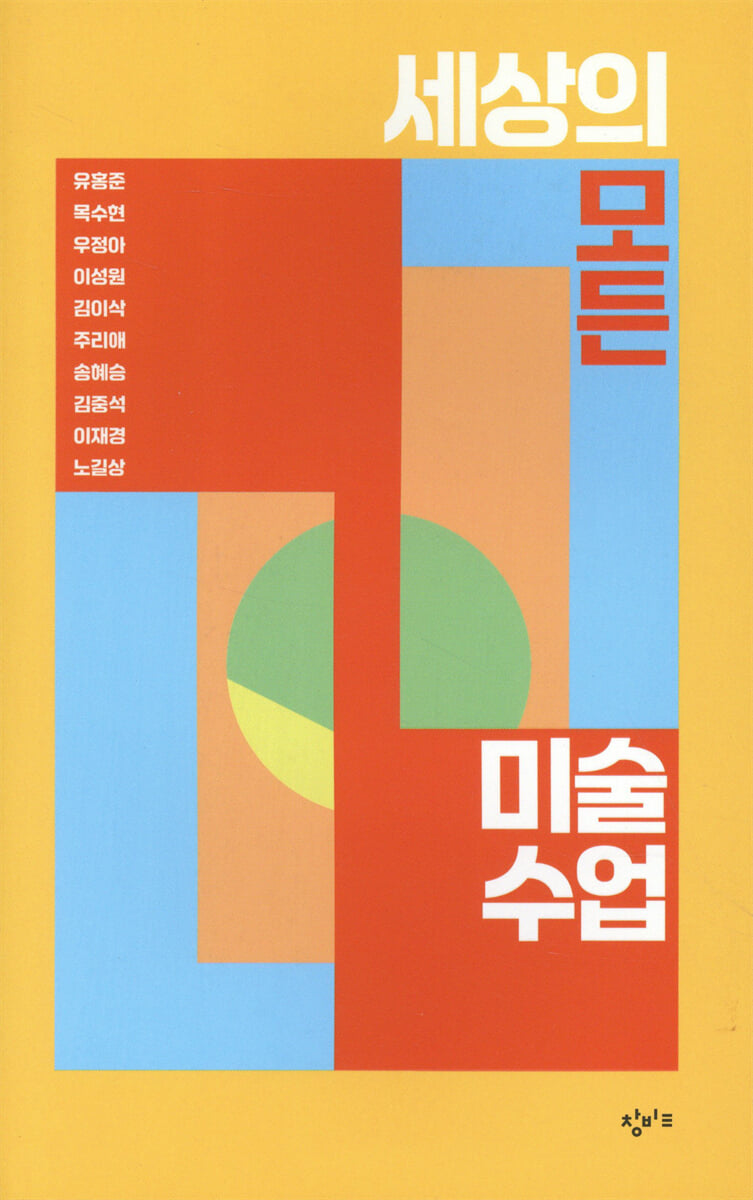
All the art classes in the world
 |
Description
Book Introduction
What a colorful art class!
10 different art classes for 10 people, both inside and outside of school
"All the Art Classes in the World" is a book filled with a variety of interesting activities that brought "art" into the realm of education, with the direct participation of people working in various art fields.
Ten authors, including art critic Yoo Hong-jun, art historians Mok Su-hyeon and Woo Jeong-ah, teachers Lee Seong-won and Noh Gil-sang, children's art museum operator Kim Lee-sak, art therapy researcher Joo Ri-ae, picture book author Song Hye-seung, painter Kim Jung-seok, and Lee Jae-kyung, the head of a social enterprise that helps at-risk youth, wrote about their experiences and feelings after meeting various types of students through art.
Authors who have been active in institutional education, including Yoo Hong-jun, introduce their experiences of guiding students to freely create works and appreciate art from their own perspectives, while authors such as Kim Jung-seok and Lee Jae-kyung, who have been active in literacy classes outside of school and juvenile detention centers, introduce classes they held with students who had difficulty connecting with art.
This book vividly demonstrates once again that educational activities using art as a medium can be found in every aspect of our lives and can greatly enrich our lives emotionally.
Readers already taking art classes will expand their thinking about the class through this book, and readers with a curiosity about art will be able to view art with a freer and more flexible mind.
10 different art classes for 10 people, both inside and outside of school
"All the Art Classes in the World" is a book filled with a variety of interesting activities that brought "art" into the realm of education, with the direct participation of people working in various art fields.
Ten authors, including art critic Yoo Hong-jun, art historians Mok Su-hyeon and Woo Jeong-ah, teachers Lee Seong-won and Noh Gil-sang, children's art museum operator Kim Lee-sak, art therapy researcher Joo Ri-ae, picture book author Song Hye-seung, painter Kim Jung-seok, and Lee Jae-kyung, the head of a social enterprise that helps at-risk youth, wrote about their experiences and feelings after meeting various types of students through art.
Authors who have been active in institutional education, including Yoo Hong-jun, introduce their experiences of guiding students to freely create works and appreciate art from their own perspectives, while authors such as Kim Jung-seok and Lee Jae-kyung, who have been active in literacy classes outside of school and juvenile detention centers, introduce classes they held with students who had difficulty connecting with art.
This book vividly demonstrates once again that educational activities using art as a medium can be found in every aspect of our lives and can greatly enrich our lives emotionally.
Readers already taking art classes will expand their thinking about the class through this book, and readers with a curiosity about art will be able to view art with a freer and more flexible mind.
- You can preview some of the book's contents.
Preview
index
preface
· My Experiential Art Education Story: Harmony of Practice and Theory, Creation and Appreciation / Yoo Hong-jun
Is this 'art'? / Mok Su-hyeon
Visual literacy for engineering students to converse with friends of the opposite sex at an art museum / Woo Jung-ah
· Art in the Landscape / Lee Seong-won
· Children Growing Up in an Art Museum / Kim Isaac
· I'll draw your heart / Ju-ri-ae
Art for All / Song Hye-seung
· When I draw it, it's honestly nice / Kim Jung-seok
The Power of Positive Imagination / Jaekyung Lee
· Art may not save us / Noh Gil-sang
· My Experiential Art Education Story: Harmony of Practice and Theory, Creation and Appreciation / Yoo Hong-jun
Is this 'art'? / Mok Su-hyeon
Visual literacy for engineering students to converse with friends of the opposite sex at an art museum / Woo Jung-ah
· Art in the Landscape / Lee Seong-won
· Children Growing Up in an Art Museum / Kim Isaac
· I'll draw your heart / Ju-ri-ae
Art for All / Song Hye-seung
· When I draw it, it's honestly nice / Kim Jung-seok
The Power of Positive Imagination / Jaekyung Lee
· Art may not save us / Noh Gil-sang
Publisher's Review
Free expression, deep appreciation
Unique art classes held at school
Expression and appreciation.
These are undeniably important elements in art.
This book contains classes that attempt to open up a space for students to freely create works within the institutional education system, from middle and high school to university lecture halls, or to resolve the vagueness felt when appreciating works.
Art critic Yoo Hong-jun emphasizes that an ideal art class should be a balance of practical and theoretical skills, talking about how he asked students who had not had the opportunity to create their own works even after entering university to make scarecrows so that they could unleash their creative desires, and how he traveled around the country giving lectures to those who wanted to properly understand Korean art.
“Is this ‘art’?” That’s the question art historian Mok Su-hyeon asked his students as he showed them photographs of artifacts such as hand axes and comb-patterned pottery.
It shows that art, which has become difficult to understand in modern times and has become distant from the public, is actually art that originated from the pursuit of beauty and convenience.
'I want to go to an art museum with a friend of the opposite sex and talk about paintings in front of them.' This is the wish that engineering students hope to achieve through art classes.
Art historian Woo Jung-ah guides engineering students who, having chosen a career in science and engineering early on, have had limited opportunities to encounter art (but are eager to learn about it) on how to read and deeply appreciate images.
Teacher Lee Seong-won, who gained fame for his 'nature art', tells us about his class activities where he created a scene using natural objects, took pictures of it, and gave it a title.
It contains a story about how he took the lead by putting flowers in his hair and encouraged children who were broken and resting without any other choice.
Gil-Sang Noh, a teacher at Iwoo School, introduces a class that focuses on the children's desire to draw freely, but above all, to draw 'well'.
The class, which creates oriental paintings through the simple activity of folding rice paper and letting ink flow, or completes pointillism by dotting with acrylic paint on OHP film, is recommended for general readers who want to create beautiful paintings with simple tasks.
To make life more beautiful
Art classes seeking students
A class needs a teacher, but above all, there needs to be someone willing to learn.
This book contains examples of the authors' experiences teaching people who were unaware of the utility of art and finding satisfaction in seeing them gradually enjoy it.
Isaac Kim, who runs the children's art museum 'Hello Museum,' talks about how art museums can be used as a place for art classes outside of school.
Viewing great works of art and experiencing programs is the art class where one can truly experience the joy of art, and the museum is the perfect space for such classes.
Joo-ri Ae, who studies art therapy, tells the story of art therapy with teenagers.
Art therapy begins by drawing a 'stone' from the image of a young person visiting with a closed mind and showing it to the patient.
The healing process of expressing a difficult-to-explain condition through images and finally opening the heart makes us think about the power of art.
Song Hye-seung, a picture book author, introduces art classes she took with visually impaired children.
After hearing the children say they want to see their own appearance, I have them feel their own bodies with their hands and express them with dolls. For children who lack a sense of space, I have them make people, trees, buildings, and houses with blocks and help them guess their relative sizes.
This article provides a refreshing reminder to readers who might think that art classes are difficult because it's hard to see ahead, but that art is something everyone can enjoy.
Painter Kim Jung-seok shares his experience of painting with grandmothers in a literacy class.
This book describes the process by which grandmothers who initially refused to draw, saying they could not draw, finally created their own picture books through consistent lessons and even held exhibitions in Suncheon, Seoul, and the United States.
The sight of grandmothers who were isolated and discouraged from the world because they could not read and write regaining their self-esteem through drawing brings a warm smile to the readers' faces.
Lee Jae-kyung, the head of a social enterprise supporting at-risk youth, shares her experience teaching art to youth living in a juvenile detention center.
The author emphasizes the importance of art classes for at-risk youth, as they treat children who are vulnerable to crime due to their disadvantaged backgrounds without prejudice, and they experience countless failures in the process of creating their own works, and learn how to overcome them.
Readers who want to take art classes,
A book for readers who want to take art classes
This book began with the hope that art would not be just a subject learned briefly during school days.
By gathering writings from people working in various fields of art, including creation, research, criticism, exhibitions, and social work, we were able to confirm that art is everywhere in our lives, and that the classes we take are docent-led classes that will lead us into the world of art.
In ten articles, the authors provide a rich overview of the many benefits of art and art classes.
Art cultivates our sense of beauty, allows us to cool our heads and relax, boosts our self-esteem, and even soothes our hearts.
Readers who teach art in educational settings will find that this book not only provides clues for leading students to happy lives, but also provides a unique sense of pride in their art classes.
The authors of this book emphasize that there are no right answers in art, and that you can freely express whatever you want.
Additionally, for readers who want to enjoy art but hesitate because they don't know how, we emphasize that what is necessary to approach art is a free and open mind.
Since there is no right answer to this question, I encourage you to trust your own active interpretation.
Unique art classes held at school
Expression and appreciation.
These are undeniably important elements in art.
This book contains classes that attempt to open up a space for students to freely create works within the institutional education system, from middle and high school to university lecture halls, or to resolve the vagueness felt when appreciating works.
Art critic Yoo Hong-jun emphasizes that an ideal art class should be a balance of practical and theoretical skills, talking about how he asked students who had not had the opportunity to create their own works even after entering university to make scarecrows so that they could unleash their creative desires, and how he traveled around the country giving lectures to those who wanted to properly understand Korean art.
“Is this ‘art’?” That’s the question art historian Mok Su-hyeon asked his students as he showed them photographs of artifacts such as hand axes and comb-patterned pottery.
It shows that art, which has become difficult to understand in modern times and has become distant from the public, is actually art that originated from the pursuit of beauty and convenience.
'I want to go to an art museum with a friend of the opposite sex and talk about paintings in front of them.' This is the wish that engineering students hope to achieve through art classes.
Art historian Woo Jung-ah guides engineering students who, having chosen a career in science and engineering early on, have had limited opportunities to encounter art (but are eager to learn about it) on how to read and deeply appreciate images.
Teacher Lee Seong-won, who gained fame for his 'nature art', tells us about his class activities where he created a scene using natural objects, took pictures of it, and gave it a title.
It contains a story about how he took the lead by putting flowers in his hair and encouraged children who were broken and resting without any other choice.
Gil-Sang Noh, a teacher at Iwoo School, introduces a class that focuses on the children's desire to draw freely, but above all, to draw 'well'.
The class, which creates oriental paintings through the simple activity of folding rice paper and letting ink flow, or completes pointillism by dotting with acrylic paint on OHP film, is recommended for general readers who want to create beautiful paintings with simple tasks.
To make life more beautiful
Art classes seeking students
A class needs a teacher, but above all, there needs to be someone willing to learn.
This book contains examples of the authors' experiences teaching people who were unaware of the utility of art and finding satisfaction in seeing them gradually enjoy it.
Isaac Kim, who runs the children's art museum 'Hello Museum,' talks about how art museums can be used as a place for art classes outside of school.
Viewing great works of art and experiencing programs is the art class where one can truly experience the joy of art, and the museum is the perfect space for such classes.
Joo-ri Ae, who studies art therapy, tells the story of art therapy with teenagers.
Art therapy begins by drawing a 'stone' from the image of a young person visiting with a closed mind and showing it to the patient.
The healing process of expressing a difficult-to-explain condition through images and finally opening the heart makes us think about the power of art.
Song Hye-seung, a picture book author, introduces art classes she took with visually impaired children.
After hearing the children say they want to see their own appearance, I have them feel their own bodies with their hands and express them with dolls. For children who lack a sense of space, I have them make people, trees, buildings, and houses with blocks and help them guess their relative sizes.
This article provides a refreshing reminder to readers who might think that art classes are difficult because it's hard to see ahead, but that art is something everyone can enjoy.
Painter Kim Jung-seok shares his experience of painting with grandmothers in a literacy class.
This book describes the process by which grandmothers who initially refused to draw, saying they could not draw, finally created their own picture books through consistent lessons and even held exhibitions in Suncheon, Seoul, and the United States.
The sight of grandmothers who were isolated and discouraged from the world because they could not read and write regaining their self-esteem through drawing brings a warm smile to the readers' faces.
Lee Jae-kyung, the head of a social enterprise supporting at-risk youth, shares her experience teaching art to youth living in a juvenile detention center.
The author emphasizes the importance of art classes for at-risk youth, as they treat children who are vulnerable to crime due to their disadvantaged backgrounds without prejudice, and they experience countless failures in the process of creating their own works, and learn how to overcome them.
Readers who want to take art classes,
A book for readers who want to take art classes
This book began with the hope that art would not be just a subject learned briefly during school days.
By gathering writings from people working in various fields of art, including creation, research, criticism, exhibitions, and social work, we were able to confirm that art is everywhere in our lives, and that the classes we take are docent-led classes that will lead us into the world of art.
In ten articles, the authors provide a rich overview of the many benefits of art and art classes.
Art cultivates our sense of beauty, allows us to cool our heads and relax, boosts our self-esteem, and even soothes our hearts.
Readers who teach art in educational settings will find that this book not only provides clues for leading students to happy lives, but also provides a unique sense of pride in their art classes.
The authors of this book emphasize that there are no right answers in art, and that you can freely express whatever you want.
Additionally, for readers who want to enjoy art but hesitate because they don't know how, we emphasize that what is necessary to approach art is a free and open mind.
Since there is no right answer to this question, I encourage you to trust your own active interpretation.
GOODS SPECIFICS
- Date of issue: February 5, 2024
- Page count, weight, size: 204 pages | 135*215*20mm
- ISBN13: 9791165702410
- ISBN10: 116570241X
You may also like
카테고리
korean


korean

![GQ KOREA Mark (Monthly): December [2025]](http://librairie.coreenne.fr/cdn/shop/files/8ef265dbbfbf186523ed75ba7319009d.jpg?v=1765340328&width=3840)


