

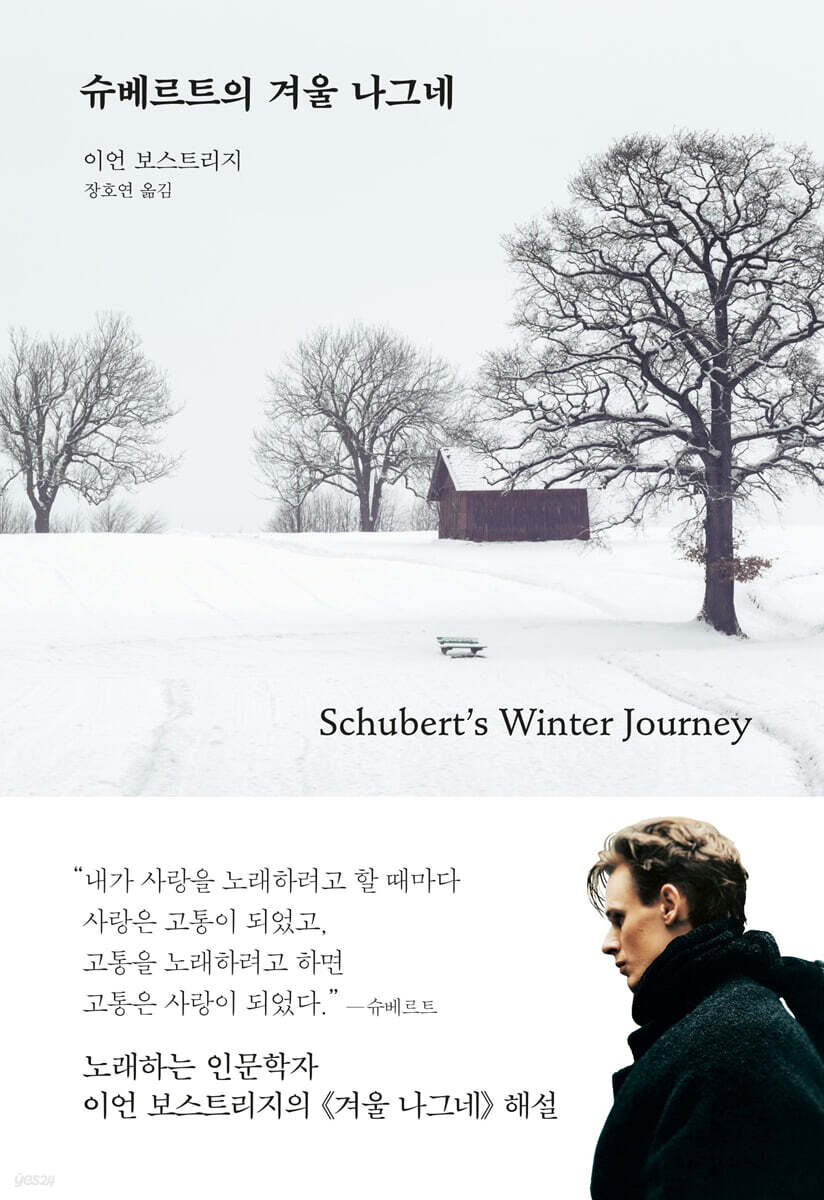
Schubert's Winter Journey (Winter Edition)
 |
Description
Book Introduction
“Winterreise can be compared to Shakespeare’s poetry and Proust’s novel.”
This book is a detailed analysis of the 24 songs of "Winterreise" by world-renowned tenor Ian Bostridge, who has performed "Winterreise" over 100 times over the past 30 years.
In his book, Schubert's Winter Journey, Ian Bostridge explains the piece through musical explanations and the historical, social, and cultural context of the time, making it more accessible to those new to classical music.
Author Ian Bostridge is a tenor with a somewhat unusual background.
He majored in history and philosophy, not vocal music, and received a doctorate in history from Oxford University in England.
He taught history at university, but at the age of twenty-nine, at the recommendation of the greatest baritone of his time, Fischer-Dieskau, he became a full-time singer.
His history is fully revealed in 『Schubert's Winter Journey』.
He brings together everything from musical descriptions to stories about the times, society, and culture of Schubert and Müller, and points out the hidden meanings of the song cycle “Winterreise.”
Through this, readers infer the social meaning implied in the song and understand Schubert's life and music.
Through Bostridge's writing and songs, readers will imagine the journey of a traveler setting out on a winter's journey in early 19th-century Germany.
This book is a detailed analysis of the 24 songs of "Winterreise" by world-renowned tenor Ian Bostridge, who has performed "Winterreise" over 100 times over the past 30 years.
In his book, Schubert's Winter Journey, Ian Bostridge explains the piece through musical explanations and the historical, social, and cultural context of the time, making it more accessible to those new to classical music.
Author Ian Bostridge is a tenor with a somewhat unusual background.
He majored in history and philosophy, not vocal music, and received a doctorate in history from Oxford University in England.
He taught history at university, but at the age of twenty-nine, at the recommendation of the greatest baritone of his time, Fischer-Dieskau, he became a full-time singer.
His history is fully revealed in 『Schubert's Winter Journey』.
He brings together everything from musical descriptions to stories about the times, society, and culture of Schubert and Müller, and points out the hidden meanings of the song cycle “Winterreise.”
Through this, readers infer the social meaning implied in the song and understand Schubert's life and music.
Through Bostridge's writing and songs, readers will imagine the journey of a traveler setting out on a winter's journey in early 19th-century Germany.
- You can preview some of the book's contents.
Preview
index
To begin with
Song 1.
Good night
Song 2.
wind chime
Song 3.
frozen tears
Song 4.
freezing
Song 5.
barley tree
Song 6.
Overflowing tears
Song 7.
In the stream
Song 8.
Looking back
Song 9.
wisp
Song 10.
rest
Song 11.
Dream of Spring
Song 12.
solitude
Song 13.
mail coach
Song 14.
gray hair
Song 15.
crow
Song 16: Last Hope
Song 17.
In the village
Song 18.
Stormy Morning
Song 19.
illusion
Song 20.
milestone
Song 21.
inn
Song 22.
courage
Song 23.
Fantasy Sun
Song 24.
street musicians
In conclusion
Translator's Note
Original lyrics of "Winter Wanderer"
Search / References
Song 1.
Good night
Song 2.
wind chime
Song 3.
frozen tears
Song 4.
freezing
Song 5.
barley tree
Song 6.
Overflowing tears
Song 7.
In the stream
Song 8.
Looking back
Song 9.
wisp
Song 10.
rest
Song 11.
Dream of Spring
Song 12.
solitude
Song 13.
mail coach
Song 14.
gray hair
Song 15.
crow
Song 16: Last Hope
Song 17.
In the village
Song 18.
Stormy Morning
Song 19.
illusion
Song 20.
milestone
Song 21.
inn
Song 22.
courage
Song 23.
Fantasy Sun
Song 24.
street musicians
In conclusion
Translator's Note
Original lyrics of "Winter Wanderer"
Search / References
Detailed image
.jpg)
Publisher's Review
The musical, cultural, political, social, and linguistic significance of "Winter Wanderer"
Anatomy of the obsession with it all!
"Schubert's Winterreise" is a book in which world-renowned tenor Ian Bostridge, who has performed "Winterreise" over 100 times over 30 years, analyzes each of the 24 songs from "Winterreise" in detail.
Music called classical or art songs is not the kind of music we normally listen to.
Many people might find it a bit difficult and perhaps even boring.
Nonetheless, Schubert's song cycle "Winterreise" continues to resonate with audiences around the world.
His answer is that it is a great work of art based on the common experience of mankind.
That is why 『Winter Wanderer』 is a must-read for even those new to classical music.
In his book, Schubert's Winterreise, Ian Bostridge explains the piece through musical explanations and the historical, social, and cultural context of the time, making it more accessible to those new to classical music.
Author Ian Bostridge is a tenor with a somewhat unusual background.
He majored in history and philosophy, not vocal music, and received a doctorate in history from Oxford University in England.
He taught history at university, but at the age of twenty-nine, at the recommendation of the greatest baritone of his time, Fischer-Dieskau, he became a full-time singer.
His history is fully revealed in 『Schubert's Winter Journey』.
He brings together everything from musical descriptions to stories about the times, society, and culture of Schubert and Müller, and points out the hidden meanings of the song cycle “Winterreise.”
Through this, readers infer the social meaning implied in the song and understand Schubert's life and music.
Through Bostridge's writing and songs, the reader imagines the journey of a traveler setting out on a winter's journey in early 19th-century Germany.
A wanderer who has parted ways with his lover and left his lover's house with dark eyes.
The loneliness and sadness of separation that comes with it.
Bostridge, with a slightly nervous voice, a skinny body, and a sad expression, sings as a 'winter traveler'.
When the song ends, a palpable silence falls over the audience.
Müller's poetry, Schubert's music
And the ultimate musical guide created by Bostridge's interpretation
Poetry that reveals the sorrowful feelings of a traveler, and music that maximizes and expresses those feelings.
Bostridge's interpretation delves into lyrics that don't reveal detailed context.
These three things come together to make Schubert's Winter Journey complete.
Bostridge recreates the world of Winterreise by delving into the works of other contemporary writers, such as Goethe and Thomas Mann, as well as Schubert and Müller, and even into people's perceptions of phenomena such as will-o'-the-wisps and glaciers.
By meticulously dissecting the 24 songs throughout the book, we can get a close-up look at everything from that time, as if we could see and hear it.
And thanks to that, even when listening to the song cycle in a different time and place than Schubert's time, I empathize with the traveler, listen to the music in a new way, and become absorbed in it.
Music is not complete in itself.
Its value is revealed anew when it is reinterpreted through the society, history, and culture of the time in which it was created.
Schubert's Winter Journey shows what a perfect guide to music is.
“Art is created in history by living, feeling, and thinking human beings.
We cannot understand art without examining how it relates to and is grounded in a world of emotions, ideologies, and practical constraints.
Art is born from the collision of life and form.
It does not exist in some kind of idealized vacuum.
“Only when we examine the personal and political in the broadest sense can we properly evaluate the more formal aspects.” _From ‘In Conclusion’
Schubert's musical world vividly unfolds along the traveler's wanderings.
The song cycle "Winterreise" was composed by Franz Schubert based on a poem by Wilhelm Müller.
Schubert's song cycle, consisting of 24 pieces in total, is slightly different in order from the poems published by Müller.
Müller changed the order of the first twelve poems he published when he later published twelve more.
However, Schubert did not change the order of the 12 songs he had composed first to match Müller's, and he composed one poem that was published later, changing its order.
Schubert completed the song cycle by adding his own unique color.
The emotions of a traveler parting ways with his beloved and setting out on a dark winter road become even more powerful when he is dressed in Schubert's melody.
In the first song, where a traveler sets out on a journey, the mood of the song is revealed by using the 'treadmill trot' melody of 'walking speed'.
The climax is made to soar to a high note, creating tension, and in the sixth song, “Overflowing Tears,” a dotted rhythm is used to portray the image of a “haggard traveler half-blinded by tears.”
The text introduces musical devices used by Schubert throughout the piece, showing how performers contemplate and express the composer's intentions.
Such explanations encourage us to listen to the music more carefully.
A deeper look into "Winter Wanderer," from a single word to its historical context.
- “You came as a stranger and you left as a stranger.”
Bostridge's "Schubert's Winter Journey" also answers the simple but important question: "Why did Schubert take an interest in Müller's poem and set it to music?"
The author suggests throughout the book that Müller implanted his own ideas in the poems and that Schubert would have sympathized with them.
Of course, breaking up with a lover is a subject that anyone can relate to, regardless of time or place.
But Bostridge looks beyond the poem's implied narrative.
For example, in the first song, the word 'stranger' is expressed as the German word 'Fremd'.
This does not mean a mere stranger, but a foreigner living in one's own land, and this word was important to Schubert and Müller.
At that time, Germany was in a situation where the Holy Roman Empire had collapsed under Napoleon and only half of its territory was recovered through the Congress of Vienna.
It was a time when sovereignty was in turmoil, nationalist uprisings occurred, and freedom was suppressed.
Schubert, who lived in Vienna during this period, and Müller, who lived in Dessau, were truly ‘foreigners living in their own land.’
According to Bostridge, these images of solitude, isolation, and alienation are scattered throughout Winterreise.
Knowing and hearing these facts, one is reminded of the composer and poet as a traveler who had to set out on a journey in the middle of a winter night and had nowhere to settle.
The music feels even more lonely.
The composer's zeitgeist revealed in "Winter Wanderer" amidst a changing social and political landscape.
- “The charcoal-cutting man’s cramped hut is my resting place.”
Bostridge's meticulous analysis of each word or situation in each song is embedded throughout.
He brings social and historical aspects to music, taking readers back to Schubert's time.
In the 10th song, the traveler takes his first rest.
The place to rest is the 'charcoal man's' hut.
Charcoal burner is a word unfamiliar to us.
This is because these days, it is rare to obtain energy from wood or charcoal.
The era of Schubert and Müller was the beginning of the Industrial Revolution, when coal replaced charcoal.
Charcoal making is a dying profession.
A place where a traveler can rest is such a space.
Bostridge talks about the meaning of the charcoal burner here.
A being that reminds us of lost ways of life and a rapidly changing economy.
Another one is more political.
Bostridge notes that the charcoal-cutters symbolize the Carbonari, a secret society of independence and freedom that was active in an era when the activities of artists were restricted.
Carbonari itself means charcoal charcoal in Italian, and their symbolic colors are black and red, reminiscent of hot charcoal.
The spirit of the times is revealed in the works of composers and poets who praised the nationalist uprising.
The world of the traveler seen through the interests of the times and its relationship with other literary works
- “When will you bloom again as a flower in the window?”
In the 11th song, "Spring Dream," Müller describes his now-lost lover as a blooming ice flower.
Schubert's time was colder than today, and there was a keen interest in glaciers and snow crystals.
Goethe expressed his thoughts on glaciers in Wilhelm Meister's Travels, and Thomas Mann's Doctor Faustus features a character fascinated by ice flowers.
This is a time when attempts are being made to scientifically and objectively interpret sex.
Bostridge explains the ice flowers in Winter Wanderer through these contemporary perceptions.
The ice flower is “an eerie symbol of the unstable boundary between the living and the inanimate,” and its fragile image “gives strength to the irony of the last existence.”
The song asks, “When will you bloom again as a flower in the window?” but the ice flower will soon melt and never bloom again.
It is like a past memory of a traveler and his lover, and perhaps it hints at the traveler's future path.
The original title of this book had the subtitle 'Anatomy of an obsession'.
Bostridge's writing, which delves into each song in detail, truly shows the author's dedication and love for music.
By following the winter traveler's journey guided by Bostridge, readers will vividly experience Schubert's musical world.
Anatomy of the obsession with it all!
"Schubert's Winterreise" is a book in which world-renowned tenor Ian Bostridge, who has performed "Winterreise" over 100 times over 30 years, analyzes each of the 24 songs from "Winterreise" in detail.
Music called classical or art songs is not the kind of music we normally listen to.
Many people might find it a bit difficult and perhaps even boring.
Nonetheless, Schubert's song cycle "Winterreise" continues to resonate with audiences around the world.
His answer is that it is a great work of art based on the common experience of mankind.
That is why 『Winter Wanderer』 is a must-read for even those new to classical music.
In his book, Schubert's Winterreise, Ian Bostridge explains the piece through musical explanations and the historical, social, and cultural context of the time, making it more accessible to those new to classical music.
Author Ian Bostridge is a tenor with a somewhat unusual background.
He majored in history and philosophy, not vocal music, and received a doctorate in history from Oxford University in England.
He taught history at university, but at the age of twenty-nine, at the recommendation of the greatest baritone of his time, Fischer-Dieskau, he became a full-time singer.
His history is fully revealed in 『Schubert's Winter Journey』.
He brings together everything from musical descriptions to stories about the times, society, and culture of Schubert and Müller, and points out the hidden meanings of the song cycle “Winterreise.”
Through this, readers infer the social meaning implied in the song and understand Schubert's life and music.
Through Bostridge's writing and songs, the reader imagines the journey of a traveler setting out on a winter's journey in early 19th-century Germany.
A wanderer who has parted ways with his lover and left his lover's house with dark eyes.
The loneliness and sadness of separation that comes with it.
Bostridge, with a slightly nervous voice, a skinny body, and a sad expression, sings as a 'winter traveler'.
When the song ends, a palpable silence falls over the audience.
Müller's poetry, Schubert's music
And the ultimate musical guide created by Bostridge's interpretation
Poetry that reveals the sorrowful feelings of a traveler, and music that maximizes and expresses those feelings.
Bostridge's interpretation delves into lyrics that don't reveal detailed context.
These three things come together to make Schubert's Winter Journey complete.
Bostridge recreates the world of Winterreise by delving into the works of other contemporary writers, such as Goethe and Thomas Mann, as well as Schubert and Müller, and even into people's perceptions of phenomena such as will-o'-the-wisps and glaciers.
By meticulously dissecting the 24 songs throughout the book, we can get a close-up look at everything from that time, as if we could see and hear it.
And thanks to that, even when listening to the song cycle in a different time and place than Schubert's time, I empathize with the traveler, listen to the music in a new way, and become absorbed in it.
Music is not complete in itself.
Its value is revealed anew when it is reinterpreted through the society, history, and culture of the time in which it was created.
Schubert's Winter Journey shows what a perfect guide to music is.
“Art is created in history by living, feeling, and thinking human beings.
We cannot understand art without examining how it relates to and is grounded in a world of emotions, ideologies, and practical constraints.
Art is born from the collision of life and form.
It does not exist in some kind of idealized vacuum.
“Only when we examine the personal and political in the broadest sense can we properly evaluate the more formal aspects.” _From ‘In Conclusion’
Schubert's musical world vividly unfolds along the traveler's wanderings.
The song cycle "Winterreise" was composed by Franz Schubert based on a poem by Wilhelm Müller.
Schubert's song cycle, consisting of 24 pieces in total, is slightly different in order from the poems published by Müller.
Müller changed the order of the first twelve poems he published when he later published twelve more.
However, Schubert did not change the order of the 12 songs he had composed first to match Müller's, and he composed one poem that was published later, changing its order.
Schubert completed the song cycle by adding his own unique color.
The emotions of a traveler parting ways with his beloved and setting out on a dark winter road become even more powerful when he is dressed in Schubert's melody.
In the first song, where a traveler sets out on a journey, the mood of the song is revealed by using the 'treadmill trot' melody of 'walking speed'.
The climax is made to soar to a high note, creating tension, and in the sixth song, “Overflowing Tears,” a dotted rhythm is used to portray the image of a “haggard traveler half-blinded by tears.”
The text introduces musical devices used by Schubert throughout the piece, showing how performers contemplate and express the composer's intentions.
Such explanations encourage us to listen to the music more carefully.
A deeper look into "Winter Wanderer," from a single word to its historical context.
- “You came as a stranger and you left as a stranger.”
Bostridge's "Schubert's Winter Journey" also answers the simple but important question: "Why did Schubert take an interest in Müller's poem and set it to music?"
The author suggests throughout the book that Müller implanted his own ideas in the poems and that Schubert would have sympathized with them.
Of course, breaking up with a lover is a subject that anyone can relate to, regardless of time or place.
But Bostridge looks beyond the poem's implied narrative.
For example, in the first song, the word 'stranger' is expressed as the German word 'Fremd'.
This does not mean a mere stranger, but a foreigner living in one's own land, and this word was important to Schubert and Müller.
At that time, Germany was in a situation where the Holy Roman Empire had collapsed under Napoleon and only half of its territory was recovered through the Congress of Vienna.
It was a time when sovereignty was in turmoil, nationalist uprisings occurred, and freedom was suppressed.
Schubert, who lived in Vienna during this period, and Müller, who lived in Dessau, were truly ‘foreigners living in their own land.’
According to Bostridge, these images of solitude, isolation, and alienation are scattered throughout Winterreise.
Knowing and hearing these facts, one is reminded of the composer and poet as a traveler who had to set out on a journey in the middle of a winter night and had nowhere to settle.
The music feels even more lonely.
The composer's zeitgeist revealed in "Winter Wanderer" amidst a changing social and political landscape.
- “The charcoal-cutting man’s cramped hut is my resting place.”
Bostridge's meticulous analysis of each word or situation in each song is embedded throughout.
He brings social and historical aspects to music, taking readers back to Schubert's time.
In the 10th song, the traveler takes his first rest.
The place to rest is the 'charcoal man's' hut.
Charcoal burner is a word unfamiliar to us.
This is because these days, it is rare to obtain energy from wood or charcoal.
The era of Schubert and Müller was the beginning of the Industrial Revolution, when coal replaced charcoal.
Charcoal making is a dying profession.
A place where a traveler can rest is such a space.
Bostridge talks about the meaning of the charcoal burner here.
A being that reminds us of lost ways of life and a rapidly changing economy.
Another one is more political.
Bostridge notes that the charcoal-cutters symbolize the Carbonari, a secret society of independence and freedom that was active in an era when the activities of artists were restricted.
Carbonari itself means charcoal charcoal in Italian, and their symbolic colors are black and red, reminiscent of hot charcoal.
The spirit of the times is revealed in the works of composers and poets who praised the nationalist uprising.
The world of the traveler seen through the interests of the times and its relationship with other literary works
- “When will you bloom again as a flower in the window?”
In the 11th song, "Spring Dream," Müller describes his now-lost lover as a blooming ice flower.
Schubert's time was colder than today, and there was a keen interest in glaciers and snow crystals.
Goethe expressed his thoughts on glaciers in Wilhelm Meister's Travels, and Thomas Mann's Doctor Faustus features a character fascinated by ice flowers.
This is a time when attempts are being made to scientifically and objectively interpret sex.
Bostridge explains the ice flowers in Winter Wanderer through these contemporary perceptions.
The ice flower is “an eerie symbol of the unstable boundary between the living and the inanimate,” and its fragile image “gives strength to the irony of the last existence.”
The song asks, “When will you bloom again as a flower in the window?” but the ice flower will soon melt and never bloom again.
It is like a past memory of a traveler and his lover, and perhaps it hints at the traveler's future path.
The original title of this book had the subtitle 'Anatomy of an obsession'.
Bostridge's writing, which delves into each song in detail, truly shows the author's dedication and love for music.
By following the winter traveler's journey guided by Bostridge, readers will vividly experience Schubert's musical world.
GOODS SPECIFICS
- Date of issue: December 15, 2023
- Page count, weight, size: 520 pages | 770g | 138*216*30mm
- ISBN13: 9791166891922
- ISBN10: 1166891925
You may also like
카테고리
korean


korean

![GQ KOREA Mark (Monthly): December [2025]](http://librairie.coreenne.fr/cdn/shop/files/8ef265dbbfbf186523ed75ba7319009d.jpg?v=1765340328&width=3840)


