

A walk through an Italian art museum
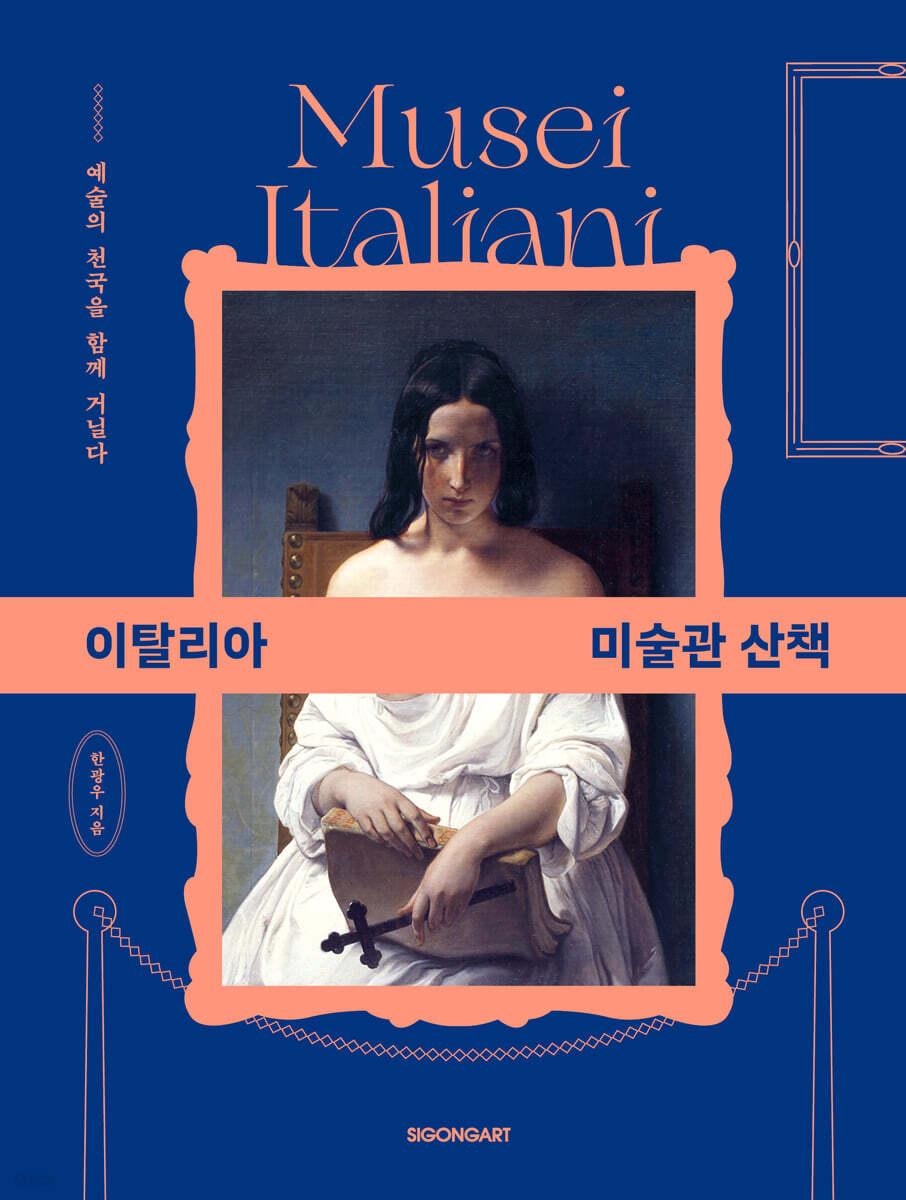 |
Description
Book Introduction
Treasures of humanity found in the paradise of art
Italy, the birthplace of European art, is literally an art paradise.
Many artists who decorated the first pages of Western art history were born and active in Italy.
Rome, which supported massive projects by inviting artists representing each era; the Vatican, home to the Papal Palace; Florence, which produced artists such as Michelangelo, Raphael, and Botticelli; and Milan and Venice cannot be left out.
The museums here house ancient Roman art, the root of all Western culture, and are a must-visit for anyone wanting to understand not only Italian but also Western art.
The author, a sculptor, shares vivid stories of Italy from his personal experience over nearly a decade, along with stories of Italian art galleries and their collections, which he has painstakingly visited one by one.
I recommend packing this book lightly in your backpack on your way to Europe and following its path along the way.
Italy, the birthplace of European art, is literally an art paradise.
Many artists who decorated the first pages of Western art history were born and active in Italy.
Rome, which supported massive projects by inviting artists representing each era; the Vatican, home to the Papal Palace; Florence, which produced artists such as Michelangelo, Raphael, and Botticelli; and Milan and Venice cannot be left out.
The museums here house ancient Roman art, the root of all Western culture, and are a must-visit for anyone wanting to understand not only Italian but also Western art.
The author, a sculptor, shares vivid stories of Italy from his personal experience over nearly a decade, along with stories of Italian art galleries and their collections, which he has painstakingly visited one by one.
I recommend packing this book lightly in your backpack on your way to Europe and following its path along the way.
- You can preview some of the book's contents.
Preview
index
Entering
Part 1.
Rome
Palazzo Massimo at the National Museum of Rome: The Beginnings of Italian Culture and the Art of Ancient Rome
Capitoline Museums: Confirming the Identity of the Roman Empire
The Vatican Museums (Musei Vaticani): The only place in the world where you can see art from all eras.
Galleria Borghese: The True Face of Baroque Art
Part 2.
Florence
Uffizi Gallery (Galleria degli Uffizi): Everything about Florentine Renaissance painting
Florence Accademia Gallery (Galleria dell'Accademia di Firenze): Home to Michelangelo's original David
The Mediceo Laurenziano Complex: The Glory of the Medici Family, Preserved in Art
[See also here] A treasure trove of sculptures
[See also here] Hidden Heavenly Colors
Part 3.
Milan and Venice
Pinacoteca di Brera: 1400s-1900s in a place where history breathes
Pinacoteca Ambrosiana: Milan's treasure, imbued with the legacy of Leonardo da Vinci.
Museo del Novecento: Italy since 1900 through Art
[See also here] The beauty of Italian Gothic architecture
The Gallerie dell'Accademia di Venezia: The extraordinary works of Venetian painters and their massive canvases.
Part 1.
Rome
Palazzo Massimo at the National Museum of Rome: The Beginnings of Italian Culture and the Art of Ancient Rome
Capitoline Museums: Confirming the Identity of the Roman Empire
The Vatican Museums (Musei Vaticani): The only place in the world where you can see art from all eras.
Galleria Borghese: The True Face of Baroque Art
Part 2.
Florence
Uffizi Gallery (Galleria degli Uffizi): Everything about Florentine Renaissance painting
Florence Accademia Gallery (Galleria dell'Accademia di Firenze): Home to Michelangelo's original David
The Mediceo Laurenziano Complex: The Glory of the Medici Family, Preserved in Art
[See also here] A treasure trove of sculptures
[See also here] Hidden Heavenly Colors
Part 3.
Milan and Venice
Pinacoteca di Brera: 1400s-1900s in a place where history breathes
Pinacoteca Ambrosiana: Milan's treasure, imbued with the legacy of Leonardo da Vinci.
Museo del Novecento: Italy since 1900 through Art
[See also here] The beauty of Italian Gothic architecture
The Gallerie dell'Accademia di Venezia: The extraordinary works of Venetian painters and their massive canvases.
Detailed image
Into the book
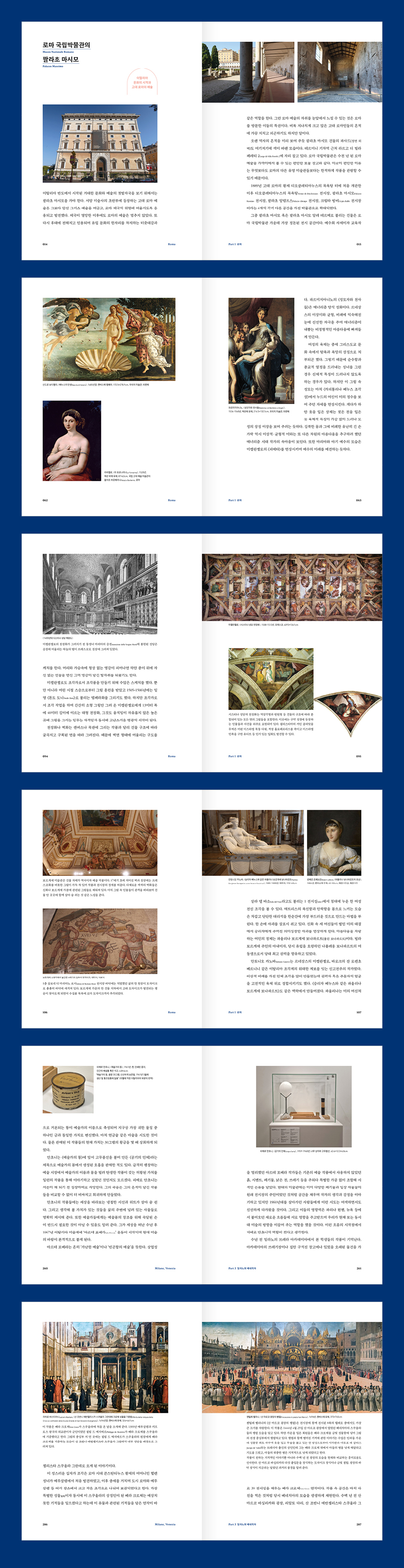
Although this book covers only works created in a limited region, Italy, it has tried to include, however insufficiently, the story of art from ancient Greece and Rome to modern times.
In the art galleries and museums of Rome, the exhibition focused on ancient Greek and Roman art, along with Renaissance and Baroque paintings and sculptures. In Florence, the exhibition featured Renaissance paintings and sculptures, along with buildings related to the Medici family, who transformed Florence into a Renaissance city.
In Milan, the exhibition featured works by several Renaissance masters, Italian Neoclassical and Romantic works, and works by modern and contemporary Italian artists active in the early 1900s. In Venice, the exhibition focused on Renaissance and Mannerist paintings born within the unique culture of Venice.
--- From "Entering"
The Romans, who loved the splendid Greek civilization, brought heavy sculptures from Greece and copied them to decorate their homes.
Roman emperors also had columns and capitals made by Greek masons transported to their capital, Rome, to decorate their buildings.
The museum displays works by artisans from thousands of years ago, from Greek sculptures unearthed hundreds of years after the fall of Rome, to Roman sculptures adapted and recreated from Greek sculptures, to the mosaics and frescoes that adorned ancient dwellings.
It is amazing to be able to see and feel these ancient relics right before your eyes without any obstructions.
--- From "Palazzo Massimo of the National Museum of Rome: The Beginnings of Italian Culture and the Art of Ancient Rome"
Even in "Fortune," painted in 1595, shortly after Caravaggio, a painter trained in Milan, arrived in Rome, it shows that the young Caravaggio was not much different from the time when he was burning with creative passion.
The work "Luck," which can also be translated as "Good luck!", warns travelers who have the good fortune to visit Rome against the misfortune that may follow.
This painting brought Caravaggio great success.
Not only did he receive another commission with the same title soon after completing the work, but many contemporary artists also wanted to join in by adapting this painting of good and bad luck. The 115×150 centimeter canvas still leads the viewer to excitement, tension, and empathy.
A girl and a somewhat arrogant boy wearing adult clothes that do not match their young faces and carrying a long sword are seen.
The sweet smile of the young gypsy girl, who seems to see through everything about the boy, foreshadows a short relationship that will soon end in misfortune.
--- From “Capitolini Museums (Musei Capitolini): Confirming the Identity of the Roman Empire”
The most familiar painting is probably The Creation of Adam.
This may be due to the characteristics of Renaissance artists armed with anatomical knowledge, which has led to speculation that 'God gave knowledge to humans.'
Because the Creator's red cloak seems to resemble a cross-section of the human brain.
It seems to be connected to the fact that Michelangelo's sculpture of David featured a somewhat enlarged head, bulging eyes, and large hands to express unique human characteristics, such as 'spirit' and 'wisdom'.
The Creator, in a red cloak supported by angels, advances toward Adam.
As in Michelangelo's The Last Judgment painted on the west wall of the Sistine Chapel, the angel's wings were omitted.
Adam, who was created in the image of the Creator and according to the standard of absolute beauty, has not yet felt the breath of life.
The audience's attention is focused on the small gap between the two fingers that conveys the warmth of life, making them wait with bated breath for the future history of mankind.
--- From "Vatican Museums (Musei Vaticani): The only place in the world where you can see all the art of all times"
If you visit Italy, you will find that each city's representative art museums have historical connections to families or groups.
The reason it continues to be mentioned even after hundreds of years is not only because of the strong military power or financial resources it had at the time.
This can be attributed to the artists they supported and the artworks they collected.
Representative examples include the Medici family in Florence, the Ambrosiana Order in Milan, and several Scuola Grande in Venice.
One of the representative families in this context is the Borghese.
This art gallery, a must-see when visiting Rome, showcases works of art collected by the Borghese family over the centuries.
Although he was from Siena, he gradually emerged among the Roman nobility after producing a pope.
Cardinal Camillo Borghese was elected Pope in 1605 and took the name Paul V.
The papal family also naturally gained great influence in Rome.
--- From "Galleria Borghese: The True Face of Baroque Art"
Sometimes, a copy becomes more famous and popular than the original.
A representative example is the Wild Boar sculpture in the Corridoio di Ponente of the Uffizi Gallery.
At the entrance to the Loggia del Mercato Nuovo, where leather goods vendors gather in downtown Florence, there is a famous landmark called the “Fountain of the Little Pig.”
Tourists from all over the world stop by to touch and take pictures of the bronze replica of a wild boar statue.
The actual protagonist of the Fountain of the Little Pig, the Boar, is known to have been a marble copy made in the 1st or 2nd century BC, based on a now-lost ancient Greek bronze statue from the 3rd century BC.
It realistically depicts a wild boar that is terrified of being prey, so it is speculated that it was installed together with other sculptures related to hunting.
--- From "The Uffizi Gallery (Galleria degli Uffizi): Everything About Florentine Renaissance Painting"
As you pass each of Michelangelo's works in the Galleria dei Prigioni, the David that was visible in the distance becomes closer and closer.
You can feel the figure described as a boy in the Bible growing larger and larger, and the head you are looking at gradually turning steeper.
As you become a dot in the midst of the bustling crowd, you arrive in front of the David at the center of the Tribuna del David.
David is bigger than you think.
Before visiting the Accademia Gallery in Florence, most people will have already seen the replica in front of the Palazzo Vecchio.
However, David, standing in front of the Piazza della Signoria with its vast horizontality and the Palazzo Vecchio with its imposing verticality, cannot help but suffer from relative dwarfism.
However, David boasts a grand scale of over 5 meters including the pedestal.
--- From "Galleria dell'Accademia di Firenze: Home to Michelangelo's original David"
Michelangelo first planned this place in 1520 at the request of Pope Leo X, who was from the Medici family.
In addition to the existing sculptures, the new sacrificial chamber was to be decorated with more colorful figures symbolizing rivers, land, and sky on the walls.
However, construction was halted and resumed several times during a period of turmoil that was not only recorded in Florence but also in European history.
When Pope Clement VII, a member of the Medici family who had supported him, passed away in 1534, Michelangelo left for Rome, leaving behind all the works he had been working on in Florence, including the New Sacristy, the Library of the Laurentian Medicea, and the Slaves for the tomb of Pope Julius II (1525-1530).
Michelangelo left for Rome in 1534, and the void left by the work was filled by artists such as Giorgio Vasari until the late 1550s, leaving it in its current form.
--- From "Complesso Mediceo Laurenziano: The Glory of the Medici Family in Art"
Francesco Ayetz's masterpiece, "The Kiss (Il bacio)", appears on the surface to be an expression of the regret between a man and a woman who must soon part ways.
In a blank, medieval space, there is a woman with her eyes closed, narrowed as if trying to watch the man who is faithful to her for a brief moment leave until the very end.
Although it may seem like a simple structure, it gives freedom of imagination through the possibility of various interpretations.
Additionally, the shadow of someone seen behind them hints at another being appearing between the two, adding a new imagination.
The colors of the clothes are also used to interpret hidden intentions: the man is wearing a reddish-brown cloak with green lining and red trousers under a brown hat with feathers, while the woman is wearing a blue dress with visible white lace.
Their appearance is reminiscent of the green, white, and red combination of the Italian flag, which began to be used around the 1800s, and the blue, white, and red combination used in the French flag.
--- From "Pinacoteca di Brera: 1400-1900s at a site where history breathes"
After leaving Florence and arriving in Milan in 1482, da Vinci painted several portraits.
And I wanted to express 'moti dell'anima', which means movement of the soul.
Believing that the nature of the soul would be revealed through appearance, he studied the physical characteristics of criminals to portray Judas, who betrayed Jesus, when painting The Last Supper.
In “Portrait of a Musician,” a calm and delicate personality seems to be revealed.
The protagonist is known as the musician Franchino Gaforio, who was the maestro (conductor) of the Milan Duomo choir.
But it's just a guess, and I can't say for sure who it is.
Just looking at the sheet music in the hands of a man in his 30s, you can guess that he is a musician.
As I stare blankly at the painting, feeling frustrated and unable to find any answers, I notice cracks and flaws in the woodblock on which the painting was painted.
It appears to be a wound that the woodblocks used for painting have acquired over time before canvas became widely used.
In that sense, I think we can understand why it is tightly wrapped in a glass case.
--- From "Pinacoteca Ambrosiana: Milan's Treasure that Preserves Traces of Leonardo da Vinci"
The one who placed “The Artist’s Shit” among the works created with refined thoughts representing the times was Piero Manzoni.
As a representative modern artist active in Milan in the 1950s and 1960s, he left tin cans in the exhibition hall.
By sealing your own shit.
You might frown and pass by the ornate works, but once you understand their meaning, you can sense a unique fragrance of modern art, different from other works that exude fragrance through beautiful colors and shapes.
While planning “Artist’s Shit,” which made him a world-renowned artist, Manzoni focused on the problem of the art world being reduced to an object of consumption for show.
In an era where people were willing to buy anything by a famous artist, he questioned what he could sell, and the conclusion he came to was that it was 'artist's shit.'
--- From “Museo del Novecento: Italy since 1900 as seen through art”
Venice is one of the cities where the Mannerist style developed.
Tintoretto, a representative Venetian painter, combines the Mannerist style with the bright colors of Venetian art in his works, allowing the audience to become more immersed in the events unfolding on the screen.
The legend of the spirit of the departed Saint Mark and the dramatic story of the miraculous transfer of his remains to Venice provide excellent material for Tintoretto's tense Mannerist style.
The exaggerated perspective seen in the space and the white brushstrokes left by the artist around the quick steps of the figures in the painting, like waves of movement, add liveliness to the breathless story.
In the art galleries and museums of Rome, the exhibition focused on ancient Greek and Roman art, along with Renaissance and Baroque paintings and sculptures. In Florence, the exhibition featured Renaissance paintings and sculptures, along with buildings related to the Medici family, who transformed Florence into a Renaissance city.
In Milan, the exhibition featured works by several Renaissance masters, Italian Neoclassical and Romantic works, and works by modern and contemporary Italian artists active in the early 1900s. In Venice, the exhibition focused on Renaissance and Mannerist paintings born within the unique culture of Venice.
--- From "Entering"
The Romans, who loved the splendid Greek civilization, brought heavy sculptures from Greece and copied them to decorate their homes.
Roman emperors also had columns and capitals made by Greek masons transported to their capital, Rome, to decorate their buildings.
The museum displays works by artisans from thousands of years ago, from Greek sculptures unearthed hundreds of years after the fall of Rome, to Roman sculptures adapted and recreated from Greek sculptures, to the mosaics and frescoes that adorned ancient dwellings.
It is amazing to be able to see and feel these ancient relics right before your eyes without any obstructions.
--- From "Palazzo Massimo of the National Museum of Rome: The Beginnings of Italian Culture and the Art of Ancient Rome"
Even in "Fortune," painted in 1595, shortly after Caravaggio, a painter trained in Milan, arrived in Rome, it shows that the young Caravaggio was not much different from the time when he was burning with creative passion.
The work "Luck," which can also be translated as "Good luck!", warns travelers who have the good fortune to visit Rome against the misfortune that may follow.
This painting brought Caravaggio great success.
Not only did he receive another commission with the same title soon after completing the work, but many contemporary artists also wanted to join in by adapting this painting of good and bad luck. The 115×150 centimeter canvas still leads the viewer to excitement, tension, and empathy.
A girl and a somewhat arrogant boy wearing adult clothes that do not match their young faces and carrying a long sword are seen.
The sweet smile of the young gypsy girl, who seems to see through everything about the boy, foreshadows a short relationship that will soon end in misfortune.
--- From “Capitolini Museums (Musei Capitolini): Confirming the Identity of the Roman Empire”
The most familiar painting is probably The Creation of Adam.
This may be due to the characteristics of Renaissance artists armed with anatomical knowledge, which has led to speculation that 'God gave knowledge to humans.'
Because the Creator's red cloak seems to resemble a cross-section of the human brain.
It seems to be connected to the fact that Michelangelo's sculpture of David featured a somewhat enlarged head, bulging eyes, and large hands to express unique human characteristics, such as 'spirit' and 'wisdom'.
The Creator, in a red cloak supported by angels, advances toward Adam.
As in Michelangelo's The Last Judgment painted on the west wall of the Sistine Chapel, the angel's wings were omitted.
Adam, who was created in the image of the Creator and according to the standard of absolute beauty, has not yet felt the breath of life.
The audience's attention is focused on the small gap between the two fingers that conveys the warmth of life, making them wait with bated breath for the future history of mankind.
--- From "Vatican Museums (Musei Vaticani): The only place in the world where you can see all the art of all times"
If you visit Italy, you will find that each city's representative art museums have historical connections to families or groups.
The reason it continues to be mentioned even after hundreds of years is not only because of the strong military power or financial resources it had at the time.
This can be attributed to the artists they supported and the artworks they collected.
Representative examples include the Medici family in Florence, the Ambrosiana Order in Milan, and several Scuola Grande in Venice.
One of the representative families in this context is the Borghese.
This art gallery, a must-see when visiting Rome, showcases works of art collected by the Borghese family over the centuries.
Although he was from Siena, he gradually emerged among the Roman nobility after producing a pope.
Cardinal Camillo Borghese was elected Pope in 1605 and took the name Paul V.
The papal family also naturally gained great influence in Rome.
--- From "Galleria Borghese: The True Face of Baroque Art"
Sometimes, a copy becomes more famous and popular than the original.
A representative example is the Wild Boar sculpture in the Corridoio di Ponente of the Uffizi Gallery.
At the entrance to the Loggia del Mercato Nuovo, where leather goods vendors gather in downtown Florence, there is a famous landmark called the “Fountain of the Little Pig.”
Tourists from all over the world stop by to touch and take pictures of the bronze replica of a wild boar statue.
The actual protagonist of the Fountain of the Little Pig, the Boar, is known to have been a marble copy made in the 1st or 2nd century BC, based on a now-lost ancient Greek bronze statue from the 3rd century BC.
It realistically depicts a wild boar that is terrified of being prey, so it is speculated that it was installed together with other sculptures related to hunting.
--- From "The Uffizi Gallery (Galleria degli Uffizi): Everything About Florentine Renaissance Painting"
As you pass each of Michelangelo's works in the Galleria dei Prigioni, the David that was visible in the distance becomes closer and closer.
You can feel the figure described as a boy in the Bible growing larger and larger, and the head you are looking at gradually turning steeper.
As you become a dot in the midst of the bustling crowd, you arrive in front of the David at the center of the Tribuna del David.
David is bigger than you think.
Before visiting the Accademia Gallery in Florence, most people will have already seen the replica in front of the Palazzo Vecchio.
However, David, standing in front of the Piazza della Signoria with its vast horizontality and the Palazzo Vecchio with its imposing verticality, cannot help but suffer from relative dwarfism.
However, David boasts a grand scale of over 5 meters including the pedestal.
--- From "Galleria dell'Accademia di Firenze: Home to Michelangelo's original David"
Michelangelo first planned this place in 1520 at the request of Pope Leo X, who was from the Medici family.
In addition to the existing sculptures, the new sacrificial chamber was to be decorated with more colorful figures symbolizing rivers, land, and sky on the walls.
However, construction was halted and resumed several times during a period of turmoil that was not only recorded in Florence but also in European history.
When Pope Clement VII, a member of the Medici family who had supported him, passed away in 1534, Michelangelo left for Rome, leaving behind all the works he had been working on in Florence, including the New Sacristy, the Library of the Laurentian Medicea, and the Slaves for the tomb of Pope Julius II (1525-1530).
Michelangelo left for Rome in 1534, and the void left by the work was filled by artists such as Giorgio Vasari until the late 1550s, leaving it in its current form.
--- From "Complesso Mediceo Laurenziano: The Glory of the Medici Family in Art"
Francesco Ayetz's masterpiece, "The Kiss (Il bacio)", appears on the surface to be an expression of the regret between a man and a woman who must soon part ways.
In a blank, medieval space, there is a woman with her eyes closed, narrowed as if trying to watch the man who is faithful to her for a brief moment leave until the very end.
Although it may seem like a simple structure, it gives freedom of imagination through the possibility of various interpretations.
Additionally, the shadow of someone seen behind them hints at another being appearing between the two, adding a new imagination.
The colors of the clothes are also used to interpret hidden intentions: the man is wearing a reddish-brown cloak with green lining and red trousers under a brown hat with feathers, while the woman is wearing a blue dress with visible white lace.
Their appearance is reminiscent of the green, white, and red combination of the Italian flag, which began to be used around the 1800s, and the blue, white, and red combination used in the French flag.
--- From "Pinacoteca di Brera: 1400-1900s at a site where history breathes"
After leaving Florence and arriving in Milan in 1482, da Vinci painted several portraits.
And I wanted to express 'moti dell'anima', which means movement of the soul.
Believing that the nature of the soul would be revealed through appearance, he studied the physical characteristics of criminals to portray Judas, who betrayed Jesus, when painting The Last Supper.
In “Portrait of a Musician,” a calm and delicate personality seems to be revealed.
The protagonist is known as the musician Franchino Gaforio, who was the maestro (conductor) of the Milan Duomo choir.
But it's just a guess, and I can't say for sure who it is.
Just looking at the sheet music in the hands of a man in his 30s, you can guess that he is a musician.
As I stare blankly at the painting, feeling frustrated and unable to find any answers, I notice cracks and flaws in the woodblock on which the painting was painted.
It appears to be a wound that the woodblocks used for painting have acquired over time before canvas became widely used.
In that sense, I think we can understand why it is tightly wrapped in a glass case.
--- From "Pinacoteca Ambrosiana: Milan's Treasure that Preserves Traces of Leonardo da Vinci"
The one who placed “The Artist’s Shit” among the works created with refined thoughts representing the times was Piero Manzoni.
As a representative modern artist active in Milan in the 1950s and 1960s, he left tin cans in the exhibition hall.
By sealing your own shit.
You might frown and pass by the ornate works, but once you understand their meaning, you can sense a unique fragrance of modern art, different from other works that exude fragrance through beautiful colors and shapes.
While planning “Artist’s Shit,” which made him a world-renowned artist, Manzoni focused on the problem of the art world being reduced to an object of consumption for show.
In an era where people were willing to buy anything by a famous artist, he questioned what he could sell, and the conclusion he came to was that it was 'artist's shit.'
--- From “Museo del Novecento: Italy since 1900 as seen through art”
Venice is one of the cities where the Mannerist style developed.
Tintoretto, a representative Venetian painter, combines the Mannerist style with the bright colors of Venetian art in his works, allowing the audience to become more immersed in the events unfolding on the screen.
The legend of the spirit of the departed Saint Mark and the dramatic story of the miraculous transfer of his remains to Venice provide excellent material for Tintoretto's tense Mannerist style.
The exaggerated perspective seen in the space and the white brushstrokes left by the artist around the quick steps of the figures in the painting, like waves of movement, add liveliness to the breathless story.
--- From "The Gallerie dell'Accademia di Venezia: The Speciality of Venetian Painters and Their Giant Canvases"
Publisher's Review
Italy, encompassing everything from ancient Greece and Rome to modern times
Part 1, Art Galleries and Museums of Rome, focuses on ancient Greek and Roman art, along with Renaissance and Baroque paintings and sculptures.
Passing through the National Museum of Rome, which preserves the beginnings of Italian culture, we confirm the identity of the Roman Empire at the equestrian statue of the emperors in the Capitoline Museums, and listen to the story behind Caravaggio's hidden masterpiece, "Fortune."
You can visit the Vatican Museums, which contain art from all eras, including the School of Athens and the Last Judgment, and the Borghese Gallery, where you can find the Apollo and Daphne sculpture, which seems to have stopped in time, as well as traces of Antonio Canova, Bernini, and Raphael.
Part 2, Florence, covers Renaissance paintings and sculptures, along with architecture related to the Medici family, who made Florence a Renaissance city.
We will look at the grotesque decorations that fill the ceiling, as well as the boar sculptures that can be seen in reproduction on the street, and Botticelli's masterpieces including "La Primavera" and "The Birth of Venus."
Passing through the Galleria della Accademia in Florence, where you can experience the thrill of seeing the original of the famous David, you arrive at the Medici Laurentiano complex, where you can glimpse the glory of the Medici family.
It also includes introductions to hidden gems such as the Bargello National Gallery and the Santa Felicita Church.
In Milan, which continues in Part 3, you will encounter works by various Renaissance masters as well as Italian Neoclassical and Romantic works through the Brera Gallery and the Ambrosiana Gallery, which preserves the work of da Vinci.
At the Novecento Gallery, you can explore the works of modern and contemporary Italian artists active in the early 1900s, including Lucio Fontana's new attempt at mangled canvases and Piero Manzoni's cool gaze and wit with works such as "Artist's Shit" and "Human Body in Air."
Finally, the Galleria d'Accademia in Venice introduces series created by artists such as Mansuetti and Tintoretto, and deals with Renaissance and Mannerist paintings born within the unique culture of Venice.
The author cites the fact that art of such diverse eras and styles was born in one country as a testament to Italy's artistic strength.
I wrote this book in the hope that readers would also encounter the “people” of various eras hidden behind the works.
Part 1, Art Galleries and Museums of Rome, focuses on ancient Greek and Roman art, along with Renaissance and Baroque paintings and sculptures.
Passing through the National Museum of Rome, which preserves the beginnings of Italian culture, we confirm the identity of the Roman Empire at the equestrian statue of the emperors in the Capitoline Museums, and listen to the story behind Caravaggio's hidden masterpiece, "Fortune."
You can visit the Vatican Museums, which contain art from all eras, including the School of Athens and the Last Judgment, and the Borghese Gallery, where you can find the Apollo and Daphne sculpture, which seems to have stopped in time, as well as traces of Antonio Canova, Bernini, and Raphael.
Part 2, Florence, covers Renaissance paintings and sculptures, along with architecture related to the Medici family, who made Florence a Renaissance city.
We will look at the grotesque decorations that fill the ceiling, as well as the boar sculptures that can be seen in reproduction on the street, and Botticelli's masterpieces including "La Primavera" and "The Birth of Venus."
Passing through the Galleria della Accademia in Florence, where you can experience the thrill of seeing the original of the famous David, you arrive at the Medici Laurentiano complex, where you can glimpse the glory of the Medici family.
It also includes introductions to hidden gems such as the Bargello National Gallery and the Santa Felicita Church.
In Milan, which continues in Part 3, you will encounter works by various Renaissance masters as well as Italian Neoclassical and Romantic works through the Brera Gallery and the Ambrosiana Gallery, which preserves the work of da Vinci.
At the Novecento Gallery, you can explore the works of modern and contemporary Italian artists active in the early 1900s, including Lucio Fontana's new attempt at mangled canvases and Piero Manzoni's cool gaze and wit with works such as "Artist's Shit" and "Human Body in Air."
Finally, the Galleria d'Accademia in Venice introduces series created by artists such as Mansuetti and Tintoretto, and deals with Renaissance and Mannerist paintings born within the unique culture of Venice.
The author cites the fact that art of such diverse eras and styles was born in one country as a testament to Italy's artistic strength.
I wrote this book in the hope that readers would also encounter the “people” of various eras hidden behind the works.
GOODS SPECIFICS
- Date of issue: December 15, 2023
- Page count, weight, size: 296 pages | 170*225*20mm
- ISBN13: 9791171252862
- ISBN10: 1171252862
You may also like
카테고리
korean


korean

![GQ KOREA Mark (Monthly): December [2025]](http://librairie.coreenne.fr/cdn/shop/files/8ef265dbbfbf186523ed75ba7319009d.jpg?v=1765340328&width=3840)


