

classical music classes
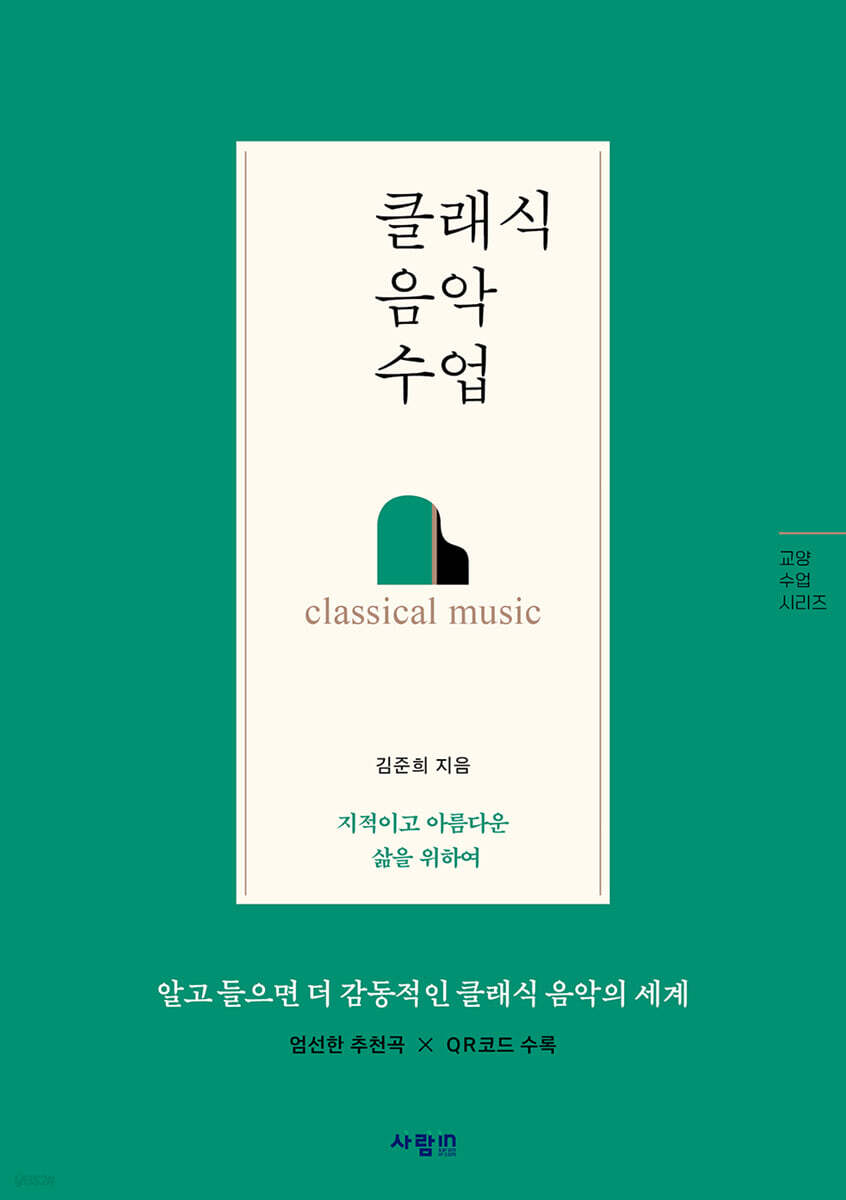 |
Description
Book Introduction
Get closer to classical music
The world of classical music becomes more moving when you know about it.
Music is like a language.
Classical music is a strange foreign language.
Everything familiar begins with an 'unfamiliar beginning'.
And in the beginning, there is a very small 'happiness' and 'curiosity'.
There is something that knocks on my heart.
That's the power of music.
This book is a comprehensive guide for both beginners and enthusiasts looking to get started with classical music.
This book contains almost all stories about classical music, including how to appreciate music by instrument and genre, the history of classical music from ancient times to the present, representative composers worth knowing such as Bach, Mozart, and Beethoven, and must-listen masterpieces.
In particular, you can enjoy music vividly anytime, anywhere by connecting to recommended songs carefully selected by the author via QR code.
If you let go of the burden of classical music being difficult and turn the pages with a relaxed mind, you will eventually encounter your own special musical world.
The world of classical music becomes more moving when you know about it.
Music is like a language.
Classical music is a strange foreign language.
Everything familiar begins with an 'unfamiliar beginning'.
And in the beginning, there is a very small 'happiness' and 'curiosity'.
There is something that knocks on my heart.
That's the power of music.
This book is a comprehensive guide for both beginners and enthusiasts looking to get started with classical music.
This book contains almost all stories about classical music, including how to appreciate music by instrument and genre, the history of classical music from ancient times to the present, representative composers worth knowing such as Bach, Mozart, and Beethoven, and must-listen masterpieces.
In particular, you can enjoy music vividly anytime, anywhere by connecting to recommended songs carefully selected by the author via QR code.
If you let go of the burden of classical music being difficult and turn the pages with a relaxed mind, you will eventually encounter your own special musical world.
- You can preview some of the book's contents.
Preview
index
Recommendation
prolog
Q&A for those new to classical music
Part.
1 Time to approach the classics
How to start appreciating classical music?
Classical music, how should I listen to it?
Listen by instrument
Woodwinds (wind instruments) | Brass (wind instruments) | Strings | Percussion | Keyboard instruments
Listen by genre
Solo pieces | Chamber music | Orchestral pieces | Opera and vocal music
Part.
2 Time to get to know the classics
Classic History
Ancient times | Middle Ages | Renaissance | Baroque | Classical | Romantic | Modern
Composers you should know
Bach, the father of music
Haydn, the father of the symphony
The greatest genius, Mozart
Malicious, Beethoven
The beginning of Romanticism, Schubert
Chopin, the poet of the piano
Classical Romanticism, Brahms
Russia's greatest composer, Tchaikovsky
The last Russian romantic, Rachmaninoff
Debussy, a leading figure in Impressionist music
Part.
3 Time to listen to classical music
Forward to Classics! | Strauss I, "Radetzky March"
Life as Art | Bach, Suite No. 1 for Solo Cello
Be My Morning | Haydn, Symphony No. 6, "Morning"
My dear star | Mozart, 12 variations on the theme "Ah, I will tell my mother"
A Silent Whisper | Mendelssohn, "Something"
The Most Intellectual Concerto | Beethoven, Piano Concerto No. 5, "Emperor"
Heavenly Song | Mozart, "Letter Duet (Gentle Breeze)" from the opera "The Marriage of Figaro"
As if galloping across a vast continent | Glinka, Overture to the opera Ruslan and Lyudmila
The Truth of Nature and the Universe? Philosophy in Music? | Strauss, Symphonic Poem "Thus Spoke Zarathustra"
Sturm und Drang | Mozart, Symphony No. 25
Academia | Brahms, "University Festival Overture"
Aria of Greed | Wagner, Opera "The Flight of the Valkyries"
Wheel of Fortune | Orff, Carmina Burana
A Journey Back 500 Years | Dunstable, Motet "You Are Beautiful"
Walking down the street on a gloomy day | Mozart, Piano Concerto No. 21
In the mirror-clear water | Schubert, Piano Quintet "Trout"
The Paradox of Minimalism | Glass, "Crazy Run"
Spring Moonlight | Chopin, Piano Concerto No. 1
Spring, the Beginning | Beethoven, Sonata No. 5 for Piano and Violin, "Spring"
A Song of Passionate LoveㅣSchumann, Song Cycle "Myrthe's Flowers"
Wanderings | Grieg, "Morning Scene" from the "Peer Gynt Suite"
Sunday Music | Borodin, String Quartet No. 2
A Narrative Beyond Technique | Liszt, "Transcendental Technique Etudes"
The All-too-human Haydn Trumpet Concerto
England itself | Elgar, "Pomp and Circumstance March"
Finland's Hero | Sibelius, Symphonic Poem "Finlandia"
A Very Oriental Flute | Isang Yun, Flute Concerto
A Midsummer Night's Ball | Chopin, "Puppy Waltz," "Gorgeous Waltz"
Delicious Classics | Rossini, "I am the know-it-all of this street" from the opera "The Barber of Seville"
Music that transcends boundaries | Paganini, Caprice No. 24
The Big Brother of American Music | Copland, "Fanfare for the Ordinary People"
A friendly and elegant introduction to classical music | Saint-Saëns, "Carnival of the Animals"
My Summer Story | Mendelssohn, Overture "Calm Sea and Merry Voyage"
Painting with Music | Debussy, Symphonic Poem "The Sea"
A Harmonious Day | Vivaldi, "Inspiration of Harmony" No. 6
Unique and sophisticated sentiment | Rachmaninoff, Piano Concerto No. 2
The Power of the Past | Stravinsky, Pulcinella
Russia itself | Tchaikovsky, Violin Concerto
Do you like Brahms? | Brahms, Symphony No. 3
A Journey to Find Myself | List, "Year of Pilgrimage"
Breathtaking tensionㅣLabel, "Bolero"
How about a cup of coffee? | Bach, "Coffee Cantata"
Very slowly, lyrically | Mahler, Symphony No. 5
Moonlight Passion | Beethoven, Piano Sonata No. 14 "Moonlight"
A Winter Journey in Autumn | Schubert, Song Collection "Winter Journey"
Comfort for the Bereaved | Brahms, "German Requiem"
Music like furniture | Satie, "Three Gymnopedies"
Poetry written in music | Chopin, Four Ballads
The Blossoming Artistic SpiritㅣBeethoven, "Chorale Fantasy"
Czechs in America | Dvořák, Symphony "From the New World"
Best ValueㅣHandel, Oratorio "Messiah"
Home | Bach, Goldberg Variations
Epilogue
prolog
Q&A for those new to classical music
Part.
1 Time to approach the classics
How to start appreciating classical music?
Classical music, how should I listen to it?
Listen by instrument
Woodwinds (wind instruments) | Brass (wind instruments) | Strings | Percussion | Keyboard instruments
Listen by genre
Solo pieces | Chamber music | Orchestral pieces | Opera and vocal music
Part.
2 Time to get to know the classics
Classic History
Ancient times | Middle Ages | Renaissance | Baroque | Classical | Romantic | Modern
Composers you should know
Bach, the father of music
Haydn, the father of the symphony
The greatest genius, Mozart
Malicious, Beethoven
The beginning of Romanticism, Schubert
Chopin, the poet of the piano
Classical Romanticism, Brahms
Russia's greatest composer, Tchaikovsky
The last Russian romantic, Rachmaninoff
Debussy, a leading figure in Impressionist music
Part.
3 Time to listen to classical music
Forward to Classics! | Strauss I, "Radetzky March"
Life as Art | Bach, Suite No. 1 for Solo Cello
Be My Morning | Haydn, Symphony No. 6, "Morning"
My dear star | Mozart, 12 variations on the theme "Ah, I will tell my mother"
A Silent Whisper | Mendelssohn, "Something"
The Most Intellectual Concerto | Beethoven, Piano Concerto No. 5, "Emperor"
Heavenly Song | Mozart, "Letter Duet (Gentle Breeze)" from the opera "The Marriage of Figaro"
As if galloping across a vast continent | Glinka, Overture to the opera Ruslan and Lyudmila
The Truth of Nature and the Universe? Philosophy in Music? | Strauss, Symphonic Poem "Thus Spoke Zarathustra"
Sturm und Drang | Mozart, Symphony No. 25
Academia | Brahms, "University Festival Overture"
Aria of Greed | Wagner, Opera "The Flight of the Valkyries"
Wheel of Fortune | Orff, Carmina Burana
A Journey Back 500 Years | Dunstable, Motet "You Are Beautiful"
Walking down the street on a gloomy day | Mozart, Piano Concerto No. 21
In the mirror-clear water | Schubert, Piano Quintet "Trout"
The Paradox of Minimalism | Glass, "Crazy Run"
Spring Moonlight | Chopin, Piano Concerto No. 1
Spring, the Beginning | Beethoven, Sonata No. 5 for Piano and Violin, "Spring"
A Song of Passionate LoveㅣSchumann, Song Cycle "Myrthe's Flowers"
Wanderings | Grieg, "Morning Scene" from the "Peer Gynt Suite"
Sunday Music | Borodin, String Quartet No. 2
A Narrative Beyond Technique | Liszt, "Transcendental Technique Etudes"
The All-too-human Haydn Trumpet Concerto
England itself | Elgar, "Pomp and Circumstance March"
Finland's Hero | Sibelius, Symphonic Poem "Finlandia"
A Very Oriental Flute | Isang Yun, Flute Concerto
A Midsummer Night's Ball | Chopin, "Puppy Waltz," "Gorgeous Waltz"
Delicious Classics | Rossini, "I am the know-it-all of this street" from the opera "The Barber of Seville"
Music that transcends boundaries | Paganini, Caprice No. 24
The Big Brother of American Music | Copland, "Fanfare for the Ordinary People"
A friendly and elegant introduction to classical music | Saint-Saëns, "Carnival of the Animals"
My Summer Story | Mendelssohn, Overture "Calm Sea and Merry Voyage"
Painting with Music | Debussy, Symphonic Poem "The Sea"
A Harmonious Day | Vivaldi, "Inspiration of Harmony" No. 6
Unique and sophisticated sentiment | Rachmaninoff, Piano Concerto No. 2
The Power of the Past | Stravinsky, Pulcinella
Russia itself | Tchaikovsky, Violin Concerto
Do you like Brahms? | Brahms, Symphony No. 3
A Journey to Find Myself | List, "Year of Pilgrimage"
Breathtaking tensionㅣLabel, "Bolero"
How about a cup of coffee? | Bach, "Coffee Cantata"
Very slowly, lyrically | Mahler, Symphony No. 5
Moonlight Passion | Beethoven, Piano Sonata No. 14 "Moonlight"
A Winter Journey in Autumn | Schubert, Song Collection "Winter Journey"
Comfort for the Bereaved | Brahms, "German Requiem"
Music like furniture | Satie, "Three Gymnopedies"
Poetry written in music | Chopin, Four Ballads
The Blossoming Artistic SpiritㅣBeethoven, "Chorale Fantasy"
Czechs in America | Dvořák, Symphony "From the New World"
Best ValueㅣHandel, Oratorio "Messiah"
Home | Bach, Goldberg Variations
Epilogue
Detailed image

Into the book
If you look around, you will find that there are surprisingly many people who want to learn more about classical music.
But most people don't know how to start appreciating it.
I recommend that you 'listen' to the music first.
I tell them to listen a lot and get used to it first, then move on to the next step.
Then beginners ask, 'What kind of music should I listen to?'
Previously, the answer would be 'Listen to KBS FM 93.1' or 'Search on YouTube and watch.'
But now? Let me put it this way.
“Follow what is written in this book.”
--- p.27, from “How should I start appreciating classical music?”
Pianist Lim Yun-chan's performance at the 2022 Van Cliburn Competition's semifinals was like witnessing the reincarnation of Franz Liszt (1811-1886).
The world fell in love with the 19-year-old pianist who perfectly unfolded each narrative contained in 12 songs.
Liszt's Transcendental Etudes, S., which had not previously received much attention from enthusiasts.
139 received a lot of love thanks to Im Yun-chan.
As is well known, Liszt was the greatest virtuoso pianist of the 19th century.
Thanks to their dazzling techniques and outstanding musicality that captivated the audience, they gained immense popularity, comparable to idols these days.
--- p.136, from “Narratives that Transcend Technique/Liszt, “Collection of Etudes for Transcendental Technique”
What is the most famous work of Chopin, the poet of the piano? The "Fantasia Impromptu," so famous it needs no description? The "Nocturne," which many amateur pianists dream of playing? Some might recall the "Puppy Waltz," which they heard and practiced in piano lessons as children.
〈Puppy Waltz〉 is a waltz, Op.
It is a nickname for 64-1.
There is an anecdote that says that Chopin composed this piece after seeing his lover, George Sand, spin around in circles trying to bite its tail.
The English title of this song is 'Minute Waltz'.
Rather than meaning that it can be played in under a minute, it means that it is a very short song, like a 'short waltz' or a 'waltz of the moment'.
--- p.148, from “A Midsummer Night’s Ball/Chopin, “Dog Waltz,” “Gorgeous Waltz”
In 18th-century Germany, cafés were places where intellectuals socialized and debated over coffee.
The three Bs (Bach, Beethoven, and Brahms), who represent the history of German classical music, were also coffee enthusiasts.
Beethoven said, “60 beans give me 60 pieces of music,” and he counted the beans every morning while making coffee.
Brahms also started his day with a cup of coffee he brewed himself, saying, “No one can match the aroma of the strong coffee I brew.”
Bach, who always composed while drinking coffee, even wrote a piece about coffee.
This is the Coffee Cantata, BWV 211.
--- p.176, from “How about a cup of coffee?/Bach, “Coffee Cantata”
“The harmonious melody of our life rings out tenderly, lovingly, and whisperingly, and the spring flowers that bloom forever sprout from the sense of beauty….
What governs a happy person is outer tranquility and inner joy.
But art, like the spring sun, will shine even brighter with the light of tranquility and joy.” This is a part of the lyrics of Beethoven’s “Choral Fantasy.”
In his symphony “Choral,” he expressed the equality, fraternity, and freedom of mankind, and in his “Chorale Fantasy,” which he composed in 1808, he expressed his praise for art and life.
But most people don't know how to start appreciating it.
I recommend that you 'listen' to the music first.
I tell them to listen a lot and get used to it first, then move on to the next step.
Then beginners ask, 'What kind of music should I listen to?'
Previously, the answer would be 'Listen to KBS FM 93.1' or 'Search on YouTube and watch.'
But now? Let me put it this way.
“Follow what is written in this book.”
--- p.27, from “How should I start appreciating classical music?”
Pianist Lim Yun-chan's performance at the 2022 Van Cliburn Competition's semifinals was like witnessing the reincarnation of Franz Liszt (1811-1886).
The world fell in love with the 19-year-old pianist who perfectly unfolded each narrative contained in 12 songs.
Liszt's Transcendental Etudes, S., which had not previously received much attention from enthusiasts.
139 received a lot of love thanks to Im Yun-chan.
As is well known, Liszt was the greatest virtuoso pianist of the 19th century.
Thanks to their dazzling techniques and outstanding musicality that captivated the audience, they gained immense popularity, comparable to idols these days.
--- p.136, from “Narratives that Transcend Technique/Liszt, “Collection of Etudes for Transcendental Technique”
What is the most famous work of Chopin, the poet of the piano? The "Fantasia Impromptu," so famous it needs no description? The "Nocturne," which many amateur pianists dream of playing? Some might recall the "Puppy Waltz," which they heard and practiced in piano lessons as children.
〈Puppy Waltz〉 is a waltz, Op.
It is a nickname for 64-1.
There is an anecdote that says that Chopin composed this piece after seeing his lover, George Sand, spin around in circles trying to bite its tail.
The English title of this song is 'Minute Waltz'.
Rather than meaning that it can be played in under a minute, it means that it is a very short song, like a 'short waltz' or a 'waltz of the moment'.
--- p.148, from “A Midsummer Night’s Ball/Chopin, “Dog Waltz,” “Gorgeous Waltz”
In 18th-century Germany, cafés were places where intellectuals socialized and debated over coffee.
The three Bs (Bach, Beethoven, and Brahms), who represent the history of German classical music, were also coffee enthusiasts.
Beethoven said, “60 beans give me 60 pieces of music,” and he counted the beans every morning while making coffee.
Brahms also started his day with a cup of coffee he brewed himself, saying, “No one can match the aroma of the strong coffee I brew.”
Bach, who always composed while drinking coffee, even wrote a piece about coffee.
This is the Coffee Cantata, BWV 211.
--- p.176, from “How about a cup of coffee?/Bach, “Coffee Cantata”
“The harmonious melody of our life rings out tenderly, lovingly, and whisperingly, and the spring flowers that bloom forever sprout from the sense of beauty….
What governs a happy person is outer tranquility and inner joy.
But art, like the spring sun, will shine even brighter with the light of tranquility and joy.” This is a part of the lyrics of Beethoven’s “Choral Fantasy.”
In his symphony “Choral,” he expressed the equality, fraternity, and freedom of mankind, and in his “Chorale Fantasy,” which he composed in 1808, he expressed his praise for art and life.
--- p.190, from “The Blossoming Artistic Spirit/Beethoven, “Chorale Fantasy”
Publisher's Review
Lively like Vivace ♪
As exciting as Allegro ♪
As comfortable as Adagio ♪
Welcome to the world of classical music.
To help you become an intellectual appreciator of classical music, "Classical Music Class" contains stories that cannot be told in the classroom in a fun and friendly way.
Mozart's genius, Beethoven's intellect, Brahms's purity, Chopin's lyricism, Debussy's freshness...
We've compiled a diverse selection of must-hear masterpieces from the Renaissance to the 21st century.
I hope this will be an enjoyable experience for readers who want to get into classical music.
- In the Epilogue
Many people are interested in classical music, but most don't know where to start.
At first, it's natural to not know much, but you start worrying, thinking, 'I really don't know anything about classical music.'
However, there are no absolute standards for appreciating classical music.
Because it's just music.
First of all, it means that you should prioritize what is good and beautiful when you hear it.
Of course, classical music is very vast from an academic perspective, so it takes a lot of time and effort to 'study' it, but that step comes after you first become 'familiar' with classical music.
"Classical Music Lessons" is a comprehensive guide for both beginners who want to learn classical music and enthusiasts who want to approach it more systematically.
Chapter 1, 'Time to Approach Classical Music', introduces methods of appreciating classical music by instrument and genre.
Chapter 2, 'Time to Learn Classical Music,' examines the history of classical music from ancient times to the present, and discusses 10 composers worth knowing, including Bach, Mozart, and Beethoven, and their representative works.
Chapter 3, “Time to Listen to Classical Music,” introduces 52 must-listen masterpieces.
You can make 52 songs your own, one song per week, over the course of a year.
I hope that "Classical Music Lessons" will be a welcome letter to everyone who wanders around a corner of classical music.
I hope that with this book, the day will come when you will listen to music in your own way, with your own philosophy.
I hope more people can enjoy classical music as lively as Vivace, as exciting as Allegro, and as comfortable as Adagio.
★Q&A for those who are listening to classical music for the first time
Q.
Classical music has long and difficult titles. Do I really have to memorize them?
One of the reasons classical music is difficult to access is because the names of composers and works are long and in unfamiliar foreign languages.
Even a work with a simple title like Beethoven's "Moonlight" would be written in its original language as "Ludwig van Beethoven, Piano Sonata No.
14 in C# Minor, Op.
27-2〉There are several alphabets and numbers that appear.
However, experts often refer to this work simply as "Beethoven's Moonlight Sonata," "Moonlight Sonata," or "Beethoven's 14th," except when it is written on a concert program.
But it still makes sense.
Q.
Would it be good to memorize and appreciate music from each era?
In general, the music that classical music lovers often listen to is mostly from the Classical and Romantic periods. If you listen to it often, you will naturally learn the characteristics of each era and composer without having to memorize it.
However, even if you know it theoretically, there are many cases where the theory doesn't really resonate with you or is not well understood when you are appreciating music.
At that time, you just have to open your heart and listen.
There is no right answer when it comes to appreciating music.
Q.
I'm not sure when to applaud at a concert.
When a musician plays a song, the audience claps twice.
The moment the performer appears on stage, and the moment the performance ends.
When a performer appears on stage, it is a good idea to continue clapping until they move to the performance area and get ready, that is, until they take their seats.
What performers and veteran audiences hate the most is the so-called "Anda applause" that erupts before the performance is even finished.
After playing the last note and feeling the lingering emotion with the audience, it is really embarrassing for a performer to hear applause.
The best time to applaud after a performance is when the performer bows to the audience.
As exciting as Allegro ♪
As comfortable as Adagio ♪
Welcome to the world of classical music.
To help you become an intellectual appreciator of classical music, "Classical Music Class" contains stories that cannot be told in the classroom in a fun and friendly way.
Mozart's genius, Beethoven's intellect, Brahms's purity, Chopin's lyricism, Debussy's freshness...
We've compiled a diverse selection of must-hear masterpieces from the Renaissance to the 21st century.
I hope this will be an enjoyable experience for readers who want to get into classical music.
- In the Epilogue
Many people are interested in classical music, but most don't know where to start.
At first, it's natural to not know much, but you start worrying, thinking, 'I really don't know anything about classical music.'
However, there are no absolute standards for appreciating classical music.
Because it's just music.
First of all, it means that you should prioritize what is good and beautiful when you hear it.
Of course, classical music is very vast from an academic perspective, so it takes a lot of time and effort to 'study' it, but that step comes after you first become 'familiar' with classical music.
"Classical Music Lessons" is a comprehensive guide for both beginners who want to learn classical music and enthusiasts who want to approach it more systematically.
Chapter 1, 'Time to Approach Classical Music', introduces methods of appreciating classical music by instrument and genre.
Chapter 2, 'Time to Learn Classical Music,' examines the history of classical music from ancient times to the present, and discusses 10 composers worth knowing, including Bach, Mozart, and Beethoven, and their representative works.
Chapter 3, “Time to Listen to Classical Music,” introduces 52 must-listen masterpieces.
You can make 52 songs your own, one song per week, over the course of a year.
I hope that "Classical Music Lessons" will be a welcome letter to everyone who wanders around a corner of classical music.
I hope that with this book, the day will come when you will listen to music in your own way, with your own philosophy.
I hope more people can enjoy classical music as lively as Vivace, as exciting as Allegro, and as comfortable as Adagio.
★Q&A for those who are listening to classical music for the first time
Q.
Classical music has long and difficult titles. Do I really have to memorize them?
One of the reasons classical music is difficult to access is because the names of composers and works are long and in unfamiliar foreign languages.
Even a work with a simple title like Beethoven's "Moonlight" would be written in its original language as "Ludwig van Beethoven, Piano Sonata No.
14 in C# Minor, Op.
27-2〉There are several alphabets and numbers that appear.
However, experts often refer to this work simply as "Beethoven's Moonlight Sonata," "Moonlight Sonata," or "Beethoven's 14th," except when it is written on a concert program.
But it still makes sense.
Q.
Would it be good to memorize and appreciate music from each era?
In general, the music that classical music lovers often listen to is mostly from the Classical and Romantic periods. If you listen to it often, you will naturally learn the characteristics of each era and composer without having to memorize it.
However, even if you know it theoretically, there are many cases where the theory doesn't really resonate with you or is not well understood when you are appreciating music.
At that time, you just have to open your heart and listen.
There is no right answer when it comes to appreciating music.
Q.
I'm not sure when to applaud at a concert.
When a musician plays a song, the audience claps twice.
The moment the performer appears on stage, and the moment the performance ends.
When a performer appears on stage, it is a good idea to continue clapping until they move to the performance area and get ready, that is, until they take their seats.
What performers and veteran audiences hate the most is the so-called "Anda applause" that erupts before the performance is even finished.
After playing the last note and feeling the lingering emotion with the audience, it is really embarrassing for a performer to hear applause.
The best time to applaud after a performance is when the performer bows to the audience.
GOODS SPECIFICS
- Date of issue: December 8, 2023
- Page count, weight, size: 200 pages | 334g | 148*210*11mm
- ISBN13: 9791171010455
- ISBN10: 1171010451
You may also like
카테고리
korean


korean

![GQ KOREA Mark (Monthly): December [2025]](http://librairie.coreenne.fr/cdn/shop/files/8ef265dbbfbf186523ed75ba7319009d.jpg?v=1765340328&width=3840)


