

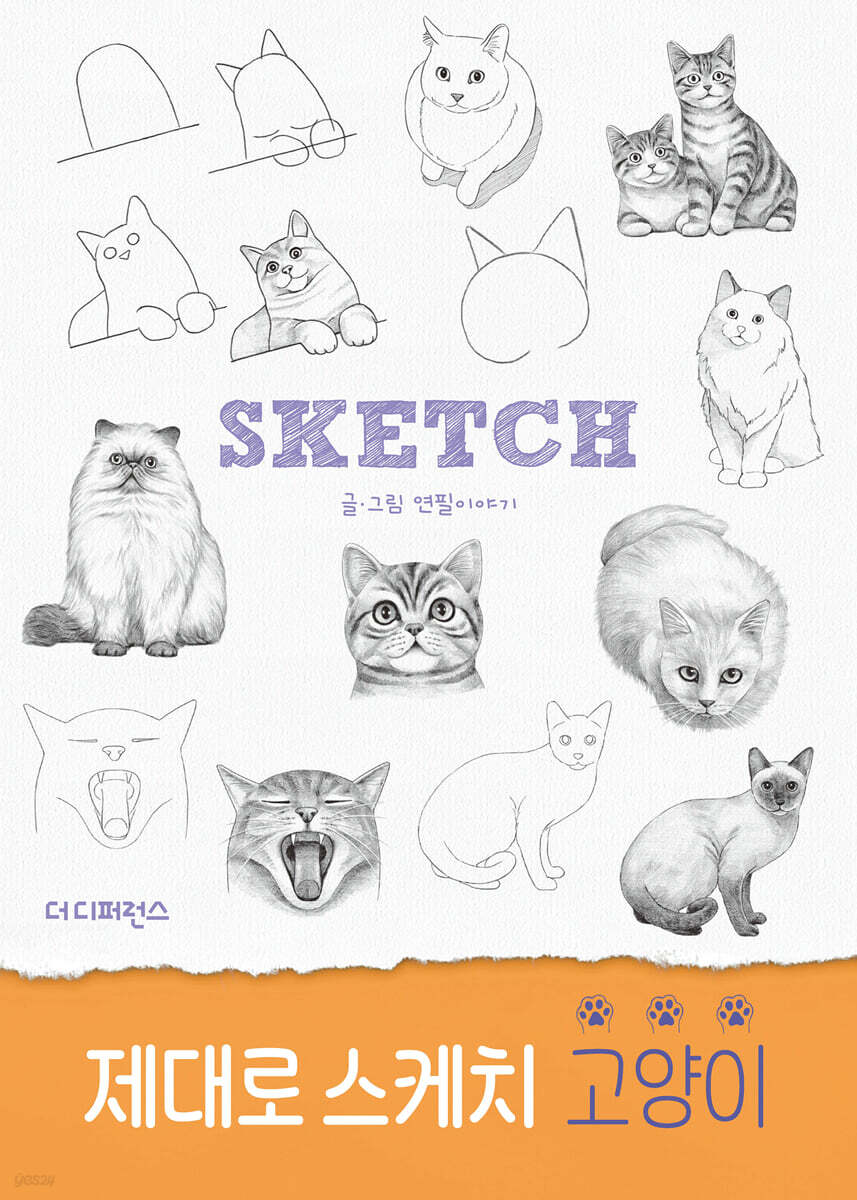
Properly Sketched Cat
 |
Description
Book Introduction
An introductory sketchbook taught by a practicing art teacher.
If this is your first time sketching, start with lines and shading!
74 cat sketches a day
When you want to learn 'line' and 'light and shade' properly
"Sketch Cat Properly" is a sketch book designed to help you practice the basic drawing skills of "line" and "light and shade" taught by an art teacher about 70 times.
This week's topic is 'cats'.
You can learn the basics of drawing and have fun while drawing the faces, bodies, and movements of various cats.
The author of this book is a professional pencil artist.
Having run an art studio and art classes for a long time, he has met many people who quickly give up on drawing because they are obsessed with the idea that they have to be good at it, people who are stuck in the theory and techniques of drawing and don't find it fun, and people who are afraid of drawing.
The author believes that the reason people give up quickly because they don't feel satisfied or enjoy drawing, and don't realize that they are improving at all, lies in the 'basics'. He prepared this sketch series with the idea of making it very easy and proper to practice the most basic of basics: 'lines' and 'light and shade'.
This book is largely composed of lines and light and shade.
In Chapter 1, we practice drawing shapes using lines.
When you are at a loss as to where to start drawing shapes when looking at an object, you can practice drawing shapes by looking at this book.
In Chapter 2, we practice adding light and shade.
Let's add light and shade to objects in an easy but clear way to give them a sense of three-dimensionality and realism.
In everything, the basics are important.
Even if you get used to it and hear that you are quite good at it, the basics will eventually come out.
If you have a solid foundation, drawing will be fun, if you have fun, you will be able to draw for a long time, and if you do it for a long time, you will be able to draw well.
I recommend this book to anyone who is just starting out with drawing, as well as anyone who has been drawing for years but is bored with it and not making any progress.
If this is your first time sketching, start with lines and shading!
74 cat sketches a day
When you want to learn 'line' and 'light and shade' properly
"Sketch Cat Properly" is a sketch book designed to help you practice the basic drawing skills of "line" and "light and shade" taught by an art teacher about 70 times.
This week's topic is 'cats'.
You can learn the basics of drawing and have fun while drawing the faces, bodies, and movements of various cats.
The author of this book is a professional pencil artist.
Having run an art studio and art classes for a long time, he has met many people who quickly give up on drawing because they are obsessed with the idea that they have to be good at it, people who are stuck in the theory and techniques of drawing and don't find it fun, and people who are afraid of drawing.
The author believes that the reason people give up quickly because they don't feel satisfied or enjoy drawing, and don't realize that they are improving at all, lies in the 'basics'. He prepared this sketch series with the idea of making it very easy and proper to practice the most basic of basics: 'lines' and 'light and shade'.
This book is largely composed of lines and light and shade.
In Chapter 1, we practice drawing shapes using lines.
When you are at a loss as to where to start drawing shapes when looking at an object, you can practice drawing shapes by looking at this book.
In Chapter 2, we practice adding light and shade.
Let's add light and shade to objects in an easy but clear way to give them a sense of three-dimensionality and realism.
In everything, the basics are important.
Even if you get used to it and hear that you are quite good at it, the basics will eventually come out.
If you have a solid foundation, drawing will be fun, if you have fun, you will be able to draw for a long time, and if you do it for a long time, you will be able to draw well.
I recommend this book to anyone who is just starting out with drawing, as well as anyone who has been drawing for years but is bored with it and not making any progress.
- You can preview some of the book's contents.
Preview
index
prolog
Note
Chapter 1 Proper Selection
Practice alone
Chapter 2: Proper Light and Shadow
Practice alone
Note
Chapter 1 Proper Selection
Practice alone
Chapter 2: Proper Light and Shadow
Practice alone
Detailed image

Into the book
When you first start drawing, don't try to draw quickly.
Just because you draw quickly doesn't mean you draw well.
If you draw quickly, the lines can become messy.
The drawing speed will naturally increase, so you need to be relaxed rather than impatient at first.
And observe things and observe them again.
You should observe thoroughly before drawing, but usually you observe after drawing.
To express in a drawing the things we pass by without a second thought in our daily lives, it is important to take the time to observe them.
This book does not explain in detail how to draw.
Sketching can feel more difficult if you know the method first because you think you can draw well only if you know everything.
Think about the method later and focus on 'observing and drawing'.
Start sketching as comfortably as you want, and have fun while drawing!
--- p.5
There are many tools needed for sketching, but you can create great drawings with just a few tools that are readily available around you.
When drawing, the most commonly used tool is probably the pencil. Pencils are easy to use, as mistakes can be erased with an eraser.
First, prepare a pencil and an eraser! A sketchbook is a good choice for drawing paper.
Any paper that is easily available around you, such as A4 paper or notebook paper, will also be fine.
Just because you draw quickly doesn't mean you draw well.
If you draw quickly, the lines can become messy.
The drawing speed will naturally increase, so you need to be relaxed rather than impatient at first.
And observe things and observe them again.
You should observe thoroughly before drawing, but usually you observe after drawing.
To express in a drawing the things we pass by without a second thought in our daily lives, it is important to take the time to observe them.
This book does not explain in detail how to draw.
Sketching can feel more difficult if you know the method first because you think you can draw well only if you know everything.
Think about the method later and focus on 'observing and drawing'.
Start sketching as comfortably as you want, and have fun while drawing!
--- p.5
There are many tools needed for sketching, but you can create great drawings with just a few tools that are readily available around you.
When drawing, the most commonly used tool is probably the pencil. Pencils are easy to use, as mistakes can be erased with an eraser.
First, prepare a pencil and an eraser! A sketchbook is a good choice for drawing paper.
Any paper that is easily available around you, such as A4 paper or notebook paper, will also be fine.
--- p.6
Publisher's Review
3 Steps to Cat Sketching from a Professional Pencil Artist!
“Everyone, just remember the lines and the light and the dark.”
Practice the first step!
Try practicing drawing simple lines with a pencil.
As you draw the line, check how thick or thin the line is depending on the strength of the force.
Feel free to draw straight, curved, or wherever your pencil takes you.
Let's approach it in two steps!
Try drawing a picture using shapes.
Cats often have round or square faces, and triangular ears.
Draw a shape to fit each location.
If you draw the lines carefully, it is easier to capture the shape.
Add 3 levels of shading!
Contrast refers to the change in color of an object depending on the light.
Sketches are mainly expressed with lines, but adding light and shade can give objects a three-dimensional feel.
Try expressing different tones of light and shade by varying the intensity.
Gradient shading that goes from dark to light is used more often than shading with the same tone.
*The “Sketch Properly” series continues to be published on various topics.
Volume 1 Puppy
Volume 2 Cat
Volume 3 Travel (Basic)
“Everyone, just remember the lines and the light and the dark.”
Practice the first step!
Try practicing drawing simple lines with a pencil.
As you draw the line, check how thick or thin the line is depending on the strength of the force.
Feel free to draw straight, curved, or wherever your pencil takes you.
Let's approach it in two steps!
Try drawing a picture using shapes.
Cats often have round or square faces, and triangular ears.
Draw a shape to fit each location.
If you draw the lines carefully, it is easier to capture the shape.
Add 3 levels of shading!
Contrast refers to the change in color of an object depending on the light.
Sketches are mainly expressed with lines, but adding light and shade can give objects a three-dimensional feel.
Try expressing different tones of light and shade by varying the intensity.
Gradient shading that goes from dark to light is used more often than shading with the same tone.
*The “Sketch Properly” series continues to be published on various topics.
Volume 1 Puppy
Volume 2 Cat
Volume 3 Travel (Basic)
GOODS SPECIFICS
- Date of issue: July 20, 2023
- Page count, weight, size: 160 pages | 162g | 125*175*11mm
- ISBN13: 9791161254098
- ISBN10: 1161254099
You may also like
카테고리
korean


korean

![GQ KOREA Mark (Monthly): December [2025]](http://librairie.coreenne.fr/cdn/shop/files/8ef265dbbfbf186523ed75ba7319009d.jpg?v=1765340328&width=3840)


