

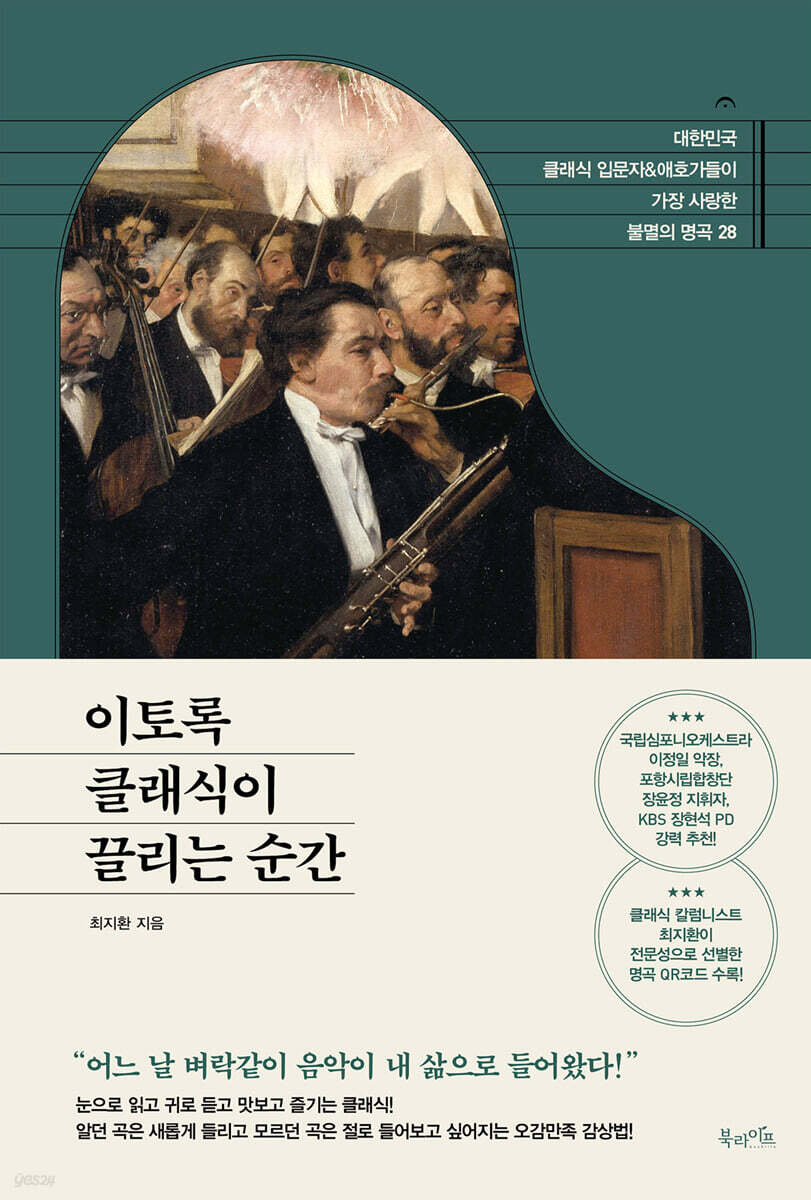
The moment when I am so drawn to classics
 |
Description
Book Introduction
“If you know, you want to love, and if you love, you want to know more!” The ultimate classic dinner for those who are serious about classics! Anyone who has ever been interested in classical music will have their first moment of falling in love with it. That fateful encounter that captivated my whole body and mind like first love and kept me up all night… . One day, it comes into my life like a bolt from the blue and brings excitement, and on days when life's adversities hit like a storm and crash down like a tidal wave, it comforts my weary heart. But why do people think of classical music as difficult, boring, and 'elite music'? Let's think back to when we were children. Have you ever been captivated by the beautiful piano playing of your neighborhood piano teacher? Have you ever listened to "Four Seasons" on classical music radio? Classical music is a common sight, even in dermatologists, bookstores, and department stores. In this way, we are often exposed to classical music without knowing it, but we cannot fall in love with it because we cannot find that spark that connects us with classical music. Author Ji-Hwan Choi, a classical record collector and columnist, describes the moment when classical music touched his heart. It's probably because of the unforgettable experience I had in high school when the moment of truth came unexpectedly. That afternoon, my mother was preparing a late lunch and I was listening to classical music on the radio in the living room. KBS 1FM, which transformed into a classical music channel in December 1980, has been actively seeking out and broadcasting good performances. That day, Wagner's "Tannhäuser" overture began to play on the broadcast... (omitted) Even after the music ended, my heart continued to pound. The name of that great conductor was Furtwängler. From that day on, I became his biggest fan. _From the author's writings This book guides weary souls to distance themselves from a world that constantly fuels desire and open their hearts to the whispers of music. Desire is a double-edged sword that must be wielded relentlessly. If you do something wrong, you might even cut your own hand. This is why, in this age of constant anxiety and impatience, we need more classical, classic spiritual nourishment. Now is the time when the ‘power of music’ is needed most. There are people who don't know everything about classical music, but once they get to know it, they eventually fall in love with it and want to know more. Whether you are a true fan of classical music or someone who doesn't know anything about it, if you want to immerse yourself in the charm of classical music, I recommend this book. By the time you close the last page, reading with your eyes, listening with your ears, and connecting with the music, you will feel as if you had enjoyed a sumptuous dinner at a five-star hotel. |
- You can preview some of the book's contents.
Preview
index
Author's Note: Open your heart to the whispers of music and let your soul breathe.
Chapter 1: Feel the Classics with Your Whole Body
1.
A Baroque Tiger Disguised as a Cat / Vivaldi's "Four Seasons"
2.
Beethoven's cry echoed across the battlefield / Beethoven's Fifth Symphony, "Fate"
3.
The Fourth Dimensional World Adults Don't Know / Mozart's Violin Concerto No. 3
4.
A must-hear album? Or a piece of crap that should never have been released? / Beethoven's Triple Concerto
5.
It's not sad to cry / Elgar Cello Concerto
6.
Can classical and romantic music be heard simultaneously? / Brahms Violin Concerto
7.
The Voice of God in Space / Bruckner Symphony No. 9
8.
It tastes best when you have dust in your mouth / Dvorak Symphony No. 9 (From the New World)
9.
Music is energy / Brahms Symphony No. 1
10.
Ashkenazy VS Ashkenazy / Rachmaninoff Piano Concerto No. 2
11.
Seasonal music to listen to when fallen leaves fall / Ravel's Piano Concerto in G major
Chapter 2: Seeing Classics as Pictures
1.
Do you really want to see moonlight? Anton Walter, piano / Beethoven, Piano Sonata No. 14, "Moonlight"
2.
There is also a maria in music / Saint-Saëns' Clarinet Sonata
3.
Stars in the Sky, Born of Music / Bach's Well-Tempered Clavier
4.
The sounds of the orchestra are heard from the piano / Mussorgsky's "Pictures at an Exhibition"
5.
Album Cover Story 1 "There Are No Trouts" / Schubert Piano Quintet "Trout"
6.
Listening to the Musical Font in Chinese Characters / Beethoven's Cello Sonata No. 3
7.
Symphony in the Art Shop / Beethoven's Symphony No. 6 (Pastoral)
8.
Album Cover Story 2 'Juan Miró and René Magritte' / Erik Satie's "Gymnopedie"
9.
Fauvism and Modern Times / Stravinsky's The Rite of Spring
Chapter 3: Reading Classics as Stories
1. Before BTS, there was Jeong Kyung-hwa / Tchaikovsky's Violin Concerto
2.
Earth's representative music that flew into space / Bach's Brandenburg Concerto No. 2
3.
The magical sound of the crooked Haskil / Mozart Piano Concerto No. 20 (+21)
4.
Intellectuals who escaped into Schubert's dreams / Schubert's Symphony No. 8 (Unfinished)
5.
A Texan country bumpkin's twisted drama / Tchaikovsky's Piano Concerto No. 1
6.
Mendelssohn, Beethoven's forgotten successor / Mendelssohn Piano Trio No. 1
7.
Find Her / Haydn Symphony in B-flat major
8.
A Feast of Elegant Madness / Berlioz's Symphonie Fantastique
index
Chapter 1: Feel the Classics with Your Whole Body
1.
A Baroque Tiger Disguised as a Cat / Vivaldi's "Four Seasons"
2.
Beethoven's cry echoed across the battlefield / Beethoven's Fifth Symphony, "Fate"
3.
The Fourth Dimensional World Adults Don't Know / Mozart's Violin Concerto No. 3
4.
A must-hear album? Or a piece of crap that should never have been released? / Beethoven's Triple Concerto
5.
It's not sad to cry / Elgar Cello Concerto
6.
Can classical and romantic music be heard simultaneously? / Brahms Violin Concerto
7.
The Voice of God in Space / Bruckner Symphony No. 9
8.
It tastes best when you have dust in your mouth / Dvorak Symphony No. 9 (From the New World)
9.
Music is energy / Brahms Symphony No. 1
10.
Ashkenazy VS Ashkenazy / Rachmaninoff Piano Concerto No. 2
11.
Seasonal music to listen to when fallen leaves fall / Ravel's Piano Concerto in G major
Chapter 2: Seeing Classics as Pictures
1.
Do you really want to see moonlight? Anton Walter, piano / Beethoven, Piano Sonata No. 14, "Moonlight"
2.
There is also a maria in music / Saint-Saëns' Clarinet Sonata
3.
Stars in the Sky, Born of Music / Bach's Well-Tempered Clavier
4.
The sounds of the orchestra are heard from the piano / Mussorgsky's "Pictures at an Exhibition"
5.
Album Cover Story 1 "There Are No Trouts" / Schubert Piano Quintet "Trout"
6.
Listening to the Musical Font in Chinese Characters / Beethoven's Cello Sonata No. 3
7.
Symphony in the Art Shop / Beethoven's Symphony No. 6 (Pastoral)
8.
Album Cover Story 2 'Juan Miró and René Magritte' / Erik Satie's "Gymnopedie"
9.
Fauvism and Modern Times / Stravinsky's The Rite of Spring
Chapter 3: Reading Classics as Stories
1. Before BTS, there was Jeong Kyung-hwa / Tchaikovsky's Violin Concerto
2.
Earth's representative music that flew into space / Bach's Brandenburg Concerto No. 2
3.
The magical sound of the crooked Haskil / Mozart Piano Concerto No. 20 (+21)
4.
Intellectuals who escaped into Schubert's dreams / Schubert's Symphony No. 8 (Unfinished)
5.
A Texan country bumpkin's twisted drama / Tchaikovsky's Piano Concerto No. 1
6.
Mendelssohn, Beethoven's forgotten successor / Mendelssohn Piano Trio No. 1
7.
Find Her / Haydn Symphony in B-flat major
8.
A Feast of Elegant Madness / Berlioz's Symphonie Fantastique
index
Detailed image
Into the book
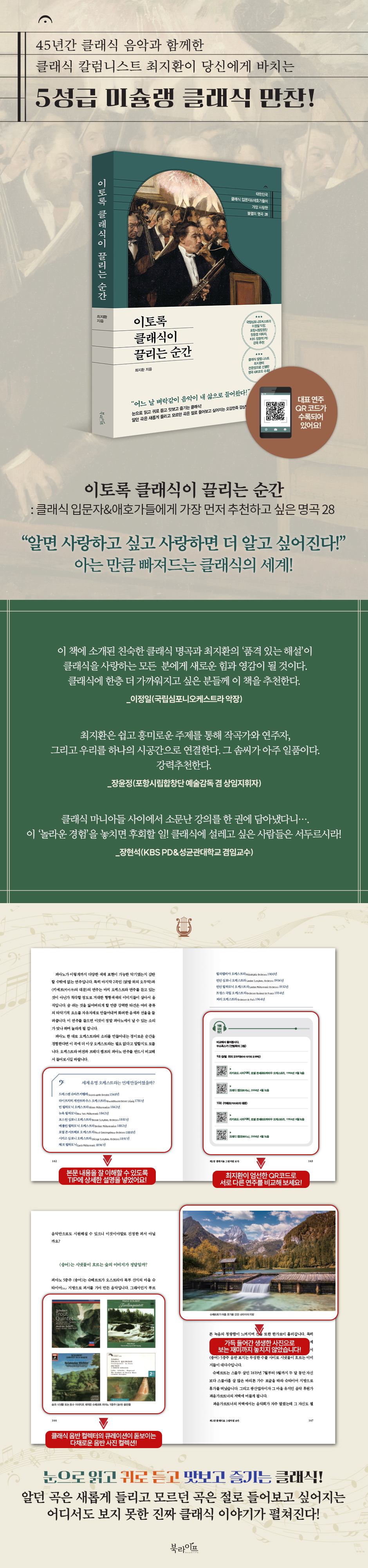
The easiest way to understand music is to think of listening to music as a form of communication and approach it through a field you are familiar with.
Art fields like art, architecture, literature, and film are good, but philosophy, travel, cooking, and sports are also good.
When you approach music through your own window into the world, you can understand classical music more quickly.
As these experiences are repeated, you will gradually begin to hear the story the music is telling, and as your emotional depth increases, your insight into music will grow even further.
---From the author's note, "Open your heart to the whisper of music and let your soul breathe."
To simply listen to music as a sound that enters our ears is to encounter music in a very limited way.
Music is energy in waves.
Because sending this wave energy directly into the ear would be a huge loss.
(Omitted) If you really want to appreciate music, feel the waves of music coming from the audio speakers with your whole body.
In fact, the thick clothes we wear also interfere with our appreciation of music.
Let's wear as light clothes as possible and listen to music.
Every cell in our body, even the hairs on our skin, feel the energy of the waves of music.
And if you try to connect with music using all your senses, the same music will sound completely different than it did in the past.
The musical scale comes from the proportions of vibrations in nature, which are also in line with the proportions of all things in the universe.
Ultimately, music appreciation is a communication between cosmic energy and our body, which is called a microcosm.
Perhaps we, who come from the depths of space, feel our distant home in the universe through music.
---From "Music is Energy: Brahms Symphony No. 1"
Pairing wine and food isn't limited to just wine and food.
Music also forms a good accompaniment to poetry and novels.
This interaction sharpens the emotions of the music and brings the expressions of the lyrics to life.
(Omitted) The last line of Kim Hoon’s “Bicycle Travel” “Flowering Coastline” “The flowers of spring are carried away by the wind or the earth.
This rather indifferent reference to the law of nature, “Light flowers die lightly, heavy flowers die heavily; when the magnolias fall, spring is gone,” accompanies the Saint-Saëns sonata to the very end.
Every year, when the spring days come and magnolias bloom and fall, I naturally listen to Reginald Kell's Saint-Saëns album and recall the emotions I felt that day when I felt the mariage.
Musical marriage is possible not only with literature but with all arts.
I am confident that if you keep classical music close to you, you too will have the wonderful experience of musical marriage by chance.
---From “Music also has Maria: Saint-Saëns’ Clarinet Sonata”
First of all, the performances of Rostropovich and Richter are the norm itself.
The technique is so precise and perfect that it is like a textbook for Beethoven's cello sonatas.
So it reminds me of the most upright and balanced of the Chinese character scripts, Haeseo.
In particular, it feels similar to the handwriting of Ouyang Xun, a famous calligrapher of the Tang Dynasty.
Chusa also has a poem in the style of “Heart Sutra,” but it is more refined and gentle than that of Guyangsun.
So, Rostropovich and Richter's Beethoven cello sonata, with its sharp angles of performance, reminds me of Ouyang Xun's calligraphy.
---From "Listening to the Font of Music in Chinese Characters: Beethoven's Cello Sonata No. 3"
Before appreciating the music, prepare two pieces of paper and colored pencils of various colors.
I will draw a picture as I feel while listening to the performances of Antal Dorati and Pierre Boulez that I recommended earlier.
If you listen to music while drawing, you will probably find that excessive rhythm and dissonance do not sound uncomfortable.
Finally, listen to the two performances and compare the two drawings you made.
If you can clearly see the difference between the two pictures, then you have already figured out the different tendencies of the two performances.
When music is difficult, drawing can be a helpful tool.
---From "Fauve and Modern Times: Stravinsky's Rite of Spring"
Clara Haskil's touch is not flashy, but it's clean and yet sounds a little cautious.
The interpretation of the performance adheres to the classics, but Haskil's careful and delicate piano sound echoes the harsh life she lived.
Her performance has a strange charm that moves the hearts of listeners, where darkness is heard in bright melodies and bright hope is heard in dark melodies.
Her attitude of trying to find a new balance amidst anxiety may stem from her life of overcoming and enduring hardships.
No other performer seems to be able to capture the essence of Mozart's music as accurately as Haskil: the sadness found amidst beauty and the renewed hope found within it.
So her Mozart feels like a transcendence and beauty that transcends the joys and sorrows of this world.
Art fields like art, architecture, literature, and film are good, but philosophy, travel, cooking, and sports are also good.
When you approach music through your own window into the world, you can understand classical music more quickly.
As these experiences are repeated, you will gradually begin to hear the story the music is telling, and as your emotional depth increases, your insight into music will grow even further.
---From the author's note, "Open your heart to the whisper of music and let your soul breathe."
To simply listen to music as a sound that enters our ears is to encounter music in a very limited way.
Music is energy in waves.
Because sending this wave energy directly into the ear would be a huge loss.
(Omitted) If you really want to appreciate music, feel the waves of music coming from the audio speakers with your whole body.
In fact, the thick clothes we wear also interfere with our appreciation of music.
Let's wear as light clothes as possible and listen to music.
Every cell in our body, even the hairs on our skin, feel the energy of the waves of music.
And if you try to connect with music using all your senses, the same music will sound completely different than it did in the past.
The musical scale comes from the proportions of vibrations in nature, which are also in line with the proportions of all things in the universe.
Ultimately, music appreciation is a communication between cosmic energy and our body, which is called a microcosm.
Perhaps we, who come from the depths of space, feel our distant home in the universe through music.
---From "Music is Energy: Brahms Symphony No. 1"
Pairing wine and food isn't limited to just wine and food.
Music also forms a good accompaniment to poetry and novels.
This interaction sharpens the emotions of the music and brings the expressions of the lyrics to life.
(Omitted) The last line of Kim Hoon’s “Bicycle Travel” “Flowering Coastline” “The flowers of spring are carried away by the wind or the earth.
This rather indifferent reference to the law of nature, “Light flowers die lightly, heavy flowers die heavily; when the magnolias fall, spring is gone,” accompanies the Saint-Saëns sonata to the very end.
Every year, when the spring days come and magnolias bloom and fall, I naturally listen to Reginald Kell's Saint-Saëns album and recall the emotions I felt that day when I felt the mariage.
Musical marriage is possible not only with literature but with all arts.
I am confident that if you keep classical music close to you, you too will have the wonderful experience of musical marriage by chance.
---From “Music also has Maria: Saint-Saëns’ Clarinet Sonata”
First of all, the performances of Rostropovich and Richter are the norm itself.
The technique is so precise and perfect that it is like a textbook for Beethoven's cello sonatas.
So it reminds me of the most upright and balanced of the Chinese character scripts, Haeseo.
In particular, it feels similar to the handwriting of Ouyang Xun, a famous calligrapher of the Tang Dynasty.
Chusa also has a poem in the style of “Heart Sutra,” but it is more refined and gentle than that of Guyangsun.
So, Rostropovich and Richter's Beethoven cello sonata, with its sharp angles of performance, reminds me of Ouyang Xun's calligraphy.
---From "Listening to the Font of Music in Chinese Characters: Beethoven's Cello Sonata No. 3"
Before appreciating the music, prepare two pieces of paper and colored pencils of various colors.
I will draw a picture as I feel while listening to the performances of Antal Dorati and Pierre Boulez that I recommended earlier.
If you listen to music while drawing, you will probably find that excessive rhythm and dissonance do not sound uncomfortable.
Finally, listen to the two performances and compare the two drawings you made.
If you can clearly see the difference between the two pictures, then you have already figured out the different tendencies of the two performances.
When music is difficult, drawing can be a helpful tool.
---From "Fauve and Modern Times: Stravinsky's Rite of Spring"
Clara Haskil's touch is not flashy, but it's clean and yet sounds a little cautious.
The interpretation of the performance adheres to the classics, but Haskil's careful and delicate piano sound echoes the harsh life she lived.
Her performance has a strange charm that moves the hearts of listeners, where darkness is heard in bright melodies and bright hope is heard in dark melodies.
Her attitude of trying to find a new balance amidst anxiety may stem from her life of overcoming and enduring hardships.
No other performer seems to be able to capture the essence of Mozart's music as accurately as Haskil: the sadness found amidst beauty and the renewed hope found within it.
So her Mozart feels like a transcendence and beauty that transcends the joys and sorrows of this world.
---From "The Magical Sound Created by the Crooked Haskil: Mozart Piano Concertos No. 20 and No. 21"
Publisher's Review
In-depth and classy commentary from classical music columnist Ji-Hwan Choi!
28 Masterpieces I'd Like to Recommend First to Classical Music Beginners & Enthusiasts
Music is an emotional art.
Through music, we escape from everyday life and rational thinking and experience a transcendent world beyond that.
The reason classical music is called 'poetry written with sound' is probably because music soothes, embraces, and heals the inner self of humans.
Can language truly fully express human thoughts and feelings?
In that realm that cannot be expressed in words, there are ‘classics’ and poetry.
Because classical music, like poetry, has rhythm and verse, and implicitly expresses emotions that are difficult to express in words.
If you experience joy and sorrow through music, achieve emotional maturity, and are able to control your inner self, personal maturity will naturally follow.
The value of classics doesn't end there.
The brain becomes more stable, imagination and creativity become richer, and emotional intelligence improves.
Stress is relieved, life becomes more energetic and enriched.
Above all, it gives us the strength to overcome any desperate situation.
So, which songs should you choose from among these songs with good value?
This book contains a selection of 28 songs that classical music columnist Ji-Hwan Choi would most like to recommend to beginners and enthusiasts of classical music.
You can look forward to this album, which is comprised of famous performances selected through the deep insight of Choi Ji-hwan, who is also a classical record collector.
These are treasures that will captivate even those new to classical music or even enthusiasts.
You can open any page.
A variety of attractive songs are introduced like a well-prepared banquet, so that familiar songs sound new and unfamiliar songs make you want to listen to them without realizing it.
So, I recommend that you search for and read the songs that appeal to you, and compare and enjoy the immortal masterpieces performed by different performers through the QR codes selected by the author's delicate eye.
This is a special opportunity to experience the in-depth and sophisticated commentary and the captivating lectures that are famous among classical music enthusiasts in one volume.
Even if you find classical music difficult, this magical book will make you listen to music without you realizing it.
Here are four reasons why this book stands out from other classic liberal arts books.
First, we will explain familiar fields around us, such as literature, art, calligraphy, film, wine, and architecture, in an easy-to-understand way by incorporating them into classical music.
It is full of interesting topics such as ‘Seasonal music to listen to when fallen leaves fall’ and ‘There is also a mariage in music’.
Second, Ji-Hwan Choi uses his humorous wit to explain difficult classics in an exciting way.
Representative articles include, ‘Beethoven’s howl echoing through the battlefield,’ ‘Before BTS, there was Jeong Kyung-hwa,’ and ‘A twist drama written by a Texas country bumpkin.’
Third, it sensually interprets music with a unique perspective and insight into classics.
I recommend 'The Baroque Tiger Disguised as a Cat' and 'It's Tastes Good When You Have Dust in Your Mouth'.
Finally, it addresses a topic that has been taboo and avoided in classical liberal arts books up to now, and raises fresh questions.
In articles like "Is this a must-listen album? Or is this a piece of crap that should never have come into the world?" and "Crying doesn't mean you're sad," the author boldly addresses topics that might be somewhat uncomfortable.
As you read this book, which introduces 28 wonderful classical pieces in a friendly and affectionate manner, you will have the magical experience of hearing music and a new world you never knew existed will unfold before you.
How about taking some time today to disconnect from the noisy world and focus solely on the beauty of music?
28 Masterpieces I'd Like to Recommend First to Classical Music Beginners & Enthusiasts
Music is an emotional art.
Through music, we escape from everyday life and rational thinking and experience a transcendent world beyond that.
The reason classical music is called 'poetry written with sound' is probably because music soothes, embraces, and heals the inner self of humans.
Can language truly fully express human thoughts and feelings?
In that realm that cannot be expressed in words, there are ‘classics’ and poetry.
Because classical music, like poetry, has rhythm and verse, and implicitly expresses emotions that are difficult to express in words.
If you experience joy and sorrow through music, achieve emotional maturity, and are able to control your inner self, personal maturity will naturally follow.
The value of classics doesn't end there.
The brain becomes more stable, imagination and creativity become richer, and emotional intelligence improves.
Stress is relieved, life becomes more energetic and enriched.
Above all, it gives us the strength to overcome any desperate situation.
So, which songs should you choose from among these songs with good value?
This book contains a selection of 28 songs that classical music columnist Ji-Hwan Choi would most like to recommend to beginners and enthusiasts of classical music.
You can look forward to this album, which is comprised of famous performances selected through the deep insight of Choi Ji-hwan, who is also a classical record collector.
These are treasures that will captivate even those new to classical music or even enthusiasts.
You can open any page.
A variety of attractive songs are introduced like a well-prepared banquet, so that familiar songs sound new and unfamiliar songs make you want to listen to them without realizing it.
So, I recommend that you search for and read the songs that appeal to you, and compare and enjoy the immortal masterpieces performed by different performers through the QR codes selected by the author's delicate eye.
This is a special opportunity to experience the in-depth and sophisticated commentary and the captivating lectures that are famous among classical music enthusiasts in one volume.
Even if you find classical music difficult, this magical book will make you listen to music without you realizing it.
Here are four reasons why this book stands out from other classic liberal arts books.
First, we will explain familiar fields around us, such as literature, art, calligraphy, film, wine, and architecture, in an easy-to-understand way by incorporating them into classical music.
It is full of interesting topics such as ‘Seasonal music to listen to when fallen leaves fall’ and ‘There is also a mariage in music’.
Second, Ji-Hwan Choi uses his humorous wit to explain difficult classics in an exciting way.
Representative articles include, ‘Beethoven’s howl echoing through the battlefield,’ ‘Before BTS, there was Jeong Kyung-hwa,’ and ‘A twist drama written by a Texas country bumpkin.’
Third, it sensually interprets music with a unique perspective and insight into classics.
I recommend 'The Baroque Tiger Disguised as a Cat' and 'It's Tastes Good When You Have Dust in Your Mouth'.
Finally, it addresses a topic that has been taboo and avoided in classical liberal arts books up to now, and raises fresh questions.
In articles like "Is this a must-listen album? Or is this a piece of crap that should never have come into the world?" and "Crying doesn't mean you're sad," the author boldly addresses topics that might be somewhat uncomfortable.
As you read this book, which introduces 28 wonderful classical pieces in a friendly and affectionate manner, you will have the magical experience of hearing music and a new world you never knew existed will unfold before you.
How about taking some time today to disconnect from the noisy world and focus solely on the beauty of music?
GOODS SPECIFICS
- Date of issue: April 25, 2023
- Page count, weight, size: 312 pages | 556g | 152*225*18mm
- ISBN13: 9791191013511
- ISBN10: 1191013510
You may also like
카테고리
korean


korean

![GQ KOREA Mark (Monthly): December [2025]](http://librairie.coreenne.fr/cdn/shop/files/8ef265dbbfbf186523ed75ba7319009d.jpg?v=1765340328&width=3840)


