

From the dust of space
 |
Description
Book Introduction
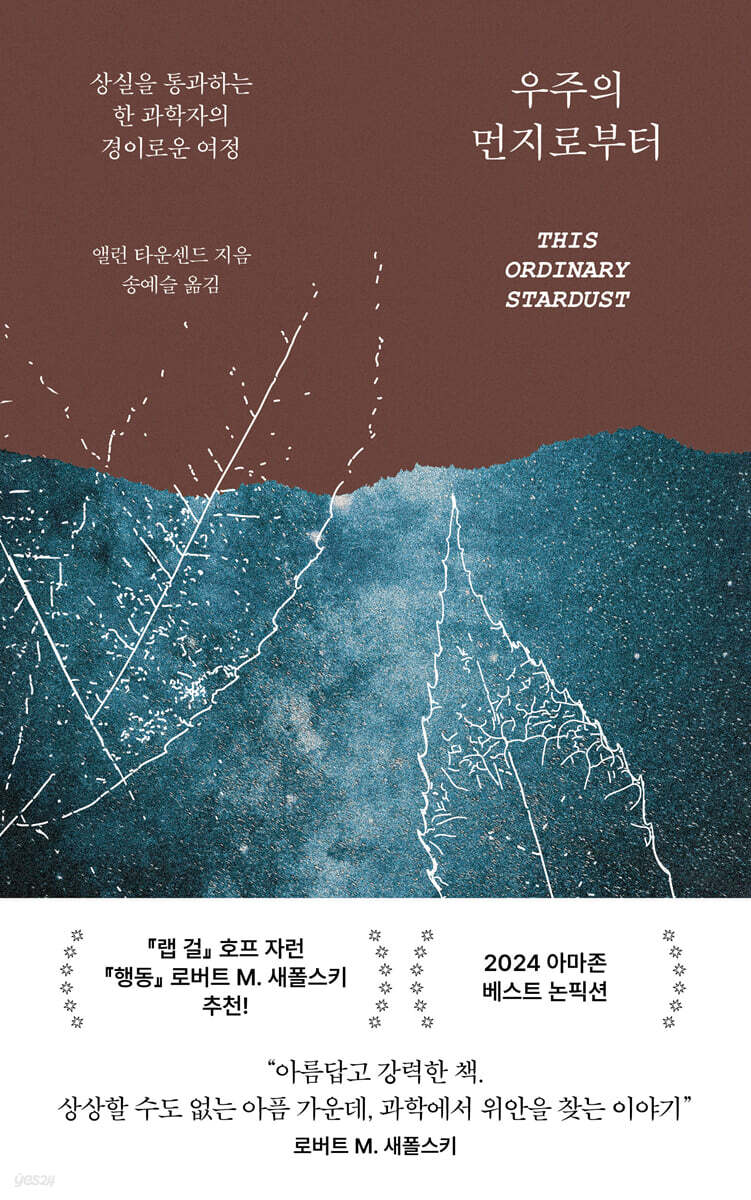
More than a decade ago, Dr. Alan Townsend's family received two devastating diagnoses.
His four-year-old daughter and his biologist wife both developed brain cancer.
The odds of both my wife and daughter developing a brain tumor are about 3 in 100 billion.
If my family were to fall into that unlikely category, how would we cope? Townsend, a lifelong scientist, realizes that even in this unfortunate situation, scientific inquiry serves as a lens through which to view the world and a lifeboat, helping us reconcile with reality.
Nature continues its cycle on its own, as seen in the history of the universe, which has been created and destroyed through the exchange of cosmic dust for billions of years; the birth of a butterfly from a melted caterpillar; the way a tree precariously rooted in volcanic rock obtains nutrients; and the vitality of an endangered American chestnut tree sprouting again.
Faced with the tragedy of life, Townsend calmly offers hope that finite human life can continue indefinitely through the insight he gains from observing nature.
His four-year-old daughter and his biologist wife both developed brain cancer.
The odds of both my wife and daughter developing a brain tumor are about 3 in 100 billion.
If my family were to fall into that unlikely category, how would we cope? Townsend, a lifelong scientist, realizes that even in this unfortunate situation, scientific inquiry serves as a lens through which to view the world and a lifeboat, helping us reconcile with reality.
Nature continues its cycle on its own, as seen in the history of the universe, which has been created and destroyed through the exchange of cosmic dust for billions of years; the birth of a butterfly from a melted caterpillar; the way a tree precariously rooted in volcanic rock obtains nutrients; and the vitality of an endangered American chestnut tree sprouting again.
Faced with the tragedy of life, Townsend calmly offers hope that finite human life can continue indefinitely through the insight he gains from observing nature.
- You can preview some of the book's contents.
Preview
index
prolog
1. Soil powder
2 Growth
3 leaves
4 Love
5 Stress
6 Volcanic Islands
7 sodium
8 bacteria
9 Antarctica
10 Immersion
11 Chaos
12 small trees
13 Curiosity
14 Hope
15 Acceptance
16 connections
17 stories
18 Ashes
19 Cosmic dust
Acknowledgements
1. Soil powder
2 Growth
3 leaves
4 Love
5 Stress
6 Volcanic Islands
7 sodium
8 bacteria
9 Antarctica
10 Immersion
11 Chaos
12 small trees
13 Curiosity
14 Hope
15 Acceptance
16 connections
17 stories
18 Ashes
19 Cosmic dust
Acknowledgements
Into the book
Living things not only exchange cosmic dust with the Earth as they live and die day by day, but also allow that cosmic dust to permeate rocks, water, air, seashells, coal, and carbon dioxide exhaust.
As we have done for billions of years, we living beings expel cosmic dust, then take it back in, hold it for a while, and then expel it again.
The rhythm of continuous activity, decay, and growth leaves its mark every minute, every hour, every year, every generation.
Your life, a byproduct of all that activity, can be said to contain a part of all humanity.
--- p.11 From the "Prologue"
The caterpillar passes through the melted present, retaining the wisdom of the past, and reaches a changed future.
In that case, wouldn't it be difficult to say that the pupa is a metaphor for resurrection?
Rather, it is a metaphor for hope.
A being that becomes infinitesimally small in times of trauma and loss, but whose presence or power never diminishes.
Life and memory find ways to endure even when the familiar crumbles in the midst of chaos and disorder, which is both terrifying and unpredictable.
In the present that is collapsing, we cannot understand the past or imagine the future.
But thanks to Dr. Weiss and other biologists who have dedicated themselves to research for over 60 years, we know that a seed of hope lies right there, floating in the middle of the swamp.
--- p.33 From "Growth"
It may sound obvious, but we need to relax a little.
Because good things start from there.
Of course, it's not as easy as it sounds.
When we're stressed, we very naturally go into fight-or-flight mode.
(……) Active choices to change external stimuli in some way—such as taking a deep breath when faced with danger, shifting your attention to something more calming, getting away and doing something better, or simply turning off your smartphone—reorganize the supply chain in your mind, filling the shelves of creativity.
After Diana calmed down, she sat down next to Neva and drew a picture, just as Neva jumped off her new bike and hugged the dog.
--- p.118 From "Sodium"
Of the approximately 75 million children living in the United States, only about 300 are diagnosed with craniopharyngioma each year.
Tragically, glioblastoma is much more common, but rare in women Diana's age.
The odds are one in 150,000 people.
So what are the odds of a mother and daughter developing cancer in just over a year? Rough calculations suggest it's less than three in a trillion.
This oddly low probability led to another speculation.
Throughout human history, no one has shared the fate of Diana and Neva.
--- p.177 From "Antarctica"
Scientific thinking involves accepting the reality of chance and probability inherent in all predictive frameworks.
And ideally, it means finding peace in an unpredictable reality.
From mundane moments to momentous moments, most of our lives are determined by probabilities and can therefore be quantified.
What are the odds of a successful pregnancy? What are the odds of a healthy baby being born? What are the odds of the stock market rising, a player making a game-changing free throw, it raining tomorrow, or the car running smoothly? Sometimes, the answers to these life questions can be given with relatively clear probabilities, but sometimes, they aren't.
Either way, life is governed by uncertainties, big and small.
Yet we always want to eliminate that unknown territory.
--- p.178 From "Chaos"
The tree's roots are stronger than you might think, and they penetrate the volcanic rock, taking root and extracting the nutrients they need from the rock.
Perhaps the tree will take the necessary elements even from the sea water that torments it.
Things like calcium, magnesium, and potassium.
At the same time, the tree is armed with a small, hard outer shell to withstand the seawater.
Even the leaves are covered with a waxy protective coating, like little umbrellas that keep out the seawater.
Of course, leaves absorb solar energy without any problem even with their protective covering.
If you walk a little into the nearby forest, you will see trees of the same species, but with completely different appearances.
Because the trees in the forest live relatively comfortably, they leisurely show off their splendor.
It's really beautiful to look at.
But I like their brother better, standing twisted on the beach.
--- p.189 From “Little Tree”
Diana did not give up on life.
At times, the sight was truly incomprehensible.
As I watched my wife live like that every day, I gradually realized that her choices had an impact that extended far beyond the boundaries of her body.
I was obsessed with finding and hoping for a miracle cure for my wife, but she wasn't.
As always, I just did my best and moved forward.
--- p.223 From “Hope”
In the context of science, acceptance does not mean resignation when life's challenges arise.
What this means is that, if we don't resist, science can train our minds to face the subtle and unpredictable, the many possibilities of a future that might be both good and bad, at almost every step.
Cancer is often defined as something to be fought against.
And the very thought of having to fight it is stressful.
Even though it is a situation where stress must be absolutely avoided.
Stress reduces your ability to treat illnesses and solve problems at hand.
Diana chose a different path.
I've found that maintaining peace of mind while fighting desperately for the outcome you want is the way to increase the odds in your favor.
Approaching life and its inevitable end like Diana meant accepting that there might still be no chance.
I learned this fact at the end of summer.
--- From "Acceptance" pp.232-233
From an atomic perspective, our immortality is already guaranteed.
The 7 billion times 1 billion times 1 billion atoms within us bring with them a far greater number of stories from the past when they make up our bodies, add to our stories during their brief stay within us, and continue to build countless stories in the years to come.
However, the places where atoms temporarily stop and go are each unique.
--- p.260 From "Story"
Barry Lopez says in Horizon, “The world outside the self has no interest in the fate of the self.”
But our egos are inextricably linked to that world in repetitive and wondrous ways.
I find solace in our inevitable demise.
Sometimes I think we are like seeds with near-infinite potential.
You and I and every human atom will play a part in a story the world has yet to tell.
To me, it means that our love will last forever.
--- p.261 From "Story"
This wonderful woman was saying goodbye in her own way.
(……) I looked at my wife lying peacefully for a long time.
And then he turned to the hospice nurse.
The nurse stood silently to one side as Diana died.
He was crying like me.
The nurse opened her mouth.
“I’ve been doing this for a long time, but this is the first time I’ve seen someone pass away so beautifully and happily.”
--- pp.267-268 From "Story"
An incident that nearly ended my life changed me on a molecular level.
When I opened the door after the darkest hour, a peace I had never known before awaited me.
I began to realize that I could emerge from the ashes of my life's worst moments as a new being, a being formed by the unexpected fusion of past and future.
Just like the elements that make up our bodies.
--- pp.286-287 from "Cosmic Dust"
My wife told me to live boldly, generously, and fully.
To focus my energy on what matters most, and to save myself by saving others first.
There is no greater comfort and joy than that which comes from being generous, infinitely curious, and never fearing failure.
So listen to your innermost voice, ask questions with an attitude of enjoyment rather than a closed mind, and seize the great opportunity before you, even if it means breaking and burning.
My wife said these words with her signature mischievous smile that suited her better than anyone else.
(……) This thought occurred to me.
'Maybe this is the map I should follow now.'
As we have done for billions of years, we living beings expel cosmic dust, then take it back in, hold it for a while, and then expel it again.
The rhythm of continuous activity, decay, and growth leaves its mark every minute, every hour, every year, every generation.
Your life, a byproduct of all that activity, can be said to contain a part of all humanity.
--- p.11 From the "Prologue"
The caterpillar passes through the melted present, retaining the wisdom of the past, and reaches a changed future.
In that case, wouldn't it be difficult to say that the pupa is a metaphor for resurrection?
Rather, it is a metaphor for hope.
A being that becomes infinitesimally small in times of trauma and loss, but whose presence or power never diminishes.
Life and memory find ways to endure even when the familiar crumbles in the midst of chaos and disorder, which is both terrifying and unpredictable.
In the present that is collapsing, we cannot understand the past or imagine the future.
But thanks to Dr. Weiss and other biologists who have dedicated themselves to research for over 60 years, we know that a seed of hope lies right there, floating in the middle of the swamp.
--- p.33 From "Growth"
It may sound obvious, but we need to relax a little.
Because good things start from there.
Of course, it's not as easy as it sounds.
When we're stressed, we very naturally go into fight-or-flight mode.
(……) Active choices to change external stimuli in some way—such as taking a deep breath when faced with danger, shifting your attention to something more calming, getting away and doing something better, or simply turning off your smartphone—reorganize the supply chain in your mind, filling the shelves of creativity.
After Diana calmed down, she sat down next to Neva and drew a picture, just as Neva jumped off her new bike and hugged the dog.
--- p.118 From "Sodium"
Of the approximately 75 million children living in the United States, only about 300 are diagnosed with craniopharyngioma each year.
Tragically, glioblastoma is much more common, but rare in women Diana's age.
The odds are one in 150,000 people.
So what are the odds of a mother and daughter developing cancer in just over a year? Rough calculations suggest it's less than three in a trillion.
This oddly low probability led to another speculation.
Throughout human history, no one has shared the fate of Diana and Neva.
--- p.177 From "Antarctica"
Scientific thinking involves accepting the reality of chance and probability inherent in all predictive frameworks.
And ideally, it means finding peace in an unpredictable reality.
From mundane moments to momentous moments, most of our lives are determined by probabilities and can therefore be quantified.
What are the odds of a successful pregnancy? What are the odds of a healthy baby being born? What are the odds of the stock market rising, a player making a game-changing free throw, it raining tomorrow, or the car running smoothly? Sometimes, the answers to these life questions can be given with relatively clear probabilities, but sometimes, they aren't.
Either way, life is governed by uncertainties, big and small.
Yet we always want to eliminate that unknown territory.
--- p.178 From "Chaos"
The tree's roots are stronger than you might think, and they penetrate the volcanic rock, taking root and extracting the nutrients they need from the rock.
Perhaps the tree will take the necessary elements even from the sea water that torments it.
Things like calcium, magnesium, and potassium.
At the same time, the tree is armed with a small, hard outer shell to withstand the seawater.
Even the leaves are covered with a waxy protective coating, like little umbrellas that keep out the seawater.
Of course, leaves absorb solar energy without any problem even with their protective covering.
If you walk a little into the nearby forest, you will see trees of the same species, but with completely different appearances.
Because the trees in the forest live relatively comfortably, they leisurely show off their splendor.
It's really beautiful to look at.
But I like their brother better, standing twisted on the beach.
--- p.189 From “Little Tree”
Diana did not give up on life.
At times, the sight was truly incomprehensible.
As I watched my wife live like that every day, I gradually realized that her choices had an impact that extended far beyond the boundaries of her body.
I was obsessed with finding and hoping for a miracle cure for my wife, but she wasn't.
As always, I just did my best and moved forward.
--- p.223 From “Hope”
In the context of science, acceptance does not mean resignation when life's challenges arise.
What this means is that, if we don't resist, science can train our minds to face the subtle and unpredictable, the many possibilities of a future that might be both good and bad, at almost every step.
Cancer is often defined as something to be fought against.
And the very thought of having to fight it is stressful.
Even though it is a situation where stress must be absolutely avoided.
Stress reduces your ability to treat illnesses and solve problems at hand.
Diana chose a different path.
I've found that maintaining peace of mind while fighting desperately for the outcome you want is the way to increase the odds in your favor.
Approaching life and its inevitable end like Diana meant accepting that there might still be no chance.
I learned this fact at the end of summer.
--- From "Acceptance" pp.232-233
From an atomic perspective, our immortality is already guaranteed.
The 7 billion times 1 billion times 1 billion atoms within us bring with them a far greater number of stories from the past when they make up our bodies, add to our stories during their brief stay within us, and continue to build countless stories in the years to come.
However, the places where atoms temporarily stop and go are each unique.
--- p.260 From "Story"
Barry Lopez says in Horizon, “The world outside the self has no interest in the fate of the self.”
But our egos are inextricably linked to that world in repetitive and wondrous ways.
I find solace in our inevitable demise.
Sometimes I think we are like seeds with near-infinite potential.
You and I and every human atom will play a part in a story the world has yet to tell.
To me, it means that our love will last forever.
--- p.261 From "Story"
This wonderful woman was saying goodbye in her own way.
(……) I looked at my wife lying peacefully for a long time.
And then he turned to the hospice nurse.
The nurse stood silently to one side as Diana died.
He was crying like me.
The nurse opened her mouth.
“I’ve been doing this for a long time, but this is the first time I’ve seen someone pass away so beautifully and happily.”
--- pp.267-268 From "Story"
An incident that nearly ended my life changed me on a molecular level.
When I opened the door after the darkest hour, a peace I had never known before awaited me.
I began to realize that I could emerge from the ashes of my life's worst moments as a new being, a being formed by the unexpected fusion of past and future.
Just like the elements that make up our bodies.
--- pp.286-287 from "Cosmic Dust"
My wife told me to live boldly, generously, and fully.
To focus my energy on what matters most, and to save myself by saving others first.
There is no greater comfort and joy than that which comes from being generous, infinitely curious, and never fearing failure.
So listen to your innermost voice, ask questions with an attitude of enjoyment rather than a closed mind, and seize the great opportunity before you, even if it means breaking and burning.
My wife said these words with her signature mischievous smile that suited her better than anyone else.
(……) This thought occurred to me.
'Maybe this is the map I should follow now.'
--- pp.288-289 From "Cosmic Dust"
Publisher's Review
“I realized that I could escape the ashes of life.
A new being created in a completely unexpected way… …
Just like the elements that make up our bodies.”
In the vastness of nature, before mortal death
Full of science and suffering, soul and love
A special and powerful story
★『Rap Girl』Hope Jaran, 『Action』Robert M.
Recommended by Sapolsky!★
★2024 Amazon Best Nonfiction★
“A beautiful and powerful book.
A story of finding solace in science amid unimaginable pain.”
_Robert M.
Sapolsky
“A book that seems to combine ‘When Breath Becomes Air’ and ‘Loss.’
I knew I would cry, but I didn't know I would sob like this.
"
_Amazon Review
In the face of the immense loss of my daughter's brain tumor and my wife's death,
A Scientist's Amazing Journey Through Grief
Just when it seemed as if peace was returning to him after a period of chaos, both in his scientific achievements and in his family's happiness, Alan Townsend's family received a fatal diagnosis.
His four-year-old daughter and his biologist wife were both diagnosed with brain cancer within a year.
From the Dust of the Cosmos tells a rich story of science and love, reason and emotion, life and death, told through the honest and vivid voice of a scientist struggling through this period of loss.
As Townsend encounters the unexpected, he realizes that scientific inquiry and rational thinking are the lenses through which he views the world and the lifeboats that help him reconcile himself with a reality that differs from his expectations.
We also realize anew that science finds its true meaning when it becomes an activity rooted in warmer, more compassionate humanity, rather than a domain of numbers and calculations measured in cold laboratories.
Townsend mourns his wife's untimely death while holding onto a small hope that finite human life can continue infinitely in nature, such as the history of the universe, which has been created and destroyed through the exchange of cosmic dust for billions of years; the birth of a butterfly starting from a melted caterpillar; the way a tree precariously rooted in volcanic rock obtains nutrients; and the vitality of an endangered American chestnut tree sprouting again.
What is noteworthy is Townsend's calm and chronological approach to writing about his wife's final stages—diagnosis, treatment, relapse, and mourning—even in the midst of heartbreaking grief.
This narrative style clearly conveys a message to readers to live in the present, make the most of the life they have been given, and maintain intellectual curiosity and an attitude of acceptance even in the midst of regret and sadness.
The reason I do not doubt this is because I have realized more painfully than anyone else what science means to scientists.
Science is not an achievement, a role, or a sophisticated knowledge.
Science is a process, a way of observing the world and existing within it.
Science does not teach us to live less miserably than others or to delay death, but rather to learn to marvel without being lost in our own ego, no matter what adversity we face.
In this bustling, tragic, profound, beautiful, surprising, and special world that exists here and now.
(Page 15)
"From the Dust of the Universe" was selected as Amazon's Best Nonfiction of 2024 immediately after its publication, recognizing the power of the story it contains.
Neuroscientist Robert M., author of Behavior
Sapolsky praised the book, calling it “a beautiful and powerful book,” and it has been recommended by scientists with humanistic insights, including Hope Jahren of Rap Girl and Jon Kracauer of Into Thin Air.
An Amazon review that says, “It’s like a cross between Paul Kalanithi’s When Breath Becomes Air and Joan Didion’s Loss,” attests to the power and appeal of this story.
“Dad, so does that mean Mom got the tumor from me?”
In a child's mind, the world revolves around cause and effect and patterns.
But science tells us that correlation is not causation, and at least works hard to emphasize that fact.
(……) It is at this point that we discover the mercy of science, along with its limitations: we cannot control everything.
We are not the cause of all our problems.
(Page 257)
Even when familiar life crumbles, science finds a way.
The power, limitations, and possibilities of science, as revealed through my family's illness.
After being drawn to the world of atoms in a biology class during his college years, Alan Townsend delved into the unfamiliar field of biogeochemistry.
The saying, “We are made of space dust,” may seem like a cliché, but it encapsulates the essence of this field.
Biogeochemistry is a comprehensive study of biology, geology, and chemistry, and it studies how fertilizers spread across vast distances affect the survival of marine life hundreds of kilometers away, and how changes in certain plant communities can have consequences for the entire planet. It is a discipline that studies the movement of elements and their relationships with each other.
As a biogeochemist, Townsend has studied the negative effects of deforestation, such as burning mountains or cutting down trees to promote crop growth, and how organisms obtain nutrients in desertified lands.
While he found joy and fulfillment in studying the world's natural world, his life was crumbling with regret and defeat as he ended a marriage that was not a good fit from the start.
While deeply realizing the scientific lesson that peace can be found by observing the unknown nature closely and embracing the moment of change, he meets Diana, who joins a new research site as if responding to that change in perception, and falls in love with her.
And between the two people who promised a future, a daughter, Neva, is born.
I had no control over most of what happened in my life.
I had little idea what would happen next.
But in that state of ignorance, one could try to find some joy.
And I also kept in mind that the final answer might be better than I thought.
(Page 60)
The harmonious and happy moment did not last long.
He hears that tests have revealed 'something' in his daughter Neva's brain.
There were two types of paper.
Because it is a chronic tumor that requires special attention to complications and recurrence, during the treatment process, he and Diana academically reviewed all possible methods and procedures for Neva's treatment to determine which method would be best for Neva.
Not only was the surgery to remove a brain tumor at the young age of four not easy, but the process of continuing treatment while being careful about recurrence after the surgery was also not easy.
Even in the face of the overwhelming uncertainty of deciding what the right choice is, Diana displays her characteristic courage, seeking cooperation from doctors, nurses, and other staff within the hospital and actively seeking advice from outside experts to ensure the child's needs are met.
As a result, he moved to North Carolina, far from Montana, where he had long been a pioneer, and took a job at Duke University, home to the world's leading brain tumor center, where he began another adjustment, seeking better treatment.
Not getting caught up in worry, not getting lost in your own ego, finding things you can do and doing them.
It was a remarkable side of Diana, who was both a brilliant scientist and a strong mother.
Just as he was adjusting to life in a new place and unfamiliar tasks, Townsend received another unexpected diagnosis.
Diana visited a neurosurgeon with arm pain and was diagnosed with glioblastoma, a type of cancer that is most aggressive in terms of metastasis and has a low cure rate.
When he hears shocking news, he asks himself uncharacteristically meaningless questions.
“What are the chances that both my wife and daughter will develop brain tumors?”
About 3 in 100 billion, a very slim chance.
His relationship with science gradually changes through a series of events.
Following in the footsteps of his scientist father, he immersed himself in science from an early age, living with a near-conviction that science could explain much of our lives if we just put in enough time and effort.
This belief was at the heart of his unconscious sense of moral and intellectual superiority.
The successive family hardships that befell him made him realize the true meaning of science.
Science, too, is something done by humans, so it contains human flaws.
That is why science cannot always be right, and sometimes it shows violence and extremes, such as eugenics, racial 'science', and quackery.
And yet, it is precisely this realization that science can only achieve its best results by applying all this mess and wonder that humanity possesses to science.
“Science is itself a human product and a way of looking at the world.
And the world continues to change.” When we observe the mysteries of this world with curious eyes and humbly recognize human limitations, science can play its role in the world.
Science is a light that illuminates everything, including our weaknesses, so we can marvel at them and embrace them.
Through science, we can dance beautifully within our own limitations.
In doing so, we also re-evaluate our thinking about limitations.
That is precisely the role of science.
(Page 126)
The death of a scientist who devoted the rest of his life to research, running, and love.
About the incomprehensible last life where I simply did my best without obsession or giving up.
This book stems from Diana's words to the author before she passed away, asking him to find ways in which her story could help others.
In the American documentary series Let Science Speak and in this book, he sought to show the wonders of science and the lesson that life can be lived fully even in the face of death through Diana's life.
Neurobiologically speaking, Diana's brain was tuned by her training as a scientist to secrete the hormone dopamine the more curious and creative she was.
He knew that while he fought desperately for the outcome he wanted, he could still tilt the odds in his favor by remaining relaxed, and he could also accept that he might not win.
Diana found science as an escape even in moments of extreme stress, and when things didn't go her way, instead of worrying, she'd run straight into nature and enjoy it.
In the remainder of Diana's life, we discover his true attitude as a scientist.
Always being present in the moment and never losing curiosity.
Unlike Townsend, who was anxious and restless throughout, Diana was excitedly discussing her next research plans with fellow scientists within hours of her surgery, never skipped a run unless she was completely paralyzed, and actively chose to do what she most wanted to do now rather than spend her time as a patient in cognitive and language rehabilitation therapy.
We can use the power of science to redefine our own limitations and be as happy as possible within them.
This is what Diana showed us: a life that is not limited by the present, but rather one that enjoys the moment to the fullest.
Science teaches that miracles are possible.
But it also reminds us that our ability to control things is limited.
Whether you want to control cancer, behavior, or just building bridges.
If we approach science with the idea that success lies only in finding miraculous and groundbreaking answers, we miss the true power of science.
If we don't resist, science teaches us limits and acceptance.
You can never be at peace unless you realize it.
(pages 223-224)
Cosmic dust that meets and disperses, dreaming of another meeting
Discover scientific insights into creation and destruction, and the wisdom of life.
This book makes us reconsider the value of science in an age when the achievements of technological advancement are praised while the value of humanity is diluted.
Even Townsend, an atheist, sees a new connection between science and spirituality.
From a religious perspective, humans before God are imperfect beings full of limitations and flaws, but at the same time, they are beings who strive to improve day by day.
Townsend says that the science that humans have developed is also like this.
Science can be the most wonderful companion for humanity when it is not deified or demanded to be perfect.
For centuries, science has been able to improve human life because scientists, with humanity at the center, have “accepted flaws and limitations while striving to reduce them, and believed that something can be truly wonderful even if it is far from perfect.”
This book shatters the stereotypes surrounding scientists, such as solution-focused thinking and a detached, self-absorbed approach to experimentation. Instead, it conveys a genuine message of humility, embracing the flaws and limitations of science as they are.
"From the Dust of the Cosmos" vividly portrays a family's struggle with cancer, while also expanding the utility of science by awakening a scientific awareness that affirms both human vulnerability and resilience.
This story, a blend of deeply personal essays and scientific nonfiction, will open readers to a broader understanding and appreciation of loss.
I realized that science, like faith or spirituality, offers hope.
Hope that life on Earth can continue even on the slimmest of odds, that each of our choices has meaning, and that love can save us from the brink of collapse.
Scientific thinking goes beyond simply finding cures and creating new technologies.
If we accept it, science can become a practice of spiritual self-salvation.
It can be an act of love.
(Page 15)
A new being created in a completely unexpected way… …
Just like the elements that make up our bodies.”
In the vastness of nature, before mortal death
Full of science and suffering, soul and love
A special and powerful story
★『Rap Girl』Hope Jaran, 『Action』Robert M.
Recommended by Sapolsky!★
★2024 Amazon Best Nonfiction★
“A beautiful and powerful book.
A story of finding solace in science amid unimaginable pain.”
_Robert M.
Sapolsky
“A book that seems to combine ‘When Breath Becomes Air’ and ‘Loss.’
I knew I would cry, but I didn't know I would sob like this.
"
_Amazon Review
In the face of the immense loss of my daughter's brain tumor and my wife's death,
A Scientist's Amazing Journey Through Grief
Just when it seemed as if peace was returning to him after a period of chaos, both in his scientific achievements and in his family's happiness, Alan Townsend's family received a fatal diagnosis.
His four-year-old daughter and his biologist wife were both diagnosed with brain cancer within a year.
From the Dust of the Cosmos tells a rich story of science and love, reason and emotion, life and death, told through the honest and vivid voice of a scientist struggling through this period of loss.
As Townsend encounters the unexpected, he realizes that scientific inquiry and rational thinking are the lenses through which he views the world and the lifeboats that help him reconcile himself with a reality that differs from his expectations.
We also realize anew that science finds its true meaning when it becomes an activity rooted in warmer, more compassionate humanity, rather than a domain of numbers and calculations measured in cold laboratories.
Townsend mourns his wife's untimely death while holding onto a small hope that finite human life can continue infinitely in nature, such as the history of the universe, which has been created and destroyed through the exchange of cosmic dust for billions of years; the birth of a butterfly starting from a melted caterpillar; the way a tree precariously rooted in volcanic rock obtains nutrients; and the vitality of an endangered American chestnut tree sprouting again.
What is noteworthy is Townsend's calm and chronological approach to writing about his wife's final stages—diagnosis, treatment, relapse, and mourning—even in the midst of heartbreaking grief.
This narrative style clearly conveys a message to readers to live in the present, make the most of the life they have been given, and maintain intellectual curiosity and an attitude of acceptance even in the midst of regret and sadness.
The reason I do not doubt this is because I have realized more painfully than anyone else what science means to scientists.
Science is not an achievement, a role, or a sophisticated knowledge.
Science is a process, a way of observing the world and existing within it.
Science does not teach us to live less miserably than others or to delay death, but rather to learn to marvel without being lost in our own ego, no matter what adversity we face.
In this bustling, tragic, profound, beautiful, surprising, and special world that exists here and now.
(Page 15)
"From the Dust of the Universe" was selected as Amazon's Best Nonfiction of 2024 immediately after its publication, recognizing the power of the story it contains.
Neuroscientist Robert M., author of Behavior
Sapolsky praised the book, calling it “a beautiful and powerful book,” and it has been recommended by scientists with humanistic insights, including Hope Jahren of Rap Girl and Jon Kracauer of Into Thin Air.
An Amazon review that says, “It’s like a cross between Paul Kalanithi’s When Breath Becomes Air and Joan Didion’s Loss,” attests to the power and appeal of this story.
“Dad, so does that mean Mom got the tumor from me?”
In a child's mind, the world revolves around cause and effect and patterns.
But science tells us that correlation is not causation, and at least works hard to emphasize that fact.
(……) It is at this point that we discover the mercy of science, along with its limitations: we cannot control everything.
We are not the cause of all our problems.
(Page 257)
Even when familiar life crumbles, science finds a way.
The power, limitations, and possibilities of science, as revealed through my family's illness.
After being drawn to the world of atoms in a biology class during his college years, Alan Townsend delved into the unfamiliar field of biogeochemistry.
The saying, “We are made of space dust,” may seem like a cliché, but it encapsulates the essence of this field.
Biogeochemistry is a comprehensive study of biology, geology, and chemistry, and it studies how fertilizers spread across vast distances affect the survival of marine life hundreds of kilometers away, and how changes in certain plant communities can have consequences for the entire planet. It is a discipline that studies the movement of elements and their relationships with each other.
As a biogeochemist, Townsend has studied the negative effects of deforestation, such as burning mountains or cutting down trees to promote crop growth, and how organisms obtain nutrients in desertified lands.
While he found joy and fulfillment in studying the world's natural world, his life was crumbling with regret and defeat as he ended a marriage that was not a good fit from the start.
While deeply realizing the scientific lesson that peace can be found by observing the unknown nature closely and embracing the moment of change, he meets Diana, who joins a new research site as if responding to that change in perception, and falls in love with her.
And between the two people who promised a future, a daughter, Neva, is born.
I had no control over most of what happened in my life.
I had little idea what would happen next.
But in that state of ignorance, one could try to find some joy.
And I also kept in mind that the final answer might be better than I thought.
(Page 60)
The harmonious and happy moment did not last long.
He hears that tests have revealed 'something' in his daughter Neva's brain.
There were two types of paper.
Because it is a chronic tumor that requires special attention to complications and recurrence, during the treatment process, he and Diana academically reviewed all possible methods and procedures for Neva's treatment to determine which method would be best for Neva.
Not only was the surgery to remove a brain tumor at the young age of four not easy, but the process of continuing treatment while being careful about recurrence after the surgery was also not easy.
Even in the face of the overwhelming uncertainty of deciding what the right choice is, Diana displays her characteristic courage, seeking cooperation from doctors, nurses, and other staff within the hospital and actively seeking advice from outside experts to ensure the child's needs are met.
As a result, he moved to North Carolina, far from Montana, where he had long been a pioneer, and took a job at Duke University, home to the world's leading brain tumor center, where he began another adjustment, seeking better treatment.
Not getting caught up in worry, not getting lost in your own ego, finding things you can do and doing them.
It was a remarkable side of Diana, who was both a brilliant scientist and a strong mother.
Just as he was adjusting to life in a new place and unfamiliar tasks, Townsend received another unexpected diagnosis.
Diana visited a neurosurgeon with arm pain and was diagnosed with glioblastoma, a type of cancer that is most aggressive in terms of metastasis and has a low cure rate.
When he hears shocking news, he asks himself uncharacteristically meaningless questions.
“What are the chances that both my wife and daughter will develop brain tumors?”
About 3 in 100 billion, a very slim chance.
His relationship with science gradually changes through a series of events.
Following in the footsteps of his scientist father, he immersed himself in science from an early age, living with a near-conviction that science could explain much of our lives if we just put in enough time and effort.
This belief was at the heart of his unconscious sense of moral and intellectual superiority.
The successive family hardships that befell him made him realize the true meaning of science.
Science, too, is something done by humans, so it contains human flaws.
That is why science cannot always be right, and sometimes it shows violence and extremes, such as eugenics, racial 'science', and quackery.
And yet, it is precisely this realization that science can only achieve its best results by applying all this mess and wonder that humanity possesses to science.
“Science is itself a human product and a way of looking at the world.
And the world continues to change.” When we observe the mysteries of this world with curious eyes and humbly recognize human limitations, science can play its role in the world.
Science is a light that illuminates everything, including our weaknesses, so we can marvel at them and embrace them.
Through science, we can dance beautifully within our own limitations.
In doing so, we also re-evaluate our thinking about limitations.
That is precisely the role of science.
(Page 126)
The death of a scientist who devoted the rest of his life to research, running, and love.
About the incomprehensible last life where I simply did my best without obsession or giving up.
This book stems from Diana's words to the author before she passed away, asking him to find ways in which her story could help others.
In the American documentary series Let Science Speak and in this book, he sought to show the wonders of science and the lesson that life can be lived fully even in the face of death through Diana's life.
Neurobiologically speaking, Diana's brain was tuned by her training as a scientist to secrete the hormone dopamine the more curious and creative she was.
He knew that while he fought desperately for the outcome he wanted, he could still tilt the odds in his favor by remaining relaxed, and he could also accept that he might not win.
Diana found science as an escape even in moments of extreme stress, and when things didn't go her way, instead of worrying, she'd run straight into nature and enjoy it.
In the remainder of Diana's life, we discover his true attitude as a scientist.
Always being present in the moment and never losing curiosity.
Unlike Townsend, who was anxious and restless throughout, Diana was excitedly discussing her next research plans with fellow scientists within hours of her surgery, never skipped a run unless she was completely paralyzed, and actively chose to do what she most wanted to do now rather than spend her time as a patient in cognitive and language rehabilitation therapy.
We can use the power of science to redefine our own limitations and be as happy as possible within them.
This is what Diana showed us: a life that is not limited by the present, but rather one that enjoys the moment to the fullest.
Science teaches that miracles are possible.
But it also reminds us that our ability to control things is limited.
Whether you want to control cancer, behavior, or just building bridges.
If we approach science with the idea that success lies only in finding miraculous and groundbreaking answers, we miss the true power of science.
If we don't resist, science teaches us limits and acceptance.
You can never be at peace unless you realize it.
(pages 223-224)
Cosmic dust that meets and disperses, dreaming of another meeting
Discover scientific insights into creation and destruction, and the wisdom of life.
This book makes us reconsider the value of science in an age when the achievements of technological advancement are praised while the value of humanity is diluted.
Even Townsend, an atheist, sees a new connection between science and spirituality.
From a religious perspective, humans before God are imperfect beings full of limitations and flaws, but at the same time, they are beings who strive to improve day by day.
Townsend says that the science that humans have developed is also like this.
Science can be the most wonderful companion for humanity when it is not deified or demanded to be perfect.
For centuries, science has been able to improve human life because scientists, with humanity at the center, have “accepted flaws and limitations while striving to reduce them, and believed that something can be truly wonderful even if it is far from perfect.”
This book shatters the stereotypes surrounding scientists, such as solution-focused thinking and a detached, self-absorbed approach to experimentation. Instead, it conveys a genuine message of humility, embracing the flaws and limitations of science as they are.
"From the Dust of the Cosmos" vividly portrays a family's struggle with cancer, while also expanding the utility of science by awakening a scientific awareness that affirms both human vulnerability and resilience.
This story, a blend of deeply personal essays and scientific nonfiction, will open readers to a broader understanding and appreciation of loss.
I realized that science, like faith or spirituality, offers hope.
Hope that life on Earth can continue even on the slimmest of odds, that each of our choices has meaning, and that love can save us from the brink of collapse.
Scientific thinking goes beyond simply finding cures and creating new technologies.
If we accept it, science can become a practice of spiritual self-salvation.
It can be an act of love.
(Page 15)
GOODS SPECIFICS
- Date of issue: November 21, 2025
- Page count, weight, size: 304 pages | 134*214*30mm
- ISBN13: 9791141614003
- ISBN10: 1141614006
You may also like
카테고리
korean


korean

![ELLE 엘르 스페셜 에디션 A형 : 12월 [2025]](http://librairie.coreenne.fr/cdn/shop/files/b8e27a3de6c9538896439686c6b0e8fb.jpg?v=1766436872&width=3840)


