

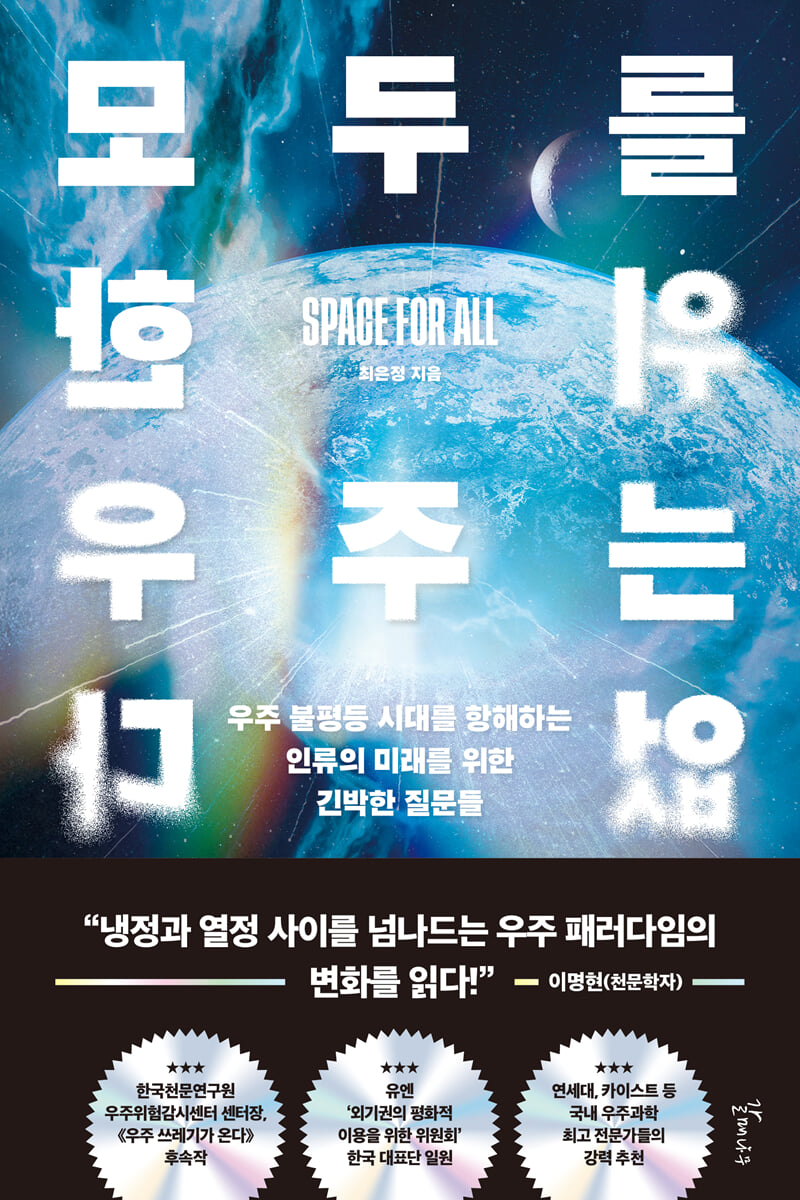
There is no universe for everyone
 |
Description
Book Introduction
The increasingly fierce competition in space development,
Is the universe we all dream of truly open and fair?
Space scientists are the first to observe what is happening outside of Earth.
Proposing a sustainable new future, not a universe monopolized by a few.
★★★ Choi Eun-jeong, Director of the Space Risk Monitoring Center at the Korea Astronomy and Space Science Institute
The sequel to "Space Junk is Coming" (2021 Youth Education Book of the Year)!
★★★ Korean delegation participates in the UN Committee on the Peaceful Uses of Outer Space!
★★★ Highly recommended by Korea's top space science experts, including KAIST and Yonsei University!
“In the 21st century, whoever controls space controls the world.” This statement from the Rumsfeld Report is no longer an exaggeration.
As even the US stock market analyzed that there is a high possibility that trillionaires will emerge from the space industry, the space economy has sufficient potential to grow to several or even dozens of times the size of the Earth's economy.
This is why many private companies, including SpaceX and Virgin Galactic, as well as countries around the world, are competing to expand into space to secure space.
Now, mankind sets out on a great voyage, not to the sea or the new continent, but to space.
This is the beginning of the 'New Space Era'.
The reason why the Age of Exploration cannot be viewed only positively is because the same inequality, monopoly, and colonization that occurred during the Age of Exploration in history are also taking place in space.
Because collisions in space occur silently and unseen by our eyes on Earth, public attention is focused on the shiny aspects of science and technology, such as space travel and the development of space resources.
However, reality is different from imagination. In real space, attacks such as satellite interception and radio jamming are carried out frequently, advanced space nations and private space companies engage in a battle over the orbits in which to launch satellites, and latecomer nations, lacking capital and systems, are technologically dependent on advanced nations.
The problem is further exacerbated by the lack of institutions currently in place to mediate or assign accountability for conflicts between nations, or between nations and private entities.
"Reading the shifting paradigm of the universe, oscillating between coolness and passion!" _Lee Myeong-hyeon (astronomer)
Eun-Jeong Choi, the director of the Space Risk Monitoring Center at the Korea Astronomy and Space Science Institute, who is the first to examine the situation and risks in space, decided to write a book because she felt regretful that people did not pay attention to the space inequality and risk of war behind space development.
The author, who has been raising awareness of the imminent danger of "space debris falling" and advocating for sustainable peaceful activities since his previous work, "Space Debris is Coming," vividly shares his experiences as a field expert in this book and proposes that we consider a "new space paradigm" suitable for the space age.
As a central figure in domestic research and development for space risk preparedness, and as a member of the Korean delegation to the UN Committee on the Peaceful Uses of Outer Space and the International Space Situation Action Joint Exercise, the author has a keen eye for reality while comprehensively foreseeing the future of space and humanity.
And it courageously brought to the surface uncomfortable but progressive stories that we need to pay attention to as we move toward a 'universe for all.'
Now we stand at a crossroads.
Is this a universe dominated by a handful of corporations and nations? Or is it a universe where all of humanity can pursue its dreams with relative equality? As the author suggests, space development, "transcending inequality and advancing toward a shared future for humanity," will not be achieved through grand challenges, but through the convergence of small, present-day challenges that prioritize "direction over speed, interoperability over ownership, and trust over monopoly."
This is why I hope this book will reach not only experts at the forefront of our country's space industry, but also all readers who will live in the space age.
Is the universe we all dream of truly open and fair?
Space scientists are the first to observe what is happening outside of Earth.
Proposing a sustainable new future, not a universe monopolized by a few.
★★★ Choi Eun-jeong, Director of the Space Risk Monitoring Center at the Korea Astronomy and Space Science Institute
The sequel to "Space Junk is Coming" (2021 Youth Education Book of the Year)!
★★★ Korean delegation participates in the UN Committee on the Peaceful Uses of Outer Space!
★★★ Highly recommended by Korea's top space science experts, including KAIST and Yonsei University!
“In the 21st century, whoever controls space controls the world.” This statement from the Rumsfeld Report is no longer an exaggeration.
As even the US stock market analyzed that there is a high possibility that trillionaires will emerge from the space industry, the space economy has sufficient potential to grow to several or even dozens of times the size of the Earth's economy.
This is why many private companies, including SpaceX and Virgin Galactic, as well as countries around the world, are competing to expand into space to secure space.
Now, mankind sets out on a great voyage, not to the sea or the new continent, but to space.
This is the beginning of the 'New Space Era'.
The reason why the Age of Exploration cannot be viewed only positively is because the same inequality, monopoly, and colonization that occurred during the Age of Exploration in history are also taking place in space.
Because collisions in space occur silently and unseen by our eyes on Earth, public attention is focused on the shiny aspects of science and technology, such as space travel and the development of space resources.
However, reality is different from imagination. In real space, attacks such as satellite interception and radio jamming are carried out frequently, advanced space nations and private space companies engage in a battle over the orbits in which to launch satellites, and latecomer nations, lacking capital and systems, are technologically dependent on advanced nations.
The problem is further exacerbated by the lack of institutions currently in place to mediate or assign accountability for conflicts between nations, or between nations and private entities.
"Reading the shifting paradigm of the universe, oscillating between coolness and passion!" _Lee Myeong-hyeon (astronomer)
Eun-Jeong Choi, the director of the Space Risk Monitoring Center at the Korea Astronomy and Space Science Institute, who is the first to examine the situation and risks in space, decided to write a book because she felt regretful that people did not pay attention to the space inequality and risk of war behind space development.
The author, who has been raising awareness of the imminent danger of "space debris falling" and advocating for sustainable peaceful activities since his previous work, "Space Debris is Coming," vividly shares his experiences as a field expert in this book and proposes that we consider a "new space paradigm" suitable for the space age.
As a central figure in domestic research and development for space risk preparedness, and as a member of the Korean delegation to the UN Committee on the Peaceful Uses of Outer Space and the International Space Situation Action Joint Exercise, the author has a keen eye for reality while comprehensively foreseeing the future of space and humanity.
And it courageously brought to the surface uncomfortable but progressive stories that we need to pay attention to as we move toward a 'universe for all.'
Now we stand at a crossroads.
Is this a universe dominated by a handful of corporations and nations? Or is it a universe where all of humanity can pursue its dreams with relative equality? As the author suggests, space development, "transcending inequality and advancing toward a shared future for humanity," will not be achieved through grand challenges, but through the convergence of small, present-day challenges that prioritize "direction over speed, interoperability over ownership, and trust over monopoly."
This is why I hope this book will reach not only experts at the forefront of our country's space industry, but also all readers who will live in the space age.
- You can preview some of the book's contents.
Preview
index
Prologue: The Universe is Not Neutral
Part 1: The Challenge to Orbit: Securing Multi-Based Space Stations
1.
Earth's orbit is an invisible battlefield
Why is the world so obsessed with geostationary orbit?
Is the sky above a public good or a common good?
The Science of Sustainability: Orbital Dynamics
2.
The Moon, the Outpost of Humanity's Dreams
“We decided to go to the moon.”
Sislunar, the center of space assets
Is lunar orbit safe without surveillance?
3.
Towards Mars and the Deep Space Beyond
The most efficient way to get to Mars
A battle for asteroid mining between planets
Protecting Mars Orbit Amidst Danger and Anxiety
Off the Record: The Story Behind South Korea's Nuri Space Launch Vehicle
Part 2: From Cosmic Inequality to Space War: Protecting the Peace in the Face of Heated Competition
4.
Space Inequality: Is Development Really Good for Everyone?
The changing meaning of space over time
Monopolies and colonies that stretched into space
Kick the ladder of technology and information
5.
Peaceful Uses of Space: Is Multilateral Coexistence Possible?
The vague definition of "peaceful use of space"
The evolution of space security: From Star Wars to the Golden Dome
6.
Space Situational Awareness: Are Launched Space Objects Safe?
Attack of the discarded space debris
Monitoring and observing the increasingly crowded universe
7.
Space Domain Awareness: Can Extreme Hegemonic Struggles Be Controlled?
'Space Force' isn't just a science fiction story.
Was the Russo-Ukrainian War Part of a 'Space War'?
Beyond intra-national cooperation to inter-national alliance
Off the Record: Behind the Scenes of Participating in Training at Vandenberg Space Force Base
Part 3: The Age of Space Exploration Has Already Begun: Prepare for a New Paradigm
8.
Let's move beyond the geocentric perspective
There are completely different time and energy systems.
Discoveries that shake up human thinking
9.
Space Traffic Management: For safe operation to support space habitation.
How to manage uncontrolled space objects?
Evasion Maneuvers: Who Regulates and Takes Responsibility?
10.
Passing through institutional gaps safely
The Path to Establishing an International Space Law System
A Guide for Future Humans Navigating Space
Off the Record: A Behind-the-Scenes Look at North Korea's Manri Gyeong from the Space Risk Monitoring Center
Epilogue: Dreaming of direction over speed, cooperation over monopoly
References
Recommendation
Part 1: The Challenge to Orbit: Securing Multi-Based Space Stations
1.
Earth's orbit is an invisible battlefield
Why is the world so obsessed with geostationary orbit?
Is the sky above a public good or a common good?
The Science of Sustainability: Orbital Dynamics
2.
The Moon, the Outpost of Humanity's Dreams
“We decided to go to the moon.”
Sislunar, the center of space assets
Is lunar orbit safe without surveillance?
3.
Towards Mars and the Deep Space Beyond
The most efficient way to get to Mars
A battle for asteroid mining between planets
Protecting Mars Orbit Amidst Danger and Anxiety
Off the Record: The Story Behind South Korea's Nuri Space Launch Vehicle
Part 2: From Cosmic Inequality to Space War: Protecting the Peace in the Face of Heated Competition
4.
Space Inequality: Is Development Really Good for Everyone?
The changing meaning of space over time
Monopolies and colonies that stretched into space
Kick the ladder of technology and information
5.
Peaceful Uses of Space: Is Multilateral Coexistence Possible?
The vague definition of "peaceful use of space"
The evolution of space security: From Star Wars to the Golden Dome
6.
Space Situational Awareness: Are Launched Space Objects Safe?
Attack of the discarded space debris
Monitoring and observing the increasingly crowded universe
7.
Space Domain Awareness: Can Extreme Hegemonic Struggles Be Controlled?
'Space Force' isn't just a science fiction story.
Was the Russo-Ukrainian War Part of a 'Space War'?
Beyond intra-national cooperation to inter-national alliance
Off the Record: Behind the Scenes of Participating in Training at Vandenberg Space Force Base
Part 3: The Age of Space Exploration Has Already Begun: Prepare for a New Paradigm
8.
Let's move beyond the geocentric perspective
There are completely different time and energy systems.
Discoveries that shake up human thinking
9.
Space Traffic Management: For safe operation to support space habitation.
How to manage uncontrolled space objects?
Evasion Maneuvers: Who Regulates and Takes Responsibility?
10.
Passing through institutional gaps safely
The Path to Establishing an International Space Law System
A Guide for Future Humans Navigating Space
Off the Record: A Behind-the-Scenes Look at North Korea's Manri Gyeong from the Space Risk Monitoring Center
Epilogue: Dreaming of direction over speed, cooperation over monopoly
References
Recommendation
Detailed image

Publisher's Review
The future of human civilization: Why has space become a space of hegemony struggles and power consolidation?
Inconvenient but progressive stories to keep in mind as we coexist with the universe!
ㆍHow to enter the orbits occupied by advanced space nations?
How will the space technology gap impact reality?
ㆍWill a space war like Star Wars really happen?
ㆍWho benefits from the space internet?
ㆍWho owns the mined space resources?
The Russo-Ukrainian war, which escalated into an all-out war in February 2022, was different from past wars.
Why? Because space attacks threaten Earth, demonstrating that space security in the 21st century is directly linked to national security.
The Russian attack on Ukraine's satellite communications network, aimed at crippling its social infrastructure and government systems, exemplifies the "soft kill" and demonstrates how cyberwarfare in space can wreak real havoc on our lives.
When we think of 'space war,' we often think of science fiction like Star Wars, but space threats are no longer just science fiction.
The United States established the Space Force in 2019 and asserted in its “Space Domain Awareness Doctrine” announced in 2023 that “exospace (…) must be considered a battlefield domain” because it recognized the reality that security cannot be guaranteed by remaining stuck to the existing space awareness perspective.
In May 2025, the Trump administration announced the "Golden Dome" defense system, the first in U.S. history to deploy weapons in space, completely expanding the language of battlefields, which had previously been confined to areas such as air, sea, and land, to space.
The space arms race kicked into high gear when China announced it was developing a "Chinese Golden Dome" system to track missiles that could be launched at it from anywhere in the world.
When humans first landed on the moon, we were thrilled to see their imagination come to life, calling them “the ones who made the impossible possible.”
But throughout the history of development, space has never been a neutral space.
From the first generation of space exploration, which saw an arms race to see who could land on the moon first during the Cold War, to the third generation of space exploration, which saw the rapid advancement of private space companies and the acceleration of innovation and chaos, space has always been a space where values intervene and where conflicts over interests are sharply contested.
Among the various problems hindering the long-term sustainability of space development, the author focuses particularly on the issue of 'space inequality.'
The chain of monopolies and resulting inequalities occurring in space are difficult to resolve because they originate from structural and institutional problems, and are already entrenched in many areas.
The author addresses the issues we need to understand to bridge the gap between the universe we imagine and the universe we will actually move toward.
For example, is the International Telecommunication Union's "International Frequency Registry," which guarantees orbital rights, truly fair? While the International Frequency Registry, which grants rights based on who "first" registered a satellite (and its frequency allocation), appears to be sound in theory, in practice, developed nations monopolized orbits in the 1980s and 1990s, leaving even limited space for new satellite networks.
Latecomer satellite networks wishing to enter must obtain coordination consent from the advanced satellite network by proving that they do not interfere with existing slots, but developing countries without space situational awareness systems find it difficult to prove this.
In fact, of the approximately 22,000 satellites currently launched into Earth's orbit, more than 90 percent are satellites from the United States, Russia, Europe, and China.
The same goes for the technology to launch space launch vehicles.
Most countries, excluding the United States, China, Russia, Europe, India, and Japan, do not have their own launch vehicles and rely on launch services from other countries, and most of the satellites they manufacture are imported.
Space launch vehicles, especially GPS, are responsible for a country's social infrastructure, including aviation, shipping, communications, finance, and power grids. Therefore, dependence on space technology is closer to the outsourcing of sovereignty than a problem of technological gap.
When we need to receive information on climate change, disasters, and reconnaissance from other countries' Earth observation satellites, technological dependence directly threatens our lives.
The International Outer Space Treaty defines space as the common heritage of humanity, stipulates that its benefits should be shared, and also stipulates that space cannot be used for military purposes.
However, since most space technologies are dual-use, it is difficult to assign responsibility, and they are only at the level of recommendations, so they have no binding force.
As space technology becomes more sophisticated, if we don't pay attention to what's happening "now," space will become even more crowded, competitive, and confrontational than it is now.
Therefore, cosmic inequality is not an abstract moral problem.
Likewise, cosmic justice is not simply a normative matter.
This is why we urgently need to think about and make efforts to make the new continent of space “an infrastructure for coexistence, not a stage for plunder.”
Earth, Moon, Mars: Secure Multiple Space Bases!
The current state of space development in Korea, as seen from space scientists on the front lines.
Center Director Eun-Jeong Choi is a scientist who analyzed the risk of collision with the Soyuz spacecraft delivering supplies to the International Space Station during the third launch of Nuri, and has been a member of the Korean delegation to the UN Committee for the Peaceful Uses of Outer Space since 2014.
The author, incorporating his own experiences into the book, shares a variety of stories from the field, including how far our country has come as a space development nation, what efforts are being made to join the ranks of advanced space nations, and how we are preparing for the growing space risks, both domestically and at the level of international cooperation.
This is significant in that it examines the current state of our country's space development and the limitations that must be overcome in the future through the eyes of experts working at the forefront of the industry.
Let's follow the situation on the day North Korea launched the Manri Gyeong in 2023.
According to the author, “Space wars begin with alarms, not gunshots.” On the large screen of the Korea Astronomy and Space Science Institute’s Space Object Monitoring Room, space objects floating around Korea are displayed as tiny dots.
Even after North Korea launched Manrigyong-1, the Space Risk Monitoring Center, to which the author belongs, observed orbital changes using its own developed space object monitoring network, OWL-Net.
Because “space warfare begins with small speed increments, not with massive destruction.”
To ensure that risks in space do not lead to political threats, the Space Risk Monitoring Center is in charge of 'technical data'.
Based on his experience participating in the US Joint Space Operations Center Space Situational Awareness joint training, as well as domestically, the author also talks about the importance of 'joint response that links strategic information in real time.'
The author's statement that, in a world where "information itself is a weapon, and accuracy and transparency are the core of information", our country's space strategy must incorporate independent information acquisition and multinational interoperability suggests the path forward for our country's space situational awareness strategy and development direction.
In Part 1 of "There is No Universe for Everyone," in addition to the author's own experiences, the book also shows scenes of multi-layered approaches to space, such as the moon and Mars, by summoning various devices.
It examines the history of space development, starting from the competition between the United States and the Soviet Union over lunar exploration before and after World War II, to the recently revived American manned lunar exploration program, the Artemis Project. It also reinterprets the rocket science and orbital mechanics that made human space exploration possible from the perspective of "sustainability."
From methods for using atmospheric resistance to drop satellites into the atmosphere after a mission ends to methods for designing avoidance maneuvers when the risk of collision between satellites arises, the author himself must have felt deeply that ‘science’ is essential for a sustainable space, having worked as a satellite developer in the past.
In the same vein, the author also points out the characteristics of various orbits outside the Earth, such as low Earth orbit (altitude 500–2,000 kilometers) and medium Earth orbit (altitude 2,000–35,786 kilometers), to explain why countries and private companies around the world are so competitively rushing to enter geostationary orbit (35,786 kilometers).
Of course, it also introduces orbital transfer methods (Hohmann transfer orbit, ballistic capture orbit, etc.) necessary for spacecraft to advance to Mars or an asteroid in the future.
Ultimately, the history of technological and knowledge evolution covered in this book provides a blueprint for dreaming more concretely about how to escape the limitations of Earth's gravity and advance into space.
As Carl Sagan, author of Cosmos, said, “You can’t go anywhere without imagination.” While not ignoring the obvious, encountering the scientific achievements of humanity gives us the courage to continue imagining the universe.
The age of space exploration has already begun,
Moving away from the geocentric perspective and toward the ‘space civilization’ paradigm
Now, space is not just 'reachable space'.
The reason the world continues to explore space despite the painstaking research and enormous investment of capital is because it is seriously considering the possibility of space as a 'habitable space'.
This means that the 'Earth-centered civilization' is no longer valid, and at the same time, it means that a new space paradigm must be established.
Does Earth's 24-hour system, centered around the Sun, hold true in space? Can Earth's energy system, fueled by fossil fuels, be applied in space? The author focuses on the issues of time systems and energy conversion because, as beings who think based on the "world perceived by the body," our perception of ourselves inevitably changes in space.
Furthermore, many issues await a paradigm re-establishment in space, such as how to divide nationality, how to define addresses and property rights, and how to adapt to weightlessness.
In the transition to a new space paradigm, the issue of institutional gaps is a key issue that cannot be overlooked.
This is because we cannot discuss peaceful and sustainable space without establishing a single framework and each country establishing its own space laws.
Because space activities where the intentions of an adversary are unclear, such as when defensive movements in space are mistaken for attacks, can trigger an arms race, governance and institutions that codify responsible behavior in space ultimately play a key role in addressing the issues addressed primarily in Part II of this book, Space Inequality and Space Warfare.
An expanded universe replicating the Earth's order is certainly not the future we dream of.
History tells us what consequences reckless expansion and exploration can lead to.
This book makes us reflect on who the current space development is for in an era where we cannot give up on advancing into space, and must do so, and poses questions for navigating towards a space that is "for everyone."
The author's critical perspective is not intended to criticize space development or suggest that it be halted.
Rather, it is intended to suggest a meaningful roadmap toward what might seem like an "ideal" path for our future journey into space.
Space is no longer a distant future.
“Space is closer than we think.” (From the 76th International Astronautical Congress) The author invites us to think together about how the changes and developments we will experience in the age of space exploration that has already begun will change human history and lead to a new era, what kind of imagination about space is needed in this paradigm shift, and what we can do for sustainable space navigation.
I hope that the publication of this book will spark discussions about creating a “shared future where we all navigate the universe together, free from domination and monopoly.”
Inconvenient but progressive stories to keep in mind as we coexist with the universe!
ㆍHow to enter the orbits occupied by advanced space nations?
How will the space technology gap impact reality?
ㆍWill a space war like Star Wars really happen?
ㆍWho benefits from the space internet?
ㆍWho owns the mined space resources?
The Russo-Ukrainian war, which escalated into an all-out war in February 2022, was different from past wars.
Why? Because space attacks threaten Earth, demonstrating that space security in the 21st century is directly linked to national security.
The Russian attack on Ukraine's satellite communications network, aimed at crippling its social infrastructure and government systems, exemplifies the "soft kill" and demonstrates how cyberwarfare in space can wreak real havoc on our lives.
When we think of 'space war,' we often think of science fiction like Star Wars, but space threats are no longer just science fiction.
The United States established the Space Force in 2019 and asserted in its “Space Domain Awareness Doctrine” announced in 2023 that “exospace (…) must be considered a battlefield domain” because it recognized the reality that security cannot be guaranteed by remaining stuck to the existing space awareness perspective.
In May 2025, the Trump administration announced the "Golden Dome" defense system, the first in U.S. history to deploy weapons in space, completely expanding the language of battlefields, which had previously been confined to areas such as air, sea, and land, to space.
The space arms race kicked into high gear when China announced it was developing a "Chinese Golden Dome" system to track missiles that could be launched at it from anywhere in the world.
When humans first landed on the moon, we were thrilled to see their imagination come to life, calling them “the ones who made the impossible possible.”
But throughout the history of development, space has never been a neutral space.
From the first generation of space exploration, which saw an arms race to see who could land on the moon first during the Cold War, to the third generation of space exploration, which saw the rapid advancement of private space companies and the acceleration of innovation and chaos, space has always been a space where values intervene and where conflicts over interests are sharply contested.
Among the various problems hindering the long-term sustainability of space development, the author focuses particularly on the issue of 'space inequality.'
The chain of monopolies and resulting inequalities occurring in space are difficult to resolve because they originate from structural and institutional problems, and are already entrenched in many areas.
The author addresses the issues we need to understand to bridge the gap between the universe we imagine and the universe we will actually move toward.
For example, is the International Telecommunication Union's "International Frequency Registry," which guarantees orbital rights, truly fair? While the International Frequency Registry, which grants rights based on who "first" registered a satellite (and its frequency allocation), appears to be sound in theory, in practice, developed nations monopolized orbits in the 1980s and 1990s, leaving even limited space for new satellite networks.
Latecomer satellite networks wishing to enter must obtain coordination consent from the advanced satellite network by proving that they do not interfere with existing slots, but developing countries without space situational awareness systems find it difficult to prove this.
In fact, of the approximately 22,000 satellites currently launched into Earth's orbit, more than 90 percent are satellites from the United States, Russia, Europe, and China.
The same goes for the technology to launch space launch vehicles.
Most countries, excluding the United States, China, Russia, Europe, India, and Japan, do not have their own launch vehicles and rely on launch services from other countries, and most of the satellites they manufacture are imported.
Space launch vehicles, especially GPS, are responsible for a country's social infrastructure, including aviation, shipping, communications, finance, and power grids. Therefore, dependence on space technology is closer to the outsourcing of sovereignty than a problem of technological gap.
When we need to receive information on climate change, disasters, and reconnaissance from other countries' Earth observation satellites, technological dependence directly threatens our lives.
The International Outer Space Treaty defines space as the common heritage of humanity, stipulates that its benefits should be shared, and also stipulates that space cannot be used for military purposes.
However, since most space technologies are dual-use, it is difficult to assign responsibility, and they are only at the level of recommendations, so they have no binding force.
As space technology becomes more sophisticated, if we don't pay attention to what's happening "now," space will become even more crowded, competitive, and confrontational than it is now.
Therefore, cosmic inequality is not an abstract moral problem.
Likewise, cosmic justice is not simply a normative matter.
This is why we urgently need to think about and make efforts to make the new continent of space “an infrastructure for coexistence, not a stage for plunder.”
Earth, Moon, Mars: Secure Multiple Space Bases!
The current state of space development in Korea, as seen from space scientists on the front lines.
Center Director Eun-Jeong Choi is a scientist who analyzed the risk of collision with the Soyuz spacecraft delivering supplies to the International Space Station during the third launch of Nuri, and has been a member of the Korean delegation to the UN Committee for the Peaceful Uses of Outer Space since 2014.
The author, incorporating his own experiences into the book, shares a variety of stories from the field, including how far our country has come as a space development nation, what efforts are being made to join the ranks of advanced space nations, and how we are preparing for the growing space risks, both domestically and at the level of international cooperation.
This is significant in that it examines the current state of our country's space development and the limitations that must be overcome in the future through the eyes of experts working at the forefront of the industry.
Let's follow the situation on the day North Korea launched the Manri Gyeong in 2023.
According to the author, “Space wars begin with alarms, not gunshots.” On the large screen of the Korea Astronomy and Space Science Institute’s Space Object Monitoring Room, space objects floating around Korea are displayed as tiny dots.
Even after North Korea launched Manrigyong-1, the Space Risk Monitoring Center, to which the author belongs, observed orbital changes using its own developed space object monitoring network, OWL-Net.
Because “space warfare begins with small speed increments, not with massive destruction.”
To ensure that risks in space do not lead to political threats, the Space Risk Monitoring Center is in charge of 'technical data'.
Based on his experience participating in the US Joint Space Operations Center Space Situational Awareness joint training, as well as domestically, the author also talks about the importance of 'joint response that links strategic information in real time.'
The author's statement that, in a world where "information itself is a weapon, and accuracy and transparency are the core of information", our country's space strategy must incorporate independent information acquisition and multinational interoperability suggests the path forward for our country's space situational awareness strategy and development direction.
In Part 1 of "There is No Universe for Everyone," in addition to the author's own experiences, the book also shows scenes of multi-layered approaches to space, such as the moon and Mars, by summoning various devices.
It examines the history of space development, starting from the competition between the United States and the Soviet Union over lunar exploration before and after World War II, to the recently revived American manned lunar exploration program, the Artemis Project. It also reinterprets the rocket science and orbital mechanics that made human space exploration possible from the perspective of "sustainability."
From methods for using atmospheric resistance to drop satellites into the atmosphere after a mission ends to methods for designing avoidance maneuvers when the risk of collision between satellites arises, the author himself must have felt deeply that ‘science’ is essential for a sustainable space, having worked as a satellite developer in the past.
In the same vein, the author also points out the characteristics of various orbits outside the Earth, such as low Earth orbit (altitude 500–2,000 kilometers) and medium Earth orbit (altitude 2,000–35,786 kilometers), to explain why countries and private companies around the world are so competitively rushing to enter geostationary orbit (35,786 kilometers).
Of course, it also introduces orbital transfer methods (Hohmann transfer orbit, ballistic capture orbit, etc.) necessary for spacecraft to advance to Mars or an asteroid in the future.
Ultimately, the history of technological and knowledge evolution covered in this book provides a blueprint for dreaming more concretely about how to escape the limitations of Earth's gravity and advance into space.
As Carl Sagan, author of Cosmos, said, “You can’t go anywhere without imagination.” While not ignoring the obvious, encountering the scientific achievements of humanity gives us the courage to continue imagining the universe.
The age of space exploration has already begun,
Moving away from the geocentric perspective and toward the ‘space civilization’ paradigm
Now, space is not just 'reachable space'.
The reason the world continues to explore space despite the painstaking research and enormous investment of capital is because it is seriously considering the possibility of space as a 'habitable space'.
This means that the 'Earth-centered civilization' is no longer valid, and at the same time, it means that a new space paradigm must be established.
Does Earth's 24-hour system, centered around the Sun, hold true in space? Can Earth's energy system, fueled by fossil fuels, be applied in space? The author focuses on the issues of time systems and energy conversion because, as beings who think based on the "world perceived by the body," our perception of ourselves inevitably changes in space.
Furthermore, many issues await a paradigm re-establishment in space, such as how to divide nationality, how to define addresses and property rights, and how to adapt to weightlessness.
In the transition to a new space paradigm, the issue of institutional gaps is a key issue that cannot be overlooked.
This is because we cannot discuss peaceful and sustainable space without establishing a single framework and each country establishing its own space laws.
Because space activities where the intentions of an adversary are unclear, such as when defensive movements in space are mistaken for attacks, can trigger an arms race, governance and institutions that codify responsible behavior in space ultimately play a key role in addressing the issues addressed primarily in Part II of this book, Space Inequality and Space Warfare.
An expanded universe replicating the Earth's order is certainly not the future we dream of.
History tells us what consequences reckless expansion and exploration can lead to.
This book makes us reflect on who the current space development is for in an era where we cannot give up on advancing into space, and must do so, and poses questions for navigating towards a space that is "for everyone."
The author's critical perspective is not intended to criticize space development or suggest that it be halted.
Rather, it is intended to suggest a meaningful roadmap toward what might seem like an "ideal" path for our future journey into space.
Space is no longer a distant future.
“Space is closer than we think.” (From the 76th International Astronautical Congress) The author invites us to think together about how the changes and developments we will experience in the age of space exploration that has already begun will change human history and lead to a new era, what kind of imagination about space is needed in this paradigm shift, and what we can do for sustainable space navigation.
I hope that the publication of this book will spark discussions about creating a “shared future where we all navigate the universe together, free from domination and monopoly.”
GOODS SPECIFICS
- Date of issue: November 28, 2025
- Page count, weight, size: 312 pages | 416g | 140*210*20mm
- ISBN13: 9791191842982
- ISBN10: 1191842983
You may also like
카테고리
korean


korean

![ELLE 엘르 스페셜 에디션 A형 : 12월 [2025]](http://librairie.coreenne.fr/cdn/shop/files/b8e27a3de6c9538896439686c6b0e8fb.jpg?v=1766436872&width=3840)


