

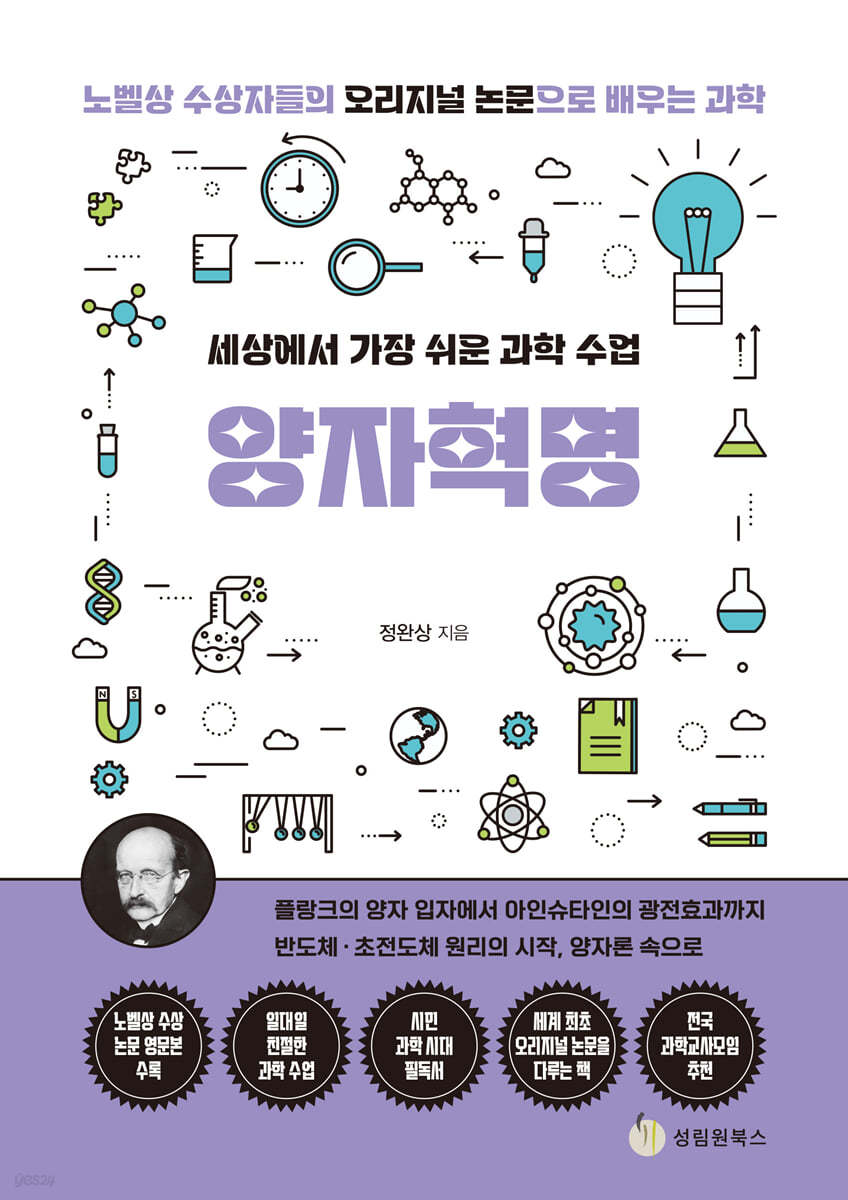
The World's Easiest Science Lesson: The Quantum Revolution
 |
Description
Book Introduction
The Beginning of Semiconductor and Superconductor Principles, Into Quantum Theory
We delve into the stories of Nobel Prize-winning scientists who are searching for new physics through papers!
Into the story of Nobel Prize-winning scientists who searched for new physics in the last century.
Planck, a giant in modern physics, first discovered a particle called a quantum.
He argued that these particles had the curious property of allowing for discrete energies, unlike the particles of classical physics.
In 1900, he boldly overturned the dynamics theory perfected by Galileo and Newton with his quantum theory paper.
The third volume of the [Learn Science with Original Papers by Nobel Prize Winners] series, 『The World's Easiest Science Lesson: Quantum Revolution』, begins by assuming that light is made up of particles called photons, and that the energy a photon can have is an integer multiple of a certain minimum energy.
Afterwards, due to the influence of Planck's paper, existing physical theories were revised, and solid-state physics also accepted the concept of quantum theory, such as nuclear physics and particle physics.
Planck's paper opened the door to the quantum era, and Newton's mechanics was subsequently revised into quantum mechanics, and had a major influence on Bohr's creation of the correct atomic model.
『The World's Easiest Science Lesson: The Quantum Revolution』 focuses on Planck's quantum theory.
At the time when Planck completed his first paper on quantum theory, he presented an interesting historical account of the thermodynamics he studied to write this paper.
At the same time, he detailed what Planck wanted to tell people in his original English paper.
This book features formulas along with episodes of scientists who made great discoveries.
It is explained in a friendly way so that you can understand it if you only know high school level math content, without feeling that it is difficult.
By following the one-on-one conversation between Professor Jeong and the physics department, even readers who are afraid of math or science will be able to easily understand.
I recommend this series to anyone interested in science, whether they're a student dreaming of becoming a scientist, someone who wants to learn more about quantum theory, a science teacher looking to introduce a great paper to their students, or a filmmaker or webtoon artist hoping to create a science fiction film that surpasses [Interstellar].
All 20 volumes of this series feature all past Nobel Prize winners in Physics.
We delve into the stories of Nobel Prize-winning scientists who are searching for new physics through papers!
Into the story of Nobel Prize-winning scientists who searched for new physics in the last century.
Planck, a giant in modern physics, first discovered a particle called a quantum.
He argued that these particles had the curious property of allowing for discrete energies, unlike the particles of classical physics.
In 1900, he boldly overturned the dynamics theory perfected by Galileo and Newton with his quantum theory paper.
The third volume of the [Learn Science with Original Papers by Nobel Prize Winners] series, 『The World's Easiest Science Lesson: Quantum Revolution』, begins by assuming that light is made up of particles called photons, and that the energy a photon can have is an integer multiple of a certain minimum energy.
Afterwards, due to the influence of Planck's paper, existing physical theories were revised, and solid-state physics also accepted the concept of quantum theory, such as nuclear physics and particle physics.
Planck's paper opened the door to the quantum era, and Newton's mechanics was subsequently revised into quantum mechanics, and had a major influence on Bohr's creation of the correct atomic model.
『The World's Easiest Science Lesson: The Quantum Revolution』 focuses on Planck's quantum theory.
At the time when Planck completed his first paper on quantum theory, he presented an interesting historical account of the thermodynamics he studied to write this paper.
At the same time, he detailed what Planck wanted to tell people in his original English paper.
This book features formulas along with episodes of scientists who made great discoveries.
It is explained in a friendly way so that you can understand it if you only know high school level math content, without feeling that it is difficult.
By following the one-on-one conversation between Professor Jeong and the physics department, even readers who are afraid of math or science will be able to easily understand.
I recommend this series to anyone interested in science, whether they're a student dreaming of becoming a scientist, someone who wants to learn more about quantum theory, a science teacher looking to introduce a great paper to their students, or a filmmaker or webtoon artist hoping to create a science fiction film that surpasses [Interstellar].
All 20 volumes of this series feature all past Nobel Prize winners in Physics.
- You can preview some of the book's contents.
Preview
index
Recommendation_008
I wish I had a book like this when I first started studying science.
A book that summarizes the experiences of the growth of physical thinking in one place.
I hope you can understand the original papers of these genius scientists.
The Birth of a World-Changing Theory of Mechanics: A Surprise Interview with Dr. Penzias
First Encounter | Planck, the Father of Quantum Theory
Helmont, who explored the invisible force _ Air is made up of many gases?
Boyle, a skeptical chemist, discovered the relationship between gas pressure and volume.
Charles's Law: The First Balloon Flight
Scientists Discover the Components of Air - Discovery of Invisible Gases
Dalton's Atom Story: Gas Molecular Theory
Avogadro, the protagonist of molecular theory - How many molecules are there in all gases?
Second Encounter | Heroes of Thermodynamics
A pioneer in the kinetic theory of gases, Jul _ experiments continued even on his honeymoon
The Birth of the First Law of Thermodynamics - Why Does Iced Coffee Get Hotter on a Hot Day?
Entropy and the Second Law of Thermodynamics - Heat moves from hotter to colder places.
Connecting the First and Second Laws of Thermodynamics - Using Partial Differentiation
Number of Combinations - Four Ways to Count the Number of Cases
Boltzmann, a pioneer in statistical mechanics, found entropy in probability and statistics.
The Birth of the Boltzmann Factor: Energy Goes to Infinity and Becomes Zero
Third Encounter | Heroes of Black Radiation
The Seven Lights - The Principles of Visible Light
Fraunhofer Opens the Door to Spectroscopy: The Discovery of Spectral Absorption Lines
Kirchhoff's law: The ratio of light absorption to emission is constant.
Stefan Unravels the Mystery of Thermal Radiation: Why the Earth Is Warming
The Vienna Formula Born from War - How is the color of an object determined?
Finding the formula for Bin and Bora _ Short wavelength light
Rayleigh-Jeans Red Formula: Solving Experimental Graphs with Formulas
Planck's Quantum Revolution: Overcoming Imperfection with a Perfect Theory
Fourth Encounter | Inside Planck's Paper
Connecting Factorials and Integrals - Applications of Partial Integration
Stirling Approximation _ Formula for Very Large N
Euler's zeta function and the relationship between prime numbers - Challenge the sum of infinite series
Planck's Strange Hypothesis: The Birth of a New Grain
The Prelude to the Quantum Age: Unraveling Planck's Constant
Fifth Meeting | Scientists Who Discovered the Existence of Photons
Einstein completes Planck's paper: explaining the photoelectric effect
Compton effect: A powerful breakthrough that revealed the existence of quantum mechanics.
In addition to the meeting
On an Improvement of Wien's Equation for the Spectrum _Planck 1 paper English version
On the Theory of the Energy Distribution Law of the Normal Spectrum _Planck 2 paper English version
On the Law of the Energy Distribution in the Normal Spectrum _Planck 3 Paper English Version
A QUANTUM THEORY OF THE SCATTERING OF X-RAYS BY LIGHT ELEMENTS _Compton's paper in English
Concluding our meeting with a great paper
Papers referenced for this book
Greek letters used in formulas
Introducing the Nobel Prize winners in Physics
I wish I had a book like this when I first started studying science.
A book that summarizes the experiences of the growth of physical thinking in one place.
I hope you can understand the original papers of these genius scientists.
The Birth of a World-Changing Theory of Mechanics: A Surprise Interview with Dr. Penzias
First Encounter | Planck, the Father of Quantum Theory
Helmont, who explored the invisible force _ Air is made up of many gases?
Boyle, a skeptical chemist, discovered the relationship between gas pressure and volume.
Charles's Law: The First Balloon Flight
Scientists Discover the Components of Air - Discovery of Invisible Gases
Dalton's Atom Story: Gas Molecular Theory
Avogadro, the protagonist of molecular theory - How many molecules are there in all gases?
Second Encounter | Heroes of Thermodynamics
A pioneer in the kinetic theory of gases, Jul _ experiments continued even on his honeymoon
The Birth of the First Law of Thermodynamics - Why Does Iced Coffee Get Hotter on a Hot Day?
Entropy and the Second Law of Thermodynamics - Heat moves from hotter to colder places.
Connecting the First and Second Laws of Thermodynamics - Using Partial Differentiation
Number of Combinations - Four Ways to Count the Number of Cases
Boltzmann, a pioneer in statistical mechanics, found entropy in probability and statistics.
The Birth of the Boltzmann Factor: Energy Goes to Infinity and Becomes Zero
Third Encounter | Heroes of Black Radiation
The Seven Lights - The Principles of Visible Light
Fraunhofer Opens the Door to Spectroscopy: The Discovery of Spectral Absorption Lines
Kirchhoff's law: The ratio of light absorption to emission is constant.
Stefan Unravels the Mystery of Thermal Radiation: Why the Earth Is Warming
The Vienna Formula Born from War - How is the color of an object determined?
Finding the formula for Bin and Bora _ Short wavelength light
Rayleigh-Jeans Red Formula: Solving Experimental Graphs with Formulas
Planck's Quantum Revolution: Overcoming Imperfection with a Perfect Theory
Fourth Encounter | Inside Planck's Paper
Connecting Factorials and Integrals - Applications of Partial Integration
Stirling Approximation _ Formula for Very Large N
Euler's zeta function and the relationship between prime numbers - Challenge the sum of infinite series
Planck's Strange Hypothesis: The Birth of a New Grain
The Prelude to the Quantum Age: Unraveling Planck's Constant
Fifth Meeting | Scientists Who Discovered the Existence of Photons
Einstein completes Planck's paper: explaining the photoelectric effect
Compton effect: A powerful breakthrough that revealed the existence of quantum mechanics.
In addition to the meeting
On an Improvement of Wien's Equation for the Spectrum _Planck 1 paper English version
On the Theory of the Energy Distribution Law of the Normal Spectrum _Planck 2 paper English version
On the Law of the Energy Distribution in the Normal Spectrum _Planck 3 Paper English Version
A QUANTUM THEORY OF THE SCATTERING OF X-RAYS BY LIGHT ELEMENTS _Compton's paper in English
Concluding our meeting with a great paper
Papers referenced for this book
Greek letters used in formulas
Introducing the Nobel Prize winners in Physics
Detailed image
.jpg)
Publisher's Review
★ Recommended by the National Science Teachers Association ★ A must-read for the era of citizen science
★ A must-read for those planning to pursue a science or engineering degree ★ The world's first book to feature original papers by a Nobel Prize winner
★ One-on-one friendly science classes ★ Original papers in English included
How great would it have been if there had been a book like this when I first started studying science?
Now, we have entered an era where space development is led by the private sector.
For example, the American company SpaceX has achieved groundbreaking achievements such as the world's first commercial spacecraft launch and the docking of private astronauts to the International Space Station.
In keeping with this trend, our country is also actively pursuing the development of the space industry by advancing the production, launch, and operation technology of Nuriho.
Why does humanity desire to go into space and conquer it? It's probably a curiosity to know, a spirit of exploration to pioneer.
It is no exaggeration to say that the development of civilization was achieved through the development of science and mathematics.
This book explains, in an easy-to-understand way, how phenomena we encounter in our daily lives have been proven theoretically, following the development of physics, rather than being difficult science.
In particular, the vividness of seeing original papers from great scientists and learning one-on-one will make learning science more familiar and enjoyable.
Want to read original papers by genius scientists?
An intimate science story, like taking a one-on-one class.
Until now, it was common for the general public, students learning science, and even scientists researching in the field to study through textbooks or theoretical books.
However, if we know how many creative thoughts and experiments scientists have gone through to discover new things before the birth of a theory, science will no longer be a subject to be memorized.
"The Quantum Revolution," a book written by Nobel Prize winners, provides an engaging introduction to science, from the foundations of scientific theory to its birth.
In particular, the first paper on quantum theory in this book provides a quick overview of the historical flow, from the interpretation of the black body radiation experiment to the proof of the quantum particle.
Of course, it would be ideal if you recall high school math to understand this paper, but it is still accessible without any burden.
I hope that, like Planck, who boldly took on the challenge, your scientific knowledge will expand further as you pick up this book.
Build up your knowledge of the history and background of science in a fun, conversational way.
Is there anything more deeply connected to our daily lives than science? The discovery of quantum mechanics a century ago has led to advancements in semiconductors, lasers, and other technologies, opening up a world of nanoscale understanding for humanity. Einstein's theory of relativity, the principle of time and space, revealed 120 years ago, has revealed how the universe was formed and how it will evolve in the future.
Also, science fiction films such as 'Interstellar' have become popular among the public by revealing the mysteries of the universe in a more accessible way.
Knowing this, science is not a difficult subject, but is closely related to the evolution and development of mankind, and can be learned in a fun way.
However, I sometimes feel sad that in our country, there are still many people who vaguely think of science as difficult.
This book is based on original papers containing the core research of scientists, and through conversations between physics professors and professor Jeong, explains the historical background and behind-the-scenes stories of historical physics theories in an easy-to-understand manner.
As you read the historical background and episodes of the birth of this book's great scientific theories, you will find yourself becoming more interested in science.
The joy of science in a series
One of the things that surprises me when talking to foreigners is that they find learning science very enjoyable.
Perhaps for this reason, the average scientific knowledge of the people is quite high, and in fact, many Nobel Prize winners in science have been produced.
However, looking at the situation in our country, it seems that the threshold is still quite high.
The author of this book expresses regret that our country has not produced a Nobel Prize winner in science, and says that science is so closely connected to our lives that anyone can learn about it in a fun way.
He emphasizes that if you follow the book's contents while understanding the original papers included in the book, you will be able to welcome the coming quantum age and the age of space travel with flying colors.
This book was planned as a series.
I believe that through the process of completing each book, one's interest in science will increase and one's level of understanding will improve.
★ A must-read for those planning to pursue a science or engineering degree ★ The world's first book to feature original papers by a Nobel Prize winner
★ One-on-one friendly science classes ★ Original papers in English included
How great would it have been if there had been a book like this when I first started studying science?
Now, we have entered an era where space development is led by the private sector.
For example, the American company SpaceX has achieved groundbreaking achievements such as the world's first commercial spacecraft launch and the docking of private astronauts to the International Space Station.
In keeping with this trend, our country is also actively pursuing the development of the space industry by advancing the production, launch, and operation technology of Nuriho.
Why does humanity desire to go into space and conquer it? It's probably a curiosity to know, a spirit of exploration to pioneer.
It is no exaggeration to say that the development of civilization was achieved through the development of science and mathematics.
This book explains, in an easy-to-understand way, how phenomena we encounter in our daily lives have been proven theoretically, following the development of physics, rather than being difficult science.
In particular, the vividness of seeing original papers from great scientists and learning one-on-one will make learning science more familiar and enjoyable.
Want to read original papers by genius scientists?
An intimate science story, like taking a one-on-one class.
Until now, it was common for the general public, students learning science, and even scientists researching in the field to study through textbooks or theoretical books.
However, if we know how many creative thoughts and experiments scientists have gone through to discover new things before the birth of a theory, science will no longer be a subject to be memorized.
"The Quantum Revolution," a book written by Nobel Prize winners, provides an engaging introduction to science, from the foundations of scientific theory to its birth.
In particular, the first paper on quantum theory in this book provides a quick overview of the historical flow, from the interpretation of the black body radiation experiment to the proof of the quantum particle.
Of course, it would be ideal if you recall high school math to understand this paper, but it is still accessible without any burden.
I hope that, like Planck, who boldly took on the challenge, your scientific knowledge will expand further as you pick up this book.
Build up your knowledge of the history and background of science in a fun, conversational way.
Is there anything more deeply connected to our daily lives than science? The discovery of quantum mechanics a century ago has led to advancements in semiconductors, lasers, and other technologies, opening up a world of nanoscale understanding for humanity. Einstein's theory of relativity, the principle of time and space, revealed 120 years ago, has revealed how the universe was formed and how it will evolve in the future.
Also, science fiction films such as 'Interstellar' have become popular among the public by revealing the mysteries of the universe in a more accessible way.
Knowing this, science is not a difficult subject, but is closely related to the evolution and development of mankind, and can be learned in a fun way.
However, I sometimes feel sad that in our country, there are still many people who vaguely think of science as difficult.
This book is based on original papers containing the core research of scientists, and through conversations between physics professors and professor Jeong, explains the historical background and behind-the-scenes stories of historical physics theories in an easy-to-understand manner.
As you read the historical background and episodes of the birth of this book's great scientific theories, you will find yourself becoming more interested in science.
The joy of science in a series
One of the things that surprises me when talking to foreigners is that they find learning science very enjoyable.
Perhaps for this reason, the average scientific knowledge of the people is quite high, and in fact, many Nobel Prize winners in science have been produced.
However, looking at the situation in our country, it seems that the threshold is still quite high.
The author of this book expresses regret that our country has not produced a Nobel Prize winner in science, and says that science is so closely connected to our lives that anyone can learn about it in a fun way.
He emphasizes that if you follow the book's contents while understanding the original papers included in the book, you will be able to welcome the coming quantum age and the age of space travel with flying colors.
This book was planned as a series.
I believe that through the process of completing each book, one's interest in science will increase and one's level of understanding will improve.
GOODS SPECIFICS
- Date of issue: August 21, 2023
- Page count, weight, size: 278 pages | 152*215*20mm
- ISBN13: 9791188762972
- ISBN10: 1188762974
You may also like
카테고리
korean


korean

![GQ KOREA Mark (Monthly): December [2025]](http://librairie.coreenne.fr/cdn/shop/files/8ef265dbbfbf186523ed75ba7319009d.jpg?v=1765340328&width=3840)


