

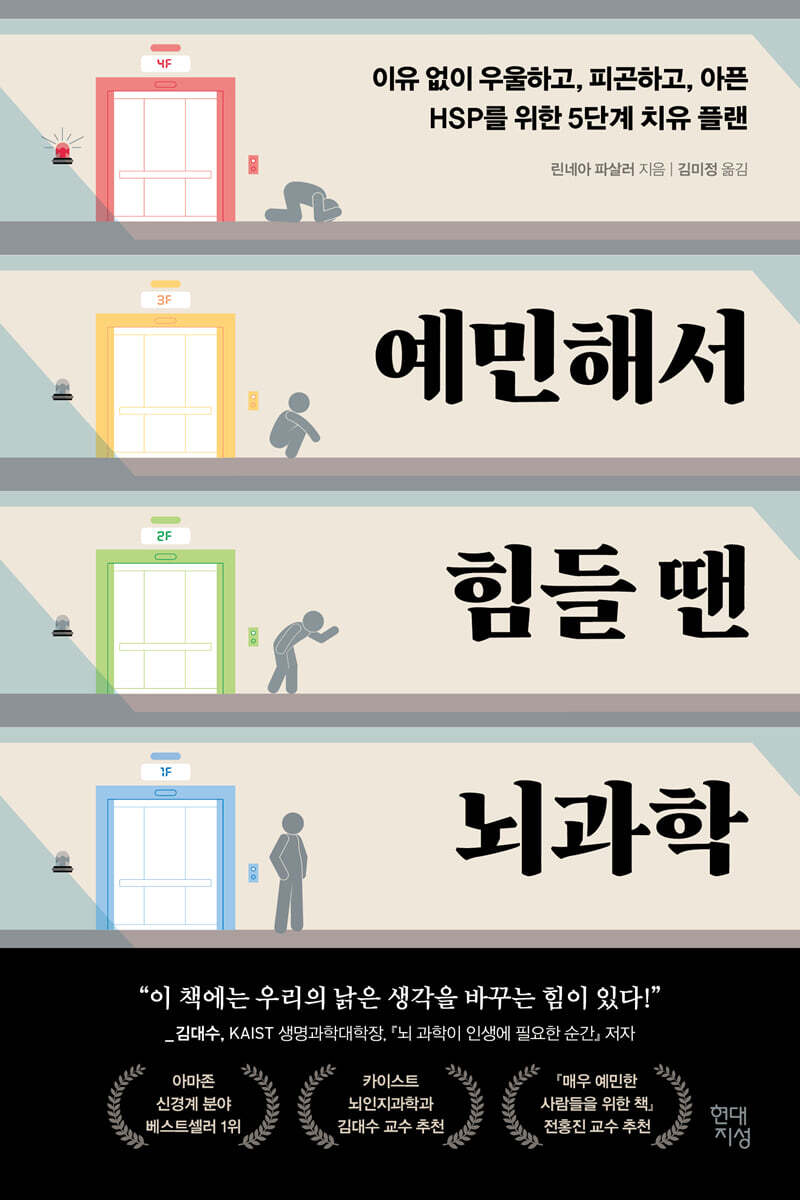
When you're feeling sensitive and having a hard time, try brain science
 |
Description
Book Introduction
Burnout, anxiety, digestive issues, inflammation, chronic fatigue…
Are you still mistaken in thinking that it is simply due to stress?
Your 'unexplained illness' is due to an overly sensitive nervous system!
★★★ Amazon's #1 Bestseller in the Nervous System Category
★★★ 『A Book for Highly Sensitive People』 Recommended by Professor Jeon Hong-jin
★★★ Recommended by Professor Dae-soo Kim of the Department of Brain and Cognitive Sciences at KAIST
Highly sensitive people are more vulnerable to external stress because they have more sensitive nervous systems than others.
So, things that others may just let go of become stressful for them, and their nervous systems are constantly on alert, unable to fully rest.
This book was written for people who suffer from various physical symptoms, including recurring anxiety and chronic fatigue, due to their sensitive nervous systems.
Dr. Linnea Parsaler, who leads the online community "Heal Your Nervous System," offers a healing plan for "neural dysregulation," the root cause of many unexplained illnesses, based on brain science research and her experience helping thousands of people heal.
By practicing the simple yet effective breathing, stretching, and sensory awakening techniques presented in this book for just five minutes a day, you'll find yourself dealing with all kinds of stress with surprising flexibility and ease.
Are you still mistaken in thinking that it is simply due to stress?
Your 'unexplained illness' is due to an overly sensitive nervous system!
★★★ Amazon's #1 Bestseller in the Nervous System Category
★★★ 『A Book for Highly Sensitive People』 Recommended by Professor Jeon Hong-jin
★★★ Recommended by Professor Dae-soo Kim of the Department of Brain and Cognitive Sciences at KAIST
Highly sensitive people are more vulnerable to external stress because they have more sensitive nervous systems than others.
So, things that others may just let go of become stressful for them, and their nervous systems are constantly on alert, unable to fully rest.
This book was written for people who suffer from various physical symptoms, including recurring anxiety and chronic fatigue, due to their sensitive nervous systems.
Dr. Linnea Parsaler, who leads the online community "Heal Your Nervous System," offers a healing plan for "neural dysregulation," the root cause of many unexplained illnesses, based on brain science research and her experience helping thousands of people heal.
By practicing the simple yet effective breathing, stretching, and sensory awakening techniques presented in this book for just five minutes a day, you'll find yourself dealing with all kinds of stress with surprising flexibility and ease.
- You can preview some of the book's contents.
Preview
index
Recommendation
Introduction: How This Book Can Help You
Chapter 1 If the nervous system is not properly regulated
Chapter 2: Four Pillars of Nervous Health
Chapter 3: What's Different About the Nervous System of a "Highly Sensitive Person"?
Chapter 4: Stress and Fear Are Not Wrong
Chapter 5: A 5-Step Plan for Building a Flexible and Resilient Nervous System
Chapter 6: Basic Routines to Support the Nervous System
Chapter 7, Step 1: Recognizing the Signals Your Nervous System Sends
Chapter 8, Step 2: Control You have the ability to control your emotions.
Chapter 9, Step 3: "Recovery": Regaining the Resilience of Your Nervous System
Chapter 10, Step 4: Relationships: Relationships strengthen the nervous system.
Chapter 11, Step 5: Expanding: Building Capacity for Bigger Challenges
Chapter 12: The Journey to Healing is a Grand Narrative
Chapter 13: Inspire Others
Going Out: Praise Sensitivity
Acknowledgements
References
Introduction: How This Book Can Help You
Chapter 1 If the nervous system is not properly regulated
Chapter 2: Four Pillars of Nervous Health
Chapter 3: What's Different About the Nervous System of a "Highly Sensitive Person"?
Chapter 4: Stress and Fear Are Not Wrong
Chapter 5: A 5-Step Plan for Building a Flexible and Resilient Nervous System
Chapter 6: Basic Routines to Support the Nervous System
Chapter 7, Step 1: Recognizing the Signals Your Nervous System Sends
Chapter 8, Step 2: Control You have the ability to control your emotions.
Chapter 9, Step 3: "Recovery": Regaining the Resilience of Your Nervous System
Chapter 10, Step 4: Relationships: Relationships strengthen the nervous system.
Chapter 11, Step 5: Expanding: Building Capacity for Bigger Challenges
Chapter 12: The Journey to Healing is a Grand Narrative
Chapter 13: Inspire Others
Going Out: Praise Sensitivity
Acknowledgements
References
Detailed image

Into the book
When there is a 'dysregulation' in the nervous system, you cannot respond naturally and flexibly to stressors and cannot escape from stress.
As the state of activation continues for long periods of time, there is little time left to return to a state of rest and recovery.
Then you can't completely relax, as if there's always something wrong, and you always feel anxious.
You may feel burned out or shut down, exhausted, depressed, or like nothing matters.
If you have a nervous system dysregulation, you may find yourself oscillating between these states, leaving you feeling trapped in a vicious cycle of anxiety and fatigue.
--- p.24
But the nervous system has an amazing ability to reorganize and heal itself from damage caused by stressors.
In fact, the nervous system is constantly connecting and reorganizing the neurons, the cells that make up the nervous system.
This process is called 'neuroplasticity'.
Neuroscientists once thought that only children's brains had neuroplasticity, but now they agree that people have neuroplasticity throughout their lives.
That is, regardless of what experiences you had in childhood or whether traumatic stressors in adulthood caused your nervous system to become dysregulated, you can rewire your nervous system to regulate itself smoothly.
To help you understand, think of the nervous system as a lump of clay.
You have the power to shape the mass, reshape it, and reattach it.
Of course, there are limits to our ability to form a nervous system.
Neurons lost from brain damage, such as trauma or stroke, cannot be replaced.
However, the nervous system is prepared to regain its ability to cope with stress by rewiring the neural pathways that cause dysregulation.
--- p.36
If you are a 'highly sensitive person', you may notice subtle details that others miss.
With that ability, there is also the possibility of becoming a talented creator such as an artist, musician, or writer.
They also capture subtle details or emotional nuances in their surroundings, which can lead to unique and profound insights or ideas.
In social situations, you can quickly perceive the emotions and needs of others, making you an empathetic friend, a thoughtful partner, and an insightful leader.
You'll probably be the first to notice when a friend is upset or a teammate feels left out.
Moreover, if you have sensitivity, you can feel beauty deeply.
A 'highly sensitive person' can find immense joy in a beautiful sunset, a piece of music, or a well-written sentence, which can greatly enrich their life experience.
This can be a wonderful talent when you are in an environment that fosters sensitivity or when you learn how to cultivate it yourself.
However, people with high sensitivity are also prone to stress.
Being stressed for too long without adequate recovery time can cause dysregulation of the nervous system.
--- p.68
Emotions are powerful motivators.
If you feel a lot of negative emotions, you may want to do whatever it takes to feel better.
In the past, it was often advised to change negative thinking patterns, such as thinking more positive thoughts, to manage unpleasant emotions.
While this approach may be beneficial in certain situations, it may be an oversimplification of how emotions work.
Traditionally, emotions have been understood as the direct result of thoughts.
It was also assumed that emotions were universal and experienced in the same way across individuals and cultures.
But modern research offers a more nuanced perspective.
One of the most widely accepted theories of emotion in recent years is the affective construct theory proposed by neuroscientist and researcher Lisa Feldman Barrett.
Contrary to traditional views, Barrett argues that emotions are not universal and experienced equally.
Rather, emotions are personal and subjective experiences, composed of a combination of the present moment's circumstances, our interpretation of the situation based on past experiences and cultural background, and our physical sensations.
--- p.208
The 'hormesis effect' refers to the phenomenon in which small amounts of harmful substances can actually be beneficial to our bodies, and can also be applied to the mechanism of adapting to stress.
While severe stress can be detrimental to the nervous system, moderate stress can actually be very beneficial for nervous system health.
The key to hormesis is finding your optimal stress level.
A certain amount of stress is necessary to stimulate growth and resilience, so it should not be too little, but it should not be so excessive that it continues for too long, leading to nervous system dysregulation and related health problems.
Exposure to optimal stress can slow the aging process, promote the development of new neural pathways, and keep the nervous system healthy and functioning.
As the state of activation continues for long periods of time, there is little time left to return to a state of rest and recovery.
Then you can't completely relax, as if there's always something wrong, and you always feel anxious.
You may feel burned out or shut down, exhausted, depressed, or like nothing matters.
If you have a nervous system dysregulation, you may find yourself oscillating between these states, leaving you feeling trapped in a vicious cycle of anxiety and fatigue.
--- p.24
But the nervous system has an amazing ability to reorganize and heal itself from damage caused by stressors.
In fact, the nervous system is constantly connecting and reorganizing the neurons, the cells that make up the nervous system.
This process is called 'neuroplasticity'.
Neuroscientists once thought that only children's brains had neuroplasticity, but now they agree that people have neuroplasticity throughout their lives.
That is, regardless of what experiences you had in childhood or whether traumatic stressors in adulthood caused your nervous system to become dysregulated, you can rewire your nervous system to regulate itself smoothly.
To help you understand, think of the nervous system as a lump of clay.
You have the power to shape the mass, reshape it, and reattach it.
Of course, there are limits to our ability to form a nervous system.
Neurons lost from brain damage, such as trauma or stroke, cannot be replaced.
However, the nervous system is prepared to regain its ability to cope with stress by rewiring the neural pathways that cause dysregulation.
--- p.36
If you are a 'highly sensitive person', you may notice subtle details that others miss.
With that ability, there is also the possibility of becoming a talented creator such as an artist, musician, or writer.
They also capture subtle details or emotional nuances in their surroundings, which can lead to unique and profound insights or ideas.
In social situations, you can quickly perceive the emotions and needs of others, making you an empathetic friend, a thoughtful partner, and an insightful leader.
You'll probably be the first to notice when a friend is upset or a teammate feels left out.
Moreover, if you have sensitivity, you can feel beauty deeply.
A 'highly sensitive person' can find immense joy in a beautiful sunset, a piece of music, or a well-written sentence, which can greatly enrich their life experience.
This can be a wonderful talent when you are in an environment that fosters sensitivity or when you learn how to cultivate it yourself.
However, people with high sensitivity are also prone to stress.
Being stressed for too long without adequate recovery time can cause dysregulation of the nervous system.
--- p.68
Emotions are powerful motivators.
If you feel a lot of negative emotions, you may want to do whatever it takes to feel better.
In the past, it was often advised to change negative thinking patterns, such as thinking more positive thoughts, to manage unpleasant emotions.
While this approach may be beneficial in certain situations, it may be an oversimplification of how emotions work.
Traditionally, emotions have been understood as the direct result of thoughts.
It was also assumed that emotions were universal and experienced in the same way across individuals and cultures.
But modern research offers a more nuanced perspective.
One of the most widely accepted theories of emotion in recent years is the affective construct theory proposed by neuroscientist and researcher Lisa Feldman Barrett.
Contrary to traditional views, Barrett argues that emotions are not universal and experienced equally.
Rather, emotions are personal and subjective experiences, composed of a combination of the present moment's circumstances, our interpretation of the situation based on past experiences and cultural background, and our physical sensations.
--- p.208
The 'hormesis effect' refers to the phenomenon in which small amounts of harmful substances can actually be beneficial to our bodies, and can also be applied to the mechanism of adapting to stress.
While severe stress can be detrimental to the nervous system, moderate stress can actually be very beneficial for nervous system health.
The key to hormesis is finding your optimal stress level.
A certain amount of stress is necessary to stimulate growth and resilience, so it should not be too little, but it should not be so excessive that it continues for too long, leading to nervous system dysregulation and related health problems.
Exposure to optimal stress can slow the aging process, promote the development of new neural pathways, and keep the nervous system healthy and functioning.
--- p.334
Publisher's Review
More than 60% of Korean adults suffer from physical or mental illness.
What's the real cause behind chronic stress, anxiety, burnout, and fatigue?
Many modern people suffer from stress and anxiety.
Highly sensitive people (HSPs) are particularly prone to this problem because they are more sensitive to external stimuli than others.
According to Dr. Elaine Aron, an American psychologist who first coined the term "highly sensitive person," HSPs make up about 15 to 20 percent of the general population and react more strongly to environmental stimuli.
They are easily overwhelmed by noise, strong light, and social situations, and are prone to chronic stress, fatigue, and anxiety disorders. According to the "2024 Korea Wellness Report" published by the KB Management Research Institute, 62.5% of economically active Korean adults have recently experienced mental health issues such as stress, depression, and anxiety, while 64.9% complained of physical symptoms such as insomnia, fatigue, and metabolic disorders.
Between work, relationships, and the endless flood of information, our nervous systems are constantly overloaded.
A healthy nervous system goes into a state of alertness when faced with a stressful stimulus, but returns to a calm and relaxed state once the stressor has passed.
However, if the nervous system is repeatedly stressed without sufficient time to recover, it can experience 'neuroregulatory dysfunction', which prevents it from returning to a state of peace even after the external storm has passed.
This causes a variety of physical and mental problems, including burnout, sleep disorders, chronic fatigue, digestive problems, and even depression. However, most people simply consider this to be stress or physical decline and continue to live without finding a fundamental solution.
From sensory stimulation to mindfulness, muscle relaxation activities, and secure attachment formation.
A 5-Step Healing Plan that Integrates Neuroscience and Psychiatry
In this book, the author presents scientific and practical methods for healing people who have difficulty regulating their nervous system, including HSPs.
The author explains in detail how the nervous system works based on brain science research.
And based on the author's own experience, the know-how he's gained from helping others, and the scientific research he's gained, he's created a five-step plan—a healing journey that will help you smoothly regulate your nervous system.
The plan begins with basic routines to help your nervous system run smoothly, and is divided into five stages: awareness, regulation, restoration, relationship, and expansion.
At first, you start with 'awareness', which is simply noticing what is happening in your body and mind without any judgment, and then you learn 'regulation', which is physically calming anxiety through breathing and muscle relaxation postures and returning to a state of calm at any time.
When you feel you have mastered the control of your physical symptoms and emotions, you begin to move towards deeper 'recovery' by reflecting on past traumas, wounds, and the process of forming unstable attachments.
Afterwards, by forming 'relationships' with others, we help our nervous system grow, and ultimately learn how to 'expand' the capabilities of our body and mind by using external stress stimuli as nutrients.
This plan is based on deep breathing, physical exercise, sensory stimulation activities, and mindfulness, so anyone can easily implement it into their daily life.
It includes several training sessions specifically designed to help 'highly sensitive people' ease the stress response they experience in their daily lives and gain a sense of stability in their daily lives.
Stressors cannot be prevented, but
You can decide how you deal with stress!
This book will help readers escape chronic stress and regain the resilience of their body and mind.
The author compares a healthy nervous system to a fern.
In other words, the key to a healthy nervous system is not ‘balance’ but ‘flexibility’.
It's natural to feel sad or anxious when problems arise in life.
So, there's no need to feel pressured to be perfectly calm or positive at all times.
What matters is the ability of the nervous system to return to a stable state after such a storm has passed.
When something stressful happens, you may experience temporary physical or emotional problems, but your nervous system has a unique ability to resiliently recover and returns to a calm state over time.
This will help restore your sleep quality, increase your energy, and improve your sense of well-being.
This book doesn't simply tell you to manage stress or look at everything positively.
Instead, it instills the belief that when you are aware of what is happening in your body and mind and take good care of your nervous system, you can respond flexibly to any stressor.
Especially if you are a 'highly sensitive' reader, you can experience greater change by using your sensitivity as a strength rather than a weakness.
Beyond simply reducing stress, the author focuses on giving readers a sense of true inner peace.
This book will offer a new turning point in life for sensitive individuals seeking relief from chronic stress and anxiety, as well as for all those whose bodies and minds are constantly overloaded and unable to rest due to repetitive stress responses.
What's the real cause behind chronic stress, anxiety, burnout, and fatigue?
Many modern people suffer from stress and anxiety.
Highly sensitive people (HSPs) are particularly prone to this problem because they are more sensitive to external stimuli than others.
According to Dr. Elaine Aron, an American psychologist who first coined the term "highly sensitive person," HSPs make up about 15 to 20 percent of the general population and react more strongly to environmental stimuli.
They are easily overwhelmed by noise, strong light, and social situations, and are prone to chronic stress, fatigue, and anxiety disorders. According to the "2024 Korea Wellness Report" published by the KB Management Research Institute, 62.5% of economically active Korean adults have recently experienced mental health issues such as stress, depression, and anxiety, while 64.9% complained of physical symptoms such as insomnia, fatigue, and metabolic disorders.
Between work, relationships, and the endless flood of information, our nervous systems are constantly overloaded.
A healthy nervous system goes into a state of alertness when faced with a stressful stimulus, but returns to a calm and relaxed state once the stressor has passed.
However, if the nervous system is repeatedly stressed without sufficient time to recover, it can experience 'neuroregulatory dysfunction', which prevents it from returning to a state of peace even after the external storm has passed.
This causes a variety of physical and mental problems, including burnout, sleep disorders, chronic fatigue, digestive problems, and even depression. However, most people simply consider this to be stress or physical decline and continue to live without finding a fundamental solution.
From sensory stimulation to mindfulness, muscle relaxation activities, and secure attachment formation.
A 5-Step Healing Plan that Integrates Neuroscience and Psychiatry
In this book, the author presents scientific and practical methods for healing people who have difficulty regulating their nervous system, including HSPs.
The author explains in detail how the nervous system works based on brain science research.
And based on the author's own experience, the know-how he's gained from helping others, and the scientific research he's gained, he's created a five-step plan—a healing journey that will help you smoothly regulate your nervous system.
The plan begins with basic routines to help your nervous system run smoothly, and is divided into five stages: awareness, regulation, restoration, relationship, and expansion.
At first, you start with 'awareness', which is simply noticing what is happening in your body and mind without any judgment, and then you learn 'regulation', which is physically calming anxiety through breathing and muscle relaxation postures and returning to a state of calm at any time.
When you feel you have mastered the control of your physical symptoms and emotions, you begin to move towards deeper 'recovery' by reflecting on past traumas, wounds, and the process of forming unstable attachments.
Afterwards, by forming 'relationships' with others, we help our nervous system grow, and ultimately learn how to 'expand' the capabilities of our body and mind by using external stress stimuli as nutrients.
This plan is based on deep breathing, physical exercise, sensory stimulation activities, and mindfulness, so anyone can easily implement it into their daily life.
It includes several training sessions specifically designed to help 'highly sensitive people' ease the stress response they experience in their daily lives and gain a sense of stability in their daily lives.
Stressors cannot be prevented, but
You can decide how you deal with stress!
This book will help readers escape chronic stress and regain the resilience of their body and mind.
The author compares a healthy nervous system to a fern.
In other words, the key to a healthy nervous system is not ‘balance’ but ‘flexibility’.
It's natural to feel sad or anxious when problems arise in life.
So, there's no need to feel pressured to be perfectly calm or positive at all times.
What matters is the ability of the nervous system to return to a stable state after such a storm has passed.
When something stressful happens, you may experience temporary physical or emotional problems, but your nervous system has a unique ability to resiliently recover and returns to a calm state over time.
This will help restore your sleep quality, increase your energy, and improve your sense of well-being.
This book doesn't simply tell you to manage stress or look at everything positively.
Instead, it instills the belief that when you are aware of what is happening in your body and mind and take good care of your nervous system, you can respond flexibly to any stressor.
Especially if you are a 'highly sensitive' reader, you can experience greater change by using your sensitivity as a strength rather than a weakness.
Beyond simply reducing stress, the author focuses on giving readers a sense of true inner peace.
This book will offer a new turning point in life for sensitive individuals seeking relief from chronic stress and anxiety, as well as for all those whose bodies and minds are constantly overloaded and unable to rest due to repetitive stress responses.
GOODS SPECIFICS
- Date of issue: January 17, 2025
- Page count, weight, size: 448 pages | 650g | 150*225*30mm
- ISBN13: 9791139718782
- ISBN10: 1139718789
You may also like
카테고리
korean


korean

![ELLE 엘르 스페셜 에디션 A형 : 12월 [2025]](http://librairie.coreenne.fr/cdn/shop/files/b8e27a3de6c9538896439686c6b0e8fb.jpg?v=1766436872&width=3840)


