

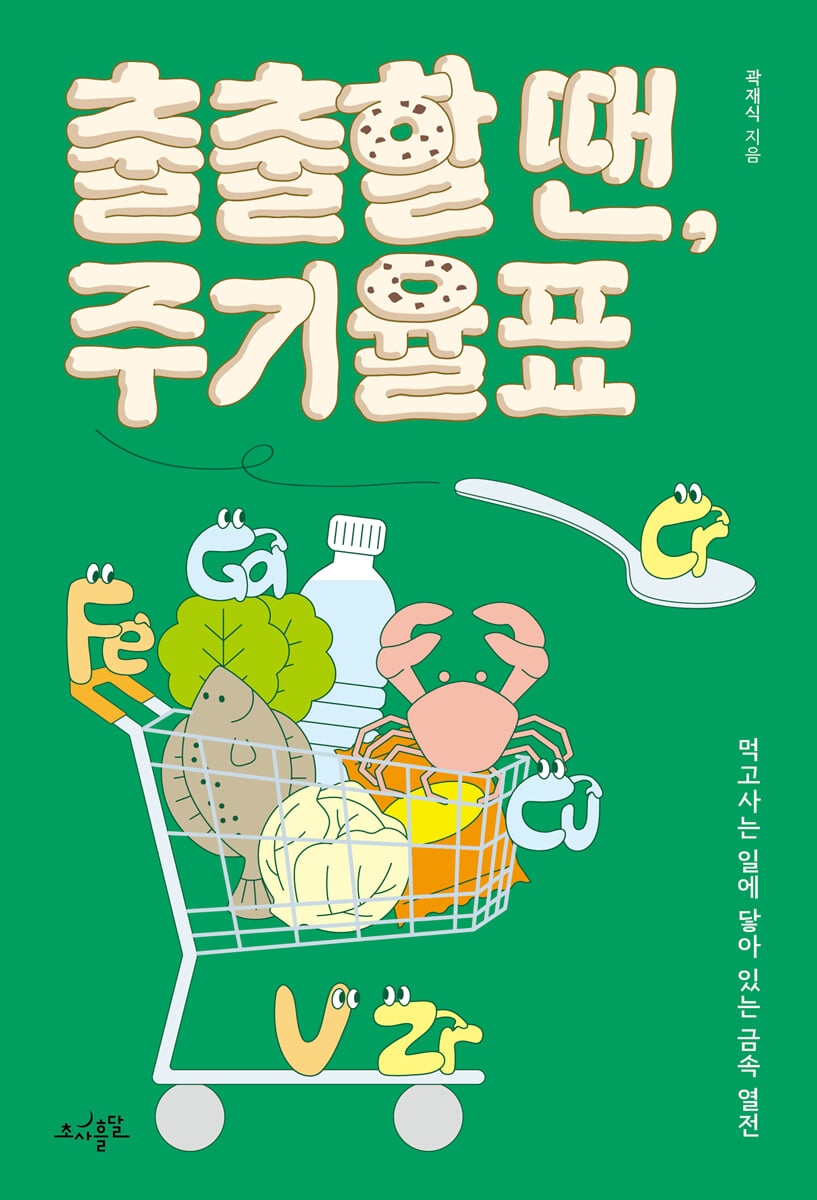
When you're hungry, the periodic table
 |
Description
Book Introduction
"When You're Hungry, the Periodic Table" is the second periodic table story by author Kwak Jae-sik in three years.
Following the introduction of twenty elements with atomic numbers 1 to 20 in the previous work, “When Going on Vacation, the Periodic Table,” “When Going Out, the Periodic Table” contains stories of twenty elements with atomic numbers 21 to 40.
However, for many people, the names of elements 1 through 20 are familiar because they were taught to memorize them in school, but for elements 21 and above, most people are unfamiliar with the names because they haven't had many opportunities to look at them.
So, the author tells the story by relating all the elements to the food we eat, so that we can feel a little closer to the unfamiliar elements.
As can be guessed from the subtitle, ‘A Biography of Metals Related to Food and Living,’ many of the elements covered this time are metals.
When we think of metal, we immediately think of sharp, hard iron, but what does that have to do with the food we eat? Just as doctors often recommend eating more iron, and zinc-containing supplements are sold commercially, some metallic elements are actually important components of food.
So the author tells a long story about why we eat it and what happens in our bodies when we eat it.
There are also elements that are essential for the tools and equipment used when making food, and there are also stories about how certain foods are sometimes damaged by certain elements.
The author, a doctor of engineering and novelist, explores not only scientific knowledge but also history, current affairs, economics, and popular culture to create a captivating story about the elements.
As we follow the story, we come to realize that various elements are involved in our lives in various ways.
Following the introduction of twenty elements with atomic numbers 1 to 20 in the previous work, “When Going on Vacation, the Periodic Table,” “When Going Out, the Periodic Table” contains stories of twenty elements with atomic numbers 21 to 40.
However, for many people, the names of elements 1 through 20 are familiar because they were taught to memorize them in school, but for elements 21 and above, most people are unfamiliar with the names because they haven't had many opportunities to look at them.
So, the author tells the story by relating all the elements to the food we eat, so that we can feel a little closer to the unfamiliar elements.
As can be guessed from the subtitle, ‘A Biography of Metals Related to Food and Living,’ many of the elements covered this time are metals.
When we think of metal, we immediately think of sharp, hard iron, but what does that have to do with the food we eat? Just as doctors often recommend eating more iron, and zinc-containing supplements are sold commercially, some metallic elements are actually important components of food.
So the author tells a long story about why we eat it and what happens in our bodies when we eat it.
There are also elements that are essential for the tools and equipment used when making food, and there are also stories about how certain foods are sometimes damaged by certain elements.
The author, a doctor of engineering and novelist, explores not only scientific knowledge but also history, current affairs, economics, and popular culture to create a captivating story about the elements.
As we follow the story, we come to realize that various elements are involved in our lives in various ways.
- You can preview some of the book's contents.
Preview
index
To begin with
21 Scandium: Choosing a Baseball Stadium Snack
22 Titanium: Picking up the alien chocolate ball
23 Vanadium: Savoring the taste of raw water
24 Chromium: A spoonful of rice
25 Manganese: Stir-frying perilla leaves
26 Iron: Waiting for the mugwort soup
27 Cobalt: Rolling Kimbap
28 Nickel: Beware of Chocolate
29 Copper: Cleaning the crab
30 Zinc: Adding oyster sauce
31 Gallium: Washing vegetables for salad
32 Germanium: Eating seasoned doraji
33 Arsenic: Thinking about the dried persimmon incident
34 Selenium: Roasting the fish
35 Bromine: While making fish cake soup
36 Krypton: Standing in front of the food cart
37 Rubidium: Mixing bear's-foot-and-cheek greens with rice
38 Strontium: Handing over cotton candy
39 Yttrium: Slicing cabbage
40 Zirconium: Opening a bag of chips
References
21 Scandium: Choosing a Baseball Stadium Snack
22 Titanium: Picking up the alien chocolate ball
23 Vanadium: Savoring the taste of raw water
24 Chromium: A spoonful of rice
25 Manganese: Stir-frying perilla leaves
26 Iron: Waiting for the mugwort soup
27 Cobalt: Rolling Kimbap
28 Nickel: Beware of Chocolate
29 Copper: Cleaning the crab
30 Zinc: Adding oyster sauce
31 Gallium: Washing vegetables for salad
32 Germanium: Eating seasoned doraji
33 Arsenic: Thinking about the dried persimmon incident
34 Selenium: Roasting the fish
35 Bromine: While making fish cake soup
36 Krypton: Standing in front of the food cart
37 Rubidium: Mixing bear's-foot-and-cheek greens with rice
38 Strontium: Handing over cotton candy
39 Yttrium: Slicing cabbage
40 Zirconium: Opening a bag of chips
References
Into the book
Let's think about continuously extracting sulfur dioxide from smoke.
Then, pollutants that have no place to be disposed of will gradually accumulate.
What can we do with all this sulfur dioxide? In this case, we can create sulfuric acid by adding vanadium pentoxide to the collected sulfur dioxide and causing a chemical reaction.
The sulfuric acid or sulfur dioxide component that is created in this way is removed, and the remaining substance can be sold for money to where it is needed.
In other words, sulfur dioxide, which was just a nuisance and cost that had to be forcibly removed to prevent air pollution, can be converted into a valuable product using vanadium pentoxide and generate profits.
I believe that it is just as important to find ways to make environmental protection actions beneficial as it is to emphasize a love for the Earth and a sense of duty to do good deeds to prevent environmental pollution.
If you link environmental protection activities to benefits, like the technology that uses vanadium pentoxide, then people will step forward and do it for the benefit of their own accord, without the government having to force or crack down on them.
I call this method of protecting the environment while also gaining profit the “killing both the pheasant and the eggs,” and vanadium is playing an important role that can be put forward as a representative example of this method.
Vanadium played a significant role in helping us escape the fear of acid rain.
--- From "23 Vanadium: Savoring the Taste of Living Water"
The reason the sun shines so brightly is because nuclear fusion occurs within the sun, transforming the element hydrogen into helium.
As heat is generated during the nuclear fusion process, the surrounding area becomes hotter.
The surrounding pressure also increases.
So once nuclear fusion occurs, the heat causes more nuclear fusion to occur in the surrounding area.
If nuclear fusion occurs nearby, that much heat will be generated there.
Then, because of that, nuclear fusion occurs again around it.
In this way, once nuclear fusion occurs, it can continue continuously.
In stars, this goes on for hundreds of millions, even billions of years.
As one element combines with another, new elements are continuously created.
But there is one strange stumbling block here.
That's iron.
When elements combine to form new elements and iron is created, things change from then on.
Even if you try to force nuclear fusion by adding other elements to iron, it does not release as much heat as when nuclear fusion of other elements occurs.
On the contrary, it makes the surroundings colder.
Therefore, once iron is created, the heat generated by nuclear fusion can no longer continue to cause further nuclear fusion.
In other words, iron is the last substance created in the process of stars creating various elements through nuclear fusion and emitting light, and it is the substance that breaks the link of heat.
You could say that the ashes of a star are iron.
--- From "26 Iron: Waiting for the Dodari Mugwort Soup"
However, this does not mean that copper is useless in the human body.
There are several enzymes in the body that use copper, although in very small amounts.
Therefore, if you do not eat any food containing copper, something will definitely happen to your body, and if you are so deficient in copper that you may need to supplement copper.
However, the human body can usually absorb enough copper to meet its needs, even with just a small amount found in many foods.
Eating a certain amount of seafood that is high in copper, such as soy sauce marinated crab, can help you more easily meet your body's needs.
However, if you drink wastewater from a copper factory, too much copper will accumulate in your body and you will become sick.
In particular, it is known that if a lot of copper accumulates in the liver, it cannot function properly and causes illness throughout the body.
A case that occasionally appears in Koreans is Wilson's disease.
Although it is a rare disease, it is said that among liver diseases, there are more cases in Koreans than in other countries, and that about one in ten thousand Koreans has this disease.
Wilson's disease is a genetic disorder that occurs when a person's body cannot properly process copper.
When a person consumes copper through food, etc., the body uses as much as it needs and excretes the rest as waste. However, if copper accumulates in the wrong places in the body due to an abnormality in the body's constitution, it can lead to Wilson's disease.
--- From "29 Copper: Cleaning the Crab"
What does "bromide" really mean? Originally, "bromide" was an English word meaning a chemical substance made from bromine.
This name is often given to substances that are made by a chemical reaction called oxidation using bromine.
For example, hydrogen bromide refers to an acidic substance made using hydrogen and bromine.
After knowing this much, you might start to think something is strange.
When you buy a magazine that claims to offer bromide, don't you get a vial filled with a chemical made from bromine? Why did this term come to mean a large photo of a celebrity? It's because bromine's chemical properties were exploited to create a substance that reacts well with light, which was then used to create photographs.
In particular, silver bromide, made from silver and bromine, was a substance that was widely used in the past when making photographs.
Nowadays, most people take pictures with smartphone cameras or digital cameras that use semiconductors and can view them immediately on the screen.
However, in the past, you could only see a photograph by recording it on photographic film and then going through a process called development, which involves printing the photograph on the film onto paper.
At this time, various chemical reactions had to occur properly to produce clean and good-looking pictures.
As a result, some photographers began to boast about the special, high-performance bromide materials they used to make high-quality photographs.
Later on, the word bromide itself was changed to mean a high-quality photograph made using such good materials.
--- From "35 Bromine: Boiling Fish Cake Soup"
As the temperature approached 1,200°C, zirconium began to exhibit an unusual property of reacting with water to produce hydrogen.
Currently, there is no need for a reaction to extract hydrogen from water, but when the high temperature condition is met, zirconium starts a hydrogen-producing reaction that no one wants.
The water and steam inside the reactor began to decompose into oxygen and hydrogen because of the zirconium.
In situations where fuel is needed, hydrogen is a clean substance that can save the planet, but when hydrogen is gushing out inside a nuclear reactor where it is not needed at all, it becomes a headache.
Even the zirconium releases heat as it extracts hydrogen from the water, further increasing the temperature inside the reactor.
Zirconium, which was normally placed there as a defensive plate for safety, ended up producing a lot of hydrogen as a tinder in this emergency situation.
Saying that hydrogen is a good fuel basically means that it is a substance that catches fire easily.
Eventually, the hydrogen ignited and caused an explosion.
The nuclear power plant's equipment was destroyed and everything began to break down uncontrollably.
After a while, radioactive materials inside the reactor began to leak out into the surrounding area.
The area around the Fukushima nuclear power plant became uninhabitable for ordinary people, and radioactive materials were mixed into the water in enormous quantities, causing mountains of contaminated water to pile up.
After the Fukushima accident, scientists studying nuclear power technology in many countries around the world, including Korea, began to study more closely than ever before what to do if hydrogen starts to form inside a nuclear reactor.
Cars that run on water, clean energy hydrogen, and mysterious catalyst technologies are not far from such terrifying accidents.
Many of the principles of science are both good and evil, and their implications depend on how people use them.
Then, pollutants that have no place to be disposed of will gradually accumulate.
What can we do with all this sulfur dioxide? In this case, we can create sulfuric acid by adding vanadium pentoxide to the collected sulfur dioxide and causing a chemical reaction.
The sulfuric acid or sulfur dioxide component that is created in this way is removed, and the remaining substance can be sold for money to where it is needed.
In other words, sulfur dioxide, which was just a nuisance and cost that had to be forcibly removed to prevent air pollution, can be converted into a valuable product using vanadium pentoxide and generate profits.
I believe that it is just as important to find ways to make environmental protection actions beneficial as it is to emphasize a love for the Earth and a sense of duty to do good deeds to prevent environmental pollution.
If you link environmental protection activities to benefits, like the technology that uses vanadium pentoxide, then people will step forward and do it for the benefit of their own accord, without the government having to force or crack down on them.
I call this method of protecting the environment while also gaining profit the “killing both the pheasant and the eggs,” and vanadium is playing an important role that can be put forward as a representative example of this method.
Vanadium played a significant role in helping us escape the fear of acid rain.
--- From "23 Vanadium: Savoring the Taste of Living Water"
The reason the sun shines so brightly is because nuclear fusion occurs within the sun, transforming the element hydrogen into helium.
As heat is generated during the nuclear fusion process, the surrounding area becomes hotter.
The surrounding pressure also increases.
So once nuclear fusion occurs, the heat causes more nuclear fusion to occur in the surrounding area.
If nuclear fusion occurs nearby, that much heat will be generated there.
Then, because of that, nuclear fusion occurs again around it.
In this way, once nuclear fusion occurs, it can continue continuously.
In stars, this goes on for hundreds of millions, even billions of years.
As one element combines with another, new elements are continuously created.
But there is one strange stumbling block here.
That's iron.
When elements combine to form new elements and iron is created, things change from then on.
Even if you try to force nuclear fusion by adding other elements to iron, it does not release as much heat as when nuclear fusion of other elements occurs.
On the contrary, it makes the surroundings colder.
Therefore, once iron is created, the heat generated by nuclear fusion can no longer continue to cause further nuclear fusion.
In other words, iron is the last substance created in the process of stars creating various elements through nuclear fusion and emitting light, and it is the substance that breaks the link of heat.
You could say that the ashes of a star are iron.
--- From "26 Iron: Waiting for the Dodari Mugwort Soup"
However, this does not mean that copper is useless in the human body.
There are several enzymes in the body that use copper, although in very small amounts.
Therefore, if you do not eat any food containing copper, something will definitely happen to your body, and if you are so deficient in copper that you may need to supplement copper.
However, the human body can usually absorb enough copper to meet its needs, even with just a small amount found in many foods.
Eating a certain amount of seafood that is high in copper, such as soy sauce marinated crab, can help you more easily meet your body's needs.
However, if you drink wastewater from a copper factory, too much copper will accumulate in your body and you will become sick.
In particular, it is known that if a lot of copper accumulates in the liver, it cannot function properly and causes illness throughout the body.
A case that occasionally appears in Koreans is Wilson's disease.
Although it is a rare disease, it is said that among liver diseases, there are more cases in Koreans than in other countries, and that about one in ten thousand Koreans has this disease.
Wilson's disease is a genetic disorder that occurs when a person's body cannot properly process copper.
When a person consumes copper through food, etc., the body uses as much as it needs and excretes the rest as waste. However, if copper accumulates in the wrong places in the body due to an abnormality in the body's constitution, it can lead to Wilson's disease.
--- From "29 Copper: Cleaning the Crab"
What does "bromide" really mean? Originally, "bromide" was an English word meaning a chemical substance made from bromine.
This name is often given to substances that are made by a chemical reaction called oxidation using bromine.
For example, hydrogen bromide refers to an acidic substance made using hydrogen and bromine.
After knowing this much, you might start to think something is strange.
When you buy a magazine that claims to offer bromide, don't you get a vial filled with a chemical made from bromine? Why did this term come to mean a large photo of a celebrity? It's because bromine's chemical properties were exploited to create a substance that reacts well with light, which was then used to create photographs.
In particular, silver bromide, made from silver and bromine, was a substance that was widely used in the past when making photographs.
Nowadays, most people take pictures with smartphone cameras or digital cameras that use semiconductors and can view them immediately on the screen.
However, in the past, you could only see a photograph by recording it on photographic film and then going through a process called development, which involves printing the photograph on the film onto paper.
At this time, various chemical reactions had to occur properly to produce clean and good-looking pictures.
As a result, some photographers began to boast about the special, high-performance bromide materials they used to make high-quality photographs.
Later on, the word bromide itself was changed to mean a high-quality photograph made using such good materials.
--- From "35 Bromine: Boiling Fish Cake Soup"
As the temperature approached 1,200°C, zirconium began to exhibit an unusual property of reacting with water to produce hydrogen.
Currently, there is no need for a reaction to extract hydrogen from water, but when the high temperature condition is met, zirconium starts a hydrogen-producing reaction that no one wants.
The water and steam inside the reactor began to decompose into oxygen and hydrogen because of the zirconium.
In situations where fuel is needed, hydrogen is a clean substance that can save the planet, but when hydrogen is gushing out inside a nuclear reactor where it is not needed at all, it becomes a headache.
Even the zirconium releases heat as it extracts hydrogen from the water, further increasing the temperature inside the reactor.
Zirconium, which was normally placed there as a defensive plate for safety, ended up producing a lot of hydrogen as a tinder in this emergency situation.
Saying that hydrogen is a good fuel basically means that it is a substance that catches fire easily.
Eventually, the hydrogen ignited and caused an explosion.
The nuclear power plant's equipment was destroyed and everything began to break down uncontrollably.
After a while, radioactive materials inside the reactor began to leak out into the surrounding area.
The area around the Fukushima nuclear power plant became uninhabitable for ordinary people, and radioactive materials were mixed into the water in enormous quantities, causing mountains of contaminated water to pile up.
After the Fukushima accident, scientists studying nuclear power technology in many countries around the world, including Korea, began to study more closely than ever before what to do if hydrogen starts to form inside a nuclear reactor.
Cars that run on water, clean energy hydrogen, and mysterious catalyst technologies are not far from such terrifying accidents.
Many of the principles of science are both good and evil, and their implications depend on how people use them.
--- From "40 Zirconium: Opening a Bag of Cookies"
Publisher's Review
If you go through every nook and cranny of the periodic table,
All kinds of elements in various forms
We come to realize that it touches our lives and culture.
Titanium, the metal used to make airplanes, is found in colorful chocolate balls?
Are stainless steel spoons that don't rust because of the chromium?
Maybe Manganese is what Iron Man needs to become stronger?
What if one night you suddenly feel depressed because of zinc?
Was it really because of poison that King Seongjong expelled Queen Yun?
Can taking selenium supplements slow down aging?
All kinds of materials including science, history, current affairs, economics, and popular culture.
A table of knowledge, deliciously blended with twenty elements!
While choosing a snack to eat at the baseball stadium, the element scandium with atomic number 21 comes to mind.
Scandium is said to be used to make the lights that brighten up baseball stadiums.
It is also said that among the practice baseball bats, there are metal bats made using scandium.
On the other hand, it is said that the scandium used in making baseball bats in Korea was used in making fighter jets in the former Soviet Union.
Of course, compared to new fighters developed with modern technology, Soviet fighters are inferior in performance.
However, it was precisely this scandium alloy fighter that shocked the world by demonstrating remarkable performance that transcended time and performance.
This is the story of the 'Ghost of Kyiv' that appeared during the Russo-Ukrainian War.
Shortly after the outbreak of war, when Russian fighter jets swarmed the skies over Kiev, the capital of Ukraine, a single Ukrainian MiG-29 fighter jet, with its exceptional piloting skills, maneuvered and fought among the advanced Russian fighter jets.
The incredible record of one fighter shooting down six Russian fighters in such an unfavorable situation began to be mentioned, and a nickname for the unknown pilot was born: the Ghost of Kyiv.
While the exact identity of the Ghost of Kyiv has never been established, the story has played a significant role, as much as military or economic power, in instilling in Ukrainians and people around the world the idea that Ukraine is not easily destroyed.
The conversation, which began casually while choosing baseball stadium snacks, brought up the unfamiliar element scandium, explained alloys made by mixing various metals, talked about the Russo-Ukrainian War, and eventually discussed the development of the periodic table.
With each turn of the page, stories related to the elements naturally follow one another, and within them, stories of all kinds, from scientific knowledge to history, current events, economics, popular culture, and even our own lives, are embedded.
This is precisely the style of Kwak Jae-sik, a storyteller armed with scientific knowledge.
Author Kwak Jae-sik's specialty of arousing curiosity and satisfying it in an easy and fun way is fully displayed in this book, "When You're Feeling Hungry, the Periodic Table."
The author relates each element to the food we eat, so that readers can feel a little closer to unfamiliar elements such as scandium, vanadium, strontium, yttrium, and zirconium, whose names we rarely hear.
Perhaps that's why, when I read the book, I feel as if I've been treated to a delicious meal prepared with twenty elements and various ingredients.
Tiny atoms spread out
Into the wide and colorful world
“As we delve into the nooks and crannies of the periodic table, we are given the opportunity to turn our attention to stories we may have overlooked because they were not present in our lives.
“If I break away from the obvious world I know, the narrow world where I compare myself to and compete with those around me and feel anxious, I will be able to see more broadly how different the world is outside of it.” - From ‘Starting’
This book does not cover the elements from hydrogen to calcium, which most schools teach you to memorize, but rather covers twenty elements in order, from scandium to zirconium, which are then unfamiliar elements.
So, while there are many stories about elements whose names are unfamiliar, there are also stories about familiar elements that we can easily see in our daily lives, such as iron and copper.
The author goes into detail about what each element is, where it is used, and why it has that name.
By looking at elements in this way, we can talk about the various substances in the world and how we live using those substances in a variety of ways.
In that sense, looking into unfamiliar elements and elements we've never heard of provides an opportunity to learn about the stories of people we don't normally encounter and about fields we aren't interested in.
We learn that scandium is not just a strange element, but that there are people who fly into the sky in objects made of scandium and perform life-threatening missions, that an unfamiliar substance like vanadium has become a symbol of a certain people and is intertwined with the story of a country's rise and fall, and that Krypton has something to do with revolution.
Let's see how vast and colorful the world unfolds through tiny atoms in "When You're Feeling Tired, Read the Periodic Table."
All kinds of elements in various forms
We come to realize that it touches our lives and culture.
Titanium, the metal used to make airplanes, is found in colorful chocolate balls?
Are stainless steel spoons that don't rust because of the chromium?
Maybe Manganese is what Iron Man needs to become stronger?
What if one night you suddenly feel depressed because of zinc?
Was it really because of poison that King Seongjong expelled Queen Yun?
Can taking selenium supplements slow down aging?
All kinds of materials including science, history, current affairs, economics, and popular culture.
A table of knowledge, deliciously blended with twenty elements!
While choosing a snack to eat at the baseball stadium, the element scandium with atomic number 21 comes to mind.
Scandium is said to be used to make the lights that brighten up baseball stadiums.
It is also said that among the practice baseball bats, there are metal bats made using scandium.
On the other hand, it is said that the scandium used in making baseball bats in Korea was used in making fighter jets in the former Soviet Union.
Of course, compared to new fighters developed with modern technology, Soviet fighters are inferior in performance.
However, it was precisely this scandium alloy fighter that shocked the world by demonstrating remarkable performance that transcended time and performance.
This is the story of the 'Ghost of Kyiv' that appeared during the Russo-Ukrainian War.
Shortly after the outbreak of war, when Russian fighter jets swarmed the skies over Kiev, the capital of Ukraine, a single Ukrainian MiG-29 fighter jet, with its exceptional piloting skills, maneuvered and fought among the advanced Russian fighter jets.
The incredible record of one fighter shooting down six Russian fighters in such an unfavorable situation began to be mentioned, and a nickname for the unknown pilot was born: the Ghost of Kyiv.
While the exact identity of the Ghost of Kyiv has never been established, the story has played a significant role, as much as military or economic power, in instilling in Ukrainians and people around the world the idea that Ukraine is not easily destroyed.
The conversation, which began casually while choosing baseball stadium snacks, brought up the unfamiliar element scandium, explained alloys made by mixing various metals, talked about the Russo-Ukrainian War, and eventually discussed the development of the periodic table.
With each turn of the page, stories related to the elements naturally follow one another, and within them, stories of all kinds, from scientific knowledge to history, current events, economics, popular culture, and even our own lives, are embedded.
This is precisely the style of Kwak Jae-sik, a storyteller armed with scientific knowledge.
Author Kwak Jae-sik's specialty of arousing curiosity and satisfying it in an easy and fun way is fully displayed in this book, "When You're Feeling Hungry, the Periodic Table."
The author relates each element to the food we eat, so that readers can feel a little closer to unfamiliar elements such as scandium, vanadium, strontium, yttrium, and zirconium, whose names we rarely hear.
Perhaps that's why, when I read the book, I feel as if I've been treated to a delicious meal prepared with twenty elements and various ingredients.
Tiny atoms spread out
Into the wide and colorful world
“As we delve into the nooks and crannies of the periodic table, we are given the opportunity to turn our attention to stories we may have overlooked because they were not present in our lives.
“If I break away from the obvious world I know, the narrow world where I compare myself to and compete with those around me and feel anxious, I will be able to see more broadly how different the world is outside of it.” - From ‘Starting’
This book does not cover the elements from hydrogen to calcium, which most schools teach you to memorize, but rather covers twenty elements in order, from scandium to zirconium, which are then unfamiliar elements.
So, while there are many stories about elements whose names are unfamiliar, there are also stories about familiar elements that we can easily see in our daily lives, such as iron and copper.
The author goes into detail about what each element is, where it is used, and why it has that name.
By looking at elements in this way, we can talk about the various substances in the world and how we live using those substances in a variety of ways.
In that sense, looking into unfamiliar elements and elements we've never heard of provides an opportunity to learn about the stories of people we don't normally encounter and about fields we aren't interested in.
We learn that scandium is not just a strange element, but that there are people who fly into the sky in objects made of scandium and perform life-threatening missions, that an unfamiliar substance like vanadium has become a symbol of a certain people and is intertwined with the story of a country's rise and fall, and that Krypton has something to do with revolution.
Let's see how vast and colorful the world unfolds through tiny atoms in "When You're Feeling Tired, Read the Periodic Table."
GOODS SPECIFICS
- Date of issue: December 6, 2024
- Page count, weight, size: 352 pages | 566g | 145*213*23mm
- ISBN13: 9791198965608
- ISBN10: 1198965606
You may also like
카테고리
korean


korean

![ELLE 엘르 스페셜 에디션 A형 : 12월 [2025]](http://librairie.coreenne.fr/cdn/shop/files/b8e27a3de6c9538896439686c6b0e8fb.jpg?v=1766436872&width=3840)


