

Exploration of the mode of existence
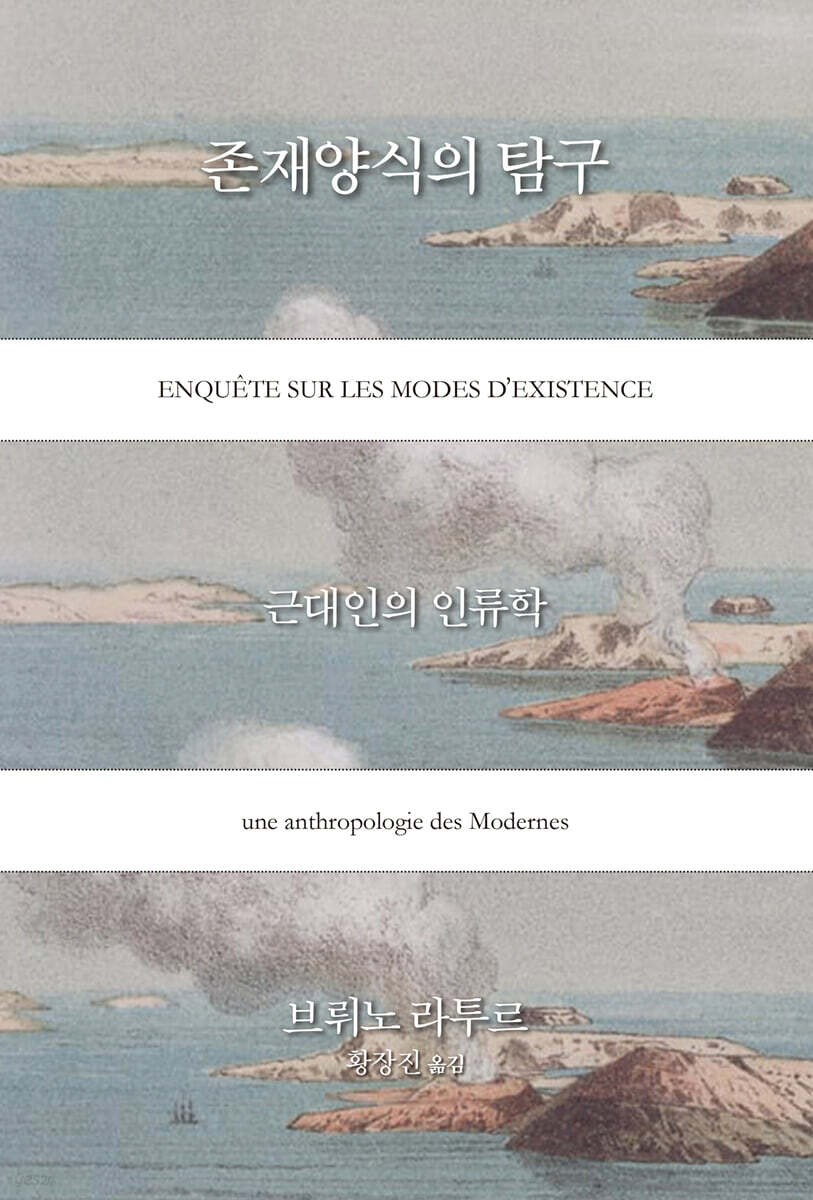 |
Description
Book Introduction
The world-renowned philosopher's final masterpiece presents a new coordinate system in the face of an ecological crisis.
This book is considered the greatest masterpiece written by Bruno Latour, a French philosopher who is a leading authority on science and technology studies and has presented a unique ecological political philosophy.
Not only does it contain all of Latour's thought, spanning nearly half a century, but it also delves into the root causes of all the problems caused by Western modernity and presents solutions and new alternatives.
Latour diagnoses that Western moderns and non-Western moderns who followed them in pursuing modernization have fallen into the crisis of extreme political conflict and climate change due to the dichotomy that separates 'nature' and 'society' and 'object' and 'subject'.
In short, modern people have failed to understand themselves and others.
This is because we have been judging the world with a coordinate system of false dichotomies.
However, Latour does not stop at presenting another critique of modernity; he surprisingly turns the gaze of Western anthropology, which had focused on non-modern people, on modern people themselves as the object of anthropological inquiry.
Through this, it crosses the fields of science, technology, politics, economics, religion, art, morality, and law that modern people have pursued, reveals the reality of modern values and institutions, and presents an outline of fifteen modes of existence.
This is to establish a more pluralistic and ecological alternative coordinate system in response to the Anthropocene era, where the entanglement between the West and the non-West, and between humans and non-humans, is dramatically increasing.
In this way, this book moves beyond the violence and errors of modernization and onto the path of ecology, opening up the possibility of a new 'diplomacy' with non-modern people, non-humans, and the Earth.
This book is considered the greatest masterpiece written by Bruno Latour, a French philosopher who is a leading authority on science and technology studies and has presented a unique ecological political philosophy.
Not only does it contain all of Latour's thought, spanning nearly half a century, but it also delves into the root causes of all the problems caused by Western modernity and presents solutions and new alternatives.
Latour diagnoses that Western moderns and non-Western moderns who followed them in pursuing modernization have fallen into the crisis of extreme political conflict and climate change due to the dichotomy that separates 'nature' and 'society' and 'object' and 'subject'.
In short, modern people have failed to understand themselves and others.
This is because we have been judging the world with a coordinate system of false dichotomies.
However, Latour does not stop at presenting another critique of modernity; he surprisingly turns the gaze of Western anthropology, which had focused on non-modern people, on modern people themselves as the object of anthropological inquiry.
Through this, it crosses the fields of science, technology, politics, economics, religion, art, morality, and law that modern people have pursued, reveals the reality of modern values and institutions, and presents an outline of fifteen modes of existence.
This is to establish a more pluralistic and ecological alternative coordinate system in response to the Anthropocene era, where the entanglement between the West and the non-West, and between humans and non-humans, is dramatically increasing.
In this way, this book moves beyond the violence and errors of modernization and onto the path of ecology, opening up the possibility of a new 'diplomacy' with non-modern people, non-humans, and the Earth.
- You can preview some of the book's contents.
Preview
index
To the Reader: A User's Manual for an Ongoing Collective Inquiry
Acknowledgements
outline
Introduction: Trusting the System Again?
Part 1: How can we make possible the exploration of the mode of existence of modern people?
Chapter 1: Defining the Goals of the Inquiry
Chapter 2: Collecting Documents for Exploration
Chapter 3: Dangerous Changes in Response
Chapter 4: Learning to Create Space
Chapter 5: Removing Barriers to Speaking
Fixing some minor flaws in the Chapter 6 composition
Part 2: How to Benefit from a Pluralism of Existential Modes
Chapter 7 Restoring the Beings of Transformation
Chapter 8: Visualizing the Beings of Technology
Chapter 9: Positioning Fictional Beings
Chapter 10: Learning to Respect Appearance
Part 2 Conclusion: Arranging the Forms of Existence
Part 3: How to Redefine Aggregates
Welcome to the Sensitive Beings at the end of Chapter 11
Chapter 12: Summoning the Ghost of the Political
Chapter 13: Passage of Law and Quasi-Subjects
Chapter 14: Speaking About Organizations in Your Own Language
Chapter 15: Mobilizing Entities with Passionate Interests
Chapter 16: Strengthening the Experience of a Guilty Conscience
Conclusion: Can we praise the coming civilization?
Commentary (Patrice Maniglier)
Detailed Table of Contents
Pivot Table
Acknowledgements
outline
Introduction: Trusting the System Again?
Part 1: How can we make possible the exploration of the mode of existence of modern people?
Chapter 1: Defining the Goals of the Inquiry
Chapter 2: Collecting Documents for Exploration
Chapter 3: Dangerous Changes in Response
Chapter 4: Learning to Create Space
Chapter 5: Removing Barriers to Speaking
Fixing some minor flaws in the Chapter 6 composition
Part 2: How to Benefit from a Pluralism of Existential Modes
Chapter 7 Restoring the Beings of Transformation
Chapter 8: Visualizing the Beings of Technology
Chapter 9: Positioning Fictional Beings
Chapter 10: Learning to Respect Appearance
Part 2 Conclusion: Arranging the Forms of Existence
Part 3: How to Redefine Aggregates
Welcome to the Sensitive Beings at the end of Chapter 11
Chapter 12: Summoning the Ghost of the Political
Chapter 13: Passage of Law and Quasi-Subjects
Chapter 14: Speaking About Organizations in Your Own Language
Chapter 15: Mobilizing Entities with Passionate Interests
Chapter 16: Strengthening the Experience of a Guilty Conscience
Conclusion: Can we praise the coming civilization?
Commentary (Patrice Maniglier)
Detailed Table of Contents
Pivot Table
Into the book
The ideal type of modern person is someone who moves from the past to the future through an unstoppable “modernization front.”
Thanks to such pioneering frontiers, such frontiers, modern man has been able to define as “irrational” everything that he must shake off from himself, and as “rational” everything that he must strive for in order to progress.
In this way, modern people were people who were breaking free from their attachment to the past in order to move toward freedom.
In short, they were people who were moving from darkness to light, towards enlightenment.
I used 'science' as a touchstone to define this peculiar coordinate system because the confusion in the way we think about science threatened the entire apparatus of modernization.
If people start mixing facts and values again, the arrow of time will stop flying, hesitate, and twist in all directions, looking like a plate of spaghetti.
--- p.30
He knows that today's anthropologists must learn to talk to their subjects about their research topic.
For that very reason, he has little recourse to the resources of critical distancing.
He is content to know how to describe practice through networks, while remaining faithful to the values of his sources and not trusting the domain and therefore not trusting reports coming from the domain, yet not giving up the idea of reformulating the connection between values and institutions (a kind of balancing act, as we will see later).
In other words, he is an anthropologist who is not afraid of the risks of diplomacy.
He knows how difficult it is to learn to speak well to someone about something that really matters to them.
--- p.81
Even though the abyss between world and words seems vast, it is not an abyss between one articulation and the next.
The word "dog" may not make him bark, but after just a few hours of training, that warm, furry creature you named "Pido" will gradually assume reality and be right at your feet, despite what you might think is the gap between words and objects.
--- p.152
It is true that a startled blind person can move forward without fear, unaware of the danger (this is the arrogance of modern man).
But when he starts to hesitate, he eventually becomes discouraged (this is postmodernism).
If he is truly afraid, even the smallest terrorist can strike fear into him (this is fundamentalism).
After three centuries of complete freedom, the invasion of the world has now arrived in the form of Earth, Gaia.
The return of the unexpected, the end of the modernist parenthesis.
Thanks to such pioneering frontiers, such frontiers, modern man has been able to define as “irrational” everything that he must shake off from himself, and as “rational” everything that he must strive for in order to progress.
In this way, modern people were people who were breaking free from their attachment to the past in order to move toward freedom.
In short, they were people who were moving from darkness to light, towards enlightenment.
I used 'science' as a touchstone to define this peculiar coordinate system because the confusion in the way we think about science threatened the entire apparatus of modernization.
If people start mixing facts and values again, the arrow of time will stop flying, hesitate, and twist in all directions, looking like a plate of spaghetti.
--- p.30
He knows that today's anthropologists must learn to talk to their subjects about their research topic.
For that very reason, he has little recourse to the resources of critical distancing.
He is content to know how to describe practice through networks, while remaining faithful to the values of his sources and not trusting the domain and therefore not trusting reports coming from the domain, yet not giving up the idea of reformulating the connection between values and institutions (a kind of balancing act, as we will see later).
In other words, he is an anthropologist who is not afraid of the risks of diplomacy.
He knows how difficult it is to learn to speak well to someone about something that really matters to them.
--- p.81
Even though the abyss between world and words seems vast, it is not an abyss between one articulation and the next.
The word "dog" may not make him bark, but after just a few hours of training, that warm, furry creature you named "Pido" will gradually assume reality and be right at your feet, despite what you might think is the gap between words and objects.
--- p.152
It is true that a startled blind person can move forward without fear, unaware of the danger (this is the arrogance of modern man).
But when he starts to hesitate, he eventually becomes discouraged (this is postmodernism).
If he is truly afraid, even the smallest terrorist can strike fear into him (this is fundamentalism).
After three centuries of complete freedom, the invasion of the world has now arrived in the form of Earth, Gaia.
The return of the unexpected, the end of the modernist parenthesis.
--- p.263
Publisher's Review
■ Translated into 12 languages, the final masterpiece of a world-renowned philosopher that has garnered attention from the media and academia worldwide
An in-depth report on "The Anthropology of Modern Man," offering a new coordinate system in the face of the ecological crisis.
'Should we cover melting glaciers with specially made white sheets to prevent their disappearance?' It's a question that sounds like a scene from a science fiction movie, but since 2004, Switzerland has been covering glaciers in the Alps with tarpaulins every summer to prevent their loss.
If humanity today is concerned about glaciers and responsible for their melting, then the relationship between nature and humanity can no longer be the same.
The dream of modernization, which dreamed of conquering nature, is over, and we must start the story again from the beginning.
This book, "Exploring the Modes of Being: Anthropology of Modern Man," is considered the greatest work written by Bruno Latour, a French philosopher who is a leading figure in the study of science and technology and has presented a unique ecological political philosophy.
Not only does it contain all of Latour's thought, spanning nearly half a century, but it also delves into the root causes of all the problems caused by Western modernity and presents solutions and new alternatives.
Latour diagnoses that Western moderns and non-Western moderns who followed them in pursuing modernization have fallen into the crisis of extreme political conflict and climate change due to the dichotomy that separates 'nature' and 'society' and 'object' and 'subject'.
In short, modern people have failed to understand themselves and others.
This is because we have been judging the world with a coordinate system of false dichotomies.
However, Latour does not stop at presenting another critique of modernity; he surprisingly turns the gaze of Western anthropology, which had focused on non-modern people, on modern people themselves as the object of anthropological inquiry.
Through this, it crosses the fields of science, technology, politics, economics, religion, art, morality, and law that modern people have pursued, reveals the reality of modern values and institutions, and presents an outline of fifteen modes of existence.
This is to establish a more pluralistic and ecological alternative coordinate system in response to the Anthropocene era, where the entanglement between the West and the non-West, and between humans and non-humans, is dramatically increasing.
In this way, this book moves beyond the violence and errors of modernization and onto the path of ecology, opening up the possibility of a new 'diplomacy' with non-modern people, non-humans, and the Earth.
■ If we were never modern, who were we?
In 1991, Bruno Latour shocked the world of thought by publishing We Have Never Been Modern, which was later translated into over 20 languages.
At the time, in the intellectual world, whether it was the modernist position that emphasized the incompleteness of modernity, the anti-modernist position that completely denied modernity, or the post-modernist position that cynically criticized the crisis of modernity, everyone agreed that we were modern people and existed within modernity.
In this context, Latour, with his provocative claim that "we have never been modern," first deeply questioned whether we had truly lived modernly in the first place.
According to Latour, the dichotomous distinctions that modern people have believed in, such as pre-modernity and modernity, fact and value, object and subject, and nature and society, have never been realized in the way that modern people thought.
On the contrary, the very attempt to divide them has produced numerous 'hybrids' that mix the two.
Hybrid problems that cross the realms of science and technology, politics and law, morality and economics, such as the coronavirus pandemic, the Fukushima contaminated water problem, and, more broadly, climate change caused by human carbon emissions, are on the rise.
Thus, Latour goes one step further from his negative stance on the past.
“I believe it is actually possible to complement the resolutely negative title, ‘We have never been modern,’ with a ‘positive’ version of the same argument.” (p. 32) In order to seek an alternative to modernity, we must reconstruct in a positive way what has happened to our values and institutions—science, politics, law, economics—before we can begin a truly ‘diplomatic relationship’ between them.
In this respect, 『Exploration of Forms of Being』 can be said to be an ambitious project that seeks to break away from the modernist framework that judges the world through a black-and-white dichotomy and restore the world's plurality through fifteen forms of being.
■ Modern people who hijacked 'science' and 'economics' to end public debate
- Going beyond the 'category error'
To understand how Latour explores the mode of existence of modern people in this book, we can look at a close example that clearly shows how 'science' is misused in the modern world.
As the recent Fukushima contaminated water controversy demonstrates, modern people hijack “science” to end public debate.
Because if you say that a political opponent is spreading rumors, the argument ends there.
Moreover, the so-called 'economic' logic is misused to silence all other political voices.
In this way, all modernist projects have a 'category error' that seeks to erase the value of other forms of existence by prioritizing 'science' and 'economics'.
But as many scientists involved in the debate have noted, real science faces endless counterarguments amidst numerous uncertainties and countless verification processes.
Just as science must be verified, politics must also have its political truth verified in the public square through its own unique methods.
In this way, science and politics have different modes of existence, each with its own unique form of verification.
However, modern people say that if they mobilize 'science' and 'economy', there is no need to listen to other voices.
Latour focuses on the various category errors that modern people commit and explores modern values and institutions one by one.
In fact, “(Latour’s) inquiry begins with the detection of category errors.” (p. 85) Modern people have failed to respect the inherent value of each mode of existence, as science misunderstands politics, politics misunderstands religion, and law misunderstands fiction.
In this book, Latour systematically examines these category errors, examining various questions such as what lies at the core of each value, what has transpired between these values in the history of modern man, and why the emergence of 'science' and 'economy' has put all other modes of existence at risk.
■ An ontological exploration of the root causes of the problems brought about by modernization
However, it should be noted that 『Inquiry into the Modes of Being』 does not simply criticize the objectivity of scientific facts or the efficiency of economic calculations.
Rather, what Latour wants to show is the relationship between various rationalities.
“There are multiple ways to distinguish between truth and falsehood” (p. 110), because there are multiple rationalities.
What Latour takes issue with is the way in which certain rationalities, such as scientific objectivity or economic efficiency, become so dominant that they silence or reduce other modes of existence, such as art, technology, morality, and religion, thereby suppressing other values.
To avoid such errors, Latour horizontally restores the diversity of modes of existence and vertically analyzes the historical origins of category errors through genealogical analysis.
Ultimately, the purpose of this book is to analyze the characteristics of each mode of existence that cannot be reduced to modernity and economics, how their relationships have deteriorated, and to rearrange these modes of existence through new designs.
For example, in the case of the 'economy', Latour analyzes that three modes of existence are fused under the name of 'economy' (see chapters 14, 15, and 16). Latour says that the 'economy' is an unstable and inconsistent fusion of 'attachment', 'organization', and 'morality', and that the misunderstanding of economics as a value-neutral 'science' has led to the 'economy' being regarded as being free from 'morality'.
The fact that the 'economy' is thus a fusion of attachment, organization, and morality means that economic decisions already imply certain moral standards, and that they guide social organization in a certain direction, solidifying certain forms of attachment through selection and concentration.
In addition, the book continues with a detailed analysis of the modes of existence such as psychology, habits, religion, law, and reproduction.
The key to this analysis is to find a way to respect all modes of existence by revealing the unique verification patterns of each mode of existence.
Therefore, “we must avoid not just one error, but all category errors” (p. 99). And through this, we can restore values that have been silenced within modern institutions but have always been important in other societies and communities.
For example, through the mode of existence called 'metamorphosis', Latour establishes a horizon for comparative anthropology that can discuss modern psychology and non-modern shamanism on the same level.
This attempt to create an 'equal' space for other non-modern values by presenting an alternative coordinate system rather than the dichotomous coordinate system of modern people is also a very important aspect of this book.
■ The existence of modern people from an anthropological perspective
Ultimately, 『Exploration of the Mode of Existence』 is an ongoing exploration of how to re-describe the modern world beyond the dominance of 'science' and 'economy', and which of the modern values to inherit.
This book fundamentally asks how we can redesign the forms and categories of life of Western modernity, whose unsustainability has been proven, through interdisciplinary, intercultural, and interhuman communication.
Here, the way Latour unfolds his exploration of modernity is thoroughly anthropological.
To view modernity through an anthropological lens means to enter the fields of science, economics, and politics, record those experiences with an unfamiliar perspective, and thereby comprehensively reconstruct those values and institutions.
Looking at it this way, it is revealed that the modern man's 'theory' about modernity has failed to understand the 'practice' of the modern man himself.
Modern people thought the world was made up of separate areas separated by boundaries, such as 'science', 'politics', and 'economics', but what actually exists are networks.
An anthropological perspective reveals the numerous gray areas and connections between modern spheres.
However, Latour simultaneously emphasizes that his goal is not to break down all boundaries, but rather to re-describe and rearrange the modern world in a way that respects the strengths of each practice.
This is an attempt to reconstruct all modern modes of existence at once, without confusing them with each other.
For Latour, the actual modern world exists in a plurality of modes of existence, each with its own mechanism for producing truth.
In short, his two main working tools are 'network' on the one hand and 'preposition' on the other.
Prepositions are ontological concepts that define the types of relationships that various forms of existence have with each other, and they inherit the perspective of actor-network theory (ANT), while complementing and completing it.
‘Network’ is a mode of existence that allows us to capture the diversity of combinations that cross realms, and ‘preposition’ is a mode of existence that allows us to capture the multiplicity of modes of existence confirmed in the complex historical process of modern people.
This allows us to go beyond the 'category error' of modern people and share practical experiences revealed in various practices, leading to alternative formalizations.
■ Overall overview of this book
This book is not only a work but also a project, and the Modes of Existence website provides a space for readers to participate and continue this exploration from their own perspectives (see modesofexistence.org). It is also a preparatory work for a diplomatic dialogue to explore what kind of common world we can build in the face of the looming ecological crisis.
It's nearly impossible to summarize this voluminous book in a few paragraphs, but here are the key takeaways from this sometimes fascinating, sometimes complex book:
Part 1 of this book, "How to Make the Inquiry into the Modern Man's Mode of Existence Possible," sets the goal of inquiry and removes two major obstacles that have made any effort to advance the understanding of modern man incomprehensible: the problem of objective knowledge and the problem of construction and reality.
In this way, we finally learn to speak appropriately about different types of beings, again relying on experience.
Instead of saying that it is simply a matter of different 'language games', we can properly deal with ontological pluralism and turn our attention to the many actors that make up the world.
Part 2, “How to Benefit from the Pluralism of Forms of Existence,” explores how to benefit from the pluralism of forms of existence and, above all, how to escape the prison of the subject/object division.
The six modes explored here—reproduction, transformation, habit, technology, fiction, and reference—provide a completely different foundation for comparative anthropology.
This allows us to understand the emergence of modes of existence, the changes in the values they possess, and the negative effects that the emergence of each mode of existence has had on our ability to understand other modes of existence.
In the conclusion to Part II, Latour uses this analysis to propose an alternative coordinate system that allows for a more systematic arrangement of modes of existence (see Part II Conclusion, Appendix: Pivot Table).
Through these alternative coordinate systems, Part 3, “How to Redefine Collectivities,” identifies six modes of existence (politics, law, religion, attachment, organization, and morality) that are more local and closer to the conventions of social science.
These modes of existence help us to reassemble the two last major obstacles to our inquiry: the notion of 'society' and, especially, the notion of 'economy', which better than any other mode characterizes modern man.
What makes it harder to imagine the end of the Earth than the end of capitalism is that the concept of "economy" has indiscriminately fused three modes of existence (attachment, organization, and morality) that are crucial to all of human life within modern institutions.
By elaborating on these three modes of existence, Latour suggests a way to move beyond the hidden god of the "economy" and connect it to more democratic and moral issues.
As Latour reveals in his conclusion, this book is both a completed work and an ongoing project of collective inquiry.
The purpose is not only to share experiences discovered through inquiry and respect diverse modes of existence, but also to propose explanations different from the author's explanation and transform the inquiry itself into a diplomatic device.
This aims to redesign the system so that each mode of existence can establish a harmonious relationship, and to suggest the possibility of a new diplomacy for peace in a world of war.
“With this book, Latour established himself as a writer who challenged the prevailing notion that French thought was in decline.
Here's a book that covers almost everything that matters to us: science, technology, religion, politics, art, economics, morals, law, and even habits.
“Nothing we have ever thought about the fundamental dimensions of our existence remains beneath Latour’s unflinching yet delicate pen.” Le Monde
“Latour’s message that rationality is ‘woven from many threads’ is for the public sphere as well as the academic seminar.
Latour urges us all to lay down the script of modernity, stop insulting each other, and learn to diversify and ecologize.
We must prepare for diplomacy.
“If we don’t talk to each other, there is only death.” The Times
“Latour’s book makes the world, or rather worlds, interesting again.
And above all, it is a project you can become attached to.” Los Angeles Review of Books “With this book, Latour establishes himself as a writer who challenges the conventional wisdom that French thought is in decline.
Here's a book that covers almost everything that matters to us: science, technology, religion, politics, art, economics, morals, law, and even habits.
“Nothing we have ever thought about the fundamental dimensions of our existence remains beneath Latour’s unflinching yet delicate pen.” Le Monde
“Latour’s message that rationality is ‘woven from many threads’ is for the public sphere as well as the academic seminar.
Latour urges us all to lay down the script of modernity, stop insulting each other, and learn to diversify and ecologize.
We must prepare for diplomacy.
“If we don’t talk to each other, there is only death.” The Times
“Latour’s book makes the world, or rather worlds, interesting again.
And above all, it's a project you can become attached to." Los Angeles Review of Books
An in-depth report on "The Anthropology of Modern Man," offering a new coordinate system in the face of the ecological crisis.
'Should we cover melting glaciers with specially made white sheets to prevent their disappearance?' It's a question that sounds like a scene from a science fiction movie, but since 2004, Switzerland has been covering glaciers in the Alps with tarpaulins every summer to prevent their loss.
If humanity today is concerned about glaciers and responsible for their melting, then the relationship between nature and humanity can no longer be the same.
The dream of modernization, which dreamed of conquering nature, is over, and we must start the story again from the beginning.
This book, "Exploring the Modes of Being: Anthropology of Modern Man," is considered the greatest work written by Bruno Latour, a French philosopher who is a leading figure in the study of science and technology and has presented a unique ecological political philosophy.
Not only does it contain all of Latour's thought, spanning nearly half a century, but it also delves into the root causes of all the problems caused by Western modernity and presents solutions and new alternatives.
Latour diagnoses that Western moderns and non-Western moderns who followed them in pursuing modernization have fallen into the crisis of extreme political conflict and climate change due to the dichotomy that separates 'nature' and 'society' and 'object' and 'subject'.
In short, modern people have failed to understand themselves and others.
This is because we have been judging the world with a coordinate system of false dichotomies.
However, Latour does not stop at presenting another critique of modernity; he surprisingly turns the gaze of Western anthropology, which had focused on non-modern people, on modern people themselves as the object of anthropological inquiry.
Through this, it crosses the fields of science, technology, politics, economics, religion, art, morality, and law that modern people have pursued, reveals the reality of modern values and institutions, and presents an outline of fifteen modes of existence.
This is to establish a more pluralistic and ecological alternative coordinate system in response to the Anthropocene era, where the entanglement between the West and the non-West, and between humans and non-humans, is dramatically increasing.
In this way, this book moves beyond the violence and errors of modernization and onto the path of ecology, opening up the possibility of a new 'diplomacy' with non-modern people, non-humans, and the Earth.
■ If we were never modern, who were we?
In 1991, Bruno Latour shocked the world of thought by publishing We Have Never Been Modern, which was later translated into over 20 languages.
At the time, in the intellectual world, whether it was the modernist position that emphasized the incompleteness of modernity, the anti-modernist position that completely denied modernity, or the post-modernist position that cynically criticized the crisis of modernity, everyone agreed that we were modern people and existed within modernity.
In this context, Latour, with his provocative claim that "we have never been modern," first deeply questioned whether we had truly lived modernly in the first place.
According to Latour, the dichotomous distinctions that modern people have believed in, such as pre-modernity and modernity, fact and value, object and subject, and nature and society, have never been realized in the way that modern people thought.
On the contrary, the very attempt to divide them has produced numerous 'hybrids' that mix the two.
Hybrid problems that cross the realms of science and technology, politics and law, morality and economics, such as the coronavirus pandemic, the Fukushima contaminated water problem, and, more broadly, climate change caused by human carbon emissions, are on the rise.
Thus, Latour goes one step further from his negative stance on the past.
“I believe it is actually possible to complement the resolutely negative title, ‘We have never been modern,’ with a ‘positive’ version of the same argument.” (p. 32) In order to seek an alternative to modernity, we must reconstruct in a positive way what has happened to our values and institutions—science, politics, law, economics—before we can begin a truly ‘diplomatic relationship’ between them.
In this respect, 『Exploration of Forms of Being』 can be said to be an ambitious project that seeks to break away from the modernist framework that judges the world through a black-and-white dichotomy and restore the world's plurality through fifteen forms of being.
■ Modern people who hijacked 'science' and 'economics' to end public debate
- Going beyond the 'category error'
To understand how Latour explores the mode of existence of modern people in this book, we can look at a close example that clearly shows how 'science' is misused in the modern world.
As the recent Fukushima contaminated water controversy demonstrates, modern people hijack “science” to end public debate.
Because if you say that a political opponent is spreading rumors, the argument ends there.
Moreover, the so-called 'economic' logic is misused to silence all other political voices.
In this way, all modernist projects have a 'category error' that seeks to erase the value of other forms of existence by prioritizing 'science' and 'economics'.
But as many scientists involved in the debate have noted, real science faces endless counterarguments amidst numerous uncertainties and countless verification processes.
Just as science must be verified, politics must also have its political truth verified in the public square through its own unique methods.
In this way, science and politics have different modes of existence, each with its own unique form of verification.
However, modern people say that if they mobilize 'science' and 'economy', there is no need to listen to other voices.
Latour focuses on the various category errors that modern people commit and explores modern values and institutions one by one.
In fact, “(Latour’s) inquiry begins with the detection of category errors.” (p. 85) Modern people have failed to respect the inherent value of each mode of existence, as science misunderstands politics, politics misunderstands religion, and law misunderstands fiction.
In this book, Latour systematically examines these category errors, examining various questions such as what lies at the core of each value, what has transpired between these values in the history of modern man, and why the emergence of 'science' and 'economy' has put all other modes of existence at risk.
■ An ontological exploration of the root causes of the problems brought about by modernization
However, it should be noted that 『Inquiry into the Modes of Being』 does not simply criticize the objectivity of scientific facts or the efficiency of economic calculations.
Rather, what Latour wants to show is the relationship between various rationalities.
“There are multiple ways to distinguish between truth and falsehood” (p. 110), because there are multiple rationalities.
What Latour takes issue with is the way in which certain rationalities, such as scientific objectivity or economic efficiency, become so dominant that they silence or reduce other modes of existence, such as art, technology, morality, and religion, thereby suppressing other values.
To avoid such errors, Latour horizontally restores the diversity of modes of existence and vertically analyzes the historical origins of category errors through genealogical analysis.
Ultimately, the purpose of this book is to analyze the characteristics of each mode of existence that cannot be reduced to modernity and economics, how their relationships have deteriorated, and to rearrange these modes of existence through new designs.
For example, in the case of the 'economy', Latour analyzes that three modes of existence are fused under the name of 'economy' (see chapters 14, 15, and 16). Latour says that the 'economy' is an unstable and inconsistent fusion of 'attachment', 'organization', and 'morality', and that the misunderstanding of economics as a value-neutral 'science' has led to the 'economy' being regarded as being free from 'morality'.
The fact that the 'economy' is thus a fusion of attachment, organization, and morality means that economic decisions already imply certain moral standards, and that they guide social organization in a certain direction, solidifying certain forms of attachment through selection and concentration.
In addition, the book continues with a detailed analysis of the modes of existence such as psychology, habits, religion, law, and reproduction.
The key to this analysis is to find a way to respect all modes of existence by revealing the unique verification patterns of each mode of existence.
Therefore, “we must avoid not just one error, but all category errors” (p. 99). And through this, we can restore values that have been silenced within modern institutions but have always been important in other societies and communities.
For example, through the mode of existence called 'metamorphosis', Latour establishes a horizon for comparative anthropology that can discuss modern psychology and non-modern shamanism on the same level.
This attempt to create an 'equal' space for other non-modern values by presenting an alternative coordinate system rather than the dichotomous coordinate system of modern people is also a very important aspect of this book.
■ The existence of modern people from an anthropological perspective
Ultimately, 『Exploration of the Mode of Existence』 is an ongoing exploration of how to re-describe the modern world beyond the dominance of 'science' and 'economy', and which of the modern values to inherit.
This book fundamentally asks how we can redesign the forms and categories of life of Western modernity, whose unsustainability has been proven, through interdisciplinary, intercultural, and interhuman communication.
Here, the way Latour unfolds his exploration of modernity is thoroughly anthropological.
To view modernity through an anthropological lens means to enter the fields of science, economics, and politics, record those experiences with an unfamiliar perspective, and thereby comprehensively reconstruct those values and institutions.
Looking at it this way, it is revealed that the modern man's 'theory' about modernity has failed to understand the 'practice' of the modern man himself.
Modern people thought the world was made up of separate areas separated by boundaries, such as 'science', 'politics', and 'economics', but what actually exists are networks.
An anthropological perspective reveals the numerous gray areas and connections between modern spheres.
However, Latour simultaneously emphasizes that his goal is not to break down all boundaries, but rather to re-describe and rearrange the modern world in a way that respects the strengths of each practice.
This is an attempt to reconstruct all modern modes of existence at once, without confusing them with each other.
For Latour, the actual modern world exists in a plurality of modes of existence, each with its own mechanism for producing truth.
In short, his two main working tools are 'network' on the one hand and 'preposition' on the other.
Prepositions are ontological concepts that define the types of relationships that various forms of existence have with each other, and they inherit the perspective of actor-network theory (ANT), while complementing and completing it.
‘Network’ is a mode of existence that allows us to capture the diversity of combinations that cross realms, and ‘preposition’ is a mode of existence that allows us to capture the multiplicity of modes of existence confirmed in the complex historical process of modern people.
This allows us to go beyond the 'category error' of modern people and share practical experiences revealed in various practices, leading to alternative formalizations.
■ Overall overview of this book
This book is not only a work but also a project, and the Modes of Existence website provides a space for readers to participate and continue this exploration from their own perspectives (see modesofexistence.org). It is also a preparatory work for a diplomatic dialogue to explore what kind of common world we can build in the face of the looming ecological crisis.
It's nearly impossible to summarize this voluminous book in a few paragraphs, but here are the key takeaways from this sometimes fascinating, sometimes complex book:
Part 1 of this book, "How to Make the Inquiry into the Modern Man's Mode of Existence Possible," sets the goal of inquiry and removes two major obstacles that have made any effort to advance the understanding of modern man incomprehensible: the problem of objective knowledge and the problem of construction and reality.
In this way, we finally learn to speak appropriately about different types of beings, again relying on experience.
Instead of saying that it is simply a matter of different 'language games', we can properly deal with ontological pluralism and turn our attention to the many actors that make up the world.
Part 2, “How to Benefit from the Pluralism of Forms of Existence,” explores how to benefit from the pluralism of forms of existence and, above all, how to escape the prison of the subject/object division.
The six modes explored here—reproduction, transformation, habit, technology, fiction, and reference—provide a completely different foundation for comparative anthropology.
This allows us to understand the emergence of modes of existence, the changes in the values they possess, and the negative effects that the emergence of each mode of existence has had on our ability to understand other modes of existence.
In the conclusion to Part II, Latour uses this analysis to propose an alternative coordinate system that allows for a more systematic arrangement of modes of existence (see Part II Conclusion, Appendix: Pivot Table).
Through these alternative coordinate systems, Part 3, “How to Redefine Collectivities,” identifies six modes of existence (politics, law, religion, attachment, organization, and morality) that are more local and closer to the conventions of social science.
These modes of existence help us to reassemble the two last major obstacles to our inquiry: the notion of 'society' and, especially, the notion of 'economy', which better than any other mode characterizes modern man.
What makes it harder to imagine the end of the Earth than the end of capitalism is that the concept of "economy" has indiscriminately fused three modes of existence (attachment, organization, and morality) that are crucial to all of human life within modern institutions.
By elaborating on these three modes of existence, Latour suggests a way to move beyond the hidden god of the "economy" and connect it to more democratic and moral issues.
As Latour reveals in his conclusion, this book is both a completed work and an ongoing project of collective inquiry.
The purpose is not only to share experiences discovered through inquiry and respect diverse modes of existence, but also to propose explanations different from the author's explanation and transform the inquiry itself into a diplomatic device.
This aims to redesign the system so that each mode of existence can establish a harmonious relationship, and to suggest the possibility of a new diplomacy for peace in a world of war.
“With this book, Latour established himself as a writer who challenged the prevailing notion that French thought was in decline.
Here's a book that covers almost everything that matters to us: science, technology, religion, politics, art, economics, morals, law, and even habits.
“Nothing we have ever thought about the fundamental dimensions of our existence remains beneath Latour’s unflinching yet delicate pen.” Le Monde
“Latour’s message that rationality is ‘woven from many threads’ is for the public sphere as well as the academic seminar.
Latour urges us all to lay down the script of modernity, stop insulting each other, and learn to diversify and ecologize.
We must prepare for diplomacy.
“If we don’t talk to each other, there is only death.” The Times
“Latour’s book makes the world, or rather worlds, interesting again.
And above all, it is a project you can become attached to.” Los Angeles Review of Books “With this book, Latour establishes himself as a writer who challenges the conventional wisdom that French thought is in decline.
Here's a book that covers almost everything that matters to us: science, technology, religion, politics, art, economics, morals, law, and even habits.
“Nothing we have ever thought about the fundamental dimensions of our existence remains beneath Latour’s unflinching yet delicate pen.” Le Monde
“Latour’s message that rationality is ‘woven from many threads’ is for the public sphere as well as the academic seminar.
Latour urges us all to lay down the script of modernity, stop insulting each other, and learn to diversify and ecologize.
We must prepare for diplomacy.
“If we don’t talk to each other, there is only death.” The Times
“Latour’s book makes the world, or rather worlds, interesting again.
And above all, it's a project you can become attached to." Los Angeles Review of Books
GOODS SPECIFICS
- Date of issue: December 1, 2023
- Format: Hardcover book binding method guide
- Page count, weight, size: 744 pages | 1,080g | 152*225*45mm
- ISBN13: 9791192092263
- ISBN10: 1192092260
You may also like
카테고리
korean


korean

![ELLE 엘르 스페셜 에디션 A형 : 12월 [2025]](http://librairie.coreenne.fr/cdn/shop/files/b8e27a3de6c9538896439686c6b0e8fb.jpg?v=1766436872&width=3840)


