

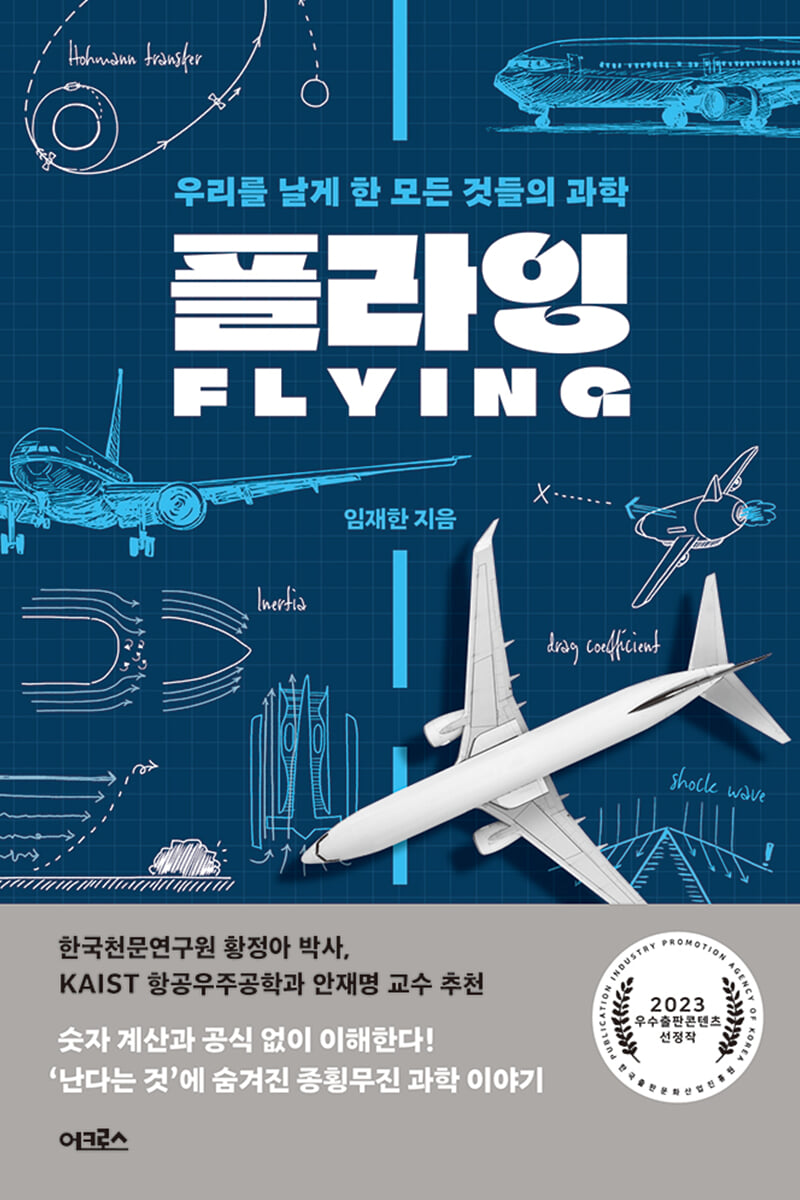
Flying FLYING
 |
Description
Book Introduction
Humans can travel long distances on two legs and swim across the ocean, but they cannot fly. Flight was an act that humans could not do on their own in a natural state, but it has finally become possible through the advancement of science and technology. What is the force that lifts us into the air, the force that pushes us forward, overcoming resistance? In an age where technological advancements are miniaturizing everything, why are airplane engines getting bigger and bigger? "Flying" is a book that explains the various fields of technology and scientific principles related to flight in an easy and interesting way. The author, an aerospace engineer, guides us into a new world of science by helping us understand aerodynamics by comparing invisible airflow to traffic flow, finding clues to the principles of flight in seemingly unrelated materials like a whale's fin and a golf ball. |
- You can preview some of the book's contents.
Preview
index
Prologue: Even Flight Needs Questions
PART 1 WIND: Without Air, You Can't Fly
1 Why airplane noses are round _Air resistance
2 But why are fighter jet noses so sharp? _Shockwave
What Happens When You Break the Sound Speed _ The Science of Engine Nozzles
4 How to avoid air hotter than the sun _The heat of the air
5 The identity of the clouds chasing the plane _ The coldness of the air
6 How to finish the flow _ Streamlined
PART 2: Power: Finding Materials for Flying
7 Things Humpback Whales and Golf Balls Have in Common - How to Use Turbulence
8 Why are engines getting bigger and heavier? _Thrust and Fuel
9 Forces that Torment Pilots _G-Force
10 Eternal Fall _ How to Use Gravity
11 How to Anchore in Space _ How to Use Zero Gravity
PART 3: EMERGENCY: The Challenges We've Solved to Fly
12 Distinguishing between up, down, left, and right in an empty sky _ Inertia
13 Where the heck am I? _Inertial Navigation System
14 Different speeds of passengers, pilots, and airplanes_The concept of flight speed
15 Why Two Wings Aren't Enough? _Tail Wings and Static Stability
16 Cost to sit in the seat you want _ Center of gravity
PART 4 TECHNOLOGY: FARTHER, FASTER, AND SAFE
17 Two Strategies for Determining Routes _ Economics of Flight
18 The Fate of Two Airplanes Divided by the Speed of Sound _ The Lost Concorde
19 The Secret of the Number of Engines Before an Airplane Crosses the Ocean
20 What if the engine fails during takeoff? _Emergency takeoff stop
21 Machines that Read Human Intentions _ Autopilot and Safety
References
Photo source
PART 1 WIND: Without Air, You Can't Fly
1 Why airplane noses are round _Air resistance
2 But why are fighter jet noses so sharp? _Shockwave
What Happens When You Break the Sound Speed _ The Science of Engine Nozzles
4 How to avoid air hotter than the sun _The heat of the air
5 The identity of the clouds chasing the plane _ The coldness of the air
6 How to finish the flow _ Streamlined
PART 2: Power: Finding Materials for Flying
7 Things Humpback Whales and Golf Balls Have in Common - How to Use Turbulence
8 Why are engines getting bigger and heavier? _Thrust and Fuel
9 Forces that Torment Pilots _G-Force
10 Eternal Fall _ How to Use Gravity
11 How to Anchore in Space _ How to Use Zero Gravity
PART 3: EMERGENCY: The Challenges We've Solved to Fly
12 Distinguishing between up, down, left, and right in an empty sky _ Inertia
13 Where the heck am I? _Inertial Navigation System
14 Different speeds of passengers, pilots, and airplanes_The concept of flight speed
15 Why Two Wings Aren't Enough? _Tail Wings and Static Stability
16 Cost to sit in the seat you want _ Center of gravity
PART 4 TECHNOLOGY: FARTHER, FASTER, AND SAFE
17 Two Strategies for Determining Routes _ Economics of Flight
18 The Fate of Two Airplanes Divided by the Speed of Sound _ The Lost Concorde
19 The Secret of the Number of Engines Before an Airplane Crosses the Ocean
20 What if the engine fails during takeoff? _Emergency takeoff stop
21 Machines that Read Human Intentions _ Autopilot and Safety
References
Photo source
Detailed image

Into the book
Figuring out the secret behind the shape of the airplane nose raises another scary question.
So, if fighter jets are just like passenger planes, why do they have pointed noses? It's said that air resistance is lowest when the nose of an airplane is round.
Since fighter jets fly faster than passenger jets, minimizing air resistance may be more important for fighter jets than for passenger jets.
So what does it mean when a fighter jet has a pointed nose?
--- p.24, from Chapter 2, “But why are fighter jet noses so sharp? - Shock Wave”
The agreement reached by the sands was a good way to keep the 'law of continuity'.
But as the flow speeds up, the message is not properly transmitted, and the agreement that 'wide places are slow, narrow places are fast' begins to break down.
Because if the news doesn't get through, you don't know if there's a narrow road ahead or a wide road.
So what happens to the law of continuity? Does it break? But a law is a law, after all, it can't be broken.
--- p.39, from Chapter 3, “What Happens When You Break the Sound Speed – The Science of Engine Nozzles”
All fluids have viscosity to some extent.
Although much smaller than honey or water, air is no exception.
The air displaced by the object creates a flow that naturally returns to fill the empty space following the shape of the object.
Whether the object is a ball or an airplane wing.
If you summarize it up to here, you will get this thought.
“Thanks to the strong Coanda effect, the air will fill the empty space, so the shape of the tail shouldn’t really matter, right?” But the problem is that the Coanda effect is not invincible.
--- p.74-75, from “Chapter 6, “How to Finish the Flow - Streamlined”
In space, there is no ground to set foot on, no dock to tie down with a rope.
To remain still in space, you can only hope for a state in which no force acts on you.
At least we need to find the point where all the acting forces are balanced and no movement occurs.
Space is a space filled with gravity generated by various celestial bodies.
So, the key to landing a spacecraft is to find a point where these gravitational forces balance each other, a truly "weightless" space where all gravity is truly canceled out.
--- p.138, from Chapter 11, “How to Drop an Anchorage in Space - How to Use Zero Gravity”
Cars and trains have 'wheels' that touch the ground, and they move in the direction these wheels are facing.
However, there is no reason for objects floating in the sky to have a direction called 'forward'.
Just as it would not be strange at all if we threw a ball into the sky and it flew around in circles.
So, the airplane we ride could fly around in a dizzying, directionless manner like a ball.
Of course, it's a terrible imagination.
At this time, the tail wing is what gives the airplane in the air direction.
--- p.192, from “Chapter 15, “Why Are Two Wings Not Enough? - Tail Wings and Static Stability”
We are in the cockpit of an airplane racing down the runway ready for takeoff.
As the speed increases and the wings begin to lift the plane, the weight of the wheels pressing down on the runway gradually becomes lighter.
Just before the stage of activity is about to be moved from the ground to the sky, one of the engines suddenly stops working and the cockpit is filled with warning sounds.
Flying without an engine is too dangerous.
Should I hit the brakes and stop? Ah, looking out the window, I can vaguely see the end of the runway.
If there is not much runway left, you may not be able to stop and may bounce off the runway.
Should we just take off? No, with the engine out, it's doubtful we can even gain any more speed.
Should we just stop? Even as we ponder this, the remaining runway length is shortening by 80 meters per second.
So, are you going to stop or just take off?
So, if fighter jets are just like passenger planes, why do they have pointed noses? It's said that air resistance is lowest when the nose of an airplane is round.
Since fighter jets fly faster than passenger jets, minimizing air resistance may be more important for fighter jets than for passenger jets.
So what does it mean when a fighter jet has a pointed nose?
--- p.24, from Chapter 2, “But why are fighter jet noses so sharp? - Shock Wave”
The agreement reached by the sands was a good way to keep the 'law of continuity'.
But as the flow speeds up, the message is not properly transmitted, and the agreement that 'wide places are slow, narrow places are fast' begins to break down.
Because if the news doesn't get through, you don't know if there's a narrow road ahead or a wide road.
So what happens to the law of continuity? Does it break? But a law is a law, after all, it can't be broken.
--- p.39, from Chapter 3, “What Happens When You Break the Sound Speed – The Science of Engine Nozzles”
All fluids have viscosity to some extent.
Although much smaller than honey or water, air is no exception.
The air displaced by the object creates a flow that naturally returns to fill the empty space following the shape of the object.
Whether the object is a ball or an airplane wing.
If you summarize it up to here, you will get this thought.
“Thanks to the strong Coanda effect, the air will fill the empty space, so the shape of the tail shouldn’t really matter, right?” But the problem is that the Coanda effect is not invincible.
--- p.74-75, from “Chapter 6, “How to Finish the Flow - Streamlined”
In space, there is no ground to set foot on, no dock to tie down with a rope.
To remain still in space, you can only hope for a state in which no force acts on you.
At least we need to find the point where all the acting forces are balanced and no movement occurs.
Space is a space filled with gravity generated by various celestial bodies.
So, the key to landing a spacecraft is to find a point where these gravitational forces balance each other, a truly "weightless" space where all gravity is truly canceled out.
--- p.138, from Chapter 11, “How to Drop an Anchorage in Space - How to Use Zero Gravity”
Cars and trains have 'wheels' that touch the ground, and they move in the direction these wheels are facing.
However, there is no reason for objects floating in the sky to have a direction called 'forward'.
Just as it would not be strange at all if we threw a ball into the sky and it flew around in circles.
So, the airplane we ride could fly around in a dizzying, directionless manner like a ball.
Of course, it's a terrible imagination.
At this time, the tail wing is what gives the airplane in the air direction.
--- p.192, from “Chapter 15, “Why Are Two Wings Not Enough? - Tail Wings and Static Stability”
We are in the cockpit of an airplane racing down the runway ready for takeoff.
As the speed increases and the wings begin to lift the plane, the weight of the wheels pressing down on the runway gradually becomes lighter.
Just before the stage of activity is about to be moved from the ground to the sky, one of the engines suddenly stops working and the cockpit is filled with warning sounds.
Flying without an engine is too dangerous.
Should I hit the brakes and stop? Ah, looking out the window, I can vaguely see the end of the runway.
If there is not much runway left, you may not be able to stop and may bounce off the runway.
Should we just take off? No, with the engine out, it's doubtful we can even gain any more speed.
Should we just stop? Even as we ponder this, the remaining runway length is shortening by 80 meters per second.
So, are you going to stop or just take off?
--- p.248-249, from “Chapter 20, “What if the engine fails during takeoff? - Emergency takeoff stop”
Publisher's Review
Selected as an excellent publication content in 2023 by the Korea Publication Industry Promotion Agency
Recommended by Dr. Hwang Jeong-ah of the Korea Astronomy and Space Science Institute and Professor Ahn Jae-myung of the Department of Aerospace Engineering at KAIST
Once you've found the optimal height and best speed, takeoff finally begins!
The easiest and most entertaining textbook to learn the science behind everything that made us fly.
Humans can travel long distances on two legs and swim across the ocean, but they cannot fly.
Flight was an act that humans could not do on their own in a natural state, but it has finally become possible through the advancement of science and technology.
What is the force that lifts us into the air, the force that pushes us forward, overcoming resistance? In an age where technological advancements are miniaturizing everything, why are airplane engines getting bigger and bigger?
《Flying》 is a book that explains the various fields of technology and scientific principles related to flight in an easy and interesting way.
The author, an aerospace engineer, guides us into a new world of science by helping us understand aerodynamics by comparing invisible airflow to traffic flow, finding clues to the principles of flight in seemingly unrelated materials like a whale's fin and a golf ball.
No special background knowledge is required to read the scientific story hidden in 'Flying'.
This is because this book is not written in a spoon-fed way that adds concept to concept, but rather in a way that broadens the scope of thought by adding question to question.
To aid in understanding the content, the author's own drawings serve as the basis for the illustrations in the book, allowing readers to intuitively grasp complex principles.
If you just follow the author's writing as if you were listening to an interesting story, you will soon become a chatterbox with a lot to say every time you board an airplane.
From airplane nerd to aerospace engineer
The process of expanding the world of science by asking questions about things you like
The author of this book, Jaehan Lim, a young aerospace engineer, is also a long-time airplane enthusiast.
The reason he was fascinated by airplanes was because of their contradictory nature.
A lump of iron weighing hundreds of tons, cutting through the thin, cold air that humans cannot breathe at a frightening speed, yet keeping its interior cozy enough for us to sleep.
Although airplanes are recognized as the safest means of transportation with a much lower risk of accidents than cars, they can also crash for extremely trivial and pointless reasons.
He has been fascinated by these seemingly massive machines and has been writing about flight and science on his blog since his school days, and current engineers, captains, and other so-called "industry people" have expressed admiration and support for the author's writing.
He entered the Department of Aerospace Engineering at KAIST as if it were a natural progression, and continued his studies and research in earnest, contributing aerospace science columns to various media outlets.
From the scientific principles hidden in the shape of an airplane to the secrets of the center of gravity related to airline ticket prices, the book explains various topics at a level that is accessible to the general reader, and announces the birth of a new science writer with both expertise and popularity in the field of aviation science.
The author begins to find answers by asking questions one by one, starting with what is visible.
This narrative style is similar to the way engineers find answers.
The nose of the airplane is blunt and round.
If you think of a sports car or boat that can reach incredible speeds, even if it's not as fast as an airplane, it seems to have a sleek appearance.
But why are airplane noses round? As the author explores the answer to this question, readers naturally come to understand that air also possesses a "sticky" viscosity, and that to reduce viscosity, a moderately rounded shape with a small surface area in contact with the air is the only option.
Through this book, the author not only explains the scientific principles of airplanes, but also allows us to experience how science works to 'solve problems.'
Once you realize something you didn't know before, things you didn't see before lead to new questions.
“Why is the nose of a fighter jet, which is faster than an airplane (passenger plane), pointed?” “What shape should the nose of a space shuttle, which is faster than that, be?” We ask questions about flight, examine the physical properties of air that we cannot feel in our daily lives, and become interested in space outside the sky.
Just as airplanes expanded the reach of humankind, science broadens the scope of our understanding of the world.
From the identity of the force that torments fighter pilots
Why airline tickets are more expensive when we choose our own seats
The science behind "flying"
《Flying》 is structured in each part to gradually get closer to the reality of the airplane, starting from the basic principles that make flight possible.
Part 1 covers the physical properties of air movement, Part 2 covers the process of gaining power from the sky, Part 3 covers the problems that had to be solved to make flight a reality, and Part 4 covers efforts to make flight more economical and safer.
The author explains complex principles in an easy-to-understand manner using illustrations, and explains the science of flight through stories, excluding as many numerical calculations and physics formulas as possible so that both general readers and young readers can understand.
In the movie Top Gun, the protagonist piloting a fighter jet is put in an extreme situation where he is on the verge of losing consciousness.
What exactly is the force that plagues pilots? The answer lies not in speed, but in abrupt changes in direction.
The force we feel when we twirl an object on a string is the same type of force that fighter pilots feel.
This time, let's think about a movie where the main character is a spy.
Even if they are kidnapped blindfolded, they know their location.
It is about estimating one's own location by considering the speed and direction of force of the moving car, which is similar to the way an airplane finds its location in the vast 'sky' where there are no terrain features.
These contents immediately dispel readers' concerns that flying-related knowledge will be limited to rigid and specialized knowledge.
Questions that started from the scientific principles of flying well become more closely related to our daily lives as the book progresses.
Why do airline tickets become more expensive when we choose our own seats? Airlines' profitability depends on the number of passengers, so is it always profitable to carry more people in larger aircraft? While aircraft, with their hundreds of tons of steel soaring thousands of meters in the air, might seem like they're filled with cutting-edge technology that's difficult for the average person to grasp, a little curiosity reveals that scientific principles are hidden everywhere, even in our own surroundings.
Through this book, you will not only gain a wealth of knowledge about aviation, but also realize that no matter how unfamiliar or difficult a subject may seem, the foundation for understanding it begins with something close to us.
Recommended by Dr. Hwang Jeong-ah of the Korea Astronomy and Space Science Institute and Professor Ahn Jae-myung of the Department of Aerospace Engineering at KAIST
Once you've found the optimal height and best speed, takeoff finally begins!
The easiest and most entertaining textbook to learn the science behind everything that made us fly.
Humans can travel long distances on two legs and swim across the ocean, but they cannot fly.
Flight was an act that humans could not do on their own in a natural state, but it has finally become possible through the advancement of science and technology.
What is the force that lifts us into the air, the force that pushes us forward, overcoming resistance? In an age where technological advancements are miniaturizing everything, why are airplane engines getting bigger and bigger?
《Flying》 is a book that explains the various fields of technology and scientific principles related to flight in an easy and interesting way.
The author, an aerospace engineer, guides us into a new world of science by helping us understand aerodynamics by comparing invisible airflow to traffic flow, finding clues to the principles of flight in seemingly unrelated materials like a whale's fin and a golf ball.
No special background knowledge is required to read the scientific story hidden in 'Flying'.
This is because this book is not written in a spoon-fed way that adds concept to concept, but rather in a way that broadens the scope of thought by adding question to question.
To aid in understanding the content, the author's own drawings serve as the basis for the illustrations in the book, allowing readers to intuitively grasp complex principles.
If you just follow the author's writing as if you were listening to an interesting story, you will soon become a chatterbox with a lot to say every time you board an airplane.
From airplane nerd to aerospace engineer
The process of expanding the world of science by asking questions about things you like
The author of this book, Jaehan Lim, a young aerospace engineer, is also a long-time airplane enthusiast.
The reason he was fascinated by airplanes was because of their contradictory nature.
A lump of iron weighing hundreds of tons, cutting through the thin, cold air that humans cannot breathe at a frightening speed, yet keeping its interior cozy enough for us to sleep.
Although airplanes are recognized as the safest means of transportation with a much lower risk of accidents than cars, they can also crash for extremely trivial and pointless reasons.
He has been fascinated by these seemingly massive machines and has been writing about flight and science on his blog since his school days, and current engineers, captains, and other so-called "industry people" have expressed admiration and support for the author's writing.
He entered the Department of Aerospace Engineering at KAIST as if it were a natural progression, and continued his studies and research in earnest, contributing aerospace science columns to various media outlets.
From the scientific principles hidden in the shape of an airplane to the secrets of the center of gravity related to airline ticket prices, the book explains various topics at a level that is accessible to the general reader, and announces the birth of a new science writer with both expertise and popularity in the field of aviation science.
The author begins to find answers by asking questions one by one, starting with what is visible.
This narrative style is similar to the way engineers find answers.
The nose of the airplane is blunt and round.
If you think of a sports car or boat that can reach incredible speeds, even if it's not as fast as an airplane, it seems to have a sleek appearance.
But why are airplane noses round? As the author explores the answer to this question, readers naturally come to understand that air also possesses a "sticky" viscosity, and that to reduce viscosity, a moderately rounded shape with a small surface area in contact with the air is the only option.
Through this book, the author not only explains the scientific principles of airplanes, but also allows us to experience how science works to 'solve problems.'
Once you realize something you didn't know before, things you didn't see before lead to new questions.
“Why is the nose of a fighter jet, which is faster than an airplane (passenger plane), pointed?” “What shape should the nose of a space shuttle, which is faster than that, be?” We ask questions about flight, examine the physical properties of air that we cannot feel in our daily lives, and become interested in space outside the sky.
Just as airplanes expanded the reach of humankind, science broadens the scope of our understanding of the world.
From the identity of the force that torments fighter pilots
Why airline tickets are more expensive when we choose our own seats
The science behind "flying"
《Flying》 is structured in each part to gradually get closer to the reality of the airplane, starting from the basic principles that make flight possible.
Part 1 covers the physical properties of air movement, Part 2 covers the process of gaining power from the sky, Part 3 covers the problems that had to be solved to make flight a reality, and Part 4 covers efforts to make flight more economical and safer.
The author explains complex principles in an easy-to-understand manner using illustrations, and explains the science of flight through stories, excluding as many numerical calculations and physics formulas as possible so that both general readers and young readers can understand.
In the movie Top Gun, the protagonist piloting a fighter jet is put in an extreme situation where he is on the verge of losing consciousness.
What exactly is the force that plagues pilots? The answer lies not in speed, but in abrupt changes in direction.
The force we feel when we twirl an object on a string is the same type of force that fighter pilots feel.
This time, let's think about a movie where the main character is a spy.
Even if they are kidnapped blindfolded, they know their location.
It is about estimating one's own location by considering the speed and direction of force of the moving car, which is similar to the way an airplane finds its location in the vast 'sky' where there are no terrain features.
These contents immediately dispel readers' concerns that flying-related knowledge will be limited to rigid and specialized knowledge.
Questions that started from the scientific principles of flying well become more closely related to our daily lives as the book progresses.
Why do airline tickets become more expensive when we choose our own seats? Airlines' profitability depends on the number of passengers, so is it always profitable to carry more people in larger aircraft? While aircraft, with their hundreds of tons of steel soaring thousands of meters in the air, might seem like they're filled with cutting-edge technology that's difficult for the average person to grasp, a little curiosity reveals that scientific principles are hidden everywhere, even in our own surroundings.
Through this book, you will not only gain a wealth of knowledge about aviation, but also realize that no matter how unfamiliar or difficult a subject may seem, the foundation for understanding it begins with something close to us.
GOODS SPECIFICS
- Date of issue: August 21, 2023
- Page count, weight, size: 280 pages | 430g | 140*210*16mm
- ISBN13: 9791167741134
- ISBN10: 1167741137
You may also like
카테고리
korean


korean

![ELLE 엘르 스페셜 에디션 A형 : 12월 [2025]](http://librairie.coreenne.fr/cdn/shop/files/b8e27a3de6c9538896439686c6b0e8fb.jpg?v=1766436872&width=3840)


