

Our universe
 |
Description
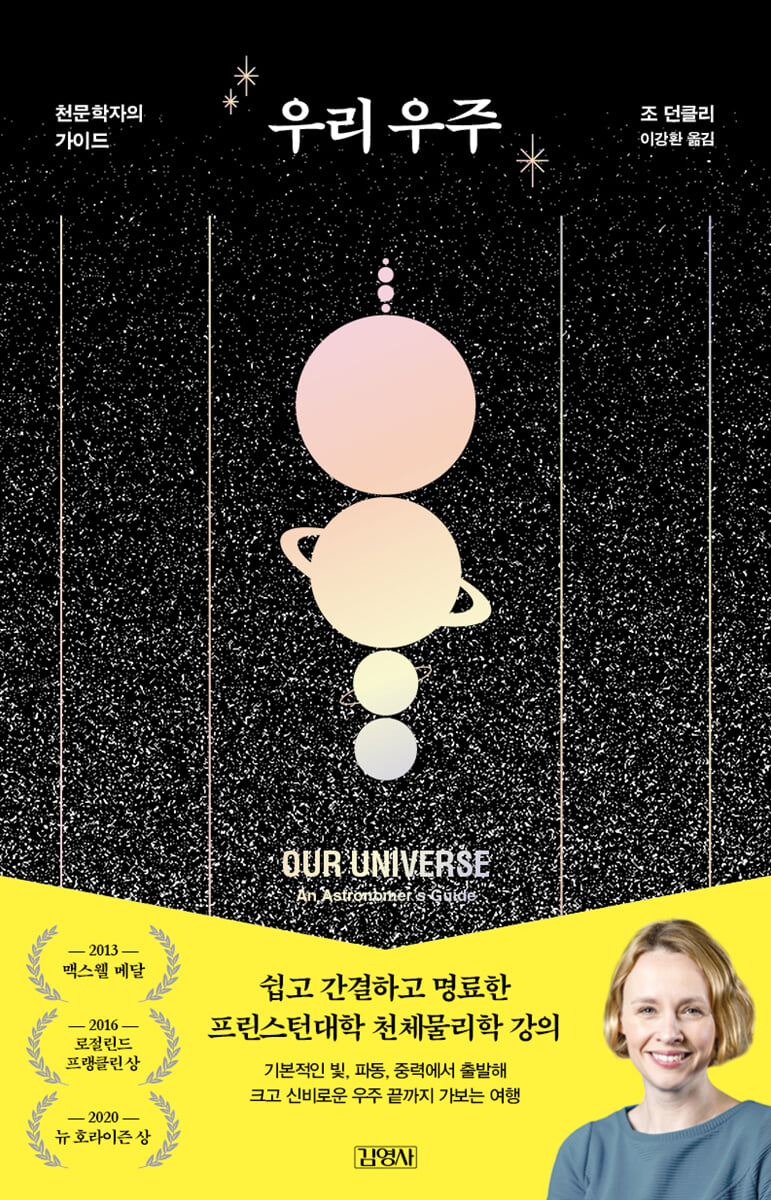
Book Introduction
How far do we know and how do we know?
Princeton University Astrophysics Lectures: Easy, Concise, and Clear
An introductory lecture on astronomy by Joe Dunkley, a professor of physics and astrophysics at Princeton University and winner of several prestigious physics awards.
He is known for his lectures that wow his audiences with explanations that get to the point without exaggerating facts or forcing any feelings.
Rather than using flashy audiovisual aids, the book teaches readers how the universe works by showing them everyday objects, so readers will feel as if they are participating in a class where a master expert in a particular field is holding a piece of chalk and helping them imagine the vast universe.
He first introduces the essential knowledge of physics, chemistry, and mathematics for understanding the universe, and then excellently explains cosmic phenomena by comparing celestial bodies to human-scale objects that we can easily understand. 42 two-dimensional illustrations without unnecessary details help this understanding even more effectively.
In other words, this is a principle-centered astronomy book that evokes the thrill and empathy of scientific discovery without losing authority and dignity.
Princeton University Astrophysics Lectures: Easy, Concise, and Clear
An introductory lecture on astronomy by Joe Dunkley, a professor of physics and astrophysics at Princeton University and winner of several prestigious physics awards.
He is known for his lectures that wow his audiences with explanations that get to the point without exaggerating facts or forcing any feelings.
Rather than using flashy audiovisual aids, the book teaches readers how the universe works by showing them everyday objects, so readers will feel as if they are participating in a class where a master expert in a particular field is holding a piece of chalk and helping them imagine the vast universe.
He first introduces the essential knowledge of physics, chemistry, and mathematics for understanding the universe, and then excellently explains cosmic phenomena by comparing celestial bodies to human-scale objects that we can easily understand. 42 two-dimensional illustrations without unnecessary details help this understanding even more effectively.
In other words, this is a principle-centered astronomy book that evokes the thrill and empathy of scientific discovery without losing authority and dignity.
- You can preview some of the book's contents.
Preview
index
Acknowledgements
introduction
Chapter 1 Our Place in the Universe
Chapter 2 We are the remnants of a star
Chapter 3: Seeing the Invisible
Chapter 4: The Nature of the Universe
Chapter 5 From beginning to end
Looking ahead to the epilogue
Translator's Note
Educational Materials and Further Reading
Search
introduction
Chapter 1 Our Place in the Universe
Chapter 2 We are the remnants of a star
Chapter 3: Seeing the Invisible
Chapter 4: The Nature of the Universe
Chapter 5 From beginning to end
Looking ahead to the epilogue
Translator's Note
Educational Materials and Further Reading
Search
Detailed image

Into the book
Why does it look like this? If you think of the disk as a pot lid, our Sun is located about halfway between the handle at the center of the lid and the tip.
What do we see when we look up at the sky? Imagine we're inside a lid, and stars fill the lid.
Nearby stars will appear scattered in all directions across the sky.
Because nearby stars surround us from all directions.
If we look in the direction through the lid of the pot, that is, through the disk of stars in our galaxy, we will see a bright band of stars.
If you look in a different direction from inside the lid of the pot, you will see far fewer stars, and beyond a few bright stars, there will be nothing but darkness.
The farthest stars we can see with our eyes are thousands of light-years away.
Because the center of our galaxy is about 30,000 light-years away, we need a telescope to distinguish the distant stars that shine brightly as actual stars.
Galileo was the first to distinguish stars from bands of light in 1609.
--- p.78, from “Chapter 1: Our Place in the Universe”
Telescopes designed to observe this infrared light are particularly useful for viewing warm, but non-visible, objects in space.
These telescopes work in the same way as visible-light telescopes, but instead of sending light to an eye or an optical camera with a CCD observer, they send it to a camera with an observer designed to detect infrared light, which has a longer wavelength.
In fact, most of the cameras on our cell phones can see some infrared light.
You can see this by pointing the remote control at your phone's camera and holding down the button to take a picture.
Because the remote control emits infrared light to transmit signals, when you press a button, the infrared light will appear as a bright dot on the camera.
--- p.108, from “Chapter 2 We Are the Remnants of a Star”
Now imagine a friend standing on the other side of the rubber plate with the ball between them.
If you remove the ball and roll the marble to either side of your friend, the marble will roll in that direction, in a straight line.
Now let's put the ball back down and roll the marble in the same direction.
Then, instead of rolling towards your friend, the marble will bend slightly as it passes through the hole and roll towards your friend.
If you roll the marble towards your friend's other side, it will curve slightly in the opposite direction and roll back towards your friend.
--- pp.190~192, from “Chapter 3 Seeing the Invisible”
A simple way to see if two surfaces have the same curvature is to draw a triangle on the surfaces.
Most people learn in school that the sum of the interior angles of a triangle is equal.
180 degrees or the sum of two right angles.
But this is only true for triangles drawn on a flat surface.
If you draw a triangle on an orange, you will see that the sum of the angles is greater than on a flat surface.
For example, you could draw a triangle starting at the North Pole of the orange and extending down to the equator.
The second side circles a quarter of the way around the equator, and the third side circles back to the North Pole.
All the angles of this triangle will be 90 degrees, so the sum will be 270 degrees.
…
What determines the curvature of space? The amount of matter in the universe.
The universe as a whole becomes more warped the more massive it becomes.
As we saw in Chapter 3, a lead ball deflects a rubber sheet more than a Styrofoam ball.
We can determine the curvature of the universe by tracking light as it travels through it and measuring how much space is curved.
Light coming to Earth from distant celestial bodies would follow a straight path if space were not curved.
If space is more curved, the light will bend more, like a bead on a rubber sheet.
Consider a rubber plate with a lead ball or a Styrofoam ball on it.
I stand on one side of the rubber plate, and on the other side, my friend spreads his arms wide and rolls a marble toward me with both hands simultaneously.
--- pp.256~259, from “Chapter 4: The Nature of the Universe”
One of the theoretical problems with dark energy is the amount of energy.
This doesn't make sense.
A possible explanation for why empty space can have its own energy has to do with the rapid creation and destruction of particles according to the laws of quantum mechanics.
However, according to this explanation, our universe must be completely under the control of this vacuum energy, or its effect must be zero.
There is no adequate theory yet to explain why it should be treated as equally important as visible and invisible matter in explaining the amount of energy that makes up the universe.
This is a really big and important issue.
But there's no need to worry too much about its existence.
Dark energy has no apparent effects, not only in our solar system but also within our galaxy.
This has the indirect effect of preventing large galaxy clusters from clumping together.
Dark energy tends to cause the universe to expand faster because gravity prevents it from forming larger and larger structures.
To us, it feels like an itch that bothers us because we don't know what the object is.
Because it may be a sign that something is wrong with our entire concept of the universe and the physical laws that describe it in a larger sense.
Some physicists are exploring the possibility that Einstein's law of gravity might not be perfect, that it might need some modifications when gravity is very weak, for example.
With these few modifications, we can reproduce the effects of dark energy.
What do we see when we look up at the sky? Imagine we're inside a lid, and stars fill the lid.
Nearby stars will appear scattered in all directions across the sky.
Because nearby stars surround us from all directions.
If we look in the direction through the lid of the pot, that is, through the disk of stars in our galaxy, we will see a bright band of stars.
If you look in a different direction from inside the lid of the pot, you will see far fewer stars, and beyond a few bright stars, there will be nothing but darkness.
The farthest stars we can see with our eyes are thousands of light-years away.
Because the center of our galaxy is about 30,000 light-years away, we need a telescope to distinguish the distant stars that shine brightly as actual stars.
Galileo was the first to distinguish stars from bands of light in 1609.
--- p.78, from “Chapter 1: Our Place in the Universe”
Telescopes designed to observe this infrared light are particularly useful for viewing warm, but non-visible, objects in space.
These telescopes work in the same way as visible-light telescopes, but instead of sending light to an eye or an optical camera with a CCD observer, they send it to a camera with an observer designed to detect infrared light, which has a longer wavelength.
In fact, most of the cameras on our cell phones can see some infrared light.
You can see this by pointing the remote control at your phone's camera and holding down the button to take a picture.
Because the remote control emits infrared light to transmit signals, when you press a button, the infrared light will appear as a bright dot on the camera.
--- p.108, from “Chapter 2 We Are the Remnants of a Star”
Now imagine a friend standing on the other side of the rubber plate with the ball between them.
If you remove the ball and roll the marble to either side of your friend, the marble will roll in that direction, in a straight line.
Now let's put the ball back down and roll the marble in the same direction.
Then, instead of rolling towards your friend, the marble will bend slightly as it passes through the hole and roll towards your friend.
If you roll the marble towards your friend's other side, it will curve slightly in the opposite direction and roll back towards your friend.
--- pp.190~192, from “Chapter 3 Seeing the Invisible”
A simple way to see if two surfaces have the same curvature is to draw a triangle on the surfaces.
Most people learn in school that the sum of the interior angles of a triangle is equal.
180 degrees or the sum of two right angles.
But this is only true for triangles drawn on a flat surface.
If you draw a triangle on an orange, you will see that the sum of the angles is greater than on a flat surface.
For example, you could draw a triangle starting at the North Pole of the orange and extending down to the equator.
The second side circles a quarter of the way around the equator, and the third side circles back to the North Pole.
All the angles of this triangle will be 90 degrees, so the sum will be 270 degrees.
…
What determines the curvature of space? The amount of matter in the universe.
The universe as a whole becomes more warped the more massive it becomes.
As we saw in Chapter 3, a lead ball deflects a rubber sheet more than a Styrofoam ball.
We can determine the curvature of the universe by tracking light as it travels through it and measuring how much space is curved.
Light coming to Earth from distant celestial bodies would follow a straight path if space were not curved.
If space is more curved, the light will bend more, like a bead on a rubber sheet.
Consider a rubber plate with a lead ball or a Styrofoam ball on it.
I stand on one side of the rubber plate, and on the other side, my friend spreads his arms wide and rolls a marble toward me with both hands simultaneously.
--- pp.256~259, from “Chapter 4: The Nature of the Universe”
One of the theoretical problems with dark energy is the amount of energy.
This doesn't make sense.
A possible explanation for why empty space can have its own energy has to do with the rapid creation and destruction of particles according to the laws of quantum mechanics.
However, according to this explanation, our universe must be completely under the control of this vacuum energy, or its effect must be zero.
There is no adequate theory yet to explain why it should be treated as equally important as visible and invisible matter in explaining the amount of energy that makes up the universe.
This is a really big and important issue.
But there's no need to worry too much about its existence.
Dark energy has no apparent effects, not only in our solar system but also within our galaxy.
This has the indirect effect of preventing large galaxy clusters from clumping together.
Dark energy tends to cause the universe to expand faster because gravity prevents it from forming larger and larger structures.
To us, it feels like an itch that bothers us because we don't know what the object is.
Because it may be a sign that something is wrong with our entire concept of the universe and the physical laws that describe it in a larger sense.
Some physicists are exploring the possibility that Einstein's law of gravity might not be perfect, that it might need some modifications when gravity is very weak, for example.
With these few modifications, we can reproduce the effects of dark energy.
--- pp.312~313, from “Chapter 5, From Beginning to End”
Publisher's Review
How far do we know and how do we know?
Princeton University Astrophysics Lectures: Easy, Concise, and Clear
★★★ “A high-level overview of humanity’s understanding of the universe.
“An excellent introduction even for those new to astrophysics.”_Space Review
★★★ BBC's "Sky at Night" selected it as the best astronomy book of the year.
In this busy life, what does it mean to look as far as you can?
Understanding our location and the movements of celestial bodies through an astronomer's guide
How much do we know about the universe, and how much do we know? What does physics tell us about the universe? What does modern astronomy study? What role do telescopes and computers play? Why is astronomy also called "astrophysics"? These are questions anyone interested in astronomy has likely wondered at least once.
In this book, Joe Dunkley, a professor of physics and astrophysics at Princeton University in the United States, guides readers to answer these questions through simple and friendly explanations.
He is a researcher who has won several prestigious physics awards, but he is also an educator who struggles to explain complex astrophysical phenomena to his students.
As can be seen from the fact that the sources of the teaching methods used in this book are recorded at the end of the book, this book carefully collects the explanations that he used most effectively to help people understand cosmic phenomena while teaching astronomy.
He is known for his lectures that wow his audiences with explanations that get to the point without exaggerating facts or forcing any feelings.
Rather than using flashy audiovisual aids, the book teaches readers how the universe works by showing them everyday objects, so readers will feel as if they are participating in a class where a master expert in a particular field is holding a piece of chalk and helping them imagine the vast universe.
In other words, this is a book that evokes the thrill and empathy of scientific discovery without losing authority and dignity.
In a word, this book is about ‘our universe.’
Universe is the name we give to all of space as we know it.
It is the space we can see with our telescopes, or the space we think is physically connected to the part we can see.
This book also gives an overview of how we on Earth fit into a larger space, how Earth got here, and what the future of our larger universe might hold.
The book also covers cutting-edge academic discussions on complex phenomena such as the accelerating expansion of the universe and the possibility that our universe may be just one of many.
To know the universe, you must know more than just the universe!
Astronomy lectures that compare celestial bodies to objects and understand the principles of physics.
In the field of cosmology, which this book covers, astronomy and physics meet.
This is because, firstly, the extreme physical conditions that exist outside of Earth and are rare to us pose questions for the physics community to solve, and secondly, if we are to elucidate the origin and evolution of the universe through observational data such as starlight, physical and mathematical calculations are necessary.
Imagine a black hole created by squeezing, for example, twice the mass of the Sun into a sphere only a few kilometers in diameter.
Furthermore, modern space research is facilitated by advancements in telescopes, computers, and simulation technology, and more accurate knowledge of physics and mathematics is essential to develop and utilize these technologies.
In order to understand the universe, it is essential to understand science outside of the so-called 'astronomy' field.
This book explains cosmic phenomena brilliantly by first extracting only the essential elements of the physics, chemistry, and mathematics knowledge needed at that time, and by comparing celestial bodies to human-scale objects that we can easily understand.
This book contains a total of 42 illustrations, all of which are flat, two-dimensional, black-and-white illustrations. While not as three-dimensional or colorful as photographs, they are the most effective images for explaining the single force that creates complex phenomena.
This book also allows readers to encounter astronomy, a field that is the result of the efforts and collaboration of more people than we previously knew.
Jo Dunkley is interested in creating a more equitable environment for women and Black scientists, who have been excluded from the history and research of science, and this perspective is reflected in this book.
Readers will also see the achievements of female scientists like Henrietta Swan-Levitt and Vera Rubin, and how researchers collaborated internationally to understand the universe.
What and how does modern astronomy study?
A journey from the fundamentals of light, waves, and gravity to the vast and mysterious reaches of the universe.
This book does not begin with the story of the beginning of the universe.
Because it's a bit of an unfamiliar place.
Instead, we begin by looking at the universe from the here and now, from this Earth.
Chapter 1 examines the location of the Earth and the celestial bodies that grow in size from Earth to the Solar System to the 'circumstances of the Sun' to the Milky Way to the Local Group of Galaxies to the superclusters to the observable universe.
If we look deeply into the night sky, we can see that the celestial objects in space are not randomly scattered.
There is a clear pattern to how things sit together, from the smallest to the largest.
We can see where the Earth fits within these cosmic regularities and get a sense of the scale of the universe.
Chapter 2 deals with stars, but there is something you need to know first to understand stars.
It's light and a telescope.
In this chapter, Dunckley first explains what light is, what types there are, what characteristics each type of light has, and how telescopes allow us to 'see' light.
Then we look at the types of stars, their composition, and their life cycles, and tell you how we figured this out.
In Chapter 3, we encounter dark matter, which cannot be seen with our eyes, telescopes, or even telescopes that observe other types of light.
This discovery, made less than a century ago, has transformed our understanding of what the universe is and what it is made of.
It is an essential element in understanding the structure of the universe, and it has a tremendous influence on everything that shines brightly, and is also considered to be part of the basic materials of nature.
How was this dark matter discovered and confirmed? We introduce the physical principles, such as "gravitational lensing," necessary to uncover this phenomenon, and also present current theories regarding what dark matter is.
Chapter 4 examines the properties of space.
We introduce the history of how we discovered that space is constantly changing, and explore what it means for the universe to be expanding or contracting and how we can know this.
In this chapter, we also encounter the idea that space itself has shape and the possibility of discovering that our universe is infinitely large.
We will also try to imagine what an expanding universe might look like through various thought experiments.
The final chapter is a summary of the history of the universe.
Here we examine the life of the universe from its first moment to the present.
In this chapter, we will watch, like a drama, how the tiny traces left at the beginning of the universe transformed billions of years later into galaxies full of stars, like our own Milky Way, the home of our solar system.
And we explore what's next for our nearby universe and the universe as a whole, and what the telescopes we're building now can do.
In the epilogue, Dunkley says that this is “a golden age for astronomy, full of curiosity and possibility.”
With the help of great new telescopes and ever-increasing computer power, we may soon be able to add to the amazing discoveries we've made so far and uncover even more surprising and mysterious discoveries.
“A shining guide to the universe.
…Joe Dunkley takes us quickly from Earth to the limits of our observable universe, then delves into the life of stars, dark matter, the evolution of the universe, and all of cosmic history.”_Nature
“A brilliant book that encapsulates countless discoveries about the universe.
Astrophysicist Joe Dunkley takes a quick tour from Earth to the observable edge, exploring the life cycles of stars, dark matter, the evolution of the universe, and everything in between.
“Also fascinating are the stories of the 10th-century Persian astronomer Abd al-Rahman al-Sufi, and the 20th- and 21st-century astronomers Subramanian Chandrasekhar, Jocelyn Bell Burnell, and Vera Rubin.”_〈Nature〉
“This book takes us into the universe by weaving observational research into a purely theoretical framework.
…a book that both observationalists and theorists will want to own.” —Ethan Siegel, Forbes
“A high-level overview of the universe as it is understood by humanity.
“It’s a great introduction for those new to astrophysics.” —Jeff Fust, Space Review
“A fascinating and accessible introduction to space.
It covers everything from the Big Bang and the first stars at the 'dawn of the universe' to current research into extrasolar planets, dark matter, and dark energy.
…Dunkley offers a perspective on the universe and the mysteries to be discovered within it.” —Publisher’s Weekly
“Dunkley takes readers on a grand tour through time and space.
From our nearest planetary neighbors to the ends of the observable universe.
…if you want to brush up on your background knowledge or are looking for a gift for a curious nephew or niece, this little gem of a book will not disappoint.” —Gobert Schilling, BBC Sky at Night
Princeton University Astrophysics Lectures: Easy, Concise, and Clear
★★★ “A high-level overview of humanity’s understanding of the universe.
“An excellent introduction even for those new to astrophysics.”_Space Review
★★★ BBC's "Sky at Night" selected it as the best astronomy book of the year.
In this busy life, what does it mean to look as far as you can?
Understanding our location and the movements of celestial bodies through an astronomer's guide
How much do we know about the universe, and how much do we know? What does physics tell us about the universe? What does modern astronomy study? What role do telescopes and computers play? Why is astronomy also called "astrophysics"? These are questions anyone interested in astronomy has likely wondered at least once.
In this book, Joe Dunkley, a professor of physics and astrophysics at Princeton University in the United States, guides readers to answer these questions through simple and friendly explanations.
He is a researcher who has won several prestigious physics awards, but he is also an educator who struggles to explain complex astrophysical phenomena to his students.
As can be seen from the fact that the sources of the teaching methods used in this book are recorded at the end of the book, this book carefully collects the explanations that he used most effectively to help people understand cosmic phenomena while teaching astronomy.
He is known for his lectures that wow his audiences with explanations that get to the point without exaggerating facts or forcing any feelings.
Rather than using flashy audiovisual aids, the book teaches readers how the universe works by showing them everyday objects, so readers will feel as if they are participating in a class where a master expert in a particular field is holding a piece of chalk and helping them imagine the vast universe.
In other words, this is a book that evokes the thrill and empathy of scientific discovery without losing authority and dignity.
In a word, this book is about ‘our universe.’
Universe is the name we give to all of space as we know it.
It is the space we can see with our telescopes, or the space we think is physically connected to the part we can see.
This book also gives an overview of how we on Earth fit into a larger space, how Earth got here, and what the future of our larger universe might hold.
The book also covers cutting-edge academic discussions on complex phenomena such as the accelerating expansion of the universe and the possibility that our universe may be just one of many.
To know the universe, you must know more than just the universe!
Astronomy lectures that compare celestial bodies to objects and understand the principles of physics.
In the field of cosmology, which this book covers, astronomy and physics meet.
This is because, firstly, the extreme physical conditions that exist outside of Earth and are rare to us pose questions for the physics community to solve, and secondly, if we are to elucidate the origin and evolution of the universe through observational data such as starlight, physical and mathematical calculations are necessary.
Imagine a black hole created by squeezing, for example, twice the mass of the Sun into a sphere only a few kilometers in diameter.
Furthermore, modern space research is facilitated by advancements in telescopes, computers, and simulation technology, and more accurate knowledge of physics and mathematics is essential to develop and utilize these technologies.
In order to understand the universe, it is essential to understand science outside of the so-called 'astronomy' field.
This book explains cosmic phenomena brilliantly by first extracting only the essential elements of the physics, chemistry, and mathematics knowledge needed at that time, and by comparing celestial bodies to human-scale objects that we can easily understand.
This book contains a total of 42 illustrations, all of which are flat, two-dimensional, black-and-white illustrations. While not as three-dimensional or colorful as photographs, they are the most effective images for explaining the single force that creates complex phenomena.
This book also allows readers to encounter astronomy, a field that is the result of the efforts and collaboration of more people than we previously knew.
Jo Dunkley is interested in creating a more equitable environment for women and Black scientists, who have been excluded from the history and research of science, and this perspective is reflected in this book.
Readers will also see the achievements of female scientists like Henrietta Swan-Levitt and Vera Rubin, and how researchers collaborated internationally to understand the universe.
What and how does modern astronomy study?
A journey from the fundamentals of light, waves, and gravity to the vast and mysterious reaches of the universe.
This book does not begin with the story of the beginning of the universe.
Because it's a bit of an unfamiliar place.
Instead, we begin by looking at the universe from the here and now, from this Earth.
Chapter 1 examines the location of the Earth and the celestial bodies that grow in size from Earth to the Solar System to the 'circumstances of the Sun' to the Milky Way to the Local Group of Galaxies to the superclusters to the observable universe.
If we look deeply into the night sky, we can see that the celestial objects in space are not randomly scattered.
There is a clear pattern to how things sit together, from the smallest to the largest.
We can see where the Earth fits within these cosmic regularities and get a sense of the scale of the universe.
Chapter 2 deals with stars, but there is something you need to know first to understand stars.
It's light and a telescope.
In this chapter, Dunckley first explains what light is, what types there are, what characteristics each type of light has, and how telescopes allow us to 'see' light.
Then we look at the types of stars, their composition, and their life cycles, and tell you how we figured this out.
In Chapter 3, we encounter dark matter, which cannot be seen with our eyes, telescopes, or even telescopes that observe other types of light.
This discovery, made less than a century ago, has transformed our understanding of what the universe is and what it is made of.
It is an essential element in understanding the structure of the universe, and it has a tremendous influence on everything that shines brightly, and is also considered to be part of the basic materials of nature.
How was this dark matter discovered and confirmed? We introduce the physical principles, such as "gravitational lensing," necessary to uncover this phenomenon, and also present current theories regarding what dark matter is.
Chapter 4 examines the properties of space.
We introduce the history of how we discovered that space is constantly changing, and explore what it means for the universe to be expanding or contracting and how we can know this.
In this chapter, we also encounter the idea that space itself has shape and the possibility of discovering that our universe is infinitely large.
We will also try to imagine what an expanding universe might look like through various thought experiments.
The final chapter is a summary of the history of the universe.
Here we examine the life of the universe from its first moment to the present.
In this chapter, we will watch, like a drama, how the tiny traces left at the beginning of the universe transformed billions of years later into galaxies full of stars, like our own Milky Way, the home of our solar system.
And we explore what's next for our nearby universe and the universe as a whole, and what the telescopes we're building now can do.
In the epilogue, Dunkley says that this is “a golden age for astronomy, full of curiosity and possibility.”
With the help of great new telescopes and ever-increasing computer power, we may soon be able to add to the amazing discoveries we've made so far and uncover even more surprising and mysterious discoveries.
“A shining guide to the universe.
…Joe Dunkley takes us quickly from Earth to the limits of our observable universe, then delves into the life of stars, dark matter, the evolution of the universe, and all of cosmic history.”_Nature
“A brilliant book that encapsulates countless discoveries about the universe.
Astrophysicist Joe Dunkley takes a quick tour from Earth to the observable edge, exploring the life cycles of stars, dark matter, the evolution of the universe, and everything in between.
“Also fascinating are the stories of the 10th-century Persian astronomer Abd al-Rahman al-Sufi, and the 20th- and 21st-century astronomers Subramanian Chandrasekhar, Jocelyn Bell Burnell, and Vera Rubin.”_〈Nature〉
“This book takes us into the universe by weaving observational research into a purely theoretical framework.
…a book that both observationalists and theorists will want to own.” —Ethan Siegel, Forbes
“A high-level overview of the universe as it is understood by humanity.
“It’s a great introduction for those new to astrophysics.” —Jeff Fust, Space Review
“A fascinating and accessible introduction to space.
It covers everything from the Big Bang and the first stars at the 'dawn of the universe' to current research into extrasolar planets, dark matter, and dark energy.
…Dunkley offers a perspective on the universe and the mysteries to be discovered within it.” —Publisher’s Weekly
“Dunkley takes readers on a grand tour through time and space.
From our nearest planetary neighbors to the ends of the observable universe.
…if you want to brush up on your background knowledge or are looking for a gift for a curious nephew or niece, this little gem of a book will not disappoint.” —Gobert Schilling, BBC Sky at Night
GOODS SPECIFICS
- Date of issue: June 4, 2021
- Page count, weight, size: 344 pages | 440g | 135*210*22mm
- ISBN13: 9788934986980
- ISBN10: 8934986980
You may also like
카테고리
korean


korean

![ELLE 엘르 스페셜 에디션 A형 : 12월 [2025]](http://librairie.coreenne.fr/cdn/shop/files/b8e27a3de6c9538896439686c6b0e8fb.jpg?v=1766436872&width=3840)


