

Physics of Matter
 |
Description
Book Introduction
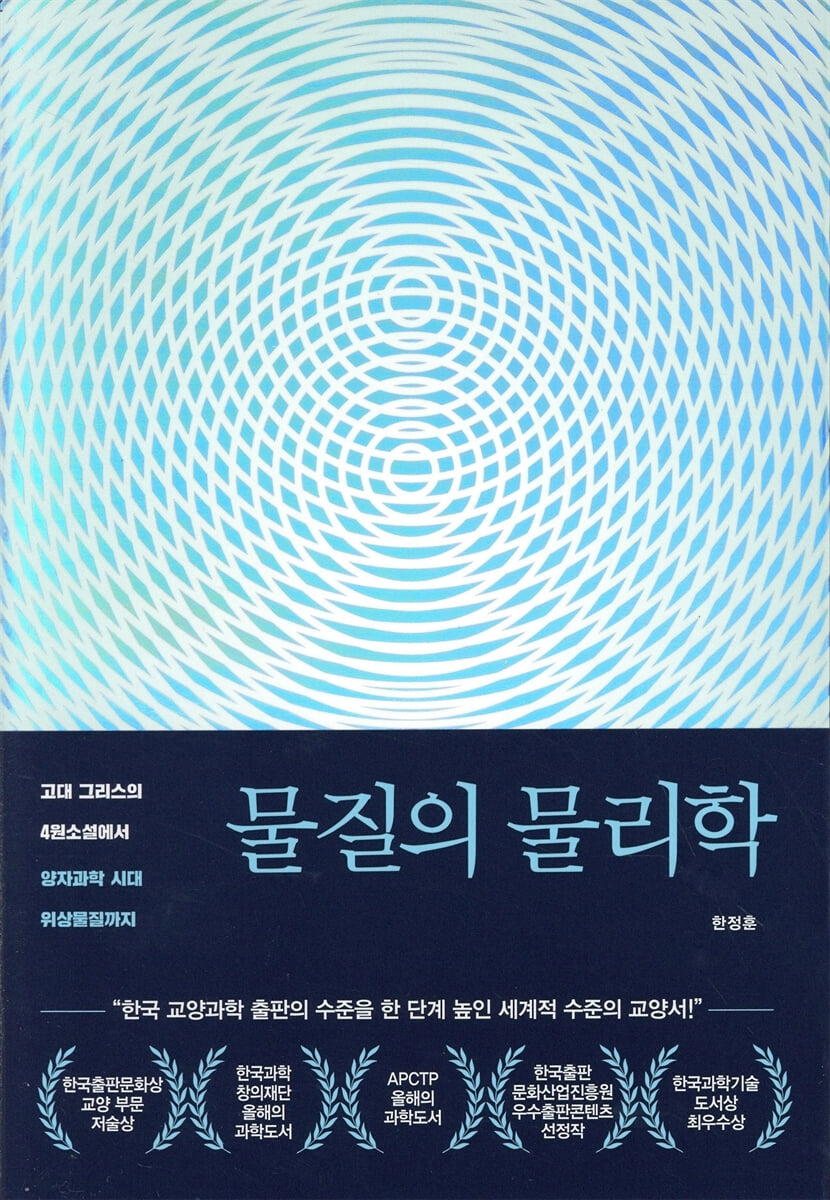
“All matter is quantum matter. Even our bodies and light!” The first general textbook introducing condensed matter physics, the largest field in modern physics. A history of quantum matter through brilliant storytelling and metaphors. ★★★61st Korea Publishing Culture Awards, General Education Category Writing Award ★★★2021 Korea Foundation for the Advancement of Science and Creativity Science Book of the Year ★★★2020 Excellent Publishing Content Selection ★★★2020 APCTP Science Book of the Year ★★★39th Korea Science and Technology Book Awards Grand Prize Winner How does mass arise? Is light matter? Why are magnets magnetic? Why do some materials conduct electricity while others don't? Are there two-dimensional and one-dimensional materials? What exactly is "matter"? "The Physics of Matter" explores fundamental questions in physics, exploring the world of bizarre materials like graphene, superconductors, quantum Hall elements, and topological matter. This book, with its brilliant storytelling and ingenious metaphors, intuitively and meticulously unravels them. The author, Dr. Han Jeong-hoon, gave several public lectures and contributed commentaries following his advisor, Professor David Thouless, who won the 2016 Nobel Prize in Physics. Feeling frustrated with the limited time and space, he conceived the idea of this book to talk to the public about 'matter' in a more extended manner. In this book, he introduces the history of 'matter' from the four elements of ancient Greece to the topological matter of the quantum science era in an interesting way, weaving together the lives of physicists, the background of the times, and his own experiences as warp and weft. In modern physics, the subject most scientists deal with is 'matter' (condensed matter physics), but in reality, most physics textbooks in Korea are occupied by 'space' (astrophysics) and 'particles' (particle physics). For readers who have been thirsty for the latest trends in modern physics, this book will be like a drop of rain in a drought. |
- You can preview some of the book's contents.
Preview
index
Recommendation
preface
1.
The first theory of matter
My nickname is Hello / Greek natural philosophers: Empedocles, Democritus / Plato's Timaeus / Parts and the Whole / Modern material theory / 30 years later
2.
twisted atoms
Helmholtz / Vortex / Vortex Atomism / The Fall, Resurrection, Fall, and… of Topological Atom Theory
3.
Pauli Hotel
Exclusive electrons / Classification of matter / Zeeman, Lorentz, and Pauli / Sociology of electrons / Bloch's proof
4.
It has to be cold to be quantum
The World of Absolute Zero / Onus' Refrigerator / Quantum, Too Quantum / Superconductors and the Higgs Boson / Two Types of Liquid Helium / Scientific Trickle-Down Effect
5.
Light is also matter
Wrong Then, Right Now / An Engineering Approach to Light: A Device That Splits Light / Light is a Wave: Maxwell's Great Discovery / Light is a Particle, Too! Lessons from Stoves and Microwaves / The Materiality of Waves, the Wave Nature of Matter / The Nobel Prize Einstein 'Missed'
6.
quantum Hall matter
The Force That Moves Electrons: Electricity and Magnetism / Maxwell's Mistake, the Discovery of Hall / The Thinnest Metal / The Accidental Discovery of Clinching / Seattle, Topological Numbers
7.
graphene
Senior / Two-dimensional materials / Carbon materials / Discovery of graphene / Relativistic electromagnetic fields / Hofstadter butterflies / Missed opportunities, new opportunities
8.
quantum magnets
Particles are magnets / Magnets are information / Phase magnets / Dimensional inversion / Peanut-sized
9.
Topological Matter Era
Memories of Chamonix / The Name of Phase / The Third Solid / The Quantum Spin Hall Effect / Even and Odd Insulators / Relativistic Metals
Footnote
Search
preface
1.
The first theory of matter
My nickname is Hello / Greek natural philosophers: Empedocles, Democritus / Plato's Timaeus / Parts and the Whole / Modern material theory / 30 years later
2.
twisted atoms
Helmholtz / Vortex / Vortex Atomism / The Fall, Resurrection, Fall, and… of Topological Atom Theory
3.
Pauli Hotel
Exclusive electrons / Classification of matter / Zeeman, Lorentz, and Pauli / Sociology of electrons / Bloch's proof
4.
It has to be cold to be quantum
The World of Absolute Zero / Onus' Refrigerator / Quantum, Too Quantum / Superconductors and the Higgs Boson / Two Types of Liquid Helium / Scientific Trickle-Down Effect
5.
Light is also matter
Wrong Then, Right Now / An Engineering Approach to Light: A Device That Splits Light / Light is a Wave: Maxwell's Great Discovery / Light is a Particle, Too! Lessons from Stoves and Microwaves / The Materiality of Waves, the Wave Nature of Matter / The Nobel Prize Einstein 'Missed'
6.
quantum Hall matter
The Force That Moves Electrons: Electricity and Magnetism / Maxwell's Mistake, the Discovery of Hall / The Thinnest Metal / The Accidental Discovery of Clinching / Seattle, Topological Numbers
7.
graphene
Senior / Two-dimensional materials / Carbon materials / Discovery of graphene / Relativistic electromagnetic fields / Hofstadter butterflies / Missed opportunities, new opportunities
8.
quantum magnets
Particles are magnets / Magnets are information / Phase magnets / Dimensional inversion / Peanut-sized
9.
Topological Matter Era
Memories of Chamonix / The Name of Phase / The Third Solid / The Quantum Spin Hall Effect / Even and Odd Insulators / Relativistic Metals
Footnote
Search
Into the book
I am a theoretical physicist.
My job is to create new physical theories and write papers.
Why write a thesis? There are many practical reasons, like promotion, recognition, and fame, but the most fundamental reason is that I have a unique story to share with others.
But the others I'm talking about here are other researchers working in the same field as me.
The target has to be narrow.
Even if I look around the world, there are only about twenty people who would read and be interested in the thesis I poured all my effort into completing over the past six months.
Considering the motivation alone, writing a book for the public is no different from writing a thesis.
When you have your own story, when you feel like sharing it with friends and colleagues in private or on social media is not enough, when you have a story that makes you feel like you're ready to die telling it, then a type of person called a "writer" is born.
I also have a story I want to leave behind before I take another step forward in life.
It's a story about material.
--- p.11
This book contains no narratives about the vast universe or the world of elementary particles that challenge the realm of God.
The starting point of the book is atoms, the root and framework of everyday life, and quantum mechanics, which explains atoms.
This book starts from the atom and grows in size.
Going out into the material world.
Rather than familiar substances commonly found in everyday life, it mainly deals with the world of unique substances that can only be found in laboratories.
The world of true quantum matter is similar to the world of martial arts masters who live in seclusion in the mountains and devote themselves solely to practicing martial arts.
I don't come out of the lab very often.
I would like to share the story of a major sect that dominates the martial arts world.
The classes of quantum materials covered in this book include superconductors, superfluids, quantum Hall materials, graphene, Dirac materials, and topological materials.
It may sound a little strange, but light is also matter.
--- p.13
The act of science can be likened to tying a brilliant hypothesis to a string and hanging it from the ceiling, and then having scientists in the kitchen below conduct various experiments and calculations to verify the hypothesis's validity.
If the hypothesis turns out to be correct, the line will be lowered, and anyone working in the kitchen will be able to touch and smell the hypothesis.
The hypothesis is now called a 'doctrine' or a 'law'.
Thanks to someone hanging that lump of hypothetical stuff from the ceiling a long time ago, I can finally get to work in the kitchen.
Democritus is the one who hung the very attractive hypothesis called 'atoms' from the ceiling, and scientists have been busy working in the kitchen for over two thousand years to bring his hypothesis down to the kitchen, to the orthodoxy, to the world of truth.
--- pp.23~24
“If we set aside the claim that there is something that cannot be divided any further, the answers of Empedocles, Democritus, and Plato are fundamentally correct.
Although the 'answers' the Greeks gave were inaccurate the more you looked into them, the 'questions' they asked were very precise scientific questions.
Modern science has filled in the gaps in the answers they offered, using rigorous mathematical language instead of vague language.
“I think the thousands of years since Plato have been spent developing the scientific tools and mathematical language needed to fill in these gaps.”
--- pp.36~37
The saddest moment for a scientist is not when his work fails, but when it is meaningless.
Although the conclusion alone suggests that the theory was a failure, historically speaking, the Timaeus contains gem-like elements that could be considered the first book to contain a theory of matter.
In particular, I would like to point out that the most attractive aspect is that the results of rigorous mathematical proofs were applied to the interpretation of natural phenomena.
Since Timaeus, there have been 25 centuries of exploration into the nature of matter.
To sum up the conclusion in one word:
'All matter is quantum matter.'
--- p.45
There is a hotel.
The name is Pauli Hotel.
This hotel has one unique, unbreakable rule.
The rule is that only one man and one woman can enter each room.
There are empty rooms, rooms for men alone, rooms for women alone, and rooms for couples, but two men and two women are never allowed in the same room.
What hotel in the world would require such a strange rule, and for what reason?
--- p.78
The Pauli Hotel is the very substance.
Matter is made up of atoms, each of which consists of a nucleus containing protons and neutrons, and electrons orbiting around it.
Ultimately, all matter contains a number of electrons proportional to the number of atoms that make up that matter.
Each electron is housed in a room with a unique room number.
In quantum mechanics, this room number is called a quantum number.
All the matter we see around us is a kind of Pauli Hotel.
--- p.81
The subject Heisenberg presented to his fledgling student was neither the problem of the atomic world nor the problem of the universe.
The two questions he addressed were, “Why is a magnet a magnet?” and “Why does electricity flow in metal?”
At a time when the wonderful tool of quantum mechanics had just been born, and every capable theoretical physicist in Europe was eager to reap its benefits, why did Heisenberg bother with such a childish problem and ask his students to solve it?
--- p.101
It is highly unlikely that Onus achieved anything that could be called scientific achievement during those 26 years.
All he did was design the equipment to create the world's best low-temperature refrigerators, refine the designs, and train skilled workers to build and maintain the equipment.
While we should certainly be wary of romanticizing or heroizing the lives and achievements of scientists too much, it's impossible not to feel a twinge of emotion at this point.
How did he manage to endure 26 years without a single paper to brag about? Imagine Onnes's tenacity, the understanding and support of those around him, and the steady support of the Netherlands and Leiden University, a nation that supported his lab's work. A mixture of surprise, envy, and respect.
--- p.114
From Maxwell's proof that light is a wave to Schrödinger's creation of quantum mechanics equations, if we look at the beginning and end of the exploration, it is clear that the changes were like the creation of a new world.
But if we examine the process step by step, we can clearly see the gradual change, just as an acorn falls to the ground, sprouts, grows, and eventually becomes an oak tree.
In Planck's paper, which introduced the core constants of quantum mechanics, the word "quantum" did not appear even once, and in Einstein's paper, which argued that light was a particle, the word "photon" did not appear.
Instead, 'quantum' is being used freely.
The first person to officially use the term 'photon' was Gilbert Lewis (1875-1946), an American physical chemist, in 1926.
The phenomenon of concepts that were considered very cautious by (academic) seniors becoming naturally accepted by the next generation and cautiously moving on to the next step based on this is a consistent pattern of science, then and now.
--- p.166
We often think of material things as objects that we can see, touch, and feel directly.
There is a prejudice that matter must be a three-dimensional object with width, length, and height.
Modern material science overcame this bias (based on everyday experience) in the latter half of the 20th century.
There are two-dimensional and one-dimensional materials.
--- p.211
The word "magnet" usually evokes images much closer to "children's toys" than ones of wonder and awe.
I used to think that way too, until I became a physicist studying quantum materials.
In fact, magnets are mysterious substances that can only be understood if you properly understand the nature of quantum mechanics.
My job is to create new physical theories and write papers.
Why write a thesis? There are many practical reasons, like promotion, recognition, and fame, but the most fundamental reason is that I have a unique story to share with others.
But the others I'm talking about here are other researchers working in the same field as me.
The target has to be narrow.
Even if I look around the world, there are only about twenty people who would read and be interested in the thesis I poured all my effort into completing over the past six months.
Considering the motivation alone, writing a book for the public is no different from writing a thesis.
When you have your own story, when you feel like sharing it with friends and colleagues in private or on social media is not enough, when you have a story that makes you feel like you're ready to die telling it, then a type of person called a "writer" is born.
I also have a story I want to leave behind before I take another step forward in life.
It's a story about material.
--- p.11
This book contains no narratives about the vast universe or the world of elementary particles that challenge the realm of God.
The starting point of the book is atoms, the root and framework of everyday life, and quantum mechanics, which explains atoms.
This book starts from the atom and grows in size.
Going out into the material world.
Rather than familiar substances commonly found in everyday life, it mainly deals with the world of unique substances that can only be found in laboratories.
The world of true quantum matter is similar to the world of martial arts masters who live in seclusion in the mountains and devote themselves solely to practicing martial arts.
I don't come out of the lab very often.
I would like to share the story of a major sect that dominates the martial arts world.
The classes of quantum materials covered in this book include superconductors, superfluids, quantum Hall materials, graphene, Dirac materials, and topological materials.
It may sound a little strange, but light is also matter.
--- p.13
The act of science can be likened to tying a brilliant hypothesis to a string and hanging it from the ceiling, and then having scientists in the kitchen below conduct various experiments and calculations to verify the hypothesis's validity.
If the hypothesis turns out to be correct, the line will be lowered, and anyone working in the kitchen will be able to touch and smell the hypothesis.
The hypothesis is now called a 'doctrine' or a 'law'.
Thanks to someone hanging that lump of hypothetical stuff from the ceiling a long time ago, I can finally get to work in the kitchen.
Democritus is the one who hung the very attractive hypothesis called 'atoms' from the ceiling, and scientists have been busy working in the kitchen for over two thousand years to bring his hypothesis down to the kitchen, to the orthodoxy, to the world of truth.
--- pp.23~24
“If we set aside the claim that there is something that cannot be divided any further, the answers of Empedocles, Democritus, and Plato are fundamentally correct.
Although the 'answers' the Greeks gave were inaccurate the more you looked into them, the 'questions' they asked were very precise scientific questions.
Modern science has filled in the gaps in the answers they offered, using rigorous mathematical language instead of vague language.
“I think the thousands of years since Plato have been spent developing the scientific tools and mathematical language needed to fill in these gaps.”
--- pp.36~37
The saddest moment for a scientist is not when his work fails, but when it is meaningless.
Although the conclusion alone suggests that the theory was a failure, historically speaking, the Timaeus contains gem-like elements that could be considered the first book to contain a theory of matter.
In particular, I would like to point out that the most attractive aspect is that the results of rigorous mathematical proofs were applied to the interpretation of natural phenomena.
Since Timaeus, there have been 25 centuries of exploration into the nature of matter.
To sum up the conclusion in one word:
'All matter is quantum matter.'
--- p.45
There is a hotel.
The name is Pauli Hotel.
This hotel has one unique, unbreakable rule.
The rule is that only one man and one woman can enter each room.
There are empty rooms, rooms for men alone, rooms for women alone, and rooms for couples, but two men and two women are never allowed in the same room.
What hotel in the world would require such a strange rule, and for what reason?
--- p.78
The Pauli Hotel is the very substance.
Matter is made up of atoms, each of which consists of a nucleus containing protons and neutrons, and electrons orbiting around it.
Ultimately, all matter contains a number of electrons proportional to the number of atoms that make up that matter.
Each electron is housed in a room with a unique room number.
In quantum mechanics, this room number is called a quantum number.
All the matter we see around us is a kind of Pauli Hotel.
--- p.81
The subject Heisenberg presented to his fledgling student was neither the problem of the atomic world nor the problem of the universe.
The two questions he addressed were, “Why is a magnet a magnet?” and “Why does electricity flow in metal?”
At a time when the wonderful tool of quantum mechanics had just been born, and every capable theoretical physicist in Europe was eager to reap its benefits, why did Heisenberg bother with such a childish problem and ask his students to solve it?
--- p.101
It is highly unlikely that Onus achieved anything that could be called scientific achievement during those 26 years.
All he did was design the equipment to create the world's best low-temperature refrigerators, refine the designs, and train skilled workers to build and maintain the equipment.
While we should certainly be wary of romanticizing or heroizing the lives and achievements of scientists too much, it's impossible not to feel a twinge of emotion at this point.
How did he manage to endure 26 years without a single paper to brag about? Imagine Onnes's tenacity, the understanding and support of those around him, and the steady support of the Netherlands and Leiden University, a nation that supported his lab's work. A mixture of surprise, envy, and respect.
--- p.114
From Maxwell's proof that light is a wave to Schrödinger's creation of quantum mechanics equations, if we look at the beginning and end of the exploration, it is clear that the changes were like the creation of a new world.
But if we examine the process step by step, we can clearly see the gradual change, just as an acorn falls to the ground, sprouts, grows, and eventually becomes an oak tree.
In Planck's paper, which introduced the core constants of quantum mechanics, the word "quantum" did not appear even once, and in Einstein's paper, which argued that light was a particle, the word "photon" did not appear.
Instead, 'quantum' is being used freely.
The first person to officially use the term 'photon' was Gilbert Lewis (1875-1946), an American physical chemist, in 1926.
The phenomenon of concepts that were considered very cautious by (academic) seniors becoming naturally accepted by the next generation and cautiously moving on to the next step based on this is a consistent pattern of science, then and now.
--- p.166
We often think of material things as objects that we can see, touch, and feel directly.
There is a prejudice that matter must be a three-dimensional object with width, length, and height.
Modern material science overcame this bias (based on everyday experience) in the latter half of the 20th century.
There are two-dimensional and one-dimensional materials.
--- p.211
The word "magnet" usually evokes images much closer to "children's toys" than ones of wonder and awe.
I used to think that way too, until I became a physicist studying quantum materials.
In fact, magnets are mysterious substances that can only be understood if you properly understand the nature of quantum mechanics.
--- p.234
Publisher's Review
“All matter is quantum matter.
Even our bodies and light!”
The first general textbook introducing condensed matter physics, the largest field in modern physics!
★★★Recommended by Professors Kim Min-hyung, Kim Philip, Yeom Han-woong, and Lee Sang-wook
A book that introduces condensed matter physics, the largest branch of modern physics, to the general public.
'Condensed matter' is, as the name suggests, a substance with strong interactions between particles, like a liquid or solid, and is the most common form of substance in the world we live in, including semiconductors, metals, magnets, and superconductors.
About a quarter of the members of the Korean Physical Society and about a third of the members of the American Physical Society are conducting research in condensed matter physics.
At this point, there should be at least one book introducing the 'physics of matter' to the general public, but it is very difficult to find such a book, not only in Korea but also in countries that are considered scientifically advanced.
The subject matter is so broad and diverse that it makes extensive use of the laws of quantum mechanics, electromagnetism, and statistical mechanics, and it is difficult to explain physics theories to the general public using only everyday language without mathematics.
This difficult task is skillfully handled by theoretical physicist Dr. Han Jeong-hoon in this book, drawing on his 30 years of research experience and his experience in public lectures and writing, which led to his advisor's Nobel Prize in Physics in 2016.
By following the intuitive yet accurate and detailed explanations, along with excellent storytelling and metaphors, you will be able to experience the major trends of modern physics.
All things in the world are made of matter.
But what is matter?
The ultimate question raised since ancient Greek times,
With the discovery of quantum mechanics just over a hundred years ago, answers began to pour in!
This book consists of nine chapters in total.
A brief introduction to the content covered in each chapter is as follows.
Chapter 1, 'The First Theory of Matter', introduces and compares the ancient Greek view of matter, represented by the theory of the four elements, with the modern quantum mechanical view of matter.
Chapter 2, "Twisted Atoms," introduces the fascinating atomic theory that was popular just before the birth of quantum mechanics, and examines how topological concepts have brought about beneficial developments despite their ups and downs in the history of physics.
Chapter 3, 'Pauli Hotel', explains how to distinguish substances from quantum mechanics by comparing them to a hotel.
From a quantum mechanical perspective, we can understand why some materials conduct electricity and others do not.
Chapter 4, “It’s Quantum Only When It’s Cold,” introduces Kamerlingh Onnes, a pioneer in low-temperature physics.
At extremely low temperatures close to absolute zero, the quantum mechanical properties of matter are clearly revealed.
Chapter 5, “Light is Matter,” describes how the common belief that light and matter are different entities was shattered.
It can be said that the foundation of quantum mechanics was laid only through the realization that light is also matter.
Chapter 6, 'Quantum Hall Matter', introduces the process of discovery and theoretical development of quantum Hall matter, a representative topological material, over a period of over 100 years.
Chapter 7, 'Graphene', discusses the story of Professor Philip Kim, a world-renowned graphene scientist who was one year the author's senior in middle school and college, from a personal perspective.
We can see that there are two-dimensional and one-dimensional substances.
Graphene is a representative two-dimensional material.
Chapter 8, “Quantum Magnets,” covers the history of quantum mechanical understanding and applications of magnets.
Magnets are not toys, they are the most quantum mechanical material and at the same time an important information storage device.
In particular, this chapter vividly describes the process by which the author's research was published in Nature, allowing readers to indirectly experience what physicists who study materials dream of and how they conduct their research.
Chapter 9, “The Era of Topological Matter,” introduces the current state-of-the-art field of quantum material physics.
The atoms that make up matter, the only tool to understand them: quantum mechanics.
A history of quantum matter, told through brilliant storytelling and ingenious metaphors.
It is truly difficult to clearly explain to a non-specialist how quantum physics, the foundation of modern physics, explains the matter that makes up this universe.
But the author does this masterfully with excellent storytelling and original metaphors.
For example, Chapter 3, 'Pauli Hotel', compares matter to a hotel and electrons in the matter to guests in the hotel.
The Pauli Hotel has a blueprint (quantum mechanics) and a method of operation (exclusion principle).
Guests (electrons) go up and down the upper and lower floors (the level of electron energy), and there is a hole in the hallway, so they have to fall through this hole to get down to the lower floor.
As it falls, it makes various sounds (lights) such as thump and crack.
As you read along with interesting analogies, you will naturally become familiar with the knowledge of quantum mechanics, spectroscopy, and electromagnetism.
This book also features numerous physicists.
Among them, the Dutch scientist Kamerlingh Onnes is an indispensable figure in the history of quantum materials.
Just as Newton's laws are best proven in the extreme environment of a vacuum, extreme environments are necessary to properly understand the principles of physics.
In this context, the quantum properties of matter are better revealed at low temperatures, and Onus' refrigerator made a decisive contribution to this problem.
The only gas that Onnes had not been able to liquefy until he took up a professorship at Leiden University in 1882 at the age of 29, was helium. Onnes delved into the subject and succeeded in obtaining liquid helium 26 years later.
An 'absolute refrigerator' that can cool any substance to near absolute zero (-273.15 degrees Celsius) has been created.
This refrigerator provided one clue after another to unlock the secrets of quantum matter throughout the first half of the 20th century.
The materials discovered in this way, metals and liquids with absolutely no resistance, namely superconductors and superliquids, have not only won the Nobel Prize in Physics, but are also widely used in machines such as MRIs already installed in large hospitals.
If we can create a memory element using 'skyrmions', a field to which the author has contributed, we can reduce the size of a memory device with current performance to the size of a peanut.
Considering the depth of theory, experimentation, and fundamental science this field encompasses, as well as the breadth of its applications, it becomes clear why "the physics of matter," or condensed matter physics, is the largest discipline in modern physics.
Even our bodies and light!”
The first general textbook introducing condensed matter physics, the largest field in modern physics!
★★★Recommended by Professors Kim Min-hyung, Kim Philip, Yeom Han-woong, and Lee Sang-wook
A book that introduces condensed matter physics, the largest branch of modern physics, to the general public.
'Condensed matter' is, as the name suggests, a substance with strong interactions between particles, like a liquid or solid, and is the most common form of substance in the world we live in, including semiconductors, metals, magnets, and superconductors.
About a quarter of the members of the Korean Physical Society and about a third of the members of the American Physical Society are conducting research in condensed matter physics.
At this point, there should be at least one book introducing the 'physics of matter' to the general public, but it is very difficult to find such a book, not only in Korea but also in countries that are considered scientifically advanced.
The subject matter is so broad and diverse that it makes extensive use of the laws of quantum mechanics, electromagnetism, and statistical mechanics, and it is difficult to explain physics theories to the general public using only everyday language without mathematics.
This difficult task is skillfully handled by theoretical physicist Dr. Han Jeong-hoon in this book, drawing on his 30 years of research experience and his experience in public lectures and writing, which led to his advisor's Nobel Prize in Physics in 2016.
By following the intuitive yet accurate and detailed explanations, along with excellent storytelling and metaphors, you will be able to experience the major trends of modern physics.
All things in the world are made of matter.
But what is matter?
The ultimate question raised since ancient Greek times,
With the discovery of quantum mechanics just over a hundred years ago, answers began to pour in!
This book consists of nine chapters in total.
A brief introduction to the content covered in each chapter is as follows.
Chapter 1, 'The First Theory of Matter', introduces and compares the ancient Greek view of matter, represented by the theory of the four elements, with the modern quantum mechanical view of matter.
Chapter 2, "Twisted Atoms," introduces the fascinating atomic theory that was popular just before the birth of quantum mechanics, and examines how topological concepts have brought about beneficial developments despite their ups and downs in the history of physics.
Chapter 3, 'Pauli Hotel', explains how to distinguish substances from quantum mechanics by comparing them to a hotel.
From a quantum mechanical perspective, we can understand why some materials conduct electricity and others do not.
Chapter 4, “It’s Quantum Only When It’s Cold,” introduces Kamerlingh Onnes, a pioneer in low-temperature physics.
At extremely low temperatures close to absolute zero, the quantum mechanical properties of matter are clearly revealed.
Chapter 5, “Light is Matter,” describes how the common belief that light and matter are different entities was shattered.
It can be said that the foundation of quantum mechanics was laid only through the realization that light is also matter.
Chapter 6, 'Quantum Hall Matter', introduces the process of discovery and theoretical development of quantum Hall matter, a representative topological material, over a period of over 100 years.
Chapter 7, 'Graphene', discusses the story of Professor Philip Kim, a world-renowned graphene scientist who was one year the author's senior in middle school and college, from a personal perspective.
We can see that there are two-dimensional and one-dimensional substances.
Graphene is a representative two-dimensional material.
Chapter 8, “Quantum Magnets,” covers the history of quantum mechanical understanding and applications of magnets.
Magnets are not toys, they are the most quantum mechanical material and at the same time an important information storage device.
In particular, this chapter vividly describes the process by which the author's research was published in Nature, allowing readers to indirectly experience what physicists who study materials dream of and how they conduct their research.
Chapter 9, “The Era of Topological Matter,” introduces the current state-of-the-art field of quantum material physics.
The atoms that make up matter, the only tool to understand them: quantum mechanics.
A history of quantum matter, told through brilliant storytelling and ingenious metaphors.
It is truly difficult to clearly explain to a non-specialist how quantum physics, the foundation of modern physics, explains the matter that makes up this universe.
But the author does this masterfully with excellent storytelling and original metaphors.
For example, Chapter 3, 'Pauli Hotel', compares matter to a hotel and electrons in the matter to guests in the hotel.
The Pauli Hotel has a blueprint (quantum mechanics) and a method of operation (exclusion principle).
Guests (electrons) go up and down the upper and lower floors (the level of electron energy), and there is a hole in the hallway, so they have to fall through this hole to get down to the lower floor.
As it falls, it makes various sounds (lights) such as thump and crack.
As you read along with interesting analogies, you will naturally become familiar with the knowledge of quantum mechanics, spectroscopy, and electromagnetism.
This book also features numerous physicists.
Among them, the Dutch scientist Kamerlingh Onnes is an indispensable figure in the history of quantum materials.
Just as Newton's laws are best proven in the extreme environment of a vacuum, extreme environments are necessary to properly understand the principles of physics.
In this context, the quantum properties of matter are better revealed at low temperatures, and Onus' refrigerator made a decisive contribution to this problem.
The only gas that Onnes had not been able to liquefy until he took up a professorship at Leiden University in 1882 at the age of 29, was helium. Onnes delved into the subject and succeeded in obtaining liquid helium 26 years later.
An 'absolute refrigerator' that can cool any substance to near absolute zero (-273.15 degrees Celsius) has been created.
This refrigerator provided one clue after another to unlock the secrets of quantum matter throughout the first half of the 20th century.
The materials discovered in this way, metals and liquids with absolutely no resistance, namely superconductors and superliquids, have not only won the Nobel Prize in Physics, but are also widely used in machines such as MRIs already installed in large hospitals.
If we can create a memory element using 'skyrmions', a field to which the author has contributed, we can reduce the size of a memory device with current performance to the size of a peanut.
Considering the depth of theory, experimentation, and fundamental science this field encompasses, as well as the breadth of its applications, it becomes clear why "the physics of matter," or condensed matter physics, is the largest discipline in modern physics.
GOODS SPECIFICS
- Date of issue: September 25, 2020
- Page count, weight, size: 300 pages | 498g | 148*215*18mm
- ISBN13: 9788934920106
- ISBN10: 8934920106
You may also like
카테고리
korean


korean

![ELLE 엘르 스페셜 에디션 A형 : 12월 [2025]](http://librairie.coreenne.fr/cdn/shop/files/b8e27a3de6c9538896439686c6b0e8fb.jpg?v=1766436872&width=3840)


