

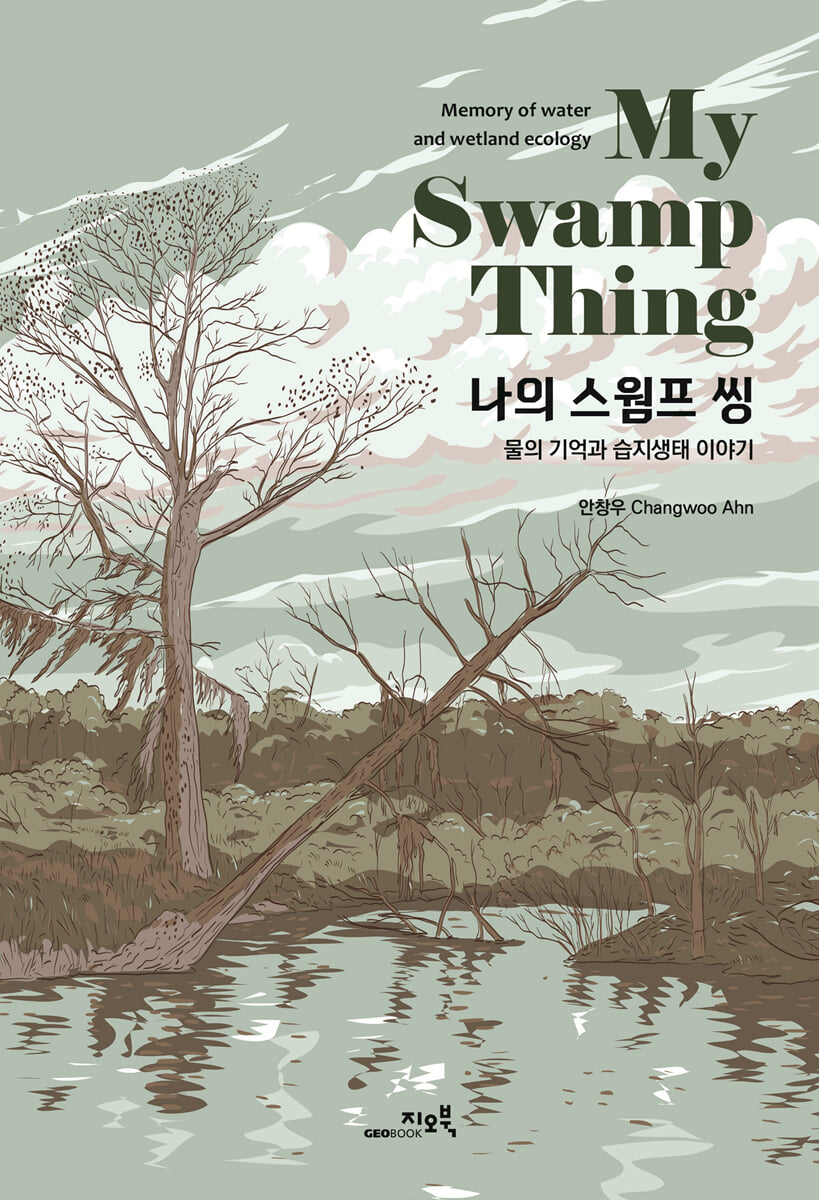
My Swamp Thing
 |
Description
Book Introduction
The wetlands were muddy, but they resembled my life.
Swamp Thing was me.
And all of us.
A memoir by an ecologist following the memory of water
This book is a memoir of an ecologist's life, dedication to wetlands, and 30 years of journey as an educator, as well as a reflection on ecological civilization.
This book contains stories about his experiences studying wetland ecology, researching ecological engineering, and focusing on wetland art at George Mason University after coming to the United States in 1996, as well as his self-identity that transcends Korea and the United States.
The dynamic rhythm of hydrology, vegetation, and soil that make up a wetland is not simply a natural phenomenon, but appears as a metaphor for human life.
In ecological stories such as 'Kidney Marsh', 'The Watercress Experiment', 'The Muskrat Invasion', and 'The Beaver Marsh', we encounter the author's scientific insight and literary sensibility at the same time.
As expressed in the text, “productive solitude” and “beautiful confinement,” the author’s thoughts and reflections as a wetland ecologist reveal the unique characteristics of wetlands, which are neither land nor water.
Swamp Thing was me.
And all of us.
A memoir by an ecologist following the memory of water
This book is a memoir of an ecologist's life, dedication to wetlands, and 30 years of journey as an educator, as well as a reflection on ecological civilization.
This book contains stories about his experiences studying wetland ecology, researching ecological engineering, and focusing on wetland art at George Mason University after coming to the United States in 1996, as well as his self-identity that transcends Korea and the United States.
The dynamic rhythm of hydrology, vegetation, and soil that make up a wetland is not simply a natural phenomenon, but appears as a metaphor for human life.
In ecological stories such as 'Kidney Marsh', 'The Watercress Experiment', 'The Muskrat Invasion', and 'The Beaver Marsh', we encounter the author's scientific insight and literary sensibility at the same time.
As expressed in the text, “productive solitude” and “beautiful confinement,” the author’s thoughts and reflections as a wetland ecologist reveal the unique characteristics of wetlands, which are neither land nor water.
- You can preview some of the book's contents.
Preview
index
Recommendation - 4
Prologue - 6
Acknowledgements - 12
Chapter 1: From Minari to Olentang River Wetland Park - 16
Chapter 2 Hi, Dr. Ahn
Ahn)! - 40
Chapter 3: A Sacred Wetland with Many Names - 64
Chapter 4: The Swamp Thing - 88
Chapter 5: Wetlands that Purify the Water of Life - 106
Chapter 6: Memories of the Wetland Bank - 124
Chapter 7: The Dance in the Rhythm 1 - 150
Chapter 8: The Dance in the Rhythm 2 - 170
Chapter 9: Memories of the Okavango - 186
Chapter 10: Outdoor Wetland Research Spaces for Experiential Learning - 198
Chapter 11: Romantic Floating Wetlands on a Remote Island - 218
Chapter 12: Somewhere Between Ecology and Art - 246
Chapter 13: The Memory of Water Preserved in Color by Wetland Soil - 266
Chapter 14: Homecoming - 292
References - 312
Search - 324
Prologue - 6
Acknowledgements - 12
Chapter 1: From Minari to Olentang River Wetland Park - 16
Chapter 2 Hi, Dr. Ahn
Ahn)! - 40
Chapter 3: A Sacred Wetland with Many Names - 64
Chapter 4: The Swamp Thing - 88
Chapter 5: Wetlands that Purify the Water of Life - 106
Chapter 6: Memories of the Wetland Bank - 124
Chapter 7: The Dance in the Rhythm 1 - 150
Chapter 8: The Dance in the Rhythm 2 - 170
Chapter 9: Memories of the Okavango - 186
Chapter 10: Outdoor Wetland Research Spaces for Experiential Learning - 198
Chapter 11: Romantic Floating Wetlands on a Remote Island - 218
Chapter 12: Somewhere Between Ecology and Art - 246
Chapter 13: The Memory of Water Preserved in Color by Wetland Soil - 266
Chapter 14: Homecoming - 292
References - 312
Search - 324
Into the book
In this age of infinitely expanded uncertainty about the future due to climate change, the biggest reason I wrote this book was my hope that more people would become interested in wetlands and the study of wetlands.
Climate change is ultimately a story about the 'water cycle'.
Wetlands are the best ecosystems for observing the changes in water, adapting to the constant cycle and rhythm of 'flood and drought', supporting diverse life forms and making everything in our lives possible.
… … The wetlands, which are constantly enticing and muddy, have often felt similar to my life living abroad for a long time.
The appearance of the wetland ecosystem, where it rains and the sun shines, and thus repeats the cycle of getting wet and drying out, is exactly like our lives.
--- p.11
"What benefits do beavers bring to the ecosystem by creating wetlands?" "That's a good question! It's a topic I've prepared to discuss in class next week. To put it simply, think about the basic ecological functions of wetlands.
Because it holds water, it prevents flooding during heavy rains, improves water quality, provides aquatic habitat for various fish and birds, and is also effective in recharging groundwater.
Beavers have been used extensively to restore wetlands, floodplains, and rivers.
So, as you know, beavers are called 'ecological engineers' or 'nature's engineers'... ... --- p.58
Besides mosquitoes, I was bitten by unknown bugs, it was hot and humid, my feet often got stuck in the mud, my boots were heavy, and sweat was running down my face, making it difficult to open my eyes.
After visiting the Dismal Swamp, I visited the nearby Back Bay National Wildlife Refuge.
Standing on the open water, the cool breeze blowing through me, the tranquil and beautiful Back Bay Marsh was a stark contrast to the Dismal Swamp.
At that moment, it suddenly felt like life was a never-ending cycle of swamps and marshes.
--- p.86
The seeds of this plant are mostly high in protein, making them an essential food source for migratory birds that must travel long distances.
However, these plants are submerged in water during their growth period due to the unpredictable flooding caused by the changed river water table, and they either die or never have a chance to germinate.
As a result, the floodplain wetland itself, which is the habitat, is disappearing.
Where there are no plants, animals cannot survive.
--- p.164
… (Love comes from places you never expect it to, in unexpected forms)” This is a line from 『Cat's Cradle』 written by the famous American author Kurt Vonnegut.
What immediately caught my eye about the idea that Americans are forever searching for this kind of love was the above part of the sentence.
… … I always tried to live with an open mind, believing that love can come from the most unexpected places and in the most unexpected forms.
But at some point, I started to feel like this life would only be complete if I became 'that kind of love' to someone.
--- p.220
The 'homing instinct' to nature was coined by the American biologist and writer Edward Wilson.
It can also be linked to the word 'biophilia' coined by O. Wilson.
This is a term he popularized to explain his theory that humans have become intricately intertwined with the natural world as they have evolved as a species.
We have become insensitive to the scent of nature as a home, and no matter how expensive the house we own, we may still be 'homeless' in some way.
Climate change is ultimately a story about the 'water cycle'.
Wetlands are the best ecosystems for observing the changes in water, adapting to the constant cycle and rhythm of 'flood and drought', supporting diverse life forms and making everything in our lives possible.
… … The wetlands, which are constantly enticing and muddy, have often felt similar to my life living abroad for a long time.
The appearance of the wetland ecosystem, where it rains and the sun shines, and thus repeats the cycle of getting wet and drying out, is exactly like our lives.
--- p.11
"What benefits do beavers bring to the ecosystem by creating wetlands?" "That's a good question! It's a topic I've prepared to discuss in class next week. To put it simply, think about the basic ecological functions of wetlands.
Because it holds water, it prevents flooding during heavy rains, improves water quality, provides aquatic habitat for various fish and birds, and is also effective in recharging groundwater.
Beavers have been used extensively to restore wetlands, floodplains, and rivers.
So, as you know, beavers are called 'ecological engineers' or 'nature's engineers'... ... --- p.58
Besides mosquitoes, I was bitten by unknown bugs, it was hot and humid, my feet often got stuck in the mud, my boots were heavy, and sweat was running down my face, making it difficult to open my eyes.
After visiting the Dismal Swamp, I visited the nearby Back Bay National Wildlife Refuge.
Standing on the open water, the cool breeze blowing through me, the tranquil and beautiful Back Bay Marsh was a stark contrast to the Dismal Swamp.
At that moment, it suddenly felt like life was a never-ending cycle of swamps and marshes.
--- p.86
The seeds of this plant are mostly high in protein, making them an essential food source for migratory birds that must travel long distances.
However, these plants are submerged in water during their growth period due to the unpredictable flooding caused by the changed river water table, and they either die or never have a chance to germinate.
As a result, the floodplain wetland itself, which is the habitat, is disappearing.
Where there are no plants, animals cannot survive.
--- p.164
… (Love comes from places you never expect it to, in unexpected forms)” This is a line from 『Cat's Cradle』 written by the famous American author Kurt Vonnegut.
What immediately caught my eye about the idea that Americans are forever searching for this kind of love was the above part of the sentence.
… … I always tried to live with an open mind, believing that love can come from the most unexpected places and in the most unexpected forms.
But at some point, I started to feel like this life would only be complete if I became 'that kind of love' to someone.
--- p.220
The 'homing instinct' to nature was coined by the American biologist and writer Edward Wilson.
It can also be linked to the word 'biophilia' coined by O. Wilson.
This is a term he popularized to explain his theory that humans have become intricately intertwined with the natural world as they have evolved as a species.
We have become insensitive to the scent of nature as a home, and no matter how expensive the house we own, we may still be 'homeless' in some way.
--- p.310
Publisher's Review
A record of a wetland ecologist exploring life at the border between water and land.
Wetlands are the most dynamic boundaries where water and land, life and thought meet.
The new book, "My Swamp Thing," chronicles the life journey of a wetland ecologist who grew up on this very border, exploring deep insights into nature and human existence through the memory of water.
The author connects the rhythm of life he encountered while studying wetlands with his own life and thoughts, movingly unraveling the process of forming an ecological self beyond natural scientific analysis.
From monster to 'ecological self': Reinterpreting 'Swamp Thing'.
The monster “Swamp Thing” in American popular culture is transformed into an ecological symbol that serves as a metaphor for human existence for the author.
Just as the film "Minari" reminded readers of the ecological relationship between minari and loaches observed during graduate school, the author leads readers into the arduous research field of an American doctoral program that began with a chance discovery.
Wetlands may seem like dark and confusing spaces, but they are places of circulation where water and soil find their place again and restore the ecosystem.
This book persuasively demonstrates, in the language of actual researchers, how these wetlands are analyzed and preserved, and how ecological engineering and hydrological and hydraulic research are conducted.
The author also emphasizes the importance of wetland ecology education.
It vividly captures the process of rediscovering oneself while teaching students and the moments of learning created through field-based education.
The value of wetlands is illuminated in multiple ways through wetland soil research, carbon storage, and collaboration with ecological art. (* Swamp Thing has become an iconic character in American popular culture, exploring environmentalism, supernatural horror, and the boundaries between humanity and nature.
Since its first appearance in DC Comics in 1971, it has been reinterpreted in various media, including comics, movies, and TV series, and has had a lasting influence.
In 1984, Alan Moore took over the series and redefined it as a "guardian of Earth's flora."
Wetlands are complex ecosystems where water, land, and nature intersect.
Wetlands are complex ecosystems where ecology, chemistry, and culture intersect at the point where water and land meet.
Although it covers only 6% of the Earth's surface, it is a huge carbon reservoir that stores more than 25% of the total soil carbon, and it is a biogeochemical hotspot where the rhythms of microbial metabolism, nutrient cycling, and organic matter decomposition are alive and well.
Wetlands are also places where society, culture, law, and policy meet.
Today, wetlands are understood not as simple transitional stages, but as independent ecosystems that adapt to unique hydrological conditions and persist over the long term.
From a restoration ecology perspective, wetlands are 'open systems', and the key to restoration is considering the pathways through which seeds and organisms are introduced through wind, water, birds, and animal movement.
'Wet-land' alone cannot capture the diverse world of wetlands.
There are currently 2,456 Ramsar wetlands worldwide, with a total area larger than that of Mexico.
There are 26 registered in Korea and 41 in the United States.
According to the classification of Professor William Michie, a world-renowned wetland scientist, wetlands are called by about 40 names and are broadly divided into seven types: salt marshes, tidal freshwater wetlands, mangrove swamps, freshwater marshes, freshwater swamps, riparian ecosystems, and peatlands.
In particular, peatlands occupy only 3% of the Earth's land surface but are a key carbon reservoir, storing 30% of soil carbon.
It is called by various regional names such as bog, fen, and moor, and is attracting attention as an important ecological buffer zone in the era of climate change.
Because wetlands are constantly changing physically and biologically, even those with the same name have completely different characteristics depending on the region, climate, and hydrology.
The most common term heard in the United States is 'swamp', which is a wetland dominated by woody plants, while 'marsh' is a wetland dominated by herbaceous plants, and they explain the difference.
Undefined wetlands, contradictions in law and policy.
In the 1980s and early 1990s, the United States incorporated the value of wetlands into the institutional framework, establishing restoration, quota systems, and wetland banking systems.
Yet, more than half of the world's natural wetlands have been lost since the 1970s, and climate change and sea level rise are accelerating this loss.
In particular, the 2023 Sackett v. EPA decision* sparked controversy by excluding wetlands not directly connected to streams and lakes from protection.
These wetlands, called 'Isolated Wetlands', are actually connected to other ecosystems through groundwater and biological movement, and play important roles such as flood control, water purification, and amphibian spawning grounds.
The author precisely points out the gap between the legal definition of wetlands and their ecological reality.
It is also said that this is the moment when ecologist Barry Commoner's words, "Everything is connected to everything else," become immediately understood. (* The Sackett v. EPA decision, handed down by the U.S. Supreme Court on May 25, 2023, is a significant precedent that limits the scope of the Clean Water Act.)
Finding the rhythm of nature and the pulse of life in wetland ecology through mesocosm research.
There is rhythm in nature.
The rhythm that makes life possible, the rhythm that supports and perpetuates life… .
The moment this rhythm disappears, the exhilarating dance of life is no more.
The pulse of the floodplain ecosystem is the basis of life and energy flow, and was the foundation upon which humanity began farming.
The author observes and analyzes these natural rhythms through mesocosm-based research and education, and, together with students, understands the dynamics of wetlands through experiments.
It vividly describes the role of ecology in deciphering nature's patterns.
Reading the memories of wetland soil and the traces left by water
The 'Dirt Project', which the author conducted, is an educational and research program that observes wetland soil and interprets the physical and chemical history of wetlands.
The color of soil is a condensed record of nature's organic matter, minerals, moisture, and climate changes, and wetland soils bear the traces of time when water seeped into them.
The 'seed bank' of soil that was once a wetland enables the miracle of restoration, where long-dormant aquatic plants come back to life when the water returns.
The author calls this 'soil memory' and reflects on the resilience of nature and the sustainability of life.
Where art and ecology meet, a new perspective on wetlands awaits.
Traveling between art museums in New York and Washington, D.C., the author experienced an expansion of ecological thinking through art.
Betty Damon's "The Garden of Life Water," which we shared together, is considered a pioneering example of the fusion of art and ecological engineering.
Vasya Erland's "Ice Book" is a work that reinterprets the river's cycle of life through visual language.
Their work evokes a deep sympathy that connects with the author's experience in river and wetland restoration research.
Through an international symposium supported by the National Science Foundation (NSF) in 2017, the author institutionally expanded the interdisciplinary connections among ecological science, ecological engineering, and ecological art.
Under the common goal of restoring the relationship between nature and humanity, art and science are emphasized as complementary companions.
Insights discovered from living on the edge, a record of inner exploration.
The journey to establishing myself in the United States as a foreign researcher was not easy.
Repeated field research in the Olentanji Wetlands, the loneliness and unfamiliar gazes of the early days of studying abroad… .
Nevertheless, the author accepted all experiences as part of learning and grew as a researcher and professor.
This book was a process of internal exploration for the author, who crossed the boundaries between language and culture, nature and humanity, due to the difficulties of 'reverse translation' experienced while translating the concept of wetland ecology into Korean.
A small observation made during my master's degree in a loach that had eaten mosquito larvae became a turning point that changed my life as a researcher.
This also led to insights into practical wetland management.
The author's research journey was, as Lao Tzu said, "A good traveler plans nothing and thinks nothing of arriving."
"My Swamp Thing" is a "record of flow" where memories, sensations, and thoughts are intertwined.
Wetlands are the most dynamic boundaries where water and land, life and thought meet.
The new book, "My Swamp Thing," chronicles the life journey of a wetland ecologist who grew up on this very border, exploring deep insights into nature and human existence through the memory of water.
The author connects the rhythm of life he encountered while studying wetlands with his own life and thoughts, movingly unraveling the process of forming an ecological self beyond natural scientific analysis.
From monster to 'ecological self': Reinterpreting 'Swamp Thing'.
The monster “Swamp Thing” in American popular culture is transformed into an ecological symbol that serves as a metaphor for human existence for the author.
Just as the film "Minari" reminded readers of the ecological relationship between minari and loaches observed during graduate school, the author leads readers into the arduous research field of an American doctoral program that began with a chance discovery.
Wetlands may seem like dark and confusing spaces, but they are places of circulation where water and soil find their place again and restore the ecosystem.
This book persuasively demonstrates, in the language of actual researchers, how these wetlands are analyzed and preserved, and how ecological engineering and hydrological and hydraulic research are conducted.
The author also emphasizes the importance of wetland ecology education.
It vividly captures the process of rediscovering oneself while teaching students and the moments of learning created through field-based education.
The value of wetlands is illuminated in multiple ways through wetland soil research, carbon storage, and collaboration with ecological art. (* Swamp Thing has become an iconic character in American popular culture, exploring environmentalism, supernatural horror, and the boundaries between humanity and nature.
Since its first appearance in DC Comics in 1971, it has been reinterpreted in various media, including comics, movies, and TV series, and has had a lasting influence.
In 1984, Alan Moore took over the series and redefined it as a "guardian of Earth's flora."
Wetlands are complex ecosystems where water, land, and nature intersect.
Wetlands are complex ecosystems where ecology, chemistry, and culture intersect at the point where water and land meet.
Although it covers only 6% of the Earth's surface, it is a huge carbon reservoir that stores more than 25% of the total soil carbon, and it is a biogeochemical hotspot where the rhythms of microbial metabolism, nutrient cycling, and organic matter decomposition are alive and well.
Wetlands are also places where society, culture, law, and policy meet.
Today, wetlands are understood not as simple transitional stages, but as independent ecosystems that adapt to unique hydrological conditions and persist over the long term.
From a restoration ecology perspective, wetlands are 'open systems', and the key to restoration is considering the pathways through which seeds and organisms are introduced through wind, water, birds, and animal movement.
'Wet-land' alone cannot capture the diverse world of wetlands.
There are currently 2,456 Ramsar wetlands worldwide, with a total area larger than that of Mexico.
There are 26 registered in Korea and 41 in the United States.
According to the classification of Professor William Michie, a world-renowned wetland scientist, wetlands are called by about 40 names and are broadly divided into seven types: salt marshes, tidal freshwater wetlands, mangrove swamps, freshwater marshes, freshwater swamps, riparian ecosystems, and peatlands.
In particular, peatlands occupy only 3% of the Earth's land surface but are a key carbon reservoir, storing 30% of soil carbon.
It is called by various regional names such as bog, fen, and moor, and is attracting attention as an important ecological buffer zone in the era of climate change.
Because wetlands are constantly changing physically and biologically, even those with the same name have completely different characteristics depending on the region, climate, and hydrology.
The most common term heard in the United States is 'swamp', which is a wetland dominated by woody plants, while 'marsh' is a wetland dominated by herbaceous plants, and they explain the difference.
Undefined wetlands, contradictions in law and policy.
In the 1980s and early 1990s, the United States incorporated the value of wetlands into the institutional framework, establishing restoration, quota systems, and wetland banking systems.
Yet, more than half of the world's natural wetlands have been lost since the 1970s, and climate change and sea level rise are accelerating this loss.
In particular, the 2023 Sackett v. EPA decision* sparked controversy by excluding wetlands not directly connected to streams and lakes from protection.
These wetlands, called 'Isolated Wetlands', are actually connected to other ecosystems through groundwater and biological movement, and play important roles such as flood control, water purification, and amphibian spawning grounds.
The author precisely points out the gap between the legal definition of wetlands and their ecological reality.
It is also said that this is the moment when ecologist Barry Commoner's words, "Everything is connected to everything else," become immediately understood. (* The Sackett v. EPA decision, handed down by the U.S. Supreme Court on May 25, 2023, is a significant precedent that limits the scope of the Clean Water Act.)
Finding the rhythm of nature and the pulse of life in wetland ecology through mesocosm research.
There is rhythm in nature.
The rhythm that makes life possible, the rhythm that supports and perpetuates life… .
The moment this rhythm disappears, the exhilarating dance of life is no more.
The pulse of the floodplain ecosystem is the basis of life and energy flow, and was the foundation upon which humanity began farming.
The author observes and analyzes these natural rhythms through mesocosm-based research and education, and, together with students, understands the dynamics of wetlands through experiments.
It vividly describes the role of ecology in deciphering nature's patterns.
Reading the memories of wetland soil and the traces left by water
The 'Dirt Project', which the author conducted, is an educational and research program that observes wetland soil and interprets the physical and chemical history of wetlands.
The color of soil is a condensed record of nature's organic matter, minerals, moisture, and climate changes, and wetland soils bear the traces of time when water seeped into them.
The 'seed bank' of soil that was once a wetland enables the miracle of restoration, where long-dormant aquatic plants come back to life when the water returns.
The author calls this 'soil memory' and reflects on the resilience of nature and the sustainability of life.
Where art and ecology meet, a new perspective on wetlands awaits.
Traveling between art museums in New York and Washington, D.C., the author experienced an expansion of ecological thinking through art.
Betty Damon's "The Garden of Life Water," which we shared together, is considered a pioneering example of the fusion of art and ecological engineering.
Vasya Erland's "Ice Book" is a work that reinterprets the river's cycle of life through visual language.
Their work evokes a deep sympathy that connects with the author's experience in river and wetland restoration research.
Through an international symposium supported by the National Science Foundation (NSF) in 2017, the author institutionally expanded the interdisciplinary connections among ecological science, ecological engineering, and ecological art.
Under the common goal of restoring the relationship between nature and humanity, art and science are emphasized as complementary companions.
Insights discovered from living on the edge, a record of inner exploration.
The journey to establishing myself in the United States as a foreign researcher was not easy.
Repeated field research in the Olentanji Wetlands, the loneliness and unfamiliar gazes of the early days of studying abroad… .
Nevertheless, the author accepted all experiences as part of learning and grew as a researcher and professor.
This book was a process of internal exploration for the author, who crossed the boundaries between language and culture, nature and humanity, due to the difficulties of 'reverse translation' experienced while translating the concept of wetland ecology into Korean.
A small observation made during my master's degree in a loach that had eaten mosquito larvae became a turning point that changed my life as a researcher.
This also led to insights into practical wetland management.
The author's research journey was, as Lao Tzu said, "A good traveler plans nothing and thinks nothing of arriving."
"My Swamp Thing" is a "record of flow" where memories, sensations, and thoughts are intertwined.
GOODS SPECIFICS
- Date of issue: November 25, 2025
- Page count, weight, size: 328 pages | 561g | 153*224*24mm
- ISBN13: 9788994242965
- ISBN10: 8994242961
You may also like
카테고리
korean


korean

![ELLE 엘르 스페셜 에디션 A형 : 12월 [2025]](http://librairie.coreenne.fr/cdn/shop/files/b8e27a3de6c9538896439686c6b0e8fb.jpg?v=1766436872&width=3840)


