

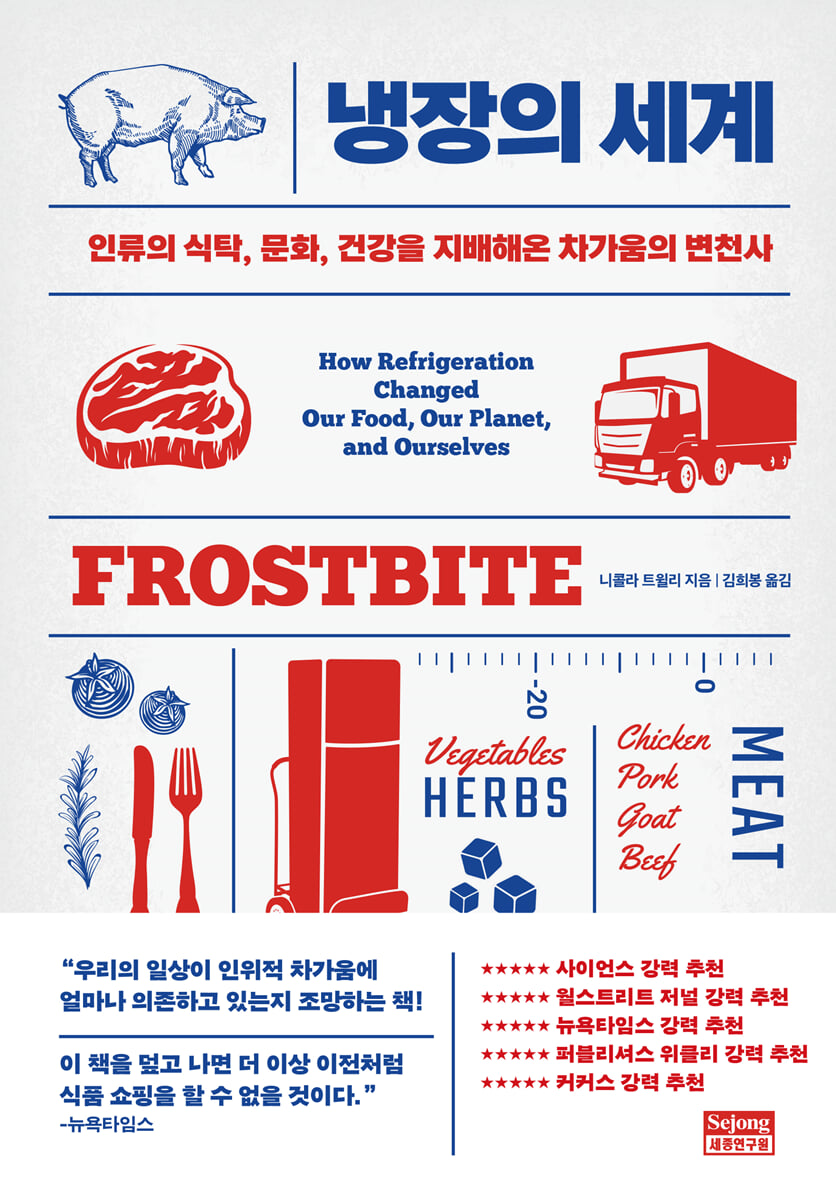
The World of Refrigeration
 |
Description
Book Introduction
Overcoming the limitations of weather, temperature, and region
Everything You Need to Know About Refrigeration Technology, the Technology That Changed Human Food Culture and History
It is common sense that food spoils when the weather is hot, and freezes or hardens when it is cold.
But our dining table is getting further and further from common sense.
We know the concepts of seasons, weather, seasonality, and origin in our heads, but all the foods that humans eat and enjoy every day transcend these natural laws.
Since when have we been able to enjoy cool, cold, and frozen food all year round, regardless of weather, production location, or season?
"The World of Refrigeration" is a report and travelogue that explores the evolution of all the fresh foods on our tables and in our local supermarkets.
Nicola Twilley, the author of this book, first became interested in the cold chain business about 15 years ago when the direct transaction movement between farmers and consumers gained attention. Since then, she has traveled the world for 10 years to explore the connection between producers and consumers.
What really happens between farm and table?
Therefore, this book cannot be simply defined as a record summarizing the development of refrigeration technology.
Readers will discover how, over the past century, technologies for growing, transporting, preserving, and packaging have radically transformed our way of life, making it easier for both the poor and those living in the heart of big cities to access a wide variety of fresh, interesting, nutritious, and affordable foods.
Another unique aspect of this book is that it offers a glimpse into how many experts have worked hard in their respective fields.
Everything You Need to Know About Refrigeration Technology, the Technology That Changed Human Food Culture and History
It is common sense that food spoils when the weather is hot, and freezes or hardens when it is cold.
But our dining table is getting further and further from common sense.
We know the concepts of seasons, weather, seasonality, and origin in our heads, but all the foods that humans eat and enjoy every day transcend these natural laws.
Since when have we been able to enjoy cool, cold, and frozen food all year round, regardless of weather, production location, or season?
"The World of Refrigeration" is a report and travelogue that explores the evolution of all the fresh foods on our tables and in our local supermarkets.
Nicola Twilley, the author of this book, first became interested in the cold chain business about 15 years ago when the direct transaction movement between farmers and consumers gained attention. Since then, she has traveled the world for 10 years to explore the connection between producers and consumers.
What really happens between farm and table?
Therefore, this book cannot be simply defined as a record summarizing the development of refrigeration technology.
Readers will discover how, over the past century, technologies for growing, transporting, preserving, and packaging have radically transformed our way of life, making it easier for both the poor and those living in the heart of big cities to access a wide variety of fresh, interesting, nutritious, and affordable foods.
Another unique aspect of this book is that it offers a glimpse into how many experts have worked hard in their respective fields.
- You can preview some of the book's contents.
Preview
index
Praise for this bookㆍ6
Chapter 1.
Welcome to the artificial ice sphere
Chapter 2.
People who conquer coldness
Stop Corruptionㆍ45
Ice Harvestingㆍ62
The Machine That Makes Coolㆍ82
Chapter 3.
Meat, from transportation to maturation
Where's the Beef?ㆍ95
Living Better with Chemistryㆍ118
When Muscle Becomes Meatㆍ136
Chapter 4.
Fruits, How to Spend the Time After Harvesting
Breathing Fruitㆍ155
Signals Exchanged Between Fruitsㆍ182
Gift Tradingㆍ201
Chapter 5.
Third polar region
Diesel Cooler Thermokingㆍ223
Youth Spent in a Freezer Containerㆍ243
Building a New Arcticㆍ260
Chapter 6.
tip of the iceberg
The emergence of the home refrigeratorㆍ293
The Refrigerator's New Concept of Freshnessㆍ311
A new world of flavor brought to you by coldnessㆍ328
The Light and Darkness of Refrigerator Dietsㆍ349
Chapter 7.
The End of Coldness
The Future of Refrigerationㆍ371
A Future That Might Not Be Refrigeratedㆍ399
Epilogue: The Man-Made Arctic Is Melting the Real Arcticㆍ414
Acknowledgmentsㆍ423
Referencesㆍ432
Chapter 1.
Welcome to the artificial ice sphere
Chapter 2.
People who conquer coldness
Stop Corruptionㆍ45
Ice Harvestingㆍ62
The Machine That Makes Coolㆍ82
Chapter 3.
Meat, from transportation to maturation
Where's the Beef?ㆍ95
Living Better with Chemistryㆍ118
When Muscle Becomes Meatㆍ136
Chapter 4.
Fruits, How to Spend the Time After Harvesting
Breathing Fruitㆍ155
Signals Exchanged Between Fruitsㆍ182
Gift Tradingㆍ201
Chapter 5.
Third polar region
Diesel Cooler Thermokingㆍ223
Youth Spent in a Freezer Containerㆍ243
Building a New Arcticㆍ260
Chapter 6.
tip of the iceberg
The emergence of the home refrigeratorㆍ293
The Refrigerator's New Concept of Freshnessㆍ311
A new world of flavor brought to you by coldnessㆍ328
The Light and Darkness of Refrigerator Dietsㆍ349
Chapter 7.
The End of Coldness
The Future of Refrigerationㆍ371
A Future That Might Not Be Refrigeratedㆍ399
Epilogue: The Man-Made Arctic Is Melting the Real Arcticㆍ414
Acknowledgmentsㆍ423
Referencesㆍ432
Detailed image

Into the book
Freezers are an unknown intermediate step in the food journey from farm to table, a black box with mysterious inner workings that allow us to overcome the time and space constraints of perishable food.
Even chefs who proudly tell stories about the meat they cook, or gourmets who insist on meeting the farmer who raised the meat they eat, don't bother to look into the meat's storage history.
They would never imagine that electric shocking beef would prevent it from becoming tough even when refrigerated.
--- p.17
In the refrigerator, foods containing allergens (soy, wheat, nuts, dairy) should not come into contact with each other, but in the freezer, they are fine.
Organic products should not be placed below conventional products, and raw foods should not be stacked on top of cooked foods.
“You have to think about the smell too,” Espinoza said.
“Onions and seafood can be quite spicy.” Pizza sauce and pepperoni can also be quite irritatingly spicy.
After moving Schwan's Big Daddy Pepperoni and Frecceta Supreme Sausage frozen pizzas for a few hours, the fur hat and fur coat collar I was wearing still had a foul odor for days.
Like natural fibers, bread and cheese tend to absorb odors, and ice cream shouldn't be stored in the same space as pizza for the same reason.
--- p.28~29
The oldest known method of preservation is drying food in the sun and wind.
Archaeologists have found evidence in the Middle East dating back to 12,000 B.C.E. of people preserving meat by evaporating moisture so it could be used by microorganisms.
At the time, such a dramatic change would have been considered a miracle.
Undried meat becomes inedible after just two days, but if dried naturally in the sun for a week, it will remain edible for up to two years.
Pickling in salt or sugar (which chemically achieves the purpose of removing moisture available to microorganisms) was also developed shortly thereafter.
Around 3,000 BC, the Sumerians salted fish and preserved them in jars, and in ancient Greece, fruit was regularly preserved in honey.
In areas where salt was unavailable or in pre-industrial times when sugar was expensive, foods were made strongly acidic or alkaline with vinegar or lye, boiled to kill microorganisms, or smothered with a layer of fat that impermeable to oxygen.
--- p.56
Steak prices in New York immediately fell.
In the West, land and corn were cheaper than in the densely populated East, so more cattle moved into the cities.
Since the cattle no longer walked on their own but were transported using fossil fuels, they did not lose weight along the way and could be sold for a higher price.
But there were still serious drawbacks.
As the terrified Pip in Charles Dickens's "Great Expectations" puts it, the increasingly crowded city centers led to the killing of more animals, leaving the nearby streets covered in "filth and fat, blood and foam."
The sound was terrible and the smell would have been even worse.
Even butchers complained that sometimes they couldn't eat lunch during the summer.
City dwellers wanted cheap, fresh meat, but not the sensory horror of mass slaughter in the cities.
--- p.104
In the short history of refrigeration, its primary role was thought to be to prevent meat spoilage by slowing the growth of bad bacteria.
But throughout the much longer history of meat-eating, it was recognized that cold air was necessary to age the dry, tough muscle fibers of red meat, transforming them into juicy, savory steaks.
That's why farmers have been slaughtering in late autumn for thousands of years.
In medieval Europe, the Martinmas festival, held on November 11th, was associated with the slaughter of pigs and cattle.
--- p.138
The motto of ASHRAE, the American Society of Heating, Refrigerating, and Air Conditioning Engineers, is “Shaping tomorrow’s built environment today.”
If today's technology were to refrigerate the food supply for a world population of 9 billion people, the planet's environment would be reshaped in the most disastrous way possible tomorrow.
Simply put, if we don't change the way we refrigerate food, droughts and crop failures caused by climate change will leave us with no food to store.
“I think it would be a disaster,” said Gu Zhong, executive director of Dunan Artificial Environment Equipment Company, a China-based competitor to Emerson.
“The only solution is to find a new solution.
But I still don't know what the solution is." --- p.392~393
In short, our very food system has been frostbitten by the cold.
One reason is that refrigeration was introduced in most cases to optimize the market, not for the health of humans and the environment.
In the early 20th century, many Americans were aware of the commercial motives behind the adoption of refrigeration, which made them skeptical of the new technology.
Coldness has been a key element in building a food system that prioritizes convenience, abundance, and profit over public health and environmental protection.
Understanding the role of refrigeration in this system is important not because it holds us accountable, but because it has the potential to help us reimagine and redesign the system.
In other words, refrigeration is essential to our food system, but a refrigerated food system doesn't have to look like this.
We must not confuse ends with means.
--- p.411
With the power to control space, time, and seasons, and the power to create an all-consuming artificial winter, we have become almost godlike.
As the new Arctic we've created for food melts the real Arctic at a rate no one could have imagined, we must act with wisdom to avoid this ominous fate.
Even chefs who proudly tell stories about the meat they cook, or gourmets who insist on meeting the farmer who raised the meat they eat, don't bother to look into the meat's storage history.
They would never imagine that electric shocking beef would prevent it from becoming tough even when refrigerated.
--- p.17
In the refrigerator, foods containing allergens (soy, wheat, nuts, dairy) should not come into contact with each other, but in the freezer, they are fine.
Organic products should not be placed below conventional products, and raw foods should not be stacked on top of cooked foods.
“You have to think about the smell too,” Espinoza said.
“Onions and seafood can be quite spicy.” Pizza sauce and pepperoni can also be quite irritatingly spicy.
After moving Schwan's Big Daddy Pepperoni and Frecceta Supreme Sausage frozen pizzas for a few hours, the fur hat and fur coat collar I was wearing still had a foul odor for days.
Like natural fibers, bread and cheese tend to absorb odors, and ice cream shouldn't be stored in the same space as pizza for the same reason.
--- p.28~29
The oldest known method of preservation is drying food in the sun and wind.
Archaeologists have found evidence in the Middle East dating back to 12,000 B.C.E. of people preserving meat by evaporating moisture so it could be used by microorganisms.
At the time, such a dramatic change would have been considered a miracle.
Undried meat becomes inedible after just two days, but if dried naturally in the sun for a week, it will remain edible for up to two years.
Pickling in salt or sugar (which chemically achieves the purpose of removing moisture available to microorganisms) was also developed shortly thereafter.
Around 3,000 BC, the Sumerians salted fish and preserved them in jars, and in ancient Greece, fruit was regularly preserved in honey.
In areas where salt was unavailable or in pre-industrial times when sugar was expensive, foods were made strongly acidic or alkaline with vinegar or lye, boiled to kill microorganisms, or smothered with a layer of fat that impermeable to oxygen.
--- p.56
Steak prices in New York immediately fell.
In the West, land and corn were cheaper than in the densely populated East, so more cattle moved into the cities.
Since the cattle no longer walked on their own but were transported using fossil fuels, they did not lose weight along the way and could be sold for a higher price.
But there were still serious drawbacks.
As the terrified Pip in Charles Dickens's "Great Expectations" puts it, the increasingly crowded city centers led to the killing of more animals, leaving the nearby streets covered in "filth and fat, blood and foam."
The sound was terrible and the smell would have been even worse.
Even butchers complained that sometimes they couldn't eat lunch during the summer.
City dwellers wanted cheap, fresh meat, but not the sensory horror of mass slaughter in the cities.
--- p.104
In the short history of refrigeration, its primary role was thought to be to prevent meat spoilage by slowing the growth of bad bacteria.
But throughout the much longer history of meat-eating, it was recognized that cold air was necessary to age the dry, tough muscle fibers of red meat, transforming them into juicy, savory steaks.
That's why farmers have been slaughtering in late autumn for thousands of years.
In medieval Europe, the Martinmas festival, held on November 11th, was associated with the slaughter of pigs and cattle.
--- p.138
The motto of ASHRAE, the American Society of Heating, Refrigerating, and Air Conditioning Engineers, is “Shaping tomorrow’s built environment today.”
If today's technology were to refrigerate the food supply for a world population of 9 billion people, the planet's environment would be reshaped in the most disastrous way possible tomorrow.
Simply put, if we don't change the way we refrigerate food, droughts and crop failures caused by climate change will leave us with no food to store.
“I think it would be a disaster,” said Gu Zhong, executive director of Dunan Artificial Environment Equipment Company, a China-based competitor to Emerson.
“The only solution is to find a new solution.
But I still don't know what the solution is." --- p.392~393
In short, our very food system has been frostbitten by the cold.
One reason is that refrigeration was introduced in most cases to optimize the market, not for the health of humans and the environment.
In the early 20th century, many Americans were aware of the commercial motives behind the adoption of refrigeration, which made them skeptical of the new technology.
Coldness has been a key element in building a food system that prioritizes convenience, abundance, and profit over public health and environmental protection.
Understanding the role of refrigeration in this system is important not because it holds us accountable, but because it has the potential to help us reimagine and redesign the system.
In other words, refrigeration is essential to our food system, but a refrigerated food system doesn't have to look like this.
We must not confuse ends with means.
--- p.411
With the power to control space, time, and seasons, and the power to create an all-consuming artificial winter, we have become almost godlike.
As the new Arctic we've created for food melts the real Arctic at a rate no one could have imagined, we must act with wisdom to avoid this ominous fate.
--- p.422
Publisher's Review
From iced coffee you can enjoy all year round,
Fresh food that can be eaten even out of season
How did we get access to cold, refreshing food at any time?
How often do we open the refrigerator or look into the freezer, anticipating the fresh, cool food we'll be eating right away? While it's a routine now, just a century ago, the prospect of eating refrigerated food evoked both fear and excitement.
The introduction of artificial refrigeration overturned thousands of years of dietary history and opened a new chapter in human nutrition.
Now we can overcome not only corruption, but also seasons and regions.
Tomatoes in January? Avocados in Shanghai? Anything is possible.
In "The World of Refrigeration," Nicola Twilley, a contributor to The New Yorker and co-host of the award-winning podcast "Gastropod," takes us on a journey through the cold chain from farm to fridge, visiting unusual and lesser-known locations like an underground cheese cave in Missouri, a banana ripening room in New York, and the massive refrigerated tanks that store America's orange juice.
Nearly three-quarters of all food on the average American's plate today is processed, transported, stored, and sold in a refrigerated state.
You can't understand the food system without understanding the invisible thermal control networks that underpin it.
Twilley's remarkable book reveals for the first time the transformative impact refrigeration has had on our health, disease, farms, dinner tables, kitchens, cities, the global economy and politics, and even the environment.
Developed countries have enjoyed the benefits of refrigeration technology for more than a century, but the costs are catching up with ours.
We have weakened our relationship with food and redefined what it means to be 'fresh'.
More importantly, refrigeration is one of the major causes of climate change.
As developing countries race to build American-style cold chains, Twilley poses the following question:
Can we reduce our reliance on refrigeration? Or should we? This ingenious and entertaining book delves into the history of the refrigerator, one of the most important inventions in food and beverage history, and presents a case for recalibrating our relationship with it, demonstrating that our future hinges on this recalibration.
Beyond meat and fruit, to sherbet and dairy products.
A refreshing and thrilling adventure through the intertwined world of human desire, "Cold Chain."
The word 'cold chain', which refers to a low-temperature distribution system, was actually a term not commonly used in everyday life.
This word has become widely known and familiar to the public as a national issue, and it was not long ago that the world was thrown into chaos by the desperate crisis of 'COVID-19' and 'securing a COVID-19 vaccine'.
This is because cold chain technology, cost, and feasibility, which enable the distribution of large quantities in their entirety, have emerged as major concerns and challenges.
The history of refrigeration, told in this book, encompasses a wide range of fields, including scientific discoveries and applied technologies, various power sources including the steam engine, ice harvesting, industrial design and mass production, popular culture, public health and hygiene, technophobia, gender roles, climate change and environmental issues, and modern eating habits.
《History of Refrigeration》 is composed of seven chapters.
Chapter 1 begins with an anecdote about how the author became interested in refrigeration and freezing technology, which he calls "artificial ice sphere," and his experience with the massive cold chain system at the Americold warehouse in Ontario, California.
Chapter 2, “Conquering the Cold,” covers the early history of the cold chain.
In a time when proper facilities were lacking, we can glimpse the fierce efforts and countless failures of people who, through trial and error, struggled to keep food colder, but were unknown to us.
Chapters 3 and 4 describe how refrigeration technology has developed, focusing on meat and fruit.
Meat, fruit, dairy products, etc. can spoil other foods placed right next to them even if the temperature is slightly different depending on the type and characteristics of each.
Additionally, because taste and aroma can vary depending on the ripening stage and period, fresh food preservation techniques are extremely difficult and complex.
We'll explore the efforts of countless engineers, professors, technicians, transporters, warehouse workers, and manufacturers to achieve this near-impossible challenge.
Chapters 5 and 6 then cover the emergence of a global cold chain system that connects the world, the companies that have thrived by leveraging it, and the various changes in recipes and cooking methods brought about by the advent of refrigerators.
The history of cold chain technology can be seen as a journey of selecting the right materials for the interior and exterior of refrigerated facilities, and finding the shapes, textures, tastes, smells, and sounds that meet the needs of diverse consumers.
The final seven chapters summarize the impact of advances in refrigeration technology on human society.
It is particularly noteworthy because it discusses the status of refrigeration technology, which was once a rare commodity but is now taken for granted, while also addressing the severity of the crises and climate issues facing humanity.
While the author admires the emergence and development of the cold chain, he neither welcomes nor opposes the emergence of this technology, arguing that it has diminished the meaning of "season," "place of origin," and "freshness."
From balanced perspectives and rigorous reporting and interviews to meticulous fact-checking, this book traces the evolution of refrigeration technology. As you do, you'll discover that our daily lives, where we can indulge in refreshing iced coffee, naengmyeon, and shaved ice even on the hottest days, will no longer feel ordinary.
A fascinating story about the technology of refrigeration! It traces the various changes refrigeration has brought to our eating habits, family relationships, and even our lives.
_〈Wall Street Journal〉
After reading this book, when you see 'fresh' orange juice and vacuum-packed chicken in the grocery section of the supermarket, you will be shocked by the ripple effect of refrigeration technology.
_〈Financial Times〉
This book is one of the most informative and entertaining books published since the advent of food science journalism.
One cannot help but admire the author's passion for informing the people who create and maintain this intricate modern marvel called refrigeration.
_〈Science〉
The mere fact that we can keep food and drinks cold, and even ourselves cool, shows how much it has changed the way we live.
It's the best book to read in summer.
_〈Science Friday〉
Fresh food that can be eaten even out of season
How did we get access to cold, refreshing food at any time?
How often do we open the refrigerator or look into the freezer, anticipating the fresh, cool food we'll be eating right away? While it's a routine now, just a century ago, the prospect of eating refrigerated food evoked both fear and excitement.
The introduction of artificial refrigeration overturned thousands of years of dietary history and opened a new chapter in human nutrition.
Now we can overcome not only corruption, but also seasons and regions.
Tomatoes in January? Avocados in Shanghai? Anything is possible.
In "The World of Refrigeration," Nicola Twilley, a contributor to The New Yorker and co-host of the award-winning podcast "Gastropod," takes us on a journey through the cold chain from farm to fridge, visiting unusual and lesser-known locations like an underground cheese cave in Missouri, a banana ripening room in New York, and the massive refrigerated tanks that store America's orange juice.
Nearly three-quarters of all food on the average American's plate today is processed, transported, stored, and sold in a refrigerated state.
You can't understand the food system without understanding the invisible thermal control networks that underpin it.
Twilley's remarkable book reveals for the first time the transformative impact refrigeration has had on our health, disease, farms, dinner tables, kitchens, cities, the global economy and politics, and even the environment.
Developed countries have enjoyed the benefits of refrigeration technology for more than a century, but the costs are catching up with ours.
We have weakened our relationship with food and redefined what it means to be 'fresh'.
More importantly, refrigeration is one of the major causes of climate change.
As developing countries race to build American-style cold chains, Twilley poses the following question:
Can we reduce our reliance on refrigeration? Or should we? This ingenious and entertaining book delves into the history of the refrigerator, one of the most important inventions in food and beverage history, and presents a case for recalibrating our relationship with it, demonstrating that our future hinges on this recalibration.
Beyond meat and fruit, to sherbet and dairy products.
A refreshing and thrilling adventure through the intertwined world of human desire, "Cold Chain."
The word 'cold chain', which refers to a low-temperature distribution system, was actually a term not commonly used in everyday life.
This word has become widely known and familiar to the public as a national issue, and it was not long ago that the world was thrown into chaos by the desperate crisis of 'COVID-19' and 'securing a COVID-19 vaccine'.
This is because cold chain technology, cost, and feasibility, which enable the distribution of large quantities in their entirety, have emerged as major concerns and challenges.
The history of refrigeration, told in this book, encompasses a wide range of fields, including scientific discoveries and applied technologies, various power sources including the steam engine, ice harvesting, industrial design and mass production, popular culture, public health and hygiene, technophobia, gender roles, climate change and environmental issues, and modern eating habits.
《History of Refrigeration》 is composed of seven chapters.
Chapter 1 begins with an anecdote about how the author became interested in refrigeration and freezing technology, which he calls "artificial ice sphere," and his experience with the massive cold chain system at the Americold warehouse in Ontario, California.
Chapter 2, “Conquering the Cold,” covers the early history of the cold chain.
In a time when proper facilities were lacking, we can glimpse the fierce efforts and countless failures of people who, through trial and error, struggled to keep food colder, but were unknown to us.
Chapters 3 and 4 describe how refrigeration technology has developed, focusing on meat and fruit.
Meat, fruit, dairy products, etc. can spoil other foods placed right next to them even if the temperature is slightly different depending on the type and characteristics of each.
Additionally, because taste and aroma can vary depending on the ripening stage and period, fresh food preservation techniques are extremely difficult and complex.
We'll explore the efforts of countless engineers, professors, technicians, transporters, warehouse workers, and manufacturers to achieve this near-impossible challenge.
Chapters 5 and 6 then cover the emergence of a global cold chain system that connects the world, the companies that have thrived by leveraging it, and the various changes in recipes and cooking methods brought about by the advent of refrigerators.
The history of cold chain technology can be seen as a journey of selecting the right materials for the interior and exterior of refrigerated facilities, and finding the shapes, textures, tastes, smells, and sounds that meet the needs of diverse consumers.
The final seven chapters summarize the impact of advances in refrigeration technology on human society.
It is particularly noteworthy because it discusses the status of refrigeration technology, which was once a rare commodity but is now taken for granted, while also addressing the severity of the crises and climate issues facing humanity.
While the author admires the emergence and development of the cold chain, he neither welcomes nor opposes the emergence of this technology, arguing that it has diminished the meaning of "season," "place of origin," and "freshness."
From balanced perspectives and rigorous reporting and interviews to meticulous fact-checking, this book traces the evolution of refrigeration technology. As you do, you'll discover that our daily lives, where we can indulge in refreshing iced coffee, naengmyeon, and shaved ice even on the hottest days, will no longer feel ordinary.
A fascinating story about the technology of refrigeration! It traces the various changes refrigeration has brought to our eating habits, family relationships, and even our lives.
_〈Wall Street Journal〉
After reading this book, when you see 'fresh' orange juice and vacuum-packed chicken in the grocery section of the supermarket, you will be shocked by the ripple effect of refrigeration technology.
_〈Financial Times〉
This book is one of the most informative and entertaining books published since the advent of food science journalism.
One cannot help but admire the author's passion for informing the people who create and maintain this intricate modern marvel called refrigeration.
_〈Science〉
The mere fact that we can keep food and drinks cold, and even ourselves cool, shows how much it has changed the way we live.
It's the best book to read in summer.
_〈Science Friday〉
GOODS SPECIFICS
- Date of issue: June 30, 2025
- Page count, weight, size: 484 pages | 700g | 150*215*30mm
- ISBN13: 9791163730217
- ISBN10: 1163730211
You may also like
카테고리
korean


korean

![ELLE 엘르 스페셜 에디션 A형 : 12월 [2025]](http://librairie.coreenne.fr/cdn/shop/files/b8e27a3de6c9538896439686c6b0e8fb.jpg?v=1766436872&width=3840)


