

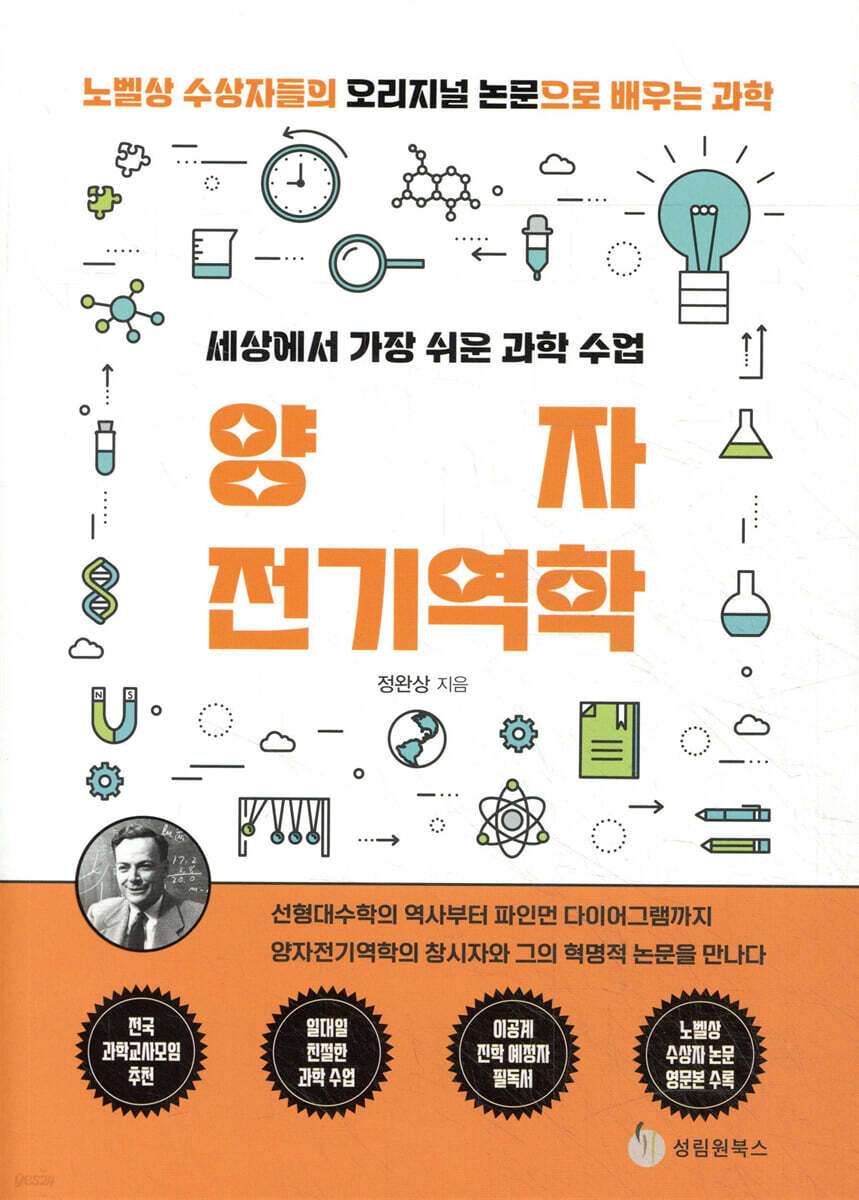
The World's Easiest Science Lesson: Quantum Electrodynamics
 |
Description
Book Introduction
Exploring the life and papers of the genius physicist and founder of quantum electrodynamics, Feynman.
The 14th installment of the series “Learning Science Through Original Papers by Nobel Prize Winners.”
This book focuses on the quantum electrodynamics papers and life of Richard Feynman, one of the founders of quantum electrodynamics.
The introduction begins with a virtual interview with Dr. Sheldon Glashow, winner of the 1979 Nobel Prize in Physics, to provide an overview of the book's contents.
Feynman's paper used a new vector symbol, the bracket, by Paul Dirac, which predicted the existence of antiparticles.
To understand this, we need a branch of mathematics called linear algebra. Chapter 1 introduced the history of linear algebra, and Chapter 2 explained the bracket notation in detail.
Chapter 3 covers Feynman's life and the idea of path integrals and their calculations, which explain quantum mechanics in a new way.
Chapter 4 introduced quantum field theory, which preceded quantum electrodynamics, and the physicists who created it. We also looked at Schwinger and Shinichiro Tomonaga, two other founders of quantum electrodynamics and Nobel Prize winners in physics.
Finally, we covered Feynman's quantum electrodynamics paper in a simplified form and introduced Feynman diagrams, which make it easier to understand quantum electrodynamics at the graduate level.
The appendix includes the English versions of Dirac and Feynman's papers, which form the main content of the book, and a list of Nobel Prize winners in physics, to help you understand the book more deeply.
The 14th installment of the series “Learning Science Through Original Papers by Nobel Prize Winners.”
This book focuses on the quantum electrodynamics papers and life of Richard Feynman, one of the founders of quantum electrodynamics.
The introduction begins with a virtual interview with Dr. Sheldon Glashow, winner of the 1979 Nobel Prize in Physics, to provide an overview of the book's contents.
Feynman's paper used a new vector symbol, the bracket, by Paul Dirac, which predicted the existence of antiparticles.
To understand this, we need a branch of mathematics called linear algebra. Chapter 1 introduced the history of linear algebra, and Chapter 2 explained the bracket notation in detail.
Chapter 3 covers Feynman's life and the idea of path integrals and their calculations, which explain quantum mechanics in a new way.
Chapter 4 introduced quantum field theory, which preceded quantum electrodynamics, and the physicists who created it. We also looked at Schwinger and Shinichiro Tomonaga, two other founders of quantum electrodynamics and Nobel Prize winners in physics.
Finally, we covered Feynman's quantum electrodynamics paper in a simplified form and introduced Feynman diagrams, which make it easier to understand quantum electrodynamics at the graduate level.
The appendix includes the English versions of Dirac and Feynman's papers, which form the main content of the book, and a list of Nobel Prize winners in physics, to help you understand the book more deeply.
- You can preview some of the book's contents.
Preview
index
I wish I had a book like this when I first started studying science.
I hope you can understand the original papers of these genius scientists.
A Surprise Interview with Dr. Feynman and Dr. Glashow, the Founders of Quantum Electrodynamics
First Encounter | The History of Linear Algebra
Linear Systems of Equations: Ancient Research Records
Cramer's Formula and Gaussian Elimination: A New Solution to Systems of Equations
The emergence of matrices - arranging numbers in a rectangular shape
The Birth of Vector _Thanks to the habit of lying down for a long time
Conditions for forming Grassmann's vector space _field
Second Encounter | Dirac's Quantum Mechanics
The Birth of the Dirac Bracket _ Another Symbol Representing Vectors
Cauchy integral _ new integral formula
Dirac Delta Function _ Properties of functions created by Dirac
Heisenberg-Born-Jordan-Schrödinger Quantum Mechanics _ The Birth of Quantum Mechanics
Position and momentum states in quantum mechanics _ Position and momentum of electrons
Third Encounter | Feynman's Path Integral
Feynman's Life: The Loves and Challenges of a Mathematical Genius
Feynman's Idea: A Theory That Redefines Quantum Mechanics
The principle of the lower hemisphere: the present is determined by past information.
Path integral - Finding the probability of finding an electron
How to find the path integral _ for all possible paths
Calculation of propagation factor - When electrons are not subject to force and when they are subject to force
Fourth Encounter | Quantum Electrodynamics
Physicists Who Created Quantum Field Theory: Falk, Jordan, and Wigner
Quantum field theory: the theory of particle creation and annihilation
The founders of quantum electrodynamics: Schwinger and Shinichiro Tomonaga
Quantum electrodynamics _ Using Feynman diagrams
In addition to the meeting
A New Notation for Quantum Mechanics _ Dirac's paper in English
Space-Time Approach to Non-Relativistic Quantum Mechanics _ Feynman 1 Paper English Version
Space-Time Approach to Quantum Electrodynamics _ Feynman 2 Paper English Version
Concluding our meeting with a great paper
Papers referenced for this book
Greek letters used in formulas
Introducing the Nobel Prize winners in Physics
I hope you can understand the original papers of these genius scientists.
A Surprise Interview with Dr. Feynman and Dr. Glashow, the Founders of Quantum Electrodynamics
First Encounter | The History of Linear Algebra
Linear Systems of Equations: Ancient Research Records
Cramer's Formula and Gaussian Elimination: A New Solution to Systems of Equations
The emergence of matrices - arranging numbers in a rectangular shape
The Birth of Vector _Thanks to the habit of lying down for a long time
Conditions for forming Grassmann's vector space _field
Second Encounter | Dirac's Quantum Mechanics
The Birth of the Dirac Bracket _ Another Symbol Representing Vectors
Cauchy integral _ new integral formula
Dirac Delta Function _ Properties of functions created by Dirac
Heisenberg-Born-Jordan-Schrödinger Quantum Mechanics _ The Birth of Quantum Mechanics
Position and momentum states in quantum mechanics _ Position and momentum of electrons
Third Encounter | Feynman's Path Integral
Feynman's Life: The Loves and Challenges of a Mathematical Genius
Feynman's Idea: A Theory That Redefines Quantum Mechanics
The principle of the lower hemisphere: the present is determined by past information.
Path integral - Finding the probability of finding an electron
How to find the path integral _ for all possible paths
Calculation of propagation factor - When electrons are not subject to force and when they are subject to force
Fourth Encounter | Quantum Electrodynamics
Physicists Who Created Quantum Field Theory: Falk, Jordan, and Wigner
Quantum field theory: the theory of particle creation and annihilation
The founders of quantum electrodynamics: Schwinger and Shinichiro Tomonaga
Quantum electrodynamics _ Using Feynman diagrams
In addition to the meeting
A New Notation for Quantum Mechanics _ Dirac's paper in English
Space-Time Approach to Non-Relativistic Quantum Mechanics _ Feynman 1 Paper English Version
Space-Time Approach to Quantum Electrodynamics _ Feynman 2 Paper English Version
Concluding our meeting with a great paper
Papers referenced for this book
Greek letters used in formulas
Introducing the Nobel Prize winners in Physics
Detailed image

Into the book
Physics: Where did the names Kat and Bra come from?
Professor Jeong: 〈 〉 is a bracket in English.
This is because here, only bra remains on the left of c, and only ket remains on the right.
--- p.65
Simply put, quantum mechanics means quantizing classical mechanics.
In classical mechanics, if you know the position of an object, you can know its momentum.
But in quantum mechanics, the position and momentum of a particle—called a quantum—cannot be precisely determined simultaneously.
--- p.84
Feynman, who enjoyed challenging conventional thinking from a young age, also had a remarkable sense of humor.
He had a talent for engineering, built a laboratory at home, and enjoyed repairing radios.
When I was in elementary school, I even built a burglar alarm system at home.
--- p.110~111
Feynman decided to marry his high school sweetheart, Arlene Greenbaum, after she received her doctorate, despite the fact that she was seriously ill with tuberculosis.
--- p.112
In Los Alamos, where the lab was isolated for security reasons, Feynman played pranks on his colleagues by picking the locks on their cabinets and desks.
He was able to easily open the cabinets of physicists by taking advantage of the fact that the passwords they used were related to mathematical or physical constants.
--- p.114~115
I'm going to talk about the path integral that Feynman discovered during his third-year quantum mechanics class.
He thought differently from others and came up with a novel idea during a quantum mechanics class.
It became a theory that gave us a new understanding of quantum mechanics.
--- p.119
Physics Group: In Newtonian mechanics, path integrals are not needed, right?
Professor Jeong: Of course.
But in quantum mechanics, we don't know through which place we reached the final location.
If we consider all possible cases, we can arrive at the right conclusion.
So we do path integration.
--- p.133
Quantum mechanics is the theory that the uncertainty of position and momentum cannot be made zero at the same time.
In contrast, quantum field theory is a theory about the creation and annihilation of particles.
--- p.158
Many scientists believe that had Jordan not joined the Nazi Party, he would have won the Nobel Prize in Physics for his work with Max Born.
However, he remained a member of the Nazi Party and was therefore unable to win the Nobel Prize in Physics.
--- p.162
As a renowned physicist, Schwinger has often been compared to another legendary contemporary, Richard Feynman.
Schwinger banned the use of Feynman diagrams in his classes, believing that they prevented students from properly understanding particle physics.
Professor Jeong: 〈 〉 is a bracket in English.
This is because here, only bra remains on the left of c, and only ket remains on the right.
--- p.65
Simply put, quantum mechanics means quantizing classical mechanics.
In classical mechanics, if you know the position of an object, you can know its momentum.
But in quantum mechanics, the position and momentum of a particle—called a quantum—cannot be precisely determined simultaneously.
--- p.84
Feynman, who enjoyed challenging conventional thinking from a young age, also had a remarkable sense of humor.
He had a talent for engineering, built a laboratory at home, and enjoyed repairing radios.
When I was in elementary school, I even built a burglar alarm system at home.
--- p.110~111
Feynman decided to marry his high school sweetheart, Arlene Greenbaum, after she received her doctorate, despite the fact that she was seriously ill with tuberculosis.
--- p.112
In Los Alamos, where the lab was isolated for security reasons, Feynman played pranks on his colleagues by picking the locks on their cabinets and desks.
He was able to easily open the cabinets of physicists by taking advantage of the fact that the passwords they used were related to mathematical or physical constants.
--- p.114~115
I'm going to talk about the path integral that Feynman discovered during his third-year quantum mechanics class.
He thought differently from others and came up with a novel idea during a quantum mechanics class.
It became a theory that gave us a new understanding of quantum mechanics.
--- p.119
Physics Group: In Newtonian mechanics, path integrals are not needed, right?
Professor Jeong: Of course.
But in quantum mechanics, we don't know through which place we reached the final location.
If we consider all possible cases, we can arrive at the right conclusion.
So we do path integration.
--- p.133
Quantum mechanics is the theory that the uncertainty of position and momentum cannot be made zero at the same time.
In contrast, quantum field theory is a theory about the creation and annihilation of particles.
--- p.158
Many scientists believe that had Jordan not joined the Nazi Party, he would have won the Nobel Prize in Physics for his work with Max Born.
However, he remained a member of the Nazi Party and was therefore unable to win the Nobel Prize in Physics.
--- p.162
As a renowned physicist, Schwinger has often been compared to another legendary contemporary, Richard Feynman.
Schwinger banned the use of Feynman diagrams in his classes, believing that they prevented students from properly understanding particle physics.
--- p.180~181
Publisher's Review
★ Recommended by the National Science Teachers Association
★ One-on-one friendly science classes
★ A must-read for those planning to pursue science and engineering majors
★ Includes English versions of Nobel Prize-winning papers
An easy and fun way to approach master's level physics.
This book focuses on a 1949 paper by Feynman, one of the founders of quantum electrodynamics.
We also covered Feynman's paper on path integrals, which made this paper possible.
To understand quantum electrodynamics, you need to know quantum field theory.
Here, quantum field theory is covered only to a degree that can be easily understood by general readers.
In fact, quantum field theory is one of the subjects that particle physics graduate students find difficult.
The reason is that a huge amount of mathematics is used.
First, we introduce in an interesting way the bracket symbol, a new vector symbol introduced by Dirac to lay the foundation for quantum field theory.
Also, since quantum mechanics was built on the foundation of mathematics called linear algebra, we covered the history of linear algebra.
Finally, Feynman's paper on quantum electrodynamics was concluded in a way that it could be understood through pictures (Feynman diagrams) rather than formulas.
This is because, to understand the original paper, one must study complex and difficult mathematics such as complex function theory and Green's function theory.
To help readers understand, we also recommend the following books in this series: The Quantum Revolution, The Atomic Model, The Uncertainty Principle, and Antiparticles.
This book will immerse readers in the mysteries of quantum electrodynamics.
Because it is difficult to understand, the genius physicist Feynman tried to make it easier to understand.
“Anyone who tells you they understand quantum mechanics is lying.” -Richard Feynman
In classical electrodynamics, light is treated as a wave called an electromagnetic wave.
In contrast, quantum electrodynamics views light as a quantum called a photon.
In the quantum world, all particles become quanta.
Electrons are also quanta.
Quantum electrodynamics is the physics that deals with the interactions of two types of quanta: photons and electrons.
Particle physics majors learn quantum electrodynamics in their master's degree programs.
Feynman introduced illustrations to make this difficult subject, which requires complex calculations, easier to understand.
A Feynman diagram is a simple representation of the paths and interactions of particles through space and time.
Feynman's ideas helped us understand quantum electrodynamics and contributed to its rapid development.
Let's delve into the brilliant physicist Feynman and his brilliant papers, which sought to make quantum mechanics easy to understand!
Meet Richard Feynman and other contemporary Nobel Prize winners in physics.
This book introduces in detail not only the main character Feynman's quantum electrodynamics papers, but also his life, research, and educational activities.
Feynman is said to have enjoyed challenging existing ways of thinking from a young age.
He came up with the idea of path integral while studying quantum mechanics in college.
This became a theory that gave a new understanding of quantum mechanics.
Feynman also had a remarkable sense of humor, and there is an anecdote about him playing a prank on his colleagues by unlocking their cabinets during his free time at the Los Alamos Laboratory while working on the Manhattan Project.
The story of Feynman's love, how he devoted himself to research while marrying his wife who suffered from an incurable disease, and how he devoted himself to playing the conga drum while on sabbatical in Brazil due to a scientist spy issue, is also fascinating.
Several physicists who were active in the same era as Feynman appear in the book.
Polk, Jordan, and Wigner, who developed quantum field theory before quantum electrodynamics.
Schwinger and Shinichiro Tomonaga, who independently studied and founded quantum electrodynamics from Feynman.
I hope that readers of this book will enjoy physics even more by glimpsing the struggles and efforts of various scientists who have studied quantum mechanics in various ways.
★ One-on-one friendly science classes
★ A must-read for those planning to pursue science and engineering majors
★ Includes English versions of Nobel Prize-winning papers
An easy and fun way to approach master's level physics.
This book focuses on a 1949 paper by Feynman, one of the founders of quantum electrodynamics.
We also covered Feynman's paper on path integrals, which made this paper possible.
To understand quantum electrodynamics, you need to know quantum field theory.
Here, quantum field theory is covered only to a degree that can be easily understood by general readers.
In fact, quantum field theory is one of the subjects that particle physics graduate students find difficult.
The reason is that a huge amount of mathematics is used.
First, we introduce in an interesting way the bracket symbol, a new vector symbol introduced by Dirac to lay the foundation for quantum field theory.
Also, since quantum mechanics was built on the foundation of mathematics called linear algebra, we covered the history of linear algebra.
Finally, Feynman's paper on quantum electrodynamics was concluded in a way that it could be understood through pictures (Feynman diagrams) rather than formulas.
This is because, to understand the original paper, one must study complex and difficult mathematics such as complex function theory and Green's function theory.
To help readers understand, we also recommend the following books in this series: The Quantum Revolution, The Atomic Model, The Uncertainty Principle, and Antiparticles.
This book will immerse readers in the mysteries of quantum electrodynamics.
Because it is difficult to understand, the genius physicist Feynman tried to make it easier to understand.
“Anyone who tells you they understand quantum mechanics is lying.” -Richard Feynman
In classical electrodynamics, light is treated as a wave called an electromagnetic wave.
In contrast, quantum electrodynamics views light as a quantum called a photon.
In the quantum world, all particles become quanta.
Electrons are also quanta.
Quantum electrodynamics is the physics that deals with the interactions of two types of quanta: photons and electrons.
Particle physics majors learn quantum electrodynamics in their master's degree programs.
Feynman introduced illustrations to make this difficult subject, which requires complex calculations, easier to understand.
A Feynman diagram is a simple representation of the paths and interactions of particles through space and time.
Feynman's ideas helped us understand quantum electrodynamics and contributed to its rapid development.
Let's delve into the brilliant physicist Feynman and his brilliant papers, which sought to make quantum mechanics easy to understand!
Meet Richard Feynman and other contemporary Nobel Prize winners in physics.
This book introduces in detail not only the main character Feynman's quantum electrodynamics papers, but also his life, research, and educational activities.
Feynman is said to have enjoyed challenging existing ways of thinking from a young age.
He came up with the idea of path integral while studying quantum mechanics in college.
This became a theory that gave a new understanding of quantum mechanics.
Feynman also had a remarkable sense of humor, and there is an anecdote about him playing a prank on his colleagues by unlocking their cabinets during his free time at the Los Alamos Laboratory while working on the Manhattan Project.
The story of Feynman's love, how he devoted himself to research while marrying his wife who suffered from an incurable disease, and how he devoted himself to playing the conga drum while on sabbatical in Brazil due to a scientist spy issue, is also fascinating.
Several physicists who were active in the same era as Feynman appear in the book.
Polk, Jordan, and Wigner, who developed quantum field theory before quantum electrodynamics.
Schwinger and Shinichiro Tomonaga, who independently studied and founded quantum electrodynamics from Feynman.
I hope that readers of this book will enjoy physics even more by glimpsing the struggles and efforts of various scientists who have studied quantum mechanics in various ways.
GOODS SPECIFICS
- Date of issue: March 25, 2025
- Page count, weight, size: 255 pages | 378g | 152*215*20mm
- ISBN13: 9791193357460
- ISBN10: 1193357462
You may also like
카테고리
korean


korean

![ELLE 엘르 스페셜 에디션 A형 : 12월 [2025]](http://librairie.coreenne.fr/cdn/shop/files/b8e27a3de6c9538896439686c6b0e8fb.jpg?v=1766436872&width=3840)


