

Where do plant names come from?
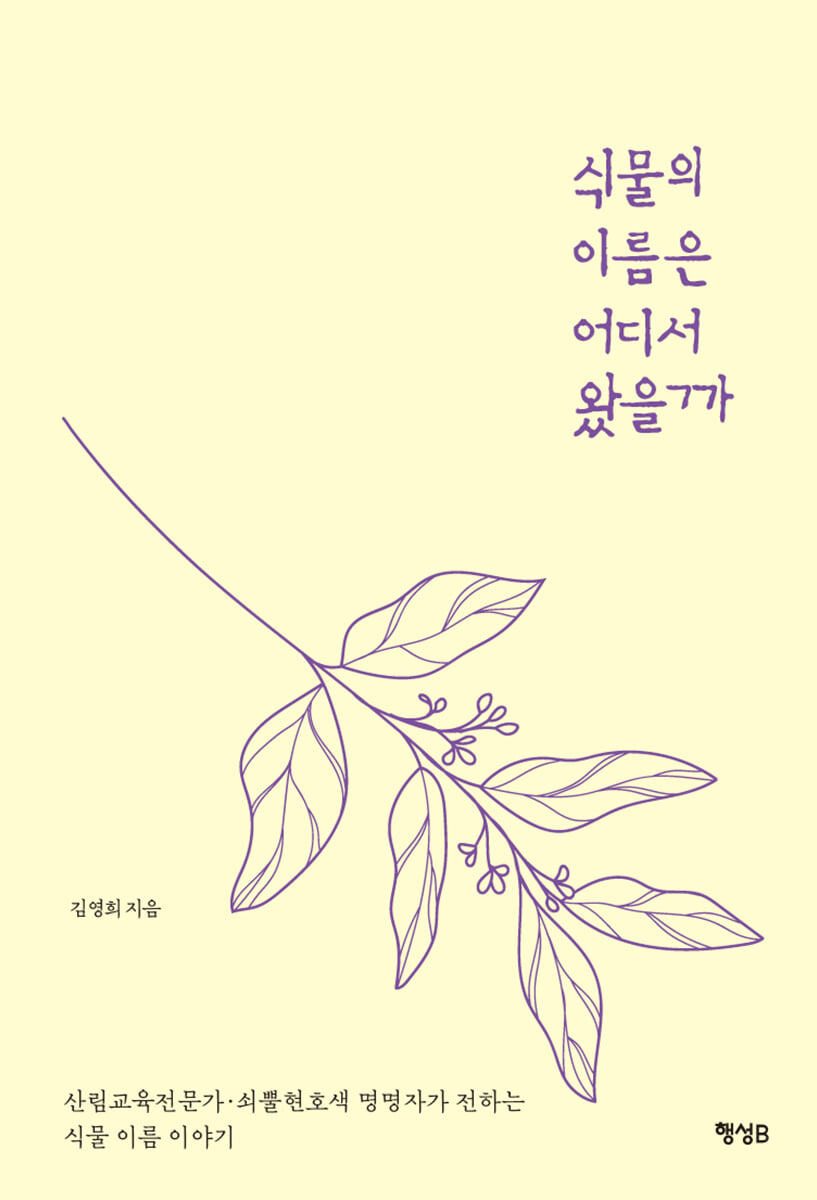 |
Description
Book Introduction
The story behind the name of the plant researcher and the name of the oxhorned tiger lily.
The legends, uses, ecology, and history of plants that alternate between Korean and international scientific names.
Love begins with knowing a name.
Plant names are given for a variety of reasons.
They are named mainly based on their appearance, ecology, legend, and edibility.
But often times it is not understood why it was given this name.
This book is a story about names written by a plant expert who gave the name 'Cowhorn Hyeonho-saek' to an unnamed wildflower while working as a researcher at the National Arboretum and other places.
The names of plants we commonly know are Korean names such as 'Gyeoulsal-i' and 'Dandelion.'
However, plants also have international names called 'scientific names', and there are times when the Korean name and scientific name are strangely similar or completely different.
This book explores the diverse aspects of plant names by covering both familiar Korean names and unfamiliar scientific names, and helps us become aware of the existence of plants we often encounter but whose names we may not have known.
It delicately guides you through the stories and history behind plant names, how plants are born and live, and even the hearts of those who look at them.
The legends, uses, ecology, and history of plants that alternate between Korean and international scientific names.
Love begins with knowing a name.
Plant names are given for a variety of reasons.
They are named mainly based on their appearance, ecology, legend, and edibility.
But often times it is not understood why it was given this name.
This book is a story about names written by a plant expert who gave the name 'Cowhorn Hyeonho-saek' to an unnamed wildflower while working as a researcher at the National Arboretum and other places.
The names of plants we commonly know are Korean names such as 'Gyeoulsal-i' and 'Dandelion.'
However, plants also have international names called 'scientific names', and there are times when the Korean name and scientific name are strangely similar or completely different.
This book explores the diverse aspects of plant names by covering both familiar Korean names and unfamiliar scientific names, and helps us become aware of the existence of plants we often encounter but whose names we may not have known.
It delicately guides you through the stories and history behind plant names, how plants are born and live, and even the hearts of those who look at them.
- You can preview some of the book's contents.
Preview
index
Prologue┃The Desire to Know the Name
Plant Name Reading Guide
Part 1: Plant Names Tell Stories
Thyme, Thyme, and Thyme┃Flowers with a fragrance that travels far
The patient-free tree┃A sturdy tree that saves people
Thorn Lotus┃Goddess with snakes for hair
Daughter-in-law's Underclothes┃The Use of Thorns Is More Important Than Legend
Angel-like Angelica┃Angel-like Angelica, Angel-like People
Magpie Tree and Crow's Nest Plants ┃Plants with Animal Names
Part 2: The Heart That Gives a Name
When naming a flower that is all your own
Southern Wind Flower┃The name of a plant whose fate is determined on a first-come, first-served basis
Dandelion┃The day our missing dandelion returned
Big dog testicles grass┃A pretty stage name given to replace an awkward real name
Scarlett O'Hara's dress with the number 3
Misennamu and Daenggangnamu┃People's names hidden in the names of plants
Part 3: Similar Names, Two Names
You too, chestnut tree, me too, chestnut tree┃If 'you too' and 'me too' come together, are they a family?
Umbrella plant and Umbrella violet┃Umbrella that blocks rain, Umbrella that lives on Ulleungdo
Gomari┃One Plant, Many Stories
Korean bellflower and Korean bellflower: Native flowers discovered in North Korea and given Japanese scientific names
Changpo·Kkotchangpo┃The names are similar, but their affiliations are completely different.
Da-rae, Gaeda-rae, Jwi-da-rae┃Is it really inferior when 'dog' and 'rat' are combined?
Poplar and Forsythia ┃A farmer's wish for a good harvest
Part 4: Familiar Plants, Unknown Names
Rose of Sharon and Rose of Sharon┃Do you know the innocent wild rose and the bold sea rose?
Azaleas, Rhododendrons, and Rhododendrons: Heralds of Spring So Similar They're Hard to Tell Apart
Fruit Trees┃Please remember the flowers as well as the fruits.
Barely surviving┃Barely surviving, surviving all winter
Willow┃Three Misconceptions About Willow
Oak family┃Six brothers of the deciduous broadleaf oak tree: Korean oak, Japanese oak, Japanese oak, Japanese oak, and Korean oak
Epilogue┃Knowing a Name is the Beginning of Love
Plant Name Reading Guide
Part 1: Plant Names Tell Stories
Thyme, Thyme, and Thyme┃Flowers with a fragrance that travels far
The patient-free tree┃A sturdy tree that saves people
Thorn Lotus┃Goddess with snakes for hair
Daughter-in-law's Underclothes┃The Use of Thorns Is More Important Than Legend
Angel-like Angelica┃Angel-like Angelica, Angel-like People
Magpie Tree and Crow's Nest Plants ┃Plants with Animal Names
Part 2: The Heart That Gives a Name
When naming a flower that is all your own
Southern Wind Flower┃The name of a plant whose fate is determined on a first-come, first-served basis
Dandelion┃The day our missing dandelion returned
Big dog testicles grass┃A pretty stage name given to replace an awkward real name
Scarlett O'Hara's dress with the number 3
Misennamu and Daenggangnamu┃People's names hidden in the names of plants
Part 3: Similar Names, Two Names
You too, chestnut tree, me too, chestnut tree┃If 'you too' and 'me too' come together, are they a family?
Umbrella plant and Umbrella violet┃Umbrella that blocks rain, Umbrella that lives on Ulleungdo
Gomari┃One Plant, Many Stories
Korean bellflower and Korean bellflower: Native flowers discovered in North Korea and given Japanese scientific names
Changpo·Kkotchangpo┃The names are similar, but their affiliations are completely different.
Da-rae, Gaeda-rae, Jwi-da-rae┃Is it really inferior when 'dog' and 'rat' are combined?
Poplar and Forsythia ┃A farmer's wish for a good harvest
Part 4: Familiar Plants, Unknown Names
Rose of Sharon and Rose of Sharon┃Do you know the innocent wild rose and the bold sea rose?
Azaleas, Rhododendrons, and Rhododendrons: Heralds of Spring So Similar They're Hard to Tell Apart
Fruit Trees┃Please remember the flowers as well as the fruits.
Barely surviving┃Barely surviving, surviving all winter
Willow┃Three Misconceptions About Willow
Oak family┃Six brothers of the deciduous broadleaf oak tree: Korean oak, Japanese oak, Japanese oak, Japanese oak, and Korean oak
Epilogue┃Knowing a Name is the Beginning of Love
Detailed image
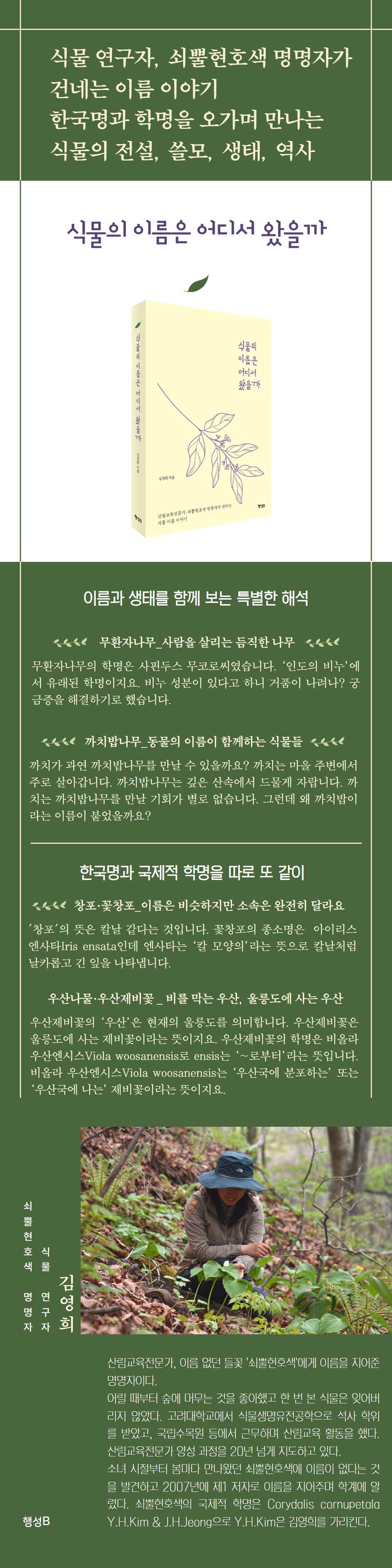
Into the book
If we were to simply break down the name of the patient tree, it would mean ‘there are no patients.’
(Omitted) The scientific name was Sapindus mukorossi.
What caught my interest was the common name, 'Sapindus'.
Its scientific name is a combination of the Latin words sapo and indicus, meaning ‘Indian soap.’
It is said that the fruit peel contains soap components and has been used for laundry in India since ancient times.
It's less fun to just check everything in writing.
Since it contains soap, I wondered if it would foam up. I decided to find out.
--- From "The Patient-Free Tree│A Sturdy Tree That Saves People"
There are several plants of the Angelica genus that are native to our country.
However, among them, there is no plant with the correct name of 'Danggui'.
It's just like there's no tree called oak among the oak genus.
The one with the most similar name is Angelica gigas.
Of course, it is also called Danggui without the 'true'.
It's like calling a Japanese oak or a hornbeam oak simply an oak.
So, what kind of plant is the angelica we eat as a vegetable? Strictly speaking, it's called "waedanggui," and it's native to Japan.
--- From "True Angelica│An Angelica, an Angelic Person"
When naming a plant, you should not name it as you like, but find the genus name (affiliation) of the plant and give it a name.
If we were to compare it to a person, would we say 'surname'? This plant belongs to the 'Hyeonho-saek' family.
So what does this "Hyeonho-saek" mean? There are various interpretations of the common name "Hyeonho-saek."
There are opinions that it was adopted as is from the Chinese notation 'Hyeonho-saek' [Hyeon means mysterious in color, 'Hyeon' means mysterious in color, 'Ho' means mysterious in origin, and 'Saek' means to search by feeling], and there are also records that it was a local name used in Joseon at the time.
--- From "Oxhorn Hyeonho-saek│When naming a flower that is all your own"
There are primroses that bloom in early spring, before the snow melts.
The name Boksucho is a very lucky name that uses the character for fortune and the character for life or longevity, but people often think of revenge or misunderstand it as revenge.
That is why it is often called 'snow flower', meaning a flower that blooms even through snow, or 'ice flower', meaning a flower that blooms even through ice.
In fact, in some areas, the primrose blooms around the Lunar New Year, which may still be considered winter.
--- From "Big Dog Testicle Grass│A pretty stage name given to replace an awkward real name"
Thanks to his nickname, Yulgok often appears in tales related to chestnut trees.
The stories flow in various directions, but they all end with someone saving his life by shouting "night tree."
Yulgok's birthplace is Ojukheon.
It's in Gangneung, Gangwon-do.
Ironically, neither the beech nor the oak tree grows in that region.
The only native habitat of the Japanese chestnut tree on the Korean Peninsula is Ulleungdo Island.
Outside of Ulleungdo, there are no native beech trees, and all beech trees on the mainland are planted trees.
You can only see one or two of them if you go to an arboretum or botanical garden.
--- From "You too, chestnut tree, me too, chestnut tree│If 'you too' and 'me too' come together, will they be a family?"
Geumgang bellflower was named in 1911 and Geomsan bellflower in 1921.
It was named when the North and South were one, and the Military Demarcation Line did not exist.
The name was given by a Japanese person named Nakai Takenoshin.
(Omitted) The genus Diamond Bellflower is a genus of plants endemic to Korea, and its genus name is Hanabusaya, a Japanese name. One species grows in both North and South Korea, and one species grows only in North Korea.
The sorrow of the Japanese colonial period and the sadness of a divided country can be felt even in plants.
--- From "Geumgang bellflower and Geomsan bellflower│Native flowers discovered in North Korea and given Japanese scientific names"
In the content of “Hanrimbyeolgok,” the phrase “Hwangjajangmi (黃紫薔薇)” appears.
It means yellow and purple rose, so roses were probably treated as very precious flowers even before that.
(Omitted) However, other than these gorgeous roses, there are many flowers with the same name, Rosa (Rosa genus), that grow naturally in our country.
There are zelkova trees and wild ash trees that can only be found in high mountains or deep forests, and there are also stone thorn trees that grow along the ground in sunny places or by the seaside.
Although they have names quite different from roses, they are also roses.
Among the many Rosas, the most representative ones that everyone knows and can easily see are 'rose of Sharon' and 'rose of Sharon'.
These are Rosas who have lived close to farmers and fishermen for a very long time.
--- From "Do you know the pure wild rose and the bold sea rose?"
When the willow trees by the river turn green in spring, did you ever think they were leaves? They're not.
The lively colors that dominate the waterfront in spring are influenced by willow blossoms.
So, from the beginning, we've been talking about flowers.
If you thought it was a leaf, you've been mistaken.
Willow trees bloom before their leaves appear.
This is the first common misconception about willow trees.
(Omitted) The scientific name was Sapindus mukorossi.
What caught my interest was the common name, 'Sapindus'.
Its scientific name is a combination of the Latin words sapo and indicus, meaning ‘Indian soap.’
It is said that the fruit peel contains soap components and has been used for laundry in India since ancient times.
It's less fun to just check everything in writing.
Since it contains soap, I wondered if it would foam up. I decided to find out.
--- From "The Patient-Free Tree│A Sturdy Tree That Saves People"
There are several plants of the Angelica genus that are native to our country.
However, among them, there is no plant with the correct name of 'Danggui'.
It's just like there's no tree called oak among the oak genus.
The one with the most similar name is Angelica gigas.
Of course, it is also called Danggui without the 'true'.
It's like calling a Japanese oak or a hornbeam oak simply an oak.
So, what kind of plant is the angelica we eat as a vegetable? Strictly speaking, it's called "waedanggui," and it's native to Japan.
--- From "True Angelica│An Angelica, an Angelic Person"
When naming a plant, you should not name it as you like, but find the genus name (affiliation) of the plant and give it a name.
If we were to compare it to a person, would we say 'surname'? This plant belongs to the 'Hyeonho-saek' family.
So what does this "Hyeonho-saek" mean? There are various interpretations of the common name "Hyeonho-saek."
There are opinions that it was adopted as is from the Chinese notation 'Hyeonho-saek' [Hyeon means mysterious in color, 'Hyeon' means mysterious in color, 'Ho' means mysterious in origin, and 'Saek' means to search by feeling], and there are also records that it was a local name used in Joseon at the time.
--- From "Oxhorn Hyeonho-saek│When naming a flower that is all your own"
There are primroses that bloom in early spring, before the snow melts.
The name Boksucho is a very lucky name that uses the character for fortune and the character for life or longevity, but people often think of revenge or misunderstand it as revenge.
That is why it is often called 'snow flower', meaning a flower that blooms even through snow, or 'ice flower', meaning a flower that blooms even through ice.
In fact, in some areas, the primrose blooms around the Lunar New Year, which may still be considered winter.
--- From "Big Dog Testicle Grass│A pretty stage name given to replace an awkward real name"
Thanks to his nickname, Yulgok often appears in tales related to chestnut trees.
The stories flow in various directions, but they all end with someone saving his life by shouting "night tree."
Yulgok's birthplace is Ojukheon.
It's in Gangneung, Gangwon-do.
Ironically, neither the beech nor the oak tree grows in that region.
The only native habitat of the Japanese chestnut tree on the Korean Peninsula is Ulleungdo Island.
Outside of Ulleungdo, there are no native beech trees, and all beech trees on the mainland are planted trees.
You can only see one or two of them if you go to an arboretum or botanical garden.
--- From "You too, chestnut tree, me too, chestnut tree│If 'you too' and 'me too' come together, will they be a family?"
Geumgang bellflower was named in 1911 and Geomsan bellflower in 1921.
It was named when the North and South were one, and the Military Demarcation Line did not exist.
The name was given by a Japanese person named Nakai Takenoshin.
(Omitted) The genus Diamond Bellflower is a genus of plants endemic to Korea, and its genus name is Hanabusaya, a Japanese name. One species grows in both North and South Korea, and one species grows only in North Korea.
The sorrow of the Japanese colonial period and the sadness of a divided country can be felt even in plants.
--- From "Geumgang bellflower and Geomsan bellflower│Native flowers discovered in North Korea and given Japanese scientific names"
In the content of “Hanrimbyeolgok,” the phrase “Hwangjajangmi (黃紫薔薇)” appears.
It means yellow and purple rose, so roses were probably treated as very precious flowers even before that.
(Omitted) However, other than these gorgeous roses, there are many flowers with the same name, Rosa (Rosa genus), that grow naturally in our country.
There are zelkova trees and wild ash trees that can only be found in high mountains or deep forests, and there are also stone thorn trees that grow along the ground in sunny places or by the seaside.
Although they have names quite different from roses, they are also roses.
Among the many Rosas, the most representative ones that everyone knows and can easily see are 'rose of Sharon' and 'rose of Sharon'.
These are Rosas who have lived close to farmers and fishermen for a very long time.
--- From "Do you know the pure wild rose and the bold sea rose?"
When the willow trees by the river turn green in spring, did you ever think they were leaves? They're not.
The lively colors that dominate the waterfront in spring are influenced by willow blossoms.
So, from the beginning, we've been talking about flowers.
If you thought it was a leaf, you've been mistaken.
Willow trees bloom before their leaves appear.
This is the first common misconception about willow trees.
--- From “Willow│Three Misunderstandings About Willow”
Publisher's Review
“Listening to the fascinating stories behind plant names told by ‘the older sister who knows a thing or two about plants’ makes me wiser.
Good people get on eye level and ask for your name first.
"What's your name? What does it mean? Who gave it to you?"
★★★★★ Recommended by Lim Tae-ju (poet, essayist, author of "The Physics of Relationships")
“Can the feeling of someone who says, ‘Green leaves are sprouting,’ and the feeling of someone who says, ‘Green leaves of the magpie tree are sprouting,’ be the same?” Plant researcher and author Kim Young-hee explains the importance of names this way.
When I know the name, the common street tree on my way to work becomes the poplar tree I know, and I see the daughter-in-law's underclothes washer with a sad name that is different from her pretty appearance again.
Knowing a name means knowing existence, and knowing the names of plants allows us to love and get closer to those who support human life.
This book is a story about plant names told by an author who has spent his entire life studying plants in and out of forests, and who never forgets a plant he has seen once.
It shows the world of plant nomenclature, which we experienced by giving names to plants ourselves, as well as stories about the wild flowers and trees we commonly encounter.
We also examine the similarities and differences between Korean and international scientific names, and explore in detail the appearance of the plants that form the basis of those names.
A fascinating story about plants that goes back and forth between name and ecology.
The magpie tree, whose fruit is eaten by magpies.
However, it is not easy for magpies to meet magpie trees.
This is because magpies mainly live in houses, and magpie trees rarely grow deep in the mountains.
So why is this tree called "magpie tree"? The "umbrella" in "umbrella violet" does not refer to an umbrella used on rainy days, but to "Usan," the old name for Ulleungdo Island.
The scientific name of this violet that lives on Ulleungdo Island is 'Viola woosanensis'.
Ensis means 'from' and means 'distributed in the Umbrella Country'.
Ulleungdo is indicated in the international scientific name of the Umbrella Violet.
This is a very common case.
The scientific name of the Chinese bellflower includes the Japanese name 'Hanabusaya'.
This is because, although it is a Korean endemic plant first discovered in Geumgangsan, the person who first gave it its name was Japanese.
So, North Korea calls this genus of bellflowers 'Keumkangsania'.
Even though it is not officially recognized as such, it is still called that.
In Gangneung, the hometown of Yulgok Yi I, there are legends about the 'Nodobamnamu' and the 'Nadobamnamu'.
It is presumed that it was created because of the nickname of Yulgok.
However, in Gangneung, Gangwon-do, there are no chestnut trees or oak trees.
How did these two trees get their names, "You too" and "Me too"? Angelica gigas is a plant renowned for its medicinal properties.
The scientific name of this Angelica is 'Angelica'.
It means angel.
Could it be because Angelica has long been known to care for the sick? Its Chinese name, Angelica gigas, means "to return to balance," while its scientific name means "angel."
"Where Do Plant Names Come From?" examines the characteristics of plants we are all too familiar with, meticulously explaining the origins and reasons for their names, while also providing fascinating facts we didn't know.
Are plants with similar names really related? Plants with "참" in the name are edible or have exceptional flavor.
So, are "dogs" and "rats" inferior? In what ways do they appear inferior to humans? Plants are given diverse names based on their shape, utility, and appearance, and sometimes the names and plants seem disconnected.
Also, there are times when the Korean name and the international scientific name strangely match, and other times when they have completely different meanings.
This book takes readers into the fascinating world of names, examining in detail the differences and similarities.
From how to read plant names to how to name them
"Where Do Plant Names Come From?" begins with a "Plant Name Reading Guide."
It provides detailed information on how to read and understand scientific names, as well as various names that refer to names, such as correct names, pseudonyms, generic names, and local names.
It also provides helpful information on the characteristics of the plant's inflorescence, how to tell the sex of the plant, and how to fertilize it.
Names are a gateway to encountering plants and helping us learn about their characteristics.
In addition, he reveals the rules of naming that he personally experienced while naming 'Soehornhyunhosaek', showing a new realm of plant stories.
Good people get on eye level and ask for your name first.
"What's your name? What does it mean? Who gave it to you?"
★★★★★ Recommended by Lim Tae-ju (poet, essayist, author of "The Physics of Relationships")
“Can the feeling of someone who says, ‘Green leaves are sprouting,’ and the feeling of someone who says, ‘Green leaves of the magpie tree are sprouting,’ be the same?” Plant researcher and author Kim Young-hee explains the importance of names this way.
When I know the name, the common street tree on my way to work becomes the poplar tree I know, and I see the daughter-in-law's underclothes washer with a sad name that is different from her pretty appearance again.
Knowing a name means knowing existence, and knowing the names of plants allows us to love and get closer to those who support human life.
This book is a story about plant names told by an author who has spent his entire life studying plants in and out of forests, and who never forgets a plant he has seen once.
It shows the world of plant nomenclature, which we experienced by giving names to plants ourselves, as well as stories about the wild flowers and trees we commonly encounter.
We also examine the similarities and differences between Korean and international scientific names, and explore in detail the appearance of the plants that form the basis of those names.
A fascinating story about plants that goes back and forth between name and ecology.
The magpie tree, whose fruit is eaten by magpies.
However, it is not easy for magpies to meet magpie trees.
This is because magpies mainly live in houses, and magpie trees rarely grow deep in the mountains.
So why is this tree called "magpie tree"? The "umbrella" in "umbrella violet" does not refer to an umbrella used on rainy days, but to "Usan," the old name for Ulleungdo Island.
The scientific name of this violet that lives on Ulleungdo Island is 'Viola woosanensis'.
Ensis means 'from' and means 'distributed in the Umbrella Country'.
Ulleungdo is indicated in the international scientific name of the Umbrella Violet.
This is a very common case.
The scientific name of the Chinese bellflower includes the Japanese name 'Hanabusaya'.
This is because, although it is a Korean endemic plant first discovered in Geumgangsan, the person who first gave it its name was Japanese.
So, North Korea calls this genus of bellflowers 'Keumkangsania'.
Even though it is not officially recognized as such, it is still called that.
In Gangneung, the hometown of Yulgok Yi I, there are legends about the 'Nodobamnamu' and the 'Nadobamnamu'.
It is presumed that it was created because of the nickname of Yulgok.
However, in Gangneung, Gangwon-do, there are no chestnut trees or oak trees.
How did these two trees get their names, "You too" and "Me too"? Angelica gigas is a plant renowned for its medicinal properties.
The scientific name of this Angelica is 'Angelica'.
It means angel.
Could it be because Angelica has long been known to care for the sick? Its Chinese name, Angelica gigas, means "to return to balance," while its scientific name means "angel."
"Where Do Plant Names Come From?" examines the characteristics of plants we are all too familiar with, meticulously explaining the origins and reasons for their names, while also providing fascinating facts we didn't know.
Are plants with similar names really related? Plants with "참" in the name are edible or have exceptional flavor.
So, are "dogs" and "rats" inferior? In what ways do they appear inferior to humans? Plants are given diverse names based on their shape, utility, and appearance, and sometimes the names and plants seem disconnected.
Also, there are times when the Korean name and the international scientific name strangely match, and other times when they have completely different meanings.
This book takes readers into the fascinating world of names, examining in detail the differences and similarities.
From how to read plant names to how to name them
"Where Do Plant Names Come From?" begins with a "Plant Name Reading Guide."
It provides detailed information on how to read and understand scientific names, as well as various names that refer to names, such as correct names, pseudonyms, generic names, and local names.
It also provides helpful information on the characteristics of the plant's inflorescence, how to tell the sex of the plant, and how to fertilize it.
Names are a gateway to encountering plants and helping us learn about their characteristics.
In addition, he reveals the rules of naming that he personally experienced while naming 'Soehornhyunhosaek', showing a new realm of plant stories.
GOODS SPECIFICS
- Date of issue: October 23, 2024
- Page count, weight, size: 276 pages | 296g | 128*188*18mm
- ISBN13: 9791164712724
- ISBN10: 1164712721
You may also like
카테고리
korean


korean

![ELLE 엘르 스페셜 에디션 A형 : 12월 [2025]](http://librairie.coreenne.fr/cdn/shop/files/b8e27a3de6c9538896439686c6b0e8fb.jpg?v=1766436872&width=3840)


