

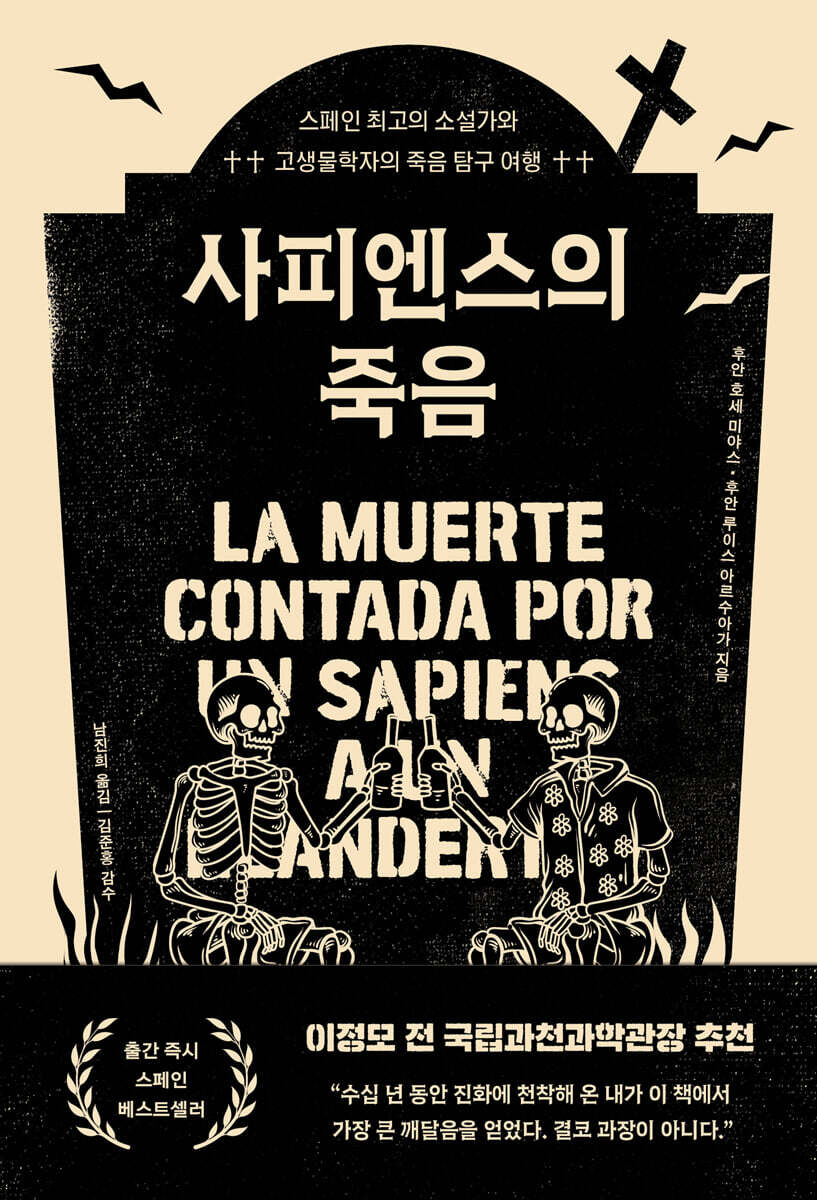
The Death of Sapiens
 |
Description
Book Introduction
Evolution's Answer to Aging and Death
A delightful and intellectual journey into death, told by Spain's greatest minds.
『The Death of Sapiens』 is the sequel to 『Lucy's Footprints』 (original title: LA VIDA CONTADA POR UN SAPIENS A UN NEANDERTAL), which became a hot topic because it was a collaboration between a top novelist and a star paleontologist to explain the theory of evolution.
"Lucy's Footprints" was a bestseller in the Spanish non-fiction category in 2020, and "The Death of Sapiens" also received rave reviews from the Spanish press immediately after its publication, attracting great interest from readers.
A sequel dealing with human society and evolution has also been announced.
As in his previous work, Miyas, a representative Spanish novelist, conveys the words of Arzuaga, the evolutionary guide, not in difficult scientific language, but in 'natural language' that even the general public can easily understand.
Miyasu tells the story of the cool-headed Arsuaga to readers in a novel-like, exciting way, at the same eye level as the readers.
And scientist Arsuaga goes on a journey with Miyasu to find traces of the evolution of living things, and shows us in a concrete and realistic way how the past and present are connected.
The theme of 『The Death of Sapiens』 is human aging and death.
The author of this book, novelist Miyasu, is 75 years old.
A writer, who is at an age where he should feel old and think about death, gives various meanings to death.
In a very traditional and romantic way.
But scientist Arsuaga explains aging and death from a sobering perspective from the perspective of natural selection.
It is something that nature never prepared for: human aging and the death that comes with it.
In a natural state, it is normal for humans to die from harsh environments, natural enemies, injuries, etc. before they die of old age.
But civilization has removed humans from their natural state, and humans have come to possess old age.
In the course of evolution, hundreds of thousands of years are but a fleeting moment.
So nature has not been able to filter out the aging and diseases that we get as we get older.
You can easily see this by looking at the pet dogs we raise at home.
Most dogs over 10 years old experience rapid decline in energy and various diseases.
This is because dogs in nature could not live as long as our current companion dogs.
This is because the survival strategy of the dog's genes is geared towards growing and reproducing quickly.
Although they had to be healthy until they were old enough to reproduce, it would have been difficult for them to survive past that age, and therefore, genes that were disadvantageous to survival and appeared only in old age were not subject to natural selection.
So, it can be seen that older dogs often suffer from all kinds of diseases and ailments of old age.
This is the same for humans.
That is, humans go through an aging process that nature has not prepared for and end up dying.
Paleontologist Arsuaga, who has studied the evolution of numerous animals, says that it is not natural for humans to grow old and die as a result.
His cold-blooded diagnosis, which is completely different from the way ordinary people deal with death, ironically provides comfort to those who fear death.
From an evolutionary perspective, human aging and death are not something prepared, but rather a gift.
According to this, the extra lives that natural selection failed to filter out belong solely to humans.
Despite all the philosophical speculation about death, the reason why death as defined by evolutionary theory resonates with us is probably because humans are also a part of nature and the result of natural selection.
In 『The Death of Sapiens』, Miyas and Arsuaga, who examined death through the lens of evolutionary theory, hinted that they would continue their journey to examine human society through the lens of evolutionary theory.
Following 『Lucy's Footprints』, which showed the process of human evolution, and 『The Death of Sapiens』, which explained the meaning of death, readers of this follow-up work, which explains society through evolutionary theory, will be able to embark on a journey to understand the core issues of evolutionary theory and their meaning.
A delightful and intellectual journey into death, told by Spain's greatest minds.
『The Death of Sapiens』 is the sequel to 『Lucy's Footprints』 (original title: LA VIDA CONTADA POR UN SAPIENS A UN NEANDERTAL), which became a hot topic because it was a collaboration between a top novelist and a star paleontologist to explain the theory of evolution.
"Lucy's Footprints" was a bestseller in the Spanish non-fiction category in 2020, and "The Death of Sapiens" also received rave reviews from the Spanish press immediately after its publication, attracting great interest from readers.
A sequel dealing with human society and evolution has also been announced.
As in his previous work, Miyas, a representative Spanish novelist, conveys the words of Arzuaga, the evolutionary guide, not in difficult scientific language, but in 'natural language' that even the general public can easily understand.
Miyasu tells the story of the cool-headed Arsuaga to readers in a novel-like, exciting way, at the same eye level as the readers.
And scientist Arsuaga goes on a journey with Miyasu to find traces of the evolution of living things, and shows us in a concrete and realistic way how the past and present are connected.
The theme of 『The Death of Sapiens』 is human aging and death.
The author of this book, novelist Miyasu, is 75 years old.
A writer, who is at an age where he should feel old and think about death, gives various meanings to death.
In a very traditional and romantic way.
But scientist Arsuaga explains aging and death from a sobering perspective from the perspective of natural selection.
It is something that nature never prepared for: human aging and the death that comes with it.
In a natural state, it is normal for humans to die from harsh environments, natural enemies, injuries, etc. before they die of old age.
But civilization has removed humans from their natural state, and humans have come to possess old age.
In the course of evolution, hundreds of thousands of years are but a fleeting moment.
So nature has not been able to filter out the aging and diseases that we get as we get older.
You can easily see this by looking at the pet dogs we raise at home.
Most dogs over 10 years old experience rapid decline in energy and various diseases.
This is because dogs in nature could not live as long as our current companion dogs.
This is because the survival strategy of the dog's genes is geared towards growing and reproducing quickly.
Although they had to be healthy until they were old enough to reproduce, it would have been difficult for them to survive past that age, and therefore, genes that were disadvantageous to survival and appeared only in old age were not subject to natural selection.
So, it can be seen that older dogs often suffer from all kinds of diseases and ailments of old age.
This is the same for humans.
That is, humans go through an aging process that nature has not prepared for and end up dying.
Paleontologist Arsuaga, who has studied the evolution of numerous animals, says that it is not natural for humans to grow old and die as a result.
His cold-blooded diagnosis, which is completely different from the way ordinary people deal with death, ironically provides comfort to those who fear death.
From an evolutionary perspective, human aging and death are not something prepared, but rather a gift.
According to this, the extra lives that natural selection failed to filter out belong solely to humans.
Despite all the philosophical speculation about death, the reason why death as defined by evolutionary theory resonates with us is probably because humans are also a part of nature and the result of natural selection.
In 『The Death of Sapiens』, Miyas and Arsuaga, who examined death through the lens of evolutionary theory, hinted that they would continue their journey to examine human society through the lens of evolutionary theory.
Following 『Lucy's Footprints』, which showed the process of human evolution, and 『The Death of Sapiens』, which explained the meaning of death, readers of this follow-up work, which explains society through evolutionary theory, will be able to embark on a journey to understand the core issues of evolutionary theory and their meaning.
- You can preview some of the book's contents.
Preview
index
Letter of Recommendation_Lee Jeong-mo (Former Director of the National Gwacheon Science Museum)
Anthropologist's Guide_Kim Jun-hong (Professor, Pohang University of Science and Technology)
0_ Carpe diem
1_ Immortal Being
2_ Live fast, die young, and leave behind a beautiful body.
3_ Eros and Thanatos
4_ Become a hedonist
5_ Grandmother hypothesis
6_ Eating naked and having fun
7_ The problem is size
8_ The flesh that went out, the flesh that came in
9_ Lion's Prey
10_ Let's slow down
11_ Wooden Man
12_ If only I had given it to them
13_ Secret Life
14_ Shangri-La
15_ Pros and Cons
16_ There is nothing programmed here
17_ The Red Queen
Translator's Note_Nam Jin-hee
Anthropologist's Guide_Kim Jun-hong (Professor, Pohang University of Science and Technology)
0_ Carpe diem
1_ Immortal Being
2_ Live fast, die young, and leave behind a beautiful body.
3_ Eros and Thanatos
4_ Become a hedonist
5_ Grandmother hypothesis
6_ Eating naked and having fun
7_ The problem is size
8_ The flesh that went out, the flesh that came in
9_ Lion's Prey
10_ Let's slow down
11_ Wooden Man
12_ If only I had given it to them
13_ Secret Life
14_ Shangri-La
15_ Pros and Cons
16_ There is nothing programmed here
17_ The Red Queen
Translator's Note_Nam Jin-hee
Detailed image
Into the book
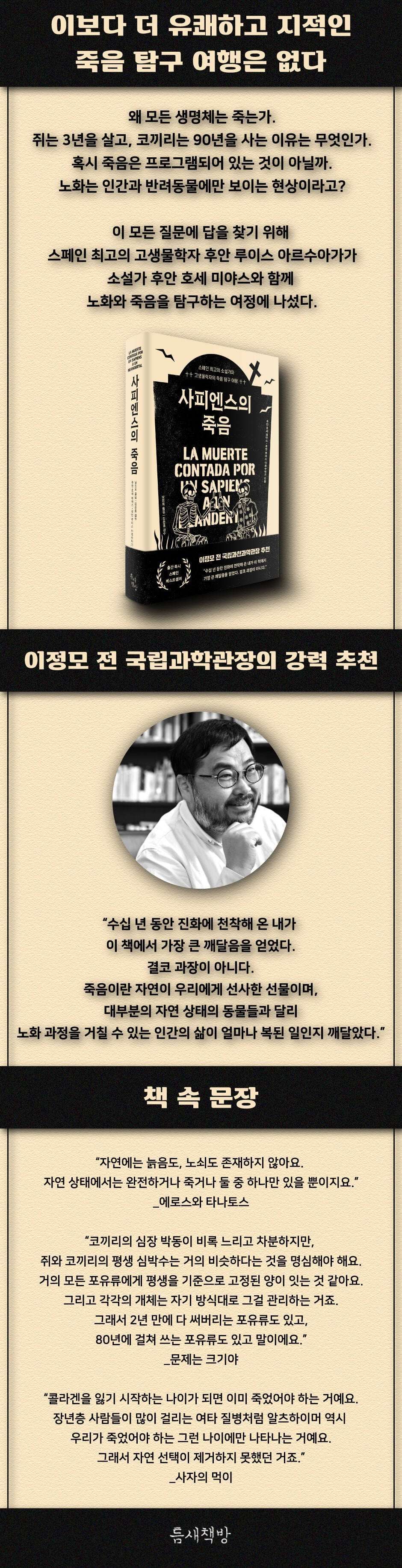
“The ecosystem does not change, it is always constant.
So, what changes is the individual.
When I was in college, my ecology professor said that where there is a lot of life, there is also a lot of death.
But I actually don't think that's true.
Because the ecosystem is unchanging, I believe death does not exist.
Life is immortal.
The ecosystem doesn't change at all, only the individuals are replaced.
So there is no death.
There is only innovation.
“Biological systems are far superior to individuals.”
--- 「1.
From "Immortal Being"
At the end of the year I had to renew my ID, and I was issued one that was valid until 9999.
When I questioned him about this, thinking it might have been a mistake, I was told that they issue a lifelong ID card once you turn 70.
I left the police station holding my identification card that guaranteed my identity for life.
Rather, it felt like this didn't guarantee my identity at all.
And it was like the state was considering me a person who had surrendered my identity card, in other words, a dead person.
--- 「2.
From "Live fast, die young, and leave behind a beautiful body"
When I told him about my illness, the paleontologist said this:
“In nature, there is no such thing as old age or senility.
In the state of nature, there is only one of two things: perfect or dead.”
“Then what about adult diseases?”
“If a gazelle that needs to run at 95 kilometers per hour to escape a predator can only run at 90 kilometers per hour, it is already dead.”
--- 「3.
From "Eros and Thanatos"
“Veterinarians help animals age gracefully,” Lola said.
“But we are unable to apply that philosophy to ourselves.
“Just because you’re eighty and taking seven different medicines doesn’t mean we should feel bad about it.”
--- 「3.
From "Eros and Thanatos"
“There are no chronic diseases in nature.
Because you won't be old enough to develop this disease.
This is something that only humans have.
Most chronic diseases occur after age 60 and are associated with degenerative processes in the cardiovascular, respiratory, and nervous systems.
In nature, there is no such thing as chronic disease because no one lives to old age.”
--- 「4.
From "Let's Become Hedonists"
“We say that the expression of genes that are not visible to natural selection makes us old.
This phenomenon is something that only humans and the animals we have domesticated experience.”
--- 「4.
From "Let's Become Hedonists"
“Then why does skin age?”
“Because collagen loses its elasticity.”
“Can’t collagen be regenerated?”
“No.
We don't have the genes to do this.
By the time you reach the age where you start losing collagen, you should already be dead.
Like many other diseases that affect older people, Alzheimer's only appears at the age when we should be dead.
So natural selection couldn't get rid of it."
--- 「9.
From "The Lion's Prey"
“George Williams, whom I spoke about earlier, said this:
'Let's imagine a gene that makes calcitonin, a hormone that hardens and calcifies bones in youth.
However, this gene causes coronary artery calcification (atherosclerosis) in old age.”
“This is where the word antagonism comes from.”
“You pay the price for enjoying too much wealth when you’re young.”
“It seems that the driving force of life and the driving force of death reside together in the same genes.
“Eros and Thanatos, the two fundamental drives unique to humans, according to Freud.”
--- 「9.
From "The Lion's Prey"
“This is what is happening to us modern people, to the wild animals in zoos and to our pets.
As we age past the age at which we would have died in nature, genes that produce harmful, but late-onset, effects begin to be expressed.
This is something that has accumulated over the long evolutionary process of the species.
I will say this over and over again without getting tired of it.
Natural selection cannot see these harmful mutations because the organisms carrying the genes die before they are expressed.
“Since we can’t see those things, we can’t get rid of them.”
“This is what it means to be old.”
"that's right.
This is old age.
“There can be no aging in nature, because the external factors of death operate relentlessly.”
--- 「15.
Among the “Advantages and Disadvantages”
“Anyway, we shouldn’t believe in science like a religion.
In the past, all problems were solved through prayer, or in other words, through nine-day prayer.
Nowadays, when people face a problem, they say, 'Science will solve it.'
I say this because I have no intention of giving up anything.
You have to give up flying and stop wasting energy without thinking.
But we say no.
I don't think so.
If so, the solution must be of a magical nature, and science must provide it.
“Because there is no realistic way to confront the problem.”
So, what changes is the individual.
When I was in college, my ecology professor said that where there is a lot of life, there is also a lot of death.
But I actually don't think that's true.
Because the ecosystem is unchanging, I believe death does not exist.
Life is immortal.
The ecosystem doesn't change at all, only the individuals are replaced.
So there is no death.
There is only innovation.
“Biological systems are far superior to individuals.”
--- 「1.
From "Immortal Being"
At the end of the year I had to renew my ID, and I was issued one that was valid until 9999.
When I questioned him about this, thinking it might have been a mistake, I was told that they issue a lifelong ID card once you turn 70.
I left the police station holding my identification card that guaranteed my identity for life.
Rather, it felt like this didn't guarantee my identity at all.
And it was like the state was considering me a person who had surrendered my identity card, in other words, a dead person.
--- 「2.
From "Live fast, die young, and leave behind a beautiful body"
When I told him about my illness, the paleontologist said this:
“In nature, there is no such thing as old age or senility.
In the state of nature, there is only one of two things: perfect or dead.”
“Then what about adult diseases?”
“If a gazelle that needs to run at 95 kilometers per hour to escape a predator can only run at 90 kilometers per hour, it is already dead.”
--- 「3.
From "Eros and Thanatos"
“Veterinarians help animals age gracefully,” Lola said.
“But we are unable to apply that philosophy to ourselves.
“Just because you’re eighty and taking seven different medicines doesn’t mean we should feel bad about it.”
--- 「3.
From "Eros and Thanatos"
“There are no chronic diseases in nature.
Because you won't be old enough to develop this disease.
This is something that only humans have.
Most chronic diseases occur after age 60 and are associated with degenerative processes in the cardiovascular, respiratory, and nervous systems.
In nature, there is no such thing as chronic disease because no one lives to old age.”
--- 「4.
From "Let's Become Hedonists"
“We say that the expression of genes that are not visible to natural selection makes us old.
This phenomenon is something that only humans and the animals we have domesticated experience.”
--- 「4.
From "Let's Become Hedonists"
“Then why does skin age?”
“Because collagen loses its elasticity.”
“Can’t collagen be regenerated?”
“No.
We don't have the genes to do this.
By the time you reach the age where you start losing collagen, you should already be dead.
Like many other diseases that affect older people, Alzheimer's only appears at the age when we should be dead.
So natural selection couldn't get rid of it."
--- 「9.
From "The Lion's Prey"
“George Williams, whom I spoke about earlier, said this:
'Let's imagine a gene that makes calcitonin, a hormone that hardens and calcifies bones in youth.
However, this gene causes coronary artery calcification (atherosclerosis) in old age.”
“This is where the word antagonism comes from.”
“You pay the price for enjoying too much wealth when you’re young.”
“It seems that the driving force of life and the driving force of death reside together in the same genes.
“Eros and Thanatos, the two fundamental drives unique to humans, according to Freud.”
--- 「9.
From "The Lion's Prey"
“This is what is happening to us modern people, to the wild animals in zoos and to our pets.
As we age past the age at which we would have died in nature, genes that produce harmful, but late-onset, effects begin to be expressed.
This is something that has accumulated over the long evolutionary process of the species.
I will say this over and over again without getting tired of it.
Natural selection cannot see these harmful mutations because the organisms carrying the genes die before they are expressed.
“Since we can’t see those things, we can’t get rid of them.”
“This is what it means to be old.”
"that's right.
This is old age.
“There can be no aging in nature, because the external factors of death operate relentlessly.”
--- 「15.
Among the “Advantages and Disadvantages”
“Anyway, we shouldn’t believe in science like a religion.
In the past, all problems were solved through prayer, or in other words, through nine-day prayer.
Nowadays, when people face a problem, they say, 'Science will solve it.'
I say this because I have no intention of giving up anything.
You have to give up flying and stop wasting energy without thinking.
But we say no.
I don't think so.
If so, the solution must be of a magical nature, and science must provide it.
“Because there is no realistic way to confront the problem.”
--- 「17.
From "The Red Queen"
From "The Red Queen"
Publisher's Review
The unexpected comfort of an evolutionary explanation of death
《The Death of Sapiens》 returns with an even more interesting theme, following its predecessor which focused on the process of human evolution.
That is human aging and death.
Since the creation of civilization, humans have always longed for immortality.
They sought the elixir of life to maintain eternal youth and turned to religion to escape the fear of death.
In this way, humans have viewed aging and death negatively and have tried to overcome them.
《Sapiens: The Death of Sapiens》 dispels the images of aging and death that humans have attached to the dawn of civilization and explains the meaning of aging and death from the perspective of natural selection.
According to this, humans, like other animals, in a natural state die sooner than the life span biologically assigned to us for various reasons.
Because it suddenly got cold or hot, because of an infectious disease, because of a stomachache, because of an attack by a wild beast, or because of an injury.
For these numerous reasons, most humans have short lifespans.
In the process, our genes undergo natural selection.
Genes that can cause disease or disability in young people are less likely to be expressed through natural selection.
On the other hand, genes that may have a negative impact on the body as we age disappear from the sight of natural selection.
Most humans had short lifespans and produced offspring at a young age.
For example, let's look at the gene that makes calcitonin, a hormone that hardens and calcifies bones.
This gene causes coronary arteries to calcify as we age, leading to atherosclerosis.
But most people die of other causes before they die of arteriosclerosis in old age.
The reason we are healthy when we are young is a result of natural selection.
But old age, which is outside the bounds of natural selection, plagues us with all kinds of diseases.
According to evolutionary theory, this is not because we are old, but because natural selection failed to eliminate genes that are disadvantageous to survival in old age.
The emergence of civilization and the subsequent development of significant populations into old age, as we know them today, is a long time in human history, but a mere moment in the clock of evolution.
That is why human old age is a surplus of time that natural selection has not yet caught up with.
Old age is a gift from nature to humans who should have already died in a natural state.
Thanks to natural selection, humans live vibrant, healthy youth, and in old age, when natural selection has not yet taken notice, we gain extra life until the cells run out of life.
From a human perspective and standard, aging and death remain a question of how to overcome the sense of loss that comes with reminiscing about youth and the fear of death.
But from an evolutionary perspective, human aging and death can be considered a blessing compared to other animals that never even get the chance to experience old age.
If a human is over 40 years old, he or she is already living in a time period that has surpassed the natural state of death.
If we realize this, we will understand that old age is not something to be feared or avoided, but rather a natural process that must be accepted.
《The Death of Sapiens》 returns with an even more interesting theme, following its predecessor which focused on the process of human evolution.
That is human aging and death.
Since the creation of civilization, humans have always longed for immortality.
They sought the elixir of life to maintain eternal youth and turned to religion to escape the fear of death.
In this way, humans have viewed aging and death negatively and have tried to overcome them.
《Sapiens: The Death of Sapiens》 dispels the images of aging and death that humans have attached to the dawn of civilization and explains the meaning of aging and death from the perspective of natural selection.
According to this, humans, like other animals, in a natural state die sooner than the life span biologically assigned to us for various reasons.
Because it suddenly got cold or hot, because of an infectious disease, because of a stomachache, because of an attack by a wild beast, or because of an injury.
For these numerous reasons, most humans have short lifespans.
In the process, our genes undergo natural selection.
Genes that can cause disease or disability in young people are less likely to be expressed through natural selection.
On the other hand, genes that may have a negative impact on the body as we age disappear from the sight of natural selection.
Most humans had short lifespans and produced offspring at a young age.
For example, let's look at the gene that makes calcitonin, a hormone that hardens and calcifies bones.
This gene causes coronary arteries to calcify as we age, leading to atherosclerosis.
But most people die of other causes before they die of arteriosclerosis in old age.
The reason we are healthy when we are young is a result of natural selection.
But old age, which is outside the bounds of natural selection, plagues us with all kinds of diseases.
According to evolutionary theory, this is not because we are old, but because natural selection failed to eliminate genes that are disadvantageous to survival in old age.
The emergence of civilization and the subsequent development of significant populations into old age, as we know them today, is a long time in human history, but a mere moment in the clock of evolution.
That is why human old age is a surplus of time that natural selection has not yet caught up with.
Old age is a gift from nature to humans who should have already died in a natural state.
Thanks to natural selection, humans live vibrant, healthy youth, and in old age, when natural selection has not yet taken notice, we gain extra life until the cells run out of life.
From a human perspective and standard, aging and death remain a question of how to overcome the sense of loss that comes with reminiscing about youth and the fear of death.
But from an evolutionary perspective, human aging and death can be considered a blessing compared to other animals that never even get the chance to experience old age.
If a human is over 40 years old, he or she is already living in a time period that has surpassed the natural state of death.
If we realize this, we will understand that old age is not something to be feared or avoided, but rather a natural process that must be accepted.
GOODS SPECIFICS
- Date of issue: October 16, 2023
- Page count, weight, size: 464 pages | 478g | 128*188*24mm
- ISBN13: 9791188949533
- ISBN10: 1188949535
You may also like
카테고리
korean


korean

![ELLE 엘르 스페셜 에디션 A형 : 12월 [2025]](http://librairie.coreenne.fr/cdn/shop/files/b8e27a3de6c9538896439686c6b0e8fb.jpg?v=1766436872&width=3840)


