

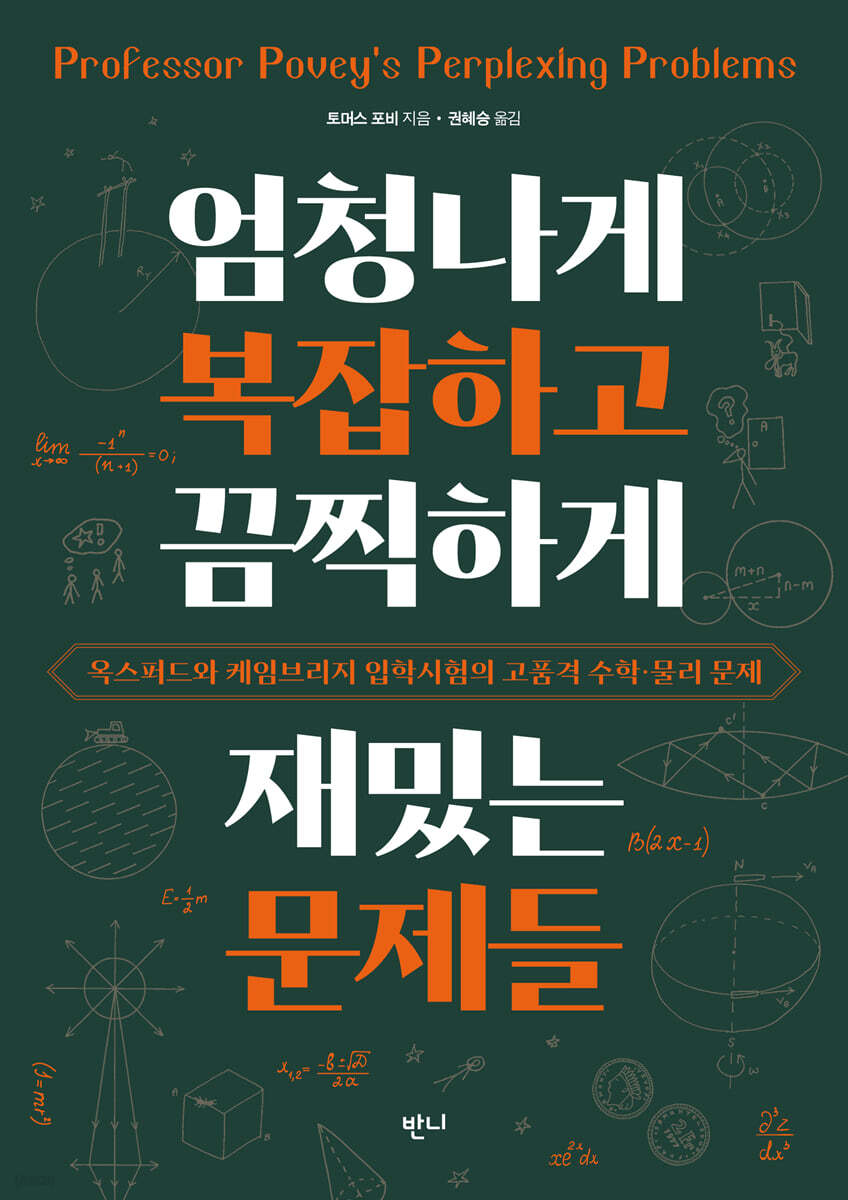
Incredibly complex and terribly fun problems
 |
Description
Book Introduction
Challenge yourself, enjoy your problems, and solve them beautifully!
Professor Poby, an admissions interviewer at Oxford University, selected
Math and science entrance exam questions from prestigious universities around the world
If we're torn about why studying math is so boring, isn't it because we're forced to do it for the sake of college? If we let go of the burden of college admission and revisit the math questions on the College Scholastic Ability Test, we might find some aspects of it more enjoyable than we expected.
University professors in many countries often select unique problems from outside the textbook to test applicants' critical thinking and application skills.
These problems are so interesting that they can keep even ordinary people absorbed in them.
This book is a compilation of his favorite questions from actual exams in physics and mathematics, his major fields, organized by Professor Povey, who created the entrance exam questions for Oxford University and participated as an interviewer, to a level suitable for prospective university students.
It contains a mix of questions designed to stimulate curiosity and fun, as well as standard questions used on college entrance exams.
Although it may seem difficult, the author says that students who have built a solid foundation in high school will be able to solve it without difficulty.
Above all, the mere fact that you can solve entrance exam questions for world-renowned universities while sitting in a corner of your room is attractive.
When reading a book, you can open it to any page whenever you have time, or you can set a period of time and focus on exploring it.
However, it is a good idea to refer to the number of stars indicating the level of difficulty so as not to lose the joy of solving problems.
A rating scale ranging from one star (★) for not-too-difficult questions to four stars (★★★★) for exceptionally difficult questions may be helpful.
Professor Poby, an admissions interviewer at Oxford University, selected
Math and science entrance exam questions from prestigious universities around the world
If we're torn about why studying math is so boring, isn't it because we're forced to do it for the sake of college? If we let go of the burden of college admission and revisit the math questions on the College Scholastic Ability Test, we might find some aspects of it more enjoyable than we expected.
University professors in many countries often select unique problems from outside the textbook to test applicants' critical thinking and application skills.
These problems are so interesting that they can keep even ordinary people absorbed in them.
This book is a compilation of his favorite questions from actual exams in physics and mathematics, his major fields, organized by Professor Povey, who created the entrance exam questions for Oxford University and participated as an interviewer, to a level suitable for prospective university students.
It contains a mix of questions designed to stimulate curiosity and fun, as well as standard questions used on college entrance exams.
Although it may seem difficult, the author says that students who have built a solid foundation in high school will be able to solve it without difficulty.
Above all, the mere fact that you can solve entrance exam questions for world-renowned universities while sitting in a corner of your room is attractive.
When reading a book, you can open it to any page whenever you have time, or you can set a period of time and focus on exploring it.
However, it is a good idea to refer to the number of stars indicating the level of difficulty so as not to lose the joy of solving problems.
A rating scale ranging from one star (★) for not-too-difficult questions to four stars (★★★★) for exceptionally difficult questions may be helpful.
- You can preview some of the book's contents.
Preview
index
Preface - A Strange Journey
Chapter 1 Geometry
Chapter 2 Mathematics
Chapter 3: Statics
Chapter 4 Dynamics and Collisions
Chapter 5 Circular Motion
Chapter 6 Simple Vibrational Motion
Chapter 7: Outrageous Inventions and Perpetual Motion
Chapter 8 Dynamics
Chapter 9 Electricity
Chapter 10 Gravity
Chapter 11 Optics
Chapter 12 Heat
Chapter 13 Buoyancy and Fluid Statics
Chapter 14 Estimation
Reviews
Chapter 1 Geometry
Chapter 2 Mathematics
Chapter 3: Statics
Chapter 4 Dynamics and Collisions
Chapter 5 Circular Motion
Chapter 6 Simple Vibrational Motion
Chapter 7: Outrageous Inventions and Perpetual Motion
Chapter 8 Dynamics
Chapter 9 Electricity
Chapter 10 Gravity
Chapter 11 Optics
Chapter 12 Heat
Chapter 13 Buoyancy and Fluid Statics
Chapter 14 Estimation
Reviews
Detailed image
.jpg)
Into the book
You may be reading this book hoping it will prepare you well for college entrance exams or for life after entering college.
I hope this book does both.
But I want to do this not by covering the syllabus in more detail, but by encouraging students to challenge themselves with more interesting and adventurous questions, with more unique and free-form answers.
--- p.25, "Strange Journey"
“You are truly extraordinary, Holmes.
“I don’t know how you do that, I really don’t,” Watson says, looking out the window.
“This is basic ballistics, Watson.
When a moving object collides elastically with a stationary object of the same mass, the objects always split apart at right angles to each other.
You see something similar every time you play billiards.
But you chose not to notice.”
Now let's solve the problem that Holmes and Watson were dealing with.
Show that in an elastic collision of objects of equal mass, if one of them was originally at rest, the objects always disperse at right angles to each other.
--- p.185, "Dynamics and Conflict"
In most of the exciting shows, cars race around a track while acrobats perform alongside the cars and motorcycles.
Perform acrobatics.
There are many videos of performances like this.
The ball of death is more thrilling than this.
This involves the motorcycle running around inside a sphere made of steel mesh.
The record for the most motorcycles spinning inside a death ball is ten, set in 2010 by a Chinese acrobatic troupe.
Consider a car driving around a 12-meter diameter wall of death.
Assume the car's center of gravity is 1 m from the wall, and the wheels on the same axle are 2 m away.
Calculate the minimum speed when the coefficient of static friction is as follows.
--- p.214, "Circular Motion"
This short chapter on heat examines conceptual issues related to heat transfer in solids and problems of time-varying or instantaneous heat transfer.
Solving these problems will require only basic, intuitive knowledge of what heat is, how it is stored, and how heat affects solids at the macroscopic level.
It is also important to note that heat is transferred from a hotter area to a colder area, that is, across a thermal gradient, at a rate proportional to the difference in temperature and its width.
But before we look at the problem, let's describe some generally useful concepts more formally.
I hope this book does both.
But I want to do this not by covering the syllabus in more detail, but by encouraging students to challenge themselves with more interesting and adventurous questions, with more unique and free-form answers.
--- p.25, "Strange Journey"
“You are truly extraordinary, Holmes.
“I don’t know how you do that, I really don’t,” Watson says, looking out the window.
“This is basic ballistics, Watson.
When a moving object collides elastically with a stationary object of the same mass, the objects always split apart at right angles to each other.
You see something similar every time you play billiards.
But you chose not to notice.”
Now let's solve the problem that Holmes and Watson were dealing with.
Show that in an elastic collision of objects of equal mass, if one of them was originally at rest, the objects always disperse at right angles to each other.
--- p.185, "Dynamics and Conflict"
In most of the exciting shows, cars race around a track while acrobats perform alongside the cars and motorcycles.
Perform acrobatics.
There are many videos of performances like this.
The ball of death is more thrilling than this.
This involves the motorcycle running around inside a sphere made of steel mesh.
The record for the most motorcycles spinning inside a death ball is ten, set in 2010 by a Chinese acrobatic troupe.
Consider a car driving around a 12-meter diameter wall of death.
Assume the car's center of gravity is 1 m from the wall, and the wheels on the same axle are 2 m away.
Calculate the minimum speed when the coefficient of static friction is as follows.
--- p.214, "Circular Motion"
This short chapter on heat examines conceptual issues related to heat transfer in solids and problems of time-varying or instantaneous heat transfer.
Solving these problems will require only basic, intuitive knowledge of what heat is, how it is stored, and how heat affects solids at the macroscopic level.
It is also important to note that heat is transferred from a hotter area to a colder area, that is, across a thermal gradient, at a rate proportional to the difference in temperature and its width.
But before we look at the problem, let's describe some generally useful concepts more formally.
--- p.388, "Heat"
Publisher's Review
It's incredibly complicated
Terribly fun problems
High-quality math and physics questions from Oxford and Cambridge entrance exams
Try solving it like a puzzle
Problems that reinforce mathematical concepts
There's no need to tense up and brace yourself just because it's an entrance exam for a world-renowned university.
This book is full of whimsical and playful problems, including treasure hunting using a pirate map, Holmes's mystery about finding an emerald thief, a businessman's plan to use the moon as a billboard, and questions about the relationship between breathing and body weight.
And the background of each problem contains concepts such as combinations, probability, momentum-centered coordinate system, gravitational field, and mass flux.
But that doesn't mean the problem is easy.
There's a reason it's titled "Incredibly Complex and Terribly Fun Problems."
If you've forgotten the math concepts you learned in high school, you may need to go back to your textbook.
There will certainly be readers who sigh and say, “I already knew all this.”
Let's solve the first problem in this book.
“An ant starts from one corner of a cube with a side length of unit length (1).
Calculate the shortest distance an ant can take to get from the starting point to the farthest vertex.
There is more than one solution to this problem.” Let’s look at the answer in the book.
For reference, the difficulty level is one star.
This book consists of 14 chapters. At the beginning of each chapter, basic knowledge that will help solve the problems in that chapter is organized.
Another indispensable pleasure of this book is solving problems related to various historical facts.
You can also gain background knowledge by calculating how many wheels the Aztecs would have used to haul a 50-ton stone, or by calculating the minimum force required to erect an obelisk in ancient Egypt.
Find it in real life
More fun problems
Birds that endanger airplanes, cable cars that run on water, races of cars and motorcycles on vertical walls, flying while sitting in a folding chair and relying on the buoyancy of helium balloons… … .
It may sound like a ridiculous story, but if you read this book, you will see that all these fictional events are true.
If we look at whether birds are a threat to airplanes, they really are.
According to the Bird Strike Prevention Team at the Central Research Institute, based in Sandhutton, England, the annual repair cost for bird strikes on commercial aircraft alone is approximately $1.2 billion, and bird strikes cause an average of 10 fatal accidents a year.
There's been a cable car on the north coast of Devon, England, that's been powered solely by water for over 120 years, and the cylindrical track with its vertical wall stunts first appeared in New York, USA, in 1911 and quickly spread to places like the UK and India, and you can easily find information online about an American who flew for 45 minutes in a helium balloon.
As we explore how such incredible things can happen, we are reminded that academia and real life are never completely separate.
Let's also find out what issues Korea appears in!
Math problems like toys
Can't you handle it?
Reflections on Mathematics Education
Please don't misunderstand that this book is only for those who are or were excellent in math and science.
Looking at the anecdotes from the author's childhood introduced in the book, when he was a student taking the entrance exam for Oxford University, he surprisingly did not know what the complex number symbol () was, did not even dream of being able to enter Oxford University, and gave many wrong answers to interview questions.
But there was something different about the author, as well as most ordinary people.
From a young age, he grew up enjoying activities that interested him, such as climbing trees, making firecrackers, woodworking, and flying kites.
For us, who are accustomed to the sight of students running from academy to academy after school until late at night, this is a story from a faraway land.
Perhaps it was thanks to the Oxford interviewers recognizing the creativity the author had unknowingly cultivated while pursuing his passion since childhood? The author, once embarrassed by his lack of skill compared to his classmates, passed the interview and now sits on the interview panel for Oxford University students.
And, of course, they argue that encouraging self-directed study is more important for achieving high-quality academics than simply doing well on high school exams and college entrance exams.
The author's advice to think of math problems as toys is worth considering for math educators, parents, and students.
Terribly fun problems
High-quality math and physics questions from Oxford and Cambridge entrance exams
Try solving it like a puzzle
Problems that reinforce mathematical concepts
There's no need to tense up and brace yourself just because it's an entrance exam for a world-renowned university.
This book is full of whimsical and playful problems, including treasure hunting using a pirate map, Holmes's mystery about finding an emerald thief, a businessman's plan to use the moon as a billboard, and questions about the relationship between breathing and body weight.
And the background of each problem contains concepts such as combinations, probability, momentum-centered coordinate system, gravitational field, and mass flux.
But that doesn't mean the problem is easy.
There's a reason it's titled "Incredibly Complex and Terribly Fun Problems."
If you've forgotten the math concepts you learned in high school, you may need to go back to your textbook.
There will certainly be readers who sigh and say, “I already knew all this.”
Let's solve the first problem in this book.
“An ant starts from one corner of a cube with a side length of unit length (1).
Calculate the shortest distance an ant can take to get from the starting point to the farthest vertex.
There is more than one solution to this problem.” Let’s look at the answer in the book.
For reference, the difficulty level is one star.
This book consists of 14 chapters. At the beginning of each chapter, basic knowledge that will help solve the problems in that chapter is organized.
Another indispensable pleasure of this book is solving problems related to various historical facts.
You can also gain background knowledge by calculating how many wheels the Aztecs would have used to haul a 50-ton stone, or by calculating the minimum force required to erect an obelisk in ancient Egypt.
Find it in real life
More fun problems
Birds that endanger airplanes, cable cars that run on water, races of cars and motorcycles on vertical walls, flying while sitting in a folding chair and relying on the buoyancy of helium balloons… … .
It may sound like a ridiculous story, but if you read this book, you will see that all these fictional events are true.
If we look at whether birds are a threat to airplanes, they really are.
According to the Bird Strike Prevention Team at the Central Research Institute, based in Sandhutton, England, the annual repair cost for bird strikes on commercial aircraft alone is approximately $1.2 billion, and bird strikes cause an average of 10 fatal accidents a year.
There's been a cable car on the north coast of Devon, England, that's been powered solely by water for over 120 years, and the cylindrical track with its vertical wall stunts first appeared in New York, USA, in 1911 and quickly spread to places like the UK and India, and you can easily find information online about an American who flew for 45 minutes in a helium balloon.
As we explore how such incredible things can happen, we are reminded that academia and real life are never completely separate.
Let's also find out what issues Korea appears in!
Math problems like toys
Can't you handle it?
Reflections on Mathematics Education
Please don't misunderstand that this book is only for those who are or were excellent in math and science.
Looking at the anecdotes from the author's childhood introduced in the book, when he was a student taking the entrance exam for Oxford University, he surprisingly did not know what the complex number symbol () was, did not even dream of being able to enter Oxford University, and gave many wrong answers to interview questions.
But there was something different about the author, as well as most ordinary people.
From a young age, he grew up enjoying activities that interested him, such as climbing trees, making firecrackers, woodworking, and flying kites.
For us, who are accustomed to the sight of students running from academy to academy after school until late at night, this is a story from a faraway land.
Perhaps it was thanks to the Oxford interviewers recognizing the creativity the author had unknowingly cultivated while pursuing his passion since childhood? The author, once embarrassed by his lack of skill compared to his classmates, passed the interview and now sits on the interview panel for Oxford University students.
And, of course, they argue that encouraging self-directed study is more important for achieving high-quality academics than simply doing well on high school exams and college entrance exams.
The author's advice to think of math problems as toys is worth considering for math educators, parents, and students.
GOODS SPECIFICS
- Date of issue: May 14, 2021
- Page count, weight, size: 468 pages | 652g | 152*215*30mm
- ISBN13: 9791191214635
- ISBN10: 119121463X
You may also like
카테고리
korean


korean

![ELLE 엘르 스페셜 에디션 A형 : 12월 [2025]](http://librairie.coreenne.fr/cdn/shop/files/b8e27a3de6c9538896439686c6b0e8fb.jpg?v=1766436872&width=3840)


