

How Math Becomes a Weapon
 |
Description
Book Introduction
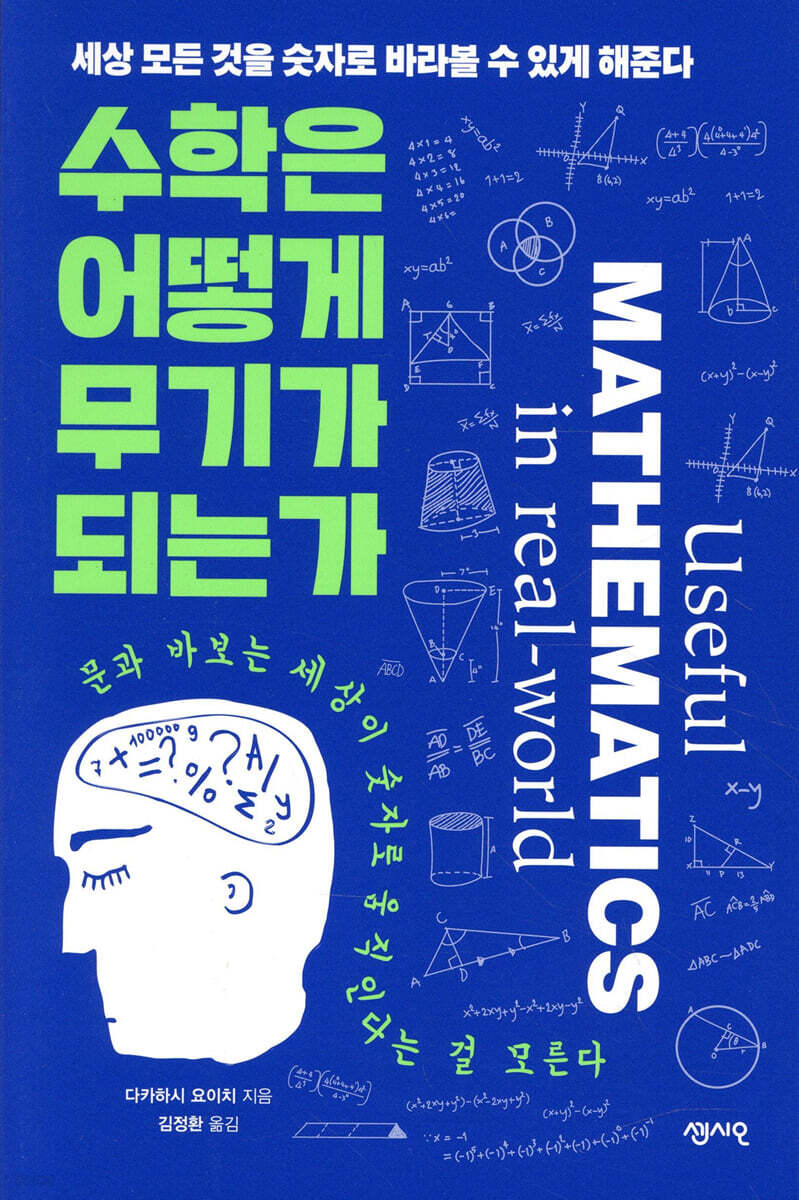
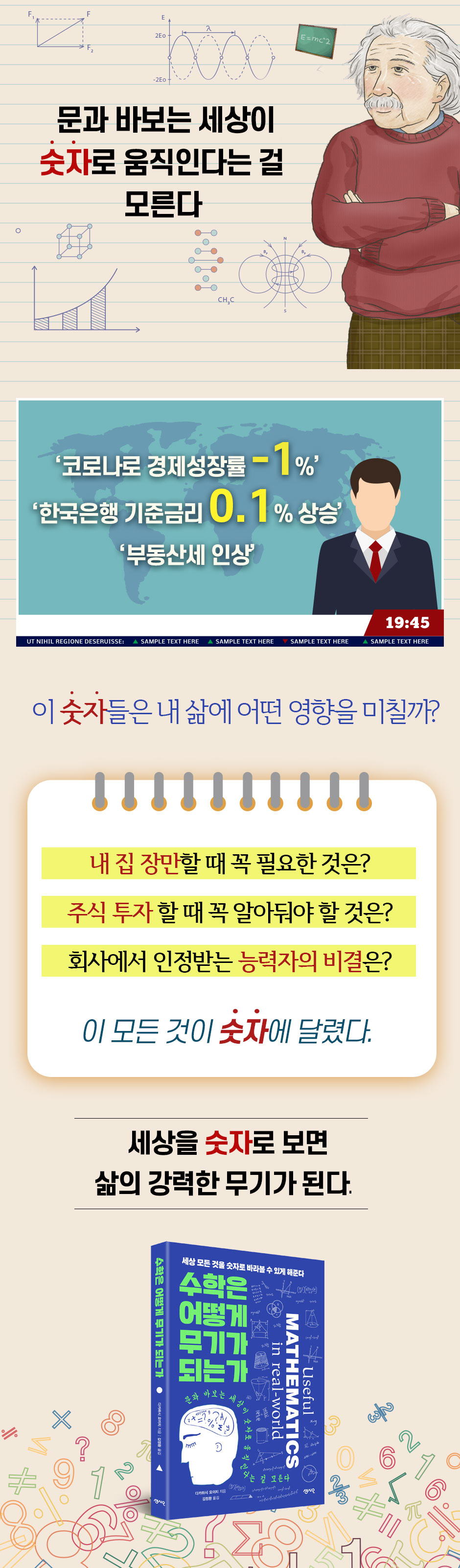
Math helps you in life? The Usefulness of Math That Humanities Students Don't Know! This book argues that numbers are what move the world, and that mathematical thinking, which views the world through numbers, is a powerful weapon in life. The book explains why the world revolves around numbers and how to view this world through numbers. And he says that simple arithmetic is sufficient for this kind of mathematical thinking, rather than mathematical knowledge. The world is made up of 'numbers'. Let me look around me. When we talk about salary increases, the returns on our insurance and pensions, loan interest rates, the latest mobile phone installments, and the odds of winning a subscription, we talk in numbers. It's the same when you look at the news that pours in every day. Whether it's economic talk, tax talk, or population decline, numbers are the foundation of the conversation, such as "Housing prices rose by 100 million won in one week" or "This year's economic growth rate is expected to be minus 1%." Mathematical thinking makes a difference in your work too. For example, when giving a presentation, expressing it in numbers, such as “To improve the goal by 10 percent, three tasks are needed”, is much more persuasive than abstract expressions like “maximization” or “efficient method.” However, people who are called 'liberal arts types' often lack mathematical thinking. Some people even react negatively when they hear the word numbers. But no matter how great your specs are, if you don't know that the world revolves around numbers, you're a fool. This book explains how numbers are used in the most frequently used fields in life. Let's start from nearby. If you're planning to buy a car on credit, get insurance, or consider a home loan, this is a great opportunity. I hope you realize how math can be a weapon in life. Your perspective on the world will change. |
- You can preview some of the book's contents.
Preview
index
Foreword: Fool, numbers make the world go round.
Chapter 1: How Mathematics Becomes a Weapon in My Life
What you need to buy a house is not your bank balance, but math skills.
Reading the numbers and managing your finances can change your life.
Do I Think Mathematically? Here's a Quick Guide
When it comes to explaining 'money,' there's no language as simple as accounting.
Just two numbers to know the real flow of money
The secret to seeing your assets and liabilities at a glance
Let's take a closer look at a company's income statement.
Debt isn't your fault! Not knowing the numbers is your fault.
The Mathematical Secrets of Reading Economic News Properly Revealed
If you are curious about the basics of economics and government finances,
So, are government bonds debt or not?
Chapter 2: How to Read Economics Fluently with Mathematics
You're saying that you can raise the price of pasta but not the price of ramen?
Even the headache of economics is okay if you just know the supply and demand curves.
What is the real reason why market prices change?
If you're a doormat and a fool who likes things when prices go down, pay attention!
The fact that the demand curves for ramen and luxury goods are the same
Just because ramen prices are rising doesn't mean it's inflation.
Good inflation vs.
bad inflation
Two ways the government manipulates prices that only I don't know about
Unemployment can be solved through supply and demand.
What is the correlation between population and economy?
Chapter 3: The Competitiveness of a Good Worker Comes from Numbers
The secret to a successful presentation is all about numbers.
Just because you're a science genius doesn't mean you're good at statistics.
Things to know when using statistics with errors in your work
Data isn't all the same; it has its own characteristics.
Statistics may seem complicated, but it's simple when you break it down.
Technology that simplifies a complex world
Normalizing all data works
Knowing statistics opens your eyes to new things.
Chapter 4: Find Your Future with Mathematics, Not a Fortune Teller
The risk I'm thinking of now isn't a danger.
What does a 50 percent chance of precipitation really mean?
Buying a lottery ticket is never 100% a loss!
The mathematical reason why even feelings can be calculated as probability
It is also possible to filter out spam emails well.
The moment when 'Really?' becomes the truth
The Secret to Winning Prizes! To Change or Not to Change?
Don't be fooled by how pharmaceutical companies use probability.
How can I rely on probability for my own safety and that of my country?
Can world peace also be described in terms of probability?
Chapter 5: The Fool's View of the World Changes Through Mathematical Thinking
A persuasive argument follows the process of mathematical reasoning.
Can exit polls accurately predict winners and losers?
Why Even Top Experts Failed to Predict Trump's Election
In the age of AI, you have to compete with what you excel at to win.
The 'pension collapse' is a misconception born of ignorance.
Chapter 1: How Mathematics Becomes a Weapon in My Life
What you need to buy a house is not your bank balance, but math skills.
Reading the numbers and managing your finances can change your life.
Do I Think Mathematically? Here's a Quick Guide
When it comes to explaining 'money,' there's no language as simple as accounting.
Just two numbers to know the real flow of money
The secret to seeing your assets and liabilities at a glance
Let's take a closer look at a company's income statement.
Debt isn't your fault! Not knowing the numbers is your fault.
The Mathematical Secrets of Reading Economic News Properly Revealed
If you are curious about the basics of economics and government finances,
So, are government bonds debt or not?
Chapter 2: How to Read Economics Fluently with Mathematics
You're saying that you can raise the price of pasta but not the price of ramen?
Even the headache of economics is okay if you just know the supply and demand curves.
What is the real reason why market prices change?
If you're a doormat and a fool who likes things when prices go down, pay attention!
The fact that the demand curves for ramen and luxury goods are the same
Just because ramen prices are rising doesn't mean it's inflation.
Good inflation vs.
bad inflation
Two ways the government manipulates prices that only I don't know about
Unemployment can be solved through supply and demand.
What is the correlation between population and economy?
Chapter 3: The Competitiveness of a Good Worker Comes from Numbers
The secret to a successful presentation is all about numbers.
Just because you're a science genius doesn't mean you're good at statistics.
Things to know when using statistics with errors in your work
Data isn't all the same; it has its own characteristics.
Statistics may seem complicated, but it's simple when you break it down.
Technology that simplifies a complex world
Normalizing all data works
Knowing statistics opens your eyes to new things.
Chapter 4: Find Your Future with Mathematics, Not a Fortune Teller
The risk I'm thinking of now isn't a danger.
What does a 50 percent chance of precipitation really mean?
Buying a lottery ticket is never 100% a loss!
The mathematical reason why even feelings can be calculated as probability
It is also possible to filter out spam emails well.
The moment when 'Really?' becomes the truth
The Secret to Winning Prizes! To Change or Not to Change?
Don't be fooled by how pharmaceutical companies use probability.
How can I rely on probability for my own safety and that of my country?
Can world peace also be described in terms of probability?
Chapter 5: The Fool's View of the World Changes Through Mathematical Thinking
A persuasive argument follows the process of mathematical reasoning.
Can exit polls accurately predict winners and losers?
Why Even Top Experts Failed to Predict Trump's Election
In the age of AI, you have to compete with what you excel at to win.
The 'pension collapse' is a misconception born of ignorance.
Detailed image
Publisher's Review
Math is essential for buying a home and getting a job.
Have you ever been tempted by ads that promise "Buy your own home with zero down payment"? If so, it's time to check your accounting knowledge.
The author says that such advertisements trap people by not addressing the issue of 'interest'.
If you don't know the principles and rules of how money moves and flows in everyday life, you may end up in a difficult financial situation.
And what tells us the flow of money most accurately is mathematics.
This book explains the basic principles of the balance sheet and income statement, which are considered the foundation of accounting in mathematics, in an easy-to-understand manner using specific examples.
The article, which makes the public anxious by claiming that the national debt is 1,000 trillion won, is also explained in detail through the basic principles of accounting.
The author says that mathematics is a tool that can provide clear and reliable information about the management status of a company as well as the flow of money.
And he says that through the flow of money, you can even understand the flow of power.
Above all, if mathematical thinking becomes second nature, you can accurately grasp the risks you may face when taking economic action, not through vague "feelings" or "atmosphere," but through numbers.
Knowing supply and demand solves even the most thorny economic problems.
Raising prices at ramen restaurants is difficult, but why can famous restaurants raise prices without hesitation? Why do prices for the same item fluctuate so frequently? All the economic situations we're curious about can be understood at a glance with just one graph.
This is a supply and demand graph.
If you understand the demand curve and supply curve on this graph, and what they mean at the point where they intersect, you can immediately understand how the price of goods is determined and why it changes.
In this way, not only the principle of determining the price of a single product, but also the broader economic perspective of jobs, wages, and government economic policies can all be understood through the movement of supply and demand curves.
The author says that thinking clearly about all economic phenomena not through feelings or intuition, but from the perspective of 'movements in the demand and supply curves' is the basis of understanding things quantitatively and is the foundation of economics.
Also, in order to understand the economy, it is most important to consider the background of why the price of a single product has risen.
Think about how the demand curve shifts when a product becomes more popular, and if the price of a product does not rise even though the product becomes more popular, try to guess the reason through the supply curve.
The author says that this is the basic attitude for reading the world through economics, and a shortcut to more accurately understanding the movements of the world.
Knowing math changes your perspective on the world.
In the 2016 US presidential election, most media outlets failed to predict Trump's victory.
Even in the 2017 Japanese House of Representatives election, some media outlets' predictions were completely off the mark.
Most countries today use exit polls to predict election results just hours before the event.
Even when making predictions using the same data, some people make correct predictions while others make incorrect predictions.
Why is this? The author argues that even objective data can lead to incorrect predictions when the bias of the person interpreting the data is at play.
This book provides an engaging explanation of the theories of statistics and probability, which allow us to predict the future based on objective facts, including election results.
From an objective standpoint, buying a lottery ticket is a loss, but from a subjective standpoint, the results can be completely different.
This book uses everyday examples to explain in an engaging way how the theories of statistics and probability, once perceived as difficult, can be applied to predict and logically understand a complex world.
And we talk specifically about how statistical thinking can help us become more persuasive in our presentations.
Through this book, readers will gain a step closer to developing a mathematical mindset that can offer solutions to everyday and business problems and even penetrate political, economic, and social issues.
Have you ever been tempted by ads that promise "Buy your own home with zero down payment"? If so, it's time to check your accounting knowledge.
The author says that such advertisements trap people by not addressing the issue of 'interest'.
If you don't know the principles and rules of how money moves and flows in everyday life, you may end up in a difficult financial situation.
And what tells us the flow of money most accurately is mathematics.
This book explains the basic principles of the balance sheet and income statement, which are considered the foundation of accounting in mathematics, in an easy-to-understand manner using specific examples.
The article, which makes the public anxious by claiming that the national debt is 1,000 trillion won, is also explained in detail through the basic principles of accounting.
The author says that mathematics is a tool that can provide clear and reliable information about the management status of a company as well as the flow of money.
And he says that through the flow of money, you can even understand the flow of power.
Above all, if mathematical thinking becomes second nature, you can accurately grasp the risks you may face when taking economic action, not through vague "feelings" or "atmosphere," but through numbers.
Knowing supply and demand solves even the most thorny economic problems.
Raising prices at ramen restaurants is difficult, but why can famous restaurants raise prices without hesitation? Why do prices for the same item fluctuate so frequently? All the economic situations we're curious about can be understood at a glance with just one graph.
This is a supply and demand graph.
If you understand the demand curve and supply curve on this graph, and what they mean at the point where they intersect, you can immediately understand how the price of goods is determined and why it changes.
In this way, not only the principle of determining the price of a single product, but also the broader economic perspective of jobs, wages, and government economic policies can all be understood through the movement of supply and demand curves.
The author says that thinking clearly about all economic phenomena not through feelings or intuition, but from the perspective of 'movements in the demand and supply curves' is the basis of understanding things quantitatively and is the foundation of economics.
Also, in order to understand the economy, it is most important to consider the background of why the price of a single product has risen.
Think about how the demand curve shifts when a product becomes more popular, and if the price of a product does not rise even though the product becomes more popular, try to guess the reason through the supply curve.
The author says that this is the basic attitude for reading the world through economics, and a shortcut to more accurately understanding the movements of the world.
Knowing math changes your perspective on the world.
In the 2016 US presidential election, most media outlets failed to predict Trump's victory.
Even in the 2017 Japanese House of Representatives election, some media outlets' predictions were completely off the mark.
Most countries today use exit polls to predict election results just hours before the event.
Even when making predictions using the same data, some people make correct predictions while others make incorrect predictions.
Why is this? The author argues that even objective data can lead to incorrect predictions when the bias of the person interpreting the data is at play.
This book provides an engaging explanation of the theories of statistics and probability, which allow us to predict the future based on objective facts, including election results.
From an objective standpoint, buying a lottery ticket is a loss, but from a subjective standpoint, the results can be completely different.
This book uses everyday examples to explain in an engaging way how the theories of statistics and probability, once perceived as difficult, can be applied to predict and logically understand a complex world.
And we talk specifically about how statistical thinking can help us become more persuasive in our presentations.
Through this book, readers will gain a step closer to developing a mathematical mindset that can offer solutions to everyday and business problems and even penetrate political, economic, and social issues.
GOODS SPECIFICS
- Date of publication: June 23, 2020
- Page count, weight, size: 202 pages | 294g | 140*210*20mm
- ISBN13: 9791190356602
- ISBN10: 1190356600
You may also like
카테고리
korean


korean

![ELLE 엘르 스페셜 에디션 A형 : 12월 [2025]](http://librairie.coreenne.fr/cdn/shop/files/b8e27a3de6c9538896439686c6b0e8fb.jpg?v=1766436872&width=3840)


