

hyperspace
 |
Description
Book Introduction
Nature becomes simpler as it goes down to its fundamental level!
The unification of natural laws in higher-dimensional spacetime
"Parallel Universes" and "Nothing is Impossible": Michio Kaku Unravels the Dimensional Revolution in Modern Physics
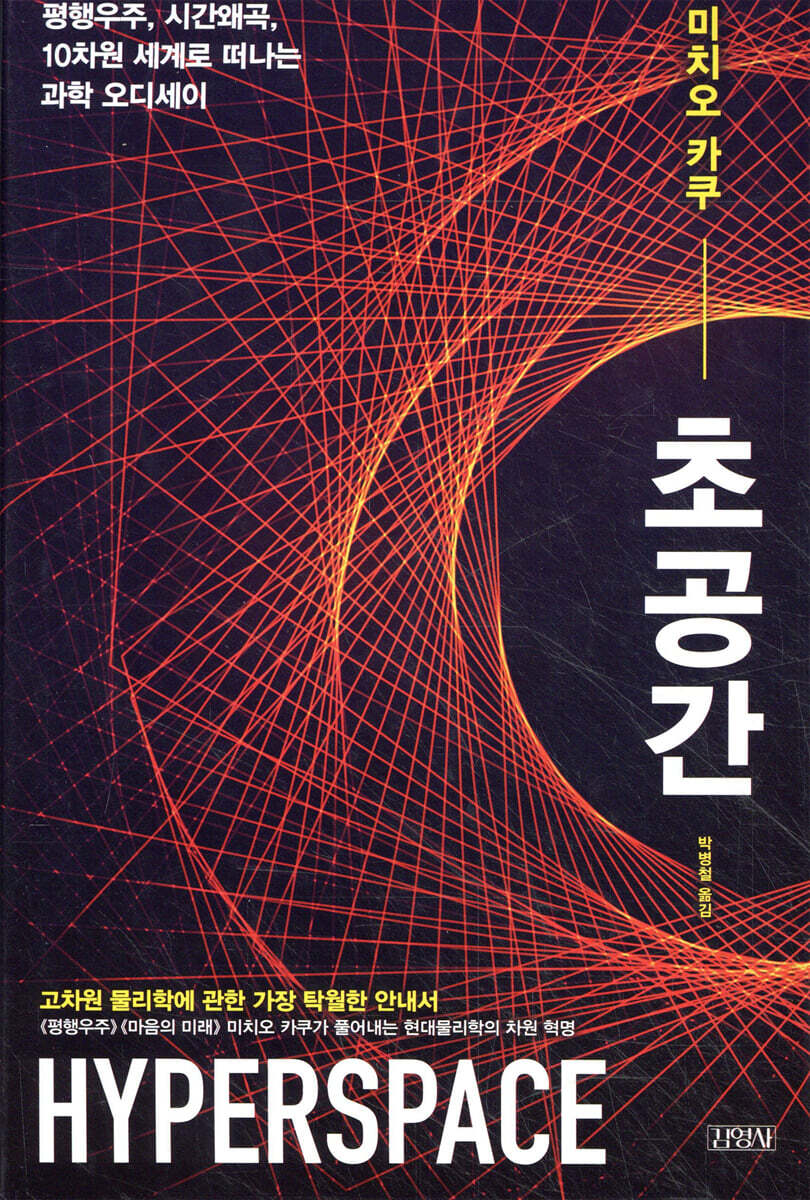
A hyperspace journey with Michio Kaku, a world-renowned theoretical physicist, futurist, and science entertainer.
"Hyperspace" offers a glimpse into the relationships between a surprisingly diverse range of topics, from relativity to quantum mechanics, black holes, wormholes, parallel universes, and the future of the universe.
This is the first general science book written solely by Michio Kaku. It is the most outstanding guide to high-dimensional physics, a must-read for modern physics students, and a classic of modern science that revolutionized our understanding.
Embark on a hyperspace journey with this new translation, faithful annotations, and commentary by Dr. Park Byeong-cheol, a science translator who has translated all of Michio Kaku's major works.
The unification of natural laws in higher-dimensional spacetime
"Parallel Universes" and "Nothing is Impossible": Michio Kaku Unravels the Dimensional Revolution in Modern Physics
A hyperspace journey with Michio Kaku, a world-renowned theoretical physicist, futurist, and science entertainer.
"Hyperspace" offers a glimpse into the relationships between a surprisingly diverse range of topics, from relativity to quantum mechanics, black holes, wormholes, parallel universes, and the future of the universe.
This is the first general science book written solely by Michio Kaku. It is the most outstanding guide to high-dimensional physics, a must-read for modern physics students, and a classic of modern science that revolutionized our understanding.
Embark on a hyperspace journey with this new translation, faithful annotations, and commentary by Dr. Park Byeong-cheol, a science translator who has translated all of Michio Kaku's major works.
- You can preview some of the book's contents.
Preview
index
introduction
Part 1: The 5th Dimension
Chapter 1: A World Beyond Time and Space
Chapter 2: The Mathematician and the Magician
Chapter 3: The Man Who Saw the Fourth Dimension
Chapter 4: The Secret of Light: Vibrations in the Fifth Dimension
Part 2: Unification in the Tenth Dimension
Chapter 5 Quantum Theory
Chapter 6: Einstein's Revenge
Chapter 7: Superstring Theory
Chapter 8: A Signal from the Tenth Dimension
Chapter 9 Before Creation
Part 3: Wormholes - Doors to Other Universes
Chapter 10: Black Holes and Parallel Universes
Chapter 11: Building a Time Machine
Chapter 12: Colliding Universes
Part 4: The Ruler of Hyperspace
Chapter 13 Beyond the Future
Chapter 14: The Fate of the Universe
Chapter 15 Conclusion
Acknowledgements
Translator's Note
Huzhou
References and Further Reading
Search
Part 1: The 5th Dimension
Chapter 1: A World Beyond Time and Space
Chapter 2: The Mathematician and the Magician
Chapter 3: The Man Who Saw the Fourth Dimension
Chapter 4: The Secret of Light: Vibrations in the Fifth Dimension
Part 2: Unification in the Tenth Dimension
Chapter 5 Quantum Theory
Chapter 6: Einstein's Revenge
Chapter 7: Superstring Theory
Chapter 8: A Signal from the Tenth Dimension
Chapter 9 Before Creation
Part 3: Wormholes - Doors to Other Universes
Chapter 10: Black Holes and Parallel Universes
Chapter 11: Building a Time Machine
Chapter 12: Colliding Universes
Part 4: The Ruler of Hyperspace
Chapter 13 Beyond the Future
Chapter 14: The Fate of the Universe
Chapter 15 Conclusion
Acknowledgements
Translator's Note
Huzhou
References and Further Reading
Search
Into the book
Perhaps future historians will write in the final chapter of the history of science that humanity made the greatest advance in history by abandoning the conventional four-dimensional spacetime and embracing the concept of hyperspace.
--- p.16
The reason quantum theory does not conform to our common sense is because it converts all physical quantities into probabilities.
--- p.191
Quantum theory does not fit our common sense at all.
What could have gone wrong? No.
There is nothing wrong.
Originally, nature had no interest in human common sense.
--- p.191
Scientists prefer an 'economical' nature.
No, I believe that nature is inherently economic.
Although there is no rigorous proof, looking back on past experience, there has never been a case where this was not the case.
Nature never overproduces when it comes to creating physical, biological, and chemical structures.
A closer look at the structure of a panda, a protein molecule, or a black hole reveals the philosophy of efficiency—maximum effect with minimum design—permeating the entire structure.
--- p.212
If we define poetry as 'a collection of words arranged according to the author's subjective rules', it is of no help to those who do not know poetry.
Not only is it tasteless, but the definition itself is wrong.
This kind of definition misses the subtle connection between poet and reader.
Poetry contains a high concentration of the author's feelings and imagination, so it contains meaning beyond the words printed on paper.
For example, when the short words of the traditional Japanese three-line poem, haiku, are conveyed to the reader's mind, a world of new feelings and sensations unfolds.
In this respect, mathematics is not much different.
Mathematical equations may not be as emotionally moving as music or poetry, but they offer the "progress" and "logic" that fuel scientists' passion.
The general public may not feel much excitement when looking at mathematical equations, but to scientists, they are like a magnificent symphony.
--- p.214
To reach a quantum theory of gravity, several difficult obstacles must be overcome.
One of them is that gravity is a very weak force.
For example, it would take the mass of the entire Earth to hold a single piece of paper on my desk in its current state.
This is because the weight of the paper is the gravitational force acting between the Earth and the paper.
However, if I bring the comb close to the paper after combing my hair, I can easily overcome the Earth's gravity and lift the paper.
This means that the electric force of the electrons in a tiny comb is much stronger than the gravity exerted by the entire Earth.
--- p.226
In the 19th century, some scientists considered the stars in the night sky to be "objects of study too distant to approach."
It was thought that the distance was too far to allow experimental observation or measurement.
In 1825, the French philosopher and social critic Auguste Comte wrote in his book Lectures on Positive Philosophy:
“Stars are so far away from us that we can't tell anything about them other than that they're just 'tiny dots in the night sky.'
“It is impossible for any current observation equipment, or any equipment invented in the future, to reach the stars.”
It is ironic that at that time, figuring out the composition of stars was considered beyond the realm of science, yet around the same time, the German physicist Joseph von Fraunhofer achieved the impossible.
--- p.303
What we learn from the laws of physics is not practicality, but possibility.
That is, we can distinguish between what is possible and what is impossible from the laws of physics, but we cannot distinguish between what is practical and what is impractical.
--- p.394
Humanity has lived on Earth for 2 million years, but the scientific achievements made in the past 200 years are so vast that they cannot be compared to the scientific knowledge accumulated before that time.
This is because the scientific achievements made over a certain period of time are proportional to the amount of content accumulated before that time.
Simply put, the more you know, the faster you learn new things.
--- p.433
When looking ahead a few years, it's not unreasonable to assume that science will advance gradually and steadily. However, when looking ahead several decades into the future, sudden advances in new fields become important variables, making accurate predictions more difficult.
--- p.437~438
If I were asked to name one of the most important and profound discoveries made in physics over the past hundred years, I would say without hesitation that nature becomes simpler as it gets closer to the fundamental level.
--- p.493
Most scientists don't like to talk about God or a creator.
The word 'God' can be interpreted differently by different individuals, so arguing about it without precisely defining its meaning can easily obscure the essence of the issue.
So, to clarify the point of the argument, I would like to suggest that we divide the meaning of God into two categories.
These are the ‘God who performs miracles (God of Miracles)’ and the ‘God who creates order (God of Order)’.
The God that scientists speak of is primarily a God of order.
--- p.519
When you think about the scale of the universe, you can't help but feel shabby.
But I think the most profound realization a scientist can have (it's almost like a religious realization) is that 'our bodies are descendants of stars and our minds can understand the laws of the universe.'
All the atoms that make up our bodies were created through nuclear fusion inside a star long ago, making them older than any mountain or river on Earth.
We are literally 'beings born from stardust'.
These atoms combined to create humans who are intelligent enough to figure out the laws of the universe, and as these humans explore the laws of the universe, they trace the origins of their own existence. If the Creator were to see this, He would be truly amazed and deeply moved.
--- p.523~524
On a cosmic scale, we are just waking up from a long slumber.
But with our limited abilities we can only discover nature's deepest secrets.
Could this be the reason and purpose of our existence?
Some people find meaning in life in personal accomplishments, personal relationships, or personal experiences.
But I think life has meaning simply because we are endowed with intelligence superior enough to uncover nature's ultimate secrets.
--- p.16
The reason quantum theory does not conform to our common sense is because it converts all physical quantities into probabilities.
--- p.191
Quantum theory does not fit our common sense at all.
What could have gone wrong? No.
There is nothing wrong.
Originally, nature had no interest in human common sense.
--- p.191
Scientists prefer an 'economical' nature.
No, I believe that nature is inherently economic.
Although there is no rigorous proof, looking back on past experience, there has never been a case where this was not the case.
Nature never overproduces when it comes to creating physical, biological, and chemical structures.
A closer look at the structure of a panda, a protein molecule, or a black hole reveals the philosophy of efficiency—maximum effect with minimum design—permeating the entire structure.
--- p.212
If we define poetry as 'a collection of words arranged according to the author's subjective rules', it is of no help to those who do not know poetry.
Not only is it tasteless, but the definition itself is wrong.
This kind of definition misses the subtle connection between poet and reader.
Poetry contains a high concentration of the author's feelings and imagination, so it contains meaning beyond the words printed on paper.
For example, when the short words of the traditional Japanese three-line poem, haiku, are conveyed to the reader's mind, a world of new feelings and sensations unfolds.
In this respect, mathematics is not much different.
Mathematical equations may not be as emotionally moving as music or poetry, but they offer the "progress" and "logic" that fuel scientists' passion.
The general public may not feel much excitement when looking at mathematical equations, but to scientists, they are like a magnificent symphony.
--- p.214
To reach a quantum theory of gravity, several difficult obstacles must be overcome.
One of them is that gravity is a very weak force.
For example, it would take the mass of the entire Earth to hold a single piece of paper on my desk in its current state.
This is because the weight of the paper is the gravitational force acting between the Earth and the paper.
However, if I bring the comb close to the paper after combing my hair, I can easily overcome the Earth's gravity and lift the paper.
This means that the electric force of the electrons in a tiny comb is much stronger than the gravity exerted by the entire Earth.
--- p.226
In the 19th century, some scientists considered the stars in the night sky to be "objects of study too distant to approach."
It was thought that the distance was too far to allow experimental observation or measurement.
In 1825, the French philosopher and social critic Auguste Comte wrote in his book Lectures on Positive Philosophy:
“Stars are so far away from us that we can't tell anything about them other than that they're just 'tiny dots in the night sky.'
“It is impossible for any current observation equipment, or any equipment invented in the future, to reach the stars.”
It is ironic that at that time, figuring out the composition of stars was considered beyond the realm of science, yet around the same time, the German physicist Joseph von Fraunhofer achieved the impossible.
--- p.303
What we learn from the laws of physics is not practicality, but possibility.
That is, we can distinguish between what is possible and what is impossible from the laws of physics, but we cannot distinguish between what is practical and what is impractical.
--- p.394
Humanity has lived on Earth for 2 million years, but the scientific achievements made in the past 200 years are so vast that they cannot be compared to the scientific knowledge accumulated before that time.
This is because the scientific achievements made over a certain period of time are proportional to the amount of content accumulated before that time.
Simply put, the more you know, the faster you learn new things.
--- p.433
When looking ahead a few years, it's not unreasonable to assume that science will advance gradually and steadily. However, when looking ahead several decades into the future, sudden advances in new fields become important variables, making accurate predictions more difficult.
--- p.437~438
If I were asked to name one of the most important and profound discoveries made in physics over the past hundred years, I would say without hesitation that nature becomes simpler as it gets closer to the fundamental level.
--- p.493
Most scientists don't like to talk about God or a creator.
The word 'God' can be interpreted differently by different individuals, so arguing about it without precisely defining its meaning can easily obscure the essence of the issue.
So, to clarify the point of the argument, I would like to suggest that we divide the meaning of God into two categories.
These are the ‘God who performs miracles (God of Miracles)’ and the ‘God who creates order (God of Order)’.
The God that scientists speak of is primarily a God of order.
--- p.519
When you think about the scale of the universe, you can't help but feel shabby.
But I think the most profound realization a scientist can have (it's almost like a religious realization) is that 'our bodies are descendants of stars and our minds can understand the laws of the universe.'
All the atoms that make up our bodies were created through nuclear fusion inside a star long ago, making them older than any mountain or river on Earth.
We are literally 'beings born from stardust'.
These atoms combined to create humans who are intelligent enough to figure out the laws of the universe, and as these humans explore the laws of the universe, they trace the origins of their own existence. If the Creator were to see this, He would be truly amazed and deeply moved.
--- p.523~524
On a cosmic scale, we are just waking up from a long slumber.
But with our limited abilities we can only discover nature's deepest secrets.
Could this be the reason and purpose of our existence?
Some people find meaning in life in personal accomplishments, personal relationships, or personal experiences.
But I think life has meaning simply because we are endowed with intelligence superior enough to uncover nature's ultimate secrets.
--- p.525
Publisher's Review
A book that will revolutionize the way you see the world!
The most excellent guide to high-dimensional physics
A must-read for modern physics and a scientific classic that revolutionized our understanding.
Hyperspace, the first general science book written solely by world-renowned theoretical physicist and futurist Michio Kaku, has been published.
After its publication in 1994, it was selected as a 'Book of the Year' by the New York Times and the Washington Post, and announced the birth of a 'smart, sharp, humorous, and kind physicist.'
In 2016, it was included in the Oxford Landmark Science series, which selects only “essential readings in modern science, books that have changed the way we think,” proving that it is a true classic of modern science.
It was published in Korea by Kim Young-sa in 1997 and went out of print for a while, but was republished after 20 years due to reader requests.
The newly published "Hyperspace" was newly translated by Dr. Park Byeong-cheol, who has translated all of Michio Kaku's major works, including "Parallel Universe," "Nothing is Impossible," "Physics of the Future," and "The Future of the Mind," and the translator's notes and commentary faithfully supplement the content that has changed since the first edition was published.
Hyperspace is a general term for a space with a higher dimension than four-dimensional spacetime, and hyperspace theory is also called by other names such as 'Kaluza-Klein theory', 'supergravity theory', and 'superstring theory'.
This theory is a strong candidate for the 'Theory of Everything', the holy grail of physics that Einstein was obsessed with in his later years. Michio Kaku is convinced that if the hyperspace theory is correct, the scientific and philosophical concepts of the universe will undergo a revolutionary change, and he defines it as a modern-day 'scientific revolution'.
The author says that he wrote this book because there was no book that properly introduced the 'theory of high-dimensional space', which has such great significance.
As the author himself puts it, "Hyperspace" is "the first book to explain hyperspace theory in a rigorous and understandable way," and even now, 25 years after its publication, it is still considered "the best book on higher-dimensional physics."
Nature becomes simpler as it goes down to its fundamental level!
The unification of natural laws in higher-dimensional spacetime
All natural phenomena are described by four fundamental forces.
It is no exaggeration to say that scientists have been struggling to figure this out for nearly two thousand years.
1) Electromagnetic force - Electromagnetic force appears in various forms such as electricity, magnetism, and light.
2) Strong nuclear force (strong force) - The strong force provides energy to burning stars.
The sun was able to shine thanks to the force, so it can be said that humans ultimately came to exist thanks to the force.
3) Weak nuclear force (weak force) - The weak force is the force involved in all types of radioactive decay.
4) Gravity - Gravity is the force that holds planets, including Earth, in their orbits and maintains the shape of galaxies.
The greatest challenge in theoretical physics is to find a 'theory of everything' that unifies these four forces, and this was the problem that Einstein was preoccupied with in his later years.
Quantum mechanics, which emerged in the early 20th century, brought the microscopic world, which had been a forbidden realm for the past two thousand years, into the realm of research.
What is matter made of? What is the source of the force that holds matter together? Why does matter exist in such diverse forms? Quantum mechanics has easily solved these intricate questions that have plagued physicists for centuries.
Quantum mechanics continued to advance, giving rise to the Yang-Mills field theory, a theory that unifies the three forces excluding gravity.
Physicists even gave this theory a name: the 'Standard Model'.
But quantum mechanics couldn't capture gravity.
The interior of a black hole, the state of the universe just before or just after the Big Bang, etc. are areas where general relativity and quantum mechanics must be applied simultaneously, but the two theories were too different.
This is where hyperspace theory comes into play.
Superstring theory, another name for hyperspace theory, explains the properties of all elementary particles as 'vibrating strings'.
In many ways, it seemed like a good candidate for the grand unification theory and the theory of everything, but the problem was that the background dimension was 10 and there were five logically possible string theories.
The first edition of Hyperspace was published in 1994, at a time when the popularity of string theory was gradually waning due to its limitations.
However, in 1995, Edward Witten, a leading figure in string theory, announced M-theory, which unified five theories into one, and string theory entered its second revolution.
However, despite its prominence, string theory has not yet been able to calculate a single observable physical quantity.
If it is a normal physical theory, it should be possible to determine whether it is true or false by calculating physical quantities that can be verified through experiments.
So, is string theory a failed theory? It's still too early to draw a conclusion.
But whatever the conclusion, string theory raises fascinating questions and ideas related to physics, geometry, and topology, and it will likely serve as Newton's "shoulders of giants."
A hyperspace journey through history, art, religion, and philosophy, centered around science.
The Dimensional Revolution in Modern Physics Unraveled by Michio Kaku
Michio Kaku divided this book into four parts.
Part 1 explores the history of hyperspace, and Part 2 explores the possibility that hyperspace theory could become the theory of everything.
Part 3 explores the possibility of space being torn apart and explores interesting topics such as black holes, wormholes, parallel universes, time travel, and extraterrestrial life through hyperspace theory.
Finally, in Part 4, we explore when, if hyperspace theory is correct, we might be able to put it to use.
The Washington Post likened the book to a Tilt-A-Whirl, an amusement ride that spins and stops in unpredictable directions.
In addition to his own childhood and the backstories of famous scientists, he also names artists like Dali, Picasso, Dostoevsky, and Oscar Wilde, and draws on philosophers like Aristotle, Thomas Aquinas, and Kant.
In addition, dramas and movies such as [Star Wars], [Star Trek], [Back to the Future], and [Contact] frequently appear and discuss God.
Michio Kaku's narrative style, which moves freely between science, history, art, religion, and philosophy over four parts, leaves no room for readers to get bored.
When you come out of this ride-like book, you will literally see the world in a revolutionary way.
The most excellent guide to high-dimensional physics
A must-read for modern physics and a scientific classic that revolutionized our understanding.
Hyperspace, the first general science book written solely by world-renowned theoretical physicist and futurist Michio Kaku, has been published.
After its publication in 1994, it was selected as a 'Book of the Year' by the New York Times and the Washington Post, and announced the birth of a 'smart, sharp, humorous, and kind physicist.'
In 2016, it was included in the Oxford Landmark Science series, which selects only “essential readings in modern science, books that have changed the way we think,” proving that it is a true classic of modern science.
It was published in Korea by Kim Young-sa in 1997 and went out of print for a while, but was republished after 20 years due to reader requests.
The newly published "Hyperspace" was newly translated by Dr. Park Byeong-cheol, who has translated all of Michio Kaku's major works, including "Parallel Universe," "Nothing is Impossible," "Physics of the Future," and "The Future of the Mind," and the translator's notes and commentary faithfully supplement the content that has changed since the first edition was published.
Hyperspace is a general term for a space with a higher dimension than four-dimensional spacetime, and hyperspace theory is also called by other names such as 'Kaluza-Klein theory', 'supergravity theory', and 'superstring theory'.
This theory is a strong candidate for the 'Theory of Everything', the holy grail of physics that Einstein was obsessed with in his later years. Michio Kaku is convinced that if the hyperspace theory is correct, the scientific and philosophical concepts of the universe will undergo a revolutionary change, and he defines it as a modern-day 'scientific revolution'.
The author says that he wrote this book because there was no book that properly introduced the 'theory of high-dimensional space', which has such great significance.
As the author himself puts it, "Hyperspace" is "the first book to explain hyperspace theory in a rigorous and understandable way," and even now, 25 years after its publication, it is still considered "the best book on higher-dimensional physics."
Nature becomes simpler as it goes down to its fundamental level!
The unification of natural laws in higher-dimensional spacetime
All natural phenomena are described by four fundamental forces.
It is no exaggeration to say that scientists have been struggling to figure this out for nearly two thousand years.
1) Electromagnetic force - Electromagnetic force appears in various forms such as electricity, magnetism, and light.
2) Strong nuclear force (strong force) - The strong force provides energy to burning stars.
The sun was able to shine thanks to the force, so it can be said that humans ultimately came to exist thanks to the force.
3) Weak nuclear force (weak force) - The weak force is the force involved in all types of radioactive decay.
4) Gravity - Gravity is the force that holds planets, including Earth, in their orbits and maintains the shape of galaxies.
The greatest challenge in theoretical physics is to find a 'theory of everything' that unifies these four forces, and this was the problem that Einstein was preoccupied with in his later years.
Quantum mechanics, which emerged in the early 20th century, brought the microscopic world, which had been a forbidden realm for the past two thousand years, into the realm of research.
What is matter made of? What is the source of the force that holds matter together? Why does matter exist in such diverse forms? Quantum mechanics has easily solved these intricate questions that have plagued physicists for centuries.
Quantum mechanics continued to advance, giving rise to the Yang-Mills field theory, a theory that unifies the three forces excluding gravity.
Physicists even gave this theory a name: the 'Standard Model'.
But quantum mechanics couldn't capture gravity.
The interior of a black hole, the state of the universe just before or just after the Big Bang, etc. are areas where general relativity and quantum mechanics must be applied simultaneously, but the two theories were too different.
This is where hyperspace theory comes into play.
Superstring theory, another name for hyperspace theory, explains the properties of all elementary particles as 'vibrating strings'.
In many ways, it seemed like a good candidate for the grand unification theory and the theory of everything, but the problem was that the background dimension was 10 and there were five logically possible string theories.
The first edition of Hyperspace was published in 1994, at a time when the popularity of string theory was gradually waning due to its limitations.
However, in 1995, Edward Witten, a leading figure in string theory, announced M-theory, which unified five theories into one, and string theory entered its second revolution.
However, despite its prominence, string theory has not yet been able to calculate a single observable physical quantity.
If it is a normal physical theory, it should be possible to determine whether it is true or false by calculating physical quantities that can be verified through experiments.
So, is string theory a failed theory? It's still too early to draw a conclusion.
But whatever the conclusion, string theory raises fascinating questions and ideas related to physics, geometry, and topology, and it will likely serve as Newton's "shoulders of giants."
A hyperspace journey through history, art, religion, and philosophy, centered around science.
The Dimensional Revolution in Modern Physics Unraveled by Michio Kaku
Michio Kaku divided this book into four parts.
Part 1 explores the history of hyperspace, and Part 2 explores the possibility that hyperspace theory could become the theory of everything.
Part 3 explores the possibility of space being torn apart and explores interesting topics such as black holes, wormholes, parallel universes, time travel, and extraterrestrial life through hyperspace theory.
Finally, in Part 4, we explore when, if hyperspace theory is correct, we might be able to put it to use.
The Washington Post likened the book to a Tilt-A-Whirl, an amusement ride that spins and stops in unpredictable directions.
In addition to his own childhood and the backstories of famous scientists, he also names artists like Dali, Picasso, Dostoevsky, and Oscar Wilde, and draws on philosophers like Aristotle, Thomas Aquinas, and Kant.
In addition, dramas and movies such as [Star Wars], [Star Trek], [Back to the Future], and [Contact] frequently appear and discuss God.
Michio Kaku's narrative style, which moves freely between science, history, art, religion, and philosophy over four parts, leaves no room for readers to get bored.
When you come out of this ride-like book, you will literally see the world in a revolutionary way.
GOODS SPECIFICS
- Date of issue: June 7, 2018
- Format: Hardcover book binding method guide
- Page count, weight, size: 568 pages | 954g | 143*216*35mm
- ISBN13: 9788934981732
- ISBN10: 8934981733
You may also like
카테고리
korean


korean

![ELLE 엘르 스페셜 에디션 A형 : 12월 [2025]](http://librairie.coreenne.fr/cdn/shop/files/b8e27a3de6c9538896439686c6b0e8fb.jpg?v=1766436872&width=3840)


