

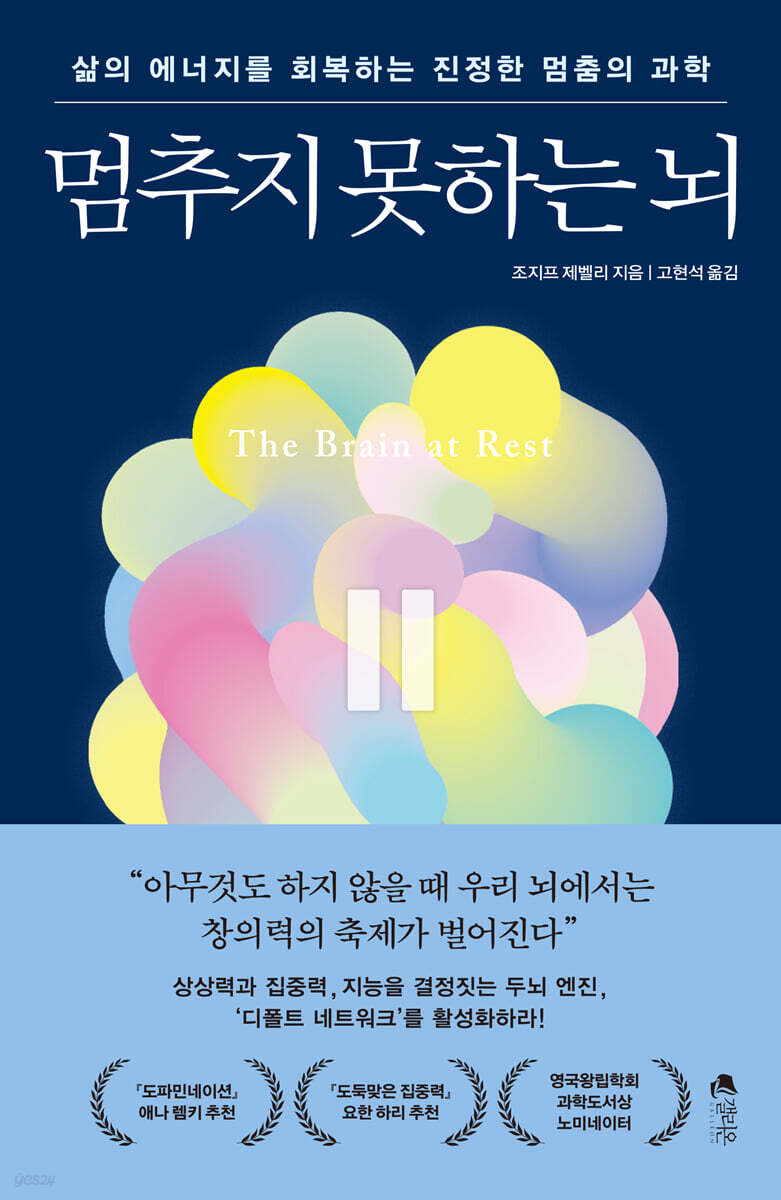
The brain that can't stop
 |
Description
Book Introduction
“When we do nothing, a festival of creativity takes place in our brains!”
The 'default network', the brain engine of healing and creation,
A meticulous and dynamic study of relaxation to unleash its potential.
* The latest work by a finalist for the Royal Society Science Book Award
* Highly recommended by Anna Lemke (Dopamine Nation) and Johann Hari (Stolen Focus)
British neuroscientist and science writer Joseph Zebeli's book, The Brain That Can't Stop, begins with a fragment of a memory about his father.
A father who left his home country, settled in England, became the head of a family, and worked hard to the best of his ability.
After spending 20 years like that, my father suddenly collapsed overnight with the cry, “I don’t even know how to rest anymore!”
Having witnessed this phenomenon up close, Jebeli delved into the topic of rest from the perspective of a neuroscientist.
There are two engines in the human brain that perform different functions.
One is the executive network, which carries out tasks in a goal-oriented manner, and the other is the default network, which allows for free expression of creativity.
If the former is a network of work, the latter can be seen as a network of rest.
These two engines must operate in balance for our brains to function healthily and effectively.
However, the brains of modern people who consider working more and more passionately as a virtue cannot possibly function harmoniously.
Zebel noticed that the executive network, not the default network, is activated even during activities commonly referred to as "rest"—such as looking at a smartphone, chatting with people, or even sleeping.
And we started exploring the 'true pause' that activates the default network.
Not only did he analyze countless studies on work and rest, he also did not hesitate to subject himself to experiments.
I went to anyone who could tell me about it: doctors, biologists, geneticists, immunologists, sociologists, management consultants, loneliness experts—anyone who could talk to me about it.
His journey to discover the most effective way to shut down the brain will provide a breakthrough for those who plan and perform even play and rest as if it were work, restoring not only their damaged brains but also their lives.
The 'default network', the brain engine of healing and creation,
A meticulous and dynamic study of relaxation to unleash its potential.
* The latest work by a finalist for the Royal Society Science Book Award
* Highly recommended by Anna Lemke (Dopamine Nation) and Johann Hari (Stolen Focus)
British neuroscientist and science writer Joseph Zebeli's book, The Brain That Can't Stop, begins with a fragment of a memory about his father.
A father who left his home country, settled in England, became the head of a family, and worked hard to the best of his ability.
After spending 20 years like that, my father suddenly collapsed overnight with the cry, “I don’t even know how to rest anymore!”
Having witnessed this phenomenon up close, Jebeli delved into the topic of rest from the perspective of a neuroscientist.
There are two engines in the human brain that perform different functions.
One is the executive network, which carries out tasks in a goal-oriented manner, and the other is the default network, which allows for free expression of creativity.
If the former is a network of work, the latter can be seen as a network of rest.
These two engines must operate in balance for our brains to function healthily and effectively.
However, the brains of modern people who consider working more and more passionately as a virtue cannot possibly function harmoniously.
Zebel noticed that the executive network, not the default network, is activated even during activities commonly referred to as "rest"—such as looking at a smartphone, chatting with people, or even sleeping.
And we started exploring the 'true pause' that activates the default network.
Not only did he analyze countless studies on work and rest, he also did not hesitate to subject himself to experiments.
I went to anyone who could tell me about it: doctors, biologists, geneticists, immunologists, sociologists, management consultants, loneliness experts—anyone who could talk to me about it.
His journey to discover the most effective way to shut down the brain will provide a breakthrough for those who plan and perform even play and rest as if it were work, restoring not only their damaged brains but also their lives.
- You can preview some of the book's contents.
Preview
index
Introduction | The Resting Brain
Part 1
Chapter 1: How Overwork Kills Us: Why the Brain's Default Network Is the Antidote
A pandemic more deadly than a virus
People who die from overwork
How does a tired brain react?
Simple ways to energize your brain
Anatomy of the default network
Brain-Saving Relaxation Technique 1: How to Wake Up Your Default Network
Chapter 2: The Neuroscience of Work: Our Brain's Executive Network
The structure of how the executive network operates
Neurodiverse people living in a neurotypical world
The problem of 'status insecurity' that fuels overwork
Brain-Saving Relaxation Techniques 2: How to Use Your Executive Network Properly
Part 2 Break
Chapter 3: Mind Wandering: Letting Your Mind Free
A peek into the wild tiger within
Biological Mechanisms of Mind Wandering
Let your thoughts flow
Relaxation Techniques to Save Your Brain 3: How to Give Your Mind the Freedom to Wander
Chapter 4: Hug the Tree: A 'Soft Charm' That Captivates the Brain
Modern people suffering from separation anxiety from nature
Nature is unconditionally beneficial to humans.
What Happens in Our Brains When We Walk in the Woods
How to Harness the Healing Power of Nature: The Sense of Smell
How to Harness the Healing Power of Nature: Touch
How to Harness the Healing Power of Nature: Hearing
Brain-Saving Relaxation Technique 4: How to Activate Your Brain in the Forest
Chapter 5: Intentional Solitude: The Correlation Between Time Alone and Cognitive Ability
The side effects of obsession with social relationships
A moment of existentialization where you meet your inner self
The cognitive and emotional impact of loneliness on the brain
Solitude that heals emotional shock
How to Use Solitude Wisely
5 Brain-Saving Relaxation Techniques: How Solitude Restores Your Brain
Chapter 6 Sleep: The Best Medicine for Healing the Brain
An era in which sleep is considered an obstacle to productivity.
Important things your brain does while you sleep
How to improve your sleep quality
The Secret to Perfect Sleep
6 Brain-Saving Relaxation Techniques: How to Get Your Brain to Sleep Well
Part 3 play
Chapter 7: The Neuroscience of Play: How Play Awakens and Strengthens the Brain
Rediscovering the positive functions of video games
Eight types of play we can enjoy
Play, an essential thing in the adult world
Play improves the quality of life
7 Brain-Saving Relaxation Techniques: How to Get Your Brain to Play
Chapter 8: Active Rest: Why Exercise Is Good for Your Brain
Lack of exercise is as dangerous to your health as smoking.
Exercise even heals the mind
The Amazing Effects Exercise Has on Your Brain
The best active relaxation practice: sex
8 Relaxation Techniques to Save Your Brain: How to Rest Most Effectively
Chapter 9: Doing Nothing: Following the Dutch Nicksen
Ultimate relaxation, Nixen
Why do we take long working hours for granted?
Doing nothing is not a waste of time.
The modern disease of 'productivity guilt'
The better you rest, the better you work.
9 Relaxation Techniques to Save Your Brain: How to Practice Nixen in Your Daily Life
Coming out | A life of rest
Acknowledgements
main
References
Part 1
Chapter 1: How Overwork Kills Us: Why the Brain's Default Network Is the Antidote
A pandemic more deadly than a virus
People who die from overwork
How does a tired brain react?
Simple ways to energize your brain
Anatomy of the default network
Brain-Saving Relaxation Technique 1: How to Wake Up Your Default Network
Chapter 2: The Neuroscience of Work: Our Brain's Executive Network
The structure of how the executive network operates
Neurodiverse people living in a neurotypical world
The problem of 'status insecurity' that fuels overwork
Brain-Saving Relaxation Techniques 2: How to Use Your Executive Network Properly
Part 2 Break
Chapter 3: Mind Wandering: Letting Your Mind Free
A peek into the wild tiger within
Biological Mechanisms of Mind Wandering
Let your thoughts flow
Relaxation Techniques to Save Your Brain 3: How to Give Your Mind the Freedom to Wander
Chapter 4: Hug the Tree: A 'Soft Charm' That Captivates the Brain
Modern people suffering from separation anxiety from nature
Nature is unconditionally beneficial to humans.
What Happens in Our Brains When We Walk in the Woods
How to Harness the Healing Power of Nature: The Sense of Smell
How to Harness the Healing Power of Nature: Touch
How to Harness the Healing Power of Nature: Hearing
Brain-Saving Relaxation Technique 4: How to Activate Your Brain in the Forest
Chapter 5: Intentional Solitude: The Correlation Between Time Alone and Cognitive Ability
The side effects of obsession with social relationships
A moment of existentialization where you meet your inner self
The cognitive and emotional impact of loneliness on the brain
Solitude that heals emotional shock
How to Use Solitude Wisely
5 Brain-Saving Relaxation Techniques: How Solitude Restores Your Brain
Chapter 6 Sleep: The Best Medicine for Healing the Brain
An era in which sleep is considered an obstacle to productivity.
Important things your brain does while you sleep
How to improve your sleep quality
The Secret to Perfect Sleep
6 Brain-Saving Relaxation Techniques: How to Get Your Brain to Sleep Well
Part 3 play
Chapter 7: The Neuroscience of Play: How Play Awakens and Strengthens the Brain
Rediscovering the positive functions of video games
Eight types of play we can enjoy
Play, an essential thing in the adult world
Play improves the quality of life
7 Brain-Saving Relaxation Techniques: How to Get Your Brain to Play
Chapter 8: Active Rest: Why Exercise Is Good for Your Brain
Lack of exercise is as dangerous to your health as smoking.
Exercise even heals the mind
The Amazing Effects Exercise Has on Your Brain
The best active relaxation practice: sex
8 Relaxation Techniques to Save Your Brain: How to Rest Most Effectively
Chapter 9: Doing Nothing: Following the Dutch Nicksen
Ultimate relaxation, Nixen
Why do we take long working hours for granted?
Doing nothing is not a waste of time.
The modern disease of 'productivity guilt'
The better you rest, the better you work.
9 Relaxation Techniques to Save Your Brain: How to Practice Nixen in Your Daily Life
Coming out | A life of rest
Acknowledgements
main
References
Detailed image

Into the book
For a long time, we have been taught that this kind of stagnation and inaction signifies indulgence, even irresponsibility, and is the antithesis of success.
But what if people often succeed not in spite of their attitude toward pause, but because of it? What if rest, rather than being an indulgence or unproductivity, is the key to people's success?
--- p.11~12
In short, the default network can be said to have the superpower to recharge and restore a tired brain.
--- p.12
Overwork also causes changes in the brain's anatomical structure and chemical composition.
The area that is hit hardest is the frontal lobe.
The frontal lobe is involved in decision-making, problem-solving, planning, and attention control, and overwork causes it to thin in the same way that aging does.
Even overwork ages the brain faster than age.
Just as trees gradually disappear from a forest, dendrites, which are branch-like structures, disappear from neurons.
--- p.46~47
If the default network is a network for rest and reflection, the executive network is a network specialized for work.
The executive network is active when we sit at our desks and focus, do household chores, or engage in simple tasks like organizing paperwork or sorting files.
Essentially, this network is activated at any moment when mental tension is required.
--- p.57
It is important to know when to activate our enforcement network and when to rest and recover it.
Even a short break from work can dramatically improve your ability to focus longer on a task.
The secret to sustainable productivity is not work, but rest.
--- p.80
‘Just thinking’ can feel boring, even like hard work.
This feeling is so deeply rooted in our psyche that psychologists have even given it a name: laziness aversion.
It is one of the sad realities of our time.
The problem is that people not only underestimate the value of "just thinking about anything," but also don't fully grasp how deeply satisfying it can be.
--- p.106
When you forest bathe or walk in nature, several areas of the default network are activated.
One of them is the medial prefrontal cortex in the frontal lobe.
This area in the frontal lobe plays a key role in forming a person's narrative.
It is a center for introspection, a place where decision-making and self-directed thinking flourish.
--- p.125
When solitude is a choice rather than a necessity, our brains react very differently.
--- p.152
While we sleep, the synapses in our brain are selectively pruned.
Rather than randomly removing synapses, it is a delicate and meticulous process that preserves connections related to important memories and prunes less important connections.
This allows our brain to gently prune where needed, like a night gardener tending to the garden of our minds, helping truly meaningful connections take hold.
--- p.186
Even with endless meetings and work, we must make sure to make time for play.
It is these moments of creativity and laughter that come unexpectedly that nourish our souls.
In those moments, we feel truly alive and reconnect with parts of ourselves that had been lost in the hustle and bustle of everyday life.
--- p.234
Simply starting a new physical activity, rather than a specialized exercise, can lead to meaningful changes in the brain's default network.
And these changes can last for years.
For example, learning to juggle for just one week can create additional gray matter in your default network, and these improvements can last for months.
--- p.243
The identity of this guilt I felt was ‘productivity guilt.’
This happens when we incorrectly link our self-worth and meaning to our work performance.
In many cultures, the idea that we must always be busy has led to equating stillness with laziness.
Breaking this mold is never easy.
Unfortunately, we find greater satisfaction when we view rest or leisure as a reward for a hard day's work.
--- p.279
A resting brain is a very powerful being.
When rest is at its deepest and most fulfilling, the brain generates dreams and ideas, unleashes creativity and problem-solving abilities, becomes a refuge from work and responsibilities, a sanctuary for healing and restoration, and unfolds a vast array of thoughts with infinite possibilities.
Above all, a rested brain is proven to increase long-term productivity and happiness.
But what if people often succeed not in spite of their attitude toward pause, but because of it? What if rest, rather than being an indulgence or unproductivity, is the key to people's success?
--- p.11~12
In short, the default network can be said to have the superpower to recharge and restore a tired brain.
--- p.12
Overwork also causes changes in the brain's anatomical structure and chemical composition.
The area that is hit hardest is the frontal lobe.
The frontal lobe is involved in decision-making, problem-solving, planning, and attention control, and overwork causes it to thin in the same way that aging does.
Even overwork ages the brain faster than age.
Just as trees gradually disappear from a forest, dendrites, which are branch-like structures, disappear from neurons.
--- p.46~47
If the default network is a network for rest and reflection, the executive network is a network specialized for work.
The executive network is active when we sit at our desks and focus, do household chores, or engage in simple tasks like organizing paperwork or sorting files.
Essentially, this network is activated at any moment when mental tension is required.
--- p.57
It is important to know when to activate our enforcement network and when to rest and recover it.
Even a short break from work can dramatically improve your ability to focus longer on a task.
The secret to sustainable productivity is not work, but rest.
--- p.80
‘Just thinking’ can feel boring, even like hard work.
This feeling is so deeply rooted in our psyche that psychologists have even given it a name: laziness aversion.
It is one of the sad realities of our time.
The problem is that people not only underestimate the value of "just thinking about anything," but also don't fully grasp how deeply satisfying it can be.
--- p.106
When you forest bathe or walk in nature, several areas of the default network are activated.
One of them is the medial prefrontal cortex in the frontal lobe.
This area in the frontal lobe plays a key role in forming a person's narrative.
It is a center for introspection, a place where decision-making and self-directed thinking flourish.
--- p.125
When solitude is a choice rather than a necessity, our brains react very differently.
--- p.152
While we sleep, the synapses in our brain are selectively pruned.
Rather than randomly removing synapses, it is a delicate and meticulous process that preserves connections related to important memories and prunes less important connections.
This allows our brain to gently prune where needed, like a night gardener tending to the garden of our minds, helping truly meaningful connections take hold.
--- p.186
Even with endless meetings and work, we must make sure to make time for play.
It is these moments of creativity and laughter that come unexpectedly that nourish our souls.
In those moments, we feel truly alive and reconnect with parts of ourselves that had been lost in the hustle and bustle of everyday life.
--- p.234
Simply starting a new physical activity, rather than a specialized exercise, can lead to meaningful changes in the brain's default network.
And these changes can last for years.
For example, learning to juggle for just one week can create additional gray matter in your default network, and these improvements can last for months.
--- p.243
The identity of this guilt I felt was ‘productivity guilt.’
This happens when we incorrectly link our self-worth and meaning to our work performance.
In many cultures, the idea that we must always be busy has led to equating stillness with laziness.
Breaking this mold is never easy.
Unfortunately, we find greater satisfaction when we view rest or leisure as a reward for a hard day's work.
--- p.279
A resting brain is a very powerful being.
When rest is at its deepest and most fulfilling, the brain generates dreams and ideas, unleashes creativity and problem-solving abilities, becomes a refuge from work and responsibilities, a sanctuary for healing and restoration, and unfolds a vast array of thoughts with infinite possibilities.
Above all, a rested brain is proven to increase long-term productivity and happiness.
--- p.293
Publisher's Review
“The moment the default network turns on,
The brain enters a mode of self-healing and creation.”
A life in crisis due to the bomb thrown by the 'absence of pause'
A young scientist's meticulous and desperate study of rest
Neuroscientist Joseph Javel, sitting at his desk in his lab as usual, finally had to admit:
His brain was damaged and was continuing to damage.
It was the result of years of tireless running, driven by an obsession with achievement that pushed me to the limit.
My memory, concentration, and cognitive functions were declining, and I was also suffering physically.
Jebeli thought of his father.
My father, who had worked his hardest for 20 years, suddenly collapsed with the cry, “I don’t even know how to rest anymore!” and has been struggling to recover for over 10 years, suffering from depression and hypersomnia.
I could no longer ignore the crisis signals my brain was sending me.
But as I reduced my workload and increased my rest, an unexpected change occurred.
Not only did I shake off my fatigue and regain my health, but I was also able to work more productively.
My creativity and problem-solving skills have improved noticeably, and I feel more energized than ever before.
As a scientist, Jebel began to delve into this phenomenon.
What happens in our brains when we rest? How does it affect our lives? Are there ways to rest more effectively? The answer lies in the brain's "default network."
Filling the driving force of life through complete rest
Default Network Activation Project
There are two engines in the human brain that perform different functions.
One is the executive network, which carries out tasks in a goal-oriented manner, and the other is the default network, which allows for free expression of creativity.
These are circuits of neurons distributed across various areas of the brain, functioning by connecting and inhibiting synapses.
These two engines must operate in balance for our brains to function healthily and effectively.
However, the brains of modern people who consider working more and more passionately as a virtue cannot possibly function harmoniously.
The important thing is that when the executive network is turned on, the default network is turned off.
When we are constantly focused on short-term achievements all day long, we use our brains in a very limited way.
Even during activities commonly referred to as "rest," such as looking at a smartphone, chatting with people, or even sleeping, the executive network, not the default network, is activated.
So when exactly does the default network turn on? Jebeli focuses on the "true pause" that activates the default network.
How a 'Quiet Brain' Can Change Your Life
A scientific exploration into the most effective way to stop the brain!
Not only did Jebelly research and analyze countless studies on work and rest, he also volunteered to be a subject of experimentation himself.
The story of participating in a 'descriptive experience sampling' experiment, which involves observing and expressing inner experiences to allow the mind to wander freely, leads readers into the world of the default network like an interesting travel story.
He also went out and asked anyone, no matter where they lived, who could tell him about true stopping.
From the neuroscientist who first discovered the default network, to a world-renowned immunologist who heads into the forest, to an acoustician who creates anechoic chambers that offer complete solitude, to a biologist who commutes by bike, to a writer who practices the Dutch relaxation technique "niksen."
By collecting their stories, Jebeli delves deeper into the brain's relaxation engine.
Furthermore, they struggle to implement methods to operate the default network themselves.
"The Brain That Can't Stop" is a record of a scientific exploration to find the most effective way to stop the brain, and the result of a relaxation experiment for a happier life.
How much richer and healthier our lives can be when we give our brains a good rest and our default network functions properly.
This book will serve as a breakthrough for those who have lost the meaning of "true pause" by planning and performing even play and rest as if it were work, and will help them restore their damaged brains and lives.
The brain enters a mode of self-healing and creation.”
A life in crisis due to the bomb thrown by the 'absence of pause'
A young scientist's meticulous and desperate study of rest
Neuroscientist Joseph Javel, sitting at his desk in his lab as usual, finally had to admit:
His brain was damaged and was continuing to damage.
It was the result of years of tireless running, driven by an obsession with achievement that pushed me to the limit.
My memory, concentration, and cognitive functions were declining, and I was also suffering physically.
Jebeli thought of his father.
My father, who had worked his hardest for 20 years, suddenly collapsed with the cry, “I don’t even know how to rest anymore!” and has been struggling to recover for over 10 years, suffering from depression and hypersomnia.
I could no longer ignore the crisis signals my brain was sending me.
But as I reduced my workload and increased my rest, an unexpected change occurred.
Not only did I shake off my fatigue and regain my health, but I was also able to work more productively.
My creativity and problem-solving skills have improved noticeably, and I feel more energized than ever before.
As a scientist, Jebel began to delve into this phenomenon.
What happens in our brains when we rest? How does it affect our lives? Are there ways to rest more effectively? The answer lies in the brain's "default network."
Filling the driving force of life through complete rest
Default Network Activation Project
There are two engines in the human brain that perform different functions.
One is the executive network, which carries out tasks in a goal-oriented manner, and the other is the default network, which allows for free expression of creativity.
These are circuits of neurons distributed across various areas of the brain, functioning by connecting and inhibiting synapses.
These two engines must operate in balance for our brains to function healthily and effectively.
However, the brains of modern people who consider working more and more passionately as a virtue cannot possibly function harmoniously.
The important thing is that when the executive network is turned on, the default network is turned off.
When we are constantly focused on short-term achievements all day long, we use our brains in a very limited way.
Even during activities commonly referred to as "rest," such as looking at a smartphone, chatting with people, or even sleeping, the executive network, not the default network, is activated.
So when exactly does the default network turn on? Jebeli focuses on the "true pause" that activates the default network.
How a 'Quiet Brain' Can Change Your Life
A scientific exploration into the most effective way to stop the brain!
Not only did Jebelly research and analyze countless studies on work and rest, he also volunteered to be a subject of experimentation himself.
The story of participating in a 'descriptive experience sampling' experiment, which involves observing and expressing inner experiences to allow the mind to wander freely, leads readers into the world of the default network like an interesting travel story.
He also went out and asked anyone, no matter where they lived, who could tell him about true stopping.
From the neuroscientist who first discovered the default network, to a world-renowned immunologist who heads into the forest, to an acoustician who creates anechoic chambers that offer complete solitude, to a biologist who commutes by bike, to a writer who practices the Dutch relaxation technique "niksen."
By collecting their stories, Jebeli delves deeper into the brain's relaxation engine.
Furthermore, they struggle to implement methods to operate the default network themselves.
"The Brain That Can't Stop" is a record of a scientific exploration to find the most effective way to stop the brain, and the result of a relaxation experiment for a happier life.
How much richer and healthier our lives can be when we give our brains a good rest and our default network functions properly.
This book will serve as a breakthrough for those who have lost the meaning of "true pause" by planning and performing even play and rest as if it were work, and will help them restore their damaged brains and lives.
GOODS SPECIFICS
- Date of issue: August 12, 2025
- Page count, weight, size: 344 pages | 574g | 140*215*21mm
- ISBN13: 9788901296630
- ISBN10: 8901296632
You may also like
카테고리
korean


korean

![ELLE 엘르 스페셜 에디션 A형 : 12월 [2025]](http://librairie.coreenne.fr/cdn/shop/files/b8e27a3de6c9538896439686c6b0e8fb.jpg?v=1766436872&width=3840)


