

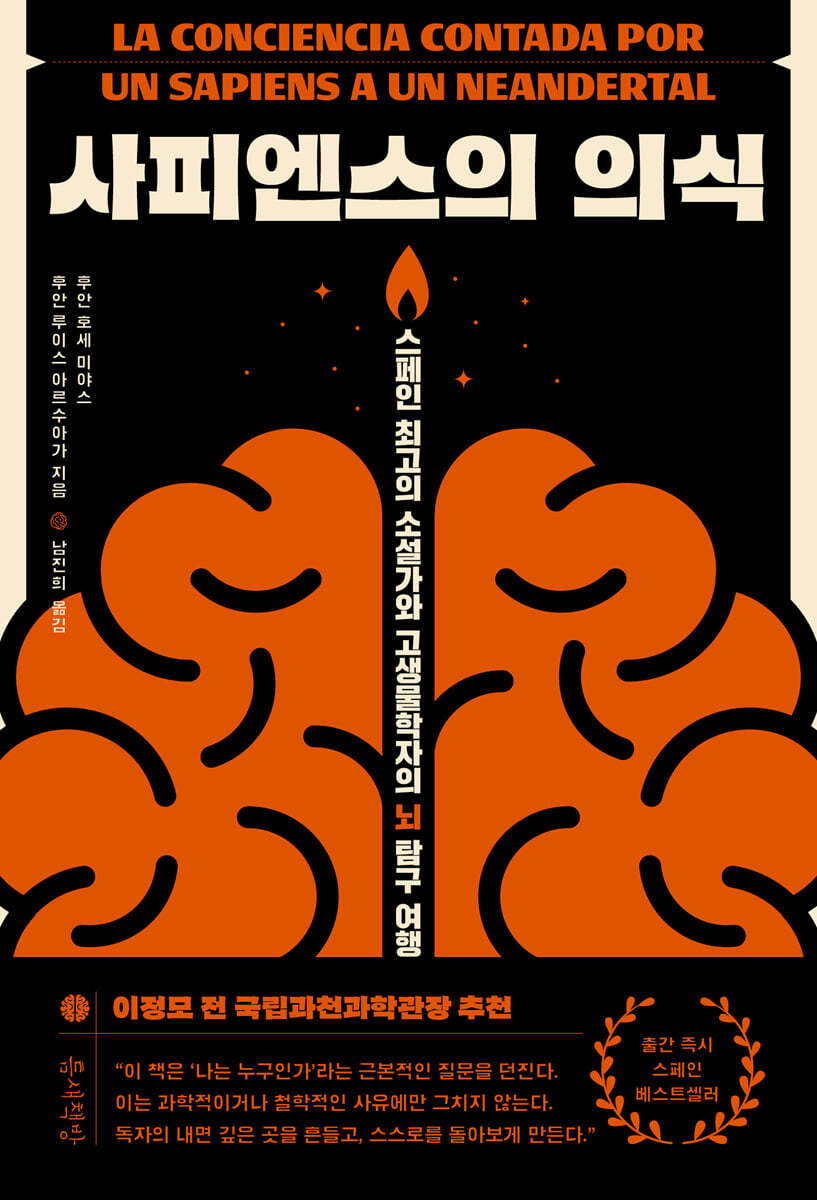
Sapiens consciousness
 |
Description
Book Introduction
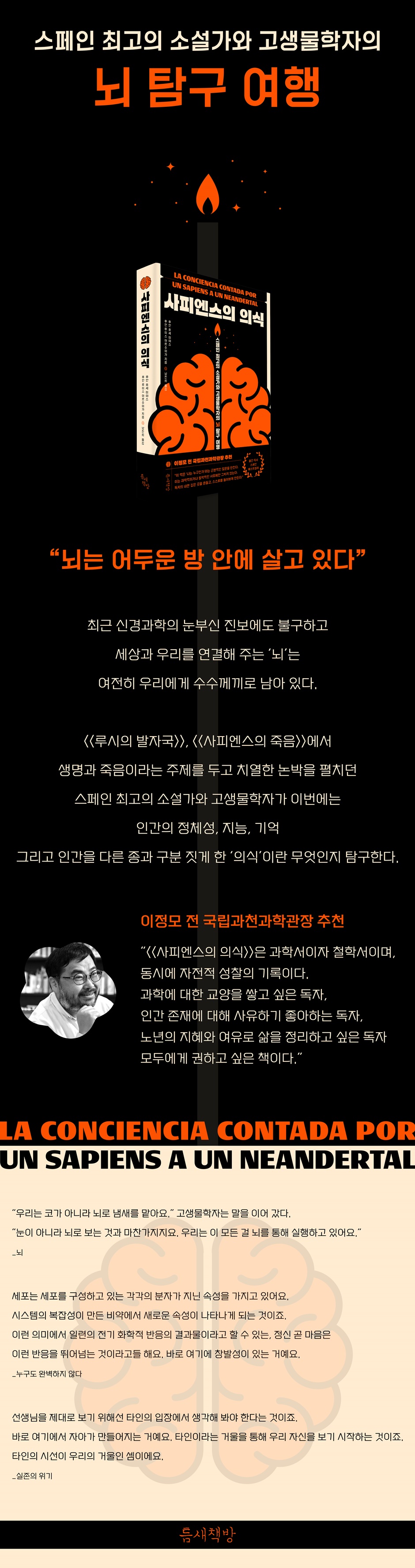
·“How was our consciousness born?”
· A fierce exploration of the brain, mind, self, and free will.
An evolutionary journey that leads to the age-old question, "Who am I?"
Sapiens: The Consciousness of the World is the third and final book in the bestselling series, which has sold over 400,000 copies.
While the first book, "Lucy's Footprints," dealt with the birth and evolution of humans, and "The Death of Sapiens" dealt with aging and death, this new work explores in earnest the origins of "consciousness," a unique ability possessed only by humans.
This time, novelist Juan José Millas, with the perspective of a "questioning human," and paleontologist Juan Luis Arzuaga, with the language of a "cool scientist," accompany readers on a journey to discover the birth and operating principles of human consciousness.
“Is the mind a product of the brain?”
“Can the brain be programmed like a computer?”
“Is consciousness just an illusion?”
These questions, which appear in the book, are core issues raised by artificial intelligence and neuroscience today, such as memory, self, free will, and AI, and are also fundamental questions that divide humans from non-humans.
Sapiens' Consciousness interprets the language of science with the sensibility of literature, and connects the imagination of literature with the factuality of science.
Complex topics are unraveled through easy and pleasant conversation, but the questions left at the end are by no means light.
“What is consciousness?”
“Who am I?”
“How did we get here?”
With the debate over AI and transhumanism raging, this book confronts the essence of human consciousness, prompting us to question our attitude toward science and what it means to be human.
· A fierce exploration of the brain, mind, self, and free will.
An evolutionary journey that leads to the age-old question, "Who am I?"
Sapiens: The Consciousness of the World is the third and final book in the bestselling series, which has sold over 400,000 copies.
While the first book, "Lucy's Footprints," dealt with the birth and evolution of humans, and "The Death of Sapiens" dealt with aging and death, this new work explores in earnest the origins of "consciousness," a unique ability possessed only by humans.
This time, novelist Juan José Millas, with the perspective of a "questioning human," and paleontologist Juan Luis Arzuaga, with the language of a "cool scientist," accompany readers on a journey to discover the birth and operating principles of human consciousness.
“Is the mind a product of the brain?”
“Can the brain be programmed like a computer?”
“Is consciousness just an illusion?”
These questions, which appear in the book, are core issues raised by artificial intelligence and neuroscience today, such as memory, self, free will, and AI, and are also fundamental questions that divide humans from non-humans.
Sapiens' Consciousness interprets the language of science with the sensibility of literature, and connects the imagination of literature with the factuality of science.
Complex topics are unraveled through easy and pleasant conversation, but the questions left at the end are by no means light.
“What is consciousness?”
“Who am I?”
“How did we get here?”
With the debate over AI and transhumanism raging, this book confronts the essence of human consciousness, prompting us to question our attitude toward science and what it means to be human.
- You can preview some of the book's contents.
Preview
index
Letter of Recommendation_Lee Jeong-mo, former director of the National Science Museum in Gwacheon
0.
brain
1.
It's already written
2.
Let's surround the fortress first.
3.
crocodile
4.
Artificial intelligence treatment
5.
ego
6.
No one is perfect
7.
An offensive of excessive meaning-making
8.
Inside the collective brain
9.
Death of the Tooth Fairy
10.
existential crisis
11.
End of the festival
Translator's Note_Nam Jin-hee
0.
brain
1.
It's already written
2.
Let's surround the fortress first.
3.
crocodile
4.
Artificial intelligence treatment
5.
ego
6.
No one is perfect
7.
An offensive of excessive meaning-making
8.
Inside the collective brain
9.
Death of the Tooth Fairy
10.
existential crisis
11.
End of the festival
Translator's Note_Nam Jin-hee
Detailed image
Into the book
“The sense of smell is a very special sense.
Unlike other senses, it has a very special ability to evoke emotions.
This is because the smell goes directly to the neurons, the neurons we call the brain, without any receptors acting as intermediaries.”
“So then the sense of smell itself is the brain?”
--- 「0.
From "Brain"
“Laplace’s demon, like an algorithm, will continue to update the information it has about each and every one of us.
Because Laplace's demon is an algorithm.
“I think you have a hard time accepting that we are ontologically determined by things that influence us outside of our awareness.”
--- 「1.
From "It's already been written"
Are we free to think, or are we subject to a program? If the brain is a machine, where does consciousness come from? How is it created? Conversely, if computers are just like the brain, will they eventually become conscious? Or perhaps they already have consciousness, but we're just unaware of it? Everything we strive to build regarding the brain and mind will stem from a proper understanding of the difference between the analog and digital worlds.
That's where the starting point is.
If this doesn't happen, everything we do will become literature.
--- 「2.
Let's first surround the fortress"
But can the brain reflect on itself? Can the eyes observe itself? While I have a vague connection to all of this, the enigmatic words of a mystic whose name I've forgotten suddenly came to mind.
'The eyes through which I see God are also the eyes through which God sees me.' Is the brain that allows me to think about the world the same brain that allows the world to think about me?
--- 「3.
From "Crocodile"
“The brain is trapped in a black box called the skull.
It's black because no light comes in, and of course, no sound can be heard.
The brain can't hear anything, can't see anything, and can't smell anything.
You can't touch it or taste it.
Anglo-American neurophilosophers call this well-known thought experiment the 'brain in a vat,' meaning 'a brain in a flask or square bowl.'
--- 「6.
From "Nobody's Perfect"
“Subjectivity has nothing to do with adaptation.
It's of no use whatsoever.
Imagine a Roomba, a home vacuum cleaner.
We clean the entire house, perfectly mapped to the electronic circuits.
And when the battery runs low, it returns to the charging station and recharges itself.
But was it hungry? Does a robot vacuum need to sense hunger to automatically recharge?
"no."
“Then why do we do that? Why do we have to feel hungry in order to eat?”
“I don’t know.” I was really suspicious.
--- 「10.
From "Existential Crisis"
“Portuguese neuroscientist Antonio Damasio said that computers have no body and therefore no consciousness.
That is, I can't say what my current situation is or how I feel, and I can't open up about it either.
In short, the ‘intestines’ create a person’s ‘consciousness’.
We are the 'body', not the 'body' that has the 'body'.
“Descartes was mistaken.”
“Suddenly Baruch Spinoza appeared in the intellectual world of the West and changed everything.
God is neither a watchmaker nor a machine maker.
God is a machine.
Everything the teacher sees is God.
Besides, both you and I are gods.”
Unlike other senses, it has a very special ability to evoke emotions.
This is because the smell goes directly to the neurons, the neurons we call the brain, without any receptors acting as intermediaries.”
“So then the sense of smell itself is the brain?”
--- 「0.
From "Brain"
“Laplace’s demon, like an algorithm, will continue to update the information it has about each and every one of us.
Because Laplace's demon is an algorithm.
“I think you have a hard time accepting that we are ontologically determined by things that influence us outside of our awareness.”
--- 「1.
From "It's already been written"
Are we free to think, or are we subject to a program? If the brain is a machine, where does consciousness come from? How is it created? Conversely, if computers are just like the brain, will they eventually become conscious? Or perhaps they already have consciousness, but we're just unaware of it? Everything we strive to build regarding the brain and mind will stem from a proper understanding of the difference between the analog and digital worlds.
That's where the starting point is.
If this doesn't happen, everything we do will become literature.
--- 「2.
Let's first surround the fortress"
But can the brain reflect on itself? Can the eyes observe itself? While I have a vague connection to all of this, the enigmatic words of a mystic whose name I've forgotten suddenly came to mind.
'The eyes through which I see God are also the eyes through which God sees me.' Is the brain that allows me to think about the world the same brain that allows the world to think about me?
--- 「3.
From "Crocodile"
“The brain is trapped in a black box called the skull.
It's black because no light comes in, and of course, no sound can be heard.
The brain can't hear anything, can't see anything, and can't smell anything.
You can't touch it or taste it.
Anglo-American neurophilosophers call this well-known thought experiment the 'brain in a vat,' meaning 'a brain in a flask or square bowl.'
--- 「6.
From "Nobody's Perfect"
“Subjectivity has nothing to do with adaptation.
It's of no use whatsoever.
Imagine a Roomba, a home vacuum cleaner.
We clean the entire house, perfectly mapped to the electronic circuits.
And when the battery runs low, it returns to the charging station and recharges itself.
But was it hungry? Does a robot vacuum need to sense hunger to automatically recharge?
"no."
“Then why do we do that? Why do we have to feel hungry in order to eat?”
“I don’t know.” I was really suspicious.
--- 「10.
From "Existential Crisis"
“Portuguese neuroscientist Antonio Damasio said that computers have no body and therefore no consciousness.
That is, I can't say what my current situation is or how I feel, and I can't open up about it either.
In short, the ‘intestines’ create a person’s ‘consciousness’.
We are the 'body', not the 'body' that has the 'body'.
“Descartes was mistaken.”
“Suddenly Baruch Spinoza appeared in the intellectual world of the West and changed everything.
God is neither a watchmaker nor a machine maker.
God is a machine.
Everything the teacher sees is God.
Besides, both you and I are gods.”
--- 「11.
From "The End of the Festival"
From "The End of the Festival"
Publisher's Review
"Are emotions just an illusion of the brain? Or is it a fundamental part of human nature that science has yet to explain?"
Sapiens: The Consciousness of Sapiens is a deep and tense intellectual dialogue between novelist Miyaz and scientist Arsuaga, focusing on human consciousness.
Miyasu represents the world of magical thinking that humanity has evolved over tens of thousands of years.
We believe that awareness and mind are inherently human, and that God and the self emerge naturally from them.
Arsuaga, on the other hand, is a cool-headed scientist and defines this as an illusion.
Emotions are reactions of neurons, the self is a construct created by the brain, and the world we experience is not reality but merely signals interpreted by the brain.
In the previous series, Miyasu asked questions and Arsuaga taught.
However, this structure is shaken when faced with the topic of ‘consciousness’.
Science tries to explain this world, but clear answers are not easy.
Although the brain is said to be a 'black box' that cannot directly experience the outside world and only interprets neural signals, the cool-headed Arsua also shows signs of reacting to and being swayed by human emotions.
The conflict between two people is not a matter of right and wrong.
This book shows the difference between two approaches to understanding human beings: science and literature on human evolution.
The questions the book poses are familiar, yet still valid.
How does memory work? Is free will real? Can AI have a sense of self? How did God come into being, and why did he disappear? These questions lead us to revisit what it means to be human.
Miyasu's way of thinking may seem irrational, but the human brain has evolved to think that way.
Emotions, imagination, beliefs, and symbolic systems were human survival strategies.
This cannot be denied outright.
However, we cannot continue to maintain the same way of thinking as before.
Science has been constantly exploring the boundaries between what can be explained and what cannot, transforming the mysterious into the unknown.
The mystery is no longer what is unexplained, but what has not yet been explained.
Sapiens: The Consciousness of Humanity asks the question of how humans will understand themselves in the context of scientific achievements.
What matters is not the explanation, but the attitude we take.
Because we still live with the question, “Who am I?”
Sapiens: The Consciousness of Sapiens is a deep and tense intellectual dialogue between novelist Miyaz and scientist Arsuaga, focusing on human consciousness.
Miyasu represents the world of magical thinking that humanity has evolved over tens of thousands of years.
We believe that awareness and mind are inherently human, and that God and the self emerge naturally from them.
Arsuaga, on the other hand, is a cool-headed scientist and defines this as an illusion.
Emotions are reactions of neurons, the self is a construct created by the brain, and the world we experience is not reality but merely signals interpreted by the brain.
In the previous series, Miyasu asked questions and Arsuaga taught.
However, this structure is shaken when faced with the topic of ‘consciousness’.
Science tries to explain this world, but clear answers are not easy.
Although the brain is said to be a 'black box' that cannot directly experience the outside world and only interprets neural signals, the cool-headed Arsua also shows signs of reacting to and being swayed by human emotions.
The conflict between two people is not a matter of right and wrong.
This book shows the difference between two approaches to understanding human beings: science and literature on human evolution.
The questions the book poses are familiar, yet still valid.
How does memory work? Is free will real? Can AI have a sense of self? How did God come into being, and why did he disappear? These questions lead us to revisit what it means to be human.
Miyasu's way of thinking may seem irrational, but the human brain has evolved to think that way.
Emotions, imagination, beliefs, and symbolic systems were human survival strategies.
This cannot be denied outright.
However, we cannot continue to maintain the same way of thinking as before.
Science has been constantly exploring the boundaries between what can be explained and what cannot, transforming the mysterious into the unknown.
The mystery is no longer what is unexplained, but what has not yet been explained.
Sapiens: The Consciousness of Humanity asks the question of how humans will understand themselves in the context of scientific achievements.
What matters is not the explanation, but the attitude we take.
Because we still live with the question, “Who am I?”
GOODS SPECIFICS
- Date of issue: May 7, 2025
- Page count, weight, size: 312 pages | 334g | 128*188*20mm
- ISBN13: 9791188949748
- ISBN10: 1188949748
You may also like
카테고리
korean


korean

![ELLE 엘르 스페셜 에디션 A형 : 12월 [2025]](http://librairie.coreenne.fr/cdn/shop/files/b8e27a3de6c9538896439686c6b0e8fb.jpg?v=1766436872&width=3840)


