

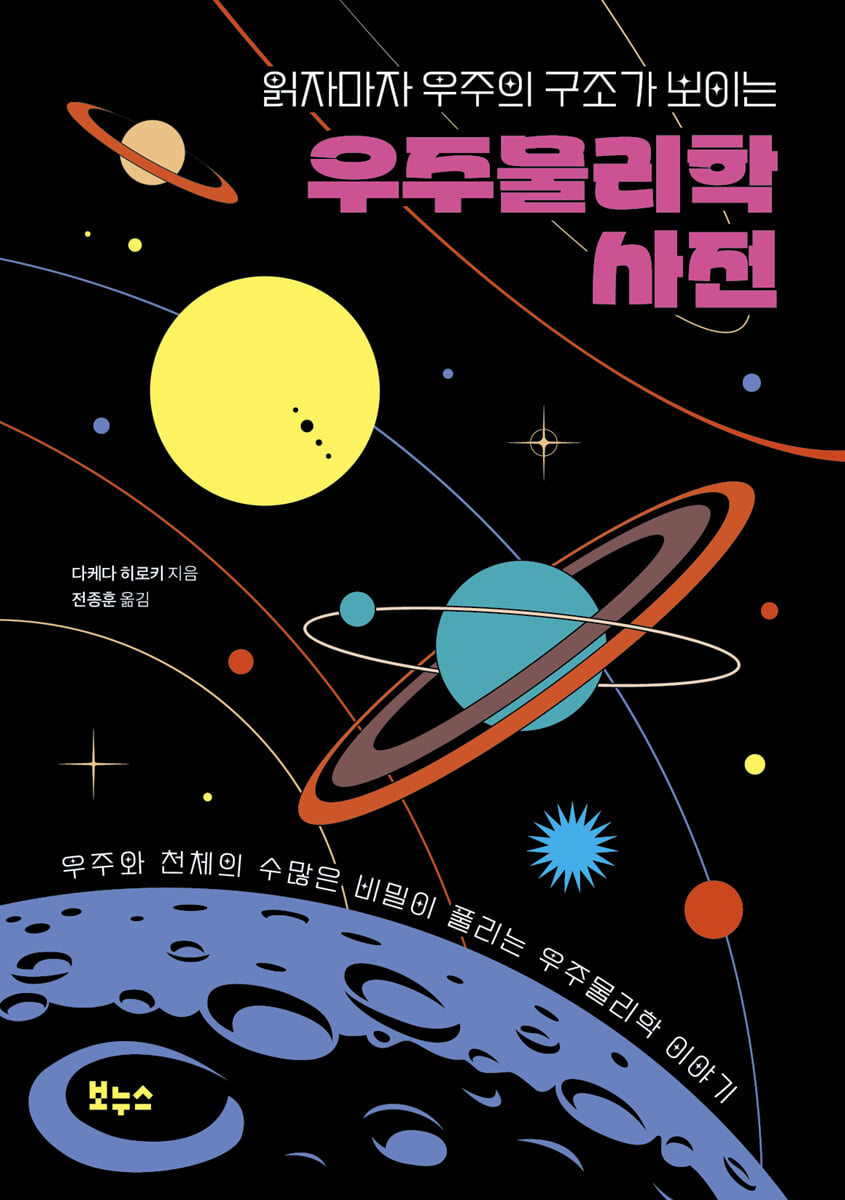
A dictionary of astrophysics that reveals the structure of the universe as soon as you read it.
 |
Description
Book Introduction
The greatest charm of the universe is that 'no one knows its true identity.'
Even astronomers, astrophysicists, and astronauts who have studied space for a long time know only a very small part of it.
Therefore, what is needed to understand the universe is not knowledge or mathematical skills, but intellectual curiosity that allows us to constantly ask questions without being intimidated by the unknown.
Astrophysics cultivates the ability to think and answer questions about the universe, both those that have always been curious and those that have yet to be discovered.
Let's break free from complex formulas and theories and freely ask and answer mysteries about the universe.
Someday, you may become the protagonist who unlocks the secrets of the universe that no one knows about.
Even astronomers, astrophysicists, and astronauts who have studied space for a long time know only a very small part of it.
Therefore, what is needed to understand the universe is not knowledge or mathematical skills, but intellectual curiosity that allows us to constantly ask questions without being intimidated by the unknown.
Astrophysics cultivates the ability to think and answer questions about the universe, both those that have always been curious and those that have yet to be discovered.
Let's break free from complex formulas and theories and freely ask and answer mysteries about the universe.
Someday, you may become the protagonist who unlocks the secrets of the universe that no one knows about.
- You can preview some of the book's contents.
Preview
index
Entering
CHAPTER 1 If you want to know about space, start here!
1 Solving Nature's Mysteries with Physics
2 What does the word 'space' really mean?
3. The Universe as Described in Ancient Religions and Myths
For four thousand years, the Earth was the center of the universe.
5 The center of the universe is from the Earth to the Sun
6 Formulas are the language that speaks the universe
7 Space researchers are surprisingly sloppy
8 A very large unit frequently used in space
9 The identity of the light that humans cannot see
10 Two ways to represent the brightness of a star
11 How do we measure distance in space?
12 The universe we see is the universe of the distant past.
13 There are many ways to measure distances in space!
14 The temperature limit is -273.15℃
15 The smallest particles that make up matter
16 The Four Forces That Move the Universe
17 Is light a particle or a wave?
18 Where exactly is the boundary between heaven and space?
COLUMN) The Life of an Astrophysicist
CHAPTER 2 Gravity, the Core of Astrophysics
19 Newton's Apple
20 How was the theory of relativity created?
21 In the theory of relativity, the universe is four-dimensional, not three-dimensional.
22 It is not known which side is stopped
23 Light travels at the same speed no matter who looks at it.
24 Let's draw a four-dimensional space-time diagram.
25 When you move fast, time slows down.
26 The faster you move, the shorter the distance becomes.
27 Why the Sun Burns in Oxygen-Free Space
28 Can gravity be eliminated?
29 Gravity can bend light
30 The Stasis of Gravity is a Distortion of Space-Time
31 Time flows more slowly in places where gravity is strong.
32 Does the distortion of space-time become a wave?
33 It took 100 years to observe gravitational waves
34 Why are black holes black?
35 Black holes grow three strands of hair
36 Celestial bodies collapse under their own gravity
37 What would happen if you fell into a black hole?
38 What is the brightly glowing disk around a black hole?
39 There is a supermassive black hole at the center of the galaxy.
40 Could General Relativity Be Changed?
COLUMN) How to Enjoy Math for Those Who Hate It
CHAPTER 3: Unraveling the Mysteries of the Universe Step by Step
41 A Massive Expansion in an Instant! The Evolution and History of the Universe
42 The universe is similar no matter where you look.
43 The evolution of the universe is expressed in equations.
44 The shape of the universe is determined by the degree to which space-time is curved.
45 Einstein originally thought that the universe was not expanding.
46 The universe continues to expand no matter where you look.
47 Most of the solar system is made of hydrogen and helium
48 Is the pitch-black universe actually completely glowing?
49 The temperature of the universe has decreased a thousand times, and its size has increased a thousand times.
50 In search of unidentified dark matter
51 The mysterious energy that accelerates the expansion of the universe
52 In the distant future, will the universe become a very small dot?
53 The universe began by rapidly expanding
54 The temperature in space is similar everywhere.
55 What will the end of the universe and beyond look like?
56 The ancient universe that modern physics doesn't understand
57 Are there other universes besides ours?
58 The universe was born from nothing?
COLUMN) If you want to learn astrophysics
CHAPTER 4 What are celestial bodies?
59 The world of many and diverse celestial bodies
60 How do you say Earth's address in space?
61 If it doesn't shine on its own, it's not a star.
62 Starlight of various ages and frequencies
63 The death of a star depends on its mass.
64 Variable stars, stars whose brightness changes
65 Supernova explosions that evolve the universe
66 Small but massive neutron stars
67 The more massive a star is, the more energy it releases when it dies.
68 Is there really nothing in empty space?
69 Are there as many as 1 trillion galaxies in the universe?
70 Spiral galaxies have arms
71 How long does it take for the solar system to orbit the galaxy?
72 A supercluster containing numerous galaxies
73 The Void, the empty space of space
74 The celestial sphere represents the movement of stars as seen from Earth.
75 The Sun's remaining lifespan is 5.5 billion years?
76 99.87% of the total mass of the solar system is the mass of the sun
77 Various views of the planets in the solar system
Not just 78 moons! Satellites discovered one after another
79 Solar eclipse, where the sun is covered, and lunar eclipse, where the moon is covered
The moon's gravity causes tidal fluctuations.
81 The reason meteors shine is because of shock waves.
82 Is there other life outside of Earth?
83 Space agencies around the world
In conclusion
Search
References and Websites
Photo source
CHAPTER 1 If you want to know about space, start here!
1 Solving Nature's Mysteries with Physics
2 What does the word 'space' really mean?
3. The Universe as Described in Ancient Religions and Myths
For four thousand years, the Earth was the center of the universe.
5 The center of the universe is from the Earth to the Sun
6 Formulas are the language that speaks the universe
7 Space researchers are surprisingly sloppy
8 A very large unit frequently used in space
9 The identity of the light that humans cannot see
10 Two ways to represent the brightness of a star
11 How do we measure distance in space?
12 The universe we see is the universe of the distant past.
13 There are many ways to measure distances in space!
14 The temperature limit is -273.15℃
15 The smallest particles that make up matter
16 The Four Forces That Move the Universe
17 Is light a particle or a wave?
18 Where exactly is the boundary between heaven and space?
COLUMN) The Life of an Astrophysicist
CHAPTER 2 Gravity, the Core of Astrophysics
19 Newton's Apple
20 How was the theory of relativity created?
21 In the theory of relativity, the universe is four-dimensional, not three-dimensional.
22 It is not known which side is stopped
23 Light travels at the same speed no matter who looks at it.
24 Let's draw a four-dimensional space-time diagram.
25 When you move fast, time slows down.
26 The faster you move, the shorter the distance becomes.
27 Why the Sun Burns in Oxygen-Free Space
28 Can gravity be eliminated?
29 Gravity can bend light
30 The Stasis of Gravity is a Distortion of Space-Time
31 Time flows more slowly in places where gravity is strong.
32 Does the distortion of space-time become a wave?
33 It took 100 years to observe gravitational waves
34 Why are black holes black?
35 Black holes grow three strands of hair
36 Celestial bodies collapse under their own gravity
37 What would happen if you fell into a black hole?
38 What is the brightly glowing disk around a black hole?
39 There is a supermassive black hole at the center of the galaxy.
40 Could General Relativity Be Changed?
COLUMN) How to Enjoy Math for Those Who Hate It
CHAPTER 3: Unraveling the Mysteries of the Universe Step by Step
41 A Massive Expansion in an Instant! The Evolution and History of the Universe
42 The universe is similar no matter where you look.
43 The evolution of the universe is expressed in equations.
44 The shape of the universe is determined by the degree to which space-time is curved.
45 Einstein originally thought that the universe was not expanding.
46 The universe continues to expand no matter where you look.
47 Most of the solar system is made of hydrogen and helium
48 Is the pitch-black universe actually completely glowing?
49 The temperature of the universe has decreased a thousand times, and its size has increased a thousand times.
50 In search of unidentified dark matter
51 The mysterious energy that accelerates the expansion of the universe
52 In the distant future, will the universe become a very small dot?
53 The universe began by rapidly expanding
54 The temperature in space is similar everywhere.
55 What will the end of the universe and beyond look like?
56 The ancient universe that modern physics doesn't understand
57 Are there other universes besides ours?
58 The universe was born from nothing?
COLUMN) If you want to learn astrophysics
CHAPTER 4 What are celestial bodies?
59 The world of many and diverse celestial bodies
60 How do you say Earth's address in space?
61 If it doesn't shine on its own, it's not a star.
62 Starlight of various ages and frequencies
63 The death of a star depends on its mass.
64 Variable stars, stars whose brightness changes
65 Supernova explosions that evolve the universe
66 Small but massive neutron stars
67 The more massive a star is, the more energy it releases when it dies.
68 Is there really nothing in empty space?
69 Are there as many as 1 trillion galaxies in the universe?
70 Spiral galaxies have arms
71 How long does it take for the solar system to orbit the galaxy?
72 A supercluster containing numerous galaxies
73 The Void, the empty space of space
74 The celestial sphere represents the movement of stars as seen from Earth.
75 The Sun's remaining lifespan is 5.5 billion years?
76 99.87% of the total mass of the solar system is the mass of the sun
77 Various views of the planets in the solar system
Not just 78 moons! Satellites discovered one after another
79 Solar eclipse, where the sun is covered, and lunar eclipse, where the moon is covered
The moon's gravity causes tidal fluctuations.
81 The reason meteors shine is because of shock waves.
82 Is there other life outside of Earth?
83 Space agencies around the world
In conclusion
Search
References and Websites
Photo source
Detailed image
.jpg)
Into the book
In the word ‘universe’, ‘u’ (宇) represents ‘space’ and ‘ju’ (宙) represents ‘time’.
In other words, the word ‘universe’ refers to ‘time and space.’
So, how should we answer the question, "What is this universe made of?" Let's think of the universe as a toy box, consisting of a "box" and "contents."
Time and space combined are often called 'space-time', and this space-time is a box.
The stars and galaxies within space-time are the contents.
These are called 'celestial bodies'.
You could say it's a toy in a box.
By learning the latest physics and astronomy, you can play with the space-time box of the universe and its contents, celestial bodies, and the entire universe as toys.
You can get closer to the mysteries of the universe that have not yet been revealed.
--- p.14
I've been asked, "How does the sun burn when there's no oxygen in space?"
As the saying goes, the sun isn't actually burning! It doesn't glow by combining with oxygen, but rather by nuclear fusion.
In special relativity, the relationship between energy and mass was derived.
In other words, even if an object does not move, if it has mass, it has energy.
So, in the high-temperature environment inside a stationary star like the Sun, a phenomenon called (thermo)nuclear fusion occurs.
A star like the Sun is called a main sequence star.
In main sequence stars, nuclear fusion creates helium, which has two protons and two neutrons, from four hydrogen atoms.
Nuclear fusion changes the number of protons, which in turn changes the type of atom.
The mass of the nuclide produced is smaller than the sum of the atomic masses before fusion, and energy corresponding to the reduced mass is emitted as light.
--- p.66
It is said that the matter that humans currently know of is only about 5% of the entire universe.
About 5% of the energy density of the universe is made up of particles of ordinary matter called baryons, but the remaining 27% is made up of dark matter, a substance of unknown origin.
The central part of a spiral galaxy is filled with stars and shines brightly.
So if we think that not only stars but also other matter are gathered at the center of the galaxy, then the rotation speed will increase because the gravity inside is stronger.
However, it has been observed that the rotational speed of spiral galaxies does not differ much between the inside and the outside.
This suggests that there are large quantities of dark matter, a mysterious substance that does not emit light, outside the center of galaxies.
--- p.114
He explained that stars come together to form galaxies, and galaxies come together to form galaxy groups and galaxy clusters.
Looking further into the universe, what kind of structure does it have? While the universe contains structures called superclusters, each 100 million light-years across, there are also vast, empty regions where galaxies are scarce, extending beyond 100 million light-years.
This huge space is called a void.
Between several galaxy clusters, there is a long, thin, band-like distribution of galaxies, which is called a filament structure.
Superclusters are distributed in a filamentary structure that surrounds the void.
The structures formed by galaxy clusters, the filamentary structures connecting them, and the voids are called the large-scale structures of the universe.
In other words, the word ‘universe’ refers to ‘time and space.’
So, how should we answer the question, "What is this universe made of?" Let's think of the universe as a toy box, consisting of a "box" and "contents."
Time and space combined are often called 'space-time', and this space-time is a box.
The stars and galaxies within space-time are the contents.
These are called 'celestial bodies'.
You could say it's a toy in a box.
By learning the latest physics and astronomy, you can play with the space-time box of the universe and its contents, celestial bodies, and the entire universe as toys.
You can get closer to the mysteries of the universe that have not yet been revealed.
--- p.14
I've been asked, "How does the sun burn when there's no oxygen in space?"
As the saying goes, the sun isn't actually burning! It doesn't glow by combining with oxygen, but rather by nuclear fusion.
In special relativity, the relationship between energy and mass was derived.
In other words, even if an object does not move, if it has mass, it has energy.
So, in the high-temperature environment inside a stationary star like the Sun, a phenomenon called (thermo)nuclear fusion occurs.
A star like the Sun is called a main sequence star.
In main sequence stars, nuclear fusion creates helium, which has two protons and two neutrons, from four hydrogen atoms.
Nuclear fusion changes the number of protons, which in turn changes the type of atom.
The mass of the nuclide produced is smaller than the sum of the atomic masses before fusion, and energy corresponding to the reduced mass is emitted as light.
--- p.66
It is said that the matter that humans currently know of is only about 5% of the entire universe.
About 5% of the energy density of the universe is made up of particles of ordinary matter called baryons, but the remaining 27% is made up of dark matter, a substance of unknown origin.
The central part of a spiral galaxy is filled with stars and shines brightly.
So if we think that not only stars but also other matter are gathered at the center of the galaxy, then the rotation speed will increase because the gravity inside is stronger.
However, it has been observed that the rotational speed of spiral galaxies does not differ much between the inside and the outside.
This suggests that there are large quantities of dark matter, a mysterious substance that does not emit light, outside the center of galaxies.
--- p.114
He explained that stars come together to form galaxies, and galaxies come together to form galaxy groups and galaxy clusters.
Looking further into the universe, what kind of structure does it have? While the universe contains structures called superclusters, each 100 million light-years across, there are also vast, empty regions where galaxies are scarce, extending beyond 100 million light-years.
This huge space is called a void.
Between several galaxy clusters, there is a long, thin, band-like distribution of galaxies, which is called a filament structure.
Superclusters are distributed in a filamentary structure that surrounds the void.
The structures formed by galaxy clusters, the filamentary structures connecting them, and the voids are called the large-scale structures of the universe.
--- p.162
Publisher's Review
The countless mysteries of the universe and celestial bodies are solved!
A story about astrophysics that reveals the structure of the universe at a glance
‘Space’ is a word that feels attractive to everyone.
Everyone has probably had a heated debate or felt their heart race while imagining interesting topics like whether there is an end to the universe, whether aliens really exist, or whether there is another version of themselves in another universe.
But being curious about space and learning about it are two different things.
Especially when learning about space, the moment the word 'physics' comes up, many people suddenly lose interest in space and even become discouraged.
But contrary to popular belief, astrophysics is simply a discipline that delves into the countless "why" questions that arise as we observe the universe, and within it lie the answers to the mysteries of the universe.
There is still so much about the universe that remains unknown, and even the facts that have been discovered are rarely clearly stated.
So, it is only natural that there are some parts that you do not know.
The easiest and most enjoyable way to understand the universe is to examine theories and laws as if reading an interesting space story, and to learn little by little by challenging yourself without being frustrated by what you don't understand.
Solar system, galaxies, black holes, dark matter, relativity, and quantum theory
If you know astrophysics, you can see the laws that move the universe!
There are many situations in space where the classical laws of physics on Earth do not apply, such as black holes, wormholes, unidentified dark matter, the multiverse, and quantum theory.
For example, in Newtonian mechanics, the laws of physics on Earth, it is quite obvious that time and space are absolute.
So we live our lives deciding what to do, when, where, and based on the unchanging time and space.
However, the one thing that is constant in the universe is the speed of light, so when viewed from the perspective of light, time speeds up or slows down, and space becomes distorted or warped.
The reason why astrophysics and astronomy are called the 'king of sciences' is because the order and laws of the universe far surpass common sense on Earth.
If we think about it the other way around, the universe is a world of infinite possibilities that break free from existing stereotypes.
Astrophysics not only teaches us what the universe is and how it works, but also provides a space for us to freely exercise our imagination and creativity.
Beyond simply learning what you want to understand, it will also stimulate your intellectual curiosity about the universe and empower you to ponder the mysteries that no one has yet uncovered.
Uncovering the secrets of the universe hidden behind complex formulas and theories.
The structure and principles of the vast universe as seen through the eyes of physics
Many people are interested in space but give up because of physics or mathematics.
However, just as you don't need to know all the artistic trends and techniques to appreciate a painting in an art museum, you can also enjoy and understand astrophysics by saying, "I don't know the complex theories, but this is how the structure of the universe appears!"
If you are overly conscious of physics or formulas, you will miss the opportunity to appreciate the laws of the vast universe.
Therefore, while this book does not avoid essential formulas and theories, we have taken care to minimize their resistance as much as possible and to avoid unnecessary interference with understanding the vast structure of the universe.
Even if there are parts of the text that you don't understand, you can understand them through the pictures. If you don't understand the pictures, you can skip them and still understand the content that follows.
If you have an overflowing intellectual curiosity about the universe, astrophysics will guide you into the mysterious world of the universe.
A story about astrophysics that reveals the structure of the universe at a glance
‘Space’ is a word that feels attractive to everyone.
Everyone has probably had a heated debate or felt their heart race while imagining interesting topics like whether there is an end to the universe, whether aliens really exist, or whether there is another version of themselves in another universe.
But being curious about space and learning about it are two different things.
Especially when learning about space, the moment the word 'physics' comes up, many people suddenly lose interest in space and even become discouraged.
But contrary to popular belief, astrophysics is simply a discipline that delves into the countless "why" questions that arise as we observe the universe, and within it lie the answers to the mysteries of the universe.
There is still so much about the universe that remains unknown, and even the facts that have been discovered are rarely clearly stated.
So, it is only natural that there are some parts that you do not know.
The easiest and most enjoyable way to understand the universe is to examine theories and laws as if reading an interesting space story, and to learn little by little by challenging yourself without being frustrated by what you don't understand.
Solar system, galaxies, black holes, dark matter, relativity, and quantum theory
If you know astrophysics, you can see the laws that move the universe!
There are many situations in space where the classical laws of physics on Earth do not apply, such as black holes, wormholes, unidentified dark matter, the multiverse, and quantum theory.
For example, in Newtonian mechanics, the laws of physics on Earth, it is quite obvious that time and space are absolute.
So we live our lives deciding what to do, when, where, and based on the unchanging time and space.
However, the one thing that is constant in the universe is the speed of light, so when viewed from the perspective of light, time speeds up or slows down, and space becomes distorted or warped.
The reason why astrophysics and astronomy are called the 'king of sciences' is because the order and laws of the universe far surpass common sense on Earth.
If we think about it the other way around, the universe is a world of infinite possibilities that break free from existing stereotypes.
Astrophysics not only teaches us what the universe is and how it works, but also provides a space for us to freely exercise our imagination and creativity.
Beyond simply learning what you want to understand, it will also stimulate your intellectual curiosity about the universe and empower you to ponder the mysteries that no one has yet uncovered.
Uncovering the secrets of the universe hidden behind complex formulas and theories.
The structure and principles of the vast universe as seen through the eyes of physics
Many people are interested in space but give up because of physics or mathematics.
However, just as you don't need to know all the artistic trends and techniques to appreciate a painting in an art museum, you can also enjoy and understand astrophysics by saying, "I don't know the complex theories, but this is how the structure of the universe appears!"
If you are overly conscious of physics or formulas, you will miss the opportunity to appreciate the laws of the vast universe.
Therefore, while this book does not avoid essential formulas and theories, we have taken care to minimize their resistance as much as possible and to avoid unnecessary interference with understanding the vast structure of the universe.
Even if there are parts of the text that you don't understand, you can understand them through the pictures. If you don't understand the pictures, you can skip them and still understand the content that follows.
If you have an overflowing intellectual curiosity about the universe, astrophysics will guide you into the mysterious world of the universe.
GOODS SPECIFICS
- Date of issue: July 10, 2024
- Page count, weight, size: 200 pages | 392g | 148*210*13mm
- ISBN13: 9788964947043
- ISBN10: 8964947045
You may also like
카테고리
korean


korean

![GQ KOREA Mark (Monthly): December [2025]](http://librairie.coreenne.fr/cdn/shop/files/8ef265dbbfbf186523ed75ba7319009d.jpg?v=1765340328&width=3840)


