

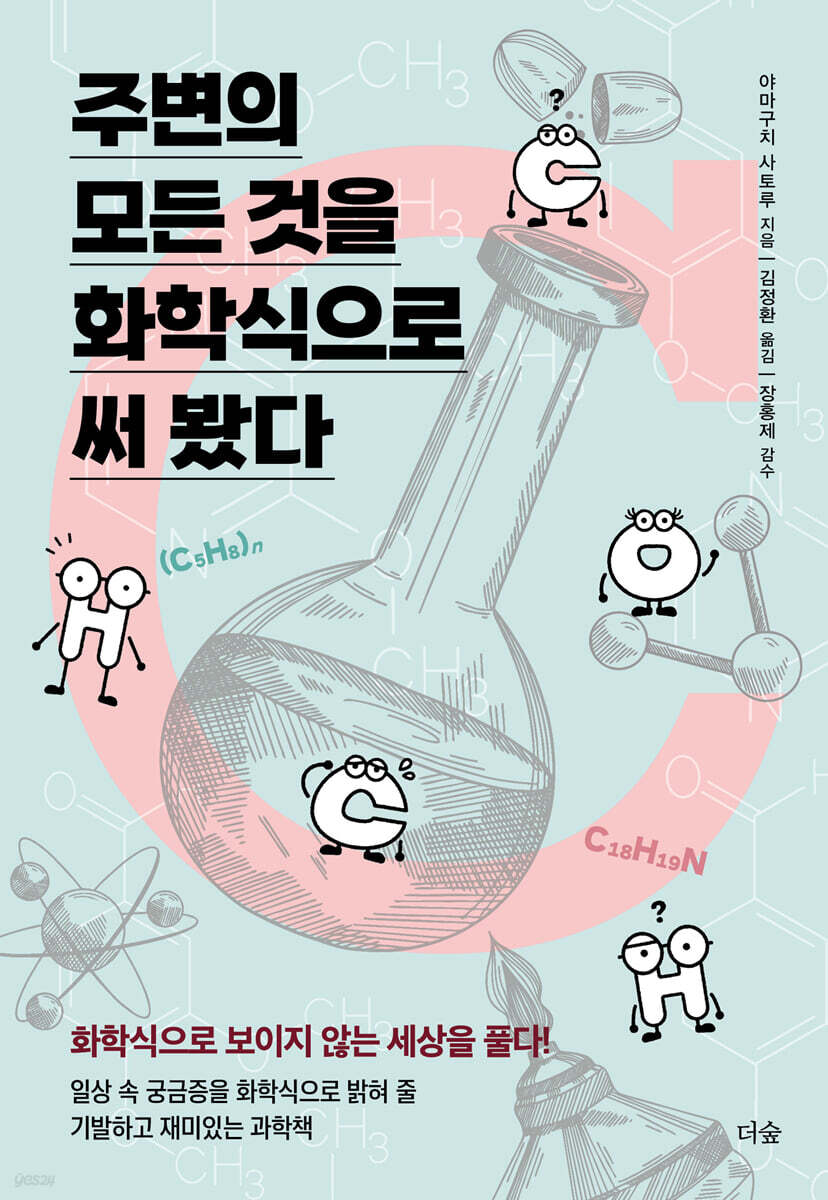
I wrote down everything around me as a chemical formula.
 |
Description
Book Introduction
Unraveling the invisible world with chemical formulas!
A novel and exciting science book that will answer everyday questions using chemical formulas.
Chemistry is considered by many to be a difficult subject, far removed from everyday life.
What are the chemical formulas and chemical reaction equations made up of the various bonding patterns of elements?
We learned it in middle and high school, but it is often forgotten in daily life because it is complicated and difficult to understand.
However, the world we live in is overflowing with stories related to chemistry, such as chemical accidents, Nobel Prizes in chemistry, and the development of pharmaceuticals, and countless products utilizing chemistry are being developed, so chemistry has invisibly permeated our lives.
But why are most people not interested in chemistry?
The author of "I Wrote Everything Around Me as a Chemical Formula" was fascinated by the fact that invisible molecules make up the world in an orderly manner, and began to explore the world of chemistry in earnest.
This book conveys the wonders of the world of chemistry by reinterpreting the objects around us through the lens of chemical formulas.
In our everyday spaces, such as bedrooms, kitchens, and bathrooms, there are familiar objects such as food, clothes, soap, and electronic devices.
This book thoroughly explains the chemical principles of the objects around us by explaining them in chemical formulas.
Friendly characters and illustrations, such as researchers of the carbon C group, oxygen O, and hydrogen H, are used to easily and concisely convey the core of the content.
From middle and high school students learning chemistry to those who find chemistry difficult and abstract after graduation, interpretations of rich examples from everyday life will reveal new aspects of chemistry, bridging the gap between life and academia and providing the joy of learning.
While teaching students at the Department of Chemistry at Kwangwoon University, I received supervision from Professor Jang Hong-je, who runs the YouTube channel 'Chemistry Haak' to popularize chemistry, leading to more detailed and in-depth discussions.
A novel and exciting science book that will answer everyday questions using chemical formulas.
Chemistry is considered by many to be a difficult subject, far removed from everyday life.
What are the chemical formulas and chemical reaction equations made up of the various bonding patterns of elements?
We learned it in middle and high school, but it is often forgotten in daily life because it is complicated and difficult to understand.
However, the world we live in is overflowing with stories related to chemistry, such as chemical accidents, Nobel Prizes in chemistry, and the development of pharmaceuticals, and countless products utilizing chemistry are being developed, so chemistry has invisibly permeated our lives.
But why are most people not interested in chemistry?
The author of "I Wrote Everything Around Me as a Chemical Formula" was fascinated by the fact that invisible molecules make up the world in an orderly manner, and began to explore the world of chemistry in earnest.
This book conveys the wonders of the world of chemistry by reinterpreting the objects around us through the lens of chemical formulas.
In our everyday spaces, such as bedrooms, kitchens, and bathrooms, there are familiar objects such as food, clothes, soap, and electronic devices.
This book thoroughly explains the chemical principles of the objects around us by explaining them in chemical formulas.
Friendly characters and illustrations, such as researchers of the carbon C group, oxygen O, and hydrogen H, are used to easily and concisely convey the core of the content.
From middle and high school students learning chemistry to those who find chemistry difficult and abstract after graduation, interpretations of rich examples from everyday life will reveal new aspects of chemistry, bridging the gap between life and academia and providing the joy of learning.
While teaching students at the Department of Chemistry at Kwangwoon University, I received supervision from Professor Jang Hong-je, who runs the YouTube channel 'Chemistry Haak' to popularize chemistry, leading to more detailed and in-depth discussions.
- You can preview some of the book's contents.
Preview
index
preface
Reviewer's note
Chapter 1 What are chemical formulas and chemical equations?
Chapter 2: Let's look at the chemical formula of air.
1 What molecules is air composed of?
2 Animals and plants cooperate through respiration and science.
3 ★ A Little More Detail! ★ Respiration and Photosynthesis
Chapter 3: Let's take a look at the chemical formula of the kitchen.
1 Why Opened Carbonated Drinks Turn into Sugar Water
2 Dry ice is a lump of CO₂ 027
3. Why drinking alcohol (C₂H?O) causes a hangover
4 ★ A Little More Detail! ★ What is an Enzyme?
5 Why does salt (NaCl) easily dissolve in water?
6 Sucrose, a wonderful molecule of sugar (C₁₂H₂₂O₁₁) that gives sweetness
7 ★ A Little More Detail! ★ Why Sugar Dissolves Easily in Water
8 ★ A little more detail! ★ How does salt taste?
9 Glutinous rice and non-glutinous rice have the same chemical formula, but why do they have different textures?
10 ★ A Little More Detail! ★ Cyclodextrin, a Ring-Shaped Molecule
11 Why is oil a liquid and fat a solid?
12 Reasons Why Neglected Maintenance Smells Bad
13 What is the smell coming from cucumbers and tomatoes?
14 The Truth About Garlic's Smell and Why Onions Make You Cry
15 The flavor of vegetables is the result of reactions with enzymes.
16 ★ A little more detail! ★ Wasabi is best eaten right after it's been ground.
Chapter 4: Let's look at the chemical formula of bathrooms and toilets.
1 The main component of teeth is Ca₁?(PO₄)?(OH)₂
2 How do cavities form in teeth?
3 ★ A Little More Detail! ★ Sweet Foods That Don't Cause Cavities
4 How do soap molecules remove grease?
5 Principles of Cleaning Using Soap
6 Hair and Protein
7. The Chemistry of Pharma
8. Combination of pressed hair and hydrogen
9 The components of urine are NaCl, CH₄N₂O
10 ★ A little more detail! ★ Absorbency of disposable diapers C₃H₃O₂Na
11. Poop is a part of the digestive process.
12 Dietary fiber and gut bacteria that make up stool
Chapter 5: Let's look at the chemical formulas of the living room and bedroom.
1 What molecules are used in liquid crystal displays?
2 Principles of LCD Television
3 What chemical reaction makes polyester?
4 Cotton fibers derived from plants, (C?H₁?O?)n
5 Charging and discharging batteries
6 Lithium batteries and lithium-ion batteries Li, Li+
Chapter 6: Let's look at other chemical formulas.
1 How is gasoline converted into energy?
2 ★ A Little More Detail! ★ What Can Be Made from Oil
3 The chemical formula of rubber, the material of tires, is (C?H?)n
4 What if plants replaced gasoline?
5 ★ A Little More Detail! ★ Energy from Plants
Conclusion
References
Reviewer's note
Chapter 1 What are chemical formulas and chemical equations?
Chapter 2: Let's look at the chemical formula of air.
1 What molecules is air composed of?
2 Animals and plants cooperate through respiration and science.
3 ★ A Little More Detail! ★ Respiration and Photosynthesis
Chapter 3: Let's take a look at the chemical formula of the kitchen.
1 Why Opened Carbonated Drinks Turn into Sugar Water
2 Dry ice is a lump of CO₂ 027
3. Why drinking alcohol (C₂H?O) causes a hangover
4 ★ A Little More Detail! ★ What is an Enzyme?
5 Why does salt (NaCl) easily dissolve in water?
6 Sucrose, a wonderful molecule of sugar (C₁₂H₂₂O₁₁) that gives sweetness
7 ★ A Little More Detail! ★ Why Sugar Dissolves Easily in Water
8 ★ A little more detail! ★ How does salt taste?
9 Glutinous rice and non-glutinous rice have the same chemical formula, but why do they have different textures?
10 ★ A Little More Detail! ★ Cyclodextrin, a Ring-Shaped Molecule
11 Why is oil a liquid and fat a solid?
12 Reasons Why Neglected Maintenance Smells Bad
13 What is the smell coming from cucumbers and tomatoes?
14 The Truth About Garlic's Smell and Why Onions Make You Cry
15 The flavor of vegetables is the result of reactions with enzymes.
16 ★ A little more detail! ★ Wasabi is best eaten right after it's been ground.
Chapter 4: Let's look at the chemical formula of bathrooms and toilets.
1 The main component of teeth is Ca₁?(PO₄)?(OH)₂
2 How do cavities form in teeth?
3 ★ A Little More Detail! ★ Sweet Foods That Don't Cause Cavities
4 How do soap molecules remove grease?
5 Principles of Cleaning Using Soap
6 Hair and Protein
7. The Chemistry of Pharma
8. Combination of pressed hair and hydrogen
9 The components of urine are NaCl, CH₄N₂O
10 ★ A little more detail! ★ Absorbency of disposable diapers C₃H₃O₂Na
11. Poop is a part of the digestive process.
12 Dietary fiber and gut bacteria that make up stool
Chapter 5: Let's look at the chemical formulas of the living room and bedroom.
1 What molecules are used in liquid crystal displays?
2 Principles of LCD Television
3 What chemical reaction makes polyester?
4 Cotton fibers derived from plants, (C?H₁?O?)n
5 Charging and discharging batteries
6 Lithium batteries and lithium-ion batteries Li, Li+
Chapter 6: Let's look at other chemical formulas.
1 How is gasoline converted into energy?
2 ★ A Little More Detail! ★ What Can Be Made from Oil
3 The chemical formula of rubber, the material of tires, is (C?H?)n
4 What if plants replaced gasoline?
5 ★ A Little More Detail! ★ Energy from Plants
Conclusion
References
Detailed image

Into the book
Chemistry is like a language.
And in order to understand and handle a language well, you must understand and follow the grammar, which is the promise of that language.
Chemistry is simple if you approach it the same way.
Why is salt only used as NaCl, which is a combination of one Na and one Cl? Why does the neutralization reaction leave behind water (H2O) when an acid (H+) and a base (OH-) meet?
Once you know everything, it's made up of obvious chemical grammar.
《Everything Around Me Written as a Chemical Formula》 explains everything from familiar chemistry stories that we often hear around us to complex and difficult-to-understand content using chemical formulas.
It also introduces the grammar of chemical formulas and shows the convenience of expressing them in formulas.
Chemical formulas, a jumble of letters, numbers, symbols, and arrows that can be a headache for those unfamiliar with chemistry, are actually the simplest sentences of substances.
This book will give you a chance to recall the chemical formulas that are buried in your memory.
---From "The Supervisor's Note"
Recent studies have shown that there are several types of taste-sensing cells.
It has been discovered that sugar acts on cells called type II cells, and salt acts on cells called type III cells.
Type I cells also exist, but their ability to transmit taste to the brain has not yet been discovered.
As shown in the figure below, when sugar (sucrose) attaches to type II cells, and when salt (sodium ion (Na+)) enters type III cells, it becomes a signal, and the information is transmitted to the nerves that control taste (gustatory nerves) through electrical signals or chemicals.
That information is transmitted to the brain, and you feel the taste of 'salty' or 'sweet'.
---From "How does salt taste? ★ A little more detail! ★"
Dry ice is a solid, but it's actually a lump of CO2. CO2 is a gas at room temperature, but it solidifies when cooled.
It's like when you freeze water, it becomes ice.
However, while water becomes solid at 0 degrees Celsius, CO2 becomes solid at about minus 78 degrees Celsius.
Because things with such low temperatures are placed together, ice cream and frozen foods remain cold.
However, when left at room temperature, dry ice reverts to gaseous CO2 over time.
In the case of ice, when it melts it becomes liquid (water), but in the case of CO2, it becomes gas.
This is called 'sublimation'.
And eventually the dry ice disappears.
---From "Dry ice is a lump of CO2"
The acetic acid produced in the body is broken down again and excreted from the body.
In this way, our body undergoes a chemical reaction that converts ethanol and expels it from the body.
However, if you drink more alcohol than the enzyme can handle, ethanol or acetaldehyde remains in your body.
Acetaldehyde is the cause of so-called hangovers because it causes headaches and nausea.
---From "Why You Get a Hangover When You Drink Alcohol (C2H6O)"
The atoms that make up enzymes are mainly C, H, O, N, and S (S is the element symbol for sulfur), and are not much different from the molecules that have appeared so far.
However, compared to molecules that have appeared so far, it is very large.
For example, the mass of alcohol dehydrogenase or aldehyde dehydrogenase is over 1,000 times that of ethanol or acetaldehyde! This gives you an idea of how large these molecules are.
As in the case of ADH and ALDH, there are many different types of enzymes, each with a different role.
There are many different types of enzymes in our bodies (many of which appear in this book).
Also, even for the same type of enzyme, some of the atoms that make up the enzyme are subtly different from person to person, and the degree of action also varies.
So, because the functions of ADH and ALDH differ from person to person, there are people who can tolerate alcohol well and those who can't.
---From "What is an enzyme? ★ A little more detail! ★"
Why does salting prevent food from spoiling and preserve it for a long time? The reason food spoils in the first place is because the number of microorganisms in the food increases.
And for microorganisms to reproduce and live, they need water, just like we do.
This is why food spoils easily during humid periods such as the rainy season.
Therefore, removing moisture from food becomes the key to long-term preservation.
And as mentioned before, salt (NaCl = Na+ and Cl-) has the property of attracting water (H2O) to each other.
So, it absorbs the water in the food well and prevents microorganisms from multiplying.
---From “Why does salt (NaCl) easily decompose in water?”
The main component of sugar is sucrose, the wonderful molecule that gives us the taste of sweetness.
The chemical formula of sucrose is C12H22O11.
Sucrose is a structure made up of molecules called glucose (C6H12O6) and fructose (C6H12O6).
Glucose has already appeared in 'Respiration and Photosynthesis'.
On the other hand, fructose came out first, and if you look closely at its chemical formula, it is C6H12O6, the same as glucose.
The chemical formula is the same, but the name is different.
---From "Sucrose, the wonderful molecule of sugar (C12H22O11) that gives sweetness"
Deodorizers eliminate unpleasant odors [deodorize] and spread pleasant scents [fragrance], but how do we perceive such smells or scents?
In fact, the way we perceive unpleasant or pleasant smells is also related to molecules.
Molecules that smell good or have an unpleasant odor exist in a gaseous state, and these molecules floating in the air are transmitted through our nose as fragrance or smell.
When molecules that cause us to sense smells attach to receptors (places where molecules attach) on cells in the nasal cavity, information is transmitted to the nerves that control the sense of smell through chemicals or electrical signals.
At this time, the cells that control the sense of smell are called the olfactory nerve.
There are many different types of molecules that allow us to perceive smell, and there are also many different types of receptors that these molecules bind to.
Humans sense smell through about 400 types of receptors.
Let's go back to the story of deodorant.
A molecule with a pleasant scent is pre-incorporated into the cyclodextrin.
And while it slowly releases those molecules, it also takes in molecules that have an unpleasant odor.
This way, it acts as a deodorizing air freshener by removing unpleasant odors while producing a pleasant scent.
---From "Cyclodextrin, a ring-shaped molecule ★ A little more detail! ★"
Mutants live comfortably in glucan and excrete lactic acid [actually, they also excrete acetic acid].
In addition, it also vomits out an acid called formic acid (HCO2H), but the proportion of lactic acid is high.]
The acid produced during this process causes concentrated demineralization, which causes teeth to dissolve and cavities to develop.
Before this happens, you must brush your teeth to remove the tartar (glucan + bacteria) that is stuck to your teeth.
Sticky tartar is not easily removed by brushing your teeth with water.
The best way to remove it is with physical force, and the most effective way is brushing your teeth.
Toothpaste contains abrasives (particles that effectively polish teeth) that are effective in removing sticky tartar.
And in order to understand and handle a language well, you must understand and follow the grammar, which is the promise of that language.
Chemistry is simple if you approach it the same way.
Why is salt only used as NaCl, which is a combination of one Na and one Cl? Why does the neutralization reaction leave behind water (H2O) when an acid (H+) and a base (OH-) meet?
Once you know everything, it's made up of obvious chemical grammar.
《Everything Around Me Written as a Chemical Formula》 explains everything from familiar chemistry stories that we often hear around us to complex and difficult-to-understand content using chemical formulas.
It also introduces the grammar of chemical formulas and shows the convenience of expressing them in formulas.
Chemical formulas, a jumble of letters, numbers, symbols, and arrows that can be a headache for those unfamiliar with chemistry, are actually the simplest sentences of substances.
This book will give you a chance to recall the chemical formulas that are buried in your memory.
---From "The Supervisor's Note"
Recent studies have shown that there are several types of taste-sensing cells.
It has been discovered that sugar acts on cells called type II cells, and salt acts on cells called type III cells.
Type I cells also exist, but their ability to transmit taste to the brain has not yet been discovered.
As shown in the figure below, when sugar (sucrose) attaches to type II cells, and when salt (sodium ion (Na+)) enters type III cells, it becomes a signal, and the information is transmitted to the nerves that control taste (gustatory nerves) through electrical signals or chemicals.
That information is transmitted to the brain, and you feel the taste of 'salty' or 'sweet'.
---From "How does salt taste? ★ A little more detail! ★"
Dry ice is a solid, but it's actually a lump of CO2. CO2 is a gas at room temperature, but it solidifies when cooled.
It's like when you freeze water, it becomes ice.
However, while water becomes solid at 0 degrees Celsius, CO2 becomes solid at about minus 78 degrees Celsius.
Because things with such low temperatures are placed together, ice cream and frozen foods remain cold.
However, when left at room temperature, dry ice reverts to gaseous CO2 over time.
In the case of ice, when it melts it becomes liquid (water), but in the case of CO2, it becomes gas.
This is called 'sublimation'.
And eventually the dry ice disappears.
---From "Dry ice is a lump of CO2"
The acetic acid produced in the body is broken down again and excreted from the body.
In this way, our body undergoes a chemical reaction that converts ethanol and expels it from the body.
However, if you drink more alcohol than the enzyme can handle, ethanol or acetaldehyde remains in your body.
Acetaldehyde is the cause of so-called hangovers because it causes headaches and nausea.
---From "Why You Get a Hangover When You Drink Alcohol (C2H6O)"
The atoms that make up enzymes are mainly C, H, O, N, and S (S is the element symbol for sulfur), and are not much different from the molecules that have appeared so far.
However, compared to molecules that have appeared so far, it is very large.
For example, the mass of alcohol dehydrogenase or aldehyde dehydrogenase is over 1,000 times that of ethanol or acetaldehyde! This gives you an idea of how large these molecules are.
As in the case of ADH and ALDH, there are many different types of enzymes, each with a different role.
There are many different types of enzymes in our bodies (many of which appear in this book).
Also, even for the same type of enzyme, some of the atoms that make up the enzyme are subtly different from person to person, and the degree of action also varies.
So, because the functions of ADH and ALDH differ from person to person, there are people who can tolerate alcohol well and those who can't.
---From "What is an enzyme? ★ A little more detail! ★"
Why does salting prevent food from spoiling and preserve it for a long time? The reason food spoils in the first place is because the number of microorganisms in the food increases.
And for microorganisms to reproduce and live, they need water, just like we do.
This is why food spoils easily during humid periods such as the rainy season.
Therefore, removing moisture from food becomes the key to long-term preservation.
And as mentioned before, salt (NaCl = Na+ and Cl-) has the property of attracting water (H2O) to each other.
So, it absorbs the water in the food well and prevents microorganisms from multiplying.
---From “Why does salt (NaCl) easily decompose in water?”
The main component of sugar is sucrose, the wonderful molecule that gives us the taste of sweetness.
The chemical formula of sucrose is C12H22O11.
Sucrose is a structure made up of molecules called glucose (C6H12O6) and fructose (C6H12O6).
Glucose has already appeared in 'Respiration and Photosynthesis'.
On the other hand, fructose came out first, and if you look closely at its chemical formula, it is C6H12O6, the same as glucose.
The chemical formula is the same, but the name is different.
---From "Sucrose, the wonderful molecule of sugar (C12H22O11) that gives sweetness"
Deodorizers eliminate unpleasant odors [deodorize] and spread pleasant scents [fragrance], but how do we perceive such smells or scents?
In fact, the way we perceive unpleasant or pleasant smells is also related to molecules.
Molecules that smell good or have an unpleasant odor exist in a gaseous state, and these molecules floating in the air are transmitted through our nose as fragrance or smell.
When molecules that cause us to sense smells attach to receptors (places where molecules attach) on cells in the nasal cavity, information is transmitted to the nerves that control the sense of smell through chemicals or electrical signals.
At this time, the cells that control the sense of smell are called the olfactory nerve.
There are many different types of molecules that allow us to perceive smell, and there are also many different types of receptors that these molecules bind to.
Humans sense smell through about 400 types of receptors.
Let's go back to the story of deodorant.
A molecule with a pleasant scent is pre-incorporated into the cyclodextrin.
And while it slowly releases those molecules, it also takes in molecules that have an unpleasant odor.
This way, it acts as a deodorizing air freshener by removing unpleasant odors while producing a pleasant scent.
---From "Cyclodextrin, a ring-shaped molecule ★ A little more detail! ★"
Mutants live comfortably in glucan and excrete lactic acid [actually, they also excrete acetic acid].
In addition, it also vomits out an acid called formic acid (HCO2H), but the proportion of lactic acid is high.]
The acid produced during this process causes concentrated demineralization, which causes teeth to dissolve and cavities to develop.
Before this happens, you must brush your teeth to remove the tartar (glucan + bacteria) that is stuck to your teeth.
Sticky tartar is not easily removed by brushing your teeth with water.
The best way to remove it is with physical force, and the most effective way is brushing your teeth.
Toothpaste contains abrasives (particles that effectively polish teeth) that are effective in removing sticky tartar.
---From "How do cavities form in teeth?"
Publisher's Review
The Amazing World of Chemical Chemistry: Connecting Everyday Life and Science
If expressed as a chemical formula
Questions about the world are clearly resolved!
This book consists of a total of six chapters.
Chapter 1 closely examines the core concepts of the chemical world that must be known before examining chemical formulas: atoms and molecules, chemical formulas, and chemical reaction equations.
Chapter 2 examines the molecules closest to us: the air.
It shows through chemical analysis how animals breathe in oxygen and exhale carbon dioxide, and plants photosynthesize, which creates molecules called glucose from carbon dioxide, to create energy.
Chapters 3 through 6 examine the chemical formulas of familiar objects found in our everyday spaces, such as food, soap, clothes, toothpaste, and electronic devices, in the kitchen, washroom, bathroom, living room, and bedroom, one by one, bringing to the surface scientific principles that are not visible in our daily lives.
Why does an open soda in the kitchen turn into bland sugar water? How do cavities form in our teeth? Why do we get hangovers after drinking alcohol (C2H6O)? Why does salt (NaCl) easily break down when placed in water? Why do glutinous and non-glutinous rice have different textures? Why is oil a liquid and fat a solid? Does oil develop an unpleasant smell and taste when exposed to air? What is the source of garlic's smell, and why does chopping an onion bring tears to our eyes?
This book begins with questions we might have had at least once in our daily lives and ultimately logically unravels how the world of molecules constitutes our daily lives and what roles those molecules play.
Laying a solid foundation in chemistry!
If only I had read it sooner
A very welcome chemistry book that could not have been better
We breathe in oxygen and breathe out carbon dioxide, forgetting that we live in a world made up of invisible molecules.
This book brings these self-evident facts to mind, allowing us to imagine and draw in an interesting way the invisible principles of chemistry.
Why do we examine chemical formulas? In the world of chemistry, expressing complex molecular structures in chemical formulas often makes understanding chemistry more convenient and easier.
Chemistry plays a vital role in many areas of life, improving and enriching our lives in numerous ways.
By understanding the chemical reactions that occur during the cooking process, you can use them to make more delicious and healthy food, and by understanding the principles of cleaning using soap, you can also find answers to questions that arise in real life.
Furthermore, chemical formulas are essential tools that contribute to the advancement of science and technology and to improving the quality of life.
When calculating the quantities of substances and products in industrial production processes to develop new substances, or when developing effective medicines for treating diseases, technologies to decompose and remove environmental pollutants, or eco-friendly energy, chemical formulas are essential for achieving results.
This book will help you overcome your fear of chemistry by teaching you how to interpret complex chemical formulas in an easy and interesting way. While complex chemical formulas may seem difficult, persistently delving into everyday concerns and questions can lead to great scientific achievements.
For science and engineering students curious about chemistry or gifted students dreaming of future Nobel Prize winners, there is no book as unique and original as this one.
If expressed as a chemical formula
Questions about the world are clearly resolved!
This book consists of a total of six chapters.
Chapter 1 closely examines the core concepts of the chemical world that must be known before examining chemical formulas: atoms and molecules, chemical formulas, and chemical reaction equations.
Chapter 2 examines the molecules closest to us: the air.
It shows through chemical analysis how animals breathe in oxygen and exhale carbon dioxide, and plants photosynthesize, which creates molecules called glucose from carbon dioxide, to create energy.
Chapters 3 through 6 examine the chemical formulas of familiar objects found in our everyday spaces, such as food, soap, clothes, toothpaste, and electronic devices, in the kitchen, washroom, bathroom, living room, and bedroom, one by one, bringing to the surface scientific principles that are not visible in our daily lives.
Why does an open soda in the kitchen turn into bland sugar water? How do cavities form in our teeth? Why do we get hangovers after drinking alcohol (C2H6O)? Why does salt (NaCl) easily break down when placed in water? Why do glutinous and non-glutinous rice have different textures? Why is oil a liquid and fat a solid? Does oil develop an unpleasant smell and taste when exposed to air? What is the source of garlic's smell, and why does chopping an onion bring tears to our eyes?
This book begins with questions we might have had at least once in our daily lives and ultimately logically unravels how the world of molecules constitutes our daily lives and what roles those molecules play.
Laying a solid foundation in chemistry!
If only I had read it sooner
A very welcome chemistry book that could not have been better
We breathe in oxygen and breathe out carbon dioxide, forgetting that we live in a world made up of invisible molecules.
This book brings these self-evident facts to mind, allowing us to imagine and draw in an interesting way the invisible principles of chemistry.
Why do we examine chemical formulas? In the world of chemistry, expressing complex molecular structures in chemical formulas often makes understanding chemistry more convenient and easier.
Chemistry plays a vital role in many areas of life, improving and enriching our lives in numerous ways.
By understanding the chemical reactions that occur during the cooking process, you can use them to make more delicious and healthy food, and by understanding the principles of cleaning using soap, you can also find answers to questions that arise in real life.
Furthermore, chemical formulas are essential tools that contribute to the advancement of science and technology and to improving the quality of life.
When calculating the quantities of substances and products in industrial production processes to develop new substances, or when developing effective medicines for treating diseases, technologies to decompose and remove environmental pollutants, or eco-friendly energy, chemical formulas are essential for achieving results.
This book will help you overcome your fear of chemistry by teaching you how to interpret complex chemical formulas in an easy and interesting way. While complex chemical formulas may seem difficult, persistently delving into everyday concerns and questions can lead to great scientific achievements.
For science and engineering students curious about chemistry or gifted students dreaming of future Nobel Prize winners, there is no book as unique and original as this one.
GOODS SPECIFICS
- Date of issue: April 12, 2024
- Page count, weight, size: 236 pages | 404g | 145*210*20mm
- ISBN13: 9791192444833
- ISBN10: 1192444833
You may also like
카테고리
korean


korean

![ELLE 엘르 스페셜 에디션 A형 : 12월 [2025]](http://librairie.coreenne.fr/cdn/shop/files/b8e27a3de6c9538896439686c6b0e8fb.jpg?v=1766436872&width=3840)


