

All the science in the world
 |
Description
Book Introduction
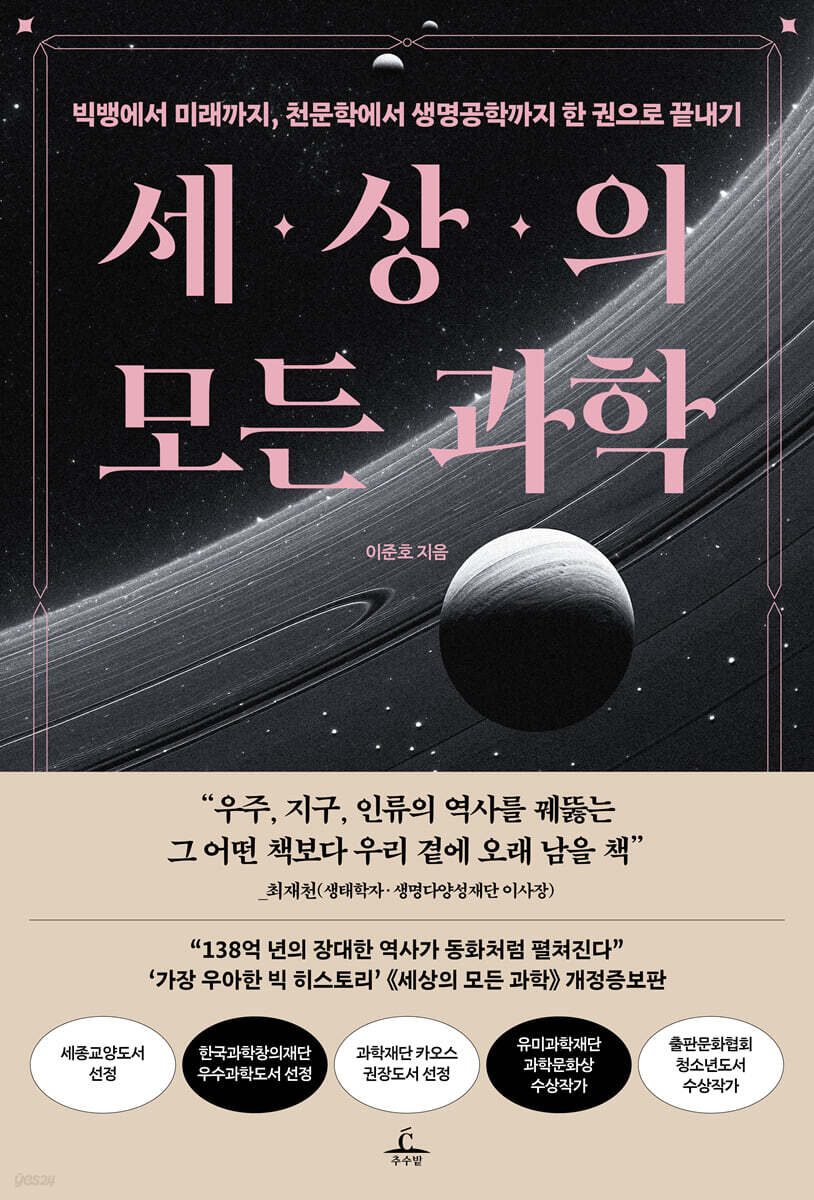
This book not only explains the history of the universe in chronological order from its beginnings to the future of humanity, but also integrates disciplines like astronomy, physics, biology, and anthropology, making it the easiest way to "complete science in one volume."
The author himself clearly illustrates difficult scientific principles with over 30 beautiful landscapes and 150 hand-drawn illustrations, presenting a warmth and friendliness not found in other science books.
Revised and republished after seven years, this book synthesizes issues that have arisen in the field of science and technology, offering insights for navigating today's increasingly complex era.
By adding a chapter on "Computer Science" that covers how generative AI, which caused a tectonic shift in the human world, was born, and a chapter on "Biotechnology" that uses technologies such as gene scissors to create superior crops and humans, we guide you through the history of science and technology that are causing sharp controversy today and take a small step toward a better future.
The author himself clearly illustrates difficult scientific principles with over 30 beautiful landscapes and 150 hand-drawn illustrations, presenting a warmth and friendliness not found in other science books.
Revised and republished after seven years, this book synthesizes issues that have arisen in the field of science and technology, offering insights for navigating today's increasingly complex era.
By adding a chapter on "Computer Science" that covers how generative AI, which caused a tectonic shift in the human world, was born, and a chapter on "Biotechnology" that uses technologies such as gene scissors to create superior crops and humans, we guide you through the history of science and technology that are causing sharp controversy today and take a small step toward a better future.
- You can preview some of the book's contents.
Preview
index
Recommendation 1: The book that most faithfully answers our past, present, and future.
Recommendation 2: Beyond "Understanding" to "Emotion," a science book that moves the world.
Entering
Before your trip
Chronology: Defining Moments in the History of the Universe, Humanity, and Science
Part 1: The Mystery of the Universe That Created Life
Chapter 1: The Universe: From the Insignificant Dot to the Vast Celestial Bodies
Chapter 2: Earth, a hell seething with lava, until it embraced the first life.
Chapter 3: From the Sea, a World of Quiet Silence, to a Dynamic World of Survival of the Fittest
Chapter 4: The Continent, the Evolutionary Adventures of Heroes Who Conquered the Earth
Chapter 5: Ancestors: From Hidden Mammals to Apes
Part 2: Humanity's Voyage on the Ship of Civilization
Chapter 6: From the Trees to Earth's Ultimate Predator
Chapter 7 Weapons, from spearheads aimed at buffaloes to nuclear bombs that shook the Earth
Chapter 8 Agriculture: From a tool that ensures survival to a blade that threatens survival
Chapter 9: Writing: The Decisive Force That Overcame Crisis and Gave Birth to a New Civilization
Part 3: Life, Civilization, and Science Advancing into Space
Chapter 10: Computers, From Resembling Their Creator's Brain to Going Beyond It
Chapter 11: Biotechnology: Beyond Genetic Discovery: Humans Approaching God's Blueprint
Chapter 12: Astronomy: A History of Intellectual Challenges and Innovations That Shake the Celestial Order
Chapter 13: The Big Bang: Humanity's Challenges Facing the Universe's Greatest Mystery
Recommendation 2: Beyond "Understanding" to "Emotion," a science book that moves the world.
Entering
Before your trip
Chronology: Defining Moments in the History of the Universe, Humanity, and Science
Part 1: The Mystery of the Universe That Created Life
Chapter 1: The Universe: From the Insignificant Dot to the Vast Celestial Bodies
Chapter 2: Earth, a hell seething with lava, until it embraced the first life.
Chapter 3: From the Sea, a World of Quiet Silence, to a Dynamic World of Survival of the Fittest
Chapter 4: The Continent, the Evolutionary Adventures of Heroes Who Conquered the Earth
Chapter 5: Ancestors: From Hidden Mammals to Apes
Part 2: Humanity's Voyage on the Ship of Civilization
Chapter 6: From the Trees to Earth's Ultimate Predator
Chapter 7 Weapons, from spearheads aimed at buffaloes to nuclear bombs that shook the Earth
Chapter 8 Agriculture: From a tool that ensures survival to a blade that threatens survival
Chapter 9: Writing: The Decisive Force That Overcame Crisis and Gave Birth to a New Civilization
Part 3: Life, Civilization, and Science Advancing into Space
Chapter 10: Computers, From Resembling Their Creator's Brain to Going Beyond It
Chapter 11: Biotechnology: Beyond Genetic Discovery: Humans Approaching God's Blueprint
Chapter 12: Astronomy: A History of Intellectual Challenges and Innovations That Shake the Celestial Order
Chapter 13: The Big Bang: Humanity's Challenges Facing the Universe's Greatest Mystery
Detailed image

Into the book
Let's raise our heads again and look at the horizon.
If we set out for the horizon now, the history of human civilization will pass us by in less than 0.1 second.
But it will take all day to reach the horizon.
I might have to come back later because my legs hurt in the middle.
Compared to the age of the universe, which is 13.8 billion years, the history of human civilization is nothing more than the blink of an eye.
So the history of the universe is really long.
Besides, we plan to travel to the future.
The scale of this journey is unlike anything you've ever experienced before.
It is full of such unique and amazing scenery.
You can look forward to it.
--- From "Entering"
For example, imagine if the Earth suddenly swelled.
The distance between Seoul, Korea and New York, USA, would be that much greater. The same goes for space.
As space expands, the distance between stars increases.
Even as you read this book, it continues to move away.
If you don't want to get farther away, you have to keep running towards that star at 25 kilometers per second.
25 kilometers per second is 25 times faster than a bullet.
Even so, it's not like we're getting closer, we're just barely getting further apart.
However, stars that are close together and are attracted to each other by strong gravity do not move apart easily.
The stars in our galaxy do not move apart because they are held together by gravity.
So, to us, the universe appears to be unchanged.
But even at this very moment, new spaces are constantly being created, and we are moving further and further away from the shining stars in other galaxies far away.
--- From "Chapter 1: Universe"
If life had to be born in a pool or crevice on the beach, the materials that were painstakingly created would often be swept away in an instant by the countless tides that surged in and out.
Moreover, because the moon was much closer at the time, the force pulling the water was tens or hundreds of times greater, so the high and low tides were at the level of a super-large tsunami.
Moreover, when the sea recedes, the sun's powerful ultraviolet rays destroy the materials.
Even now, when you go to the beach, your skin gets sunburned even though the ozone layer is thick to block ultraviolet rays, but back then, when there was no ozone layer, the destruction would have been even more severe.
But there was just the right space in the hydrothermal vent.
These are tiny mazes, each only one-tenth of a millimeter in size, created by the accumulation of substances here and there as the flow of water gushes out.
It was here that countless chemicals were able to combine and decompose into various forms and accumulate in the labyrinths.
Hydrothermal vents were chemical laboratories, factories, and warehouses all at once.
So it's highly likely that something was created right here 4 billion years ago.
--- From "Chapter 2 Earth"
For the first time in Earth's history, life forms of a size and shape visible to the naked eye appeared.
However, since it is still the first time, most of them have soft, jelly-like tissues and simple shapes, so you cannot find organs such as eyes, mouths, fins, or legs.
Charnia, which resembles a leaf and sways with the waves, Dickinsonia, which is shaped like a flat, wide, round mat, and Spriggina, which looks like a straw shoe footprint, are very slow-moving, either floating with the waves or barely gliding a few millimeters at a time.
Compared to the current living things, it may be a bit boring, but it is a landscape that has a certain charm, like the ‘aesthetics of slowness’ that puts one’s mind at ease.
Would it go well with soft classical music?
--- From "Chapter 3: The Sea"
But this survival strategy unexpectedly helps fish land.
The fins were of little help in navigating the underwater undergrowth.
Of course, it didn't matter for very small fish because they didn't get caught in the bushes, but for fairly large fish, it was better to crawl rather than swim quickly.
It is this very need that changes the fins.
Through evolution, bones developed between the webbed feet and the body, lengthening them and gradually becoming legs. The webbed feet also developed bones, taking on the appearance of feet.
With legs that can bend and extend and feet that can graze through undergrowth, the fish can move more comfortably by wriggling.
To put it simply, Eustenopteron evolved from the shoulder to the elbow, Tiktaalik, which followed, evolved from the elbow to the wrist, and Acanthostega evolved up to the hand.
Acanthostega was the first fish to crawl around, similar to a crocodile, and lived in shallow water, catching small prey.
Fierce competition in a changing environment transformed the thin webbed feet that swam through the water into limbs made of strong bones and muscles.
--- From "Chapter 4 Continents"
Now the new protagonists of evolution were mammals that climbed trees to escape their predators.
One of them, Carpolestes, weighed only 100 grams and was only 15 centimeters long.
If caught by a Megistotherium, it would have been less than a bite, so it would have been difficult to survive without hanging tightly to a tree.
Carpolestes' feet evolved in a unique way because flat, hard feet would not be able to support themselves in trees.
The toes were long, and even the inner toe could act like our thumb, grasping branches with the other toes.
Moreover, the claws were also different.
Previously, they had hooked claws like those of wolves, cats, and eagles, but Carpolestes' new claws were flat and covered flesh like human fingernails.
Thanks to this, I was able to feel the tree trunk more delicately with the fleshy part under my claws and hold on to it in a precise position.
--- From "Chapter 5 Ancestors"
Still, the fire was clearly worth fighting for.
It was the best means of protection against wild beasts, but more importantly, it was an excellent cooking method.
Sweet potatoes, tuberous roots, and animal meat, which our ancestors ate a lot, are much easier to digest and absorb when grilled.
And if you cook meat using fire, you can store it for much longer than when it's raw, and it also prevents parasites.
There was more to eat, digestion was better, and it became more comfortable in many ways.
This effective nutritional intake may have been crucial in the development of a key human characteristic: the "big brain."
The human brain is a burdensome organ that consumes 20% of the body's energy even though it accounts for only 3% of the body's weight.
So, in the case of Homo erectus, who knew how to use fire, despite being 60% larger than their ancestors, their teeth were blunter and their intestines were shorter.
Thanks to fire, there was no need for large intestines and teeth.
Instead, the brain grows to about 1,000 cc, approaching the brain size of a modern human, which is about 1,400 cc.
I guess there's a reason why there's a story in Greek mythology about Prometheus stealing fire and giving it to humans.
Without fire, humans could not exist.
--- From "Chapter 6: Humanity"
The reason nuclear bombs could create such powerful explosions was because of a new energy called 'nuclear fission' hidden within matter.
Nuclear fission produced an incredible amount of light and heat, incomparable to gunpowder, and was essentially the creation of another sun.
In fact, when a nuclear explosion occurs, a fireball is created, and its central temperature is said to exceed 100 million degrees, which is hotter than the sun's central temperature of 15 million degrees.
Just 500 years ago, people were barely able to send rocks flying by exploding crude gunpowder, but now they are able to create the sun.
But people were not satisfied with that.
The race to build a more powerful nuclear bomb begins.
Just as France developed cannons to counter the British longbow, the Soviet Union developed the most powerful bomb in human history to counter the American atomic bomb.
--- From "Chapter 7 Weapons"
Farming like this is likely to ultimately destroy the soil, whether through soil erosion or soil salinization.
Areas with abundant rainfall experience soil erosion problems, while areas with insufficient rainfall experience soil salinization problems.
Agriculture is not as eco-friendly as you might think.
"Industry" is a resource that, like industry, destroys the environment and exploits the soil. According to the UN, 33% of soil resources have already been devastated by erosion, salinization, and acidification.
And if soil destruction continues at this rate, it is predicted that in 60 years, all soil on Earth suitable for growing crops will be lost.
The map above shows areas of soil destruction due to erosion in 2002, with the red areas indicating danger spreading very widely.
Outside of extremely cold, dry areas and tropical rainforests, there is little land left that is suitable for farming, and much of that is suffering from erosion.
--- From "Chapter 8 Agriculture"
People didn't just seek entertainment from books.
The desire for useful information and knowledge was strong, and publishers and booksellers worked hard to meet that demand to make money.
As a result, the intellectual abilities of the lower classes also grow at a frightening rate.
In the 1700s, French priests even wrote that "country people are so absorbed in reading that they prefer reading to playing on holidays and that they understand the Constitution better than we do."
The power of the citizens formed in this way became one of the main driving forces of the French Revolution, which eventually led to the overthrow of the government and the astonishing event of executing the king, who had been revered as a divine being, on the guillotine.
The power of the words in the book was so strong that it overthrew the monarchy and ushered in an era of democracy.
--- From "Chapter 9 Characters"
But the perceptron was shocking not only because it resembled humans, but also in another way.
Originally, a computer program was a code written by a person line by line, that is, it carried out commands.
This is still the case today.
Almost all of the programs you use, such as the various apps on your mobile phone or the Windows operating system on your computer, are made of code.
Microsoft Windows has about a billion lines of code.
It was created line by line by countless programmers.
But there is no code with that meaning in perceptron.
The goal could be reached without people having to give orders one by one.
The secret lies in the neural network of mathematical neurons.
Neurons are connected to each other and do not simply transmit signals, but also make 'judgments' on how to transmit the received signals.
Judgments are made based on a 'standard'. If the input signals fall short of the 'standard', they are ignored, and if they exceed the 'standard', they are output and sent out as signals to other neurons.
It's like a switch that has its own criteria for judgment.
A neural network is made up of switches connected to each other, sending and receiving signals.
And those connections are put together to create the final answer.
--- From "Chapter 10 Computers"
Researchers at Danisco, a Danish yogurt company, discovered a peculiar phenomenon in lactic acid bacteria one day.
The lactic acid bacteria that normally make yogurt are susceptible to phage virus (bacteriophage) infection.
Phageviruses, like other viruses, inject their DNA into bacteria, causing the bacteria to produce phageviruses.
Lactic acid bacteria infected with phage viruses will continue to produce viruses by diligently using their energy.
In this way, phage viruses multiply within the lactic acid bacteria, and when the condition of the lactic acid bacteria is not good, they break through the cell membrane of the bacteria and spread to other places.
However, researchers observed that some lactic acid bacteria were not infected by phage viruses.
Out of curiosity, the researchers looked into the DNA of this lactic acid bacteria.
Then, it turned out that all of them had specific genes activated.
What's even more surprising is that this particular gene contained the DNA of a phage virus that kills lactic acid bacteria.
This particular gene is the 'CRISPR gene', which is a hot topic in the biotechnology world these days.
The CRISPR gene acts like a wanted poster.
This means that 'this type of gene is a viral gene that causes harm to bacteria, so it should be eliminated.'
--- From "Chapter 11 Biotechnology"
Now the question Einstein had to solve was, 'If light bends on Earth, why does it bend?'
Here comes another brilliant idea.
This means that the space-time through which light passes is warped.
It's like a billiard ball trying to roll straight, but if the billiard table is dented, the ball will inevitably roll crookedly.
This is how the core idea of the great general theory of relativity comes about.
Gravity is caused by the warping of space-time.
Just as if you put a heavy bowling ball on a trampoline, that part will sink in, and if you put other balls on it, they will all roll towards the bowling ball, when space-time is warped, gravity is generated in that direction and you are pulled in.
--- From "Chapter 12 Astronomy"
Friedman used his exceptional mathematical skills to simplify the complex formulas of the theory of relativity.
While Einstein, as a physicist, complicated his equations by introducing antigravity to explain the existing, seemingly stable universe, Friedman took a purely mathematical approach and simplified it.
It doesn't matter whether the actual universe is like this or that.
If Einstein's relativity equations are like a bus, Friedmann's relativity equations are like a bicycle. It's easy to see how a bicycle works, but it's hard to see how a bus rolls.
That's how easy it is to understand the principles of a bicycle.
To know where a bike will go, you need to look at factors like how fast you pedal, which way you turn the handlebars, and how much you weigh.
Likewise, when Friedman's formula for relativity was applied to the universe, it was easier to figure out how the universe would behave.
Friedman found that in relativity, how the universe behaves depends on three variables.
The first was the expansion of the universe, the second was the amount of matter, and the third was the antigravity between matter.
Of these, both expansion and antigravity result in the universe expanding.
You can think of expansion as a trampoline stretching out in all directions, and antigravity as a force that pushes matter away from each other.
The opposite of these is the amount of matter; if there is a lot of matter, the gravitational force increases, causing the universe to shrink.
If we set out for the horizon now, the history of human civilization will pass us by in less than 0.1 second.
But it will take all day to reach the horizon.
I might have to come back later because my legs hurt in the middle.
Compared to the age of the universe, which is 13.8 billion years, the history of human civilization is nothing more than the blink of an eye.
So the history of the universe is really long.
Besides, we plan to travel to the future.
The scale of this journey is unlike anything you've ever experienced before.
It is full of such unique and amazing scenery.
You can look forward to it.
--- From "Entering"
For example, imagine if the Earth suddenly swelled.
The distance between Seoul, Korea and New York, USA, would be that much greater. The same goes for space.
As space expands, the distance between stars increases.
Even as you read this book, it continues to move away.
If you don't want to get farther away, you have to keep running towards that star at 25 kilometers per second.
25 kilometers per second is 25 times faster than a bullet.
Even so, it's not like we're getting closer, we're just barely getting further apart.
However, stars that are close together and are attracted to each other by strong gravity do not move apart easily.
The stars in our galaxy do not move apart because they are held together by gravity.
So, to us, the universe appears to be unchanged.
But even at this very moment, new spaces are constantly being created, and we are moving further and further away from the shining stars in other galaxies far away.
--- From "Chapter 1: Universe"
If life had to be born in a pool or crevice on the beach, the materials that were painstakingly created would often be swept away in an instant by the countless tides that surged in and out.
Moreover, because the moon was much closer at the time, the force pulling the water was tens or hundreds of times greater, so the high and low tides were at the level of a super-large tsunami.
Moreover, when the sea recedes, the sun's powerful ultraviolet rays destroy the materials.
Even now, when you go to the beach, your skin gets sunburned even though the ozone layer is thick to block ultraviolet rays, but back then, when there was no ozone layer, the destruction would have been even more severe.
But there was just the right space in the hydrothermal vent.
These are tiny mazes, each only one-tenth of a millimeter in size, created by the accumulation of substances here and there as the flow of water gushes out.
It was here that countless chemicals were able to combine and decompose into various forms and accumulate in the labyrinths.
Hydrothermal vents were chemical laboratories, factories, and warehouses all at once.
So it's highly likely that something was created right here 4 billion years ago.
--- From "Chapter 2 Earth"
For the first time in Earth's history, life forms of a size and shape visible to the naked eye appeared.
However, since it is still the first time, most of them have soft, jelly-like tissues and simple shapes, so you cannot find organs such as eyes, mouths, fins, or legs.
Charnia, which resembles a leaf and sways with the waves, Dickinsonia, which is shaped like a flat, wide, round mat, and Spriggina, which looks like a straw shoe footprint, are very slow-moving, either floating with the waves or barely gliding a few millimeters at a time.
Compared to the current living things, it may be a bit boring, but it is a landscape that has a certain charm, like the ‘aesthetics of slowness’ that puts one’s mind at ease.
Would it go well with soft classical music?
--- From "Chapter 3: The Sea"
But this survival strategy unexpectedly helps fish land.
The fins were of little help in navigating the underwater undergrowth.
Of course, it didn't matter for very small fish because they didn't get caught in the bushes, but for fairly large fish, it was better to crawl rather than swim quickly.
It is this very need that changes the fins.
Through evolution, bones developed between the webbed feet and the body, lengthening them and gradually becoming legs. The webbed feet also developed bones, taking on the appearance of feet.
With legs that can bend and extend and feet that can graze through undergrowth, the fish can move more comfortably by wriggling.
To put it simply, Eustenopteron evolved from the shoulder to the elbow, Tiktaalik, which followed, evolved from the elbow to the wrist, and Acanthostega evolved up to the hand.
Acanthostega was the first fish to crawl around, similar to a crocodile, and lived in shallow water, catching small prey.
Fierce competition in a changing environment transformed the thin webbed feet that swam through the water into limbs made of strong bones and muscles.
--- From "Chapter 4 Continents"
Now the new protagonists of evolution were mammals that climbed trees to escape their predators.
One of them, Carpolestes, weighed only 100 grams and was only 15 centimeters long.
If caught by a Megistotherium, it would have been less than a bite, so it would have been difficult to survive without hanging tightly to a tree.
Carpolestes' feet evolved in a unique way because flat, hard feet would not be able to support themselves in trees.
The toes were long, and even the inner toe could act like our thumb, grasping branches with the other toes.
Moreover, the claws were also different.
Previously, they had hooked claws like those of wolves, cats, and eagles, but Carpolestes' new claws were flat and covered flesh like human fingernails.
Thanks to this, I was able to feel the tree trunk more delicately with the fleshy part under my claws and hold on to it in a precise position.
--- From "Chapter 5 Ancestors"
Still, the fire was clearly worth fighting for.
It was the best means of protection against wild beasts, but more importantly, it was an excellent cooking method.
Sweet potatoes, tuberous roots, and animal meat, which our ancestors ate a lot, are much easier to digest and absorb when grilled.
And if you cook meat using fire, you can store it for much longer than when it's raw, and it also prevents parasites.
There was more to eat, digestion was better, and it became more comfortable in many ways.
This effective nutritional intake may have been crucial in the development of a key human characteristic: the "big brain."
The human brain is a burdensome organ that consumes 20% of the body's energy even though it accounts for only 3% of the body's weight.
So, in the case of Homo erectus, who knew how to use fire, despite being 60% larger than their ancestors, their teeth were blunter and their intestines were shorter.
Thanks to fire, there was no need for large intestines and teeth.
Instead, the brain grows to about 1,000 cc, approaching the brain size of a modern human, which is about 1,400 cc.
I guess there's a reason why there's a story in Greek mythology about Prometheus stealing fire and giving it to humans.
Without fire, humans could not exist.
--- From "Chapter 6: Humanity"
The reason nuclear bombs could create such powerful explosions was because of a new energy called 'nuclear fission' hidden within matter.
Nuclear fission produced an incredible amount of light and heat, incomparable to gunpowder, and was essentially the creation of another sun.
In fact, when a nuclear explosion occurs, a fireball is created, and its central temperature is said to exceed 100 million degrees, which is hotter than the sun's central temperature of 15 million degrees.
Just 500 years ago, people were barely able to send rocks flying by exploding crude gunpowder, but now they are able to create the sun.
But people were not satisfied with that.
The race to build a more powerful nuclear bomb begins.
Just as France developed cannons to counter the British longbow, the Soviet Union developed the most powerful bomb in human history to counter the American atomic bomb.
--- From "Chapter 7 Weapons"
Farming like this is likely to ultimately destroy the soil, whether through soil erosion or soil salinization.
Areas with abundant rainfall experience soil erosion problems, while areas with insufficient rainfall experience soil salinization problems.
Agriculture is not as eco-friendly as you might think.
"Industry" is a resource that, like industry, destroys the environment and exploits the soil. According to the UN, 33% of soil resources have already been devastated by erosion, salinization, and acidification.
And if soil destruction continues at this rate, it is predicted that in 60 years, all soil on Earth suitable for growing crops will be lost.
The map above shows areas of soil destruction due to erosion in 2002, with the red areas indicating danger spreading very widely.
Outside of extremely cold, dry areas and tropical rainforests, there is little land left that is suitable for farming, and much of that is suffering from erosion.
--- From "Chapter 8 Agriculture"
People didn't just seek entertainment from books.
The desire for useful information and knowledge was strong, and publishers and booksellers worked hard to meet that demand to make money.
As a result, the intellectual abilities of the lower classes also grow at a frightening rate.
In the 1700s, French priests even wrote that "country people are so absorbed in reading that they prefer reading to playing on holidays and that they understand the Constitution better than we do."
The power of the citizens formed in this way became one of the main driving forces of the French Revolution, which eventually led to the overthrow of the government and the astonishing event of executing the king, who had been revered as a divine being, on the guillotine.
The power of the words in the book was so strong that it overthrew the monarchy and ushered in an era of democracy.
--- From "Chapter 9 Characters"
But the perceptron was shocking not only because it resembled humans, but also in another way.
Originally, a computer program was a code written by a person line by line, that is, it carried out commands.
This is still the case today.
Almost all of the programs you use, such as the various apps on your mobile phone or the Windows operating system on your computer, are made of code.
Microsoft Windows has about a billion lines of code.
It was created line by line by countless programmers.
But there is no code with that meaning in perceptron.
The goal could be reached without people having to give orders one by one.
The secret lies in the neural network of mathematical neurons.
Neurons are connected to each other and do not simply transmit signals, but also make 'judgments' on how to transmit the received signals.
Judgments are made based on a 'standard'. If the input signals fall short of the 'standard', they are ignored, and if they exceed the 'standard', they are output and sent out as signals to other neurons.
It's like a switch that has its own criteria for judgment.
A neural network is made up of switches connected to each other, sending and receiving signals.
And those connections are put together to create the final answer.
--- From "Chapter 10 Computers"
Researchers at Danisco, a Danish yogurt company, discovered a peculiar phenomenon in lactic acid bacteria one day.
The lactic acid bacteria that normally make yogurt are susceptible to phage virus (bacteriophage) infection.
Phageviruses, like other viruses, inject their DNA into bacteria, causing the bacteria to produce phageviruses.
Lactic acid bacteria infected with phage viruses will continue to produce viruses by diligently using their energy.
In this way, phage viruses multiply within the lactic acid bacteria, and when the condition of the lactic acid bacteria is not good, they break through the cell membrane of the bacteria and spread to other places.
However, researchers observed that some lactic acid bacteria were not infected by phage viruses.
Out of curiosity, the researchers looked into the DNA of this lactic acid bacteria.
Then, it turned out that all of them had specific genes activated.
What's even more surprising is that this particular gene contained the DNA of a phage virus that kills lactic acid bacteria.
This particular gene is the 'CRISPR gene', which is a hot topic in the biotechnology world these days.
The CRISPR gene acts like a wanted poster.
This means that 'this type of gene is a viral gene that causes harm to bacteria, so it should be eliminated.'
--- From "Chapter 11 Biotechnology"
Now the question Einstein had to solve was, 'If light bends on Earth, why does it bend?'
Here comes another brilliant idea.
This means that the space-time through which light passes is warped.
It's like a billiard ball trying to roll straight, but if the billiard table is dented, the ball will inevitably roll crookedly.
This is how the core idea of the great general theory of relativity comes about.
Gravity is caused by the warping of space-time.
Just as if you put a heavy bowling ball on a trampoline, that part will sink in, and if you put other balls on it, they will all roll towards the bowling ball, when space-time is warped, gravity is generated in that direction and you are pulled in.
--- From "Chapter 12 Astronomy"
Friedman used his exceptional mathematical skills to simplify the complex formulas of the theory of relativity.
While Einstein, as a physicist, complicated his equations by introducing antigravity to explain the existing, seemingly stable universe, Friedman took a purely mathematical approach and simplified it.
It doesn't matter whether the actual universe is like this or that.
If Einstein's relativity equations are like a bus, Friedmann's relativity equations are like a bicycle. It's easy to see how a bicycle works, but it's hard to see how a bus rolls.
That's how easy it is to understand the principles of a bicycle.
To know where a bike will go, you need to look at factors like how fast you pedal, which way you turn the handlebars, and how much you weigh.
Likewise, when Friedman's formula for relativity was applied to the universe, it was easier to figure out how the universe would behave.
Friedman found that in relativity, how the universe behaves depends on three variables.
The first was the expansion of the universe, the second was the amount of matter, and the third was the antigravity between matter.
Of these, both expansion and antigravity result in the universe expanding.
You can think of expansion as a trampoline stretching out in all directions, and antigravity as a force that pushes matter away from each other.
The opposite of these is the amount of matter; if there is a lot of matter, the gravitational force increases, causing the universe to shrink.
--- From "Chapter 13 Big Bang"
Publisher's Review
***Praise from readers who have read the book***
“I recommend this book to anyone new to 'Big History.'”
"Weaving science into a fairy tale for visual enjoyment."
“It’s easy to read with illustrations and no burden.”
“A true teacher is someone who can write a book like this.”
"We've lowered the reading level significantly so that even those with scientific literacy can enjoy it."
… …
“13.8 billion years of history in one breath
Fragmented scientific knowledge at a glance
“The future of nature and humanity at the same time”
To live in the age of science
The One Book You Must Read
From exploring space to find planets that can support life, to creating generative AI capable of communicating with humans, to developing gene-editing technology to achieve a complete body, to finding alternative energy sources for the era of climate change.
Science is increasingly becoming a tool for change and innovation in every aspect of our lives.
And in order to live in this 'age of science', there are essential knowledge required from youth to adults.
It is 'Big History'.
There is a wealth of Big History content that answers the questions, “Where did we come from, what are we, and where are we going?”
But for those who are not familiar with science, even a book like the famous "Cosmos" can feel too difficult.
What books should ordinary people, not scientists, read if they want to understand the fate of Earth and humanity in the vast universe, and if they want young people and the next generation to draw a blueprint for a better tomorrow based on science?
“The easiest way to understand big history.”
An elegant scientific journey through over 180 illustrations
《All the Science of the World》 has been loved by many for the past seven years in response to the wishes of these 'science ignorants'.
Author Lee Jun-ho, an elementary school teacher and the author of the podcast “Science Shines at Night,” wrote this book with his deep love for science, remarkable insight, and outstanding drawing skills.
After its publication, the book steadily spread through word of mouth among parents and teachers, becoming a steady seller and achieving the feat of being selected as a Sejong Excellent Liberal Arts Book and an Excellent Science Book.
This book not only explains the history of the universe in chronological order from its beginnings to the future of humanity, but also integrates disciplines like astronomy, physics, biology, and anthropology, making it the easiest way to "complete science in one volume."
The author himself clearly illustrates difficult scientific principles with over 30 beautiful landscapes and 150 hand-drawn illustrations, presenting a warmth and friendliness not found in other science books.
Revised and republished after seven years, this book synthesizes issues that have arisen in the field of science and technology, offering insights for navigating today's increasingly complex era.
By adding a chapter on "Computer Science" that covers how generative AI, which caused a tectonic shift in the human world, was born, and a chapter on "Biotechnology" that uses technologies such as gene scissors to create superior crops and humans, we guide you through the history of science and technology that are causing sharp controversy today and take a small step toward a better future.
From the beginning of the universe to the ancestors of mankind,
If you admire it, you will read the history of the Earth on your own.
Everyone has probably heard at least once that the universe began from a very small point.
But not many people know how small this point was.
This book gives us a realistic picture of the size of the first universe, a size that is difficult to describe simply by saying it was small.
This is through the metaphor of the 'magic staircase' that goes down 9 times, each time by 1/1,000 of a meter.
In addition, the author magnificently depicts the vivid history of the baby Earth, with its enormous impact and the rising of a pillar of fire, as if it were a still cut from a movie.
It also vividly depicts the turbulent evolution of how the first life arose, how life evolved over billions of years, and how creatures that conquered the sea and land not only adapted to their surroundings but also influenced the entire planet.
From coming down from the trees to becoming the ultimate predator,
The history of human civilization is depicted in a single breath, as if watching a movie.
Everyone has probably heard of the history of monkeys evolving into apes and then humans, and of humans moving from a hunter-gatherer era to an agricultural society.
However, not many people know that it was external factors such as ‘climate change’ that promoted this development.
Moreover, it is not widely known that agriculture is not a very eco-friendly industry and that it has both promoted and destroyed human civilization.
This book delves into the secrets of the rise and fall of human civilization, focusing on weapons, agriculture, and writing—vital tools developed by humans to meet their needs.
Unlike conventional history books that simply unfold in chronological order, the author connects scenes from the past directly to problematic scenes of the present, thereby tracing approximately 2 million years of human history in one breath.
The author's narrative, which unfolds like a movie's 'dissolve' scene, elevates our perspective on history to a new level.
From the discovery of gravity to exploring the origins of the universe,
A glimpse into the history of science, a field of repeated challenges.
Everyone knows that Galileo created the astronomical telescope, Newton discovered the law of gravitation, and Einstein discovered the theory of relativity.
But only a few people know the exact details.
Someone invented the telescope before Galileo, Newton's laws were unstable, and Einstein's theories were continually challenged by later scientists.
This book depicts the human side of those who challenged the established order and pioneered science.
From the giant ENIAC to ChatGPT, the challenges of computer scientists who have tried to mimic and surpass the human brain are revealed, and the fascinating story of how scientists developed the gene scissors discovered 'accidentally' by researchers at a yogurt company into a biotechnology technology is introduced.
In addition, we present a detailed outlook, using various news and case studies, on whether these scientific technologies developed by humans will trip us up or open up a new world.
Climate change, soil destruction, the crisis of war, low birth rate, etc.
Looking at humanity's challenges from a global perspective
Earth, the planet of life, gave birth to humans, and humans have been using Earth as their home, and the two have influenced each other and created a long history.
However, human civilization has often failed to recognize its own position and has brought about crises it could not control.
Massive emissions of carbon dioxide have led to global climate change, agricultural development has eaten away at fertile soil, and the development of nuclear bombs has increased the risk of fratricide and war.
《All the Science of the World》 looks back on our present reality from a global perspective that has shaped the magnificent history of life, and also speculates about what the future of humanity will be like.
The author says that while there are many challenges ahead of us, that doesn't mean the future is completely bleak.
The author, who says that “humanity is the only species that can create crises that cannot be handled, but also has the ability to prepare in advance,” provides food for thought by showing us two versions of the future we will face: a “dark version” and a “bright version.”
Returning with even richer content, "All the Science of the World" will be read as a classic, as it is an "eternal steady seller" (Choi Jae-cheon) among the "easy science books" published so far.
“I recommend this book to anyone new to 'Big History.'”
"Weaving science into a fairy tale for visual enjoyment."
“It’s easy to read with illustrations and no burden.”
“A true teacher is someone who can write a book like this.”
"We've lowered the reading level significantly so that even those with scientific literacy can enjoy it."
… …
“13.8 billion years of history in one breath
Fragmented scientific knowledge at a glance
“The future of nature and humanity at the same time”
To live in the age of science
The One Book You Must Read
From exploring space to find planets that can support life, to creating generative AI capable of communicating with humans, to developing gene-editing technology to achieve a complete body, to finding alternative energy sources for the era of climate change.
Science is increasingly becoming a tool for change and innovation in every aspect of our lives.
And in order to live in this 'age of science', there are essential knowledge required from youth to adults.
It is 'Big History'.
There is a wealth of Big History content that answers the questions, “Where did we come from, what are we, and where are we going?”
But for those who are not familiar with science, even a book like the famous "Cosmos" can feel too difficult.
What books should ordinary people, not scientists, read if they want to understand the fate of Earth and humanity in the vast universe, and if they want young people and the next generation to draw a blueprint for a better tomorrow based on science?
“The easiest way to understand big history.”
An elegant scientific journey through over 180 illustrations
《All the Science of the World》 has been loved by many for the past seven years in response to the wishes of these 'science ignorants'.
Author Lee Jun-ho, an elementary school teacher and the author of the podcast “Science Shines at Night,” wrote this book with his deep love for science, remarkable insight, and outstanding drawing skills.
After its publication, the book steadily spread through word of mouth among parents and teachers, becoming a steady seller and achieving the feat of being selected as a Sejong Excellent Liberal Arts Book and an Excellent Science Book.
This book not only explains the history of the universe in chronological order from its beginnings to the future of humanity, but also integrates disciplines like astronomy, physics, biology, and anthropology, making it the easiest way to "complete science in one volume."
The author himself clearly illustrates difficult scientific principles with over 30 beautiful landscapes and 150 hand-drawn illustrations, presenting a warmth and friendliness not found in other science books.
Revised and republished after seven years, this book synthesizes issues that have arisen in the field of science and technology, offering insights for navigating today's increasingly complex era.
By adding a chapter on "Computer Science" that covers how generative AI, which caused a tectonic shift in the human world, was born, and a chapter on "Biotechnology" that uses technologies such as gene scissors to create superior crops and humans, we guide you through the history of science and technology that are causing sharp controversy today and take a small step toward a better future.
From the beginning of the universe to the ancestors of mankind,
If you admire it, you will read the history of the Earth on your own.
Everyone has probably heard at least once that the universe began from a very small point.
But not many people know how small this point was.
This book gives us a realistic picture of the size of the first universe, a size that is difficult to describe simply by saying it was small.
This is through the metaphor of the 'magic staircase' that goes down 9 times, each time by 1/1,000 of a meter.
In addition, the author magnificently depicts the vivid history of the baby Earth, with its enormous impact and the rising of a pillar of fire, as if it were a still cut from a movie.
It also vividly depicts the turbulent evolution of how the first life arose, how life evolved over billions of years, and how creatures that conquered the sea and land not only adapted to their surroundings but also influenced the entire planet.
From coming down from the trees to becoming the ultimate predator,
The history of human civilization is depicted in a single breath, as if watching a movie.
Everyone has probably heard of the history of monkeys evolving into apes and then humans, and of humans moving from a hunter-gatherer era to an agricultural society.
However, not many people know that it was external factors such as ‘climate change’ that promoted this development.
Moreover, it is not widely known that agriculture is not a very eco-friendly industry and that it has both promoted and destroyed human civilization.
This book delves into the secrets of the rise and fall of human civilization, focusing on weapons, agriculture, and writing—vital tools developed by humans to meet their needs.
Unlike conventional history books that simply unfold in chronological order, the author connects scenes from the past directly to problematic scenes of the present, thereby tracing approximately 2 million years of human history in one breath.
The author's narrative, which unfolds like a movie's 'dissolve' scene, elevates our perspective on history to a new level.
From the discovery of gravity to exploring the origins of the universe,
A glimpse into the history of science, a field of repeated challenges.
Everyone knows that Galileo created the astronomical telescope, Newton discovered the law of gravitation, and Einstein discovered the theory of relativity.
But only a few people know the exact details.
Someone invented the telescope before Galileo, Newton's laws were unstable, and Einstein's theories were continually challenged by later scientists.
This book depicts the human side of those who challenged the established order and pioneered science.
From the giant ENIAC to ChatGPT, the challenges of computer scientists who have tried to mimic and surpass the human brain are revealed, and the fascinating story of how scientists developed the gene scissors discovered 'accidentally' by researchers at a yogurt company into a biotechnology technology is introduced.
In addition, we present a detailed outlook, using various news and case studies, on whether these scientific technologies developed by humans will trip us up or open up a new world.
Climate change, soil destruction, the crisis of war, low birth rate, etc.
Looking at humanity's challenges from a global perspective
Earth, the planet of life, gave birth to humans, and humans have been using Earth as their home, and the two have influenced each other and created a long history.
However, human civilization has often failed to recognize its own position and has brought about crises it could not control.
Massive emissions of carbon dioxide have led to global climate change, agricultural development has eaten away at fertile soil, and the development of nuclear bombs has increased the risk of fratricide and war.
《All the Science of the World》 looks back on our present reality from a global perspective that has shaped the magnificent history of life, and also speculates about what the future of humanity will be like.
The author says that while there are many challenges ahead of us, that doesn't mean the future is completely bleak.
The author, who says that “humanity is the only species that can create crises that cannot be handled, but also has the ability to prepare in advance,” provides food for thought by showing us two versions of the future we will face: a “dark version” and a “bright version.”
Returning with even richer content, "All the Science of the World" will be read as a classic, as it is an "eternal steady seller" (Choi Jae-cheon) among the "easy science books" published so far.
GOODS SPECIFICS
- Date of issue: March 20, 2024
- Page count, weight, size: 440 pages | 776g | 152*224*30mm
- ISBN13: 9791155402290
- ISBN10: 1155402294
You may also like
카테고리
korean


korean

![ELLE 엘르 스페셜 에디션 A형 : 12월 [2025]](http://librairie.coreenne.fr/cdn/shop/files/b8e27a3de6c9538896439686c6b0e8fb.jpg?v=1766436872&width=3840)


