

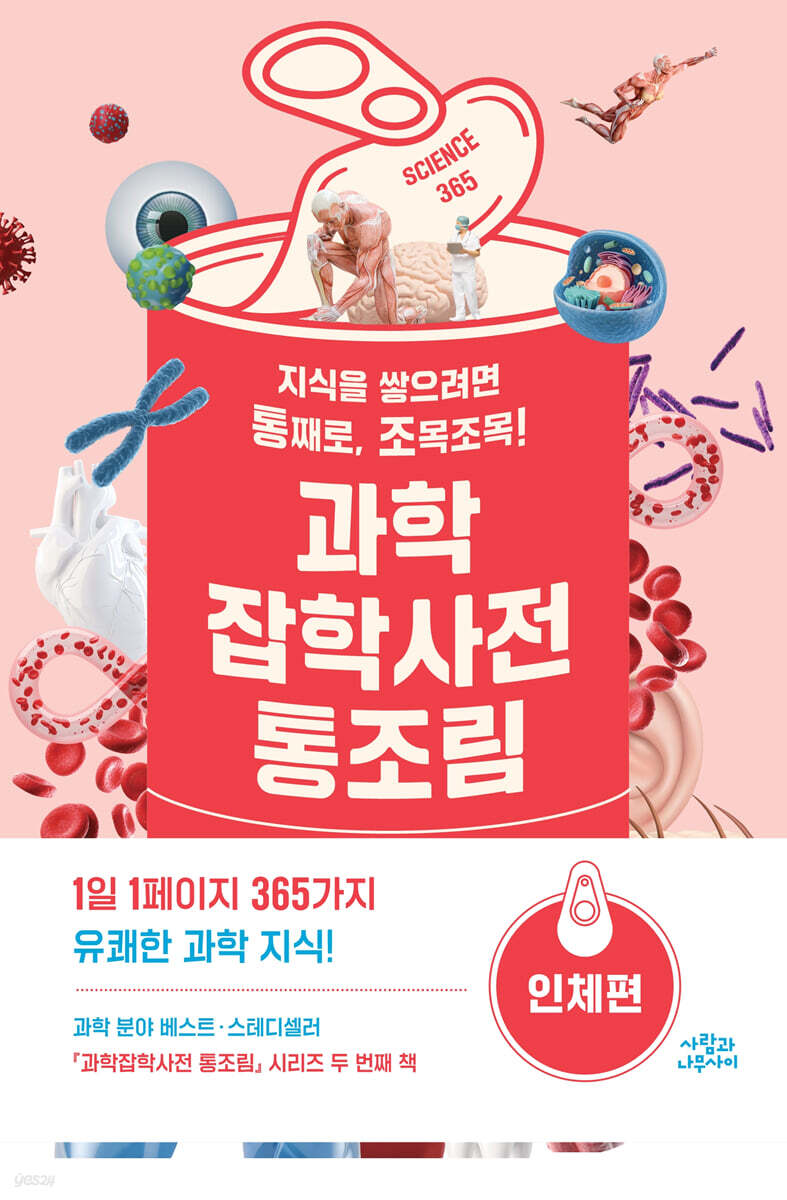
Encyclopedia of Science Trivia: Canned Food (Human Body)
 |
Description
Book Introduction
365 days, one page a day
If you read it with such enjoyment that you don't even realize how much time has passed,
You too can become a 'human body doctor' and an 'amateur scientist'!
If you examine the 365 items in this book one page a day, one by one, as if examining a tree, and then understand and connect them as a whole, as if looking at the forest, you will surprisingly come up with new 'scientific knowledge'.
You too can read this book in a 'canned' manner and become a 'human body doctor' and an 'amateur scientist'!
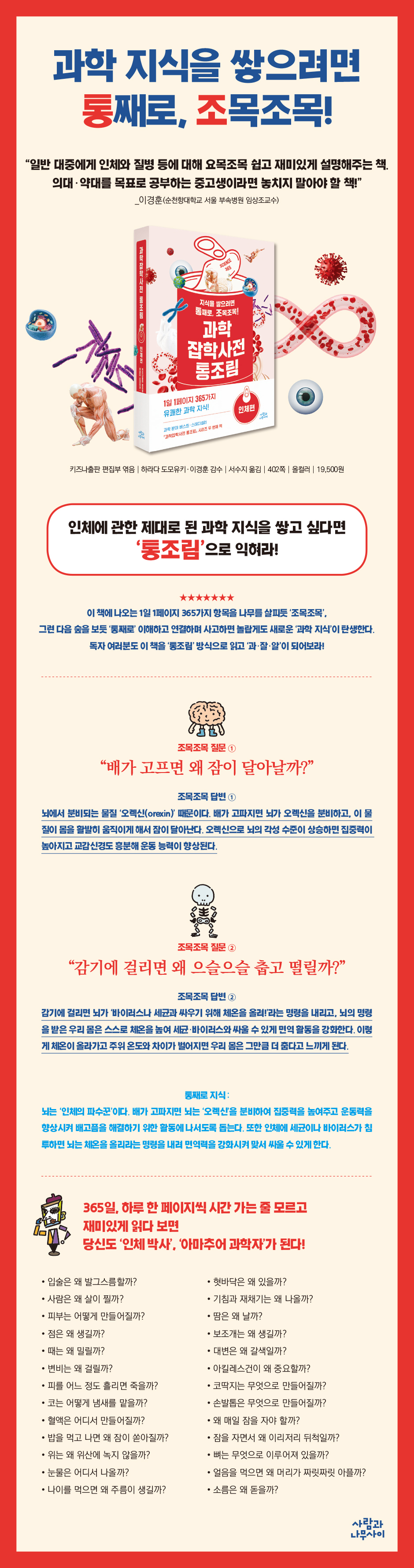
Question 1: “Why do I have trouble sleeping when I’m hungry?”
Answer 1: It is because of the substance ‘orexin’ secreted from the brain.
When you get hungry, your brain secretes orexin, which activates your body and keeps you awake.
When the brain's level of arousal increases due to orexin, concentration increases and the sympathetic nervous system is also stimulated, improving motor skills.
Question 2: “Why do I feel chill and shiver when I have a cold?”
Answer 2: When you catch a cold, your brain gives the command to 'raise your body temperature to fight viruses and bacteria!' and your body, upon receiving the command from the brain, raises its body temperature and strengthens its immune system to fight bacteria and viruses.
As our body temperature rises and the difference with the surrounding temperature increases, our body feels colder.
Knowledge in its entirety: The brain is the 'guardian of the human body'.
When you feel hungry, your brain secretes orexin, which helps you focus and improves your motor skills to relieve your hunger.
Additionally, when bacteria or viruses invade the human body, the brain sends a command to raise body temperature, strengthening the immune system to fight back.
If you read it with such enjoyment that you don't even realize how much time has passed,
You too can become a 'human body doctor' and an 'amateur scientist'!
If you examine the 365 items in this book one page a day, one by one, as if examining a tree, and then understand and connect them as a whole, as if looking at the forest, you will surprisingly come up with new 'scientific knowledge'.
You too can read this book in a 'canned' manner and become a 'human body doctor' and an 'amateur scientist'!
Question 1: “Why do I have trouble sleeping when I’m hungry?”
Answer 1: It is because of the substance ‘orexin’ secreted from the brain.
When you get hungry, your brain secretes orexin, which activates your body and keeps you awake.
When the brain's level of arousal increases due to orexin, concentration increases and the sympathetic nervous system is also stimulated, improving motor skills.
Question 2: “Why do I feel chill and shiver when I have a cold?”
Answer 2: When you catch a cold, your brain gives the command to 'raise your body temperature to fight viruses and bacteria!' and your body, upon receiving the command from the brain, raises its body temperature and strengthens its immune system to fight bacteria and viruses.
As our body temperature rises and the difference with the surrounding temperature increases, our body feels colder.
Knowledge in its entirety: The brain is the 'guardian of the human body'.
When you feel hungry, your brain secretes orexin, which helps you focus and improves your motor skills to relieve your hunger.
Additionally, when bacteria or viruses invade the human body, the brain sends a command to raise body temperature, strengthening the immune system to fight back.
- You can preview some of the book's contents.
Preview
index
To the readers of this book
How to use this book
Disease│Infectious Disease
Day 001 What is COVID-19?┃Day 002 What is influenza?┃Day 003 What is measles?┃Day 004 How does mumps occur?┃Day 005 What is dengue fever?┃Day 006 What is AIDS?┃Day 007 What is the difference between bacteria and viruses?
Five Senses│Various Powers
Day 008 Why are lips red?┃Day 009 Why do we have tongues?┃Day 010 What are tonsils?┃Day 011 What is the role of the uvula?┃Day 012 Where does saliva come from?┃Day 013 How do we taste?┃Day 014 What is temporomandibular joint disorder?
Organs│Heart
Day 015 What does the heart do?┃Day 016 Why does my heart beat faster when I run?┃Day 017 What is a heart attack?┃Day 018 What is a coronary artery?┃Day 019 What is an arrhythmia?┃Day 020 What is a heart valve disease?┃Day 021 What is an artificial pacemaker?
Metabolism│Immunity
Day 022 What is immunity?┃Day 023 What is natural immunity?┃Day 024 What is acquired immunity?┃Day 025 What are antigens and antibodies?┃Day 026 Where are immune cells made?┃Day 027 What is lymph?┃Day 028 What is immunity?
Body Movement│Obesity
Day 029 Why do people gain weight?┃Day 030 What is subcutaneous fat?┃Day 031 What is visceral fat?┃Day 032 What is triglyceride?┃Day 033 What is cholesterol?┃Day 034 What is metabolic syndrome?┃Day 035 What is motor dysfunction syndrome?
Disease│Cold
Day 036 What kind of disease is a cold?┃Day 037 Why do we cough and sneeze?┃Day 038 Why does our throat feel sore?┃Day 039 Why do we have a runny nose?┃Day 040 Why are our tonsils swollen?┃Day 041 Why do we have a fever?┃Day 042 Why do we feel chills and shivers when we have a cold?
Five Senses│Skin
Day 043 How is skin made?┃Day 044 Why do we sweat?┃Day 045 How do we feel pain or warmth?┃Day 046 Why do spots appear?┃Day 047 Why do dimples appear?┃Day 048 Why do we get sunburned?┃Day 049 Why do we get sunburned?
Long-term│Lung
Day 050 What do the lungs do? Day 051 What do we do with breathing? Day 052 What are the trachea and bronchi? Day 053 What do the trachea and bronchi do? Day 054 What is asthma? Day 055 What is pneumonia? Day 056 What is tuberculosis?
Metabolism│Fecundation
Day 057 Why is stool brown?┃Day 058 Why do we fart?┃Day 059 Why do we get constipated?┃Day 060 How does diarrhea occur?┃Day 061 Why do we get hemorrhoids?┃Day 062 What can a stool test tell us?┃Day 063 What are parasites?
Movement of water│Bridge
Day 064 Why do we have arches on the soles of our feet?┃Day 065 Why do mice fly?┃Day 066 Why do we get ingrown toenails?┃Day 067 What are the shapes of O-legs and X-legs?┃Day 068 What is hallux valgus?┃Day 069 Why do we get corns?┃Day 070 Why is the Achilles tendon important?
Disease│Cancer
Day 071 What is cancer? Day 072 What is leukemia? Day 073 How can we detect cancer early? Day 074 What is an endoscopy? Day 075 What is a PET scan? Day 076 How is radiation therapy administered? Day 077 What are chemotherapy drugs?
Network│Blood vessels
Day 078 What is the difference between arteries and veins?┃Day 079 How much blood loss is necessary to die?┃Day 080 What is blood pressure?┃Day 081 What is a blood clot?┃Day 082 What is arteriosclerosis?┃Day 083 What are aneurysms and varicose veins?┃Day 084 What is economy class syndrome?
Five senses│Nose
Day 085 How does the nose smell?┃Day 086 Why do nosebleeds occur?┃Day 087 What does nose hair do?┃Day 088 What are boogers made of?┃Day 089 Why do we often get eye mucus when our nose is blocked?┃Day 090 Why does it hurt when water gets into our nose?┃Day 091 What is sinusitis?
Organs│Esophagus and trachea
Day 092 What does the esophagus do? ┃Day 093 How do we hear spit? ┃Day 094 Why do we burp? ┃Day 095 What is reflux esophagitis? ┃Day 096 What does the pharynx do? ┃Day 097 What does the larynx do? ┃Day 098 What do the vocal cords do?
Body movements│hands
Day 099 What are fingernails made of? ┃Day 100 What is the difference between right-handed and left-handed people? ┃Day 101 Why does my ring finger bend when I bend my pinky finger? ┃Day 102 Why does it make a snapping sound when I crack my finger? ┃Day 103 Why does it hurt when I sprain my finger? ┃Day 104 What are trigger finger and club finger? ┃Day 105 What are spoon fingernails?
Disease│Poison
Day 106 Why is pufferfish poison dangerous? ┃Day 107 What happens if you get stung by a wasp? ┃Day 108 What is poisonous gas? ┃Day 109 What happens if you get stung by a jellyfish? ┃Day 110 What is snake venom? ┃Day 111 Why is mercury harmful to the body? ┃Day 112 What types of poisonous mushrooms are there?
Network│Blood
Day 113 Where is blood made?┃Day 114 What do red blood cells do?┃Day 115 What do white blood cells do?┃Day 116 What do platelets do?┃Day 117 What is plasma?┃Day 118 What does it mean when someone says their blood is cloudy?┃Day 119 What are the differences between blood types?
Metabolism│Sleep
Day 120 Why do we need to sleep every day? ┃Day 121 What is the difference between REM sleep and non-REM sleep? ┃Day 122 Why do we feel sleepy? ┃Day 123 Why do we yawn? ┃Day 124 When do we talk in our sleep? ┃Day 125 Why do I feel sleepy after eating? ┃Day 126 Why do I toss and turn in my sleep?
Five senses│Hair
Day 127 What is hair made of?┃Day 128 How is hair made?┃Day 129 What is the difference between straight and curly hair?┃Day 130 Why do we get gray hair as we age?┃Day 131 Why do we have hair in our armpits and lower abdomen as adults?┃Day 132 What is AGA?┃Day 133 Why does alopecia areata occur?
Long-term│Upper
Day 134 What does the stomach do?┃Day 135 What are the components of stomach acid?┃Day 136 Why doesn't the stomach dissolve in stomach acid?┃Day 137 What is a stomach ulcer?┃Day 138 Why do people vomit?┃Day 139 Why does my stomach hurt when I run right after eating?┃Day 140 Why is Helicobacter pylori dangerous?
Body Movement│Bones
Day 141 What are bones made of?┃Day 142 What kind of cells are in bones?┃Day 143 How many bones are there in our body?┃Day 144 What is the structure of the skull?┃Day 145 What is the structure of the spine?┃Day 146 What is the structure of the ribs?┃Day 147 What is osteoporosis?
Disease│Vaccine
Day 148 What is a vaccine? Day 149 What is a live vaccine? Day 150 What is an inactivated vaccine? Day 151 What is a combined vaccine? Day 152 What was the world's first vaccine developed? Day 153 Why do we need vaccinations? Day 154 What is an mRNA vaccine?
Metabolism│Cells
Day 155 What is a cell? Day 156 What's inside a cell? Day 157 What is DNA? Day 158 What is RNA? Day 159 What is a gene? Day 160 What is a chromosome? Day 161 What are ES cells and iPS cells?
Network│Neural
Day 162 What are nerves?┃Day 163 What are the autonomic nervous system?┃Day 164 What is the difference between the sympathetic and parasympathetic nervous systems?┃Day 165 What are reflexes and conditioned reflexes?┃Day 166 What are neurons and synapses?┃Day 167 What is neuralgia?┃Day 168 What is shingles?
Body Movement│Joints
Day 169 What is a joint? Day 170 What is a tendon? Day 171 What is a sprain? Day 172 What is a dislocation? Day 173 What is tendon synovitis? Day 174 What is gout? Day 175 What is rheumatic disease?
Disease│Illness of the mind
Day 176 What is depression? Day 177 What is bipolar disorder? Day 178 What is panic disorder? Day 179 What is HSP? Day 180 What is schizophrenia? Day 181 What is an eating disorder? Day 182 Why does hyperventilation occur?
Long-term│Upper
Day 183 What does the small intestine do? Day 184 What does the duodenum do? Day 185 What do the small intestine and the small intestine do? Day 186 What does the inside of the villi look like? Day 187 What is Peyer's patch? Day 188 What kind of bacteria are in the intestines? Day 189 What is the intestinal flora?
Metabolic function│Hormones
Day 190 What are hormones? Day 191 What is negative feedback? Day 192 What is the role of the pituitary gland? Day 193 What is the role of the thyroid gland? Day 194 What is the role of the adrenal gland? Day 195 What is menopausal disorder? Day 196 What is Graves' disease?
Body Movement│Muscles
Day 197 What kind of muscles do we have in our body?┃Day 198 What is skeletal muscle?┃Day 199 What is smooth muscle?┃Day 200 What is the difference between cardiac muscle and cardiac muscle?┃Day 201 How can we make muscles bigger?┃Day 202 What are muscle pain and muscle tears?┃Day 203 What is ALS?
Five senses│Eyes
Day 204 What is the structure of the pupil? ┃Day 205 How can we tell the difference in color? ┃Day 206 What is the difference between myopia and hyperopia? ┃Day 207 What is astigmatism? ┃Day 208 What is strabismus? ┃Day 209 What is presbyopia? ┃Day 210 Where do tears come from?
Network│Brain
Day 211 What is the difference between the right and left brain? ┃Day 212 What is cerebrospinal fluid? ┃Day 213 What does the frontal lobe do? ┃Day 214 What does the parietal lobe do? ┃Day 215 What does the temporal lobe do? ┃Day 216 What does the occipital lobe do? ┃Day 217 What is the hypothalamus?
Long-term│Large intestine
Day 218 What does the colon do? ┃Day 220 What does the rectum do? ┃Day 221 What is the appendix? ┃Day 222 What is appendicitis? ┃Day 223 What is a polyp? ┃Day 224 What types of colon diseases are there?
Five Senses│Teeth
Day 225 What are teeth made of?┃Day 226 What is the difference between people with even teeth and those with bad teeth?┃Day 227 What are wisdom teeth?┃Day 228 Why do cavities hurt?┃Day 229 What is periodontal disease?┃Day 230 Why is teeth grinding bad for dental health?┃Day 231 What is the difference between adults' teeth and children's teeth?
Metabolism│Urine
Day 232 What does the bladder do?┃Day 233 Where does urine come from?┃Day 234 How much urine do we produce in a day?┃Day 235 What is the difference between cloudy urine and clear urine?┃Day 236 What is nocturnal enuresis?┃Day 237 What can a urine test reveal?┃Day 238 What is urea?
Disease│Headache
Day 239 Why does my head tingle when I eat ice?┃Day 240 What is a tension headache?┃Day 241 What is a migraine?┃Day 242 What is meningitis?┃Day 243 Why does my headache go away when I take painkillers?┃Day 244 What is a cerebral hemorrhage?┃Day 245 What is a subarachnoid hemorrhage?
Long-term│Internal
Day 246 What does the liver do?┃Day 247 How is alcohol broken down in the body?┃Day 248 What is uric acid?┃Day 249 What is fatty liver?┃Day 250 What is the difference between hepatitis A, hepatitis B, and hepatitis C?┃Day 251 What is cirrhosis?┃Day 252 What is the gallbladder?
Five senses│Ear
Day 253 What does the inside of your ear look like?┃Day 254 What does the eardrum do?┃Day 255 Why does water get into your ear and make you feel dizzy?┃Day 256 Why does tinnitus occur?┃Day 257 Why do motion sickness symptoms occur?┃Day 258 What is otitis media?┃Day 259 What is Meniere's disease?
Metabolism│Snow cells
Day 260 What is a cytotoxic T cell? Day 261 What is a helper T cell? Day 262 What is a neutrophil? Day 263 What is a naive T cell? Day 264 What is a B cell? Day 265 What is a natural killer cell? Day 266 What is a macrophage?
Body movements│Neck?Shoulders?Waist
Day 267 Why do some people's shoulders rise and others' shoulders fall?┃Day 268 Why does frozen shoulder occur?┃Day 269 What is straight neck syndrome?┃Day 270 What is a herniated disc?┃Day 271 Why does back pain occur?┃Day 272 Why does the back become hunched as we age?┃Day 273 What does it mean to have a sprained back?
Disease│Addiction and Addiction
Day 274 What is addiction, a dependent addiction?┃Day 275 What is the difference between addiction and addiction?┃Day 276 What happens when alcohol enters the body?┃Day 277 Why are cigarettes harmful to the body?┃Day 278 Why are drugs bad for the body?┃Day 279 Why does gambling addiction occur?┃Day 280 What is food poisoning?
Network│ Parts of the Brain
Day 281 What is the difference between the cerebrum, cerebellum, and brainstem?┃Day 282 What is the difference between the medulla oblongata and the spinal cord?┃Day 283 What do the thalamus and hypothalamus mean?┃Day 284 What does the corpus callosum do?┃Day 285 What does the hippocampus do?┃Day 286 What is the cerebral cortex?┃Day 287 What is the ventricular system?
Five Senses│Skin Diseases
Day 288 Why do we get heat rash?┃Day 289 Why do we get hives?┃Day 290 Why do we have body odor (bromhidrosis)?┃Day 291 Why do we get acne?┃Day 292 Why do we get freckles?┃Day 293 Why do we get wrinkles as we age?┃Day 294 Why do we get athlete's foot?┃Day 295 Why do we have Mongolian spots?
Long-term│Various long-term
Day 296 What role does the pancreas play? ┃Day 297 What kind of liquid is pancreatic juice? ┃Day 298 What are the islets of Langerhans? ┃Day 299 What role do the kidneys play? ┃Day 300 What are nephrons? ┃Day 301 What are urinary stones? ┃Day 302 What role does the spleen play?
Metabolic Function│Hormone 2
Day 303 What kind of hormone is oxytocin? Day 304 What kind of hormone is insulin? Day 305 What kind of hormone is melatonin? Day 306 What kind of hormone is adrenaline? Day 307 What kind of hormone is norepinephrine? Day 308 What kind of hormone is testosterone? Day 309 What kind of hormone is estrogen?
Network│Brain-related diseases
Day 310 What is dementia? ┃Day 311 What is a concussion? ┃Day 312 What is brain death? ┃Day 313 What types of parasites can enter the brain? ┃Day 314 What is Parkinson's disease? ┃Day 315 What is a brain tumor? ┃Day 316 What is a stroke?
Disease│Bacteria
Day 317 What types of bacteria are there? Day 318 What type of bacteria is Helicobacter pylori? Day 319 What type of bacteria is O-157? Day 320 What is the difference between cocci and bacilli? Day 321 What type of bacteria is Streptococcus pneumoniae? Day 322 What type of bacteria is Staphylococcus aureus? Day 323 What type of bacteria is Campylobacter?
Body Movement│Heat and Cold
Day 324 How does heatstroke occur? ┃Day 325 How do you get a burn? ┃Day 326 Why do we catch colds more easily in the winter? ┃Day 327 What is first-degree frostbite? ┃Day 328 Why do we get hypothermia? ┃Day 329 What happens when you get frostbite? ┃Day 330 Why do we get goosebumps?
Five Senses│Skin Diseases
Day 331 Why do my eyes get red? ┃Day 332 Why do I get styes? ┃Day 333 Why do I have dark circles? ┃Day 334 What is dry eye? ┃Day 335 Why can't some people perceive the difference in colors? ┃Day 336 What is a cataract? ┃Day 337 What is glaucoma?
Disease│Allergy
Day 338 What is the structure of a man's reproductive organ? Day 339 What do the testicles do? Day 340 What is the structure of a woman's reproductive organ? Day 341 What do the ovaries do? Day 342 What happens during menstruation? Day 343 How are babies born? Day 344 How is breast milk made?
Disease│Allergy
Day 345 What is an allergy? Day 346 What is atopic dermatitis? Day 347 What causes metal allergies? Day 348 What is anaphylaxis? Day 349 What is food allergy? Day 350 What is keratosis? Day 351 What are mast cells?
Metabolic Function│Sleep-Related Problems
Day 352 What is muscle pain after sleeping? ┃Day 353 Why do we snore? ┃Day 354 What is sleep apnea? ┃Day 355 What is insomnia? ┃Day 356 What is the biological clock? ┃Day 357 Why can't I sleep after drinking coffee? ┃Day 358 What is narcolepsy?
Network│Blood 2
Day 359 Why does anemia occur? ┃Day 360 What is blood sugar? ┃Day 361 What is hematuria? ┃Day 362 What are eosinophils? ┃Day 363 What are basophils? ┃Day 364 What are lymphocytes? ┃Day 365 What are monocytes?
Search
How to use this book
Disease│Infectious Disease
Day 001 What is COVID-19?┃Day 002 What is influenza?┃Day 003 What is measles?┃Day 004 How does mumps occur?┃Day 005 What is dengue fever?┃Day 006 What is AIDS?┃Day 007 What is the difference between bacteria and viruses?
Five Senses│Various Powers
Day 008 Why are lips red?┃Day 009 Why do we have tongues?┃Day 010 What are tonsils?┃Day 011 What is the role of the uvula?┃Day 012 Where does saliva come from?┃Day 013 How do we taste?┃Day 014 What is temporomandibular joint disorder?
Organs│Heart
Day 015 What does the heart do?┃Day 016 Why does my heart beat faster when I run?┃Day 017 What is a heart attack?┃Day 018 What is a coronary artery?┃Day 019 What is an arrhythmia?┃Day 020 What is a heart valve disease?┃Day 021 What is an artificial pacemaker?
Metabolism│Immunity
Day 022 What is immunity?┃Day 023 What is natural immunity?┃Day 024 What is acquired immunity?┃Day 025 What are antigens and antibodies?┃Day 026 Where are immune cells made?┃Day 027 What is lymph?┃Day 028 What is immunity?
Body Movement│Obesity
Day 029 Why do people gain weight?┃Day 030 What is subcutaneous fat?┃Day 031 What is visceral fat?┃Day 032 What is triglyceride?┃Day 033 What is cholesterol?┃Day 034 What is metabolic syndrome?┃Day 035 What is motor dysfunction syndrome?
Disease│Cold
Day 036 What kind of disease is a cold?┃Day 037 Why do we cough and sneeze?┃Day 038 Why does our throat feel sore?┃Day 039 Why do we have a runny nose?┃Day 040 Why are our tonsils swollen?┃Day 041 Why do we have a fever?┃Day 042 Why do we feel chills and shivers when we have a cold?
Five Senses│Skin
Day 043 How is skin made?┃Day 044 Why do we sweat?┃Day 045 How do we feel pain or warmth?┃Day 046 Why do spots appear?┃Day 047 Why do dimples appear?┃Day 048 Why do we get sunburned?┃Day 049 Why do we get sunburned?
Long-term│Lung
Day 050 What do the lungs do? Day 051 What do we do with breathing? Day 052 What are the trachea and bronchi? Day 053 What do the trachea and bronchi do? Day 054 What is asthma? Day 055 What is pneumonia? Day 056 What is tuberculosis?
Metabolism│Fecundation
Day 057 Why is stool brown?┃Day 058 Why do we fart?┃Day 059 Why do we get constipated?┃Day 060 How does diarrhea occur?┃Day 061 Why do we get hemorrhoids?┃Day 062 What can a stool test tell us?┃Day 063 What are parasites?
Movement of water│Bridge
Day 064 Why do we have arches on the soles of our feet?┃Day 065 Why do mice fly?┃Day 066 Why do we get ingrown toenails?┃Day 067 What are the shapes of O-legs and X-legs?┃Day 068 What is hallux valgus?┃Day 069 Why do we get corns?┃Day 070 Why is the Achilles tendon important?
Disease│Cancer
Day 071 What is cancer? Day 072 What is leukemia? Day 073 How can we detect cancer early? Day 074 What is an endoscopy? Day 075 What is a PET scan? Day 076 How is radiation therapy administered? Day 077 What are chemotherapy drugs?
Network│Blood vessels
Day 078 What is the difference between arteries and veins?┃Day 079 How much blood loss is necessary to die?┃Day 080 What is blood pressure?┃Day 081 What is a blood clot?┃Day 082 What is arteriosclerosis?┃Day 083 What are aneurysms and varicose veins?┃Day 084 What is economy class syndrome?
Five senses│Nose
Day 085 How does the nose smell?┃Day 086 Why do nosebleeds occur?┃Day 087 What does nose hair do?┃Day 088 What are boogers made of?┃Day 089 Why do we often get eye mucus when our nose is blocked?┃Day 090 Why does it hurt when water gets into our nose?┃Day 091 What is sinusitis?
Organs│Esophagus and trachea
Day 092 What does the esophagus do? ┃Day 093 How do we hear spit? ┃Day 094 Why do we burp? ┃Day 095 What is reflux esophagitis? ┃Day 096 What does the pharynx do? ┃Day 097 What does the larynx do? ┃Day 098 What do the vocal cords do?
Body movements│hands
Day 099 What are fingernails made of? ┃Day 100 What is the difference between right-handed and left-handed people? ┃Day 101 Why does my ring finger bend when I bend my pinky finger? ┃Day 102 Why does it make a snapping sound when I crack my finger? ┃Day 103 Why does it hurt when I sprain my finger? ┃Day 104 What are trigger finger and club finger? ┃Day 105 What are spoon fingernails?
Disease│Poison
Day 106 Why is pufferfish poison dangerous? ┃Day 107 What happens if you get stung by a wasp? ┃Day 108 What is poisonous gas? ┃Day 109 What happens if you get stung by a jellyfish? ┃Day 110 What is snake venom? ┃Day 111 Why is mercury harmful to the body? ┃Day 112 What types of poisonous mushrooms are there?
Network│Blood
Day 113 Where is blood made?┃Day 114 What do red blood cells do?┃Day 115 What do white blood cells do?┃Day 116 What do platelets do?┃Day 117 What is plasma?┃Day 118 What does it mean when someone says their blood is cloudy?┃Day 119 What are the differences between blood types?
Metabolism│Sleep
Day 120 Why do we need to sleep every day? ┃Day 121 What is the difference between REM sleep and non-REM sleep? ┃Day 122 Why do we feel sleepy? ┃Day 123 Why do we yawn? ┃Day 124 When do we talk in our sleep? ┃Day 125 Why do I feel sleepy after eating? ┃Day 126 Why do I toss and turn in my sleep?
Five senses│Hair
Day 127 What is hair made of?┃Day 128 How is hair made?┃Day 129 What is the difference between straight and curly hair?┃Day 130 Why do we get gray hair as we age?┃Day 131 Why do we have hair in our armpits and lower abdomen as adults?┃Day 132 What is AGA?┃Day 133 Why does alopecia areata occur?
Long-term│Upper
Day 134 What does the stomach do?┃Day 135 What are the components of stomach acid?┃Day 136 Why doesn't the stomach dissolve in stomach acid?┃Day 137 What is a stomach ulcer?┃Day 138 Why do people vomit?┃Day 139 Why does my stomach hurt when I run right after eating?┃Day 140 Why is Helicobacter pylori dangerous?
Body Movement│Bones
Day 141 What are bones made of?┃Day 142 What kind of cells are in bones?┃Day 143 How many bones are there in our body?┃Day 144 What is the structure of the skull?┃Day 145 What is the structure of the spine?┃Day 146 What is the structure of the ribs?┃Day 147 What is osteoporosis?
Disease│Vaccine
Day 148 What is a vaccine? Day 149 What is a live vaccine? Day 150 What is an inactivated vaccine? Day 151 What is a combined vaccine? Day 152 What was the world's first vaccine developed? Day 153 Why do we need vaccinations? Day 154 What is an mRNA vaccine?
Metabolism│Cells
Day 155 What is a cell? Day 156 What's inside a cell? Day 157 What is DNA? Day 158 What is RNA? Day 159 What is a gene? Day 160 What is a chromosome? Day 161 What are ES cells and iPS cells?
Network│Neural
Day 162 What are nerves?┃Day 163 What are the autonomic nervous system?┃Day 164 What is the difference between the sympathetic and parasympathetic nervous systems?┃Day 165 What are reflexes and conditioned reflexes?┃Day 166 What are neurons and synapses?┃Day 167 What is neuralgia?┃Day 168 What is shingles?
Body Movement│Joints
Day 169 What is a joint? Day 170 What is a tendon? Day 171 What is a sprain? Day 172 What is a dislocation? Day 173 What is tendon synovitis? Day 174 What is gout? Day 175 What is rheumatic disease?
Disease│Illness of the mind
Day 176 What is depression? Day 177 What is bipolar disorder? Day 178 What is panic disorder? Day 179 What is HSP? Day 180 What is schizophrenia? Day 181 What is an eating disorder? Day 182 Why does hyperventilation occur?
Long-term│Upper
Day 183 What does the small intestine do? Day 184 What does the duodenum do? Day 185 What do the small intestine and the small intestine do? Day 186 What does the inside of the villi look like? Day 187 What is Peyer's patch? Day 188 What kind of bacteria are in the intestines? Day 189 What is the intestinal flora?
Metabolic function│Hormones
Day 190 What are hormones? Day 191 What is negative feedback? Day 192 What is the role of the pituitary gland? Day 193 What is the role of the thyroid gland? Day 194 What is the role of the adrenal gland? Day 195 What is menopausal disorder? Day 196 What is Graves' disease?
Body Movement│Muscles
Day 197 What kind of muscles do we have in our body?┃Day 198 What is skeletal muscle?┃Day 199 What is smooth muscle?┃Day 200 What is the difference between cardiac muscle and cardiac muscle?┃Day 201 How can we make muscles bigger?┃Day 202 What are muscle pain and muscle tears?┃Day 203 What is ALS?
Five senses│Eyes
Day 204 What is the structure of the pupil? ┃Day 205 How can we tell the difference in color? ┃Day 206 What is the difference between myopia and hyperopia? ┃Day 207 What is astigmatism? ┃Day 208 What is strabismus? ┃Day 209 What is presbyopia? ┃Day 210 Where do tears come from?
Network│Brain
Day 211 What is the difference between the right and left brain? ┃Day 212 What is cerebrospinal fluid? ┃Day 213 What does the frontal lobe do? ┃Day 214 What does the parietal lobe do? ┃Day 215 What does the temporal lobe do? ┃Day 216 What does the occipital lobe do? ┃Day 217 What is the hypothalamus?
Long-term│Large intestine
Day 218 What does the colon do? ┃Day 220 What does the rectum do? ┃Day 221 What is the appendix? ┃Day 222 What is appendicitis? ┃Day 223 What is a polyp? ┃Day 224 What types of colon diseases are there?
Five Senses│Teeth
Day 225 What are teeth made of?┃Day 226 What is the difference between people with even teeth and those with bad teeth?┃Day 227 What are wisdom teeth?┃Day 228 Why do cavities hurt?┃Day 229 What is periodontal disease?┃Day 230 Why is teeth grinding bad for dental health?┃Day 231 What is the difference between adults' teeth and children's teeth?
Metabolism│Urine
Day 232 What does the bladder do?┃Day 233 Where does urine come from?┃Day 234 How much urine do we produce in a day?┃Day 235 What is the difference between cloudy urine and clear urine?┃Day 236 What is nocturnal enuresis?┃Day 237 What can a urine test reveal?┃Day 238 What is urea?
Disease│Headache
Day 239 Why does my head tingle when I eat ice?┃Day 240 What is a tension headache?┃Day 241 What is a migraine?┃Day 242 What is meningitis?┃Day 243 Why does my headache go away when I take painkillers?┃Day 244 What is a cerebral hemorrhage?┃Day 245 What is a subarachnoid hemorrhage?
Long-term│Internal
Day 246 What does the liver do?┃Day 247 How is alcohol broken down in the body?┃Day 248 What is uric acid?┃Day 249 What is fatty liver?┃Day 250 What is the difference between hepatitis A, hepatitis B, and hepatitis C?┃Day 251 What is cirrhosis?┃Day 252 What is the gallbladder?
Five senses│Ear
Day 253 What does the inside of your ear look like?┃Day 254 What does the eardrum do?┃Day 255 Why does water get into your ear and make you feel dizzy?┃Day 256 Why does tinnitus occur?┃Day 257 Why do motion sickness symptoms occur?┃Day 258 What is otitis media?┃Day 259 What is Meniere's disease?
Metabolism│Snow cells
Day 260 What is a cytotoxic T cell? Day 261 What is a helper T cell? Day 262 What is a neutrophil? Day 263 What is a naive T cell? Day 264 What is a B cell? Day 265 What is a natural killer cell? Day 266 What is a macrophage?
Body movements│Neck?Shoulders?Waist
Day 267 Why do some people's shoulders rise and others' shoulders fall?┃Day 268 Why does frozen shoulder occur?┃Day 269 What is straight neck syndrome?┃Day 270 What is a herniated disc?┃Day 271 Why does back pain occur?┃Day 272 Why does the back become hunched as we age?┃Day 273 What does it mean to have a sprained back?
Disease│Addiction and Addiction
Day 274 What is addiction, a dependent addiction?┃Day 275 What is the difference between addiction and addiction?┃Day 276 What happens when alcohol enters the body?┃Day 277 Why are cigarettes harmful to the body?┃Day 278 Why are drugs bad for the body?┃Day 279 Why does gambling addiction occur?┃Day 280 What is food poisoning?
Network│ Parts of the Brain
Day 281 What is the difference between the cerebrum, cerebellum, and brainstem?┃Day 282 What is the difference between the medulla oblongata and the spinal cord?┃Day 283 What do the thalamus and hypothalamus mean?┃Day 284 What does the corpus callosum do?┃Day 285 What does the hippocampus do?┃Day 286 What is the cerebral cortex?┃Day 287 What is the ventricular system?
Five Senses│Skin Diseases
Day 288 Why do we get heat rash?┃Day 289 Why do we get hives?┃Day 290 Why do we have body odor (bromhidrosis)?┃Day 291 Why do we get acne?┃Day 292 Why do we get freckles?┃Day 293 Why do we get wrinkles as we age?┃Day 294 Why do we get athlete's foot?┃Day 295 Why do we have Mongolian spots?
Long-term│Various long-term
Day 296 What role does the pancreas play? ┃Day 297 What kind of liquid is pancreatic juice? ┃Day 298 What are the islets of Langerhans? ┃Day 299 What role do the kidneys play? ┃Day 300 What are nephrons? ┃Day 301 What are urinary stones? ┃Day 302 What role does the spleen play?
Metabolic Function│Hormone 2
Day 303 What kind of hormone is oxytocin? Day 304 What kind of hormone is insulin? Day 305 What kind of hormone is melatonin? Day 306 What kind of hormone is adrenaline? Day 307 What kind of hormone is norepinephrine? Day 308 What kind of hormone is testosterone? Day 309 What kind of hormone is estrogen?
Network│Brain-related diseases
Day 310 What is dementia? ┃Day 311 What is a concussion? ┃Day 312 What is brain death? ┃Day 313 What types of parasites can enter the brain? ┃Day 314 What is Parkinson's disease? ┃Day 315 What is a brain tumor? ┃Day 316 What is a stroke?
Disease│Bacteria
Day 317 What types of bacteria are there? Day 318 What type of bacteria is Helicobacter pylori? Day 319 What type of bacteria is O-157? Day 320 What is the difference between cocci and bacilli? Day 321 What type of bacteria is Streptococcus pneumoniae? Day 322 What type of bacteria is Staphylococcus aureus? Day 323 What type of bacteria is Campylobacter?
Body Movement│Heat and Cold
Day 324 How does heatstroke occur? ┃Day 325 How do you get a burn? ┃Day 326 Why do we catch colds more easily in the winter? ┃Day 327 What is first-degree frostbite? ┃Day 328 Why do we get hypothermia? ┃Day 329 What happens when you get frostbite? ┃Day 330 Why do we get goosebumps?
Five Senses│Skin Diseases
Day 331 Why do my eyes get red? ┃Day 332 Why do I get styes? ┃Day 333 Why do I have dark circles? ┃Day 334 What is dry eye? ┃Day 335 Why can't some people perceive the difference in colors? ┃Day 336 What is a cataract? ┃Day 337 What is glaucoma?
Disease│Allergy
Day 338 What is the structure of a man's reproductive organ? Day 339 What do the testicles do? Day 340 What is the structure of a woman's reproductive organ? Day 341 What do the ovaries do? Day 342 What happens during menstruation? Day 343 How are babies born? Day 344 How is breast milk made?
Disease│Allergy
Day 345 What is an allergy? Day 346 What is atopic dermatitis? Day 347 What causes metal allergies? Day 348 What is anaphylaxis? Day 349 What is food allergy? Day 350 What is keratosis? Day 351 What are mast cells?
Metabolic Function│Sleep-Related Problems
Day 352 What is muscle pain after sleeping? ┃Day 353 Why do we snore? ┃Day 354 What is sleep apnea? ┃Day 355 What is insomnia? ┃Day 356 What is the biological clock? ┃Day 357 Why can't I sleep after drinking coffee? ┃Day 358 What is narcolepsy?
Network│Blood 2
Day 359 Why does anemia occur? ┃Day 360 What is blood sugar? ┃Day 361 What is hematuria? ┃Day 362 What are eosinophils? ┃Day 363 What are basophils? ┃Day 364 What are lymphocytes? ┃Day 365 What are monocytes?
Search
Detailed image
Into the book
If I knew just three things, I could be a scientist!
The lips are much thinner than the skin on your face.
Facial skin and lips have different colors and thicknesses.
The skin covering the surface of the face (epidermis) is slightly thick and firm, whereas the epidermis of the lips is very thin, so the red color of the blood flowing just underneath is visible.
The lips are the part of the oral mucosa that protrudes outside!
Knowing what your lips are like can help you understand why they are much thinner than the skin on your face.
The true identity of the lips is the 'oral mucosa'! When you open your mouth wide, the pinkish, reddish part inside is the mucosa.
The mucous membrane that protrudes outside the mouth is the lips.
Only humans have red lips
If you think about it, mammals are the only creatures with lips.
Red lips are a unique characteristic of humans among mammals.
Red is eye-catching.
A smile with bright red lips makes you look healthy and happy.
Lips also play a role in conveying a person's condition and mood to the other person.
By the way, if your lips turn blue after having fun in the pool, it is because your body temperature has dropped.
--- p.32, from “Why are lips red?”
If I knew just three things, I could be a scientist!
Transports oxygen and nutrients to every corner of the body
For activities that involve a lot of body movement, such as running, nutrients and oxygen are essential.
When you run, your muscles move quickly, circulating blood quickly to every corner of your body.
The process of delivering oxygen and nutrients and exchanging them with carbon dioxide and gases produced after consuming nutrients continues without pause.
Self-regulation of heart movement
The heart is controlled by the autonomic nervous system (day 163).
So you don't have to worry about how to move your heart.
When we run, walk, and even sleep, our heart beats without rest.
The resting heart rate for one minute is 60-80 beats per minute for adults and 70-100 beats per minute for those aged 6-15, with children having a higher heart rate than adults.
Why does my heart race when I'm nervous?
When looking down from a dizzyingly high place, when speaking in front of a group of people, or when it's hot, your heart beats faster than usual.
This is due to the action of the sympathetic nerves.
When you're stressed, your sympathetic nervous system switches on and you feel your heart beating faster than usual.
--- p.40, from “Why does my heart beat faster when I run?”
If I knew just three things, I could be a scientist!
Energy intake and energy expenditure
A car cannot move without gasoline or electricity.
People also function with the energy (calories) they receive through food.
Energy taken in through food is called 'intake energy', and energy used through activities, etc. is called 'expenditure energy'.
Unused energy is the cause of obesity
Obesity arises from a problem of balance between ‘energy intake’ and ‘energy expenditure.’
If you consume too much energy, the energy remains in your body and you gain weight.
Conversely, if you 'consume a lot of energy', you will lose weight due to lack of energy.
Since the energy of water is 0, drinking water and gaining weight cannot be considered fat gain.
Energy is used even when you don't move
Some of the energy consumed is used for basic bodily functions such as breathing, moving internal organs, and maintaining body temperature.
This energy, which is used even when you are not moving or sleeping, is called 'basal metabolism'.
--- p.53, from “Why do people gain weight?”
If I knew just three things, I could be a scientist!
Neutral fat, the cause of obesity
There are four types of fat in our body: neutral fat, free fatty acids, phospholipids, and cholesterol.
Among these, neutral fat is the cause of obesity.
Neutral fat exists in the blood and serves as an energy source that helps the activities of internal organs and other organs.
Neutral fat that accumulates when left over
If you consume a lot of energy and expend it, the remaining energy becomes neutral fat.
Neutral fat passes through the blood vessels and is stored in fat cells as energy.
This accumulated state is body fat.
As fat cells steadily increase, the body appears plump and chubby.
One kilogram of body fat is 7,200 kilocalories.
If you exceed 400 calories per day, you will gain 1 kilogram after 18 days.
Neutral fat secreted when insufficient
Conversely, if energy consumption continues to increase, neutral fat in fat cells is released into the blood vessels and used as energy.
Then the fat cells will shrink and you will become slimmer.
--- p.56, from “What is neutral fat?”
If I knew just three things, I could be a scientist!
Shivering is a signal from the brain to raise body temperature.
When you catch a cold, you suddenly feel a chill.
When the brain orders your body temperature to rise to fight off viruses or bacteria, blood rushes to the heart, constricting the blood vessels in your limbs and causing you to feel chilled.
I had chills and my body was shaking at the same time.
When you feel cold, your body shivers, which is a physical response to raise your body temperature by releasing heat through trembling muscles.
If you have a low fever when you have a cold, it is okay to take a bath, but you should keep it short in lukewarm water to avoid exhaustion.
If you have chills, keep your body warm
Shivering is a response to the brain's command to quickly raise body temperature.
Chills are often followed by a high fever.
When you have chills, your body temperature does not reach the level your brain commands, so your fever does not go down.
In such cases, it is recommended to drink a warm beverage, put on some warm clothes, and rest.
--- p.66, from “Why do I feel chill and shiver when I catch a cold?”
If I knew just three things, I could be a scientist!
If more than one-fifth of the blood is lost, symptoms of shock appear.
The amount of blood flowing through the body is about 8 percent of an adult's body weight.
If you weigh 50 kilograms, that's about 4 liters.
If more than one-fifth of that blood volume suddenly disappears, shock can occur, and if one-third of the blood volume disappears, life can be at risk.
Bleeding may occur inside the body.
If bleeding occurs in the body, such as in the digestive tract, a large amount of blood may be lost.
If not treated quickly, respiratory failure may occur, causing difficulty breathing in the lungs and preventing the heart and kidneys from functioning properly.
Children are at risk even from minor bleeding!
Even if the amount of bleeding is the same, it is dangerous if it happens in a short period of time.
Children have a blood volume of about 1/19th of their body weight, so even a small amount of bleeding can cause shock.
It is known that women have a constitution that tolerates bleeding better than men.
During surgery, if the bleeding exceeds 500 milliliters, it is often supplemented with a blood transfusion.
Because the amount of blood varies depending on body weight, there is a weight limit when donating blood.
The lips are much thinner than the skin on your face.
Facial skin and lips have different colors and thicknesses.
The skin covering the surface of the face (epidermis) is slightly thick and firm, whereas the epidermis of the lips is very thin, so the red color of the blood flowing just underneath is visible.
The lips are the part of the oral mucosa that protrudes outside!
Knowing what your lips are like can help you understand why they are much thinner than the skin on your face.
The true identity of the lips is the 'oral mucosa'! When you open your mouth wide, the pinkish, reddish part inside is the mucosa.
The mucous membrane that protrudes outside the mouth is the lips.
Only humans have red lips
If you think about it, mammals are the only creatures with lips.
Red lips are a unique characteristic of humans among mammals.
Red is eye-catching.
A smile with bright red lips makes you look healthy and happy.
Lips also play a role in conveying a person's condition and mood to the other person.
By the way, if your lips turn blue after having fun in the pool, it is because your body temperature has dropped.
--- p.32, from “Why are lips red?”
If I knew just three things, I could be a scientist!
Transports oxygen and nutrients to every corner of the body
For activities that involve a lot of body movement, such as running, nutrients and oxygen are essential.
When you run, your muscles move quickly, circulating blood quickly to every corner of your body.
The process of delivering oxygen and nutrients and exchanging them with carbon dioxide and gases produced after consuming nutrients continues without pause.
Self-regulation of heart movement
The heart is controlled by the autonomic nervous system (day 163).
So you don't have to worry about how to move your heart.
When we run, walk, and even sleep, our heart beats without rest.
The resting heart rate for one minute is 60-80 beats per minute for adults and 70-100 beats per minute for those aged 6-15, with children having a higher heart rate than adults.
Why does my heart race when I'm nervous?
When looking down from a dizzyingly high place, when speaking in front of a group of people, or when it's hot, your heart beats faster than usual.
This is due to the action of the sympathetic nerves.
When you're stressed, your sympathetic nervous system switches on and you feel your heart beating faster than usual.
--- p.40, from “Why does my heart beat faster when I run?”
If I knew just three things, I could be a scientist!
Energy intake and energy expenditure
A car cannot move without gasoline or electricity.
People also function with the energy (calories) they receive through food.
Energy taken in through food is called 'intake energy', and energy used through activities, etc. is called 'expenditure energy'.
Unused energy is the cause of obesity
Obesity arises from a problem of balance between ‘energy intake’ and ‘energy expenditure.’
If you consume too much energy, the energy remains in your body and you gain weight.
Conversely, if you 'consume a lot of energy', you will lose weight due to lack of energy.
Since the energy of water is 0, drinking water and gaining weight cannot be considered fat gain.
Energy is used even when you don't move
Some of the energy consumed is used for basic bodily functions such as breathing, moving internal organs, and maintaining body temperature.
This energy, which is used even when you are not moving or sleeping, is called 'basal metabolism'.
--- p.53, from “Why do people gain weight?”
If I knew just three things, I could be a scientist!
Neutral fat, the cause of obesity
There are four types of fat in our body: neutral fat, free fatty acids, phospholipids, and cholesterol.
Among these, neutral fat is the cause of obesity.
Neutral fat exists in the blood and serves as an energy source that helps the activities of internal organs and other organs.
Neutral fat that accumulates when left over
If you consume a lot of energy and expend it, the remaining energy becomes neutral fat.
Neutral fat passes through the blood vessels and is stored in fat cells as energy.
This accumulated state is body fat.
As fat cells steadily increase, the body appears plump and chubby.
One kilogram of body fat is 7,200 kilocalories.
If you exceed 400 calories per day, you will gain 1 kilogram after 18 days.
Neutral fat secreted when insufficient
Conversely, if energy consumption continues to increase, neutral fat in fat cells is released into the blood vessels and used as energy.
Then the fat cells will shrink and you will become slimmer.
--- p.56, from “What is neutral fat?”
If I knew just three things, I could be a scientist!
Shivering is a signal from the brain to raise body temperature.
When you catch a cold, you suddenly feel a chill.
When the brain orders your body temperature to rise to fight off viruses or bacteria, blood rushes to the heart, constricting the blood vessels in your limbs and causing you to feel chilled.
I had chills and my body was shaking at the same time.
When you feel cold, your body shivers, which is a physical response to raise your body temperature by releasing heat through trembling muscles.
If you have a low fever when you have a cold, it is okay to take a bath, but you should keep it short in lukewarm water to avoid exhaustion.
If you have chills, keep your body warm
Shivering is a response to the brain's command to quickly raise body temperature.
Chills are often followed by a high fever.
When you have chills, your body temperature does not reach the level your brain commands, so your fever does not go down.
In such cases, it is recommended to drink a warm beverage, put on some warm clothes, and rest.
--- p.66, from “Why do I feel chill and shiver when I catch a cold?”
If I knew just three things, I could be a scientist!
If more than one-fifth of the blood is lost, symptoms of shock appear.
The amount of blood flowing through the body is about 8 percent of an adult's body weight.
If you weigh 50 kilograms, that's about 4 liters.
If more than one-fifth of that blood volume suddenly disappears, shock can occur, and if one-third of the blood volume disappears, life can be at risk.
Bleeding may occur inside the body.
If bleeding occurs in the body, such as in the digestive tract, a large amount of blood may be lost.
If not treated quickly, respiratory failure may occur, causing difficulty breathing in the lungs and preventing the heart and kidneys from functioning properly.
Children are at risk even from minor bleeding!
Even if the amount of bleeding is the same, it is dangerous if it happens in a short period of time.
Children have a blood volume of about 1/19th of their body weight, so even a small amount of bleeding can cause shock.
It is known that women have a constitution that tolerates bleeding better than men.
During surgery, if the bleeding exceeds 500 milliliters, it is often supplemented with a blood transfusion.
Because the amount of blood varies depending on body weight, there is a weight limit when donating blood.
--- p.103, from “How much blood do I have to lose to die?”
Publisher's Review
To build scientific knowledge, go through it all, step by step!
If you want to break away from 'knowing and not knowing' and become 'knowing and knowing'
Learn 365 scientific facts in one page a day!
How can we effectively learn scientific knowledge? Learning it in a "canned" way is effective.
'Tong·Jo·Rim' refers to 'a method of acquiring scientific knowledge in a whole, step-by-step manner.'
In other words, rather than focusing on the details of a book full of useful scientific knowledge, it is a method of acquiring the book by first grasping the big picture and understanding the central content, as if looking at a forest.
Then, we examine the details 'point by point' as if examining each tree.
This is a method of acquiring knowledge that is close to the 'deductive method' of logic training.
The opposite is also possible.
In other words, it is a method of acquiring scientific knowledge in detail.
That is, first, you enter the forest, carefully examine each tree, 'piece by piece', understand the characteristics and differences of each tree, and then exit the forest to grasp (or gain insight into) the overall outline and characteristics of the forest.
This is a method of acquiring knowledge that is close to the 'inductive method' of logic training.
Let's take a concrete example from the contents of this book.
For example, it is like this.
Question 1.
“Why do we cough and sneeze?”
Answer each point 1.
When you have a cold, mucus and phlegm flow into your trachea and bronchi.
The inside of the trachea and bronchi are lined with tiny hairs called cilia.
When a foreign substance sticks to these cilia, a cough is produced to expel it from the airway.
It is a defense mechanism that prevents foreign substances from entering the lungs.
Question 2, point by point.
“Why do tonsils swell so easily?”
Answer each point 2.
The tonsils are one of the defense organs that prevent pathogens such as bacteria and viruses from entering the body.
Viruses and bacteria can easily attach and multiply in this area, causing swelling.
Knowledge in its entirety: Both the bronchi and the tonsils are important organs that protect the human body, like a gatekeeper guarding a castle or a goalkeeper protecting a goal.
At this point, shouldn't it become clearer why we need to learn scientific knowledge through 'canned food'?
When you become accustomed to and proficient in this way of acquiring scientific knowledge 'in its entirety-by-item' or 'by-item-by-item', learning science and accumulating knowledge becomes an exciting game rather than a difficult and painful process.
And gradually, we will move beyond the simple level of 'acquiring scientific knowledge' to the stage of 'utilizing and applying scientific knowledge.'
“A book that provides detailed, easy-to-follow explanations of the human body and diseases to the general public.
“A must-read for middle and high school students studying to enter medical or pharmacy school!”
― Lee Kyung-hoon (Clinical Assistant Professor, Soonchunhyang University Seoul Hospital)
The second book in the best-selling and steady-selling "Science Trivia Canned" series in the science field, "Science Trivia Canned Human Body," is a book compiled and published by the editorial department of Kizuna Publishing with the cooperation of 13 authoritative experts in the field, including Kahoru Ichihashi, medical doctors, and other medical professionals.
This book has been meticulously reviewed by Tomoyuki Harada, a medical doctor, chairman of the board of directors of Hikarikai Medical Corporation and director of Park Hospital, and Kyung-Hoon Lee, clinical assistant professor at Soonchunhyang University Seoul Hospital, to enhance the completeness of its contents.
In this book, the authors provide clear, scientifically proven answers to detailed topics that we have always wondered about but did not know the exact reasons and principles related to the human body, such as 'Why are lips red?', 'Why do people gain weight?', 'How is skin made?', 'Why is stool brown?', 'How much blood does it take to die?', 'Why does the ring finger bend when you bend your little finger?', 'Where is blood made?', 'Why do wrinkles appear as we age?', and 'Why do we get goosebumps?'.
This book has a format that clearly organizes '1 page per day, 365 days, 365 items', so that anyone can read it with ease and accumulate knowledge. In addition, since it clearly organizes all items into three categories with the subtitle 'If you know just three things, I can be a scientist!', even readers without much scientific knowledge can easily remember the content and organize it in their heads after reading it just once.
『Science Encyclopedia: Canned Human Body』 is content tailored to general adult readers who were not good at science in school but are curious about the surprising scientific principles by which the human body resists bacteria and viruses, maintains life, grows, ages, and finally dies.
Moreover, this book has a high degree of 'curriculum connection', so it is also suitable as a kind of supplementary textbook on human body and biology for young readers, and as the editor, Professor Lee Kyung-hoon, said, "This is a book that middle and high school students studying for medical or pharmacy school should not miss" and is a must-read.
If you want to break away from 'knowing and not knowing' and become 'knowing and knowing'
Learn 365 scientific facts in one page a day!
How can we effectively learn scientific knowledge? Learning it in a "canned" way is effective.
'Tong·Jo·Rim' refers to 'a method of acquiring scientific knowledge in a whole, step-by-step manner.'
In other words, rather than focusing on the details of a book full of useful scientific knowledge, it is a method of acquiring the book by first grasping the big picture and understanding the central content, as if looking at a forest.
Then, we examine the details 'point by point' as if examining each tree.
This is a method of acquiring knowledge that is close to the 'deductive method' of logic training.
The opposite is also possible.
In other words, it is a method of acquiring scientific knowledge in detail.
That is, first, you enter the forest, carefully examine each tree, 'piece by piece', understand the characteristics and differences of each tree, and then exit the forest to grasp (or gain insight into) the overall outline and characteristics of the forest.
This is a method of acquiring knowledge that is close to the 'inductive method' of logic training.
Let's take a concrete example from the contents of this book.
For example, it is like this.
Question 1.
“Why do we cough and sneeze?”
Answer each point 1.
When you have a cold, mucus and phlegm flow into your trachea and bronchi.
The inside of the trachea and bronchi are lined with tiny hairs called cilia.
When a foreign substance sticks to these cilia, a cough is produced to expel it from the airway.
It is a defense mechanism that prevents foreign substances from entering the lungs.
Question 2, point by point.
“Why do tonsils swell so easily?”
Answer each point 2.
The tonsils are one of the defense organs that prevent pathogens such as bacteria and viruses from entering the body.
Viruses and bacteria can easily attach and multiply in this area, causing swelling.
Knowledge in its entirety: Both the bronchi and the tonsils are important organs that protect the human body, like a gatekeeper guarding a castle or a goalkeeper protecting a goal.
At this point, shouldn't it become clearer why we need to learn scientific knowledge through 'canned food'?
When you become accustomed to and proficient in this way of acquiring scientific knowledge 'in its entirety-by-item' or 'by-item-by-item', learning science and accumulating knowledge becomes an exciting game rather than a difficult and painful process.
And gradually, we will move beyond the simple level of 'acquiring scientific knowledge' to the stage of 'utilizing and applying scientific knowledge.'
“A book that provides detailed, easy-to-follow explanations of the human body and diseases to the general public.
“A must-read for middle and high school students studying to enter medical or pharmacy school!”
― Lee Kyung-hoon (Clinical Assistant Professor, Soonchunhyang University Seoul Hospital)
The second book in the best-selling and steady-selling "Science Trivia Canned" series in the science field, "Science Trivia Canned Human Body," is a book compiled and published by the editorial department of Kizuna Publishing with the cooperation of 13 authoritative experts in the field, including Kahoru Ichihashi, medical doctors, and other medical professionals.
This book has been meticulously reviewed by Tomoyuki Harada, a medical doctor, chairman of the board of directors of Hikarikai Medical Corporation and director of Park Hospital, and Kyung-Hoon Lee, clinical assistant professor at Soonchunhyang University Seoul Hospital, to enhance the completeness of its contents.
In this book, the authors provide clear, scientifically proven answers to detailed topics that we have always wondered about but did not know the exact reasons and principles related to the human body, such as 'Why are lips red?', 'Why do people gain weight?', 'How is skin made?', 'Why is stool brown?', 'How much blood does it take to die?', 'Why does the ring finger bend when you bend your little finger?', 'Where is blood made?', 'Why do wrinkles appear as we age?', and 'Why do we get goosebumps?'.
This book has a format that clearly organizes '1 page per day, 365 days, 365 items', so that anyone can read it with ease and accumulate knowledge. In addition, since it clearly organizes all items into three categories with the subtitle 'If you know just three things, I can be a scientist!', even readers without much scientific knowledge can easily remember the content and organize it in their heads after reading it just once.
『Science Encyclopedia: Canned Human Body』 is content tailored to general adult readers who were not good at science in school but are curious about the surprising scientific principles by which the human body resists bacteria and viruses, maintains life, grows, ages, and finally dies.
Moreover, this book has a high degree of 'curriculum connection', so it is also suitable as a kind of supplementary textbook on human body and biology for young readers, and as the editor, Professor Lee Kyung-hoon, said, "This is a book that middle and high school students studying for medical or pharmacy school should not miss" and is a must-read.
GOODS SPECIFICS
- Date of issue: August 18, 2023
- Page count, weight, size: 402 pages | 622g | 148*210*30mm
- ISBN13: 9791188635825
- ISBN10: 1188635824
You may also like
카테고리
korean


korean

![ELLE 엘르 스페셜 에디션 A형 : 12월 [2025]](http://librairie.coreenne.fr/cdn/shop/files/b8e27a3de6c9538896439686c6b0e8fb.jpg?v=1766436872&width=3840)


