

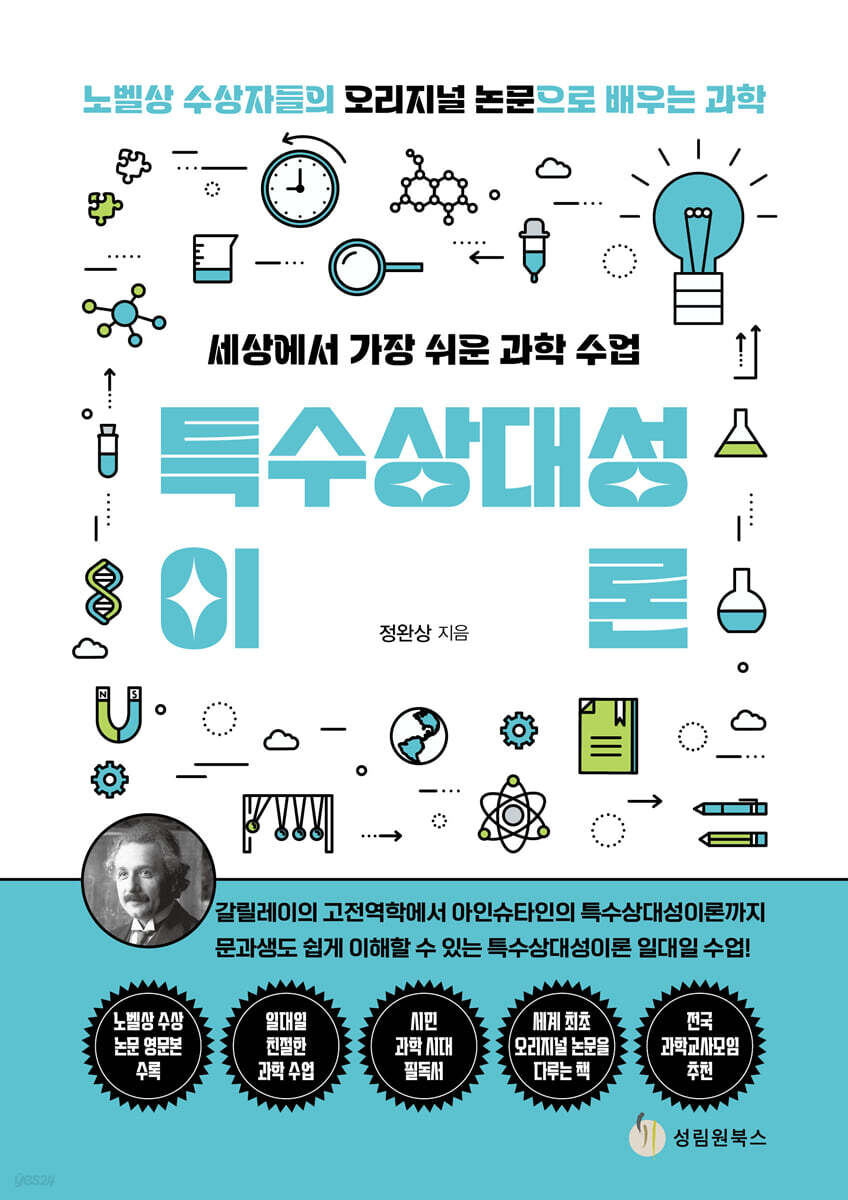
The World's Easiest Science Lesson: Special Relativity
 |
Description
Book Introduction
From Galileo's classical mechanics to Einstein's special theory of relativity
Let's delve into the secrets of space-time that genius scientist Einstein looked into through his thesis!
A one-on-one lesson on special relativity that even liberal arts students can easily understand!
A taste of the original Nobel Prize-winning paper, presented through the lens of mathematics and the history of science.
Over the years, countless books on quantum mechanics and relativity have been published.
However, most of it is written around related historical stories.
This series was designed with the hope that you will no longer avoid formulas and instead understand the original papers of genius scientists.
This book contains the exact process of solving the formulas contained in the paper.
Of course, there are some difficult contents, but they are explained in a friendly way so that anyone with a high school level of math knowledge can understand them.
If you follow the one-on-one conversation between a student and a professor, even liberal arts students who are afraid of formulas will be able to easily understand.
This book focuses on the first paper on special relativity by 26-year-old Einstein (1905).
To help understand the paper, the first meeting covered the history of Galileo and Newtonian mechanics, and the second meeting told the story of those who measured the speed of light and the scientists who believed in ether.
Through this, I lectured on Part 1 of Einstein's paper at the third meeting.
In the fourth meeting, the history of electromagnetism was discussed, and in the fifth meeting, Maxwell's equations and the properties of waves were discussed.
Based on this, the second part of the paper was lectured at the sixth meeting, and finally the E=Mc² formula was reached.
The English version of the paper is included at the back of the book, allowing readers to indirectly experience the original paper.
I recommend this series to anyone interested in science, including students who dream of becoming scientists, people who want to learn more about quantum mechanics and relativity, science teachers who want to introduce great papers to their students, and filmmakers or webtoon artists who want to make a science fiction film that surpasses [Interstellar].
All 20 volumes of this series feature all past Nobel Prize winners in Physics.
Let's delve into the secrets of space-time that genius scientist Einstein looked into through his thesis!
A one-on-one lesson on special relativity that even liberal arts students can easily understand!
A taste of the original Nobel Prize-winning paper, presented through the lens of mathematics and the history of science.
Over the years, countless books on quantum mechanics and relativity have been published.
However, most of it is written around related historical stories.
This series was designed with the hope that you will no longer avoid formulas and instead understand the original papers of genius scientists.
This book contains the exact process of solving the formulas contained in the paper.
Of course, there are some difficult contents, but they are explained in a friendly way so that anyone with a high school level of math knowledge can understand them.
If you follow the one-on-one conversation between a student and a professor, even liberal arts students who are afraid of formulas will be able to easily understand.
This book focuses on the first paper on special relativity by 26-year-old Einstein (1905).
To help understand the paper, the first meeting covered the history of Galileo and Newtonian mechanics, and the second meeting told the story of those who measured the speed of light and the scientists who believed in ether.
Through this, I lectured on Part 1 of Einstein's paper at the third meeting.
In the fourth meeting, the history of electromagnetism was discussed, and in the fifth meeting, Maxwell's equations and the properties of waves were discussed.
Based on this, the second part of the paper was lectured at the sixth meeting, and finally the E=Mc² formula was reached.
The English version of the paper is included at the back of the book, allowing readers to indirectly experience the original paper.
I recommend this series to anyone interested in science, including students who dream of becoming scientists, people who want to learn more about quantum mechanics and relativity, science teachers who want to introduce great papers to their students, and filmmakers or webtoon artists who want to make a science fiction film that surpasses [Interstellar].
All 20 volumes of this series feature all past Nobel Prize winners in Physics.
- You can preview some of the book's contents.
Preview
index
Recommendation
I hope you can understand the original papers of these genius scientists.
Time is finally moving! _A surprise interview with Dr. Hawking
First Encounter│Physics before Einstein
Aristotle's Theory of Motion: A Plausible Reason Why a Stone Falls to the Ground
Galileo, the founder of classical mechanics - A great discovery thanks to a boring sermon!
Galileo, defining speed - How do we compare the speeds of two objects?
Newton, who perfected classical mechanics - Standing on the shoulders of giants
The Discovery of Differentiation and Integration - Infinitely Closer and Infinitely Finer
Defining instantaneous velocity by differentiation - How much has my car's speed changed?
Newton's Three Laws of Motion - Let's keep going like this!
Galileo's Theory of Relativity: Why Street Trees Appear to Move Backward
Work and Kinetic Energy - About the Force That Moves Objects
Second Encounter│The Appearance of Hero Einstein
Scientists who measured the speed of light - You are so fast!
The Ether Controversy - I don't know for sure, but it must exist(?)
Michelson-Morley Experiment - Let's Find Ether!
Lorentz-Fitzgerald Contraction: A Forced Theory Created by False Beliefs
Mach's Critique of Mechanics: Which Comes First: Time or Motion?
Einstein's School Days: The Importance of an Environment That Helped Genius Blossom
Third Encounter│Inside the Paper, Part 1
Outline of the Special Theory of Relativity Paper: Two Revolutionary Hypotheses
Taylor, Representing Functions as Series _ The Magic of Representing Functions as Expansion Formulas
Measuring the length of a stationary stick _ Catch the ball with light!
Measuring the length of a stick moving at constant velocity v - What is the distance traveled by the light I see?
The Relativity of Length and Time - Your and My Time Are Different
Einstein's Velocity Addition _ This rule applies at the speed of light!
Fourth Meeting│People Who Studied Electricity
Electrical Research Begins with Static Electricity - Not Taking Everyday Inconveniences for granted
Kleist and Leyden Bottles _ Let's collect the electricity!
Coulomb's Law _ About the law between two charges
The Invention of the Battery - What Happens Between Different Metal Plates?
Electric Field _ Ready to play the electric force game!
Gauss's Law: The Difficult Path to the Core
Electric potential _ Properties of electric force similar to gravity
Fifth Encounter│The Secret of Electricity and Magnetism
Magnetic Field _ Giant Magnet, Earth
Magnetic action of current _ When current flows, the compass moves?!
Ampere's Law - Forces Acting Between Currents
Faraday's Law of Electromagnetic Induction - What happens when a magnet moves?
Maxwell's Equations - The Complete Equations for Electromagnetism
Light is an electromagnetic wave _ About waves moving at the speed of light
Doppler effect - Perceiving the frequency of a wave differently
Sixth Meeting│Inside the Paper, Part 2
Relativity of Maxwell's Equations in Empty Space - How would two observers describe Maxwell's equations?
Relativistic Doppler Effect - How do two observers perceive the phase of an electromagnetic wave?
The Birth of the Mass-Energy Relationship E=Mc² _Highlight Formula
In addition to the meeting
On the Electrodynamics of Moving Bodies _Einstein's paper in English
Concluding our meeting with a great paper
Papers referenced for this book
Greek letters used in formulas
Introducing the Nobel Prize winners in Physics
I hope you can understand the original papers of these genius scientists.
Time is finally moving! _A surprise interview with Dr. Hawking
First Encounter│Physics before Einstein
Aristotle's Theory of Motion: A Plausible Reason Why a Stone Falls to the Ground
Galileo, the founder of classical mechanics - A great discovery thanks to a boring sermon!
Galileo, defining speed - How do we compare the speeds of two objects?
Newton, who perfected classical mechanics - Standing on the shoulders of giants
The Discovery of Differentiation and Integration - Infinitely Closer and Infinitely Finer
Defining instantaneous velocity by differentiation - How much has my car's speed changed?
Newton's Three Laws of Motion - Let's keep going like this!
Galileo's Theory of Relativity: Why Street Trees Appear to Move Backward
Work and Kinetic Energy - About the Force That Moves Objects
Second Encounter│The Appearance of Hero Einstein
Scientists who measured the speed of light - You are so fast!
The Ether Controversy - I don't know for sure, but it must exist(?)
Michelson-Morley Experiment - Let's Find Ether!
Lorentz-Fitzgerald Contraction: A Forced Theory Created by False Beliefs
Mach's Critique of Mechanics: Which Comes First: Time or Motion?
Einstein's School Days: The Importance of an Environment That Helped Genius Blossom
Third Encounter│Inside the Paper, Part 1
Outline of the Special Theory of Relativity Paper: Two Revolutionary Hypotheses
Taylor, Representing Functions as Series _ The Magic of Representing Functions as Expansion Formulas
Measuring the length of a stationary stick _ Catch the ball with light!
Measuring the length of a stick moving at constant velocity v - What is the distance traveled by the light I see?
The Relativity of Length and Time - Your and My Time Are Different
Einstein's Velocity Addition _ This rule applies at the speed of light!
Fourth Meeting│People Who Studied Electricity
Electrical Research Begins with Static Electricity - Not Taking Everyday Inconveniences for granted
Kleist and Leyden Bottles _ Let's collect the electricity!
Coulomb's Law _ About the law between two charges
The Invention of the Battery - What Happens Between Different Metal Plates?
Electric Field _ Ready to play the electric force game!
Gauss's Law: The Difficult Path to the Core
Electric potential _ Properties of electric force similar to gravity
Fifth Encounter│The Secret of Electricity and Magnetism
Magnetic Field _ Giant Magnet, Earth
Magnetic action of current _ When current flows, the compass moves?!
Ampere's Law - Forces Acting Between Currents
Faraday's Law of Electromagnetic Induction - What happens when a magnet moves?
Maxwell's Equations - The Complete Equations for Electromagnetism
Light is an electromagnetic wave _ About waves moving at the speed of light
Doppler effect - Perceiving the frequency of a wave differently
Sixth Meeting│Inside the Paper, Part 2
Relativity of Maxwell's Equations in Empty Space - How would two observers describe Maxwell's equations?
Relativistic Doppler Effect - How do two observers perceive the phase of an electromagnetic wave?
The Birth of the Mass-Energy Relationship E=Mc² _Highlight Formula
In addition to the meeting
On the Electrodynamics of Moving Bodies _Einstein's paper in English
Concluding our meeting with a great paper
Papers referenced for this book
Greek letters used in formulas
Introducing the Nobel Prize winners in Physics
Detailed image

Publisher's Review
★ Recommended by the National Science Teachers Association ★ A must-read for the era of citizen science
★ A must-read for those planning to pursue a science or engineering degree ★ The world's first book to feature original papers by a Nobel Prize winner
★ One-on-one friendly science classes ★ Original papers in English included
The theory of relativity that everyone knows but no one knows
A special lecture on Einstein's special theory of relativity in everyday life!
〈Example 1〉You have just installed a new app on your smartphone.
When I try to start using the app, this pop-up appears.
'We would like to use your current location information in ㅇㅇㅇ.
Do you agree?'
〈Case 2〉 I decided to go on an outing to the suburbs with my family over the weekend.
When you get into the driver's seat, the first thing you do is launch the navigation system installed in the car or on your smartphone.
When you enter your destination, it will provide recommended routes, travel times, etc. and also show which roads are currently open or blocked.
Things that were unimaginable just 20 years ago have now become a natural part of our daily lives.
It is thanks to GPS, which uses satellites, that we can know our exact location anywhere in the world.
How is this possible? The core theory underlying it is Einstein's special theory of relativity.
Even people who are not familiar with science have probably heard of Einstein, the theory of relativity, or the formula E=Mc².
The science curriculum also covers the basic content as a mandatory subject, so students who dream of becoming scientists in particular are likely to have flipped through a few pages of general books on 'Einstein' or 'theory of relativity'.
But how many people truly understand this famous theory? Of course, that's unless they're studying it in a natural science department at university.
It is so famous that everyone has heard of it, and it is used in many areas of our lives, but it is not easy to clearly understand what it actually means.
Einstein published his paper on special relativity in 1905 and his paper on general relativity in 1915.
This book focuses on the original paper that shocked the academic world when Einstein first announced his theory of light, speed, time and space.
Following Einstein's research method, I will follow the main lines of his thesis and explore what he wanted to convey to the world.
Essential Reading for the Age of Citizen Science
In the face of pandemics and the climate crisis, scientific knowledge is essential, not optional.
We live in an age where an infinite amount of information is being poured out through various social media platforms, to the point where individuals cannot handle it.
Meanwhile, there is an increasing amount of fake information packaged as if it were scientifically verified facts.
Throughout the coronavirus pandemic, we have seen countless instances of how such misinformation can put people at risk, even leading to outbreaks in unexpected places.
The 'climate crisis' is no longer just a claim made by environmentalists.
The world is suffering from damage caused by large-scale wildfires and sudden torrential rains.
In Korea, where four distinct seasons existed, spring and fall are disappearing, and the crop cultivation maps of each region are rapidly changing.
The climate crisis is upon us now, leaving us no time to think about future generations.
Because of this, the number of citizens who are interested in the environment and have a voice in policy decisions is gradually increasing.
In line with the lifelong education society, the number of local governments operating citizen universities that provide liberal arts education for adults is increasing.
Here, not only various humanities and practical studies, but also science courses are often seen.
Knowing scientific knowledge no longer ends with taking school exams and advancing to higher education.
The reason why ordinary citizens who have graduated from school need continuing education is because they are all members who lead this society.
When politicians formulate and decide on policies, they cannot help but be mindful of the will of the citizens.
The level of the citizens' eyes becomes the level of the society.
Major policies implemented in recent years, such as infectious disease response, the Four Major Rivers Project, and the nuclear phase-out, all require scientific review. In this era where AI is becoming part of everyday life, science-related policies will only increase.
I hope that as members of society, there will be more citizens who have scientific knowledge and can voice their opinions on policy.
I hope this book will serve as a stepping stone for that journey.
Would you like to read Einstein's original paper?
Einstein's special theory of relativity explained easily through one-on-one lessons
Wait a minute! I have a question.
I'm the type of person who has to muster up a lot of courage even to read a book that's simply written in Korean.
You're saying you're reading a 'thesis'? Is that even possible?
Here, the depth of knowledge of Professor Jeong Wan-sang, the author of this book, is fully revealed.
The author is a physics professor who teaches students at a university and is a veteran in explaining scientific theories in an easy-to-understand way, having written science and mathematics textbooks for elementary, middle, and high school students for decades.
This book contains six sessions of one-on-one conversations with Professor Jeong, who kindly explains physics to aspiring physics students.
There is another important thread: the history of science.
Although the subject of this book is 'An Explanation of the Special Theory of Relativity Paper,' it also discusses the scientific theories and historical background that formed the basis for Einstein's paper.
All of the scientific theories mentioned are fundamental and core topics covered in the school curriculum, so reading the book will naturally help you understand the background and stimulate your interest in learning.
A head-on confrontation with formulas
Take on the most beautiful and revolutionary scientific paper in human history!
Another feature of this book is that it uses the same 'formulas' used in the paper.
Many popular science books on the market only list historical background and explanations, excluding formulas.
This may be because they took into consideration the readers who would get a headache just looking at numbers or mathematical symbols and put the book down.
But this book takes that formula head-on.
Naturally, formulas continue to appear in Einstein's papers.
Reading the paper without considering these formulas is only superficial.
Let's follow the author's friendly explanations, step by step, to arrive at the beautiful formula E=Mc², just as Einstein wrote in his paper.
It is said that mathematics is the language of science.
To understand science, you must know mathematics, the language of science.
Only when mathematics is the foundation can science be fully understood.
Don't be too greedy.
It's okay if you don't understand all of this at once.
How can you understand a paper written by the genius Einstein in one sitting?
It's okay to just follow along with the interesting story of scientific history.
Why not try to vaguely understand the foundation upon which Einstein developed his great theory? It's fine to just read the formulas with your eyes.
If you read it again and again when you understand the content, you will feel a greater sense of accomplishment.
The English version of the original paper is also included at the back of the book.
I hope you will also be able to experience the joy of seeing the formulas you encountered during your meeting with the author.
Students who stake their future on science, citizens who love science and change the world.
Let's challenge the paper that contains the most beautiful and revolutionary ideas in human history.
Let's shout, "I read Einstein's paper!"
Don't you feel your shoulders shrugging already?
Of course, preparing for scientific exploration is essential for science students!
Thorough preparation for Korean language and non-literature science texts is essential even for liberal arts students.
The recent college entrance exams (including mock exams and academic ability assessments) are showing a trend of increasingly longer question passages.
Problems in the field of scientific inquiry do not simply ask about concepts or derive calculation results, but also detail experimental procedures or explain the historical background of science.
Scientific texts often appear in the non-literature section of the Korean language section of the College Scholastic Ability Test.
However, there are many cases where people fail to properly manage their time while reading non-fiction texts and end up in trouble.
Why is that? It's because of background knowledge.
What helps you read large amounts of text quickly depends on whether you are familiar with the content.
This book covers the scientific history of the theories that formed the basis of the central thesis commentary.
You can naturally acquire related knowledge by reading about the life of the scientist who discovered the theory and episodes about new discoveries.
Let us remember what Newton said, “If I have seen farther, it is because I stood on the shoulders of giants.”
The papers Einstein left behind are the result of his enormous effort.
As you read the paper and encounter the problems Einstein grappled with, you can get a sense of what his research process was like.
I encourage you to use this book as a stepping stone to move forward.
I am a physics teacher at a general high school.
With students who chose the physics subject, I have experience exploring the achievements, contributions to scholarship, and Nobel Prize acceptance speeches of various scientists, from the 1901 Nobel laureate Röntgen to current scientists, as part of an in-depth study of modern physics.
Furthermore, we looked for experiments performed by Nobel Prize-winning scientists that students could try out themselves.
I remember spending a lot of time creating teaching materials to prepare for one period of experimental classes.
Then, I came across the series “Learning Science through Original Papers by Nobel Prize Winners” published by Seonglimwon Books.
『The World's Easiest Science Lesson: Special Relativity』 This book provides a detailed overview of the vast body of physics knowledge that led to the development of the special theory of relativity.
I would especially recommend this book to students who have been exposed to mechanics, electromagnetism, and waves in high school and are highly interested in modern physics; physics teachers who want to teach modern physics meaningfully to their students; college students studying physics at university; and the general public who are interested in modern physics but have hesitated due to lack of mathematics.
If you ignore the formulas written in books because they are difficult to understand, you will lose the language of scientific knowledge: formulas.
The author boldly wrote the book so that you can learn the formulas from mechanics to Maxwell's equations before approaching the special theory of relativity.
As a physics teacher, I feel so refreshed when I see these attempts.
I hope you will experience an understanding of Einstein's thesis by looking at the author's explanations of the stories and formulas of various scientists before Einstein.
I hope you too will experience the joy of enlightenment that this book leads you to.
- National Science Teachers Association
★ A must-read for those planning to pursue a science or engineering degree ★ The world's first book to feature original papers by a Nobel Prize winner
★ One-on-one friendly science classes ★ Original papers in English included
The theory of relativity that everyone knows but no one knows
A special lecture on Einstein's special theory of relativity in everyday life!
〈Example 1〉You have just installed a new app on your smartphone.
When I try to start using the app, this pop-up appears.
'We would like to use your current location information in ㅇㅇㅇ.
Do you agree?'
〈Case 2〉 I decided to go on an outing to the suburbs with my family over the weekend.
When you get into the driver's seat, the first thing you do is launch the navigation system installed in the car or on your smartphone.
When you enter your destination, it will provide recommended routes, travel times, etc. and also show which roads are currently open or blocked.
Things that were unimaginable just 20 years ago have now become a natural part of our daily lives.
It is thanks to GPS, which uses satellites, that we can know our exact location anywhere in the world.
How is this possible? The core theory underlying it is Einstein's special theory of relativity.
Even people who are not familiar with science have probably heard of Einstein, the theory of relativity, or the formula E=Mc².
The science curriculum also covers the basic content as a mandatory subject, so students who dream of becoming scientists in particular are likely to have flipped through a few pages of general books on 'Einstein' or 'theory of relativity'.
But how many people truly understand this famous theory? Of course, that's unless they're studying it in a natural science department at university.
It is so famous that everyone has heard of it, and it is used in many areas of our lives, but it is not easy to clearly understand what it actually means.
Einstein published his paper on special relativity in 1905 and his paper on general relativity in 1915.
This book focuses on the original paper that shocked the academic world when Einstein first announced his theory of light, speed, time and space.
Following Einstein's research method, I will follow the main lines of his thesis and explore what he wanted to convey to the world.
Essential Reading for the Age of Citizen Science
In the face of pandemics and the climate crisis, scientific knowledge is essential, not optional.
We live in an age where an infinite amount of information is being poured out through various social media platforms, to the point where individuals cannot handle it.
Meanwhile, there is an increasing amount of fake information packaged as if it were scientifically verified facts.
Throughout the coronavirus pandemic, we have seen countless instances of how such misinformation can put people at risk, even leading to outbreaks in unexpected places.
The 'climate crisis' is no longer just a claim made by environmentalists.
The world is suffering from damage caused by large-scale wildfires and sudden torrential rains.
In Korea, where four distinct seasons existed, spring and fall are disappearing, and the crop cultivation maps of each region are rapidly changing.
The climate crisis is upon us now, leaving us no time to think about future generations.
Because of this, the number of citizens who are interested in the environment and have a voice in policy decisions is gradually increasing.
In line with the lifelong education society, the number of local governments operating citizen universities that provide liberal arts education for adults is increasing.
Here, not only various humanities and practical studies, but also science courses are often seen.
Knowing scientific knowledge no longer ends with taking school exams and advancing to higher education.
The reason why ordinary citizens who have graduated from school need continuing education is because they are all members who lead this society.
When politicians formulate and decide on policies, they cannot help but be mindful of the will of the citizens.
The level of the citizens' eyes becomes the level of the society.
Major policies implemented in recent years, such as infectious disease response, the Four Major Rivers Project, and the nuclear phase-out, all require scientific review. In this era where AI is becoming part of everyday life, science-related policies will only increase.
I hope that as members of society, there will be more citizens who have scientific knowledge and can voice their opinions on policy.
I hope this book will serve as a stepping stone for that journey.
Would you like to read Einstein's original paper?
Einstein's special theory of relativity explained easily through one-on-one lessons
Wait a minute! I have a question.
I'm the type of person who has to muster up a lot of courage even to read a book that's simply written in Korean.
You're saying you're reading a 'thesis'? Is that even possible?
Here, the depth of knowledge of Professor Jeong Wan-sang, the author of this book, is fully revealed.
The author is a physics professor who teaches students at a university and is a veteran in explaining scientific theories in an easy-to-understand way, having written science and mathematics textbooks for elementary, middle, and high school students for decades.
This book contains six sessions of one-on-one conversations with Professor Jeong, who kindly explains physics to aspiring physics students.
There is another important thread: the history of science.
Although the subject of this book is 'An Explanation of the Special Theory of Relativity Paper,' it also discusses the scientific theories and historical background that formed the basis for Einstein's paper.
All of the scientific theories mentioned are fundamental and core topics covered in the school curriculum, so reading the book will naturally help you understand the background and stimulate your interest in learning.
A head-on confrontation with formulas
Take on the most beautiful and revolutionary scientific paper in human history!
Another feature of this book is that it uses the same 'formulas' used in the paper.
Many popular science books on the market only list historical background and explanations, excluding formulas.
This may be because they took into consideration the readers who would get a headache just looking at numbers or mathematical symbols and put the book down.
But this book takes that formula head-on.
Naturally, formulas continue to appear in Einstein's papers.
Reading the paper without considering these formulas is only superficial.
Let's follow the author's friendly explanations, step by step, to arrive at the beautiful formula E=Mc², just as Einstein wrote in his paper.
It is said that mathematics is the language of science.
To understand science, you must know mathematics, the language of science.
Only when mathematics is the foundation can science be fully understood.
Don't be too greedy.
It's okay if you don't understand all of this at once.
How can you understand a paper written by the genius Einstein in one sitting?
It's okay to just follow along with the interesting story of scientific history.
Why not try to vaguely understand the foundation upon which Einstein developed his great theory? It's fine to just read the formulas with your eyes.
If you read it again and again when you understand the content, you will feel a greater sense of accomplishment.
The English version of the original paper is also included at the back of the book.
I hope you will also be able to experience the joy of seeing the formulas you encountered during your meeting with the author.
Students who stake their future on science, citizens who love science and change the world.
Let's challenge the paper that contains the most beautiful and revolutionary ideas in human history.
Let's shout, "I read Einstein's paper!"
Don't you feel your shoulders shrugging already?
Of course, preparing for scientific exploration is essential for science students!
Thorough preparation for Korean language and non-literature science texts is essential even for liberal arts students.
The recent college entrance exams (including mock exams and academic ability assessments) are showing a trend of increasingly longer question passages.
Problems in the field of scientific inquiry do not simply ask about concepts or derive calculation results, but also detail experimental procedures or explain the historical background of science.
Scientific texts often appear in the non-literature section of the Korean language section of the College Scholastic Ability Test.
However, there are many cases where people fail to properly manage their time while reading non-fiction texts and end up in trouble.
Why is that? It's because of background knowledge.
What helps you read large amounts of text quickly depends on whether you are familiar with the content.
This book covers the scientific history of the theories that formed the basis of the central thesis commentary.
You can naturally acquire related knowledge by reading about the life of the scientist who discovered the theory and episodes about new discoveries.
Let us remember what Newton said, “If I have seen farther, it is because I stood on the shoulders of giants.”
The papers Einstein left behind are the result of his enormous effort.
As you read the paper and encounter the problems Einstein grappled with, you can get a sense of what his research process was like.
I encourage you to use this book as a stepping stone to move forward.
I am a physics teacher at a general high school.
With students who chose the physics subject, I have experience exploring the achievements, contributions to scholarship, and Nobel Prize acceptance speeches of various scientists, from the 1901 Nobel laureate Röntgen to current scientists, as part of an in-depth study of modern physics.
Furthermore, we looked for experiments performed by Nobel Prize-winning scientists that students could try out themselves.
I remember spending a lot of time creating teaching materials to prepare for one period of experimental classes.
Then, I came across the series “Learning Science through Original Papers by Nobel Prize Winners” published by Seonglimwon Books.
『The World's Easiest Science Lesson: Special Relativity』 This book provides a detailed overview of the vast body of physics knowledge that led to the development of the special theory of relativity.
I would especially recommend this book to students who have been exposed to mechanics, electromagnetism, and waves in high school and are highly interested in modern physics; physics teachers who want to teach modern physics meaningfully to their students; college students studying physics at university; and the general public who are interested in modern physics but have hesitated due to lack of mathematics.
If you ignore the formulas written in books because they are difficult to understand, you will lose the language of scientific knowledge: formulas.
The author boldly wrote the book so that you can learn the formulas from mechanics to Maxwell's equations before approaching the special theory of relativity.
As a physics teacher, I feel so refreshed when I see these attempts.
I hope you will experience an understanding of Einstein's thesis by looking at the author's explanations of the stories and formulas of various scientists before Einstein.
I hope you too will experience the joy of enlightenment that this book leads you to.
- National Science Teachers Association
GOODS SPECIFICS
- Date of issue: July 17, 2023
- Page count, weight, size: 304 pages | 152*215*30mm
- ISBN13: 9791188762941
- ISBN10: 118876294X
You may also like
카테고리
korean


korean

![ELLE 엘르 스페셜 에디션 A형 : 12월 [2025]](http://librairie.coreenne.fr/cdn/shop/files/b8e27a3de6c9538896439686c6b0e8fb.jpg?v=1766436872&width=3840)


