

Encyclopedia of Science: Canned Food (General Science Edition)
 |
Description
Book Introduction
Get away from 'know · don't know · don't know'
If you want to be reborn as 'Gwa·Jal·Al'
Learn scientific knowledge through 'Tong·Jo·Rim'!
If you examine the 365 items in this book one page a day, one by one, as if examining a tree, and then understand and connect them as a whole, as if looking at the forest, you will surprisingly come up with new 'scientific knowledge'.
You too, read this book in a 'canned' way and become 'well-versed'!
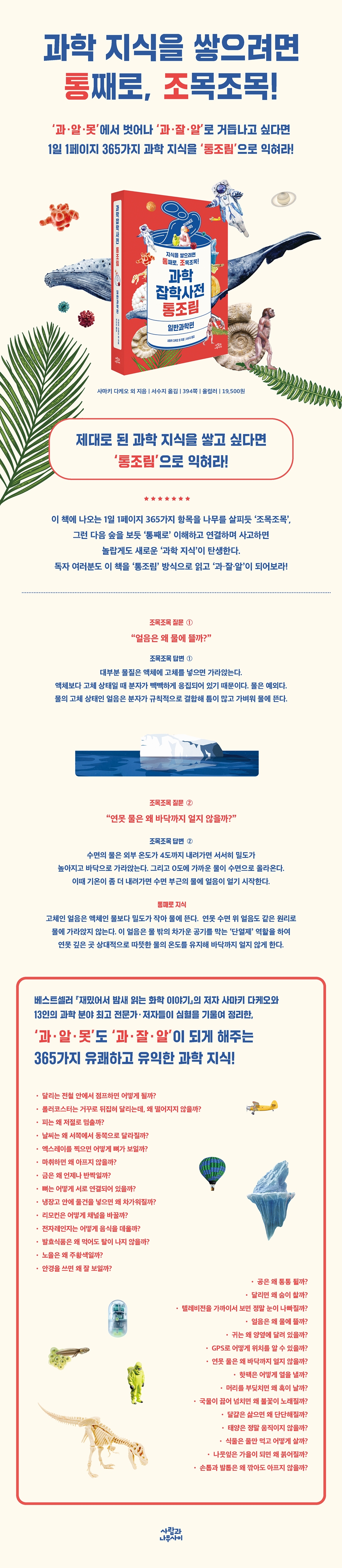
Question 1: “Why does ice float on water?” Answer 1: Most substances sink when a solid is added to a liquid.
This is because the molecules are packed more densely in a solid state than in a liquid.
Water is an exception.
Ice, the solid state of water, has molecules that are regularly bonded together, have many gaps, and are light, so it floats on water.
Question 2: “Why doesn’t the pond water freeze all the way to the bottom?” Answer 2: When the outside temperature drops to 4 degrees, the water on the surface gradually becomes denser and sinks to the bottom.
And water close to 0 degrees rises to the surface.
At this time, when the temperature drops further, ice begins to freeze on the water near the surface.
Ice, which is a solid solid, has a lower density than liquid water and floats on water.
Ice on the surface of a pond also does not sink in water for the same reason.
This ice acts as an 'insulator' to block the cold air outside the water, maintaining the relatively warm temperature of the water deep in the pond and preventing it from freezing to the bottom.
If you want to be reborn as 'Gwa·Jal·Al'
Learn scientific knowledge through 'Tong·Jo·Rim'!
If you examine the 365 items in this book one page a day, one by one, as if examining a tree, and then understand and connect them as a whole, as if looking at the forest, you will surprisingly come up with new 'scientific knowledge'.
You too, read this book in a 'canned' way and become 'well-versed'!
Question 1: “Why does ice float on water?” Answer 1: Most substances sink when a solid is added to a liquid.
This is because the molecules are packed more densely in a solid state than in a liquid.
Water is an exception.
Ice, the solid state of water, has molecules that are regularly bonded together, have many gaps, and are light, so it floats on water.
Question 2: “Why doesn’t the pond water freeze all the way to the bottom?” Answer 2: When the outside temperature drops to 4 degrees, the water on the surface gradually becomes denser and sinks to the bottom.
And water close to 0 degrees rises to the surface.
At this time, when the temperature drops further, ice begins to freeze on the water near the surface.
Ice, which is a solid solid, has a lower density than liquid water and floats on water.
Ice on the surface of a pond also does not sink in water for the same reason.
This ice acts as an 'insulator' to block the cold air outside the water, maintaining the relatively warm temperature of the water deep in the pond and preventing it from freezing to the bottom.
- You can preview some of the book's contents.
Preview
index
To the readers of this book
How to use this book
Creatures│Humans
Day 001 Were humans originally monkeys?┃Day 002 How are babies born?┃Day 003 How do babies grow in the womb?┃Day 004 Why do people have different skin and hair colors depending on where they live?┃Day 005 Why are most creatures divided into male and female?┃Day 006 Are whales and humans related?┃Day 007 Why don't humans have tails?
Science│Various Powers
Day 008 Why do things fall? Day 009 What happens if you jump from a moving train? Day 010 Why does the human body float on water? Day 011 Why do your hands get warm when you rub them together? Day 012 Why doesn't a roller coaster fall when it's running upside down? Day 013 Why do magnets stick to metal? Day 014 Why does a sharp knife cut better?
Human body│What comes out of the body
Day 015 Why do people fart?┃Day 016 What is feces made of?┃Day 017 What is urine made of?┃Day 018 What is blood made of?┃Day 019 Why does blood stop flowing on its own?┃Day 020 Why do people breathe?┃Day 021 Why do we sweat when it's hot?
Nature│The Mystery of Weather
Day 022 What are high and low pressure?┃Day 024 Why does the weather change from west to east?┃Day 025 How does hail form?┃Day 026 What is the Foehn phenomenon?┃Day 027 What does it mean when humidity is high or low?┃Day 028 How does a rainbow form?
Food│Nutrition
Day 029 What role does protein play in our body?┃Day 030 Do we need fat in our body?┃Day 031 What role do carbohydrates play in our body?┃Day 032 What do vitamins do?┃Day 033 What exactly is dietary fiber?┃Day 034 What minerals are there?┃Day 035 What do calories mean?
Universe│The Structure of the Universe
Day 036 What does the universe look like?┃Day 037 What is a black hole?┃Day 038 What are galaxies made of?┃Day 039 What is the difference between a shining star and a non-shining star?┃Day 040 What would happen if humans went into space?┃Day 041 What is dark matter?┃Day 042 Is the universe expanding?
Machines and Tools│Principles of Sound and Image
Day 043 How can we talk on the phone? Day 044 How do digital cameras take pictures? Day 045 How do DVDs record information? Day 046 How does 3D appear three-dimensional? Day 047 How do 3D printers work? Day 048 What is the difference between stereo and mono? Day 049 What is the nature of cell phone radio waves?
Disease and Medicine│Medical
Day 050 How do bones show up on an X-ray?┃Day 051 Why doesn't anesthesia hurt?┃Day 052 What are the benefits of applying a patch?┃Day 053 Why does the itchiness go away when you apply ointment?┃Day 054 How can alcohol sterilize?┃Day 055 Why do we need vaccinations?┃Day 056 How are vaccines made?
The incredible power of animals
Day 057 How do birds fly? Day 058 How do tadpoles become frogs? Day 059 How do snakes move without legs? Day 060 How do owls fly in the night sky? Day 061 Why do swallows come in spring? Day 062 How do fish breathe underwater? Day 063 Why do some creatures hibernate?
Nature│Metals and Gems
Day 064 Why are diamonds hard?┃Day 065 Why is iron so versatile?┃Day 066 What kind of metal is aluminum?┃Day 067 How is copper extracted?┃Day 068 Why does gold always shine?┃Day 069 What is silver used for?┃Day 070 What is platinum used for?
Human body│Inside the body
Day 071 Why is the heart the most important?┃Day 072 What is the role of the stomach?┃Day 073 What does the small intestine do?┃Day 074 How many bones are there in our body?┃Day 075 How are bones connected to each other?┃Day 076 What function do the lungs have in our body?┃Day 077 Why is the brain called the command organ of our body?
Science│Chemistry around us
Day 078 How does detergent remove stains?┃Day 079 Why should we wash our hands with soap?┃Day 080 What happens when we mix 'dangerous substances'?┃Day 081 How do balloons float?┃Day 082 How are soap bubbles formed?┃Day 083 Does spraying deodorizing spray really eliminate odors?┃Day 084 Are pesticides only effective against bugs?
Machines and Tools│Amazing Home Appliances
Day 085 Why does the refrigerator get cold when you put things in it?┃Day 086 Why does the air conditioner get cool when you turn it on?┃Day 087 How does a television display images?┃Day 088 How does a remote control change channels?┃Day 089 What is different about a pressure cooker?┃Day 090 How does an induction cooktop generate heat?┃Day 091 How does a microwave oven heat food?
Food│Mysteries of Food
Day 092 How is bread made?┃Day 093 Why does rice cake rise when baked?┃Day 094 How is mayonnaise made?┃Day 095 Why can we eat fermented foods without getting sick?┃Day 096 What happens when we drink alcohol?┃Day 097 Why don't I have trouble sleeping when I drink coffee?┃Day 098 Why does cider foam up?
Nature│Ground
Day 099 How do hot springs form?┃Day 100 What is the identity of the magma in the ground?┃Day 101 How are rocks formed?┃Day 102 What is the difference between sand and clay?┃Day 103 How is soil formed?┃Day 104 How are fossils formed?┃Day 105 How are frostbite formed?
Space│Amazing space knowledge
Day 106 Is there junk in space?┃Day 107 What are neutrinos?┃Day 108 Why do day and night occur?┃Day 109 Why is it hot in summer and cold in winter?┃Day 110 Why are sunsets orange?┃Day 111 Why do leap years occur?┃Day 112 Why do tidal differences occur?
Machines and Tools│What are Tools?
Day 113 How does a violin make sound?┃Day 114 Why doesn't a cake get crushed when you pick it up with tongs?┃Day 115 How does a towel absorb moisture?┃Day 116 Why do we see better when we wear glasses?┃Day 117 What is reflected in a mirror?┃Day 118 How does a dishwashing sponge make bubbles?┃Day 119 Why does a ball bounce?
Human Body│Differences in the Body
Day 120 Why do children resemble their parents?┃Day 121 What is DNA?┃Day 122 Why do we have belly buttons?┃Day 123 Why is my grandfather's hair white?┃Day 124 What's the difference between different blood types?┃Day 125 What's the difference between eyes with and without double eyelids?┃Day 126 Why do only men have beards?
Science│Electricity
Day 127 Where does the word 'electricity' come from?┃Day 128 How is electricity created?┃Day 129 What is the difference between objects that conduct electricity and objects that do not?┃Day 130 How does solar power generation work?┃Day 131 How does static electricity occur?┃Day 132 What is the principle of nuclear power generation?┃Day 133 What does it mean to be 'electrically shocked'?
Disease and Medicine│Mysteries of Health
Day 134 Why do we get pollen allergies?┃Day 135 Why do we get hives?┃Day 136 Why do I get out of breath when I run?┃Day 137 Why do mosquito bites itch?┃Day 138 Does watching TV up close really make your eyesight worse?┃Day 139 Why do we gain weight when we eat a lot?┃Day 140 Why do we get stressed?
Machines and Tools│Amazing Technology in Vehicles
Day 141 How do cars run? Day 142 How do airplanes fly? Day 143 How do balloons float? Day 144 How do helicopters fly? Day 145 How do high-speed trains run faster than subways? Day 146 What does the inside of an escalator look like? Day 147 How do locomotives move?
Biology│Bioscience
Day 148 What did the first living thing look like? Day 149 What does an animal's body look like? Day 150 What is the smallest living thing? Day 151 What is a clone? Day 152 What on earth are iPS cells? Day 153 What is autophagy? Day 154 How big are 'micro' and 'nano'?
Nature│Scary disasters
Day 155 How do tornadoes form?┃Day 156 Why do typhoons blow from summer to fall?┃Day 157 Why do tsunamis form?┃Day 158 Why do earthquakes occur?┃Day 159 Why do volcanoes erupt?┃Day 160 Why do guerrilla rainstorms occur?┃Day 161 How do forest fires start?
Science│It changes here and there!
Day 162 Why does ice float on water?┃Day 163 How does water boil?┃Day 164 How is gasoline created?┃Day 165 What is a chemical change?┃Day 166 What is oxygen?┃Day 167 Why do explosions occur?┃Day 168 How do you make slime (a liquid monster)?
human body│face
Day 169 Why are ears on both sides?┃Day 170 Why do we have two eyes?┃Day 171 Why do noses stick out?┃Day 172 Where does saliva come from?┃Day 173 Why do baby teeth fall out and permanent teeth grow in?┃Day 174 Why do we have hair?┃Day 175 Why do we have eyebrows and eyelashes?
Machines and Tools│Digital
Day 176 How is a QR code made?┃Day 177 What is the Internet?┃Day 178 What is OLED?┃Day 179 How does an IC card work?┃Day 180 What does the inside of a computer look like?┃Day 181 How does a touch panel work?┃Day 182 How can we find our location with GPS?
Space│Stars
Day 183 What does the Milky Way look like?┃Day 184 Where do shooting stars go?┃Day 185 What happens when a meteorite falls?┃Day 186 Are there really aliens?┃Day 187 Can humans live on Mars?┃Day 188 What on earth is the solar system?┃Day 189 Why does Saturn have rings?
Nature│Beautiful nature
Day 190 Why is it cold on top of the mountain?┃Day 191 How do rivers flow?┃Day 192 How did mountains rise?┃Day 193 Why doesn't pond water freeze all the way to the bottom?┃Day 194 Why does it snow when it's cold?┃Day 195 Why is the sea blue?┃Day 196 How do aurorae form?
Food│Snacks
Day 197 How do you make honey?┃Day 198 How do you make ice cream?┃Day 199 How do you make chocolate?┃Day 200 How do you make sugar?┃Day 201 How do you make cotton candy?┃Day 202 How do you make yogurt?┃Day 203 How do you make butter?
Science│Chemical Reactions
Day 204 What is organic matter?┃Day 205 What is an atom?┃Day 206 What is a molecule?┃Day 207 What is an ion?┃Day 208 What does the inside of a battery look like?┃Day 209 How do hot packs generate heat?┃Day 210 Why do metals rust?
Disease and Medicine│Is your body feeling strange?
Day 211 Why do we get motion sickness?┃Day 212 Why do we get heatstroke?┃Day 213 Why do we get hiccups?┃Day 214 Why do adults have stiff shoulders?┃Day 215 Why do adults have muscle pain?┃Day 216 Why do bumps on the head cause bumps?┃Day 217 What is fainting?
Machines and Tools│Principles of Stationery
Day 218 How can you write with a ballpoint pen?┃Day 219 What is the principle of an erasable ballpoint pen?┃Day 220 How can you write with a pencil?┃Day 221 How does an eraser work?┃Day 222 What is paint made of?┃Day 223 Why does paper stick when you apply glue?┃Day 224 How can you write on a blackboard with chalk?
The human body's tremendous power
Day 225 Is it true that studying increases the wrinkles in the brain?┃Day 226 How are memories preserved?┃Day 227 What are hormones?┃Day 228 Why do we cry?┃Day 229 Why do we have fingerprints?┃Day 230 Why do we have a runny nose?┃Day 231 How does the voice sound?
Nature│Various materials
Day 232 Why does it get warmer when you cover yourself with a blanket?┃Day 233 How is concrete made?┃Day 234 How is asphalt made?┃Day 235 How does rubber stretch?┃Day 236 How is glass made?┃Day 237 How is plastic made?┃Day 238 What is ceramics made of?
Creatures│Various animals
Day 239 What is the difference between carnivores and herbivores?┃Day 240 Why did dinosaurs disappear?┃Day 241 What creatures are born from eggs?┃Day 242 Why are octopuses and squids mushy?┃Day 243 What are crab shells made of?┃Day 244 Are clams fish or not?┃Day 245 Are dolphins fish or not?
Science│Fire and Water
Day 246 When do objects burn easily?┃Day 247 Do railroads catch fire?┃Day 248 How do you put out a fire?┃Day 249 Why do flames turn yellow when soup boils over?┃Day 250 How do fireworks produce so many colors?┃Day 251 Why does it feel cool when you put a fever-reducing sheet on your forehead?┃Day 252 Is there water vapor over 100 degrees?
Machines and Tools│Amazing Technology
Day 253 How do we create artificial intelligence?┃Day 254 What's different about lasers?┃Day 255 How do LEDs emit light?┃Day 256 What is biometrics?┃Day 257 What is optical fiber?┃Day 258 How are linear motors made?┃Day 259 Why are 4K and 8K televisions so great?
Food│Cooking
Day 260 Why do tears come out when I cut an onion?┃Day 261 Why do boiled eggs become hard?┃Day 262 Why does popcorn puff up?┃Day 263 Is tofu really made from soybeans?┃Day 264 Why is fried food crispy?┃Day 265 Why does mold grow?┃Day 266 What is the difference between white fish and red fish?
Space│Earth, Moon, and Sun
Day 267 How was the Earth born?┃Day 268 What is at the center of the Earth?┃Day 269 How was the moon born?┃Day 270 Why does the moon's shape change?┃Day 271 Does the sun really not move?┃Day 272 Why is the sun bright?┃Day 273 Why do solar eclipses occur?
Science│Sound and Light
Day 274 How do sounds come about?┃Day 275 Why do ambulance sirens change their sound?┃Day 276 Why are there holes in soundproof walls?┃Day 277 What is ultraviolet light?┃Day 278 What is visible light?┃Day 279 Why does a pencil appear bent when you put it in water?┃Day 280 Why are there different colors?┃Day 281 How do fluorescent lights emit light?
Diseases and Medicines│Infectious Diseases
Day 282 Why do viruses occur?┃Day 283 What is the difference between bacteria and viruses?┃Day 284 What is a cold?┃Day 285 Why do we sneeze and cough?┃Day 286 Why do we get a fever when we have a bad cold?┃Day 287 What is influenza?┃Day 288 What is COVID-19?
The Human Body│The Mysteries of the Body
Day 289 Why do my ears ring and feel stuffy when I take an elevator?┃Day 290 Why can't I walk straight after spinning around in circles?┃Day 291 Why do I laugh when I'm tickled?┃Day 292 Why do my hands flinch when I touch something hot?┃Day 293 Why do I yawn when I'm sleepy?┃Day 294 Why do we dream?┃Day 295 Why does my skin get sunburned when I'm exposed to sunlight?┃Day 296 Why do we have to sleep every day?
Nature│How to make it?
Day 297 How are mummies made?┃Day 298 How is paper made?┃Day 299 How is salt made?┃Day 300 How is tap water made?┃Day 301 How are pearls made?┃Day 302 How is oil made?┃Day 303 How is amber made?
Machines and Tools│Handy Tools
Day 304 How do you measure temperature with a thermometer?┃Day 305 How are disposable diapers made?┃Day 306 How does a magnifying glass make things look bigger?┃Day 307 How do zippers close?┃Day 308 How do Velcro tapes close?┃Day 309 How can you erase writing on a whiteboard cleanly?┃Day 310 How does a compass work?
Living Things│Insects and Plants
Day 311 How many types of insects are there?┃Day 312 Why do insects flock to light?┃Day 313 What is the difference between trees and grass?┃Day 314 How do plants survive by drinking only water?┃Day 315 What is the difference between plants that bear fruit and those that do not?┃Day 316 Are mushrooms also plants?┃Day 317 How do 'fruits' without seeds reproduce?
Food│Food-related technology
Day 318 How can frozen foods be stored for a long time?┃Day 319 Why are food additives necessary?┃Day 320 What are the benefits of breeding?┃Day 321 What are genetically modified foods?┃Day 322 Why do we need to spray pesticides?┃Day 323 Can instant foods really be eaten just by heating them up?┃Day 324 How is gum made?
Space│Space Technology
Day 325 What is the theory of relativity? Day 326 What do satellites do? Day 327 How do space shuttles fly? Day 328 How are spacesuits made? Day 329 What do they do on the International Space Station? Day 330 What kind of food is in space food?
Science│Air
Day 331 What is air made of?┃Day 332 Why is there so much nitrogen in the air?┃Day 333 What is argon?┃Day 334 What is carbon dioxide?┃Day 335 What is carbon monoxide poisoning?┃Day 336 Why does climbing a high mountain make you feel unwell?┃Day 337 How is dry ice made?
Nature│Mysterious Natural Phenomena
Day 338 What is the difference between hail and snow?┃Day 339 Why do leaves turn red in the fall?┃Day 340 What is El Niño?┃Day 341 Is it true that the Earth is getting warmer?┃Day 342 Why is Antarctica cold even though it is in the south?┃Day 343 Why do seasons change?┃Day 344 What is the deep sea like?
Diseases and Medicines│Various Diseases
Day 345 Why do we have diarrhea?┃Day 346 What is cancer?┃Day 347 What is poison?┃Day 348 Why does athlete's foot itch?┃Day 349 Why do we get cavities when we eat sweet foods?┃Day 350 What is asthma?┃Day 351 What is food poisoning?
Machines and Tools│Principles of Electricity
Day 352 What does the inside of an electrical outlet look like? Day 353 How do wristwatches work? Day 354 How do robot vacuum cleaners detect dust? Day 355 How do electric cars run? Day 356 What's the difference between a drone and a remote-controlled airplane? Day 357 How do elevators work? Day 358 How do digital scales measure weight?
Human Body│Feeling Power
Day 359 Why do we feel pain?┃Day 360 How do we know what tastes are?┃Day 361 How do we sense smells?┃Day 362 Why do we get goosebumps?┃Day 363 Why do our legs go numb when we kneel?┃Day 364 Why don't our fingernails and toenails hurt when we cut them?┃Day 365 Why does our heart pound when we're nervous?
Search
How to use this book
Creatures│Humans
Day 001 Were humans originally monkeys?┃Day 002 How are babies born?┃Day 003 How do babies grow in the womb?┃Day 004 Why do people have different skin and hair colors depending on where they live?┃Day 005 Why are most creatures divided into male and female?┃Day 006 Are whales and humans related?┃Day 007 Why don't humans have tails?
Science│Various Powers
Day 008 Why do things fall? Day 009 What happens if you jump from a moving train? Day 010 Why does the human body float on water? Day 011 Why do your hands get warm when you rub them together? Day 012 Why doesn't a roller coaster fall when it's running upside down? Day 013 Why do magnets stick to metal? Day 014 Why does a sharp knife cut better?
Human body│What comes out of the body
Day 015 Why do people fart?┃Day 016 What is feces made of?┃Day 017 What is urine made of?┃Day 018 What is blood made of?┃Day 019 Why does blood stop flowing on its own?┃Day 020 Why do people breathe?┃Day 021 Why do we sweat when it's hot?
Nature│The Mystery of Weather
Day 022 What are high and low pressure?┃Day 024 Why does the weather change from west to east?┃Day 025 How does hail form?┃Day 026 What is the Foehn phenomenon?┃Day 027 What does it mean when humidity is high or low?┃Day 028 How does a rainbow form?
Food│Nutrition
Day 029 What role does protein play in our body?┃Day 030 Do we need fat in our body?┃Day 031 What role do carbohydrates play in our body?┃Day 032 What do vitamins do?┃Day 033 What exactly is dietary fiber?┃Day 034 What minerals are there?┃Day 035 What do calories mean?
Universe│The Structure of the Universe
Day 036 What does the universe look like?┃Day 037 What is a black hole?┃Day 038 What are galaxies made of?┃Day 039 What is the difference between a shining star and a non-shining star?┃Day 040 What would happen if humans went into space?┃Day 041 What is dark matter?┃Day 042 Is the universe expanding?
Machines and Tools│Principles of Sound and Image
Day 043 How can we talk on the phone? Day 044 How do digital cameras take pictures? Day 045 How do DVDs record information? Day 046 How does 3D appear three-dimensional? Day 047 How do 3D printers work? Day 048 What is the difference between stereo and mono? Day 049 What is the nature of cell phone radio waves?
Disease and Medicine│Medical
Day 050 How do bones show up on an X-ray?┃Day 051 Why doesn't anesthesia hurt?┃Day 052 What are the benefits of applying a patch?┃Day 053 Why does the itchiness go away when you apply ointment?┃Day 054 How can alcohol sterilize?┃Day 055 Why do we need vaccinations?┃Day 056 How are vaccines made?
The incredible power of animals
Day 057 How do birds fly? Day 058 How do tadpoles become frogs? Day 059 How do snakes move without legs? Day 060 How do owls fly in the night sky? Day 061 Why do swallows come in spring? Day 062 How do fish breathe underwater? Day 063 Why do some creatures hibernate?
Nature│Metals and Gems
Day 064 Why are diamonds hard?┃Day 065 Why is iron so versatile?┃Day 066 What kind of metal is aluminum?┃Day 067 How is copper extracted?┃Day 068 Why does gold always shine?┃Day 069 What is silver used for?┃Day 070 What is platinum used for?
Human body│Inside the body
Day 071 Why is the heart the most important?┃Day 072 What is the role of the stomach?┃Day 073 What does the small intestine do?┃Day 074 How many bones are there in our body?┃Day 075 How are bones connected to each other?┃Day 076 What function do the lungs have in our body?┃Day 077 Why is the brain called the command organ of our body?
Science│Chemistry around us
Day 078 How does detergent remove stains?┃Day 079 Why should we wash our hands with soap?┃Day 080 What happens when we mix 'dangerous substances'?┃Day 081 How do balloons float?┃Day 082 How are soap bubbles formed?┃Day 083 Does spraying deodorizing spray really eliminate odors?┃Day 084 Are pesticides only effective against bugs?
Machines and Tools│Amazing Home Appliances
Day 085 Why does the refrigerator get cold when you put things in it?┃Day 086 Why does the air conditioner get cool when you turn it on?┃Day 087 How does a television display images?┃Day 088 How does a remote control change channels?┃Day 089 What is different about a pressure cooker?┃Day 090 How does an induction cooktop generate heat?┃Day 091 How does a microwave oven heat food?
Food│Mysteries of Food
Day 092 How is bread made?┃Day 093 Why does rice cake rise when baked?┃Day 094 How is mayonnaise made?┃Day 095 Why can we eat fermented foods without getting sick?┃Day 096 What happens when we drink alcohol?┃Day 097 Why don't I have trouble sleeping when I drink coffee?┃Day 098 Why does cider foam up?
Nature│Ground
Day 099 How do hot springs form?┃Day 100 What is the identity of the magma in the ground?┃Day 101 How are rocks formed?┃Day 102 What is the difference between sand and clay?┃Day 103 How is soil formed?┃Day 104 How are fossils formed?┃Day 105 How are frostbite formed?
Space│Amazing space knowledge
Day 106 Is there junk in space?┃Day 107 What are neutrinos?┃Day 108 Why do day and night occur?┃Day 109 Why is it hot in summer and cold in winter?┃Day 110 Why are sunsets orange?┃Day 111 Why do leap years occur?┃Day 112 Why do tidal differences occur?
Machines and Tools│What are Tools?
Day 113 How does a violin make sound?┃Day 114 Why doesn't a cake get crushed when you pick it up with tongs?┃Day 115 How does a towel absorb moisture?┃Day 116 Why do we see better when we wear glasses?┃Day 117 What is reflected in a mirror?┃Day 118 How does a dishwashing sponge make bubbles?┃Day 119 Why does a ball bounce?
Human Body│Differences in the Body
Day 120 Why do children resemble their parents?┃Day 121 What is DNA?┃Day 122 Why do we have belly buttons?┃Day 123 Why is my grandfather's hair white?┃Day 124 What's the difference between different blood types?┃Day 125 What's the difference between eyes with and without double eyelids?┃Day 126 Why do only men have beards?
Science│Electricity
Day 127 Where does the word 'electricity' come from?┃Day 128 How is electricity created?┃Day 129 What is the difference between objects that conduct electricity and objects that do not?┃Day 130 How does solar power generation work?┃Day 131 How does static electricity occur?┃Day 132 What is the principle of nuclear power generation?┃Day 133 What does it mean to be 'electrically shocked'?
Disease and Medicine│Mysteries of Health
Day 134 Why do we get pollen allergies?┃Day 135 Why do we get hives?┃Day 136 Why do I get out of breath when I run?┃Day 137 Why do mosquito bites itch?┃Day 138 Does watching TV up close really make your eyesight worse?┃Day 139 Why do we gain weight when we eat a lot?┃Day 140 Why do we get stressed?
Machines and Tools│Amazing Technology in Vehicles
Day 141 How do cars run? Day 142 How do airplanes fly? Day 143 How do balloons float? Day 144 How do helicopters fly? Day 145 How do high-speed trains run faster than subways? Day 146 What does the inside of an escalator look like? Day 147 How do locomotives move?
Biology│Bioscience
Day 148 What did the first living thing look like? Day 149 What does an animal's body look like? Day 150 What is the smallest living thing? Day 151 What is a clone? Day 152 What on earth are iPS cells? Day 153 What is autophagy? Day 154 How big are 'micro' and 'nano'?
Nature│Scary disasters
Day 155 How do tornadoes form?┃Day 156 Why do typhoons blow from summer to fall?┃Day 157 Why do tsunamis form?┃Day 158 Why do earthquakes occur?┃Day 159 Why do volcanoes erupt?┃Day 160 Why do guerrilla rainstorms occur?┃Day 161 How do forest fires start?
Science│It changes here and there!
Day 162 Why does ice float on water?┃Day 163 How does water boil?┃Day 164 How is gasoline created?┃Day 165 What is a chemical change?┃Day 166 What is oxygen?┃Day 167 Why do explosions occur?┃Day 168 How do you make slime (a liquid monster)?
human body│face
Day 169 Why are ears on both sides?┃Day 170 Why do we have two eyes?┃Day 171 Why do noses stick out?┃Day 172 Where does saliva come from?┃Day 173 Why do baby teeth fall out and permanent teeth grow in?┃Day 174 Why do we have hair?┃Day 175 Why do we have eyebrows and eyelashes?
Machines and Tools│Digital
Day 176 How is a QR code made?┃Day 177 What is the Internet?┃Day 178 What is OLED?┃Day 179 How does an IC card work?┃Day 180 What does the inside of a computer look like?┃Day 181 How does a touch panel work?┃Day 182 How can we find our location with GPS?
Space│Stars
Day 183 What does the Milky Way look like?┃Day 184 Where do shooting stars go?┃Day 185 What happens when a meteorite falls?┃Day 186 Are there really aliens?┃Day 187 Can humans live on Mars?┃Day 188 What on earth is the solar system?┃Day 189 Why does Saturn have rings?
Nature│Beautiful nature
Day 190 Why is it cold on top of the mountain?┃Day 191 How do rivers flow?┃Day 192 How did mountains rise?┃Day 193 Why doesn't pond water freeze all the way to the bottom?┃Day 194 Why does it snow when it's cold?┃Day 195 Why is the sea blue?┃Day 196 How do aurorae form?
Food│Snacks
Day 197 How do you make honey?┃Day 198 How do you make ice cream?┃Day 199 How do you make chocolate?┃Day 200 How do you make sugar?┃Day 201 How do you make cotton candy?┃Day 202 How do you make yogurt?┃Day 203 How do you make butter?
Science│Chemical Reactions
Day 204 What is organic matter?┃Day 205 What is an atom?┃Day 206 What is a molecule?┃Day 207 What is an ion?┃Day 208 What does the inside of a battery look like?┃Day 209 How do hot packs generate heat?┃Day 210 Why do metals rust?
Disease and Medicine│Is your body feeling strange?
Day 211 Why do we get motion sickness?┃Day 212 Why do we get heatstroke?┃Day 213 Why do we get hiccups?┃Day 214 Why do adults have stiff shoulders?┃Day 215 Why do adults have muscle pain?┃Day 216 Why do bumps on the head cause bumps?┃Day 217 What is fainting?
Machines and Tools│Principles of Stationery
Day 218 How can you write with a ballpoint pen?┃Day 219 What is the principle of an erasable ballpoint pen?┃Day 220 How can you write with a pencil?┃Day 221 How does an eraser work?┃Day 222 What is paint made of?┃Day 223 Why does paper stick when you apply glue?┃Day 224 How can you write on a blackboard with chalk?
The human body's tremendous power
Day 225 Is it true that studying increases the wrinkles in the brain?┃Day 226 How are memories preserved?┃Day 227 What are hormones?┃Day 228 Why do we cry?┃Day 229 Why do we have fingerprints?┃Day 230 Why do we have a runny nose?┃Day 231 How does the voice sound?
Nature│Various materials
Day 232 Why does it get warmer when you cover yourself with a blanket?┃Day 233 How is concrete made?┃Day 234 How is asphalt made?┃Day 235 How does rubber stretch?┃Day 236 How is glass made?┃Day 237 How is plastic made?┃Day 238 What is ceramics made of?
Creatures│Various animals
Day 239 What is the difference between carnivores and herbivores?┃Day 240 Why did dinosaurs disappear?┃Day 241 What creatures are born from eggs?┃Day 242 Why are octopuses and squids mushy?┃Day 243 What are crab shells made of?┃Day 244 Are clams fish or not?┃Day 245 Are dolphins fish or not?
Science│Fire and Water
Day 246 When do objects burn easily?┃Day 247 Do railroads catch fire?┃Day 248 How do you put out a fire?┃Day 249 Why do flames turn yellow when soup boils over?┃Day 250 How do fireworks produce so many colors?┃Day 251 Why does it feel cool when you put a fever-reducing sheet on your forehead?┃Day 252 Is there water vapor over 100 degrees?
Machines and Tools│Amazing Technology
Day 253 How do we create artificial intelligence?┃Day 254 What's different about lasers?┃Day 255 How do LEDs emit light?┃Day 256 What is biometrics?┃Day 257 What is optical fiber?┃Day 258 How are linear motors made?┃Day 259 Why are 4K and 8K televisions so great?
Food│Cooking
Day 260 Why do tears come out when I cut an onion?┃Day 261 Why do boiled eggs become hard?┃Day 262 Why does popcorn puff up?┃Day 263 Is tofu really made from soybeans?┃Day 264 Why is fried food crispy?┃Day 265 Why does mold grow?┃Day 266 What is the difference between white fish and red fish?
Space│Earth, Moon, and Sun
Day 267 How was the Earth born?┃Day 268 What is at the center of the Earth?┃Day 269 How was the moon born?┃Day 270 Why does the moon's shape change?┃Day 271 Does the sun really not move?┃Day 272 Why is the sun bright?┃Day 273 Why do solar eclipses occur?
Science│Sound and Light
Day 274 How do sounds come about?┃Day 275 Why do ambulance sirens change their sound?┃Day 276 Why are there holes in soundproof walls?┃Day 277 What is ultraviolet light?┃Day 278 What is visible light?┃Day 279 Why does a pencil appear bent when you put it in water?┃Day 280 Why are there different colors?┃Day 281 How do fluorescent lights emit light?
Diseases and Medicines│Infectious Diseases
Day 282 Why do viruses occur?┃Day 283 What is the difference between bacteria and viruses?┃Day 284 What is a cold?┃Day 285 Why do we sneeze and cough?┃Day 286 Why do we get a fever when we have a bad cold?┃Day 287 What is influenza?┃Day 288 What is COVID-19?
The Human Body│The Mysteries of the Body
Day 289 Why do my ears ring and feel stuffy when I take an elevator?┃Day 290 Why can't I walk straight after spinning around in circles?┃Day 291 Why do I laugh when I'm tickled?┃Day 292 Why do my hands flinch when I touch something hot?┃Day 293 Why do I yawn when I'm sleepy?┃Day 294 Why do we dream?┃Day 295 Why does my skin get sunburned when I'm exposed to sunlight?┃Day 296 Why do we have to sleep every day?
Nature│How to make it?
Day 297 How are mummies made?┃Day 298 How is paper made?┃Day 299 How is salt made?┃Day 300 How is tap water made?┃Day 301 How are pearls made?┃Day 302 How is oil made?┃Day 303 How is amber made?
Machines and Tools│Handy Tools
Day 304 How do you measure temperature with a thermometer?┃Day 305 How are disposable diapers made?┃Day 306 How does a magnifying glass make things look bigger?┃Day 307 How do zippers close?┃Day 308 How do Velcro tapes close?┃Day 309 How can you erase writing on a whiteboard cleanly?┃Day 310 How does a compass work?
Living Things│Insects and Plants
Day 311 How many types of insects are there?┃Day 312 Why do insects flock to light?┃Day 313 What is the difference between trees and grass?┃Day 314 How do plants survive by drinking only water?┃Day 315 What is the difference between plants that bear fruit and those that do not?┃Day 316 Are mushrooms also plants?┃Day 317 How do 'fruits' without seeds reproduce?
Food│Food-related technology
Day 318 How can frozen foods be stored for a long time?┃Day 319 Why are food additives necessary?┃Day 320 What are the benefits of breeding?┃Day 321 What are genetically modified foods?┃Day 322 Why do we need to spray pesticides?┃Day 323 Can instant foods really be eaten just by heating them up?┃Day 324 How is gum made?
Space│Space Technology
Day 325 What is the theory of relativity? Day 326 What do satellites do? Day 327 How do space shuttles fly? Day 328 How are spacesuits made? Day 329 What do they do on the International Space Station? Day 330 What kind of food is in space food?
Science│Air
Day 331 What is air made of?┃Day 332 Why is there so much nitrogen in the air?┃Day 333 What is argon?┃Day 334 What is carbon dioxide?┃Day 335 What is carbon monoxide poisoning?┃Day 336 Why does climbing a high mountain make you feel unwell?┃Day 337 How is dry ice made?
Nature│Mysterious Natural Phenomena
Day 338 What is the difference between hail and snow?┃Day 339 Why do leaves turn red in the fall?┃Day 340 What is El Niño?┃Day 341 Is it true that the Earth is getting warmer?┃Day 342 Why is Antarctica cold even though it is in the south?┃Day 343 Why do seasons change?┃Day 344 What is the deep sea like?
Diseases and Medicines│Various Diseases
Day 345 Why do we have diarrhea?┃Day 346 What is cancer?┃Day 347 What is poison?┃Day 348 Why does athlete's foot itch?┃Day 349 Why do we get cavities when we eat sweet foods?┃Day 350 What is asthma?┃Day 351 What is food poisoning?
Machines and Tools│Principles of Electricity
Day 352 What does the inside of an electrical outlet look like? Day 353 How do wristwatches work? Day 354 How do robot vacuum cleaners detect dust? Day 355 How do electric cars run? Day 356 What's the difference between a drone and a remote-controlled airplane? Day 357 How do elevators work? Day 358 How do digital scales measure weight?
Human Body│Feeling Power
Day 359 Why do we feel pain?┃Day 360 How do we know what tastes are?┃Day 361 How do we sense smells?┃Day 362 Why do we get goosebumps?┃Day 363 Why do our legs go numb when we kneel?┃Day 364 Why don't our fingernails and toenails hurt when we cut them?┃Day 365 Why does our heart pound when we're nervous?
Search
Detailed image
Into the book
If I knew just three things, I could be a scientist!
The Earth is moving at an incredible speed.
The Earth's rotation is when it starts from the east and returns to its starting point in one day.
You can calculate speed using the formula 'speed = distance ÷ time'.
If the distance traveled per day is approximately 33,000 kilometers, then '33,000 ÷ 24 = approximately 1,400'.
That is, the Earth is moving at an incredible speed of 1,400 kilometers per hour.
No matter how many times you repeat it, it always falls back to its original location.
The Earth is moving at an incredible speed.
If you jump with all your might, the Earth will move eastward while you fall, so you might think you'll land at a different point than when you first started.
But the place you land after jumping is always the same.
The 'law of inertia' that maintains the same speed
No matter how high you jump, you will still fall back to your original location because you will maintain the same speed as the Earth's rotation.
The same goes for jumping on a subway train.
This is because when moving at a constant speed, the 'law of inertia' that maintains that speed is established.
Moving objects tend to maintain the same speed, a property called 'inertia'.
---From "What happens if you jump on a moving train?", p. 33
If I knew just three things, I could be a scientist!
It's like clothes sticking to the drum walls in a dryer!
When you dry clothes in a dryer, the clothes stick to the walls of the rotating drum.
Also, when you take a curve in a car or train, you feel like you are being pressed against the outer wall.
This same phenomenon occurs on roller coasters.
What happens if you spin a bucket full of water?
If you turn it slowly, the water will pour out due to gravity, but if you turn it vigorously, centrifugal force will be applied and the water will stick to the bottom of the bucket and not pour out.
This is because the centrifugal force is greater than the gravity acting on the water in the bucket.
The same principle applies to roller coasters.
Objects have a tendency to move in a straight line.
When a roller coaster hits a curve, your body goes straight, but the roller coaster does not follow in the same direction as your body.
So you are pulled in the opposite direction of the roller coaster's rotation.
That force is centrifugal force.
Centrifugal force is the force that acts on an object or particle moving in a circular motion to move it out of the circle.
When rotating, the greater the circular motion speed, the greater the centrifugal force.
---From "Why doesn't a roller coaster fall when it's upside down?", p. 36
If I knew just three things, I could be a scientist!
When a blood vessel is damaged, platelets fill the wound.
What happens when a blood vessel is injured and bleeds? Tiny platelets work to stop the bleeding.
Platelets adhere to the injured blood vessel and patch up the wound.
Then, protein threads are created.
Then, platelets and other cells become active and quickly create a large amount of thread from the proteins in the plasma.
These net-like threads cling to blood cells and coagulate like a cake, and this coagulated blood blocks the wound entrance, stopping the bleeding.
When coagulated blood like this dries and sticks to the outside of the skin, a scab is formed.
Cells gather to seal the wound entrance
At this stage, our body creates new tissue.
More specifically, it is a bodily activity and phenomenon that occurs when surrounding cells gather under the coagulated blood that was blocking the wound entrance.
Then the wound will finally heal.
---From “Why Does Bleeding Stop on Itself?”, p. 43
If I knew just three things, I could be a scientist!
Metal used since ancient times
Gold is a beautiful metal that does not rust and never loses its brilliant luster.
Moreover, gold that has been dissolved in riverbeds or river water can be extracted without any special equipment, so it has been loved since ancient times.
Gold can be pounded and stretched like a stick or flattened into a thin sheet of paper.
However, contrary to its name, gold coins are not pure gold.
It is made by mixing in about 10 percent copper to increase strength.
Because it is easy to break if it is handled by multiple people.
Even gold becomes liquid when melted!
Gold does not undergo ionization reactions.
It has the property of not reacting easily with other substances and maintaining its metallic form.
However, when dissolved in concentrated nitric acid and concentrated hydrochloric acid, it becomes liquid.
This solution that can melt gold is called 'Aqua regia'.
Gold is also used in mobile phones and other devices.
Gold and silver are most commonly used in coins and ornaments.
It does not rust and conducts heat and electricity well, so it is also used in plating for electronic components, connectors, and integrated circuits.
It is also widely used in dental prosthetics.
As an alloy of gold, its purity (content) is expressed in carats.
100% gold (pure gold) is called 24K.
---From “Why Does Gold Always Shine?”, p. 92
If I knew just three things, I could be a scientist!
Uses the refraction of light
Eyeglass lenses utilize the refraction of light.
Refraction of light is the phenomenon in which the direction of light changes when it passes from one transparent material to another transparent material.
In eyeglass lenses, these two substances correspond to air and the glass or plastic of the lens.
Compensate for the light refracting ability of eyeglass lenses
If light is not refracted by the lens inside the eye, objects cannot be seen clearly.
This is because objects are not clearly reflected on the retina, which senses light.
If you have poor eyesight, your eyes do not refract light properly, and eyeglass lenses compensate for this loss of light refracting ability.
Myopia is a concave lens, hyperopia is a convex lens
People who are nearsighted (have difficulty seeing distant objects) use concave lenses, and people who are farsighted (have difficulty seeing close objects) use convex lenses.
When you wear the right lens for your eyes, it refracts light before it enters your eyes, adjusting it to form a clear image on the retina.
---From "Why do I see better when I wear glasses?", p. 140
If I knew just three things, I could be a scientist!
How to understand the other person's voice?
Ears are located on the sides of the head and help to monitor activities in places that are out of sight.
And it faces slightly forward, so it is sensitive to sounds coming from the front.
If you turn your face to the other person and listen to them, you can hear their voice even in the noise.
How to detect the direction of sound?
Even if a sound rings out from the same place, the time it takes for the sound to reach both ears and the loudness heard are slightly different.
This error is processed in the brain, allowing us to immediately determine where the sound is coming from.
But if you block one ear and listen to a sound, it is difficult to determine the direction from which the sound is coming.
Why do humans have ears in different positions than other animals?
In all animals, the auditory nerves are connected near the border of the brain and spinal cord.
Humans have a large brain, a straight spinal cord extending from underneath, and the skull surrounding the brain.
So, the ears have no choice but to stick to the side.
The Earth is moving at an incredible speed.
The Earth's rotation is when it starts from the east and returns to its starting point in one day.
You can calculate speed using the formula 'speed = distance ÷ time'.
If the distance traveled per day is approximately 33,000 kilometers, then '33,000 ÷ 24 = approximately 1,400'.
That is, the Earth is moving at an incredible speed of 1,400 kilometers per hour.
No matter how many times you repeat it, it always falls back to its original location.
The Earth is moving at an incredible speed.
If you jump with all your might, the Earth will move eastward while you fall, so you might think you'll land at a different point than when you first started.
But the place you land after jumping is always the same.
The 'law of inertia' that maintains the same speed
No matter how high you jump, you will still fall back to your original location because you will maintain the same speed as the Earth's rotation.
The same goes for jumping on a subway train.
This is because when moving at a constant speed, the 'law of inertia' that maintains that speed is established.
Moving objects tend to maintain the same speed, a property called 'inertia'.
---From "What happens if you jump on a moving train?", p. 33
If I knew just three things, I could be a scientist!
It's like clothes sticking to the drum walls in a dryer!
When you dry clothes in a dryer, the clothes stick to the walls of the rotating drum.
Also, when you take a curve in a car or train, you feel like you are being pressed against the outer wall.
This same phenomenon occurs on roller coasters.
What happens if you spin a bucket full of water?
If you turn it slowly, the water will pour out due to gravity, but if you turn it vigorously, centrifugal force will be applied and the water will stick to the bottom of the bucket and not pour out.
This is because the centrifugal force is greater than the gravity acting on the water in the bucket.
The same principle applies to roller coasters.
Objects have a tendency to move in a straight line.
When a roller coaster hits a curve, your body goes straight, but the roller coaster does not follow in the same direction as your body.
So you are pulled in the opposite direction of the roller coaster's rotation.
That force is centrifugal force.
Centrifugal force is the force that acts on an object or particle moving in a circular motion to move it out of the circle.
When rotating, the greater the circular motion speed, the greater the centrifugal force.
---From "Why doesn't a roller coaster fall when it's upside down?", p. 36
If I knew just three things, I could be a scientist!
When a blood vessel is damaged, platelets fill the wound.
What happens when a blood vessel is injured and bleeds? Tiny platelets work to stop the bleeding.
Platelets adhere to the injured blood vessel and patch up the wound.
Then, protein threads are created.
Then, platelets and other cells become active and quickly create a large amount of thread from the proteins in the plasma.
These net-like threads cling to blood cells and coagulate like a cake, and this coagulated blood blocks the wound entrance, stopping the bleeding.
When coagulated blood like this dries and sticks to the outside of the skin, a scab is formed.
Cells gather to seal the wound entrance
At this stage, our body creates new tissue.
More specifically, it is a bodily activity and phenomenon that occurs when surrounding cells gather under the coagulated blood that was blocking the wound entrance.
Then the wound will finally heal.
---From “Why Does Bleeding Stop on Itself?”, p. 43
If I knew just three things, I could be a scientist!
Metal used since ancient times
Gold is a beautiful metal that does not rust and never loses its brilliant luster.
Moreover, gold that has been dissolved in riverbeds or river water can be extracted without any special equipment, so it has been loved since ancient times.
Gold can be pounded and stretched like a stick or flattened into a thin sheet of paper.
However, contrary to its name, gold coins are not pure gold.
It is made by mixing in about 10 percent copper to increase strength.
Because it is easy to break if it is handled by multiple people.
Even gold becomes liquid when melted!
Gold does not undergo ionization reactions.
It has the property of not reacting easily with other substances and maintaining its metallic form.
However, when dissolved in concentrated nitric acid and concentrated hydrochloric acid, it becomes liquid.
This solution that can melt gold is called 'Aqua regia'.
Gold is also used in mobile phones and other devices.
Gold and silver are most commonly used in coins and ornaments.
It does not rust and conducts heat and electricity well, so it is also used in plating for electronic components, connectors, and integrated circuits.
It is also widely used in dental prosthetics.
As an alloy of gold, its purity (content) is expressed in carats.
100% gold (pure gold) is called 24K.
---From “Why Does Gold Always Shine?”, p. 92
If I knew just three things, I could be a scientist!
Uses the refraction of light
Eyeglass lenses utilize the refraction of light.
Refraction of light is the phenomenon in which the direction of light changes when it passes from one transparent material to another transparent material.
In eyeglass lenses, these two substances correspond to air and the glass or plastic of the lens.
Compensate for the light refracting ability of eyeglass lenses
If light is not refracted by the lens inside the eye, objects cannot be seen clearly.
This is because objects are not clearly reflected on the retina, which senses light.
If you have poor eyesight, your eyes do not refract light properly, and eyeglass lenses compensate for this loss of light refracting ability.
Myopia is a concave lens, hyperopia is a convex lens
People who are nearsighted (have difficulty seeing distant objects) use concave lenses, and people who are farsighted (have difficulty seeing close objects) use convex lenses.
When you wear the right lens for your eyes, it refracts light before it enters your eyes, adjusting it to form a clear image on the retina.
---From "Why do I see better when I wear glasses?", p. 140
If I knew just three things, I could be a scientist!
How to understand the other person's voice?
Ears are located on the sides of the head and help to monitor activities in places that are out of sight.
And it faces slightly forward, so it is sensitive to sounds coming from the front.
If you turn your face to the other person and listen to them, you can hear their voice even in the noise.
How to detect the direction of sound?
Even if a sound rings out from the same place, the time it takes for the sound to reach both ears and the loudness heard are slightly different.
This error is processed in the brain, allowing us to immediately determine where the sound is coming from.
But if you block one ear and listen to a sound, it is difficult to determine the direction from which the sound is coming.
Why do humans have ears in different positions than other animals?
In all animals, the auditory nerves are connected near the border of the brain and spinal cord.
Humans have a large brain, a straight spinal cord extending from underneath, and the skull surrounding the brain.
So, the ears have no choice but to stick to the side.
---From “Why are ears on both sides?”, p. 193
Publisher's Review
To build scientific knowledge, go through it all, step by step!
If you want to break away from 'knowing, knowing, and not knowing' and be reborn as 'knowing, knowing, and knowing'
Learn 365 scientific facts in one page a day!
How can we effectively acquire scientific knowledge? Learning it in a "can, stew, and rim" manner is effective.
'Tong·Jo·Rim' refers to 'a method of acquiring scientific knowledge in its entirety, step by step.'
In other words, rather than focusing on the details of a book full of useful scientific knowledge, it is a method of acquiring the book by first grasping the big picture and understanding the central content, as if looking at a forest.
Then, we examine the details 'point by point' as if examining each tree.
This is a method of acquiring knowledge that is close to the 'deductive method' of logic training.
The opposite is also possible.
In other words, it is a method of acquiring scientific knowledge in detail.
That is, first, you enter the forest, carefully examine each tree, 'piece by piece', understand the characteristics and differences of each tree, and then exit the forest to grasp (or gain insight into) the overall outline and characteristics of the forest.
This is a method of acquiring knowledge that is close to the 'inductive method' of logic training.
Let's take a concrete example from the contents of this book.
For example, it is like this.
Question 1: “Why does ice float on water?”
Answer 1: Most substances sink when a solid is placed in a liquid.
This is because the molecules are packed more densely in a solid state than in a liquid.
Water is an exception.
Ice, the solid state of water, has molecules that are regularly bonded together, have many gaps, and are light, so it floats on water.
Question 2: “Why doesn’t the pond water freeze all the way to the bottom?”
Answer 2: When the outside temperature drops to 4 degrees, the water on the surface gradually becomes denser and sinks to the bottom.
And water close to 0 degrees rises to the surface.
At this time, when the temperature drops further, ice begins to freeze on the water near the surface.
Knowledge in its entirety: Solid ice has a lower density than liquid water, so it floats on water.
Ice on the surface of a pond also does not sink in water for the same reason.
This ice acts as an 'insulator' to block out the cold air outside the water, and maintains the temperature of the relatively warm water deep in the pond, preventing it from freezing to the bottom.
Let's take one more example.
Question 1.
“How do airplanes fly?”
Answer each point 1.
The secret to an airplane weighing hundreds of tons flying is ‘buoyancy’ and ‘lift.’
The heavy airplane can fly because the upward force of the object, 'buoyancy', and the force of the object moving in a gas or liquid, 'lift', acting perpendicular to the direction of movement, are greater than the force of gravity.
Question 2, point by point.
“The roller coaster runs upside down, so why doesn’t it fall?”
Answer each point 2.
The reason why a person riding a roller coaster doesn't fall to the ground even though it's upside down is, in a word, because 'centrifugal force' is greater than 'gravity'.
More specifically, when a roller coaster hits a curve, your body moves straight ahead, but the roller coaster does not follow in the same direction.
Therefore, the body of a person (on a roller coaster) is pulled in the opposite direction to the direction in which the roller coaster rotates.
This force is called 'centrifugal force', and it refers to the force that acts on an object or particle moving in a circular motion to move it out of the circle.
When a roller coaster spins at high speed and creates a strong centrifugal force that far exceeds gravity, the rider will never fall to the bottom.
Knowledge in its entirety: No matter how heavy an object is, whether it's a roller coaster or an airplane, if you can create a force that "overcomes gravity," you can keep it from falling to the ground or keep it floating in the air.
At this point, shouldn't it become clearer why we need to learn scientific knowledge through 'canned food'?
If you become accustomed to and proficient in this way of acquiring scientific knowledge 'in its entirety─point by point' or 'in its entirety─point by point', learning science and accumulating knowledge will become an exciting game rather than a difficult and painful process.
And gradually, we will move beyond the simple level of 'acquiring scientific knowledge' to the stage of 'utilizing and applying scientific knowledge.'
Author of the best-selling book "Fun Chemistry Stories You'll Read All Night"
Written by Takeo Samaki and 13 top experts
365 fun science facts, one page a day!
『Science Encyclopedia: Canned? General Science Edition』 is a collection of 365 delightful pieces of scientific knowledge, one page a day, painstakingly compiled by Takeo Samaki, author of the best-selling 『Fun Chemistry Stories You'll Read All Night』 and 『Fun Physics Stories You'll Read All Night』, along with 13 top science experts.
In this book, the authors provide clear, scientifically proven answers to detailed questions that people have always wondered about but did not know the exact reasons and principles for, such as, "What happens if you jump on a moving train?", "Why don't you fall off a roller coaster that runs backwards?", "Why does bleeding stop on its own?", "Why doesn't anesthesia hurt?", and "Why does gold always shine?"
This book has a format that clearly organizes '1 page per day, 365 days, 365 items', so that anyone can read it with ease and accumulate knowledge. In addition, since it clearly organizes all items into three categories with the subtitle 'If you know just three things, I can be a scientist!', even readers without much scientific knowledge can easily remember the content and organize it in their heads after reading it just once.
"Science Encyclopedia: Canned? General Science" is content tailored to general adult readers who weren't good at science in school but are curious about the fundamentals of objects and tools, the Earth and the universe, and the ways in which nature and all things in the world work, as well as scientific principles.
Moreover, as can be seen from the fact that most of the authors of this book are science teachers in elementary, middle, and high schools, or professors or lecturers who teach students at universities, it has a high degree of 'curriculum relevance' and is suitable as a kind of science supplementary textbook for young readers.
If you want to break away from 'knowing, knowing, and not knowing' and be reborn as 'knowing, knowing, and knowing'
Learn 365 scientific facts in one page a day!
How can we effectively acquire scientific knowledge? Learning it in a "can, stew, and rim" manner is effective.
'Tong·Jo·Rim' refers to 'a method of acquiring scientific knowledge in its entirety, step by step.'
In other words, rather than focusing on the details of a book full of useful scientific knowledge, it is a method of acquiring the book by first grasping the big picture and understanding the central content, as if looking at a forest.
Then, we examine the details 'point by point' as if examining each tree.
This is a method of acquiring knowledge that is close to the 'deductive method' of logic training.
The opposite is also possible.
In other words, it is a method of acquiring scientific knowledge in detail.
That is, first, you enter the forest, carefully examine each tree, 'piece by piece', understand the characteristics and differences of each tree, and then exit the forest to grasp (or gain insight into) the overall outline and characteristics of the forest.
This is a method of acquiring knowledge that is close to the 'inductive method' of logic training.
Let's take a concrete example from the contents of this book.
For example, it is like this.
Question 1: “Why does ice float on water?”
Answer 1: Most substances sink when a solid is placed in a liquid.
This is because the molecules are packed more densely in a solid state than in a liquid.
Water is an exception.
Ice, the solid state of water, has molecules that are regularly bonded together, have many gaps, and are light, so it floats on water.
Question 2: “Why doesn’t the pond water freeze all the way to the bottom?”
Answer 2: When the outside temperature drops to 4 degrees, the water on the surface gradually becomes denser and sinks to the bottom.
And water close to 0 degrees rises to the surface.
At this time, when the temperature drops further, ice begins to freeze on the water near the surface.
Knowledge in its entirety: Solid ice has a lower density than liquid water, so it floats on water.
Ice on the surface of a pond also does not sink in water for the same reason.
This ice acts as an 'insulator' to block out the cold air outside the water, and maintains the temperature of the relatively warm water deep in the pond, preventing it from freezing to the bottom.
Let's take one more example.
Question 1.
“How do airplanes fly?”
Answer each point 1.
The secret to an airplane weighing hundreds of tons flying is ‘buoyancy’ and ‘lift.’
The heavy airplane can fly because the upward force of the object, 'buoyancy', and the force of the object moving in a gas or liquid, 'lift', acting perpendicular to the direction of movement, are greater than the force of gravity.
Question 2, point by point.
“The roller coaster runs upside down, so why doesn’t it fall?”
Answer each point 2.
The reason why a person riding a roller coaster doesn't fall to the ground even though it's upside down is, in a word, because 'centrifugal force' is greater than 'gravity'.
More specifically, when a roller coaster hits a curve, your body moves straight ahead, but the roller coaster does not follow in the same direction.
Therefore, the body of a person (on a roller coaster) is pulled in the opposite direction to the direction in which the roller coaster rotates.
This force is called 'centrifugal force', and it refers to the force that acts on an object or particle moving in a circular motion to move it out of the circle.
When a roller coaster spins at high speed and creates a strong centrifugal force that far exceeds gravity, the rider will never fall to the bottom.
Knowledge in its entirety: No matter how heavy an object is, whether it's a roller coaster or an airplane, if you can create a force that "overcomes gravity," you can keep it from falling to the ground or keep it floating in the air.
At this point, shouldn't it become clearer why we need to learn scientific knowledge through 'canned food'?
If you become accustomed to and proficient in this way of acquiring scientific knowledge 'in its entirety─point by point' or 'in its entirety─point by point', learning science and accumulating knowledge will become an exciting game rather than a difficult and painful process.
And gradually, we will move beyond the simple level of 'acquiring scientific knowledge' to the stage of 'utilizing and applying scientific knowledge.'
Author of the best-selling book "Fun Chemistry Stories You'll Read All Night"
Written by Takeo Samaki and 13 top experts
365 fun science facts, one page a day!
『Science Encyclopedia: Canned? General Science Edition』 is a collection of 365 delightful pieces of scientific knowledge, one page a day, painstakingly compiled by Takeo Samaki, author of the best-selling 『Fun Chemistry Stories You'll Read All Night』 and 『Fun Physics Stories You'll Read All Night』, along with 13 top science experts.
In this book, the authors provide clear, scientifically proven answers to detailed questions that people have always wondered about but did not know the exact reasons and principles for, such as, "What happens if you jump on a moving train?", "Why don't you fall off a roller coaster that runs backwards?", "Why does bleeding stop on its own?", "Why doesn't anesthesia hurt?", and "Why does gold always shine?"
This book has a format that clearly organizes '1 page per day, 365 days, 365 items', so that anyone can read it with ease and accumulate knowledge. In addition, since it clearly organizes all items into three categories with the subtitle 'If you know just three things, I can be a scientist!', even readers without much scientific knowledge can easily remember the content and organize it in their heads after reading it just once.
"Science Encyclopedia: Canned? General Science" is content tailored to general adult readers who weren't good at science in school but are curious about the fundamentals of objects and tools, the Earth and the universe, and the ways in which nature and all things in the world work, as well as scientific principles.
Moreover, as can be seen from the fact that most of the authors of this book are science teachers in elementary, middle, and high schools, or professors or lecturers who teach students at universities, it has a high degree of 'curriculum relevance' and is suitable as a kind of science supplementary textbook for young readers.
GOODS SPECIFICS
- Date of issue: April 13, 2023
- Page count, weight, size: 394 pages | 608g | 148*210*28mm
- ISBN13: 9791188635788
- ISBN10: 1188635786
You may also like
카테고리
korean


korean

![GQ KOREA Mark (Monthly): December [2025]](http://librairie.coreenne.fr/cdn/shop/files/8ef265dbbfbf186523ed75ba7319009d.jpg?v=1765340328&width=3840)


