

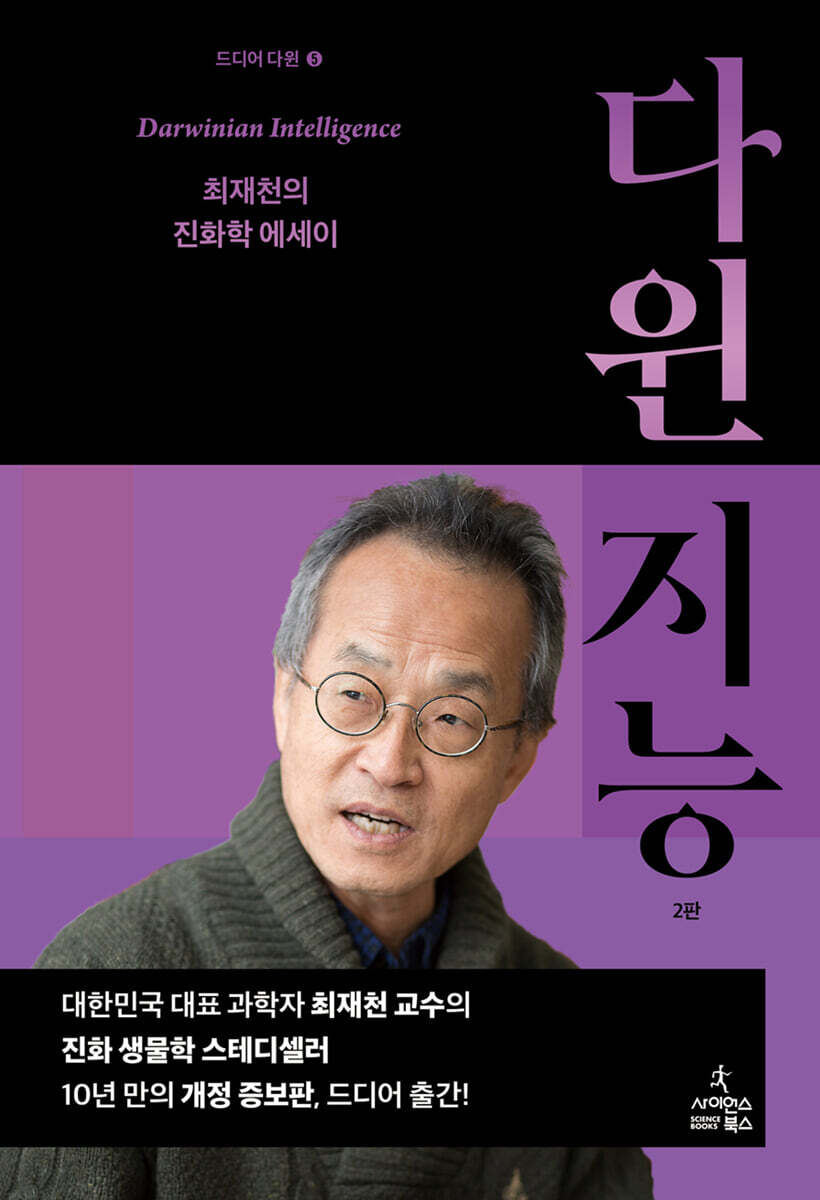
Darwinian intelligence
 |
Description
Book Introduction
Without evolution Nothing in our lives has meaning! Choi Jae-cheon, Professor Emeritus, Ewha Womans University In this book, I will celebrate the diversity of the knowledge ecosystem fostered by evolutionary theory and unravel its dazzling beauty, piece by piece. I hope to meet Darwin the scientist, Darwin the thinker, and Darwin the human being. -In the text A steady seller in evolutionary biology by Professor Choi Jae-cheon, a leading scientist in South Korea. The revised and expanded edition, released after 10 years, is finally here! Every year, November 24th is 'Evolution Day'. This day commemorates the publication of 『On the Origin of Species』 on the same day in 1859. It originated from the fact that in 1909, on the 100th anniversary of Darwin's birth and the 50th anniversary of the publication of 『On the Origin of Species』, about 500 scientists and intellectuals gathered in Cambridge, England to reflect on Darwin's achievements and the meaning of the theory of evolution. On November 24, 1959, the 100th anniversary of the publication of 『On the Origin of Species』, American anthropologist Sol Tax led the event at the University of Chicago, where 2,500 scholars (based on registration) from various fields from around the world gathered for five days. The event included an academic conference, a book exhibition, and an exhibition of Darwin-related materials, covering everything from the origin of life to the physical, mental, and socio-cultural evolution of humans. Even in 1960, a documentary covering this event was aired, showing off the power of evolutionary biology, which was developing rapidly at the time and integrating genetics and other biological achievements. And in 2009, the 200th anniversary of the publication of 『On the Origin of Species』, not only the academic world in the United States and Europe, but also the entire world, and even in the Far East, Korea, various academic events, special media and broadcasting programs, and publications were held intensively to commemorate Darwin's achievements, which can be said to be a singular point in the history of human intelligence. Professor Jae-Cheon Choi of Ewha Womans University's "Darwin's Intelligence," published by Science Books in 2012 and contributing greatly to the popularization of Darwinian evolutionary biology in Korean society, was based on a Naver serial project planned to commemorate Darwin's Year and Darwin Day in 2009. However, this book was not originally planned as a single volume, but as one volume of "Finally Darwin," a Darwin anthology project of the "Darwin Forum" created by Professor Choi Jae-cheon, a gathering of Darwinists in our society. It was originally scheduled to be published together with the Korean version of the first edition of "Origin of Species" and "Darwin's Apostles," which included interviews with scientists and intellectuals who represented Darwinists around the world at the time. However, this book was first published as a single volume along with 『Darwin Revolution in the 21st Century』, in which 19 leading Korean intellectuals analyzed Darwin's influence on the intellectual world, and was loved by readers who were thirsty for a proper explanation of Darwinism. |
- You can preview some of the book's contents.
Preview
index
Publisher's Note ┃ On the Publication of the "Finally Darwin" Series… … … 5
Preface ┃ South Korea Finally Meets Darwin… … … 13
01 Evolution, its simplicity… … … 23
02 The 'Principle' of Natural Selection... 31
03 The Vulnerability of Mutant Blind Faith… … … 41
04 Mutation, the driving force of change… … … 51
05 The Gamble of Evolution, Genetic Drift… … … 61
06 Is evolution progress? … … … 71
07 Adaptation and Natural Selection … … … 83
08 There is no such thing as perfect evolution… … … 91
09 The Blind Watchmaker … … … 101
10 Evolutionary Scenes … … … 111
11 Evolutionary Laboratory, Hospital… … … 121
12 Pandemics and Coevolution… … … 133
13 Evolution of the Stars … … … 145
14 The Dream of the Male and Female Statues… … … 157
15 Is bragging a male trait? … … … 169
16 The Contradiction of Monogamy … … … 181
17 Rec and Competition Markets … … … 193
18 The Origin of Sex: Was Male and Female Really Necessary? … … … 205
19 Does a surname have to be a male and a female? … … … 217
Life Through the Eyes of 20 Genes… … … 229
21 Lamarck's Resurrection? … … … 241
22 Units, Levels, Objects, and Results of Selection … … … 253
23 The Biology of the Contract … … … 265
24 Homo Symbius: From Competition to Cooperation… … … 277
25 The Evolution of the Mind: Evolutionary Psychology … … … 289
26 The Evolution of Religion: Gould, Wilson, Dawkins, and Dennett … … … 301
27 The Evolution of Music: How Did Music Captivate Humans? … … … 313
28 Cultural Evolution and the Palm of Genes… … … 325
29 The Emergence of Free Will and the Evolution of the Human Brain… … … 337
Conclusion ┃ Misunderstandings and New Understandings of Darwin… … … 349
Further Reading… … … 370
Search … … … 375
Preface ┃ South Korea Finally Meets Darwin… … … 13
01 Evolution, its simplicity… … … 23
02 The 'Principle' of Natural Selection... 31
03 The Vulnerability of Mutant Blind Faith… … … 41
04 Mutation, the driving force of change… … … 51
05 The Gamble of Evolution, Genetic Drift… … … 61
06 Is evolution progress? … … … 71
07 Adaptation and Natural Selection … … … 83
08 There is no such thing as perfect evolution… … … 91
09 The Blind Watchmaker … … … 101
10 Evolutionary Scenes … … … 111
11 Evolutionary Laboratory, Hospital… … … 121
12 Pandemics and Coevolution… … … 133
13 Evolution of the Stars … … … 145
14 The Dream of the Male and Female Statues… … … 157
15 Is bragging a male trait? … … … 169
16 The Contradiction of Monogamy … … … 181
17 Rec and Competition Markets … … … 193
18 The Origin of Sex: Was Male and Female Really Necessary? … … … 205
19 Does a surname have to be a male and a female? … … … 217
Life Through the Eyes of 20 Genes… … … 229
21 Lamarck's Resurrection? … … … 241
22 Units, Levels, Objects, and Results of Selection … … … 253
23 The Biology of the Contract … … … 265
24 Homo Symbius: From Competition to Cooperation… … … 277
25 The Evolution of the Mind: Evolutionary Psychology … … … 289
26 The Evolution of Religion: Gould, Wilson, Dawkins, and Dennett … … … 301
27 The Evolution of Music: How Did Music Captivate Humans? … … … 313
28 Cultural Evolution and the Palm of Genes… … … 325
29 The Emergence of Free Will and the Evolution of the Human Brain… … … 337
Conclusion ┃ Misunderstandings and New Understandings of Darwin… … … 349
Further Reading… … … 370
Search … … … 375
Detailed image
.jpg)
Publisher's Review
An expanded edition of the Korean standard Darwin Anthology!
The first commentary in the "Darwin at Last" series
In July 2019, the Korean edition of "The Origin of Species," based on the first edition, which allowed readers to see the true nature of Darwin's ideas, translated by Jang Dae-ik, a distinguished professor at Gachon University's College of Entrepreneurship, was published as Volume 1 of "Finally Darwin." In November 2020, "The Expression of Emotions in Humans and Animals," which can be considered the starting point of modern evolutionary psychology and emotional research, was published as Volume 4 of "Finally Darwin."
This second edition of 『Darwin's Intelligence』, published this time, is the fifth volume in the "Finally Darwin" series. It is a revised and expanded edition that updates the knowledge and information of the existing manuscript of the first edition and adds articles on topics not covered in the first edition, such as pandemics and coevolution, the evolution of the mind, the evolution of music, and Homo symbious.
In the first edition of 『Darwinian Intelligence』, Professor Choi Jae-cheon summarized Darwinism with the keywords of ‘simplicity’, ‘Darwinian intelligence’, and ‘essential liberal arts for the 21st century’.
The keyword 'simplicity' means that Darwin's theory of evolution is a theory that fundamentally and cleanly explains how simple single-celled organisms, such as 'inheritance with change' and 'evolution through natural selection', evolve into complex neural networks that reflect on the birth of the universe and the evolution of life. The keyword 'Darwinian intelligence' means that if you are armed with this Darwinian methodology, you can comprehensively reconstruct the human knowledge system, starting from biology, and going through ecology, psychology, sociology, philosophy, aesthetics, and even physics. The keyword 'essential liberal arts for the 21st century' means that now everyone, not just experts but the general public, needs to look at the world with the perspective of Darwinian evolution.
It is true that it is difficult to find a book that summarizes Darwin's evolutionary ideas so clearly and concisely in the global scientific publishing world.
In the four newly added chapters, you can experience the essence of the Darwinian reflections deepened by Professor Choi Jae-cheon's ten years since the publication of the first edition, including as the first director of the National Institute of Ecology and as the civilian chairman of the COVID-19 Daily Life Recovery Support Committee.
Life is still evolving without rest!
The only science book for evolving evolution!
The best theory that explains the meaning and phenomenon of life, the theory of evolution.
Darwin's theory of evolution, strengthened through 150 years of harsh trials and tribulations, is a model of collective intelligence that will usher in the 21st century.
From Thomas Huxley to J.
BS
Darwin's wisdom, inherited and developed by numerous intellectuals such as Haldane, William Hamilton, Edward Wilson, and Richard Dawkins, has led to a richer and more diverse knowledge ecosystem for humanity than anything else.
Now that we have entered an age of integration and empathy, we need Darwinian intelligence.
- In the text
Towards the end of the last millennium, a survey of scholars and artists in the United States was conducted to select and announce the 1,000 people who had had the greatest influence on humanity over the past 1,000 years.
Gutenberg, who invented metal type for the first time in the West and made mass production of books possible, was evaluated as the person who played the most important role in the past 1,000 years, followed by Columbus, who discovered the New World, and religious reformer Martin Luther in third place.
The 4th, 5th, and 6th places were occupied by Galileo, the father of modern science, Shakespeare, the great literary genius, and Newton, who discovered the law of universal gravitation, respectively, followed by Darwin in 7th place.
Considering that most of the people in the top ten were active during the mid-19th century, in the 15th and 16th centuries, the fact that Darwin, a figure who emerged late in the 19th century, made the list means that he and the theory of evolution he presented to the world had a tremendous impact in a short period of time.
Moreover, Darwin ranked highly among scientists, surpassing Einstein and Kepler.
Darwin's On the Origin of Species (1859) and the theory of evolution, which shocked Victorian British society at the time with their provocative claim that the creation of the universe and the birth of life were not due to the grace and will of the Creator, but rather the result of natural laws that appeared spontaneously and by chance, quickly spread throughout human civilization and other academic worlds after undergoing harsh trials and tempering over the following 150 years.
Through constant discussion, inheritance, and development by numerous contemporary intellectuals, Darwin's theory of evolution has now established itself not as a biological theory that merely explains life phenomena, the antithesis of creationism, but as the only theory that clearly explains all things in the world, including both the living and non-living environments.
『Darwinian Intelligence』, published by Science Books, is the best textbook on evolutionary biology in name and reality, written by Professor Jae-Cheon Choi, a world-renowned scientist and intellectual of convergence born in Korea, and contains the process of the development of the theory of evolution over the past 150 years, the debate among brains surrounding the theory of evolution, and the core of the modern theory of evolution. It is also an essential liberal arts book of our time that comprehensively covers the prospects of the knowledge ecosystem of the 21st century, which has become richer and more diverse as the theory of evolution has influenced various fields such as philosophy, economics, law, literature, politics, and art beyond the realm of biology.
Professor Choi Jae-cheon says that properly understanding and evaluating the theory of evolution, which is the most comprehensive principle explaining not only the world of life on Earth but also all social phenomena that life has created and expanded, will help us find practical solutions to the many problems we face today, and that it will be able to function as a “collective intelligence” like our predecessors did, expanding and enriching the intellectual world of humanity.
Now, in an era of convergence where the walls between individual academic worlds are lowered and freedom of movement is allowed to flow, and in an era of empathy where cooperation and harmony, rather than competition and conflict, are desperately needed, what we need is not just "collective intelligence," but "Darwinian intelligence," where everyone contributes with Darwin's wisdom.
With "Darwinian Intelligence," we hope to explore the current state of the theory of evolution, which is not only the most basic liberal arts knowledge that will open the 21st century, but also the specialized knowledge that any scholar in a cutting-edge academic field should possess, and meet Darwin, a scientist and thinker who brought about profound changes in the structure of human consciousness and the intellectual world.
Evolutionary theory, its simplicity The attributes that a good theory should have are often cited as simplicity, robustness, and intuitive beauty.
If the theory itself is too complex, not only will its usability be limited, but it will also be difficult to convey meaning and apply.
The origins of countless life forms that have existed and exist on Earth were very simple.
It is certainly remarkable that such a vast diversity of life has evolved from such simple beginnings, but even more remarkable is the sheer simplicity of Darwin's theory of evolution, which explains the process of change.
The greatest appeal of Darwin's theory of evolution comes from its simplicity.
Moreover, “you cannot understand this mysterious world without understanding evolution.
As Harvard University evolutionary biologist Ernst Mayr said, “Evolution is the most comprehensive principle that explains the world,” and “Darwin’s theory of evolution is the ‘only’ theory that can solve the mystery of our existence.
It is even more surprising that there are few phenomena that cannot be explained by such a concise theory, as Richard Dawkins said, “This is true not only on this planet we live on, but anywhere in the universe where life is found.”
『Darwinian Intelligence』 carefully examines how Darwin's theory of evolution, represented by the theory of natural selection, can function as a fundamental law, or principle, that explains all processes by which the form and behavior of living things change over generations, from the structure of DNA to human social life and civilization. It also clearly organizes the arguments that have been made surrounding Darwin and the theory of evolution, such as the blind faith in mutations that think that mutations are the main driver of evolution, the flaws in the adaptationist research program that believes that all life phenomena are the result of evolutionary adaptation, and the problem of the direction of evolution.
Also, the theory of sexual selection, which was overshadowed by the theory of natural selection for a long time, is now established as the most important theory to explain not only the phenomena of life in nature but also the complex relationships between men and women in human society and the various social phenomena that have arisen as a result. It explains the theory in an easy-to-understand way with various real-life examples and the latest research results.
Darwinian intelligence
Darwin's theory of evolution was popularized in the 1930s and 1940s by Ronald Fisher, J.
BS
With the help of population genetics, which was founded by Haldane and others, a new synthesis, a modern synthesis, was achieved, and it was able to escape the past stigma of being overly descriptive and not being treated as a mature natural science, and rise to the level of a strategic science.
And in the 1960s and 1970s, through debates on the 'level of selection', such as whether the level or unit at which natural selection occurs is a group, an individual, or a gene, it began to become more theoretically sophisticated, with William Hamilton, George Williams, and Richard Dawkins, and by the late 20th century, based on a new understanding of human nature, it could be called a Darwinian revolution, shedding new light on all knowledge systems achieved by humans, including not only the humanities and social sciences, but also law, politics, literature, morality, and art.
Recently, in the wake of the global economic crisis, economists themselves have reflected on the lack of insight into the behavior and nature of human beings, the main economic agents, and are actively developing new academic fields such as behavioral economics, neuroeconomics, and evolutionary economics, which actively embrace evolutionary theory.
True economist Robert H.
As Frank predicted, “before the end of the next century, economists may be naming Darwin the founder of economics.”
Professor Choi Jae-cheon says that the flame of the Darwinian revolution was so strong that in the West, which had long ago recognized the infinite potential of Darwin's theory of evolution, numerous intellectuals inherited and developed Darwin's theory through discussion and debate, and it took the form of 'Darwinian intelligence.'
In "Darwinian Intelligence," we examine in detail modern evolutionary theory, which offers new solutions for 21st-century human civilization, including economics, the resurgence of religious debate following the 9/11 terrorist attacks, and the biological basis and operating mechanisms of free will, altruism, cooperation, and ethics, which are essential in this era of empathy.
And by showcasing the dazzling achievements of countless intellectuals who have contributed to Darwin's theory of evolution, which is not just a biological theory, but a comprehensive theory that will lead to a rich and diverse intellectual ecosystem, it also presents a role model for adapting to the changing world of knowledge.
21st Century Liberal Arts Darwin
With 2009 being the year of Darwin, the 200th anniversary of Darwin's birth and the 150th anniversary of the publication of 'On the Origin of Species', the work of reexamining the influence of Darwin and the theory of evolution on the intellectual world of humanity gained even more momentum.
Although there have been translations and publications by Korean scholars of the 150-year history of evolution theory, detailed discussions within modern evolution theory, and biographies describing the life of scientist Darwin, this is the first time that a book has been published by a Korean scholar that comprehensively covers the past, present, and future of Darwin and evolution theory.
Professor Choi Jae-cheon, who brought the wind of 'integration' to the domestic knowledge society in 2005 to lower the barriers between academic disciplines and achieve a great integration of knowledge, has now returned with a new concept of knowledge called 'Darwinian intelligence' as essential liberal arts to prepare for the era of integration and empathy.
『Darwin's Intelligence』 is a science and humanities book written by Professor Jae-Cheon Choi, a world-renowned evolutionary biologist, that examines the core and current state of the theory of evolution, which is active in all directions beyond its boundaries to the point that it can be called the flower of the 21st century intellectual world, and imparts Darwin's wisdom that is essential for participating in the changing knowledge ecosystem of the future.
Intellectuals from all walks of life are praising the value of Darwin's theory of evolution and the revolution in the intellectual ecosystem it brought about, saying things like, "The most brilliant idea ever," "The single scientific idea that ties everything we know together," and "The most comprehensive principle for understanding this mysterious world."
Through this book, I hope that readers will also listen to Darwin's wisdom, the liberal arts of the coming century, and by sharing their thoughts and opinions, contribute to "Darwinian intelligence" and participate in a transformed knowledge society.
The first commentary in the "Darwin at Last" series
In July 2019, the Korean edition of "The Origin of Species," based on the first edition, which allowed readers to see the true nature of Darwin's ideas, translated by Jang Dae-ik, a distinguished professor at Gachon University's College of Entrepreneurship, was published as Volume 1 of "Finally Darwin." In November 2020, "The Expression of Emotions in Humans and Animals," which can be considered the starting point of modern evolutionary psychology and emotional research, was published as Volume 4 of "Finally Darwin."
This second edition of 『Darwin's Intelligence』, published this time, is the fifth volume in the "Finally Darwin" series. It is a revised and expanded edition that updates the knowledge and information of the existing manuscript of the first edition and adds articles on topics not covered in the first edition, such as pandemics and coevolution, the evolution of the mind, the evolution of music, and Homo symbious.
In the first edition of 『Darwinian Intelligence』, Professor Choi Jae-cheon summarized Darwinism with the keywords of ‘simplicity’, ‘Darwinian intelligence’, and ‘essential liberal arts for the 21st century’.
The keyword 'simplicity' means that Darwin's theory of evolution is a theory that fundamentally and cleanly explains how simple single-celled organisms, such as 'inheritance with change' and 'evolution through natural selection', evolve into complex neural networks that reflect on the birth of the universe and the evolution of life. The keyword 'Darwinian intelligence' means that if you are armed with this Darwinian methodology, you can comprehensively reconstruct the human knowledge system, starting from biology, and going through ecology, psychology, sociology, philosophy, aesthetics, and even physics. The keyword 'essential liberal arts for the 21st century' means that now everyone, not just experts but the general public, needs to look at the world with the perspective of Darwinian evolution.
It is true that it is difficult to find a book that summarizes Darwin's evolutionary ideas so clearly and concisely in the global scientific publishing world.
In the four newly added chapters, you can experience the essence of the Darwinian reflections deepened by Professor Choi Jae-cheon's ten years since the publication of the first edition, including as the first director of the National Institute of Ecology and as the civilian chairman of the COVID-19 Daily Life Recovery Support Committee.
Life is still evolving without rest!
The only science book for evolving evolution!
The best theory that explains the meaning and phenomenon of life, the theory of evolution.
Darwin's theory of evolution, strengthened through 150 years of harsh trials and tribulations, is a model of collective intelligence that will usher in the 21st century.
From Thomas Huxley to J.
BS
Darwin's wisdom, inherited and developed by numerous intellectuals such as Haldane, William Hamilton, Edward Wilson, and Richard Dawkins, has led to a richer and more diverse knowledge ecosystem for humanity than anything else.
Now that we have entered an age of integration and empathy, we need Darwinian intelligence.
- In the text
Towards the end of the last millennium, a survey of scholars and artists in the United States was conducted to select and announce the 1,000 people who had had the greatest influence on humanity over the past 1,000 years.
Gutenberg, who invented metal type for the first time in the West and made mass production of books possible, was evaluated as the person who played the most important role in the past 1,000 years, followed by Columbus, who discovered the New World, and religious reformer Martin Luther in third place.
The 4th, 5th, and 6th places were occupied by Galileo, the father of modern science, Shakespeare, the great literary genius, and Newton, who discovered the law of universal gravitation, respectively, followed by Darwin in 7th place.
Considering that most of the people in the top ten were active during the mid-19th century, in the 15th and 16th centuries, the fact that Darwin, a figure who emerged late in the 19th century, made the list means that he and the theory of evolution he presented to the world had a tremendous impact in a short period of time.
Moreover, Darwin ranked highly among scientists, surpassing Einstein and Kepler.
Darwin's On the Origin of Species (1859) and the theory of evolution, which shocked Victorian British society at the time with their provocative claim that the creation of the universe and the birth of life were not due to the grace and will of the Creator, but rather the result of natural laws that appeared spontaneously and by chance, quickly spread throughout human civilization and other academic worlds after undergoing harsh trials and tempering over the following 150 years.
Through constant discussion, inheritance, and development by numerous contemporary intellectuals, Darwin's theory of evolution has now established itself not as a biological theory that merely explains life phenomena, the antithesis of creationism, but as the only theory that clearly explains all things in the world, including both the living and non-living environments.
『Darwinian Intelligence』, published by Science Books, is the best textbook on evolutionary biology in name and reality, written by Professor Jae-Cheon Choi, a world-renowned scientist and intellectual of convergence born in Korea, and contains the process of the development of the theory of evolution over the past 150 years, the debate among brains surrounding the theory of evolution, and the core of the modern theory of evolution. It is also an essential liberal arts book of our time that comprehensively covers the prospects of the knowledge ecosystem of the 21st century, which has become richer and more diverse as the theory of evolution has influenced various fields such as philosophy, economics, law, literature, politics, and art beyond the realm of biology.
Professor Choi Jae-cheon says that properly understanding and evaluating the theory of evolution, which is the most comprehensive principle explaining not only the world of life on Earth but also all social phenomena that life has created and expanded, will help us find practical solutions to the many problems we face today, and that it will be able to function as a “collective intelligence” like our predecessors did, expanding and enriching the intellectual world of humanity.
Now, in an era of convergence where the walls between individual academic worlds are lowered and freedom of movement is allowed to flow, and in an era of empathy where cooperation and harmony, rather than competition and conflict, are desperately needed, what we need is not just "collective intelligence," but "Darwinian intelligence," where everyone contributes with Darwin's wisdom.
With "Darwinian Intelligence," we hope to explore the current state of the theory of evolution, which is not only the most basic liberal arts knowledge that will open the 21st century, but also the specialized knowledge that any scholar in a cutting-edge academic field should possess, and meet Darwin, a scientist and thinker who brought about profound changes in the structure of human consciousness and the intellectual world.
Evolutionary theory, its simplicity The attributes that a good theory should have are often cited as simplicity, robustness, and intuitive beauty.
If the theory itself is too complex, not only will its usability be limited, but it will also be difficult to convey meaning and apply.
The origins of countless life forms that have existed and exist on Earth were very simple.
It is certainly remarkable that such a vast diversity of life has evolved from such simple beginnings, but even more remarkable is the sheer simplicity of Darwin's theory of evolution, which explains the process of change.
The greatest appeal of Darwin's theory of evolution comes from its simplicity.
Moreover, “you cannot understand this mysterious world without understanding evolution.
As Harvard University evolutionary biologist Ernst Mayr said, “Evolution is the most comprehensive principle that explains the world,” and “Darwin’s theory of evolution is the ‘only’ theory that can solve the mystery of our existence.
It is even more surprising that there are few phenomena that cannot be explained by such a concise theory, as Richard Dawkins said, “This is true not only on this planet we live on, but anywhere in the universe where life is found.”
『Darwinian Intelligence』 carefully examines how Darwin's theory of evolution, represented by the theory of natural selection, can function as a fundamental law, or principle, that explains all processes by which the form and behavior of living things change over generations, from the structure of DNA to human social life and civilization. It also clearly organizes the arguments that have been made surrounding Darwin and the theory of evolution, such as the blind faith in mutations that think that mutations are the main driver of evolution, the flaws in the adaptationist research program that believes that all life phenomena are the result of evolutionary adaptation, and the problem of the direction of evolution.
Also, the theory of sexual selection, which was overshadowed by the theory of natural selection for a long time, is now established as the most important theory to explain not only the phenomena of life in nature but also the complex relationships between men and women in human society and the various social phenomena that have arisen as a result. It explains the theory in an easy-to-understand way with various real-life examples and the latest research results.
Darwinian intelligence
Darwin's theory of evolution was popularized in the 1930s and 1940s by Ronald Fisher, J.
BS
With the help of population genetics, which was founded by Haldane and others, a new synthesis, a modern synthesis, was achieved, and it was able to escape the past stigma of being overly descriptive and not being treated as a mature natural science, and rise to the level of a strategic science.
And in the 1960s and 1970s, through debates on the 'level of selection', such as whether the level or unit at which natural selection occurs is a group, an individual, or a gene, it began to become more theoretically sophisticated, with William Hamilton, George Williams, and Richard Dawkins, and by the late 20th century, based on a new understanding of human nature, it could be called a Darwinian revolution, shedding new light on all knowledge systems achieved by humans, including not only the humanities and social sciences, but also law, politics, literature, morality, and art.
Recently, in the wake of the global economic crisis, economists themselves have reflected on the lack of insight into the behavior and nature of human beings, the main economic agents, and are actively developing new academic fields such as behavioral economics, neuroeconomics, and evolutionary economics, which actively embrace evolutionary theory.
True economist Robert H.
As Frank predicted, “before the end of the next century, economists may be naming Darwin the founder of economics.”
Professor Choi Jae-cheon says that the flame of the Darwinian revolution was so strong that in the West, which had long ago recognized the infinite potential of Darwin's theory of evolution, numerous intellectuals inherited and developed Darwin's theory through discussion and debate, and it took the form of 'Darwinian intelligence.'
In "Darwinian Intelligence," we examine in detail modern evolutionary theory, which offers new solutions for 21st-century human civilization, including economics, the resurgence of religious debate following the 9/11 terrorist attacks, and the biological basis and operating mechanisms of free will, altruism, cooperation, and ethics, which are essential in this era of empathy.
And by showcasing the dazzling achievements of countless intellectuals who have contributed to Darwin's theory of evolution, which is not just a biological theory, but a comprehensive theory that will lead to a rich and diverse intellectual ecosystem, it also presents a role model for adapting to the changing world of knowledge.
21st Century Liberal Arts Darwin
With 2009 being the year of Darwin, the 200th anniversary of Darwin's birth and the 150th anniversary of the publication of 'On the Origin of Species', the work of reexamining the influence of Darwin and the theory of evolution on the intellectual world of humanity gained even more momentum.
Although there have been translations and publications by Korean scholars of the 150-year history of evolution theory, detailed discussions within modern evolution theory, and biographies describing the life of scientist Darwin, this is the first time that a book has been published by a Korean scholar that comprehensively covers the past, present, and future of Darwin and evolution theory.
Professor Choi Jae-cheon, who brought the wind of 'integration' to the domestic knowledge society in 2005 to lower the barriers between academic disciplines and achieve a great integration of knowledge, has now returned with a new concept of knowledge called 'Darwinian intelligence' as essential liberal arts to prepare for the era of integration and empathy.
『Darwin's Intelligence』 is a science and humanities book written by Professor Jae-Cheon Choi, a world-renowned evolutionary biologist, that examines the core and current state of the theory of evolution, which is active in all directions beyond its boundaries to the point that it can be called the flower of the 21st century intellectual world, and imparts Darwin's wisdom that is essential for participating in the changing knowledge ecosystem of the future.
Intellectuals from all walks of life are praising the value of Darwin's theory of evolution and the revolution in the intellectual ecosystem it brought about, saying things like, "The most brilliant idea ever," "The single scientific idea that ties everything we know together," and "The most comprehensive principle for understanding this mysterious world."
Through this book, I hope that readers will also listen to Darwin's wisdom, the liberal arts of the coming century, and by sharing their thoughts and opinions, contribute to "Darwinian intelligence" and participate in a transformed knowledge society.
GOODS SPECIFICS
- Publication date: November 24, 2022
- Format: Hardcover book binding method guide
- Page count, weight, size: 384 pages | 584g | 128*188*30mm
- ISBN13: 9791192107318
- ISBN10: 1192107314
You may also like
카테고리
korean


korean

![ELLE 엘르 스페셜 에디션 A형 : 12월 [2025]](http://librairie.coreenne.fr/cdn/shop/files/b8e27a3de6c9538896439686c6b0e8fb.jpg?v=1766436872&width=3840)


