

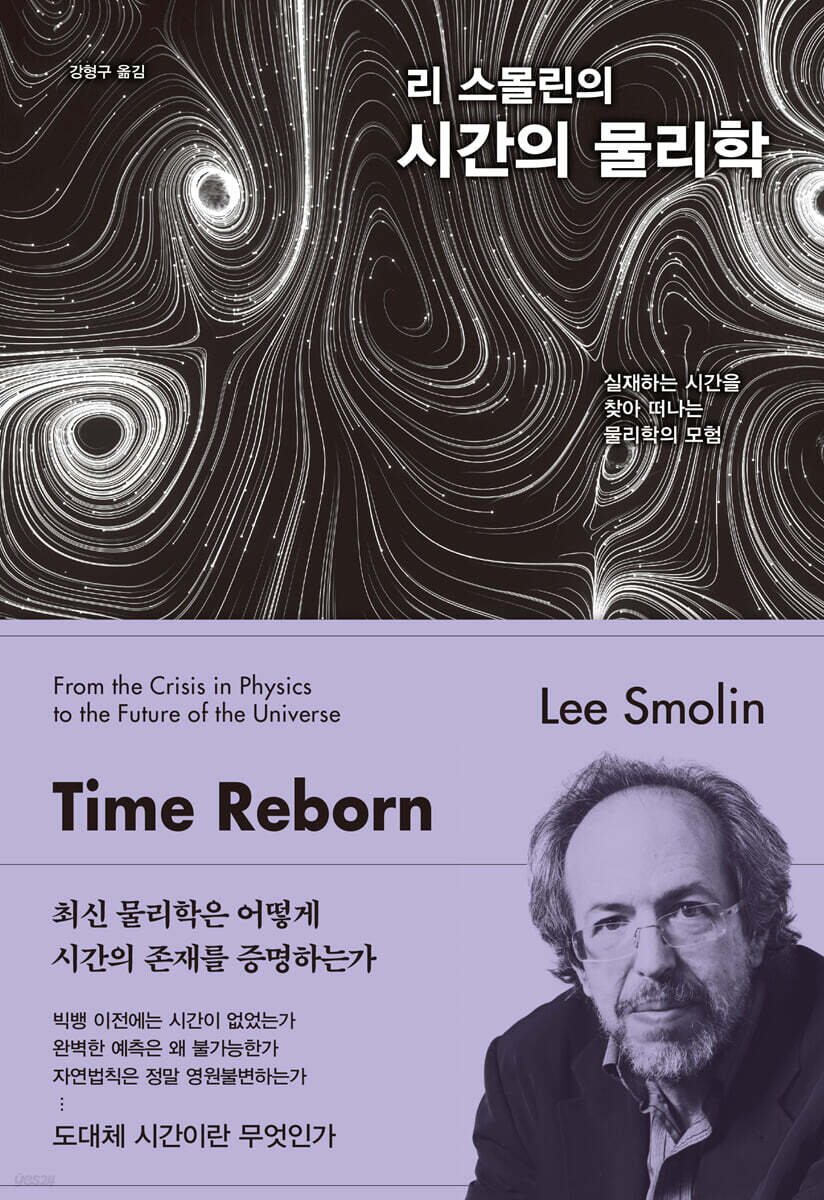
Lee Smolin's The Physics of Time
 |
Description
Book Introduction
How Modern Physics Proves the Existence of Time Was there no time before the Big Bang? Why is perfect prediction impossible? Are the laws of nature truly eternal and unchanging? What on earth is time? Lee Smolin, a leading authority on quantum gravity research, founding member and senior professor at the Perimeter Institute for Theoretical Physics, and recognized as a rival by Carlo Rovelli, has published his book, "Lee Smolin's Physics of Time." The original book, published under the title "Time Reborn," has been considered a must-read for understanding the research on time in modern physics since its publication in 2013, and is considered to be the book that covers the discussion on the physics of time in the most comprehensive and three-dimensional way. In this book, Lee Smolin argues that the "atemporal" view, which assumes that the laws of physics apply regardless of time and space, has led theoretical physics and cosmology to a dead end today. Drawing on the latest research in physics, he explains why, in order to understand the present universe and existence, we must acknowledge that time flows in only one direction and affects existence. How do we exist in time differently than in space, and how does the constraint of time create the complexity and diversity of the universe and the world? This book is an invitation to a world constrained by time, and thus more scientifically understandable. |
- You can preview some of the book's contents.
Preview
index
Opening Remarks/ What is Time?
introduction
Part 1 Weight: Exiled Time
Chapter 1 is falling
Chapter 2: Lost Time
Chapter 3: Catch Ball Game
Chapter 4: Physics in a Box
Chapter 5: The Banishment of Novelty and Surprise
Chapter 6 Relativity and Timelessness
Chapter 7: Quantum Cosmology and the End of Time
Part 2 Light: The Time of Rebirth
Einstein's Complaints
Chapter 8 Cosmological Errors
Chapter 9: Cosmological Challenges
Chapter 10: Principles for a New Cosmology
Chapter 11: The Evolution of Laws
Chapter 12: Quantum Mechanics and the Liberation of the Atom
Chapter 13: The Battle of Relativity and Quantum
Chapter 14: Time Reborn from Relativity
Chapter 15: The Emergence of Space
Chapter 16: Life and Death in the Universe
Chapter 17: Time Reborn from Heat and Light
Chapter 18 Infinite Space or Infinite Time?
Chapter 19: The Future of Time
Conclusion/ Thinking in Time
Acknowledgements
Translator's Note
main
References
Search
introduction
Part 1 Weight: Exiled Time
Chapter 1 is falling
Chapter 2: Lost Time
Chapter 3: Catch Ball Game
Chapter 4: Physics in a Box
Chapter 5: The Banishment of Novelty and Surprise
Chapter 6 Relativity and Timelessness
Chapter 7: Quantum Cosmology and the End of Time
Part 2 Light: The Time of Rebirth
Einstein's Complaints
Chapter 8 Cosmological Errors
Chapter 9: Cosmological Challenges
Chapter 10: Principles for a New Cosmology
Chapter 11: The Evolution of Laws
Chapter 12: Quantum Mechanics and the Liberation of the Atom
Chapter 13: The Battle of Relativity and Quantum
Chapter 14: Time Reborn from Relativity
Chapter 15: The Emergence of Space
Chapter 16: Life and Death in the Universe
Chapter 17: Time Reborn from Heat and Light
Chapter 18 Infinite Space or Infinite Time?
Chapter 19: The Future of Time
Conclusion/ Thinking in Time
Acknowledgements
Translator's Note
main
References
Search
Detailed image

Into the book
The reasons for my taking such a radically different viewpoint can be found in recent developments in science, specifically in physics and cosmology.
I have come to believe that time plays a central role in the meaning of quantum theory and in its ultimate integration with space, time, gravity, and cosmology.
Most importantly, I have come to believe that understanding what cosmological observations reveal about the universe requires a new way of embracing the reality of time.
---「Opening remarks.
From "What is Time?"
Thinking in time is not relativism, but a kind of relationism.
Relationism is a philosophy that argues that the truest description of something is one that specifies its relationships to other parts of the system to which it belongs.
Truth can be objective while remaining bound by time when it concerns things.
Things of this time were invented by evolution or human thought.
On a personal level, thinking in time is accepting the uncertainty of life as a necessary price to pay for living.
To think that life can be organized so that it resists the vicissitudes of life, denies uncertainty, takes no risks, or eliminates risk altogether is to think outside the box.
Humans live suspended between risk and luck.
---「Opening remarks.
From "What is Time?"
It is a far more challenging task to accept a science that explains the universe we perceive and experience solely in its own terms, that is, to explain the real as real and the things held in time as held in time.
But even if this task is more challenging, this limited and less romantic path will ultimately be more successful.
---「Chapter 1.
From "Falling"
Note that to apply mathematics to the physical world, we must first isolate this system and then mentally separate it from the complexities of the motions of the actual universe.
…this kind of approximation, which restricts our attention to a few variables, objects, or particles, is characteristic of physics in a box.
The key step here is to select the subsystem you want to study from the entire universe.
The important thing is that this is always an approximation to a richer reality.
---「Chapter 4.
From "Physics in a Box"
If you were to show a movie of the Earth's motion to an alien, the alien (if it had a concept of laws) would say that Newton's laws govern motion.
But even if you showed an alien a movie that was turned upside down, they would say that the Earth's orbit in it is allowed by Newton's laws.
In fact, if you showed both movies to an alien and asked it to tell which one was the original and which one was reversed, it would not be able to tell.
---「Chapter 5.
From “The Expulsion of Novelty and Surprise”
This resolves old paradoxes that arise when applying quantum mechanics to large objects, such as cats or observers.
The strange properties of quantum systems are limited to atomic systems.
Because there are so many copies of these systems in the universe.
Quantum uncertainty arises because these systems continually replicate each other's properties.
---「Chapter 13.
From "The Battle of Relativity and Quantum"
Suppose we break down a cat into its constituent atoms and then randomly mix these atoms into the air in a room.
The microscopic states in which a cat's atoms randomly mix in the air are far more numerous than the microscopic states in which a cat recombines, sits on a sofa, licks its fur, and purrs.
Cats are an incredibly unlikely way for atoms to be arranged.
Therefore, it has low entropy and a lot of information compared to randomly mixing the same atoms in air.
---「Chapter 6.
From “Life and Death in the Universe”
From the perspective of accepting the reality of time, it is entirely natural that the universe and its fundamental laws are asymmetrical in time.
The strong arrow of time can encompass both the increasing entropy of isolated systems and the continued increase in structure and complexity.
---「Chapter 17.
From “Time Reborn from Heat and Light”
The most basic first step is to devise a framework of hypotheses about the evolution of laws.
These hypotheses encompass possible cosmic history before the Big Bang and lead to predictions that can be falsified by actionable observations.
These include predictions of cosmological natural selection and predictions of cyclical cosmology.
It is too early to say whether any of these concepts are true or not, but it is encouraging to know that current or near-future observations may disprove them.
---「Concluding remarks.
From “Thinking in Time”
We need to see everything in nature, including ourselves and our technologies, as part of a larger, ever-evolving system, caught in time.
A timeless world is a world with a fixed set of possibilities that cannot be transcended.
On the other hand, if time is real and everything is subject to time, there is no fixed set of possibilities, and there are no obstacles to inventing truly new concepts and solutions to problems.
Therefore, to move beyond the distinction between the natural and the artificial and to construct a system that is both, we must locate ourselves in time.
I have come to believe that time plays a central role in the meaning of quantum theory and in its ultimate integration with space, time, gravity, and cosmology.
Most importantly, I have come to believe that understanding what cosmological observations reveal about the universe requires a new way of embracing the reality of time.
---「Opening remarks.
From "What is Time?"
Thinking in time is not relativism, but a kind of relationism.
Relationism is a philosophy that argues that the truest description of something is one that specifies its relationships to other parts of the system to which it belongs.
Truth can be objective while remaining bound by time when it concerns things.
Things of this time were invented by evolution or human thought.
On a personal level, thinking in time is accepting the uncertainty of life as a necessary price to pay for living.
To think that life can be organized so that it resists the vicissitudes of life, denies uncertainty, takes no risks, or eliminates risk altogether is to think outside the box.
Humans live suspended between risk and luck.
---「Opening remarks.
From "What is Time?"
It is a far more challenging task to accept a science that explains the universe we perceive and experience solely in its own terms, that is, to explain the real as real and the things held in time as held in time.
But even if this task is more challenging, this limited and less romantic path will ultimately be more successful.
---「Chapter 1.
From "Falling"
Note that to apply mathematics to the physical world, we must first isolate this system and then mentally separate it from the complexities of the motions of the actual universe.
…this kind of approximation, which restricts our attention to a few variables, objects, or particles, is characteristic of physics in a box.
The key step here is to select the subsystem you want to study from the entire universe.
The important thing is that this is always an approximation to a richer reality.
---「Chapter 4.
From "Physics in a Box"
If you were to show a movie of the Earth's motion to an alien, the alien (if it had a concept of laws) would say that Newton's laws govern motion.
But even if you showed an alien a movie that was turned upside down, they would say that the Earth's orbit in it is allowed by Newton's laws.
In fact, if you showed both movies to an alien and asked it to tell which one was the original and which one was reversed, it would not be able to tell.
---「Chapter 5.
From “The Expulsion of Novelty and Surprise”
This resolves old paradoxes that arise when applying quantum mechanics to large objects, such as cats or observers.
The strange properties of quantum systems are limited to atomic systems.
Because there are so many copies of these systems in the universe.
Quantum uncertainty arises because these systems continually replicate each other's properties.
---「Chapter 13.
From "The Battle of Relativity and Quantum"
Suppose we break down a cat into its constituent atoms and then randomly mix these atoms into the air in a room.
The microscopic states in which a cat's atoms randomly mix in the air are far more numerous than the microscopic states in which a cat recombines, sits on a sofa, licks its fur, and purrs.
Cats are an incredibly unlikely way for atoms to be arranged.
Therefore, it has low entropy and a lot of information compared to randomly mixing the same atoms in air.
---「Chapter 6.
From “Life and Death in the Universe”
From the perspective of accepting the reality of time, it is entirely natural that the universe and its fundamental laws are asymmetrical in time.
The strong arrow of time can encompass both the increasing entropy of isolated systems and the continued increase in structure and complexity.
---「Chapter 17.
From “Time Reborn from Heat and Light”
The most basic first step is to devise a framework of hypotheses about the evolution of laws.
These hypotheses encompass possible cosmic history before the Big Bang and lead to predictions that can be falsified by actionable observations.
These include predictions of cosmological natural selection and predictions of cyclical cosmology.
It is too early to say whether any of these concepts are true or not, but it is encouraging to know that current or near-future observations may disprove them.
---「Concluding remarks.
From “Thinking in Time”
We need to see everything in nature, including ourselves and our technologies, as part of a larger, ever-evolving system, caught in time.
A timeless world is a world with a fixed set of possibilities that cannot be transcended.
On the other hand, if time is real and everything is subject to time, there is no fixed set of possibilities, and there are no obstacles to inventing truly new concepts and solutions to problems.
Therefore, to move beyond the distinction between the natural and the artificial and to construct a system that is both, we must locate ourselves in time.
---「Concluding remarks.
From “Thinking in Time”
From “Thinking in Time”
Publisher's Review
How does time, once banished from physics, return?
A book that explores the physics of time in the most three-dimensional way possible, based on the latest research.
★★★★★ “An excellent analysis of the nature of time.
“This is the best science textbook I’ve ever read.” — Popular Science
★★★★★ “It’s like a fusion of science, philosophy, and science fiction.” —New York Times Book Review
Time does not flow, and the past, present, and future are illusions that exist in the mind?
No, time flows in one direction and is real!
Lee Smolin's Physics of Time, written by Lee Smolin, an authority on quantum gravity research, founding member and senior professor at the Perimeter Institute for Theoretical Physics, and recognized 'rival' by Carlo Rovelli, has been published.
The original book, published under the title “Time Reborn,” has been considered a must-read for understanding the research on time in modern physics since its publication in 2013, and is considered to be the book that covers the discussion on the physics of time in the most comprehensive and three-dimensional way.
Carlo Rovelli, in If Time Did Not Exist, spends several pages discussing the book with Lee Smolin, and then adds at the end:
“Smolin and I have had passionate discussions since the beginning of our research collaboration, often with opposing views.
This is the charm of science.
“Even though we are completely opposed to each other, we can learn from each other through the discussions that arise from that opposition, and even though we have opposing opinions, we can remain close like real brothers.”
So, what are the differences between the positions of mainstream physicists, including Rovelli, and Smolin? This book addresses the following conflicting issues, carefully elucidating the basis for each argument and why modern physics lends more weight to the latter, Smolin's.
● Time is an illusion.
vs.
Time is the most real aspect of our perception of the world.
● Space and geometric structures are real.
vs.
Space is emergent and approximate.
● The future is determined by the laws of physics.
vs.
Perfect prediction of the future is impossible.
● The universe is spatially infinite.
vs.
The universe is spatially finite.
● Quantum mechanics is the final theory.
vs.
It is an approximation to a cosmological theory that is not yet known.
Everything evolves in time.
Quantum, cat, and the laws of physics!
What does it mean to introduce 'time' into the puzzles of modern physics and cosmology?
Physics, including quantum mechanics, is often considered a discipline that seeks to find laws that apply universally regardless of time.
Quantums appear to move beyond time and space as if by magic, and the objects of physical research are also assumed to exist in space, unaffected by time.
So the laws of physics that are true here and now are considered to be eternal truths, like the laws of mathematics, and some people even think that if we knew the exact positions and movements of every atom, we could perfectly predict the future.
That is, the future is considered a logical consequence of calculating the present.
From this perspective, time is merely a factor that delays the outcome, but does not function as a condition that influences the operation of physical laws, and physical laws are understood as non-temporal.
This leads to the idea that if we have enough information about every particle, perfect predictions are possible, and that the laws of physics can even be controlled in reverse based on the symmetry of cause and effect.
But Lee Smolin argues that this very perspective has led theoretical physics and cosmology to a dead end today, and that to understand the universe we must consider time as a crucial variable, flowing in only one direction and influencing existence.
This means that we must understand that all matter is under the constraints of past influences, that laws also have mechanisms that have made it what it is today, and that matter and laws have evolved while influencing each other.
Just as it is clear that the law of evolutionary natural selection would not have existed if life had not arisen, the laws of physics would also have been different if the universe had not arisen as it is now.
Let's take an example.
In quantum mechanics, a phenomenon is observed where the observation of a quantum on one side immediately affects the state of a quantum far away from it, but today's quantum mechanics simply describes this as being due to the 'entanglement' of two particles, but does not fully explain the principle of behavior.
The same goes for particles communicating across vast distances at faster-than-light speeds, or for descriptions of reality that change depending on what is measured or who is observing (the uncertainty principle).
For this reason, questions such as how can a cat be in a superposition of two states in a quantum, such as being both dead and alive at the same time, like in the 'Schrödinger's cat paradox', and why does a cat not behave like a quantum if that is how the basic atoms that make up matter behave?
The book asks about this:
"Why do you assume that quantum mechanics have always behaved this way? Couldn't it be otherwise? What if entities in the early universe were intimately connected? And what if the interactions they undertook then still resonate today?" Starting with these questions, Smolin explores cosmology and quantum theory, encompassing relativity, thermodynamics, and other scientific discoveries to date.
What is time, the most fundamental aspect of the world we experience?
The Physics of Time for Everyone Who Wants to Think About Time Scientifically and Philosophically
There are books that address the cutting edge of academic debate while also serving as excellent introductions to the subject.
This book is exactly like that.
The book contains no formulas, and the core questions are explained through the simplest possible examples.
Everything the reader needs to know to follow the argument is explained in the book, making it accessible even to those without a background in physics or mathematics.
In fact, the claim that time exists is a claim that is very consistent with our intuition.
Yes, that's right.
The very time we experience as we live! Smolin is saying that it is also very important to physics.
But this discussion is not limited to physics; it also touches on very philosophical and existential topics.
We, who have physically existed in time, will be able to look again at the physical reality of time, and the universe and our lives that have changed and will continue to change within it, based on our experience of sensing time.
Furthermore, while this book primarily explores a very specific reality, it also speaks volumes about the philosophical perspective of science, which takes a step back from science and looks at the ecology of scholarship. Therefore, it will be helpful to anyone who wants to think philosophically about not only existence and time, but also the discipline of science itself.
〈Part 1.
In "Weight: Exiled Time," we introduce a scientific paradigm that has had a major influence on considering time as an illusion.
Here we provide a general overview of the development of the concept of time throughout the history of science and how it has been weakened.
〈Part 2.
In "Light: Time Reborn," the book asks questions like "Why were these laws chosen?" and "Why were these initial conditions given?" to understand the principles of "cosmological natural selection" that evolves laws. It also delves into recent discoveries in physics that support the argument that time should be reintroduced to the core of science, the issues currently being debated in academia, and the various theories that seek to answer them.
Through this book, readers will be able to experience a new sense of what it means to think within and with time.
“What I have gained from my journey of exploration is the realization that a revolutionary concept is embedded in the simple statement that time exists.
“I began my life as a scientist in search of equations that are not bound by time, but now I believe that the deepest secrets of the universe lie in the way it unfolds its essence moment by moment in time.”_From the opening remarks
A book that explores the physics of time in the most three-dimensional way possible, based on the latest research.
★★★★★ “An excellent analysis of the nature of time.
“This is the best science textbook I’ve ever read.” — Popular Science
★★★★★ “It’s like a fusion of science, philosophy, and science fiction.” —New York Times Book Review
Time does not flow, and the past, present, and future are illusions that exist in the mind?
No, time flows in one direction and is real!
Lee Smolin's Physics of Time, written by Lee Smolin, an authority on quantum gravity research, founding member and senior professor at the Perimeter Institute for Theoretical Physics, and recognized 'rival' by Carlo Rovelli, has been published.
The original book, published under the title “Time Reborn,” has been considered a must-read for understanding the research on time in modern physics since its publication in 2013, and is considered to be the book that covers the discussion on the physics of time in the most comprehensive and three-dimensional way.
Carlo Rovelli, in If Time Did Not Exist, spends several pages discussing the book with Lee Smolin, and then adds at the end:
“Smolin and I have had passionate discussions since the beginning of our research collaboration, often with opposing views.
This is the charm of science.
“Even though we are completely opposed to each other, we can learn from each other through the discussions that arise from that opposition, and even though we have opposing opinions, we can remain close like real brothers.”
So, what are the differences between the positions of mainstream physicists, including Rovelli, and Smolin? This book addresses the following conflicting issues, carefully elucidating the basis for each argument and why modern physics lends more weight to the latter, Smolin's.
● Time is an illusion.
vs.
Time is the most real aspect of our perception of the world.
● Space and geometric structures are real.
vs.
Space is emergent and approximate.
● The future is determined by the laws of physics.
vs.
Perfect prediction of the future is impossible.
● The universe is spatially infinite.
vs.
The universe is spatially finite.
● Quantum mechanics is the final theory.
vs.
It is an approximation to a cosmological theory that is not yet known.
Everything evolves in time.
Quantum, cat, and the laws of physics!
What does it mean to introduce 'time' into the puzzles of modern physics and cosmology?
Physics, including quantum mechanics, is often considered a discipline that seeks to find laws that apply universally regardless of time.
Quantums appear to move beyond time and space as if by magic, and the objects of physical research are also assumed to exist in space, unaffected by time.
So the laws of physics that are true here and now are considered to be eternal truths, like the laws of mathematics, and some people even think that if we knew the exact positions and movements of every atom, we could perfectly predict the future.
That is, the future is considered a logical consequence of calculating the present.
From this perspective, time is merely a factor that delays the outcome, but does not function as a condition that influences the operation of physical laws, and physical laws are understood as non-temporal.
This leads to the idea that if we have enough information about every particle, perfect predictions are possible, and that the laws of physics can even be controlled in reverse based on the symmetry of cause and effect.
But Lee Smolin argues that this very perspective has led theoretical physics and cosmology to a dead end today, and that to understand the universe we must consider time as a crucial variable, flowing in only one direction and influencing existence.
This means that we must understand that all matter is under the constraints of past influences, that laws also have mechanisms that have made it what it is today, and that matter and laws have evolved while influencing each other.
Just as it is clear that the law of evolutionary natural selection would not have existed if life had not arisen, the laws of physics would also have been different if the universe had not arisen as it is now.
Let's take an example.
In quantum mechanics, a phenomenon is observed where the observation of a quantum on one side immediately affects the state of a quantum far away from it, but today's quantum mechanics simply describes this as being due to the 'entanglement' of two particles, but does not fully explain the principle of behavior.
The same goes for particles communicating across vast distances at faster-than-light speeds, or for descriptions of reality that change depending on what is measured or who is observing (the uncertainty principle).
For this reason, questions such as how can a cat be in a superposition of two states in a quantum, such as being both dead and alive at the same time, like in the 'Schrödinger's cat paradox', and why does a cat not behave like a quantum if that is how the basic atoms that make up matter behave?
The book asks about this:
"Why do you assume that quantum mechanics have always behaved this way? Couldn't it be otherwise? What if entities in the early universe were intimately connected? And what if the interactions they undertook then still resonate today?" Starting with these questions, Smolin explores cosmology and quantum theory, encompassing relativity, thermodynamics, and other scientific discoveries to date.
What is time, the most fundamental aspect of the world we experience?
The Physics of Time for Everyone Who Wants to Think About Time Scientifically and Philosophically
There are books that address the cutting edge of academic debate while also serving as excellent introductions to the subject.
This book is exactly like that.
The book contains no formulas, and the core questions are explained through the simplest possible examples.
Everything the reader needs to know to follow the argument is explained in the book, making it accessible even to those without a background in physics or mathematics.
In fact, the claim that time exists is a claim that is very consistent with our intuition.
Yes, that's right.
The very time we experience as we live! Smolin is saying that it is also very important to physics.
But this discussion is not limited to physics; it also touches on very philosophical and existential topics.
We, who have physically existed in time, will be able to look again at the physical reality of time, and the universe and our lives that have changed and will continue to change within it, based on our experience of sensing time.
Furthermore, while this book primarily explores a very specific reality, it also speaks volumes about the philosophical perspective of science, which takes a step back from science and looks at the ecology of scholarship. Therefore, it will be helpful to anyone who wants to think philosophically about not only existence and time, but also the discipline of science itself.
〈Part 1.
In "Weight: Exiled Time," we introduce a scientific paradigm that has had a major influence on considering time as an illusion.
Here we provide a general overview of the development of the concept of time throughout the history of science and how it has been weakened.
〈Part 2.
In "Light: Time Reborn," the book asks questions like "Why were these laws chosen?" and "Why were these initial conditions given?" to understand the principles of "cosmological natural selection" that evolves laws. It also delves into recent discoveries in physics that support the argument that time should be reintroduced to the core of science, the issues currently being debated in academia, and the various theories that seek to answer them.
Through this book, readers will be able to experience a new sense of what it means to think within and with time.
“What I have gained from my journey of exploration is the realization that a revolutionary concept is embedded in the simple statement that time exists.
“I began my life as a scientist in search of equations that are not bound by time, but now I believe that the deepest secrets of the universe lie in the way it unfolds its essence moment by moment in time.”_From the opening remarks
GOODS SPECIFICS
- Publication date: August 16, 2022
- Format: Hardcover book binding method guide
- Page count, weight, size: 492 pages | 754g | 151*221*27mm
- ISBN13: 9788934942474
- ISBN10: 8934942479
You may also like
카테고리
korean


korean

![GQ KOREA Mark (Monthly): December [2025]](http://librairie.coreenne.fr/cdn/shop/files/8ef265dbbfbf186523ed75ba7319009d.jpg?v=1765340328&width=3840)


