

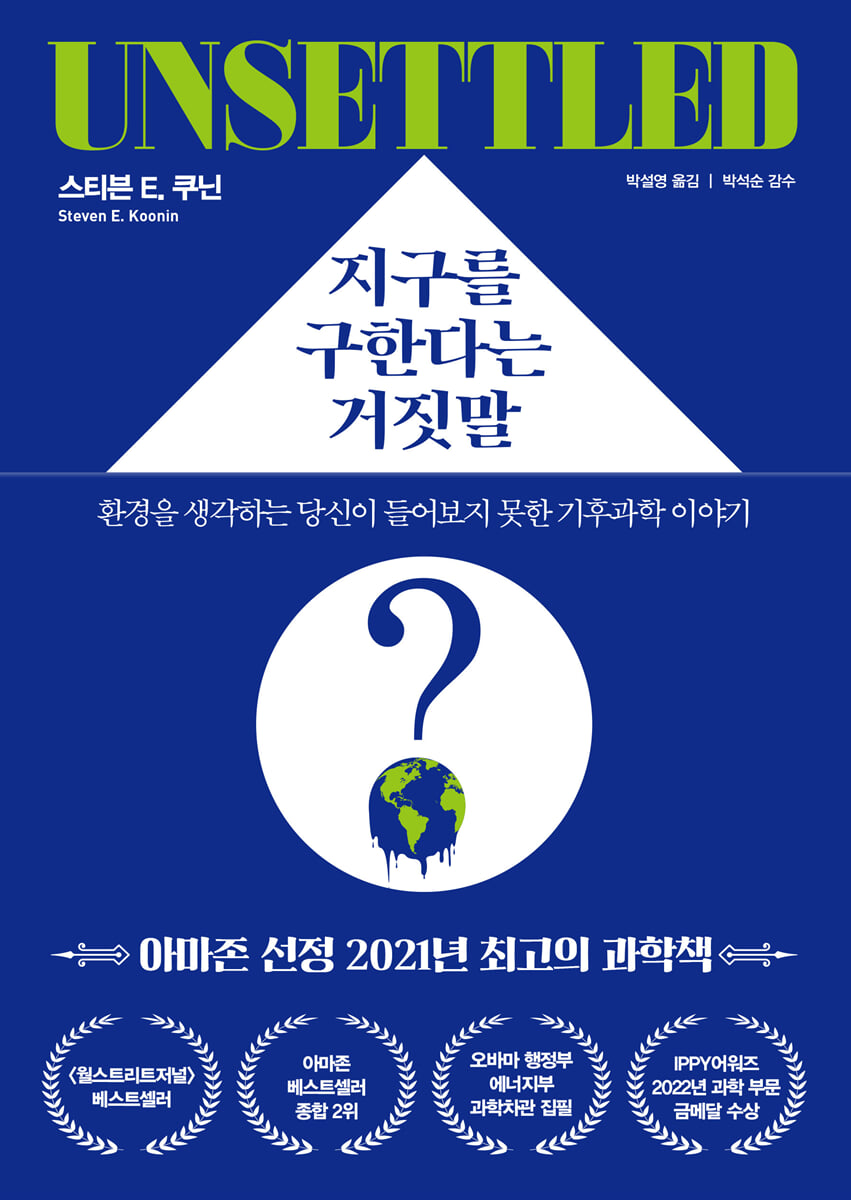
The lie of saving the Earth
 |
Description
Book Introduction
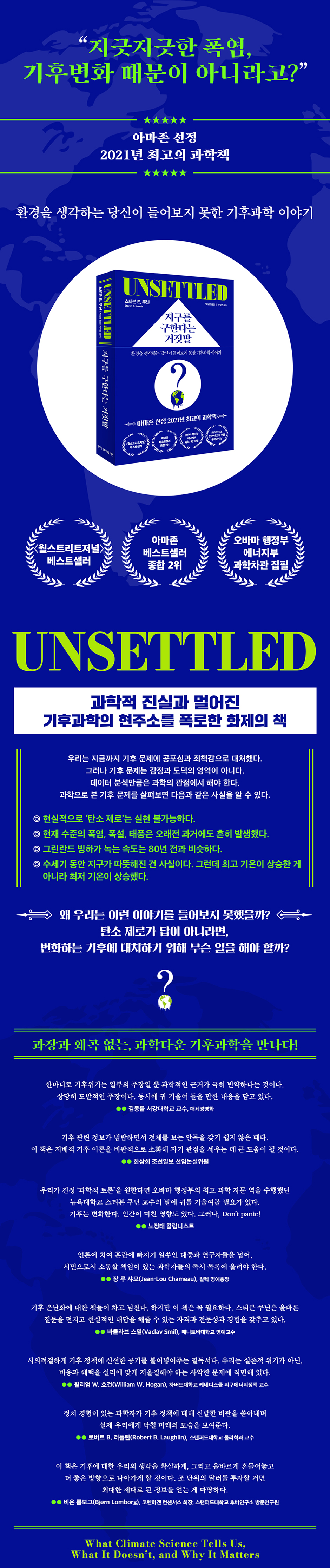
Amazon's Best Science Books of 2021
Climate Science Stories You've Never Heard About Saving the Earth
- Amazon Comprehensive Bestseller
- Wall Street Journal bestseller
- Written by the Obama administration's Under Secretary of Energy for Science
What if "carbon zero" is realistically impossible? What if the current heatwaves, heavy snow, and typhoons were common in the past? What if the Greenland ice sheet is melting at the same rate as it was 80 years ago? These previously unheard-of stories are scientific truths based on climate data.
But it is unfamiliar to us.
This is because a significant portion of the climate-related information available is distorted and exaggerated.
'The Earth is burning hot because of the carbon dioxide emitted by humans, and as temperatures rise, glaciers are melting, sea levels are rising, and habitats are disappearing, and heat waves, heavy snow, and typhoons are increasing due to climate change.
It has become common sense in this era that 'we have ruined the Earth.'
But this common sense is full of errors.
The Earth is not burning, sea levels are not rising at a frightening rate, and heat waves, blizzards, and typhoons have not increased dramatically.
Yet, the reason this 'belief' persists is because of various interest groups that try to manipulate the climate change issue based on people's fear and guilt.
The author, who has studied renewable energy for a long time and served as Under Secretary of Energy for Science in the Obama administration, where he was in charge of energy and climate-related policies, sharply criticizes the current state of climate science in this book.
We encourage you to examine climate issues from a scientific perspective, interpreting the data and graphs in key assessment reports published by the UN and the US government.
The author hopes to bridge the gap between the public and climate science, so that climate issues can be discussed from a scientific perspective.
Only then can we make sober-minded choices that protect the Earth and, by extension, our lives.
Climate Science Stories You've Never Heard About Saving the Earth
- Amazon Comprehensive Bestseller
- Wall Street Journal bestseller
- Written by the Obama administration's Under Secretary of Energy for Science
What if "carbon zero" is realistically impossible? What if the current heatwaves, heavy snow, and typhoons were common in the past? What if the Greenland ice sheet is melting at the same rate as it was 80 years ago? These previously unheard-of stories are scientific truths based on climate data.
But it is unfamiliar to us.
This is because a significant portion of the climate-related information available is distorted and exaggerated.
'The Earth is burning hot because of the carbon dioxide emitted by humans, and as temperatures rise, glaciers are melting, sea levels are rising, and habitats are disappearing, and heat waves, heavy snow, and typhoons are increasing due to climate change.
It has become common sense in this era that 'we have ruined the Earth.'
But this common sense is full of errors.
The Earth is not burning, sea levels are not rising at a frightening rate, and heat waves, blizzards, and typhoons have not increased dramatically.
Yet, the reason this 'belief' persists is because of various interest groups that try to manipulate the climate change issue based on people's fear and guilt.
The author, who has studied renewable energy for a long time and served as Under Secretary of Energy for Science in the Obama administration, where he was in charge of energy and climate-related policies, sharply criticizes the current state of climate science in this book.
We encourage you to examine climate issues from a scientific perspective, interpreting the data and graphs in key assessment reports published by the UN and the US government.
The author hopes to bridge the gap between the public and climate science, so that climate issues can be discussed from a scientific perspective.
Only then can we make sober-minded choices that protect the Earth and, by extension, our lives.
- You can preview some of the book's contents.
Preview
index
Starting the article
Part 1 Science
- Science's Answer to the Misconception of the Climate Crisis
Chapter 1: What They Don't Say About Global Warming
Chapter 2: The Minor Influence of Humans
Chapter 3: The Truth About Carbon Emissions
Chapter 4: How Accurate Are Climate Models?
Chapter 5: Lies Surrounding Temperature
Chapter 6: Have Typhoons Really Increased?
Chapter 7: Has Precipitation Changed? From Floods to Wildfires
Chapter 8: Are Sea Levels Rising at a Frightening Rate?
Chapter 9: The End of the World That Will Never Happen
Chapter 10: Who Ruined Science and Why?
Chapter 11: Fixing Broken Science
Part 2 response
-What will we do to cope with the changing climate?
Chapter 12: The Unfounded Illusion of Zero Carbon
Chapter 13: Can Unfounded Illusions Be Corrected?
Chapter 14 Plan B
In closing
Acknowledgements
main
Part 1 Science
- Science's Answer to the Misconception of the Climate Crisis
Chapter 1: What They Don't Say About Global Warming
Chapter 2: The Minor Influence of Humans
Chapter 3: The Truth About Carbon Emissions
Chapter 4: How Accurate Are Climate Models?
Chapter 5: Lies Surrounding Temperature
Chapter 6: Have Typhoons Really Increased?
Chapter 7: Has Precipitation Changed? From Floods to Wildfires
Chapter 8: Are Sea Levels Rising at a Frightening Rate?
Chapter 9: The End of the World That Will Never Happen
Chapter 10: Who Ruined Science and Why?
Chapter 11: Fixing Broken Science
Part 2 response
-What will we do to cope with the changing climate?
Chapter 12: The Unfounded Illusion of Zero Carbon
Chapter 13: Can Unfounded Illusions Be Corrected?
Chapter 14 Plan B
In closing
Acknowledgements
main
Detailed image
Into the book
Scientists are not prophets.
There is no crystal ball that can tell us how (or if) we will save the planet from the climate problems caused by nature and humans.
What we have is imperfect data and the ability to apply critical thinking and problem-solving skills to find, predict, and solve problems with that data.
There are countless people coming up with countless ideas for solutions.
You've probably heard of at least a few of them.
There is also the more extreme option of implementing an "ambitious and innovative plan" to completely halt human greenhouse gas emissions within the next few decades, as advocated by most countries, the United Nations, and virtually all NGOs.
On the other hand, there are also arguments that humans have minimal impact on the climate and that humans will adapt to any changes, so we can continue to live as we do now.
Various assessment reports from the UN Intergovernmental Panel on Climate Change (IPCC) urge (in effect, compels) the world to immediately reduce greenhouse gas emissions to prevent the worst impacts of human-caused climate change.
These reports also argue that emissions (primarily energy-related carbon dioxide emissions) must be 'reduced' by switching to 'low-carbon' energy sources and 'low-carbon' agriculture, and by reducing energy and food consumption.
The main goal is to reach 'Net Zero' by the mid-21st century.
In theory, there are no absolute barriers to achieving this reduction target, but a combination of scientific, technological, economic, and social factors makes it very unlikely that the world will achieve what it "will" achieve.
Fortunately, as we saw in Part 1, the imminent threat of climate catastrophe is not only uncertain, but we also have other strategies to cope with a changing climate.
It's adaptation and geoengineering.
--- From "Part 2 Response"
For example, both research and government reports that scientifically summarize and assess the state of the climate clearly state that heat waves in the United States are no more frequent now than they were in 1900, and that maximum temperatures have not increased in the past 50 years.
But when I say this, most people don't believe me.
Some are speechless.
There are also people who are openly hostile.
But this isn't the only thing you'll hear about climate for the first time.
You might be surprised by these three facts, taken from recent climate science assessments released by the United Nations and the U.S. government, as well as recent research papers.
·Human impact on hurricanes over the past 100 years has been so minimal as to be undetectable.
·The Greenland ice sheet is shrinking at a rate no faster than it was 80 years ago.
·The net economic impact of human-induced climate change will be minimal, at least until the end of this century.
What on earth is this? After the surprise wears off, you'll wonder why you were surprised at all.
Why haven't we heard this before? How does it differ from the now-ubiquitous cultural meme that humans have destroyed the climate and that unless we change our ways, the apocalypse is imminent?
--- From "Starting the Writing"
But science says otherwise.
A look at observations from a century ago reveals no significant changes in most weather events.
In fact, despite the growing impact of humans on the climate, some phenomena have actually decreased in severity or frequency.
In general, there is a great deal of uncertainty in finding trends in climate change.
Here's a (surprising) excerpt from the IPCC's AR5 WG1 report, which talks about some of the trends we know (or don't know).
“……Indicators showing trends in the intensity and frequency of floods worldwide are unreliable.”
“……The observed drought or dryness (reduced rainfall) trend around the world since the mid-20th century is of low reliability.”
“……The trend indicating small-scale severe weather such as hail and thunderstorms is of low reliability.”
“……The claim that the intensity of severe subtropical cyclones has changed significantly since 1900 is not credible.”
There is no crystal ball that can tell us how (or if) we will save the planet from the climate problems caused by nature and humans.
What we have is imperfect data and the ability to apply critical thinking and problem-solving skills to find, predict, and solve problems with that data.
There are countless people coming up with countless ideas for solutions.
You've probably heard of at least a few of them.
There is also the more extreme option of implementing an "ambitious and innovative plan" to completely halt human greenhouse gas emissions within the next few decades, as advocated by most countries, the United Nations, and virtually all NGOs.
On the other hand, there are also arguments that humans have minimal impact on the climate and that humans will adapt to any changes, so we can continue to live as we do now.
Various assessment reports from the UN Intergovernmental Panel on Climate Change (IPCC) urge (in effect, compels) the world to immediately reduce greenhouse gas emissions to prevent the worst impacts of human-caused climate change.
These reports also argue that emissions (primarily energy-related carbon dioxide emissions) must be 'reduced' by switching to 'low-carbon' energy sources and 'low-carbon' agriculture, and by reducing energy and food consumption.
The main goal is to reach 'Net Zero' by the mid-21st century.
In theory, there are no absolute barriers to achieving this reduction target, but a combination of scientific, technological, economic, and social factors makes it very unlikely that the world will achieve what it "will" achieve.
Fortunately, as we saw in Part 1, the imminent threat of climate catastrophe is not only uncertain, but we also have other strategies to cope with a changing climate.
It's adaptation and geoengineering.
--- From "Part 2 Response"
For example, both research and government reports that scientifically summarize and assess the state of the climate clearly state that heat waves in the United States are no more frequent now than they were in 1900, and that maximum temperatures have not increased in the past 50 years.
But when I say this, most people don't believe me.
Some are speechless.
There are also people who are openly hostile.
But this isn't the only thing you'll hear about climate for the first time.
You might be surprised by these three facts, taken from recent climate science assessments released by the United Nations and the U.S. government, as well as recent research papers.
·Human impact on hurricanes over the past 100 years has been so minimal as to be undetectable.
·The Greenland ice sheet is shrinking at a rate no faster than it was 80 years ago.
·The net economic impact of human-induced climate change will be minimal, at least until the end of this century.
What on earth is this? After the surprise wears off, you'll wonder why you were surprised at all.
Why haven't we heard this before? How does it differ from the now-ubiquitous cultural meme that humans have destroyed the climate and that unless we change our ways, the apocalypse is imminent?
--- From "Starting the Writing"
But science says otherwise.
A look at observations from a century ago reveals no significant changes in most weather events.
In fact, despite the growing impact of humans on the climate, some phenomena have actually decreased in severity or frequency.
In general, there is a great deal of uncertainty in finding trends in climate change.
Here's a (surprising) excerpt from the IPCC's AR5 WG1 report, which talks about some of the trends we know (or don't know).
“……Indicators showing trends in the intensity and frequency of floods worldwide are unreliable.”
“……The observed drought or dryness (reduced rainfall) trend around the world since the mid-20th century is of low reliability.”
“……The trend indicating small-scale severe weather such as hail and thunderstorms is of low reliability.”
“……The claim that the intensity of severe subtropical cyclones has changed significantly since 1900 is not credible.”
--- From "Chapter 5 Lies Surrounding Temperature"
Publisher's Review
Discussing climate science without exaggeration or distortion, and in a scientific manner.
A hotly debated book that sharply criticizes the current state of climate science.
There is a widespread perception among the public that humans have already destroyed the Earth and that greenhouse gases will destroy it.
Temperatures are rising, unprecedented heat waves, heavy snowfall, and typhoons are occurring, and all of this is due to human influence.
But, in fact, that is not the case.
Of course, the Earth is warming and humans are contributing to this warming, but that's not the whole story.
If we look at it scientifically, we are faced with the following truth.
· It is true that the Earth has warmed over the past centuries.
However, this is not a result of an increase in the maximum temperature, but rather an increase in the minimum temperature.
In other words, the climate is not becoming more violent, but rather milder.
This means that there is no such thing as a 'burning earth' as seen in news headlines.
· The frequency of heat waves in the United States today is no higher than in 1900.
· The blizzard that hit Washington, D.C. in early 2010 is called "Snowmageddon" and is cited as an example of the climate crisis.
However, the next winter with the most snow was 1898, long before humans influenced the climate.
· Typhoons appear to have increased in frequency since 1995, although there was a similar period of activity before 1949.
In other words, there was a time before human influence became prominent when activity was at least as active as it is today.
Additionally, the Comprehensive Storm Scenario Review (CSSR) states that the increase in typhoon occurrence “does not appear to reflect any trend other than the variability of natural phenomena.”
· When comparing the results of currently used climate models with each other or with actual observations, inconsistent or even conflicting results may be obtained.
So researchers adjust experimental conditions, etc.
It is about intervening directly to achieve the desired result.
· In order to achieve the 'carbon neutrality' set forth in the Paris Agreement, it is not enough to simply reduce carbon dioxide emissions; we must reduce them to 'zero' (once carbon dioxide is emitted, it remains in the atmosphere for a long time.
So, ‘reduction’ cannot achieve the desired effect.
To limit global warming to 2°C, carbon dioxide emissions must be reduced to zero by 2075, and to limit it to 1.5°C, carbon dioxide emissions must be reduced to zero by 2050.
However, this goal has already not been achieved.
This story, which we haven't heard, comes from Stephen E., a scientist who studied renewable energy and worked as the Under Secretary of Science for the U.S. Department of Energy, preparing plans to reduce carbon dioxide emissions.
It is included in Kunin's book, "The Lie That Saves the Planet."
The author, who worked as a key figure in the effort to "save the Earth" more than anyone else, discovered in the process that current climate science has a very low academic standard and began to have doubts about the climate change controversy.
The fact that the heat waves, heavy snow, and typhoons that the media touts as being caused by global warming have occurred with similar frequency in previous eras suggests that the current climate change is more likely to be caused by large-scale natural flows than by human activities.
Moreover, the fact that climate models' predictions differ from each other and that they cannot even reproduce past climates shows that the scientific basis for the 'climate crisis theory' is weak.
In conclusion, the author concludes that we currently lack the ability to distinguish between natural and human influences.
The Earth is warming, but we don't know if it's because of humans.
Even the great currents of nature cannot yet be known in which direction they will flow.
In other words, when we synthesize the data, all we can know is that 'we don't know the future of the Earth yet.'
Carbon neutrality isn't the answer?
But why are climatologists silent?
In other words, the author's core argument is that the current climate crisis theory is exaggerated.
And he proves the scientific facts he discovered and mentioned above through numerous data and graphs.
However, it is surprising that the sources are reports that are mainly covered by academia and the media when dealing with climate issues, such as the UN's IPCC assessment report and the US's NCA.
Ultimately, these reports contain the author's points, but they are distorted in the process of being conveyed to the public.
So why does this happen? Why are climate scientists silent? The reason they tolerate exaggerations and distortions is because they believe that even if it means resorting to fear, reducing carbon dioxide emissions even a little is a good thing.
The media, politicians, and environmental groups are all exaggerating the sense of crisis connected to climate issues for their own benefit.
But what's the problem? Aren't the climatologists right? After all, if we can't perfectly predict the future, wouldn't it be better to at least be cautious and reduce carbon emissions? The author argues that the current state of climate science, which has lost its scientific perspective, has led to the current obsession with zero carbon emissions.
Because carbon dioxide stays in the atmosphere for a long time, to be truly effective, emissions must be reduced to 'zero', which is realistically impossible.
Energy demand is increasing, and the Paris Agreement is not being implemented due to the circumstances of each country.
Even most issue makers, including Bill Gates, agree that achieving carbon zero is very difficult.
The future of the Earth, which cannot yet be determined,
What is the most realistic response we should take?
The authors argue that we should invest in adaptation projects rather than carbon neutrality measures that are unlikely to be achieved.
The alternative of literally 'adapting' to a changing climate is a response that has been consistently implemented throughout human history.
The author, who lives in earthquake-prone California, took earthquake precautions instead of moving, such as securing her home, shelves, and furniture, conducting safety drills with her children, purchasing earthquake insurance, and stockpiling several days' worth of food and water.
This is adaptation.
The important thing is that these adaptation policies must be actively implemented for the vulnerable.
Representative policy targets include farmers who must change the crops they produce due to changing climate, and island and coastal residents who must adapt their living environments to long-term rising sea levels.
Meanwhile, we must also invest in geoengineering technologies, which have long been excluded from discussion due to their risks.
A representative example is the carbon dioxide removal (CDR) method, which directly captures and removes carbon dioxide from the atmosphere.
Although the technology will require further development and will require significant investment, commercialization will allow developing countries to address climate change without hindering economic development, so it is best to prepare now.
The most realistic way to address climate change is to move beyond the Paris Agreement, which merely talks about reducing emissions and remains stagnant, and to discuss various options that can be put into action right now.
A hotly debated book that sharply criticizes the current state of climate science.
There is a widespread perception among the public that humans have already destroyed the Earth and that greenhouse gases will destroy it.
Temperatures are rising, unprecedented heat waves, heavy snowfall, and typhoons are occurring, and all of this is due to human influence.
But, in fact, that is not the case.
Of course, the Earth is warming and humans are contributing to this warming, but that's not the whole story.
If we look at it scientifically, we are faced with the following truth.
· It is true that the Earth has warmed over the past centuries.
However, this is not a result of an increase in the maximum temperature, but rather an increase in the minimum temperature.
In other words, the climate is not becoming more violent, but rather milder.
This means that there is no such thing as a 'burning earth' as seen in news headlines.
· The frequency of heat waves in the United States today is no higher than in 1900.
· The blizzard that hit Washington, D.C. in early 2010 is called "Snowmageddon" and is cited as an example of the climate crisis.
However, the next winter with the most snow was 1898, long before humans influenced the climate.
· Typhoons appear to have increased in frequency since 1995, although there was a similar period of activity before 1949.
In other words, there was a time before human influence became prominent when activity was at least as active as it is today.
Additionally, the Comprehensive Storm Scenario Review (CSSR) states that the increase in typhoon occurrence “does not appear to reflect any trend other than the variability of natural phenomena.”
· When comparing the results of currently used climate models with each other or with actual observations, inconsistent or even conflicting results may be obtained.
So researchers adjust experimental conditions, etc.
It is about intervening directly to achieve the desired result.
· In order to achieve the 'carbon neutrality' set forth in the Paris Agreement, it is not enough to simply reduce carbon dioxide emissions; we must reduce them to 'zero' (once carbon dioxide is emitted, it remains in the atmosphere for a long time.
So, ‘reduction’ cannot achieve the desired effect.
To limit global warming to 2°C, carbon dioxide emissions must be reduced to zero by 2075, and to limit it to 1.5°C, carbon dioxide emissions must be reduced to zero by 2050.
However, this goal has already not been achieved.
This story, which we haven't heard, comes from Stephen E., a scientist who studied renewable energy and worked as the Under Secretary of Science for the U.S. Department of Energy, preparing plans to reduce carbon dioxide emissions.
It is included in Kunin's book, "The Lie That Saves the Planet."
The author, who worked as a key figure in the effort to "save the Earth" more than anyone else, discovered in the process that current climate science has a very low academic standard and began to have doubts about the climate change controversy.
The fact that the heat waves, heavy snow, and typhoons that the media touts as being caused by global warming have occurred with similar frequency in previous eras suggests that the current climate change is more likely to be caused by large-scale natural flows than by human activities.
Moreover, the fact that climate models' predictions differ from each other and that they cannot even reproduce past climates shows that the scientific basis for the 'climate crisis theory' is weak.
In conclusion, the author concludes that we currently lack the ability to distinguish between natural and human influences.
The Earth is warming, but we don't know if it's because of humans.
Even the great currents of nature cannot yet be known in which direction they will flow.
In other words, when we synthesize the data, all we can know is that 'we don't know the future of the Earth yet.'
Carbon neutrality isn't the answer?
But why are climatologists silent?
In other words, the author's core argument is that the current climate crisis theory is exaggerated.
And he proves the scientific facts he discovered and mentioned above through numerous data and graphs.
However, it is surprising that the sources are reports that are mainly covered by academia and the media when dealing with climate issues, such as the UN's IPCC assessment report and the US's NCA.
Ultimately, these reports contain the author's points, but they are distorted in the process of being conveyed to the public.
So why does this happen? Why are climate scientists silent? The reason they tolerate exaggerations and distortions is because they believe that even if it means resorting to fear, reducing carbon dioxide emissions even a little is a good thing.
The media, politicians, and environmental groups are all exaggerating the sense of crisis connected to climate issues for their own benefit.
But what's the problem? Aren't the climatologists right? After all, if we can't perfectly predict the future, wouldn't it be better to at least be cautious and reduce carbon emissions? The author argues that the current state of climate science, which has lost its scientific perspective, has led to the current obsession with zero carbon emissions.
Because carbon dioxide stays in the atmosphere for a long time, to be truly effective, emissions must be reduced to 'zero', which is realistically impossible.
Energy demand is increasing, and the Paris Agreement is not being implemented due to the circumstances of each country.
Even most issue makers, including Bill Gates, agree that achieving carbon zero is very difficult.
The future of the Earth, which cannot yet be determined,
What is the most realistic response we should take?
The authors argue that we should invest in adaptation projects rather than carbon neutrality measures that are unlikely to be achieved.
The alternative of literally 'adapting' to a changing climate is a response that has been consistently implemented throughout human history.
The author, who lives in earthquake-prone California, took earthquake precautions instead of moving, such as securing her home, shelves, and furniture, conducting safety drills with her children, purchasing earthquake insurance, and stockpiling several days' worth of food and water.
This is adaptation.
The important thing is that these adaptation policies must be actively implemented for the vulnerable.
Representative policy targets include farmers who must change the crops they produce due to changing climate, and island and coastal residents who must adapt their living environments to long-term rising sea levels.
Meanwhile, we must also invest in geoengineering technologies, which have long been excluded from discussion due to their risks.
A representative example is the carbon dioxide removal (CDR) method, which directly captures and removes carbon dioxide from the atmosphere.
Although the technology will require further development and will require significant investment, commercialization will allow developing countries to address climate change without hindering economic development, so it is best to prepare now.
The most realistic way to address climate change is to move beyond the Paris Agreement, which merely talks about reducing emissions and remains stagnant, and to discuss various options that can be put into action right now.
GOODS SPECIFICS
- Publication date: July 15, 2022
- Page count, weight, size: 400 pages | 682g | 152*215*23mm
- ISBN13: 9788947548311
- ISBN10: 8947548316
You may also like
카테고리
korean


korean

![ELLE 엘르 스페셜 에디션 A형 : 12월 [2025]](http://librairie.coreenne.fr/cdn/shop/files/b8e27a3de6c9538896439686c6b0e8fb.jpg?v=1766436872&width=3840)


