

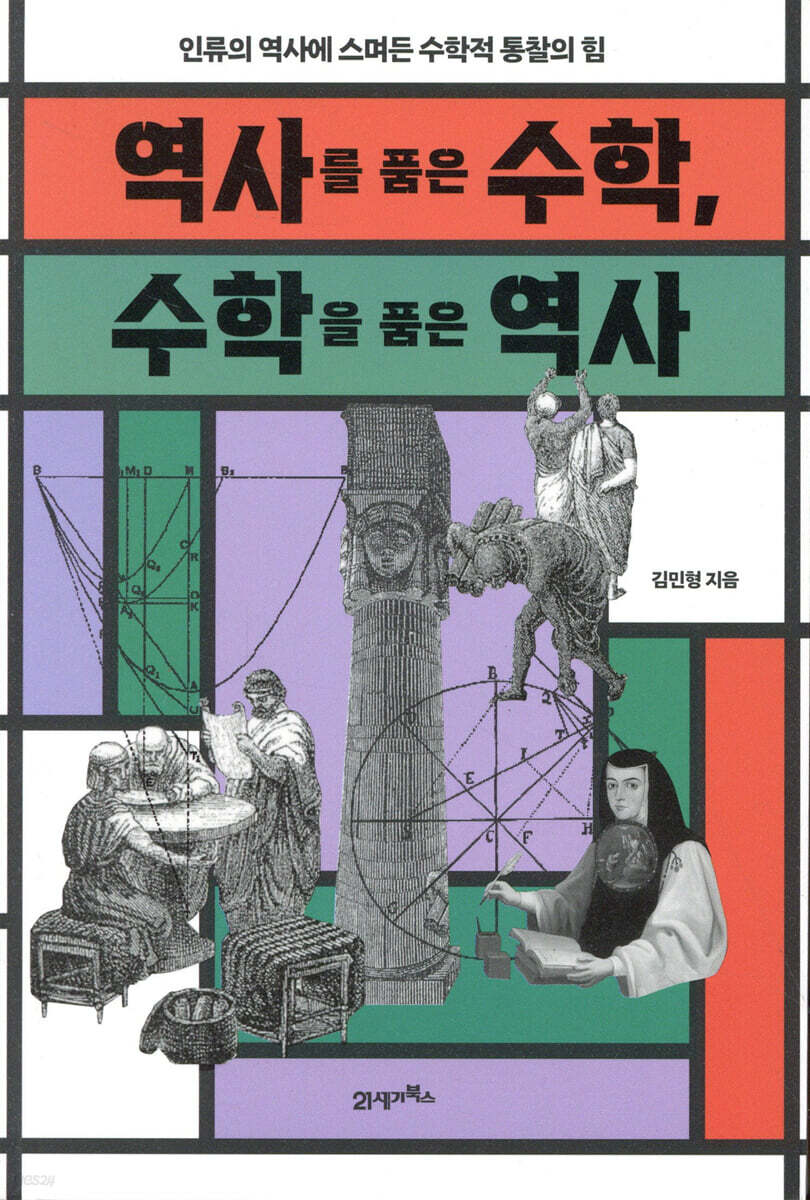
Mathematics with History, History with Mathematics
 |
Description
Book Introduction
A time to add wisdom to my life, 'Life's Great River'
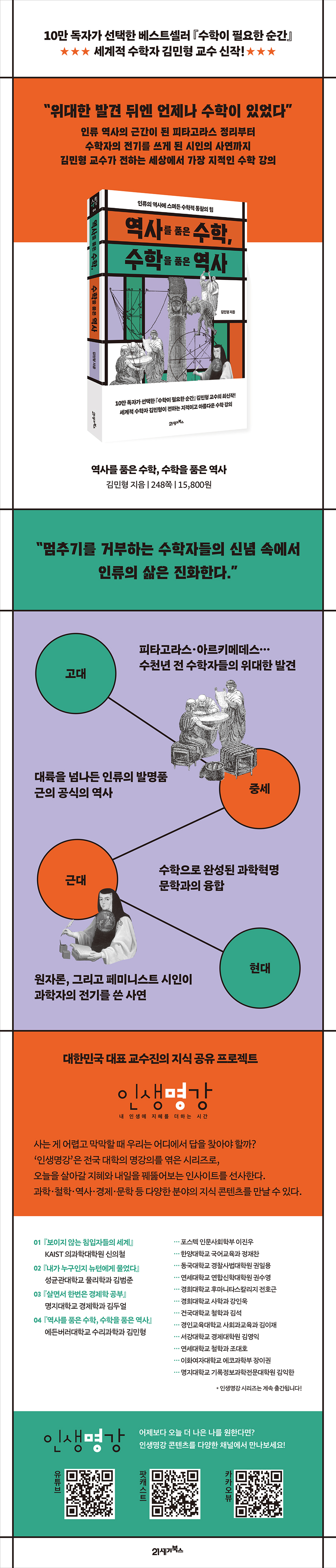
The world's most intelligent math lecture, delivered by world-renowned mathematician Minhyung Kim. All the essential knowledge you need for life is gathered together! The fourth book in the "Life Lessons" series, a fascinating knowledge experience presented by Korea's leading professors, has been published. The Life Lectures series, which transcribes the lectures of the best professors in various fields from universities across the country, including history, philosophy, science, medicine, and art, into books, provides readers with useful knowledge to live today and insight to look forward to tomorrow. It is a knowledge and culture brand that allows you to encounter the best knowledge content in your daily life through not only books but also online lectures, YouTube, Instagram, and podcasts. Professor Minhyung Kim's latest work, "Mathematics with History, History with Mathematics," chosen by 100,000 readers, is a book that compiles eight mathematics lectures given in Naver's online lecture series "Knowledge Live ON." Audience members who attended this lecture, which combined mathematics and humanities, commented, “It was fun to learn about the influence of the Pythagorean theorem, which everyone learned, on world history,” and “Mathematics, which I always thought was difficult, became interesting.” This book explores the impact of ancient mathematics on our lives, the history of human mathematical thought that transcended continents before the invention of the quadratic formula, and the story of how a poet wrote a mathematician's biography at a turning point in modern science. It offers a fascinating account of mathematics intertwined with many academic disciplines, including literature and natural science. As you read this book, you will broaden your perspective on the world by thinking about mathematics and the humanities in a fusion manner, and you will find yourself captivated by the charm of mathematics, which once seemed distant. |
- You can preview some of the book's contents.
Preview
index
introduction
Lecture 1: Ancient Times - The Ecstatic Rules of Pythagoras
Desire all the knowledge in the world
The Amazing Discoveries of Pythagoras
Harmony, more beautiful because it is mathematics
It's all thanks to the Pythagorean theorem.
Lecture 2: Ancient Times - Archimedes' Great Invention
Mathematics has always been behind great discoveries.
Archimedes' geometry
Why did Plutarch praise Archimedes?
Cicero, the politician who loved mathematicians
Reinventing Archimedes
Lessons from Plutarch and Cicero
Lecture 3: The Middle Ages - The Babylonian Algorithm and Its Discovery
The Greatness of Ancient Babylonian Formulas
The Crisis of Algebra and the Emergence of Geometry
Mathematics advances without foundation.
Heron's Formula and the Rise of Alexandria
4th Middle Ages - From Shapes to Equations, Mathematics That Shaped the Renaissance
Thoughts evolve, in the time of mathematicians.
The poet's solution to the cubic equation
Art created by nine numbers
Why did Newton write the Principia geometrically?
Precise questions about the history of mathematics
Lecture 5: Modernity: Experiments and Theories in the Age of Scientific Revolution
The spark of revolution ignited by scientists
Modern history owes a great debt to Bacon
Baconianism, experience and experimentation
Mathematics, the language that describes the universe
Lecture 6: Modernity - The Fusion of Science and Literature, the 17th Century of Aspiration
A genius poet who read the universe like a book
Sor Juana's Philosophical Background
Exploration and mathematical theory of spinning tops
Lecture 7 Modern Times - From Lucretius's Atomic Theory
What are I and the world made of?
Maxwell and Boltzmann: Establishing Statistical Physics
Ideal gas distribution derived from physical intuition
The True Impact of Statistical Physics
8th Modern _ Why Write Poetry in the World of Scientists
The companionship of scientist Gibbs and poet Rukeyser
Writing Poetry in the World of Poets and Scientists
Poetry and Mathematics: A Way to Understand the World
Main keywords
References
Lecture 1: Ancient Times - The Ecstatic Rules of Pythagoras
Desire all the knowledge in the world
The Amazing Discoveries of Pythagoras
Harmony, more beautiful because it is mathematics
It's all thanks to the Pythagorean theorem.
Lecture 2: Ancient Times - Archimedes' Great Invention
Mathematics has always been behind great discoveries.
Archimedes' geometry
Why did Plutarch praise Archimedes?
Cicero, the politician who loved mathematicians
Reinventing Archimedes
Lessons from Plutarch and Cicero
Lecture 3: The Middle Ages - The Babylonian Algorithm and Its Discovery
The Greatness of Ancient Babylonian Formulas
The Crisis of Algebra and the Emergence of Geometry
Mathematics advances without foundation.
Heron's Formula and the Rise of Alexandria
4th Middle Ages - From Shapes to Equations, Mathematics That Shaped the Renaissance
Thoughts evolve, in the time of mathematicians.
The poet's solution to the cubic equation
Art created by nine numbers
Why did Newton write the Principia geometrically?
Precise questions about the history of mathematics
Lecture 5: Modernity: Experiments and Theories in the Age of Scientific Revolution
The spark of revolution ignited by scientists
Modern history owes a great debt to Bacon
Baconianism, experience and experimentation
Mathematics, the language that describes the universe
Lecture 6: Modernity - The Fusion of Science and Literature, the 17th Century of Aspiration
A genius poet who read the universe like a book
Sor Juana's Philosophical Background
Exploration and mathematical theory of spinning tops
Lecture 7 Modern Times - From Lucretius's Atomic Theory
What are I and the world made of?
Maxwell and Boltzmann: Establishing Statistical Physics
Ideal gas distribution derived from physical intuition
The True Impact of Statistical Physics
8th Modern _ Why Write Poetry in the World of Scientists
The companionship of scientist Gibbs and poet Rukeyser
Writing Poetry in the World of Poets and Scientists
Poetry and Mathematics: A Way to Understand the World
Main keywords
References
Detailed image
Into the book
Pythagoras' theory of harmony is very important not only for music but also for understanding all phenomena of the universe and nature.
When creating sound, the frequency of the sound is fundamental, but more importantly, all sounds are created by combining frequencies.
There is a device called a 'spectrum analyzer' that analyzes the frequency spectrum.
(…) If you upload a recording file online, there are machines that will display all the frequencies in the sound as pictures and colors.
If you search for 'spectrum analyzer' on the Internet, you will find that anyone can analyze frequencies with this device. Nowadays, all sounds are divided into frequencies and analyzed, recorded, and reproduced.
This frequency analysis is the basis of all sound science and technology, and it also began with the observations of Pythagoras.
--- p.33, from “Lesson 1: Harmony, More Beautiful Because It’s Mathematics”
It is necessary to look more closely at Hellenistic mathematics from various historical perspectives.
It is true that the claim that mathematics developed geometrically due to the crisis in the number system is true, but that does not mean that scholars such as Heron and Diophantus only studied Greek geometry.
Moreover, since the Hellenistic period, mathematics has been able to make tremendous leaps in various directions beyond geometry through the development of various civilizations, including India and Arabia.
If so, we cannot help but ask again why geometry was so uniquely important in the development of Renaissance science.
--- p.105, from “The Three Powers of Heron’s Formula and the Rise of Alexandria”
When Al-Khwarizmi first developed the theory of equations, equations were expressed descriptively like this, but they gradually changed into the form of equations we know.
One of the reasons why the development of mathematics has been so important in human history is because these changes have made human thinking incredibly efficient.
Moreover, the reason why even trivial concepts and notations must be treated seriously is because mathematics is continuously evolving in a similar way even at this very moment.
--- p.132, from “Why did Newton write the Principia geometrically?”
Decades later, with Newton, a scientific revolution took place that utilized mathematics on a much larger scale.
Since then, and especially today, it has become increasingly impossible to understand physics without mathematics.
In the case of physics papers, there are many parts that are difficult to read even if you don't know mathematics.
In that sense, the 17th century can be seen as a period in which the scientific revolution and the mathematical revolution occurred simultaneously.
This is also true in the 20th century.
As mathematics is developed out of scientific necessity, scientific revolutions sometimes lead to mathematical revolutions, and mathematical revolutions sometimes contribute to scientific revolutions.
Thus, from past to present, there has been a very complex interaction between mathematics and science.
--- p.158, from “Lecture 5: Mathematics, the Language that Describes the Universe”
In his book The Life of Poetry, Rukeyser states that “poetry is essential to democracy and to human life and understanding.”
Depending on your perspective, you might accept this as a natural claim, or you might wonder what the relationship between poetry and democracy is.
But the moment I read this sentence, I felt a kind of thrill.
Because I also have the same thoughts about math.
Ultimately, I came to the conclusion that since we live in the same world, the goal of understanding the world must be the same whether we are poets or mathematicians.
When creating sound, the frequency of the sound is fundamental, but more importantly, all sounds are created by combining frequencies.
There is a device called a 'spectrum analyzer' that analyzes the frequency spectrum.
(…) If you upload a recording file online, there are machines that will display all the frequencies in the sound as pictures and colors.
If you search for 'spectrum analyzer' on the Internet, you will find that anyone can analyze frequencies with this device. Nowadays, all sounds are divided into frequencies and analyzed, recorded, and reproduced.
This frequency analysis is the basis of all sound science and technology, and it also began with the observations of Pythagoras.
--- p.33, from “Lesson 1: Harmony, More Beautiful Because It’s Mathematics”
It is necessary to look more closely at Hellenistic mathematics from various historical perspectives.
It is true that the claim that mathematics developed geometrically due to the crisis in the number system is true, but that does not mean that scholars such as Heron and Diophantus only studied Greek geometry.
Moreover, since the Hellenistic period, mathematics has been able to make tremendous leaps in various directions beyond geometry through the development of various civilizations, including India and Arabia.
If so, we cannot help but ask again why geometry was so uniquely important in the development of Renaissance science.
--- p.105, from “The Three Powers of Heron’s Formula and the Rise of Alexandria”
When Al-Khwarizmi first developed the theory of equations, equations were expressed descriptively like this, but they gradually changed into the form of equations we know.
One of the reasons why the development of mathematics has been so important in human history is because these changes have made human thinking incredibly efficient.
Moreover, the reason why even trivial concepts and notations must be treated seriously is because mathematics is continuously evolving in a similar way even at this very moment.
--- p.132, from “Why did Newton write the Principia geometrically?”
Decades later, with Newton, a scientific revolution took place that utilized mathematics on a much larger scale.
Since then, and especially today, it has become increasingly impossible to understand physics without mathematics.
In the case of physics papers, there are many parts that are difficult to read even if you don't know mathematics.
In that sense, the 17th century can be seen as a period in which the scientific revolution and the mathematical revolution occurred simultaneously.
This is also true in the 20th century.
As mathematics is developed out of scientific necessity, scientific revolutions sometimes lead to mathematical revolutions, and mathematical revolutions sometimes contribute to scientific revolutions.
Thus, from past to present, there has been a very complex interaction between mathematics and science.
--- p.158, from “Lecture 5: Mathematics, the Language that Describes the Universe”
In his book The Life of Poetry, Rukeyser states that “poetry is essential to democracy and to human life and understanding.”
Depending on your perspective, you might accept this as a natural claim, or you might wonder what the relationship between poetry and democracy is.
But the moment I read this sentence, I felt a kind of thrill.
Because I also have the same thoughts about math.
Ultimately, I came to the conclusion that since we live in the same world, the goal of understanding the world must be the same whether we are poets or mathematicians.
--- p.238, from “Poetry and Mathematics, A Way to Understand the World”
Publisher's Review
Time to add wisdom to my life, the Life Lecture Series
Professor Minhyung Kim's latest work, "When Math is Needed," chosen by 100,000 readers!
An intellectual and beautiful mathematics lecture by world-renowned mathematician Kim Min-hyung.
“Mathematics has always been present at turning points in history!”
A captivating collaboration that fuses history and culture within the grand world of mathematics.
“Human life evolves within the unwavering conviction of mathematicians.” (p. 108)
There is no one who does not know that mathematics, which has been created and refined over centuries, has had a profound impact on the development of human civilization.
Mathematicians of the past have attempted to logically organize and technically solve the diverse and complex problems that arise in the world, thereby elevating human thinking to a level of considerable efficiency.
For example, it is said that the systematic method of solving quadratic equations that we are familiar with began with Al-Khwarizmi, the greatest mathematician of Islamic civilization, but the method of solving numbers, operations, and equations that are taken for granted in modern mathematics was not systematized before Al-Khwarizmi announced it.
This theory of equations has had a surprisingly large impact on the history of science, and it is the beginning of modern quantum mechanics.
Moreover, the theory of harmony, which began with Pythagoras' mathematical curiosity, played a very important role in understanding not only music but also all phenomena of the universe and nature.
All sound frequencies in the world are created synthetically, and analyzing these frequencies is the basis of all sound science and technology, which began with Pythagoras' theory of harmony.
In this way, mathematics has accumulated along with human civilization and has permeated our lives in every aspect.
This is reason enough to study mathematics.
Professor Kim Min-hyung, who has already provided readers with profound insights into the power of mathematical thinking through bestsellers such as "When Math is Needed," presents the joy of mathematics by crossing academic boundaries in "Mathematics with History, History with Mathematics."
You can discover the historical background behind complex formulas and principles, as well as the brilliant insights and achievements of mathematicians who penetrate philosophy, history, and the humanities.
We need mathematics to understand the world more deeply!
The power of mathematical insight permeating our daily lives
There are many cases where people give up on math after experiencing a mental breakdown when faced with unfamiliar formulas or shapes.
As the number of difficult equations and problems increases, the fear of mathematics increases and the avoidance of mathematics increases.
However, Professor Kim Min-hyung lists “understanding the world more deeply” as the common goal of literature, mathematics, and the humanities.
People majoring in subjects like literature or history often distance themselves from mathematics in their daily lives, but if they build up basic mathematical knowledge, it will help them gain deeper insight into that knowledge.
A universal tool for understanding the world - this is the power of mathematics.
The works of Sor Juana, a representative writer and poet nun of colonial Latin America, thoroughly reflect the scientific spirit of the 17th century.
“One day I saw two little girls playing with a top.
“As soon as I saw the motion of the top and the patterns drawn on the floor, I began to study, from my own strange perspective, the way in which a round shape moves with ease, and the inertia by which the top maintains its initial speed after it leaves the hand of the child who forces it to spin.” (From “Reply to Sor Filotea de la Cruz”)
Her work, which reveals a desire to understand the world, a spirit of inquiry born of curiosity, and theoretical reflection, is a brilliant fusion of literature, philosophy, and science that infuses important ideas from the history of 17th-century science.
Likewise, mathematics is necessary when we understand a work of literature.
The author hopes to break down the barriers to mathematics for non-majors and liberal arts students.
Even those who only think of complex formulas when they think of math, or liberal arts students who believe math has nothing to do with them, will be able to gain more power and depth in their mathematical insight with this book.
“How did mathematics become history?”
A History of Mathematical Thinking that Spanned Era and Continents
Instead of listing academic evidence from history or literature, this book contains anecdotes and representative episodes related to mathematics.
This book, consisting of eight lectures spanning from ancient times to the present, examines how mathematics has advanced life and culture through the biographies and achievements of well-known mathematicians such as Pythagoras and Archimedes.
You can understand the worldview of mathematicians thousands of years ago, how curiosity and ideas about 'numbers' changed ancient thought.
In lectures 3 and 4, we will cover Indian and Arabic mathematics across the continent and into Europe during the Middle Ages.
We trace the influence of mathematics on the formation of culture and science, including the process leading to the creation of the root formula and the solution to equations discovered by poets.
In Lectures 5 and 6, we explore the complex interplay between science and mathematics, drawing on experiments and theories from the Age of Scientific Revolution. We also explore the poet's mathematical insights through the works of Sor Juana in the 17th century, imagining the intellectual climate on both sides of the Atlantic at the time.
And in lectures 7 and 8, we will consider the background and principles of the full-fledged systematization of atomic theory in modern science, and the motivation of poet and political activist Muriel Rukeyser to write a biography of Gibbs, the first American scientist and founder of statistical mechanics.
Let's embark on an intellectual journey led by Professor Kim Min-hyung.
Readers of this book will learn about the significance of mathematics in human history and, furthermore, will be able to take a step closer to the joy of viewing the world through a mathematical lens.
"Life's Great Lectures," a knowledge-sharing project by Korea's top professors.
Life Lectures is a series that compiles lectures by renowned professors from universities across the country, and is a sister brand of 'Seogamyeonggang (famous lectures you can listen to without going to Seoul National University),' which compiles lectures by Seoul National University professors.
Lectures by Korea's leading scholars have been reconstructed into useful knowledge content for our lives, making them readily available not only through books but also through online lectures, YouTube, podcasts, and Instagram.
This course provides an opportunity for professionals seeking wisdom in their work, at home, and in interpersonal relationships, young people contemplating their career path, and everyone in need of solutions at every critical juncture in life to easily watch, listen to, and learn from renowned lectures delivered by leading experts in their respective fields.
☞ Meet 'Life's Great Lecture' on YouTube, lectures, and Podbbang!
▶ Lecture book21.com/lecture
▶ YouTube youtube.com/unibstar
▶ Audio clip audioclip.naver.com/channels/345
▶ Podbbang www.podbbang.com/ch/14808
▶ Post post.naver.com/21c_sgmk?
Professor Minhyung Kim's latest work, "When Math is Needed," chosen by 100,000 readers!
An intellectual and beautiful mathematics lecture by world-renowned mathematician Kim Min-hyung.
“Mathematics has always been present at turning points in history!”
A captivating collaboration that fuses history and culture within the grand world of mathematics.
“Human life evolves within the unwavering conviction of mathematicians.” (p. 108)
There is no one who does not know that mathematics, which has been created and refined over centuries, has had a profound impact on the development of human civilization.
Mathematicians of the past have attempted to logically organize and technically solve the diverse and complex problems that arise in the world, thereby elevating human thinking to a level of considerable efficiency.
For example, it is said that the systematic method of solving quadratic equations that we are familiar with began with Al-Khwarizmi, the greatest mathematician of Islamic civilization, but the method of solving numbers, operations, and equations that are taken for granted in modern mathematics was not systematized before Al-Khwarizmi announced it.
This theory of equations has had a surprisingly large impact on the history of science, and it is the beginning of modern quantum mechanics.
Moreover, the theory of harmony, which began with Pythagoras' mathematical curiosity, played a very important role in understanding not only music but also all phenomena of the universe and nature.
All sound frequencies in the world are created synthetically, and analyzing these frequencies is the basis of all sound science and technology, which began with Pythagoras' theory of harmony.
In this way, mathematics has accumulated along with human civilization and has permeated our lives in every aspect.
This is reason enough to study mathematics.
Professor Kim Min-hyung, who has already provided readers with profound insights into the power of mathematical thinking through bestsellers such as "When Math is Needed," presents the joy of mathematics by crossing academic boundaries in "Mathematics with History, History with Mathematics."
You can discover the historical background behind complex formulas and principles, as well as the brilliant insights and achievements of mathematicians who penetrate philosophy, history, and the humanities.
We need mathematics to understand the world more deeply!
The power of mathematical insight permeating our daily lives
There are many cases where people give up on math after experiencing a mental breakdown when faced with unfamiliar formulas or shapes.
As the number of difficult equations and problems increases, the fear of mathematics increases and the avoidance of mathematics increases.
However, Professor Kim Min-hyung lists “understanding the world more deeply” as the common goal of literature, mathematics, and the humanities.
People majoring in subjects like literature or history often distance themselves from mathematics in their daily lives, but if they build up basic mathematical knowledge, it will help them gain deeper insight into that knowledge.
A universal tool for understanding the world - this is the power of mathematics.
The works of Sor Juana, a representative writer and poet nun of colonial Latin America, thoroughly reflect the scientific spirit of the 17th century.
“One day I saw two little girls playing with a top.
“As soon as I saw the motion of the top and the patterns drawn on the floor, I began to study, from my own strange perspective, the way in which a round shape moves with ease, and the inertia by which the top maintains its initial speed after it leaves the hand of the child who forces it to spin.” (From “Reply to Sor Filotea de la Cruz”)
Her work, which reveals a desire to understand the world, a spirit of inquiry born of curiosity, and theoretical reflection, is a brilliant fusion of literature, philosophy, and science that infuses important ideas from the history of 17th-century science.
Likewise, mathematics is necessary when we understand a work of literature.
The author hopes to break down the barriers to mathematics for non-majors and liberal arts students.
Even those who only think of complex formulas when they think of math, or liberal arts students who believe math has nothing to do with them, will be able to gain more power and depth in their mathematical insight with this book.
“How did mathematics become history?”
A History of Mathematical Thinking that Spanned Era and Continents
Instead of listing academic evidence from history or literature, this book contains anecdotes and representative episodes related to mathematics.
This book, consisting of eight lectures spanning from ancient times to the present, examines how mathematics has advanced life and culture through the biographies and achievements of well-known mathematicians such as Pythagoras and Archimedes.
You can understand the worldview of mathematicians thousands of years ago, how curiosity and ideas about 'numbers' changed ancient thought.
In lectures 3 and 4, we will cover Indian and Arabic mathematics across the continent and into Europe during the Middle Ages.
We trace the influence of mathematics on the formation of culture and science, including the process leading to the creation of the root formula and the solution to equations discovered by poets.
In Lectures 5 and 6, we explore the complex interplay between science and mathematics, drawing on experiments and theories from the Age of Scientific Revolution. We also explore the poet's mathematical insights through the works of Sor Juana in the 17th century, imagining the intellectual climate on both sides of the Atlantic at the time.
And in lectures 7 and 8, we will consider the background and principles of the full-fledged systematization of atomic theory in modern science, and the motivation of poet and political activist Muriel Rukeyser to write a biography of Gibbs, the first American scientist and founder of statistical mechanics.
Let's embark on an intellectual journey led by Professor Kim Min-hyung.
Readers of this book will learn about the significance of mathematics in human history and, furthermore, will be able to take a step closer to the joy of viewing the world through a mathematical lens.
"Life's Great Lectures," a knowledge-sharing project by Korea's top professors.
Life Lectures is a series that compiles lectures by renowned professors from universities across the country, and is a sister brand of 'Seogamyeonggang (famous lectures you can listen to without going to Seoul National University),' which compiles lectures by Seoul National University professors.
Lectures by Korea's leading scholars have been reconstructed into useful knowledge content for our lives, making them readily available not only through books but also through online lectures, YouTube, podcasts, and Instagram.
This course provides an opportunity for professionals seeking wisdom in their work, at home, and in interpersonal relationships, young people contemplating their career path, and everyone in need of solutions at every critical juncture in life to easily watch, listen to, and learn from renowned lectures delivered by leading experts in their respective fields.
☞ Meet 'Life's Great Lecture' on YouTube, lectures, and Podbbang!
▶ Lecture book21.com/lecture
▶ YouTube youtube.com/unibstar
▶ Audio clip audioclip.naver.com/channels/345
▶ Podbbang www.podbbang.com/ch/14808
▶ Post post.naver.com/21c_sgmk?
GOODS SPECIFICS
- Date of issue: December 1, 2021
- Page count, weight, size: 248 pages | 278g | 128*188*20mm
- ISBN13: 9788950998189
- ISBN10: 8950998181
You may also like
카테고리
korean


korean

![ELLE 엘르 스페셜 에디션 A형 : 12월 [2025]](http://librairie.coreenne.fr/cdn/shop/files/b8e27a3de6c9538896439686c6b0e8fb.jpg?v=1766436872&width=3840)


