

Marine Anatomy Atlas
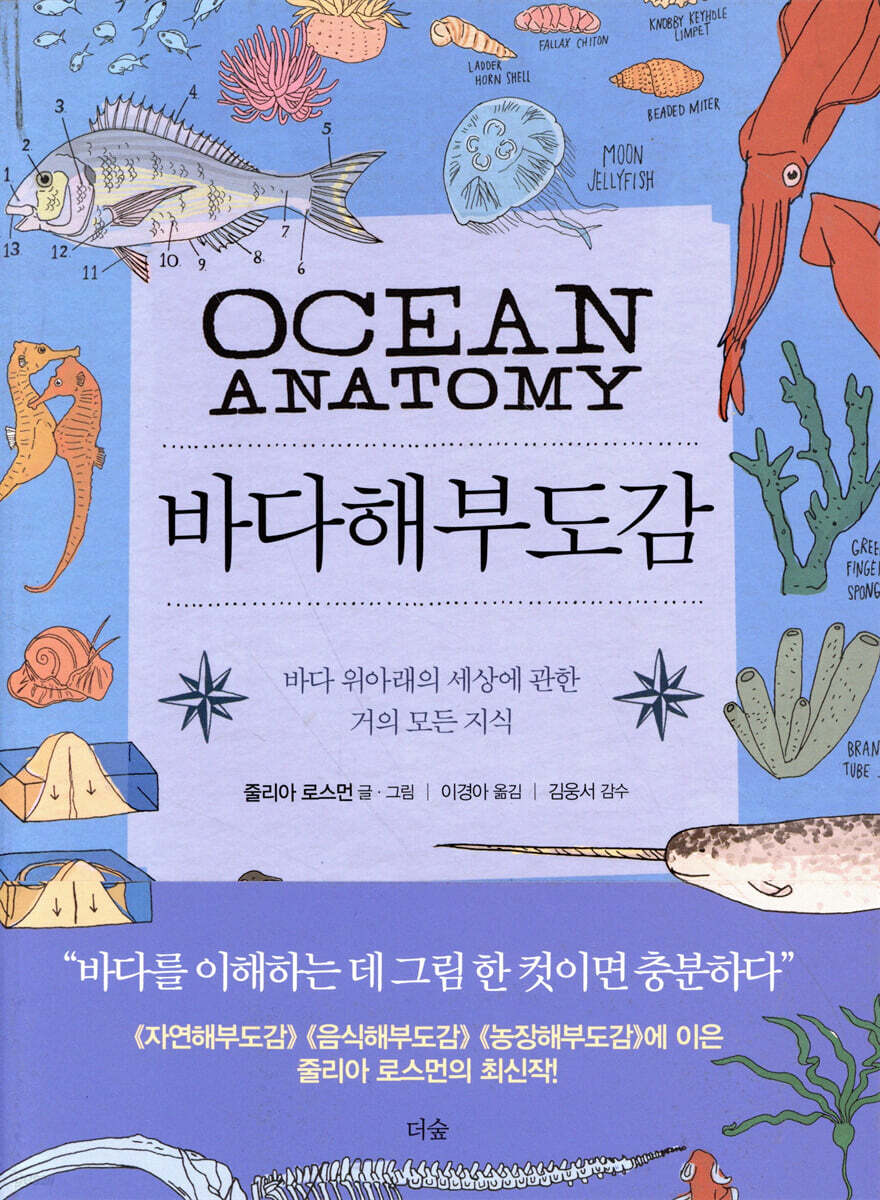 |
Description
Book Introduction
One picture is enough to understand the sea!
A marine encyclopedia showing everything about the sea
Julia Rothman, who has been consistently loved by domestic readers through 『Natural Anatomy Atlas』, 『Farm Anatomy Atlas』, and 『Food Anatomy Atlas』, has published her new book 『Sea Anatomy Atlas』.
Julia Rothman, a bestselling author who not only receives attention from major American media outlets such as the New York Times and the Washington Post, but also receives over 2,000 reader comments and five-star reader reviews on Amazon.com every time a book is published.
She has conveyed knowledge and information from various fields, including science and history, cities and nature, food and animals, through sensuous and warm pictures and stories. The world she has explored this time is the 'sea'.
This book began with a handwritten letter from a girl who lived by the sea and dreamed of becoming a marine biologist.
Since the publication of the [Anatomy Atlas] series, the author has received many messages of encouragement and gratitude from readers around the world.
Not only through email, but also through social media, we have been seeing endless posts from readers living simple lives with the [Anatomy Atlas] series, and children have been sending handwritten letters along with carefully drawn drawings.
One of the girls suggested that he tell her a story about the sea, and for the author, who has conveyed the beauty and value of life and beings that coexist with humans through warm pictures in his previous three books, the expansive 'Sea Story' guides readers into another mysterious world.
The book is full of detailed and interesting knowledge and information about the ocean, including the Earth, which is 70% covered by water, tides and ocean currents, the names of various marine life such as fish, sharks, seaweed, coral reefs, and seals, their anatomical knowledge, their struggle for survival, marine phenomena, and the beach, a treasure trove of life.
In particular, the story of the beginning of the oceans due to continental drift, rising water temperatures caused by plastic and global warming, environmentally destructive fishing, the giant garbage patch, and climate change not only provides a glimpse into the history of the Earth, but also raises awareness of the environmental crisis facing the world.
To ensure the accuracy of the content and to help readers understand it, President Kim Woong-seo of the Korea Institute of Ocean Science and Technology (KIOST), who reviewed the book, recommends the book to readers as follows:
“The vast ocean and the diverse marine life that lives within it are all contained in one small book.
As the title suggests, 『Sea Anatomy Atlas』 is a marine encyclopedia that shows everything about the sea in detail, and a microscope that allows you to observe the sea in detail.
“Let’s take a book and set off to the mysterious sea.”
A marine encyclopedia showing everything about the sea
Julia Rothman, who has been consistently loved by domestic readers through 『Natural Anatomy Atlas』, 『Farm Anatomy Atlas』, and 『Food Anatomy Atlas』, has published her new book 『Sea Anatomy Atlas』.
Julia Rothman, a bestselling author who not only receives attention from major American media outlets such as the New York Times and the Washington Post, but also receives over 2,000 reader comments and five-star reader reviews on Amazon.com every time a book is published.
She has conveyed knowledge and information from various fields, including science and history, cities and nature, food and animals, through sensuous and warm pictures and stories. The world she has explored this time is the 'sea'.
This book began with a handwritten letter from a girl who lived by the sea and dreamed of becoming a marine biologist.
Since the publication of the [Anatomy Atlas] series, the author has received many messages of encouragement and gratitude from readers around the world.
Not only through email, but also through social media, we have been seeing endless posts from readers living simple lives with the [Anatomy Atlas] series, and children have been sending handwritten letters along with carefully drawn drawings.
One of the girls suggested that he tell her a story about the sea, and for the author, who has conveyed the beauty and value of life and beings that coexist with humans through warm pictures in his previous three books, the expansive 'Sea Story' guides readers into another mysterious world.
The book is full of detailed and interesting knowledge and information about the ocean, including the Earth, which is 70% covered by water, tides and ocean currents, the names of various marine life such as fish, sharks, seaweed, coral reefs, and seals, their anatomical knowledge, their struggle for survival, marine phenomena, and the beach, a treasure trove of life.
In particular, the story of the beginning of the oceans due to continental drift, rising water temperatures caused by plastic and global warming, environmentally destructive fishing, the giant garbage patch, and climate change not only provides a glimpse into the history of the Earth, but also raises awareness of the environmental crisis facing the world.
To ensure the accuracy of the content and to help readers understand it, President Kim Woong-seo of the Korea Institute of Ocean Science and Technology (KIOST), who reviewed the book, recommends the book to readers as follows:
“The vast ocean and the diverse marine life that lives within it are all contained in one small book.
As the title suggests, 『Sea Anatomy Atlas』 is a marine encyclopedia that shows everything about the sea in detail, and a microscope that allows you to observe the sea in detail.
“Let’s take a book and set off to the mysterious sea.”
- You can preview some of the book's contents.
Preview
index
preface
Chapter 1 Seawater
The unique appearance of the ocean on Earth│The world's oceans│Why is seawater salty│The speed of sound│The breakup of Pangaea│The trade winds│The appearance of the ocean floor│Tides│Ocean currents│Waves│Giant waves│Zones of the ocean according to depth
Chapter 2 Various Marine Fish
Food chain of the ocean│Bioluminescence│Appearance of fish│All about fish│Fish schooling│Predator fish│Appearance of sharks│Classification of sharks by size│Types of sharks│Rays│Appearance of jellyfish│All about jellyfish│Life cycle of jellyfish│Deep-sea life
Chapter 3 Whale Sammae-gyeong
Appearance of whales│Big and small whales│Bubble net hunting│Appearance of dolphins│Comparison of dolphins and porpoises│Echolocation│Types of dolphins│Killer whales│Threatened whales│Manatees
Chapter 4: The Treasure Trove of Life Beach
Sand│Beach appearance│Tidal pools│Intertidal ecosystem│Shapes of shells│Appearance of shells│Various shells│Seaweed│Appearance of seaweed│Kelp forests│Barnacles│Ram clams│Birds living on the shore│Birds living in the open sea│Coastal fish│Appearance of crabs│Small crabs + large crabs│Pin crabs│Appearance of sea snails│Appearance of scallops
Chapter 5 Towards the underwater world!
Ocean floor│Sea cucumber│Three-legged fish│Joint operation of grouper and moray eel│Three-legged starfish│Appearance of octopus│Octopus internal organs│Comparison of squid and cuttlefish│Squid│Cuttlefish│Nautilus│Pearl│Appearance of crab│Sea crab│Shrimp│Appearance of shrimp│Starfish│Anemone│How to identify sea turtles│Sea turtles│Mass migration
Chapter 6: The World of Coral Reefs
Coral reefs│Coral reef zones│Coral worms│Corals│Fish living in coral reefs│Great Barrier Reef│Appearance of seahorses│Sponge│Seaweed│Nudiformes
Chapter 7 Frozen
Sea ice│Life under the ice│Glacier│Iceberg│Comparison of sea lions and seals│Monkey whale│Penguin│Comparison of penguin sizes│Polar bear
Chapter 8 Towards a wider sea
Fishing with less environmental damage│Fishing with more environmental damage│Lighthouse│Cape Hatteras Lighthouse moving slowly│Oceanographers studying the ocean│Underwater exploration with Alvin│Scuba│Maritime trade│Cargo ships│The Pacific's giant garbage patch│Climate change in numbers│Hopeful Ocean Daily
Recommended Reading / Reference Reading / Acknowledgments
Chapter 1 Seawater
The unique appearance of the ocean on Earth│The world's oceans│Why is seawater salty│The speed of sound│The breakup of Pangaea│The trade winds│The appearance of the ocean floor│Tides│Ocean currents│Waves│Giant waves│Zones of the ocean according to depth
Chapter 2 Various Marine Fish
Food chain of the ocean│Bioluminescence│Appearance of fish│All about fish│Fish schooling│Predator fish│Appearance of sharks│Classification of sharks by size│Types of sharks│Rays│Appearance of jellyfish│All about jellyfish│Life cycle of jellyfish│Deep-sea life
Chapter 3 Whale Sammae-gyeong
Appearance of whales│Big and small whales│Bubble net hunting│Appearance of dolphins│Comparison of dolphins and porpoises│Echolocation│Types of dolphins│Killer whales│Threatened whales│Manatees
Chapter 4: The Treasure Trove of Life Beach
Sand│Beach appearance│Tidal pools│Intertidal ecosystem│Shapes of shells│Appearance of shells│Various shells│Seaweed│Appearance of seaweed│Kelp forests│Barnacles│Ram clams│Birds living on the shore│Birds living in the open sea│Coastal fish│Appearance of crabs│Small crabs + large crabs│Pin crabs│Appearance of sea snails│Appearance of scallops
Chapter 5 Towards the underwater world!
Ocean floor│Sea cucumber│Three-legged fish│Joint operation of grouper and moray eel│Three-legged starfish│Appearance of octopus│Octopus internal organs│Comparison of squid and cuttlefish│Squid│Cuttlefish│Nautilus│Pearl│Appearance of crab│Sea crab│Shrimp│Appearance of shrimp│Starfish│Anemone│How to identify sea turtles│Sea turtles│Mass migration
Chapter 6: The World of Coral Reefs
Coral reefs│Coral reef zones│Coral worms│Corals│Fish living in coral reefs│Great Barrier Reef│Appearance of seahorses│Sponge│Seaweed│Nudiformes
Chapter 7 Frozen
Sea ice│Life under the ice│Glacier│Iceberg│Comparison of sea lions and seals│Monkey whale│Penguin│Comparison of penguin sizes│Polar bear
Chapter 8 Towards a wider sea
Fishing with less environmental damage│Fishing with more environmental damage│Lighthouse│Cape Hatteras Lighthouse moving slowly│Oceanographers studying the ocean│Underwater exploration with Alvin│Scuba│Maritime trade│Cargo ships│The Pacific's giant garbage patch│Climate change in numbers│Hopeful Ocean Daily
Recommended Reading / Reference Reading / Acknowledgments
Detailed image

Into the book
Octopuses live anywhere there is sea water, but when they are not actively foraging, they prefer to hide in coral reefs and reefs on the bottom.
They reproduce by laying eggs only once during their one to five year lifespan.
The male uses specialized feet to deliver a large spermatophore containing sperm to the female, and then dies immediately.
Mother octopuses are known for their exceptionally attentive maternal instincts.
For months, the mother gently blows fresh water over the more than 100,000 eggs she has attached to her hiding place.
Meanwhile, the mother not only does not leave her seat, but she does not even eat.
The mother octopus dies shortly after the eggs hatch.
Octopuses exhibit behaviors reminiscent of the intelligence of higher animals.
Captive octopuses are considered master escapees, able to squeeze their bodies through any hole larger than their mouths.
Octopuses can also remove lids and open locks, and have been seen eating seafood trapped in adjacent tanks before returning to their own.
--- From "The Appearance of an Octopus"
Sharks have a fearsome image as relentless, vengeful hunters who relish the sight of humans.
Just a single fin cutting through the water can be enough to trigger extreme fear in those who suffer from a fear of sharks.
But in terms of risk, it is far less dangerous than lightning or a lawn mower.
Of the over 500 species of sharks, fewer than 10 pose a threat to humans.
Worldwide, there are no more than 90 shark attacks on humans each year, and only a few are fatal.
In comparison, more than 100 million sharks are killed by humans each year.
--- From "The Appearance of Ivory"
Humpback whales spend 90% of their time consuming fish each day, consuming up to 2.3 tons of fish in preparation for their long-distance migrations.
The complex and cooperative social structure of humpback whales is clearly revealed in their hunting behavior.
A pod of up to 60 humpback whales surrounds a school of small fish below.
When a pod of whales exhales through their blowholes, a 'net' of bubbles is formed, disorienting fish and trapping them in a dense ball-shaped net of bubbles.
Get trapped.
The whales emit a unique call to signal the start of their feast, then they all open their mouths and dive towards the school of fish.
Using this technique, humpback whales can swallow fish weighing tens to hundreds of kilograms in a single gulp.
--- From "Bubble Net Hunting"
Kelp can grow more than 30 centimeters a day, providing a huge amount of food for sea urchins, which are notoriously voracious eaters.
The cunning sea otter ties its young to kelp leaves as it dives into the water to catch sea urchins.
Sea bass, crabs, jellyfish, rockfish, and even whales live in the safe kelp forests as their home.
Cormorants, gulls, terns and herons also feed on the abundant food available here.
The abundance provided by kelp forests attracts predators such as sharks, seals, and sea lions.
They hide in dense kelp forests when hunting for food.
--- From "Kelp Forest"
Over the past 200 years, commercial fishing has had a negative impact on the world's fish populations.
Large ships, like floating factories, stay at sea for long periods of time, catching hundreds of tons of fish, washing and processing them on board, and then storing them in freezers.
… vessels engaged in purse seine fishing spread out a 1.6-kilometer-long net firmly anchored to the bottom.
When the net is pulled back onto the boat, thousands of commercially valuable fish such as tuna, sardines and squid are caught.
These fishing practices kill hundreds of thousands of 'unwanted' fish, seabirds, sea turtles, sharks, dolphins, seals and whales every year.
They reproduce by laying eggs only once during their one to five year lifespan.
The male uses specialized feet to deliver a large spermatophore containing sperm to the female, and then dies immediately.
Mother octopuses are known for their exceptionally attentive maternal instincts.
For months, the mother gently blows fresh water over the more than 100,000 eggs she has attached to her hiding place.
Meanwhile, the mother not only does not leave her seat, but she does not even eat.
The mother octopus dies shortly after the eggs hatch.
Octopuses exhibit behaviors reminiscent of the intelligence of higher animals.
Captive octopuses are considered master escapees, able to squeeze their bodies through any hole larger than their mouths.
Octopuses can also remove lids and open locks, and have been seen eating seafood trapped in adjacent tanks before returning to their own.
--- From "The Appearance of an Octopus"
Sharks have a fearsome image as relentless, vengeful hunters who relish the sight of humans.
Just a single fin cutting through the water can be enough to trigger extreme fear in those who suffer from a fear of sharks.
But in terms of risk, it is far less dangerous than lightning or a lawn mower.
Of the over 500 species of sharks, fewer than 10 pose a threat to humans.
Worldwide, there are no more than 90 shark attacks on humans each year, and only a few are fatal.
In comparison, more than 100 million sharks are killed by humans each year.
--- From "The Appearance of Ivory"
Humpback whales spend 90% of their time consuming fish each day, consuming up to 2.3 tons of fish in preparation for their long-distance migrations.
The complex and cooperative social structure of humpback whales is clearly revealed in their hunting behavior.
A pod of up to 60 humpback whales surrounds a school of small fish below.
When a pod of whales exhales through their blowholes, a 'net' of bubbles is formed, disorienting fish and trapping them in a dense ball-shaped net of bubbles.
Get trapped.
The whales emit a unique call to signal the start of their feast, then they all open their mouths and dive towards the school of fish.
Using this technique, humpback whales can swallow fish weighing tens to hundreds of kilograms in a single gulp.
--- From "Bubble Net Hunting"
Kelp can grow more than 30 centimeters a day, providing a huge amount of food for sea urchins, which are notoriously voracious eaters.
The cunning sea otter ties its young to kelp leaves as it dives into the water to catch sea urchins.
Sea bass, crabs, jellyfish, rockfish, and even whales live in the safe kelp forests as their home.
Cormorants, gulls, terns and herons also feed on the abundant food available here.
The abundance provided by kelp forests attracts predators such as sharks, seals, and sea lions.
They hide in dense kelp forests when hunting for food.
--- From "Kelp Forest"
Over the past 200 years, commercial fishing has had a negative impact on the world's fish populations.
Large ships, like floating factories, stay at sea for long periods of time, catching hundreds of tons of fish, washing and processing them on board, and then storing them in freezers.
… vessels engaged in purse seine fishing spread out a 1.6-kilometer-long net firmly anchored to the bottom.
When the net is pulled back onto the boat, thousands of commercially valuable fish such as tuna, sardines and squid are caught.
These fishing practices kill hundreds of thousands of 'unwanted' fish, seabirds, sea turtles, sharks, dolphins, seals and whales every year.
--- Among the "fishing industries that cause a lot of environmental damage"
Publisher's Review
Through exploration of the ocean that covers most of the Earth's surface,
Meet the interesting and surprising planet Earth
As the title 'Sea Anatomy Atlas' suggests, it contains almost all knowledge about the world above and below the sea.
From the tidal action necessary for life to why seawater is salty, the depth of the ocean, the world of coral reefs, and the shape of beaches, all the scenery surrounding the ocean is presented in easy-to-understand pictures.
Stories about living things are also interesting.
Stories of groupers and moray eels that cooperate brilliantly rather than compete with each other for food; the three-legged fish that waits for prey on the sea floor with its pelvic and caudal fins three times its body length erected; dolphins that emit high-pitched sounds through their sinuses and interpret the returning echoes to understand their surroundings; why shark tooth fossils are more commonly found than in other creatures; why penguins slide on their bellies on slippery ice; and the sea cucumber that developed the technique of living safely in the anus of a sea cucumber to avoid predators. Every page tells the story of struggles for survival, solidarity, and overcoming.
Exploring the depths of the ocean, which covers most of the Earth's surface, allows you to discover the fascinating and surprising planet Earth and its mysterious creatures.
The beauty and value of life and beings that coexist with humans.
The Earth is no longer a world for humans alone.
The book contains both familiar names and many unfamiliar names and information to the general public.
For example, penguins are divided into emperor penguins, king penguins, warrior penguins, macaroni penguins, and Humboldt penguins according to their size, and the fins of fish have different names such as pelvic fin, anal fin, and pectoral fin.
There are also many different types of sharks, including leopard sharks, great white sharks, hammerhead sharks, lemon sharks, mako sharks, and wobbegong sharks.
Some birds live far out in the ocean, while others live near the shore.
Beach sand, a treasure trove of life, is also made up of various minerals such as coral, volcanic rock, quartz, and seashells.
In this way, the author names and mentions the characteristics of countless living beings that exist in this world with us.
The author constantly raises the global problems facing the ocean today.
Sponges in some areas have been damaged by long-standing human exploitation for cleaning purposes, and a garbage patch 16 times the size of South Korea exists between California and Hawaii.
In commercial fisheries, up to 40% of the total catch is discarded as 'unintended' catch.
Dozens of gentle vegetarian manatees die each year when boats hit them while they are napping near the ocean surface.
Due to human civilization, six out of seven species of sea turtles have become endangered or near-endangered.
Due to climate change, there will be no ice in the Arctic during the summer in the next 30 years.
5.9 kilograms of plastic was once found in the stomach of a dead sperm whale.
The author's drawings are always warm and lovely.
And the short story contains 'respect for all beings that live together on this earth.'
This time again, the author tells us this through pictures and stories.
The Earth is no longer a world for humans alone.
Meet the interesting and surprising planet Earth
As the title 'Sea Anatomy Atlas' suggests, it contains almost all knowledge about the world above and below the sea.
From the tidal action necessary for life to why seawater is salty, the depth of the ocean, the world of coral reefs, and the shape of beaches, all the scenery surrounding the ocean is presented in easy-to-understand pictures.
Stories about living things are also interesting.
Stories of groupers and moray eels that cooperate brilliantly rather than compete with each other for food; the three-legged fish that waits for prey on the sea floor with its pelvic and caudal fins three times its body length erected; dolphins that emit high-pitched sounds through their sinuses and interpret the returning echoes to understand their surroundings; why shark tooth fossils are more commonly found than in other creatures; why penguins slide on their bellies on slippery ice; and the sea cucumber that developed the technique of living safely in the anus of a sea cucumber to avoid predators. Every page tells the story of struggles for survival, solidarity, and overcoming.
Exploring the depths of the ocean, which covers most of the Earth's surface, allows you to discover the fascinating and surprising planet Earth and its mysterious creatures.
The beauty and value of life and beings that coexist with humans.
The Earth is no longer a world for humans alone.
The book contains both familiar names and many unfamiliar names and information to the general public.
For example, penguins are divided into emperor penguins, king penguins, warrior penguins, macaroni penguins, and Humboldt penguins according to their size, and the fins of fish have different names such as pelvic fin, anal fin, and pectoral fin.
There are also many different types of sharks, including leopard sharks, great white sharks, hammerhead sharks, lemon sharks, mako sharks, and wobbegong sharks.
Some birds live far out in the ocean, while others live near the shore.
Beach sand, a treasure trove of life, is also made up of various minerals such as coral, volcanic rock, quartz, and seashells.
In this way, the author names and mentions the characteristics of countless living beings that exist in this world with us.
The author constantly raises the global problems facing the ocean today.
Sponges in some areas have been damaged by long-standing human exploitation for cleaning purposes, and a garbage patch 16 times the size of South Korea exists between California and Hawaii.
In commercial fisheries, up to 40% of the total catch is discarded as 'unintended' catch.
Dozens of gentle vegetarian manatees die each year when boats hit them while they are napping near the ocean surface.
Due to human civilization, six out of seven species of sea turtles have become endangered or near-endangered.
Due to climate change, there will be no ice in the Arctic during the summer in the next 30 years.
5.9 kilograms of plastic was once found in the stomach of a dead sperm whale.
The author's drawings are always warm and lovely.
And the short story contains 'respect for all beings that live together on this earth.'
This time again, the author tells us this through pictures and stories.
The Earth is no longer a world for humans alone.
GOODS SPECIFICS
- Date of issue: August 20, 2021
- Page count, weight, size: 212 pages | 638g | 165*227*20mm
- ISBN13: 9791190357708
- ISBN10: 1190357704
You may also like
카테고리
korean


korean

![ELLE 엘르 스페셜 에디션 A형 : 12월 [2025]](http://librairie.coreenne.fr/cdn/shop/files/b8e27a3de6c9538896439686c6b0e8fb.jpg?v=1766436872&width=3840)


